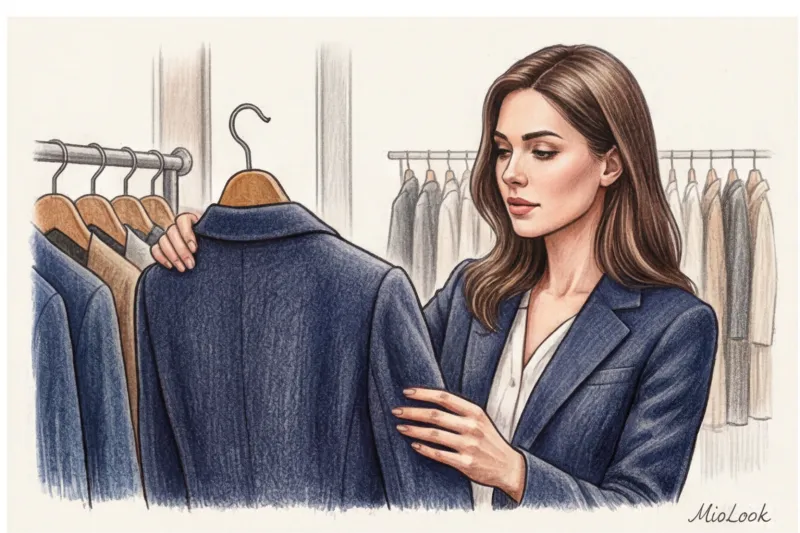
Stylist's Dictionary: Why It's Important to Know the Names of Clothing Parts
Have you ever noticed how a stunning jacket pictured online suddenly makes you look boxy and adds a few extra pounds when you try it on? We often blame ourselves: "I'm not the right figure," "I need to lose weight." But after 12 years of working as an image consultant, I can confidently say: the problem almost always lies in the design of the garment itself. Studying clothing details names which often seem like boring theory from design textbooks, you get a real impression management tool.
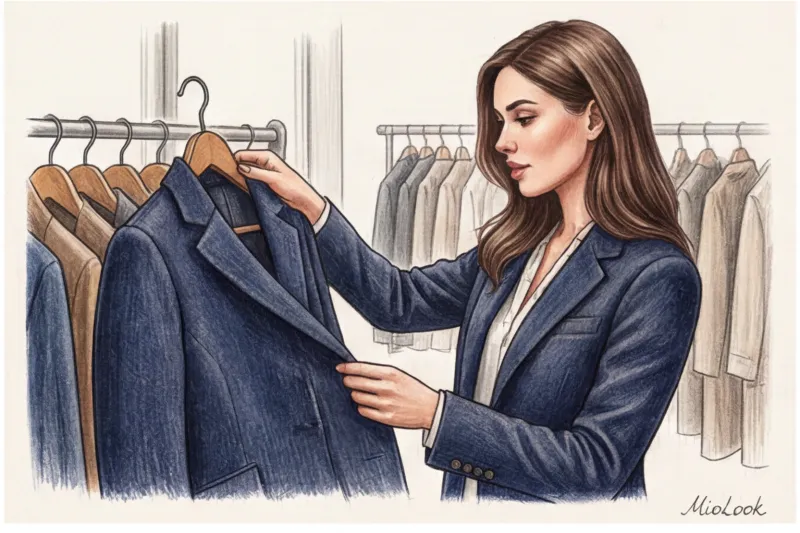
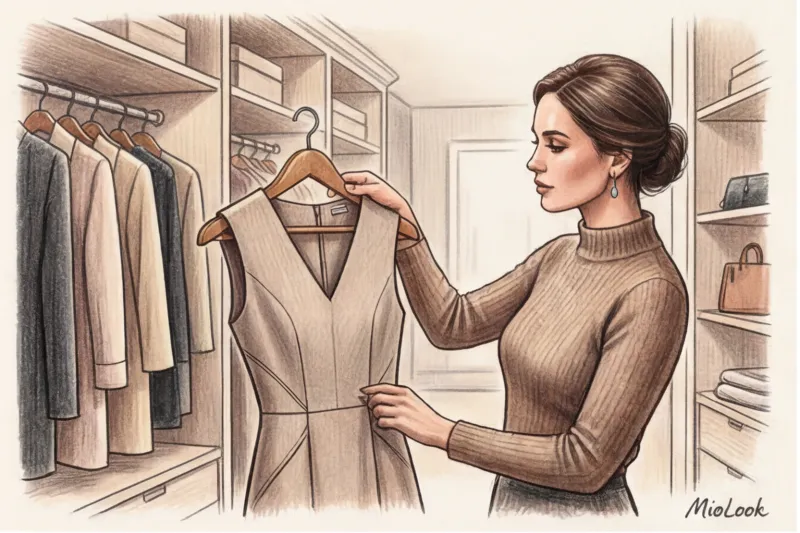
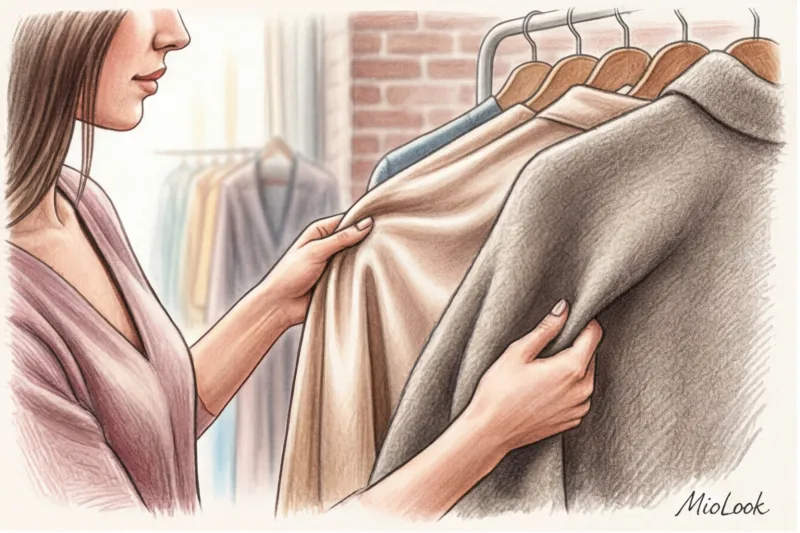
Let me get this straight: I'm not teaching you how to sew. My job as a stylist is to teach you how to "read" a garment on the hanger, before you take it to the fitting room or hit the "pay" button. When my clients and I start speaking the same language, magic happens instantly. The abstract phrase "I want a beautiful blouse" turns into a precise, technical request: "We're looking for a style with set-in sleeves and a V-neck." This saves hours of wandering around shopping malls.
Knowing the fit is your best insurance against impulse purchases and unsuccessful online orders. According to e-commerce analytics (2023), approximately 60% of clothing returns are due to poor fit. If you know that a dropped armhole and dropped shoulders visually widen the upper body, you'll simply skip that sweater, even if it's the perfect trendy shade and only €30 on sale.
There's a direct connection between the construction of a garment and how it shapes the silhouette. Flat fabric transforms into a three-dimensional shell for our bodies solely through darts, raised seams, and the correct sleeve cap. Understanding how each detail works, you can visually elongate your height or accentuate your waist using just tailoring. Incidentally, it's precisely this analytical approach that we use in MioLook — When digitizing your wardrobe, pay attention not only to color but also to the design features of your most successful items.
Portrait architecture: collars, lapels and necklines
Have you ever wondered why your face looks rested and toned in some photos, while in others it looks tired, with pronounced shadows? The answer lies not only in lighting or the right makeup. The head area (the space from the chest to the crown of the head) is the absolute epicenter of any interviewer's attention. And in the age of endless video conferences and Zoom dressing, the geometry of the top has become crucial.
According to a Stanford University study on the phenomenon of "Zoom fatigue" (2021), during online meetings, people look at your face and shoulders four times more intensely than during in-person conversations. Only your upper body is in the frame, and it bears the brunt of the communication. Therefore, the right clothing details and their names are not just boring theory for tailors, but your personal impression management tool.
The way your facial lines are arranged directly influences the perception of your face's shape and the length of your neck. Sharp angles add rigidity and dynamism, while smooth lines soften features. Let's break down this architecture, brick by brick.
Collars and lapels: a frame for your face
The collar acts like a passe-partout for a painting: it can either highlight the shape of the face or completely distort its natural proportions.
Let's start with the classics. English collar A notched lapel (also known as a collar with lapels and a flare) is the foundation of a business wardrobe. The flare is the seam line where the collar meets the lapel. A strict rule of proportionality applies here: the lapel width should be in harmony with the width of your shoulders and the scale of your facial features. Narrow lapels (about 5-6 cm) on a broad chest will visually make you look larger, emphasizing your size. And exaggeratedly wide lapels, à la 70s style, will look comical on a petite woman, as if the jacket was lifted from someone else's shoulder. Also, pay attention to the height of the flare: the higher it is, the slimmer and taller you appear.
If you need to convey absolute power, confidence and authority, choose peaked lapels , the ends of which are boldly pointed upward. Take a look at the iconic Tom Ford suits: this detail is subconsciously interpreted as an aggressive, dominant line. One of my clients, a finance executive, wears a jacket with peak lapels exclusively for difficult negotiations—and, according to her, this structural detail works like armor.
It carries a completely different energy shawl collar Its one-piece, rounded shape without sharp corners is ideal for those with smooth facial features. It softens the look, making it more relaxed, formal, and elegant.
But with stand-up collar and its eastern brother - the collar "mandarin" — you need to be extremely careful. Because they fit tightly around the base of the neck and end in a sharp horizontal line, they inevitably "eat" 2-3 centimeters of neck length. If your neck isn't naturally swan-like, the stand-up collar can visually pull your head into your shoulders. In such cases, I always recommend leaving the top 1-2 buttons undone, creating an artificially beneficial V-shape.
Access to MioLook for €0.99 — one-time payment
A smart AI stylist will analyze your proportions and select the perfect look with the right cut details.
Get access — €0.99 onceNecklines and necklines: geometry that changes proportions
While collars create the outer frame, necklines define the interior space of the portrait area. And here, optical illusion reigns supreme.
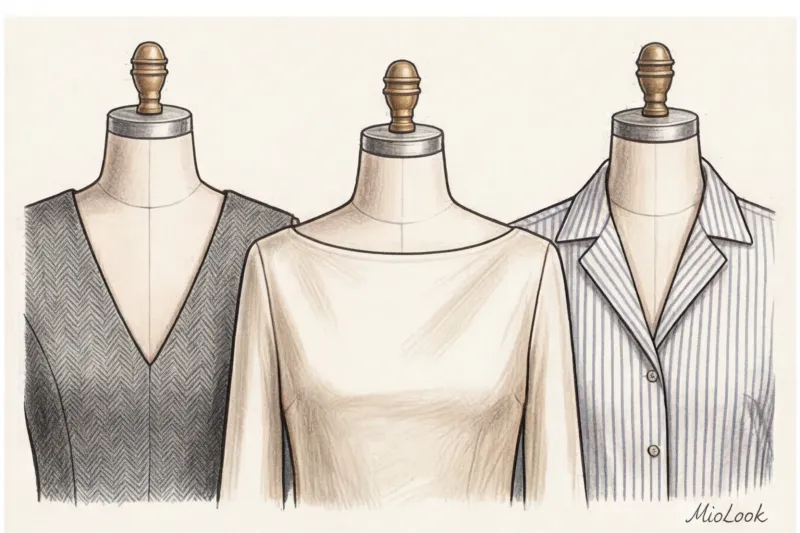
V-neck The V-neck is perhaps the most powerful and versatile tool in a stylist's arsenal. Its downward diagonals elongate the silhouette, slimming and visually lengthening the neck. But there's an important nuance: the angle of the neckline should follow or slightly sharpen the shape of your chin. A deep V-neck is inappropriate for a formal office dress code, but paired with a basic cashmere jumper (even a mass-market one for €40-50), it works wonders for proportions in a casual look.
The V-neck's antagonist is elegant boat neckline (or bateau neckline) This wide horizontal line, delicately revealing the collarbone, is associated with the aesthetics of Christian Dior and the refined style of Audrey Hepburn. It's important to understand the physics of cut: a boat neckline mercilessly widens the shoulder girdle. If you have a pear-shaped figure (narrow shoulders and voluminous hips), a bateau neckline will be your salvation, harmoniously balancing the top and bottom. However, for women with broad shoulders (an inverted triangle shape), this neckline is strictly contraindicated.
Square neckline It sets a very strict, uncompromising geometry. It luxuriously accentuates the collarbones and décolleté, bringing the look together. However, I don't recommend it for those with a pronounced square jawline. The horizontal neckline will replicate the jawline, visually weighing down the lower third of the face.
Finally, the cutout "swing" — a complex, flowing drape across the neckline. This is a brilliant design solution for those who want to visually add volume to the bust without the use of an uncomfortable push-up bra. The soft folds of the fabric create a 3D effect, making the look feminine and sculpted. However, on a fuller bust, this "swing" can create an undesirable effect of monumentality. In this case, it's better to opt for smooth textures and clean lines.
Micro-tip from a stylist: When heading to an important online meeting, wear a V-neck top and layer a peak-lapel jacket in a contrasting color over it. This will create a double diagonal line that will elongate your neck and draw attention to your face.
Anatomy of the Shoulder Girdle and Shoulder Girdle: The Basics of Posture
According to researchers at the Fashion Institute of Technology (FIT), the shoulder design determines exactly 80% of the successful fit of any garment—from a lightweight silk blouse to a heavy winter coat. The shoulder seam acts like a load-bearing beam in a building's architecture: if it's positioned incorrectly or misaligned, the entire structure will inevitably "float," creating unsightly diagonal creases across the chest and back.
Studying clothing details names For garments that clients often find boring tailoring theory, I always start with the shoulder area. Modern mass-market clothing is incredibly tricky. Creating a proper, anatomical armhole requires pinpoint precision patterns, expert wet-heat treatment, and time. How do manufacturers save money on complex armhole designs? Simple: they simply lower the shoulder seam 5-7 centimeters below the natural line and widen the armhole as much as possible. As a result, the factory sews the garment twice as fast, it fits three different sizes at once (that notorious oversize), but at the same time completely deprives your figure of grace and defined contours.
Set-in sleeves, raglan and dropped shoulder
Let's take a look at basic sleeve designs and how they manipulate our proportions.
Set-in sleeve — is the undisputed gold standard of business attire and a guarantee of perfect posture. A well-tailored jacket has its seam set precisely at the natural end point of the shoulder, creating a precise angle. This geometry disciplines the back, visually tones the figure, and conveys composure. In a corporate environment, where visual cues are read in seconds, a clear shoulder line is subconsciously associated with your reliability and professionalism.
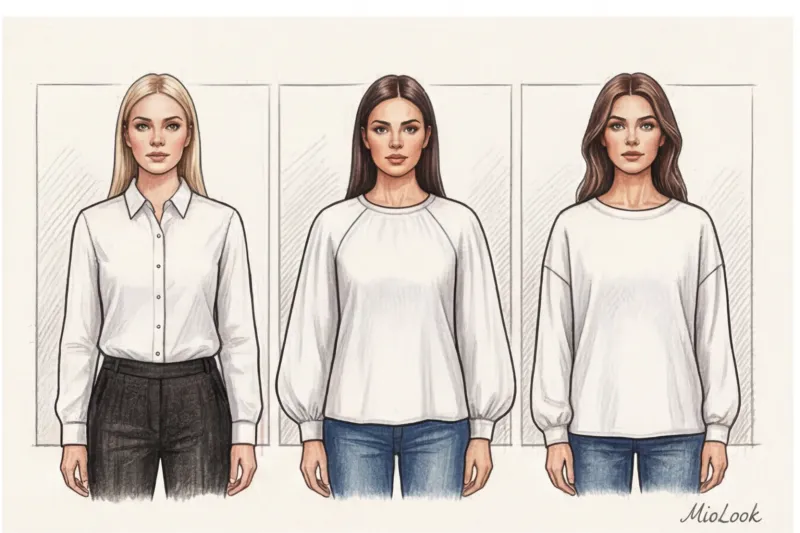
Dropped shoulder On the contrary, the dropped shoulder is the most insidious cut of our time. The artificially lowered seam creates the effect of sloping, tired shoulders. Moreover, the horizontal seam on the forearm visually "cuts" the arm at its widest point, adding unnecessary bulk. If you already have a favorite dropped shoulder sweater in your wardrobe, be sure to roll up the sleeves, revealing your slender wrists—it's an effective stylistic trick for restoring grace to the silhouette.
Raglan The raglan has interesting military and sporting origins. Historically, it was created for British Field Marshal Lord Raglan to allow the sleeves to move freely in battle. The diagonal seam running from the neckline to the armpit works well to visually narrow the shoulders. But herein lies the danger: the raglan requires extreme caution for the pear-shaped figure. If you have naturally narrow shoulders and large hips, the raglan will make the top even more slender, dramatically increasing the disproportion with the bottom.
One-piece sleeve (batwing) The dolman has no seam along the armhole—the front flows smoothly into the sleeve. This is an excellent tool for creating a soft, relaxed silhouette. However, for those with larger busts, it's a double-edged sword. A dolman drapes beautifully in thin, flowing fabrics (such as silk or cupra). But if the fabric is thick, the sleeve will create a massive monoblock from the chest to the waist, visually adding 5-7 kilograms.
I remember a case from my practice: I had a client who had been hiding her arms under shapeless cardigans for years. She was sincerely convinced that her arms were "too full." When we began digitizing and sorting through her clothes, MioLook I noticed a pattern: 90% of her tops had low, wide armholes, which added a huge amount of bulk to the underarm area. We went shopping and tried on a structured jacket with a high, precisely cut armhole that fit. The effect stunned us both—our arms looked two sizes slimmer, and our silhouette became more graceful. The problem wasn't with her body, but with the cheap patterns.
Cuffs and armholes: hidden quality markers
Continuing the discussion of sleeve design, we can't ignore armhole height. There's a popular myth that armholes need to be wide and deep to allow comfortable movement in a garment. From a garment design perspective, this is absolute nonsense. Armhole height works in exactly the opposite way: why would a low armhole hinder movement? If the armhole is cut too low, any attempt to raise the arm will drag the entire garment with it (the "webbed wing" effect). In high-quality, premium clothing, the armhole is always cut high—it fits snugly against the armpit, allowing the arm to move completely freely from the body.
Another hidden marker of a high-status garment is the sleeve cap (the rounded top part sewn into the armhole). What is a sleeve cap and why is it needed on a jacket? It's a special piece made of soft material (often batting or felt) that's sewn inside to maintain the shape of the sleeve cap. Without a sleeve cap, a jacket's sleeve will sag and wrinkle. If you see a jacket in a store for €250-300, but the sleeve cap is sagging inward, don't hesitate to return it to the hanger; the manufacturer has skimped on the basic technology.
And finally, the cuffs are the finishing touches on the sleeve. Status is in the details. French cuffs (double, with cufflinks) are the pinnacle of formal style. They don't just hold the sleeve in place; they draw attention to the hands when gesturing, making your speech more visually compelling. Italian cuffs (single, without buttons, often with a scalloped edge) are less common but no less elegant. According to good etiquette, the shirt cuff should protrude 1-1.5 centimeters from the jacket sleeve, creating that precise layering that distinguishes a well-thought-out look from a casual one.
Structural elements of cutting: darts, reliefs and folds
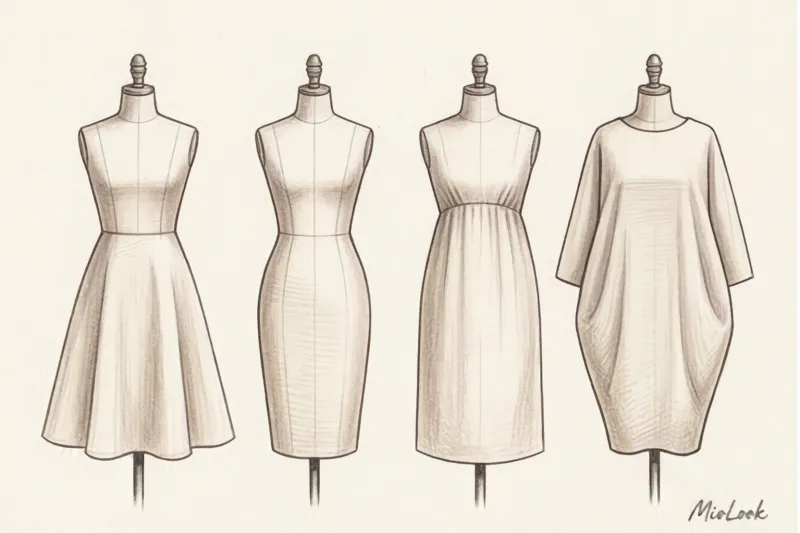
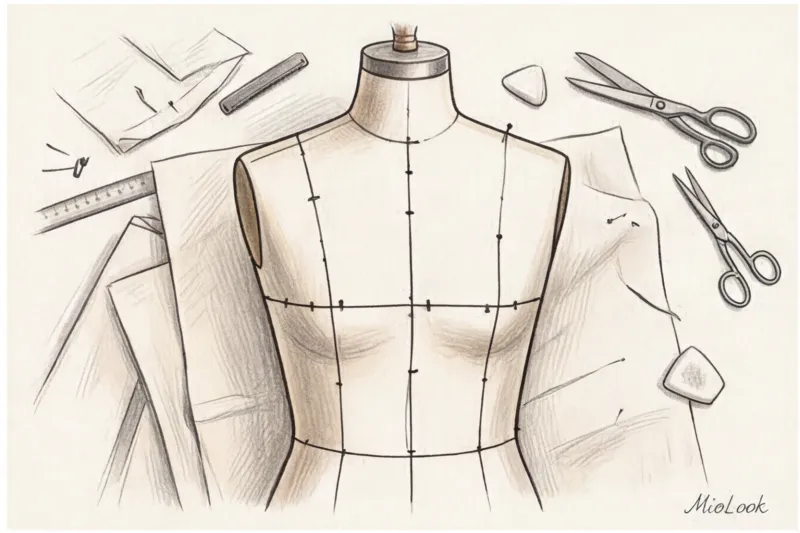
My background in art and design taught me one important thing: the human body is a complex three-dimensional form. Imagine trying to wrap a regular sheet of paper around a ball. The paper will inevitably wrinkle, fold, and bulge. Exactly the same thing happens when flat fabric is transformed into a 3D shell for our bodies. For the material to flow smoothly around curves requires serious architectural work.
Let's be honest: why are there so many straight, shapeless shirt dresses in stores today, costing 30-50 euros? Because clothes without darts are significantly cheaper to produce. They don't require complex modeling; they're literally stamped from flat templates and sewn in minutes. But on a figure with a pronounced bust or a noticeable difference between the waist and hips, such a garment looks the worst—it either treacherously stretches at the protruding points or hangs lifelessly like a bag.
If we look at classic tailoring and the legendary Dior patterns - especially the famous jacket Bar from the collection New Look 1947—we will see the absolute triumph of structural seams. Christian Dior created this iconic hourglass silhouette not through the elasticity of the fabric, but solely through his masterful use of form. In the professional dictionary that collects the clothing details whose names we're examining today, these elements occupy a central place.
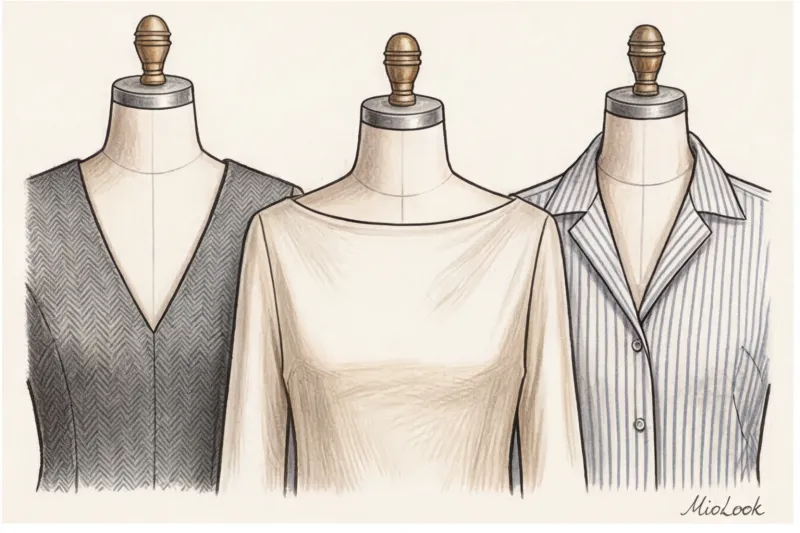
Darts and raised seams: the secret to a perfect fit
A dart is essentially a stitched-in wedge of excess fabric. It removes bulk where it's not needed (like at the waist) and adds volume where there's a bulge. Bust darts always point toward the center of the chest and prevent the garment from riding up in the front. Waist darts create that graceful curve in the lower back, preventing the fabric from bunching up above the belt.
But my absolute favorite in working with clients’ figures is the “princess” reliefs ( Princess Seams ). These are structural seams that run smoothly downwards from the armhole or from the middle of the shoulder seam, passing through the center of the chest to the very hem of the garment.
Stylist insight: Raised seams are the most powerful tool for visually elongating the silhouette. They work more effectively than any vertical stripe print because they create a real, tangible vertical line while sculpting the waist without creating a tight squeeze.
Another important element of a perfect fit is the yoke. On a classic shirt, this is the cut-off detail at the back of the shoulders. Its function is purely anatomical: it allows the shoulder blades freedom of movement when you extend your arms forward. On jeans, however, the yoke (the V-shaped seam above the back pockets) serves an aesthetic purpose. The deeper this "V" is, the more rounded and lifted the buttocks appear.
Access to MioLook for €0.99 — one-time payment
Start creating perfect looks and managing your wardrobe with the help of artificial intelligence.
Get access — €0.99 oncePleats, tucks and drapes: managing volume
While darts remove excess fabric, pleats and tucks, on the contrary, control the added volume, setting it in the correct direction.
Let's start with trousers. Many women are terrified of pleats ( tucks ) — small folds of fabric at the waist, believing they make you look bigger. This is one of the most persistent myths, which I regularly debunk during fittings! In fact, if you have wide hips, one or two deep pleats are your salvation. They allow the fabric to fall gracefully. On a fuller figure, flat-front trousers often stretch at the groin, creating unsightly horizontal creases (called "whiskers") that accentuate the fullness.
In skirts, pleats set the rhythm and geometry of the step:
- One-sided folds ( knife pleats ) are stitched in one direction. If they are stitched from the waist to the hip line (as on kilts), the skirt will not add volume to the stomach area.
- Counter folds ( inverted pleats ) — two pleats facing each other. Often used at the front of straight skirts to provide freedom of movement without a slit.
- Box pleats ( box pleats ) - the reverse version of the counter, creates a strict, almost architectural volume, ideal for dense fabrics such as taffeta or tweed.
I'd like to clarify the perennial confusion between pleats and goffered fabric. Pleats are parallel folds of equal width along the entire length (like an accordion). Goffered fabric is cut using the "sun" principle: the folds are narrow at the waist and widen toward the bottom. For everyday wear, I always recommend goffered fabric. It doesn't add extra bulk at the waist, creates a stunning dynamic effect, and looks much more expensive.
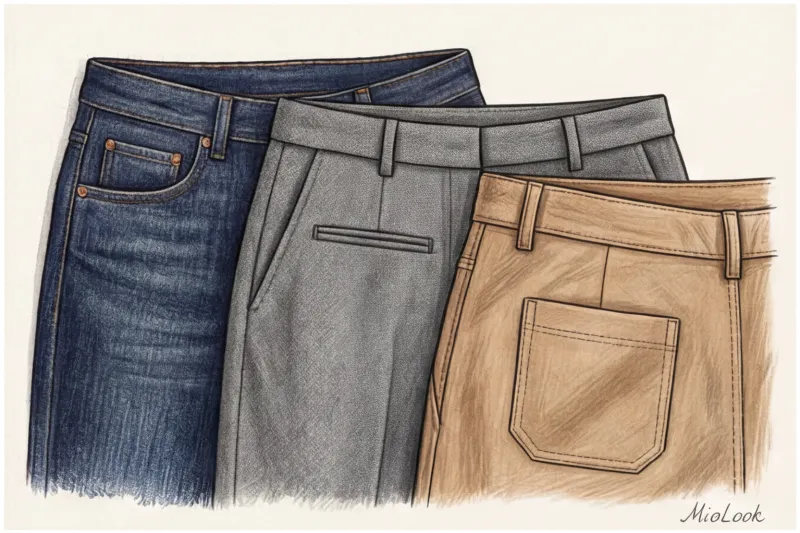
Incidentally, the design of the bottom doesn't end with pleats. Once we've figured out the waist and hips, details come to the forefront that can either save or completely ruin the proportions of the lower body.
Bottom details: pockets, belts and vents
We're used to blaming evening desserts for suddenly adding weight to our favorite pants. But over the years of working with women's silhouettes, I've discovered another pattern: more often than not, it's not calories that add extra pounds, but poorly chosen design elements on pants and skirts. Explore clothing details names which sometimes sound like terms from an architectural reference book—means gaining real control over how others read your proportions.
The lower body is a zone of maximum kinetics. The tissue here is constantly stretched when walking, sitting, and bending. This is why the design elements of the lower body carry not only an aesthetic but also a rigid engineering load.
Types of pockets and their insidious influence on the figure
Pockets are the main saboteurs in a woman's wardrobe. Mass-market manufacturers love to add them everywhere for the sake of functionality, without any regard for body shape.
Official stylist warning: Flared pockets break up the hip line. If you have even a minimal difference between your waist and hips, side-seam pockets will inevitably open up as you walk, creating an unwanted "loop" effect.
Let's look at the main types of pockets and their impact on the silhouette:
- Side seam pockets: The most popular and most problematic option for dresses and wide-leg trousers. If the fabric is thick (such as suiting wool or heavy linen), the inner baggy layer creates extra bulk at the hips. My pro tip? If you bought trousers for 150 euros and they fit perfectly everywhere except the pockets, simply take them to a tailor and have them sew the pockets shut, cutting away the inner baggy layer. You'll instantly drop half a size.
- Patch pockets: This is a 100% volume adder. They work like 3D pads. They're essential on the butt of jeans (otherwise the rear looks flat), but on cargo-style hips, they visually widen the pelvis. Save them for areas that really lack volume.
- Welt pockets (framed or with welt): The epitome of elegance and minimalism, a welt is a stitched strip of fabric that forms the pocket opening. These pockets lie completely flat, don't distort the silhouette, and are a sign of high-end tailoring.
Slits, cuts and belts: dynamics and status
Many people confuse a vent and a cut, considering them synonymous. But in clothing design, these are fundamentally different elements with different meanings.
Section — this is simply an unsewn section of seam. The edges of the fabric come apart, revealing the leg. It's an element of dynamism, seduction, and relaxation. Slot It has a special allowance (the fabric's fold) that allows one side to overlap the other. According to classical etiquette, a vent is a marker of business status. It allows for freedom of movement, but at the same time, it doesn't reveal anything unnecessary when you stand.
Deserves special attention double vent on jackets (on the sides of the back). This is a historical feature of English style, originating from equestrian equipment. Unlike a single center vent, which can unsightly flare out over a protruding buttocks, a double vent ensures a perfect fit, even when you put your hands in your trouser pockets.
And finally, the foundation of any quality trousers is corset-type belt Have you ever noticed why classic trousers from premium brands flatten your stomach, while budget-friendly models made from thin fabric only accentuate your rolls? The secret lies in the rigid waistband sewn into the waistband. It works like a mini-corset: it prevents the waistband from bunching up, maintains your posture, and keeps your shirt in place.
When you take inventory of your things and load them into MioLook I highly recommend paying attention to these details. Note: "pants with a waistband fit better" or "a skirt with a vent is more comfortable than a skirt with a slit." This will help the app's algorithms (and you personally) create flawless capsule collections in the future, based not only on color but also on proper cut architecture.
Myths about cuts: why "basic" and "oversized" styles don't suit everyone
I'll let you in on the biggest trade secret of the modern industry. The glut of shapeless hoodies, cocoon coats, and off-the-shoulder sweaters on store shelves isn't so much a concern for our comfort as it is a simple cost-cutting measure.
Introducing into our everyday vocabulary clothing details names By using garments that sound like "oversized" or "unisex," fast-fashion giants are simply optimizing their costs. Sewing a classic jacket with set-in sleeves and a proper armhole requires complex patterns, precise fitting, and the time of a skilled tailor. A dropped shoulder is essentially two rectangles of fabric sewn together. This design allows for any fit errors and fits three or four sizes at once. The efficiency of the cut clearly trumps aesthetics here: production costs drop dramatically (sometimes to 5-7 euros per unit), and we get a garment that completely ignores the anatomy of our bodies.
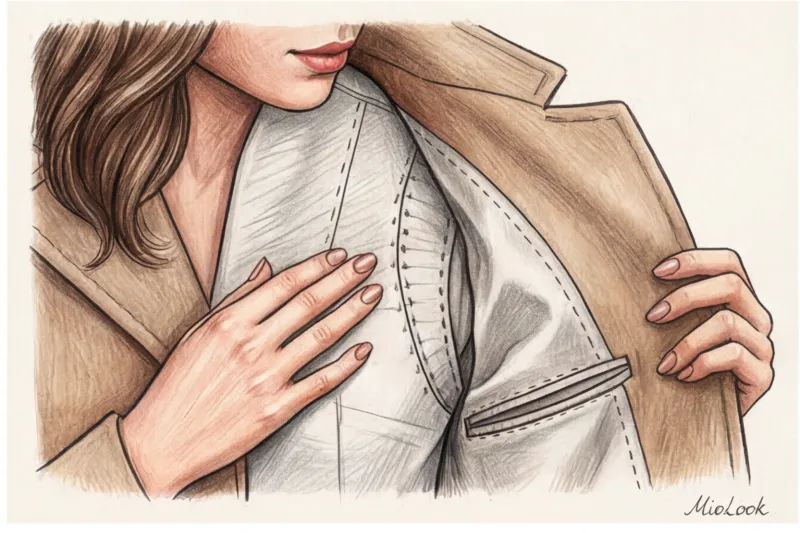
This is where the most dangerous and widespread misconception comes from: "straight cut clothes hide imperfections" Let's examine this myth from a geometric perspective. A straight cut doesn't hide the nuances of your figure—it projects your widest point (be it your chest, stomach, or hips) onto the rest of your silhouette. If you have a full D-cup bust, a straight shirtdress will visually draw a vertical line from the highest point of your bust right down to the hem. So, instead of hiding a few extra inches at your waist, you're making your figure appear boxy and massive. You're not masking volume; you're enhancing it.
How does a lack of design details ruin feminine proportions? Fabric itself is a completely flat material. To beautifully contour to a woman's three-dimensional body, with its natural curves and the differences in waist and hip measurements, it needs to be shaped into darts. However, mass-market brands often ruthlessly remove waist and bust darts from patterns to cut production costs. As a result, the garment simply hangs like a bag, creating unsightly diagonal creases from the armpits to the chest and empty spaces at the waist.
Constructor rule: If a blouse or dress does not have a single dart, this item was created for a flat mannequin, and not for a living woman.
Stop hiding behind bland sacks under the pretext of creating a "basic" wardrobe. Yes, a well-sculpted dress from a mid-range brand will cost you not 30, but 90 or 150 euros. But it will create a beautiful posture, delicately define your waist, and provide that luxurious fit that a shapeless oversize dress can't achieve.
Your perfect look starts here
Join thousands of users who look flawless every day with MioLook. Smart wardrobe analysis and perfect silhouette selection.
Get access — €0.99 onceStylist's Checklist: How to "Read" Clothing Details Before Buying
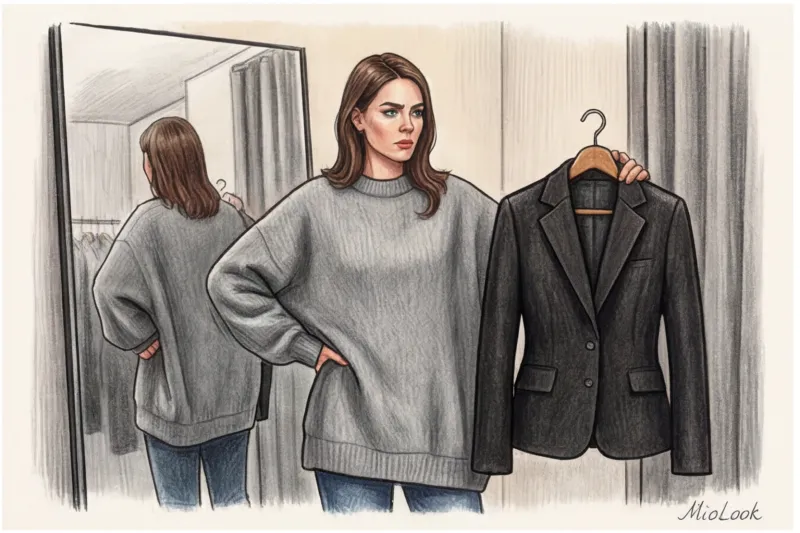
I often see the same scene in shopping malls: a woman puts on a jacket, stands straight in front of the mirror, fixes her hair, and goes to the checkout. This is a fatal mistake. Clothes are designed for movement, not static. To prevent items from sitting like dead weight in the closet, I've developed a strict fitting room inspection protocol for my clients. Keeping these in mind clothing details names which we discussed in detail in previous chapters, you will learn how to scan the quality of a cut in a couple of minutes.
Here's my step-by-step test drive that will save you from wasting your money:
- Armhole check (arms raised test). Put the item on, fasten it and raise your arms in front of you at about 45 degrees, as if you were holding the steering wheel of a car. If your jacket or shirt immediately starts to ride up, exposing your lower back, and the shoulder seams are digging into your neck, take it off. This is a classic sign of armholes that are too low and wide. Mass-market brands create armholes that fit as many body types as possible, but they make it impossible to move comfortably in them.
- Inspection of lapels (durability test). How can you tell if your collar won't turn into a dull rag after the first dry cleaning? Fold back the lapel and look at the crease. According to classic tailoring standards, it should feel firm. Gently squeeze the corner of the lapel in your fist (gently) and release. A high-quality interfacing (dublerin) will instantly restore the fabric to its original shape. If the lapel remains wrinkled or looks flat, as if cut out of paper, the garment will quickly lose its shape.
- Evaluation of seams and darts from the inside. Never buy clothing over €100 without turning it inside out. Look at the darts: their peaks should taper smoothly, without any bubbles on the front, and the seam allowances on the back should be pressed toward the center or down. If you're wearing a silk blouse, look for a closed French seam. A common, rough overlock on delicate fabrics in the premium segment is a sign of the manufacturer's strict cost-cutting.
- Pocket rule (figure distortion test). Pockets should work for you, not against you. When putting on trousers, stand up straight: if the side slit pockets bulge, creating "ears," the pattern doesn't accommodate the curve of your hips (or the size is too small). When it comes to jeans, always check the back pockets: they shouldn't fall below the crease in your buttocks. Pockets that are too low or too wide apart will visually flatten your buttocks and make them droop.
Insider tip: If you've found the perfect basic trousers, but the side pockets are slightly bulging when you walk, simply take them to a tailor and have them sewn shut. This service costs around 10-15 euros, but it will improve the visual fit of your hips by a million.
Once you start using this checklist, your shopping will become truly mindful. And to track which styles work best for your figure, record your successful finds in MioLook By analyzing your virtual capsule, you'll quickly realize that, for example, a high armhole and a certain angle of darts are your personal code for the perfect fit.
Conclusion: Your wardrobe as an architectural project
Buying clothes based solely on a trendy color or a beautiful print is like choosing an apartment based solely on the shade of the wallpaper, completely ignoring the load-bearing walls and layout. Sooner or later, this "foundation" will crack: the garment will start to warp after the first wash, the silhouette will lose its shape, and you will feel uncomfortable. As we conclude our in-depth analysis of garment design, I want you to look at the contents of your closet from a completely new, engineering perspective.
Now you understand that specific clothing details names The concepts we've explored in detail in previous chapters aren't just a boring glossary for textile college students and tailors. They're your personal keys to understanding and scaling your own style. An English collar, a raised princess seam, the correct armhole height, and skillfully placed French darts—these are the architectural elements that transform a flat piece of fabric into a powerful tool for impression management. You're no longer a passive consumer of mass-market products, forced by marketers to wear shapeless cuts to reduce production costs. You're a conscious curator of your own visual image.
So right now, I'm giving you a practical homework assignment. Don't put it off until some mythical "free weekend." Open your closet and take out that one item—your absolute favorite. That jacket or dress that always garners compliments, makes difficult meetings easy, and makes you feel like a million euros. Turn that item inside out and analyze it according to these new rules.
- Where exactly are the darts located and how do they shape the waist?
- What is the lapel shape and how does it relate to the oval of your face?
- How is the sleeve cap constructed: is there a lining to create a clear shoulder line?
- If these are your favorite classic trousers (even basic ones priced at €80-100), look at the waistband. It's likely there's a stiff grosgrain band sewn in there to prevent them from slipping and becoming misshapen.
I guarantee you'll find the very design solutions in this garment that perfectly match your body shape. Conversely, take out a garment that's been hanging with the tag for a year. I bet you'll find a dropped shoulder, missing bust darts, or tricky patch pockets right at the widest point of the hip. This is the physics of tailoring in action.
Keeping all this complex analytics in mind can be difficult, especially when you're standing in a stuffy fitting room or scrolling through dozens of online store pages. This is where MioLook smart wardrobe When my clients digitize their items in the app, we don't just photograph clothes for a pretty online catalog. We add system tags with clever design solutions.
For example, if we've determined that set-in sleeves and a V-neckline are ideal for your figure, the app's algorithms will help you filter the database and create new capsule collections based on these winning features. MioLook transforms intuitive guesses into a clear, actionable system: you can clearly see on your smartphone screen which cut details flatter your figure day after day, and which ones mercilessly distort your proportions.
"Style isn't an innate gift available only to a select few. It's a skill that begins with understanding the geometry of one's own body and the laws of clothing design."
According to the legendary Hubert de Givenchy, a dress should follow a woman's body, not her body the shape of the dress. When a woman understands the mechanics of tailoring, her shopping behavior changes dramatically. She no longer falters in front of the mirror, thinking, "Something's wrong with me, I need to lose weight ASAP." She looks at a crooked seam, a fold in the fabric, or an armhole that's too low and confidently declares, "Something's wrong with this thing. The designer skimped on the patterns." And it's an incredibly liberating feeling.
By mastering the language of tailoring, you gain absolute control over your wardrobe. Choose your clothes as meticulously and deliberately as architects select the materials for their finest buildings—and your style will become truly impeccable and unaffected by fleeting trends.
Guide Chapters
Supatnaya clasp: what it is, its design, and how to wear it
Apache Collar: What It Means in Clothing | Glossary
Pata on clothing: what it is and its types (Fashion Dictionary)
Scallops on clothing: what they are, types, and what to wear them with
What are lapels: types, features, and role in clothing
What is a drawstring in clothing: types, functions, and applications
Raglan sleeve: what it is, types of cuts, and what to wear it with
What are trouser pleats: types and styling rules
What Is a Boat Neckline: Features, History, and Styling
Learn everything about the boat neckline, from its naval origins to expert tips on choosing the right fabrics, accessories, and hairstyles.
Bob cut: what it is, cut features, and what to wear it with
Pleated fabric: what it is, types of fabric, and what to wear it with
What Is a Dart in Clothing: Meaning, Types, and Fit Guide
A complete guide to understanding darts in clothing, their structural purpose, and how they create a perfectly tailored silhouette.
Vents in clothing: what they are, types, and cutting features
What Is a Peplum: Types, History, and Styling Rules
A complete guide to the peplum silhouette, exploring its historical origins, modern variations, and essential styling rules for a balanced look.
What is a belt loop: types and rules for using it in clothing
Stand-up collar: what it is, types and combination rules
English collar: what it is and its cutting features
Cuff - Definition, Types, and Wearing Rules
What is goffered fabric: a description of the fabric and what to wear it with
Yoke in clothing: what it is and types of cut details
Ruffles in clothing: what they are, their types, and what to wear them with
Ruffles: What They Are, Types, and How to Combine Them in Clothing
What is a fly: definition, types, and design of the part
Bias cutting: what it is, features, and rules
Set-in sleeve: what it is, types and cutting features
What is a one-piece sleeve: types and cutting features
What Is an Armhole in Clothing: Types, Fit, and Meaning
The armhole is a fundamental structural element in clothing that dictates both the silhouette and the wearer's freedom of movement.
What Is a Frill in Clothing: Types, Differences, and Styling Rules
Learn how to distinguish a frill from a ruffle and discover the best ways to style garments with voluminous decorative details.
What are stripes: types and rules for combining them in clothing
Peter Pan Collar: What It Is, Its Features, and Style
Piping in clothing: what it is, types and applications
What Is a Jabot: Meaning, Types, and How to Wear It
A complete guide to the jabot, exploring its origins, structural variations, and modern styling techniques for everyday and formal wear.