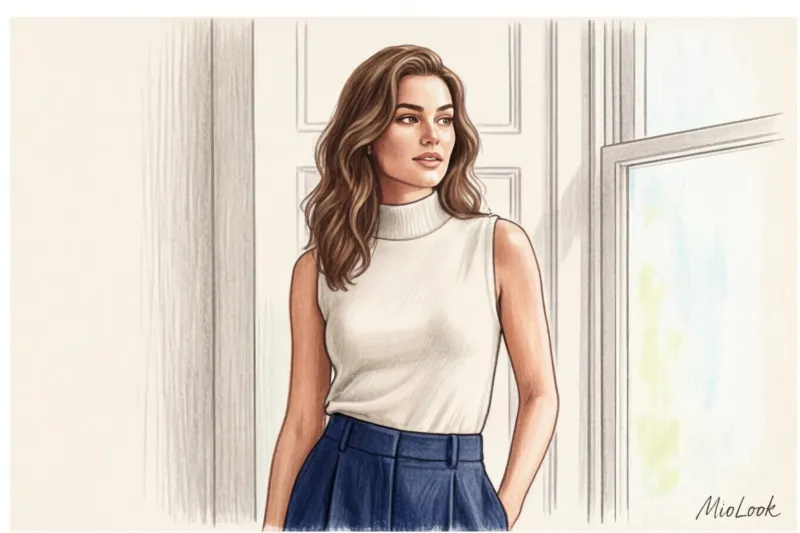
I recently helped a client sort through her wardrobe, and we mercilessly tossed fifteen stiff, uncomfortable hyper-push-up bras into the trash. Do you know why? Surveys show that over 60% of women wear the wrong bra size solely because they want to artificially add volume. But we replaced this arsenal of torture with a few blouses with the right architectural neckline, and the results were astonishing.
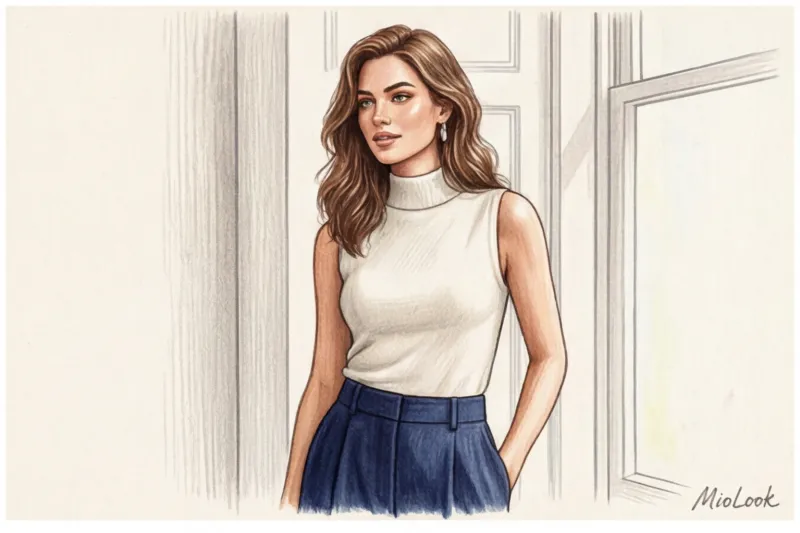
As a textile expert and stylist, I constantly say: you don’t need to deform your body with foam. Knowing that How to visually enlarge your breasts with clothing , is based on the physics of light, thread tension, and optical illusions. We discussed these basic principles in more detail in our a complete guide to visually correcting your figure with clothing Today we'll look at specific engineering solutions for the upper body.
The Anatomy of an Illusion: How to Visually Enlarge Your Breasts with Clothes Without Push-Ups
It's time to abandon radical physical methods. Rigid corsets and unnatural inserts not only damage posture but often cheapen one's appearance. Modern styling works differently: we don't resculpt the body, we skillfully create a façade.
This approach is based on the interplay of light and shadow. Imagine a blank canvas. If we create the right curves and textures on it, the viewer's eye perceives them as 3D volume. MioLook app analytics reveal an interesting statistic: users who abandon the "tighten and lift" strategy in favor of "architectural styling" report a 40% increase in satisfaction with their everyday looks.
This happens because you begin to control the lines rather than fight your own physiology. Dense fabric, the right cut, and the right light reflection do all the work for you.
Neckline Myths: Why a Deep Neckline Works Against You
Let's debunk the biggest stereotype that glossy magazines have been perpetuating for decades. A deep V-neck is supposedly ideal for a small bust. In reality, it's the worst thing you can wear if you're trying to create the illusion of volume.
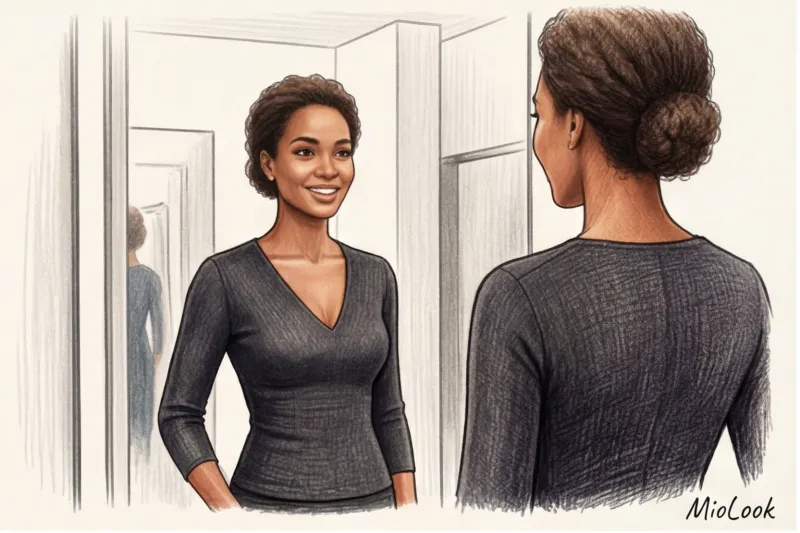
The V-neckline acts as a pointer. It directs the viewer's gaze downwards, toward the narrow point of the solar plexus. It visually narrows the chest and emphasizes the smooth surface of the décolleté. Bare skin does not equal volume.
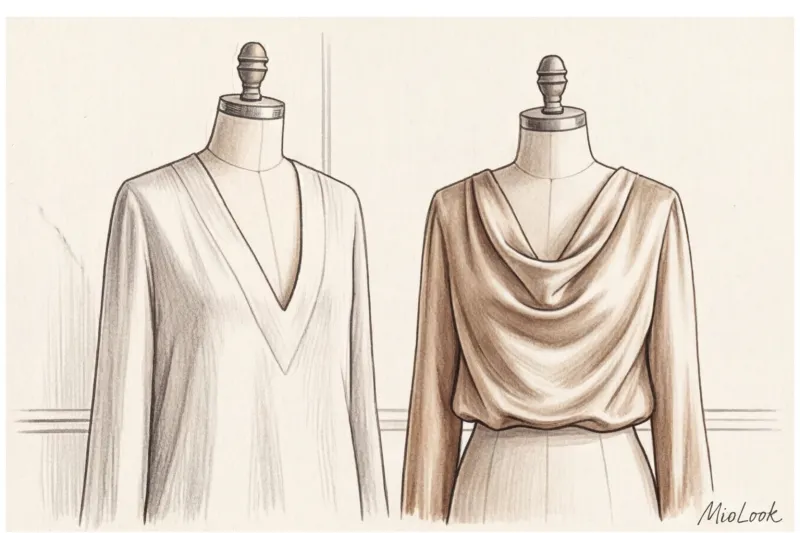
Our goal is not to narrow, but to expand. The maximum uninterrupted area of fabric on the chest creates maximum visual scale.
Necklines that really create volume
- Halter neckline (American armhole): By cutting the fabric diagonally from the neck to the armpits, you expose the shoulders. This creates a powerful optical illusion of a broad, open chest.
- Bateau and crew neck: A clear horizontal line from shoulder to shoulder mathematically widens the upper body.
- Cow neck: This is a physical addition of volume. The natural drape of a flowing fabric (especially silk or viscose) creates real folds that the eye perceives as a protruding form.
Access to MioLook for €0.99 — one-time payment
A smart AI stylist will select the perfect look based on your proportions.
Get access — €0.99 onceThe architecture of the cut: details that change proportions
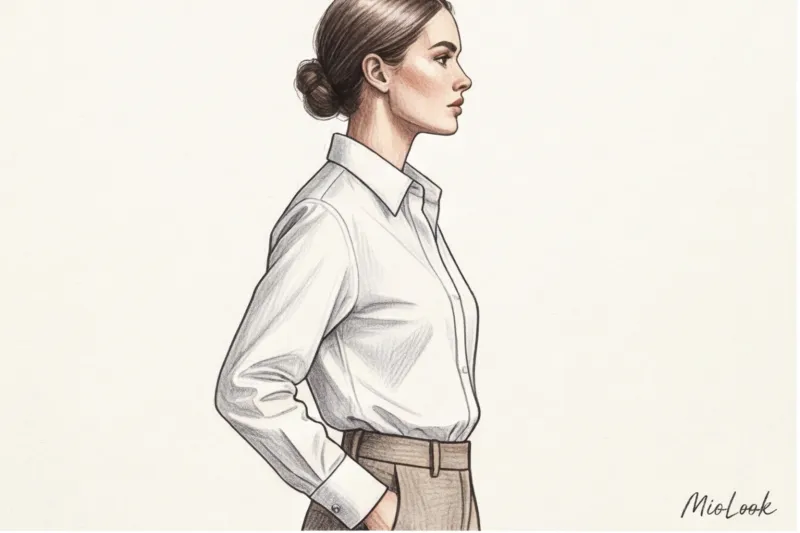
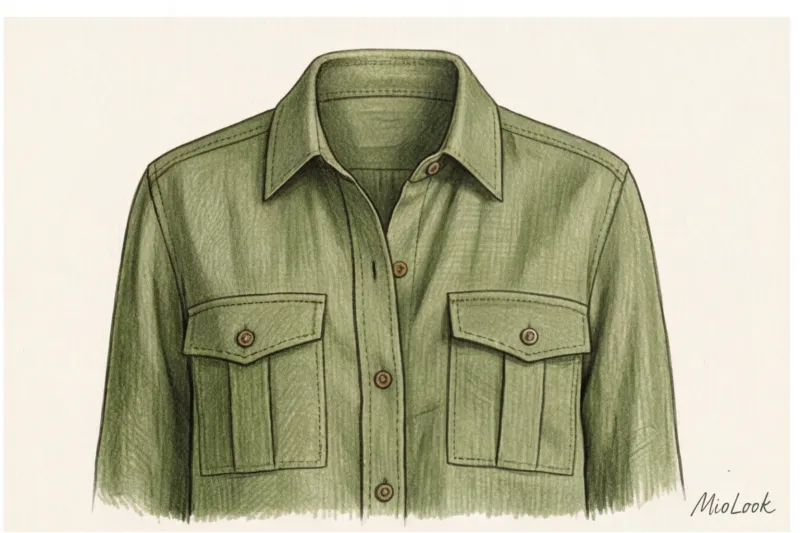
Over 12 years of working with fabrics and silhouettes, I've developed a golden rule: where natural volume is lacking, we add constructive volume. One of my clients was self-conscious about her A-cup breasts. We simply replaced her basic plain shirt with a heavy linen model from Massimo Dutti (around €90) with two large patch pockets and flaps.
The effect was immediate. The geometry worked flawlessly.
What architectural elements work for you?
- Patch pockets: Strictly at the bust line. If the pockets slide lower, they will weigh down the waist and depress the bust.
- Yokes, tucks and pleats: They create directional expansion vectors. Any gathering of the fabric above the chest provides the necessary tension for the material.
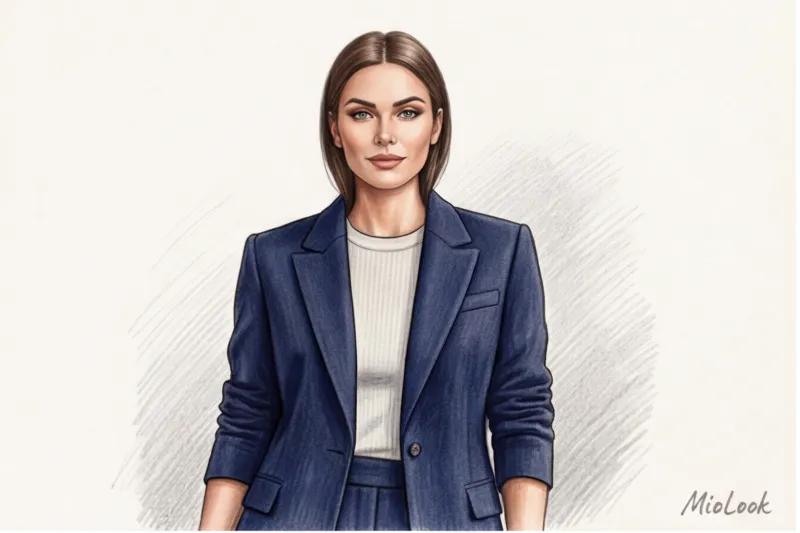
- Double-breasted jackets: The mathematics of buttons. The two rows of buttons on a double-breasted blazer draw the eye horizontally between them, visually widening the torso. A single-breasted jacket, on the other hand, elongates and narrows.
Limitation of the method: This doesn't work if the fabric is too stiff (like oak denim) and the garment sits like a tent, forming a "tent" from the chest down. Architecture demands clarity, but not wooden rigidity.
Textile Engineering: How Fabric Texture Affects Perception
As a textile expert, I can tell you: you can choose the perfect cut, but if the fabric is wrong, the magic will disappear. Textiles are a tool for manipulating light.
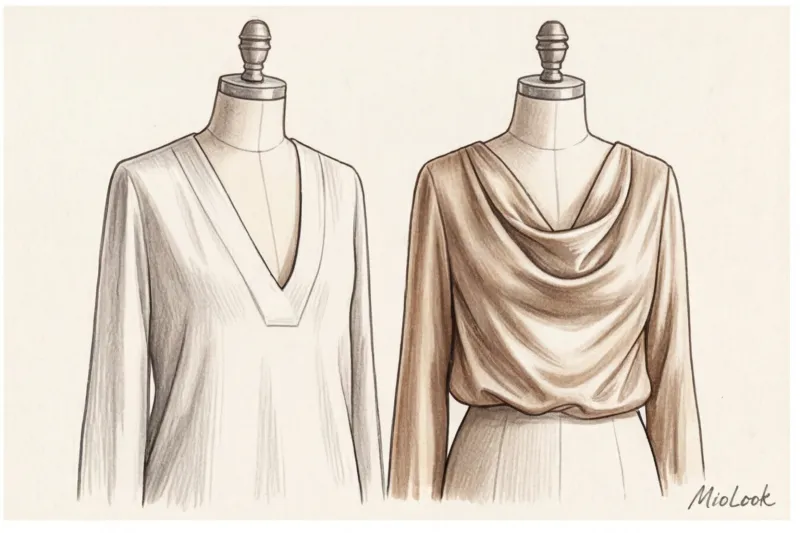
Take, for example, 19-mommie silk (the quality standard for blouses). Its smooth, glossy surface reflects light on the body's most prominent features. It works like a highlighter in makeup—illuminating and enhancing. Satin, velvet, and high-quality viscose have the same effect.
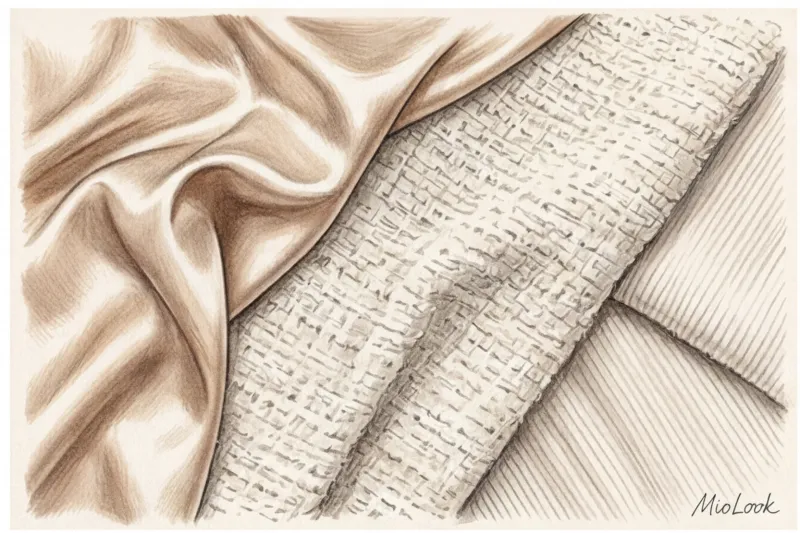
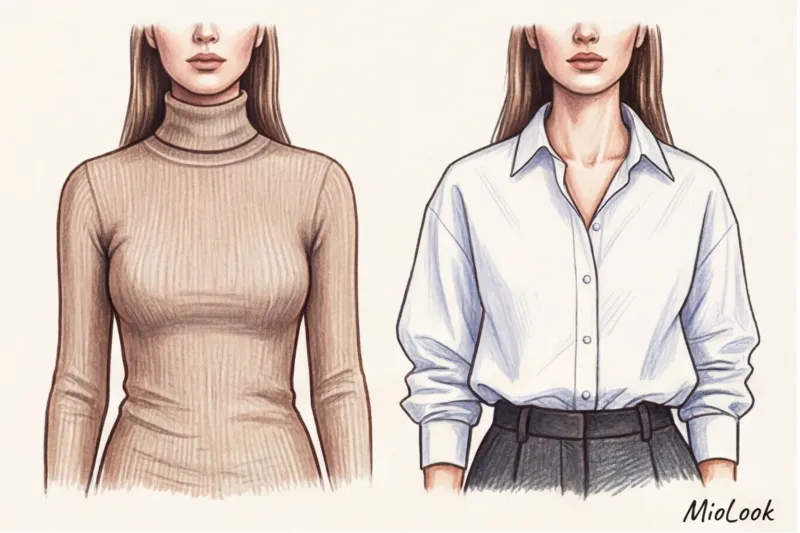
The second most important factor is fabric density, or GSM (grams per square meter). Thin, flimsy mass-market knits (with a density below 120 g/m²) cling to the body like a second skin, mercilessly revealing a lack of volume. You need fabrics with a density of 150 g/m² and above. Dense organic cotton, linen, tweed, or dense wool blends hold their shape, creating a frame around your body.
Prints and Color: Optics 90% of Women Don't Know About
In 1867, German physicist Hermann von Helmholtz demonstrated an interesting optical illusion: a square filled with horizontal stripes appears taller and wider than a square with vertical stripes. This works 100% in fashion.
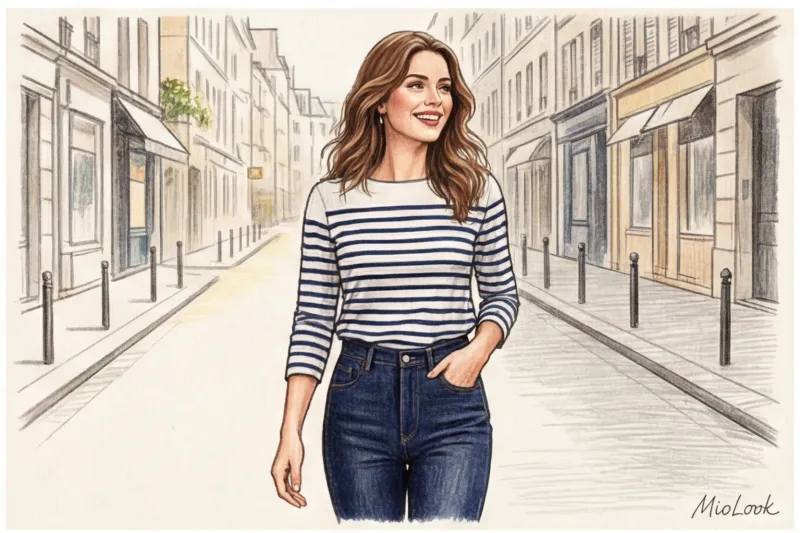
The classic French Breton striped shirt (with dark stripes on a light background) is your best friend. It creates a clear rhythm that expands the upper body.
What else works in optics?
- Light top, dark bottom: White, cream, and light gray colors are highly reflective. Dark pants or a skirt absorb light, making the top appear fuller than the bottom.
- Large patterns: A small flower "ripples" and gets lost. Large geometric, abstract, or large floral motifs at chest level act as a magnet for attention, visually enlarging the area they occupy.
Your perfect look starts here
Join thousands of users who look flawless every day with MioLook.
Get access — €0.99 onceLayering and Accessories: The Architect's Finishing Touches
Even a simple basic top can be made to enhance your bust with the right top layer. By wearing an unbuttoned dark jacket or cardigan over a light top, you create a contrasting vertical line. The dark edges of the jacket conceal the true contours of your ribcage, while the light top in the center appears to push forward.
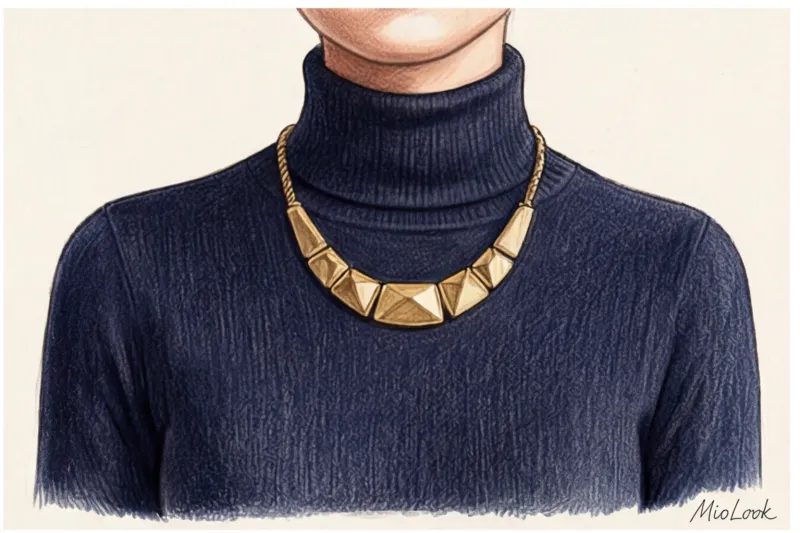
Accessories are your focal points. Where you place the accent, that's where your conversation partner will look.
Try wearing a tight-fitting navy blue turtleneck with a chunky, intricate geometric necklace that ends just below your collarbone. You'll create a distinct 3D relief on a flat background. Heavy metal brooches or voluminous silk scarves tied in a French knot around your neck work on the same principle.
MioLook Checklist: Putting Together a Look for Small Busts
Now let's move from theory to practice. If you want to save time in the morning, upload your items to the "smart wardrobe" feature in MioLook app The algorithm will help you create outfits that take into account the correct proportions.
What to avoid:
- Thin, translucent, tight-fitting knitwear (especially low-quality viscose).
- Deep V-shaped necklines that reach up to the solar plexus.
- Double push-up bras that are visible under clothing (they break the natural silhouette).
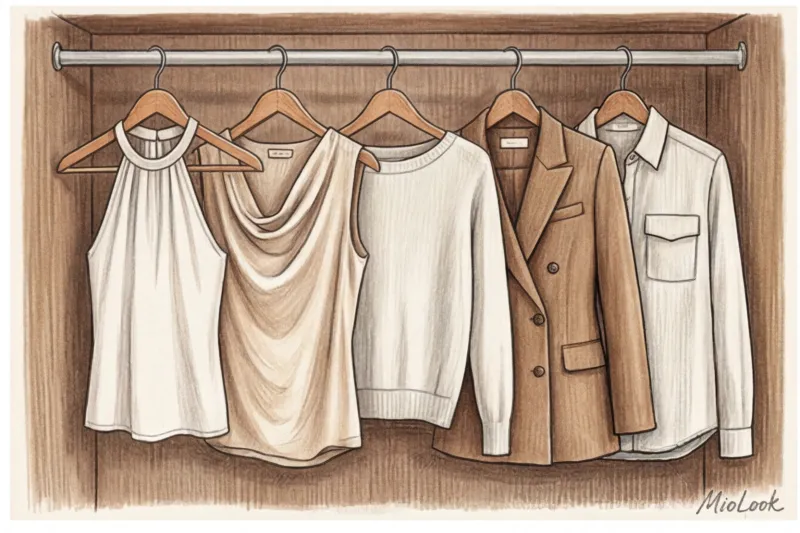
Your must-haves for the capsule:
- Bralettes made of lace or thick cotton provide support without adding bulk.
- Halterneck blouses for evening and summer looks.
- Safari shirts with chest pockets (linen or heavy cotton).
- Double-breasted jackets made of suit wool.
- Turtlenecks and long sleeves with a boat collar.
Remember the most important thing: style isn't about trying to remake yourself to fit the standards of lingerie brands. It's about using fabric, cut, and light as tools to create the desired impression. Forget discomfort, embrace architectural lines, and you'll see how not only your silhouette but also your confidence will transform.