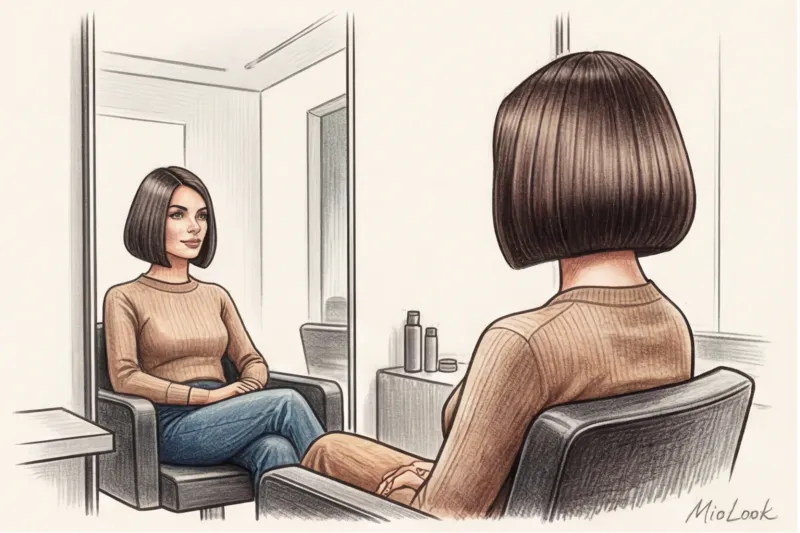
Hair Architecture: Why It's Important to Know the Correct Names of Women's Haircuts
Have you ever noticed how going to a salon often feels like playing roulette? You show your stylist the perfect photo from Pinterest, they nod confidently, and an hour later you look in the mirror and barely hold back tears. The problem isn't always the stylist's qualifications. Over 12 years of working in the fashion industry, I've learned the most important rule: to get the desired result, you need to know the exact names of women's haircuts and understand basic salon terminology.
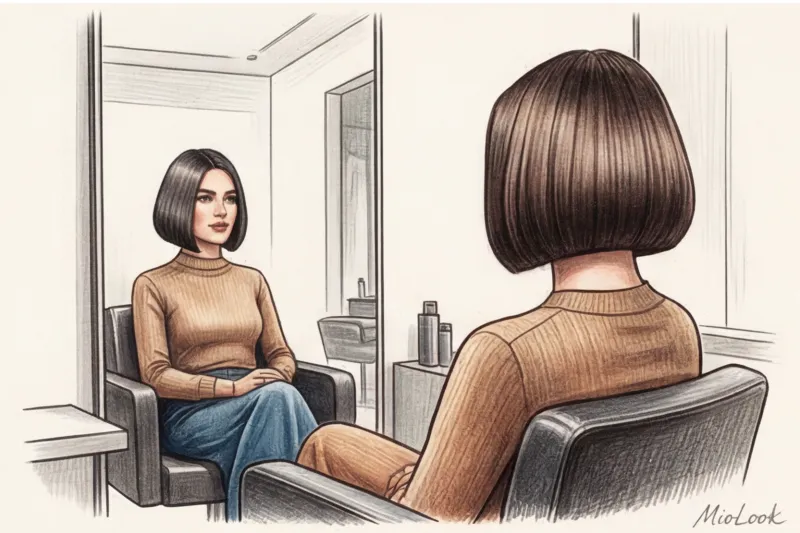
A photograph is just a flat image. It doesn't show the model's hair thickness, the direction of its growth, or the fact that the stylist spent 40 minutes styling the hair with texturizing spray before the shoot. When you use a specific term, you set a professional framework. Words create a clear expectation: the stylist understands the exact geometry to be achieved.
"The architecture of a haircut begins with the right dialogue. If you can't name what you want, you're leaving the result to someone else's taste."
I had a very illustrative case in my practice. One of my clients, preparing for an important photo shoot (by the way, we discussed some great ideas in the article about hairstyles for a business portrait ), asked the hairdresser for "just a bob." In her mind, it was a strict, single-line cut—graphic, heavy, Anna Wintour-style. The stylist, however, heard the word "bob" and gave her a classic salon-style graduated bob with dramatic volume. Technically, he did a flawless job, but the client ended up with a completely different shape. Had she known the difference in terms, this bitter disappointment in the hairdresser's chair could have been avoided.
At the heart of any competent work are two fundamental concepts that clients often confuse: form (silhouette) and texture (internal structure).
Shape is the outer contours of your hairstyle. Imagine the shadow cast by your head: it could be a square (a classic bob), a circle (a sessile), or a triangle (an A-line). Texture, on the other hand, is what happens within that contour. Will the edge be tight and solid, or will the strands flow freely and casually thanks to invisible layers? The same square shape can look completely different depending on the cutting technique.
Understanding this architecture is your main insurance policy. When you come to the salon and say, "I want a square shape without graduation, but with soft texture at the ends," you're on the same page as the stylist. And that's where the magic of a predictable, expensive result that fits seamlessly into your style begins. strict styling for every day.
Fundamental names of women's haircuts: from Vidal Sassoon's geometry to the present day
In the 1960s, British hairdresser Vidal Sassoon revolutionized the beauty industry forever. Before him, women literally slept in tight curlers and doused their hair with gallons of hairspray to maintain complex shapes. Sassoon, however, picked up a pair of scissors and applied the principles of Bauhaus architecture to hair. He mathematically proved that if a shape is precisely constructed geometrically, taking into account the bone structure of the skull, complex styling is no longer necessary—hair will fall naturally after a simple wash.
"My goal was to liberate women from the tyranny of salon haircuts. We cut geometric shapes, not just shortened hair," Sassoon wrote in his memoirs.
Today, when you browse the service menu at a premium salon, 90% of all modern work is based on these basic shapes. All those complex, poetic names for women's haircuts we see in glossy magazines are simply derivatives of three fundamental techniques: line, graduation, and layers. Understanding this architectural foundation is the key to communicating with your stylist and accurately predicting how your hair will grow in two months.
Bob, Kare and Lob: What's the Real Difference?
Perhaps the most common confusion in the hairdresser's chair stems from these three terms. Clients often use them interchangeably, but to a professional, they represent completely different cutting patterns. Let's break down their architecture, because the difference lies not in length, but in weight distribution.
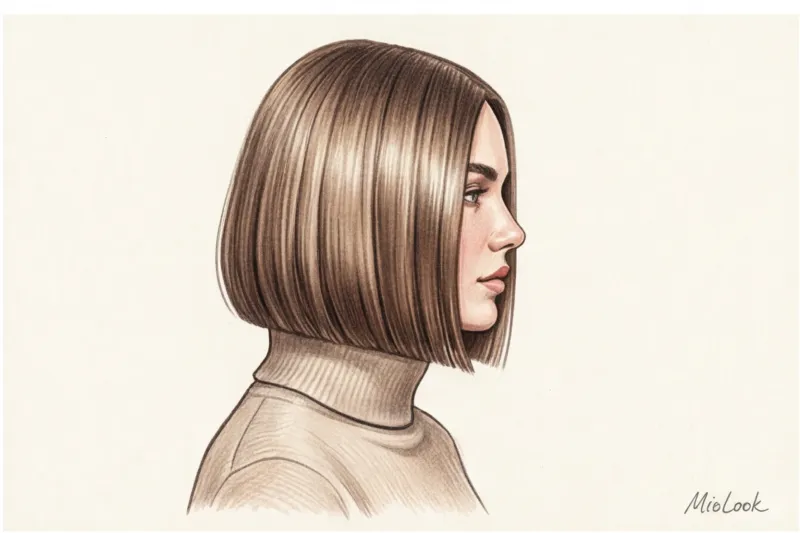
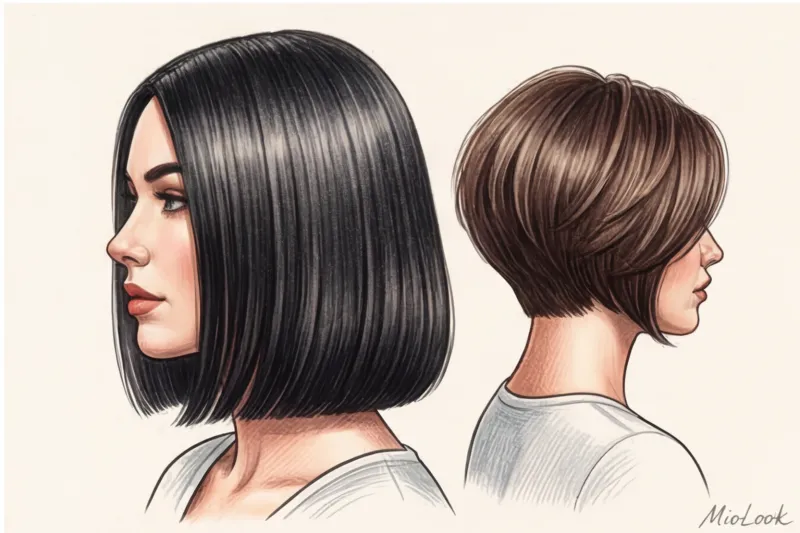
bob (from French carré The square (or square) is a strict, uncompromising geometric cut. The hair is cut along a single, massive line with zero lift. All the weight is carried by the dense edge along the lower perimeter. This is an ideal choice for fine, thin hair, as the dense, blunt cut visually doubles its thickness.
Bean , on the contrary, is based on graduation. The back is cut shorter and gradually lengthens toward the face, creating internal volume without the use of styling. While a bob falls flat and square, a bob always has a rounded, dynamic silhouette.
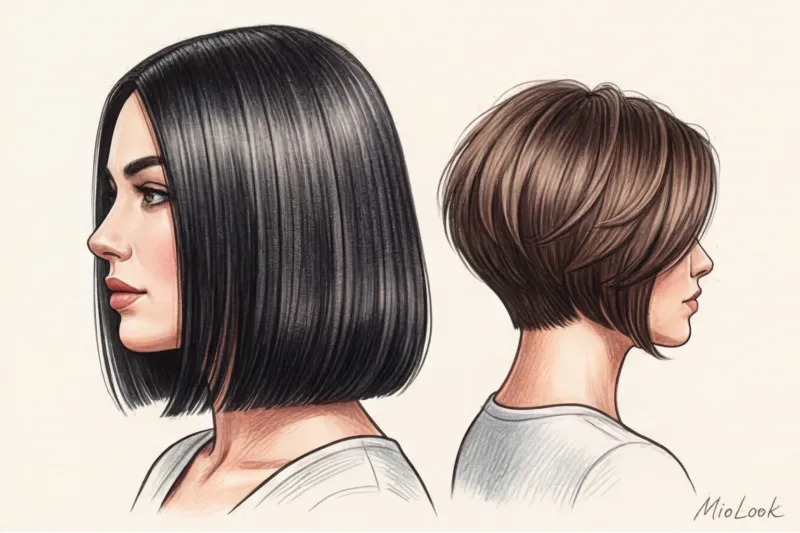
The historical context here is crucial to understanding the style. French bob , shortened to the lip line and often complemented by a careless micro-bang, harks back to the 1920s Jazz Age and rebellious flappers. Today, it's a manifesto of Parisian chic. It's ideal for girls with an oval or heart-shaped face. But a strict A-line silhouette A sharply angled, elongated cut perfectly elongates round faces thanks to its vertical lines. However, keep in mind: maintaining this graphic shape at a reputable European salon will cost approximately €90–€150 every four to five weeks.
If you are not ready for radical measures and frequent visits to the salon, your salvation will be Long Bob This is a longer version of the classic bob, with a cut that reaches the collarbone. Over the years, I've interviewed dozens of successful women, and I can confidently say: the bob is the absolute ideal for a formal business style. It allows you to pull your hair into a low, sleek bun for the boardroom, but it still looks luxurious and fluid when worn loose for an evening event.
Access to MioLook for €0.99 — one-time payment
A smart AI stylist will create the perfect look, analyze your appearance, and help you choose a haircut that will highlight your best features and fit your lifestyle.
Get access — €0.99 oncePixie, Garson and Crop: Ultra-short cuts
Ultra-short hairstyles require a certain amount of courage and an impeccable understanding of facial proportions. When a woman decides to radically reduce the length, the correct names for women's haircuts become critical—a one-centimeter error at the nape of the neck can completely change the perception of the look.
Pixie — it's bold, textured, and airy. The pixie's defining characteristic is its choppy, textured strands of varying lengths, maximum volume at the crown, and a completely open neck. The sides are usually either shaved or cut very short. This shape beautifully elongates the face, accentuates the cheekbones, and requires a matte texturizing paste for daily styling.
Garcon It sounds similar, but technically it's a completely different story. Think of Twiggy's iconic look. Garcon translates from French as "boy," but paradoxically, it makes the look incredibly fragile and feminine. Unlike the daring pixie, the garcon has a softer, more fluid shape. Here, the stylist actively thins the strands so they gently hug the shape of the head, creating a sleek, almost couture silhouette without any sharp transitions. For styling, you don't need a paste, but a smoothing serum.
In the last few years, hybrid haircuts have taken over the industry. According to a large-scale study by the trend agency WGSN (2023), demand for adaptive short haircuts has grown by 40%. This has made them a regular part of salon styles. Crop And Bixie.
- Crop Came from the men's section: a shaved or very short back and sides, contrasted with thick, textured bangs falling thickly onto the forehead. A choice for bold women with expressive features.
- Bixie (a mix of a bob and a pixie) is a brilliant invention for those who want a short haircut but are afraid to expose their ears and neck. The shape maintains the lightness and choppy texture of a pixie on top, while leaving the life-saving length of a bob at the back and around the face.
Watching the street style transformations of the latest Milan Fashion Week, I noticed an interesting trend: the bixie has become the most sought-after and safest "bridge" for those transitioning from long hair to a radically minimal look. This proves that knowing the terminology gives you the freedom to vary your style without compromising your comfort.
Layers and Texture: How Stylists Classify Layered Haircuts
At a private masterclass at the Toni&Guy Academy in London, which I was fortunate enough to attend several years ago, a phrase was said that perfectly describes the essence of layered forms: "Texture is how your hair behaves when you lose control of it." While a classic bob is all about strict statics and monolithic architecture, haircuts that vary hair length from crown to tip are pure kinetics and movement.
To understand how such names for women's haircuts are formed, we need to look behind the scenes of hairdressing and get acquainted with a fundamental technical term - guy rope (elevation) The lift is the angle at which the stylist lifts the hair section relative to the scalp before cutting. This angle determines how pronounced the layers will be.
Imagine: if a stylist pulls a strand straight down at a 0-degree angle, they create a dense, heavy line (like in a classic bob). But lift the strand 90 degrees (perpendicular to the head) or even 180 degrees (straight up), and the hair cascades after the cut, creating those same layers. The higher the angle, the more weight is removed from within the cut, and the more movement it becomes. Understanding this physics of the process will forever change the way you approach your hair in the salon.
Cascade vs. Ladder: Debunking the Biggest Beauty Myth
Let's once and for all clarify the difference between the two most confused terms in the Slavic beauty space. In English terminology, this distinction is obvious: face-framing layers (framing layers) and all-over layers (layers throughout the entire volume). For us, it's an eternal battle between "ladder" and "cascade."
Ladder - this is a step-by-step cut that is performed exclusively in person Its purpose is to soften the oval shape, conceal overly wide cheekbones, or visually elongate a round face. The majority of the hair at the back remains the same length. It's a two-dimensional design element.
Cascade — is a three-dimensional shape. These layers are distributed throughout the entire head, including the back and crown areas. The cascade changes the very structure of the hair's weight distribution, creating volume at the crown and lightness at the ends.
"Give me a layered cut all over"—this phrase makes professional stylists sigh quietly. Technically, "a layered cut all over" is an oxymoron. If a stylist tries to literally cut steps around the perimeter, you'll end up with the choppy look of the early 2000s, not a modern, flowing texture.
Today, premium salons most often offer Italian cascade Unlike the classic '90s bob with its abrupt, defined transitions, the Italian technique (popularized by the Aldo Coppola school) features invisible, seamless transitions. The stylist uses a slicing technique (sliding cut) to ensure the layers flow smoothly into each other. The hair appears thick at the ends, yet easily lends itself to voluminous styling with a brush.
Shaggy, Mullet, and Wolfcut: Rebellious Names for Women's Haircuts
Fashion is cyclical, and the rock 'n' roll aesthetic of the '70s has returned in the form of three aggressively textured cuts. They require a certain amount of courage and, crucially, an understanding of your hair texture.
Shaggy Translated as "shaggy," the name speaks for itself. This haircut features an even, very active texture and multiple, chaotic layers throughout the head. The main focus here is on the voluminous, tousled crown and jagged ends. The shaggy style works perfectly on curly and wavy hair, as the layers allow the curl to bounce and reveal its shape.
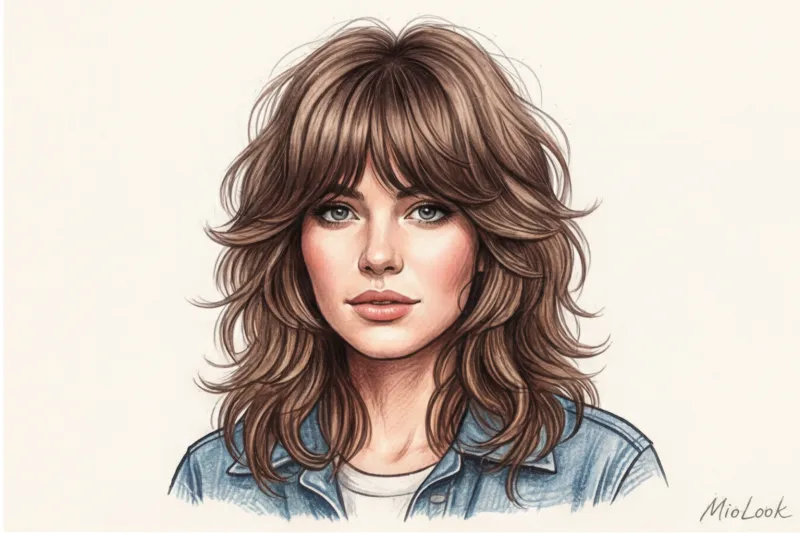
Mullet — a shape built on a radical contrast of lengths. Short, often textured bangs, open or very short sides (business in the front), and longer strands at the back (party in the back). While the '80s mullet was deliberately harsh, the modern women's version (often worn by Miley Cyrus and Ursula Corbero) has become softer, with a smooth blending of the hair.
Wolf cut — A child of the social media era, the wulfcut is a hybrid of the shag and mullet. From the mullet, the wulfcut takes a shortened front and a longer back, and from the shag, an abundance of layers and a wild, untamed texture. An important warning from my experience: these rebellious haircuts only look casual at first glance. To create the “I just woke up and look like a rock star” effect, you will need salt sprays and texturizing pastes (a good professional styling will cost around 25-40 euros per bottle).
Trending terms from TikTok: Butterfly, Rachel and Kitten
TikTok's algorithms operate like a giant rebranding machine: they take classic hairdressing techniques, invent viral, "savory" names for women's haircuts, and sell them to Zoomers as innovation. If you want to be on the same wavelength as your hairstylist, it's important to be able to translate these terms into professional language.
Butterfly cut — is perhaps the biggest trend of recent seasons. This haircut gets its name from its shape: short layers around the face flutter outward, reminiscent of butterfly wings. Essentially, it's an optical illusion. From the front, the cut looks like a voluminous bob reaching just below the chin or collarbone, while the back maintains extreme length. It's the perfect compromise for those who want a dramatic facelift but are terrified of losing their length. In the language of a stylist: "heavily graduated layers at the face while maintaining density at the back of the head."
The Rachel Haircut — the triumphant return of Jennifer Aniston's iconic '90s hairstyle. The creator of the original style, Chris McMillan, used a razor to create those distinctive "chunky layers" (large, distinct layers) that frame the face. The modern version is softer: the length transitions are more gradual, and styling doesn't require such an aggressive inward curling of the ends.
Kitten (Kitten cut) — or "kitten cut." It's a delicate response to the aggressive wulfcat. If the wulfcat is a wild wolf, then the kitten is its domesticated version. The length typically reaches the collarbone, the layers are less contrasting, and the curtain bangs blend seamlessly into the main body of the hair. An excellent choice for fine hair that lacks movement.
To avoid playing "telephone" with your hairdresser and being disappointed by bringing a reference from social media, I always advise my clients to analyze the geometry of their desired hairstyle in advance. You can upload a video or photo you like to MioLook The app's algorithms will help you break down trendy haircuts into understandable technical elements: length, layering, and fringe type. With this pre-prepared glossary, your conversation with your stylist will reach a whole new level of professionalism.
Professional Beauty Terms: Cutting Techniques You Need to Know
Have you ever wondered why two stylists can cut the same bob, yet in the first case the hair falls into place, while in the second, it hangs lifelessly? The secret lies in the mechanics of the haircut. The names of women's haircuts alone only define the outer silhouette. But the cutting techniques dictate how the hairstyle will behave dynamically.
In premium European salons, where a top stylist's services cost between €150 and €300, stylists rarely use a simple straight cut. They employ a complex arsenal of techniques, the terminology of which is helpful to understand so you can communicate with the professional and accurately predict the outcome.
Graduation: Volume Architecture
Graduation is a smooth, mathematically calculated change in hair length, precise to the millimeter. Strands are pulled at a specific angle (usually between 0 and 90 degrees) and cut so that each successive strand is slightly longer or shorter than the previous one. It is the graduation that creates the "weight" of the haircut and that voluminous nape that stays in place even without morning styling.
Point-cut: the illusion of natural softness
While a straight cut produces a hard, graphic line, a point cut creates a soft, diffuse edge. The stylist holds the scissors perpendicular or at a slight angle to the strand and makes precise cuts with the tips of the blades deep into the hair.
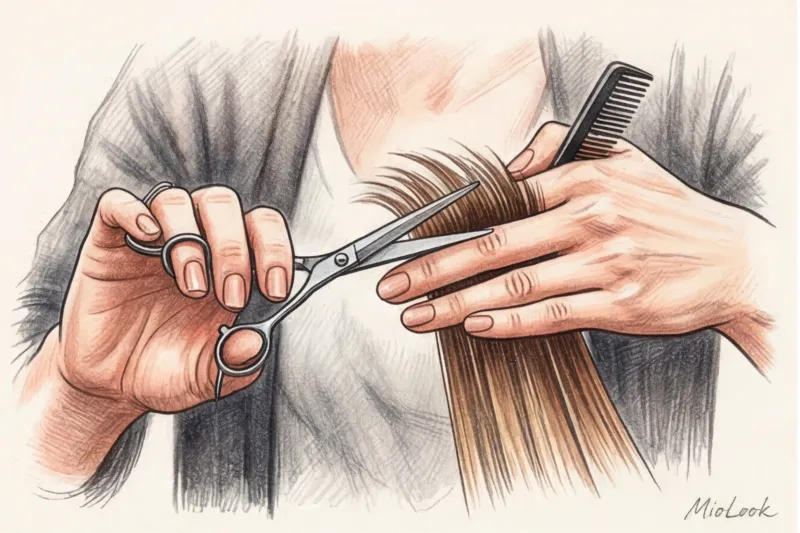
This technique is indispensable when you need to remove excess weight from the ends while maintaining the overall length. After point cutting, the hair falls naturally, as if it grew naturally, rather than having been cut with a ruler.
Slicing: Slipping Texture and the Main Mistake of Fine Hair
When slicing, semi-open scissors glide smoothly across the surface of the strand from top to bottom, cutting away a portion of the hair. This creates stunning texture, movement, and lightness, which are essential for thick, heavy Asian or dense European hair.
As a practicing stylist, I regularly see the consequences of one critical mistake in my chair: using slicers on fine, thin hair. This is a real volume disaster.
Fine hair requires a tight, even edge to visually appear thicker. Slicing will literally gut such a strand from the inside, turning it into a transparent web. If you have naturally thin hair and the stylist starts actively sliding the scissors along the length, it's time to politely but firmly stop the process.
Thinning and shading: is the fear justified?
Many clients are terrified of the sound of thinning shears (tools with serrated blades), as in the wrong hands they can turn the ends into a fluffy "broom." However, in certain situations, they are essential. Thinning is a lifesaver for those with extremely thick, coarse hair, when they need to remove excess volume to prevent the head from looking like a triangle.
Blending is a delicate, smooth transition from very short hair to longer hair. It's crucial in ultra-short cuts, where you need to taper off the length at the neck or temples, creating a flawless gradient.
To understand in advance which texture and cut density will suit your face, I recommend testing different options virtually. This is very helpful. MioLook - You can try on different shapes and clearly see whether you need a tight edge or a ragged, flowing texture.
Access to MioLook for €0.99 — one-time payment
Start creating perfect images with the help of artificial intelligence
Get access — €0.99 onceBangs Terminology: How to Explain the Details to a Stylist
According to the fundamental principles of the international Pivot Point method, the frontal-parietal zone (i.e., the bangs) is more than just a decorative detail. It's the primary tool for architectural facial correction, capable of visually narrowing the cheekbones, concealing asymmetry, or altering the height of the forehead. Clients often ask their stylist to "just trim the bangs," unaware that this element completely transforms the underlying features. names of women's haircuts For example, a classic bob with textured bangs instantly transforms into a French cut, while a simple straight cut with jagged strands around the face takes on a grunge aesthetic.
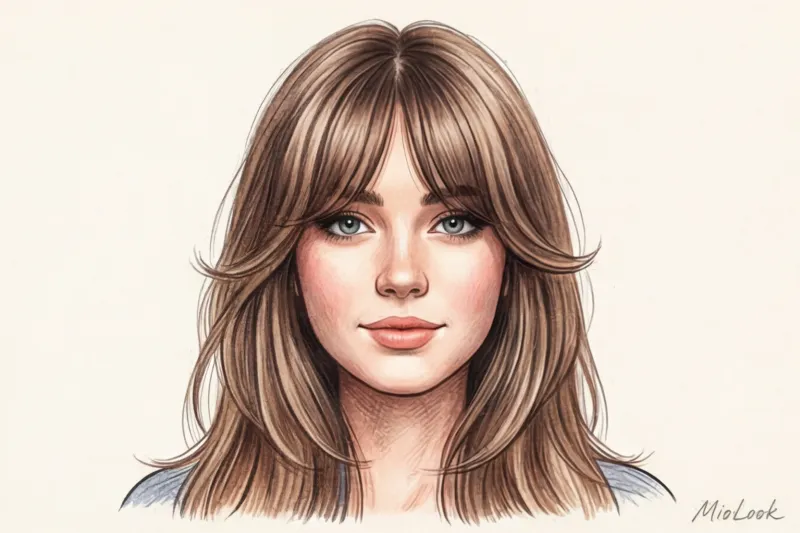
The most common salon request of recent years is curtain bangs This elongated shape, gently falling on both sides of the parting, is inspired by Brigitte Bardot's iconic 1970s look. In professional terms, it's a long, graduated fringe that blends into the temples. It perfectly conceals wide cheekbones and suits 90% of face types, as it creates a visual vertical vector, elongating the oval shape.
If the curtain seems too classic to you, pay attention to French bangs Unlike sleek options, this style is choppy, slightly unkempt, and always lengthens toward the temples. The stylist creates this shape using a deep point cut, giving the ends a light, bouncy look, as if you've just woken up in a Parisian apartment. It looks chic with cascading shapes and doesn't require complex brushing.
At the opposite stylistic pole are graphic elements - micro bangs and classic straight, thick bangs. Micro bangs (cut 2-3 centimeters above the eyebrows) are a powerful, avant-garde accent that requires impeccable proportions. According to face contouring guidelines, such harsh horizontal lines are categorically unsuitable for round or square face shapes, as they visually "cut" the face and widen it. However, on an elongated, narrow oval face, straight, thick bangs work flawlessly, harmonizing the proportions.
Getting your bangs cut is always stressful, as it takes at least six months for them to grow to a comfortable length. To avoid tears in the hairdresser's chair, I strongly recommend trying out different styles virtually first. You can upload a photo of yourself to MioLook and see how micro-bangs or an elongated curtain change the geometry of your face. This relieves a lot of anxiety before a visit to the stylist.
It's important to remember: bangs should never exist separately from the hairstyle. When studying fashionable women's haircuts, always pay attention to how the frontal area connects to the main body of hair. Proper transition (integration of lengths) is what distinguishes an expensive salon cut from a home haircut with kitchen scissors.
Dictionary of styling: from brushing to texturing
The biggest disappointment often comes the morning after a salon visit. A perfectly shaped hairdo suddenly turns into chaos. According to a 2023 survey by the British portal Hairdressers Journal, 68% of women are dissatisfied with their new hairstyle precisely because they don't know how to style it properly at home. In the context of building a personal brand, well-groomed hair is an unspoken marker of status and self-discipline. At an important business meeting, your hairstyle is noticed in milliseconds, conveying confidence and competence even before you begin speaking.
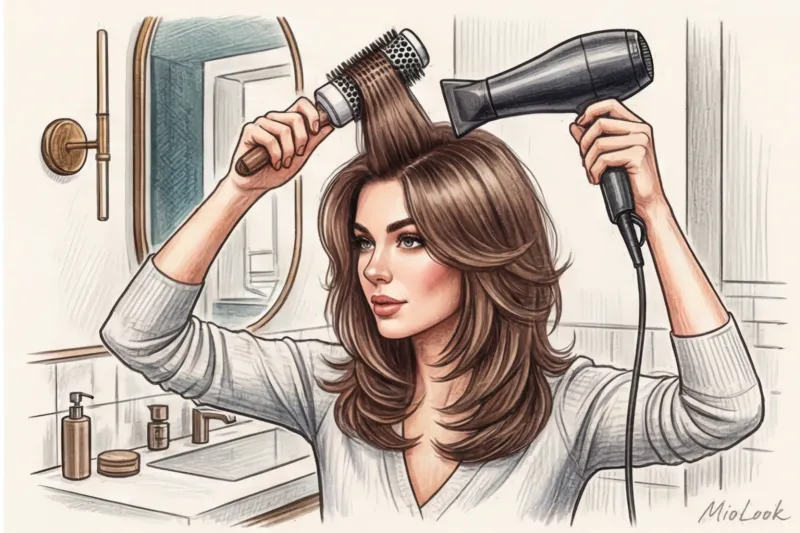
I always emphasize to my executive clients: a salon cut is only half the battle. The other half is proper styling. The foundation of this discipline is brushing In professional circles, this is the term for styling with a round brush and a powerful hair dryer. This technique achieves two goals at once: it creates long-lasting root volume and polishes the hair cuticle, making it reflect light. A high-quality ceramic brush, which costs approximately 40–60 euros, and the correct tension of the strand is the secret to that "expensive" style that won't fall apart in the wind.
The complete opposite of polished brushing is texturing Watching top stylists at work backstage at Isabel Marant shows, I always admired how they created their signature "beach waves." It's the art of controlled casualness that visually rejuvenates and adds dynamism to a look. They use salt sprays, dry shampoos, and matte pastes. The goal is to break up the smooth, single layer into individual strands, creating a slightly "yesterday" texture.
It is important to understand the fundamental rule: different names of women's haircuts It's not just an aesthetic choice based on a picture; it's a strict contract for a specific morning routine. The chosen shape literally dictates your daily schedule in front of the mirror:
- Classic bob It will require 15–20 minutes of daily ironing and smoothing creams to achieve a graphic, mirror-like smoothness. Without straightening, the shape will lose its geometric meaning.
- Rebel Shaggy , on the contrary, it can be styled in three minutes: just spray a texturizing spray generously onto towel-dried hair and vigorously squeeze the strands with your hands, allowing them to dry naturally.
- Cascading shapes and elongated bangs They live solely on the strength of a large-diameter brush—without it, the layers would simply hang in lifeless, straight lines.
Before asking your stylist to radically change your hair's structure, ask yourself this honest question: how many minutes are you really willing to invest in your appearance each morning?
Your ideal image
it begins Here
Join thousands of users who look flawless every day with MioLook.
Get access — €0.99 onceChecklist: How to Describe Your Desired Haircut to a Stylist
According to statistics from the British portal Hairdressers Journal (2023), 68% of disappointments in beauty salons are not due to poor technique, but to simple misunderstandings during the first ten minutes of the consultation. We often forget that the hairdresser's chair is a place for negotiation. To ensure the final result in the mirror fully matches your expectations, a clear communication process is essential.
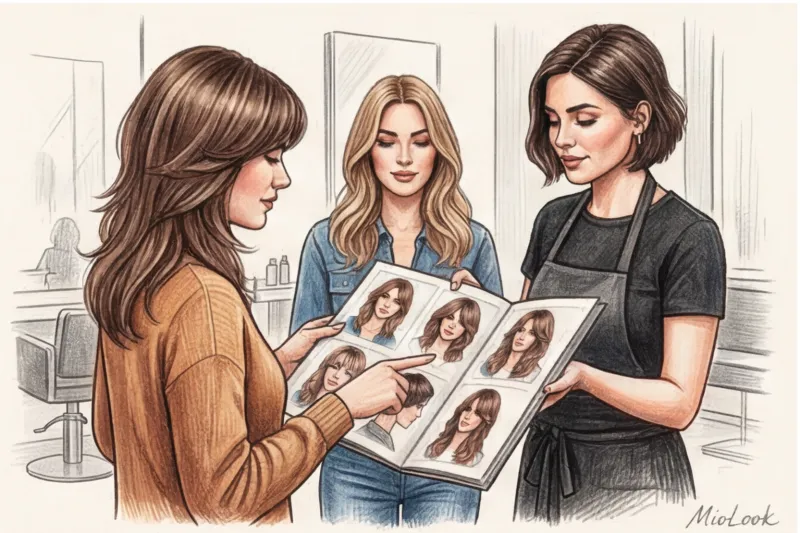
Let's start with visualization. The golden "3-Photo Rule" is a basic communication protocol I implement in my personal analysis sessions. Show the stylist two or three references of the silhouette you truly like. But here's the key: be sure to show one photo of something you ABSOLUTELY don't want to see on your head. This is your visual stop signal. For one person, "short" means an exposed earlobe; for another, it's collarbone-length. An anti-reference instantly delineates the boundaries of what's acceptable.
The second common mistake is trying to speak exclusively in memorized terms. You've studied the fashionable names of women's haircuts, sit down with a hairdresser, and confidently declare, "Give me a bob." But the specialist will mine A classic bob may be completely unsuitable for your frame. My advice: talk about your concerns and desires, not just the names. Saying, "I want more volume at the back to visually elongate my neck and correct a heavy jawline" will give a professional a hundred times more useful information. You describe the problem, and a competent stylist will select the right technique to solve it.
Here's the harsh truth: Discuss your morning routine with complete honesty. I always ask my clients: how many real minutes are you willing to spend styling your hair at 7 a.m. on a Tuesday? If your honest answer is "exactly zero minutes, I just blow-dry my hair upside down," then complex textured shapes are not for you. A luxurious €150 haircut won't look classy if it doesn't fit into your lifestyle. Communicate your strict time limit to your stylist.
Finally, the final step is to calibrate your professional lingo. Clarify the terms before you hear the first click of scissors. Ask your stylist to explain what they mean by the cut you've described. If you've agreed on a "long fringe," have them use their fingers to indicate where exactly the cut line will be—at cheekbone level, at the tip of the nose, or at the chin?
To prepare for this conversation and stay on track, gather your successful and unsuccessful beauty experiments in one place. It's very convenient to organize your references and analyze facial geometry through MioLook — this way, you'll come to the showroom with a ready-made, well-reasoned technical specification, and not just an abstract idea.
Conclusion: Your next level of communication with beauty professionals
A renowned Yale University study led by Professor Marianne LaFrance in the early 2000s scientifically proved what women have intuitively known for centuries: a so-called "bad hair day" not only ruins your mood, it also objectively reduces your cognitive abilities and confidence in negotiations. We subconsciously feel less competent when the geometry on our heads takes on a life of its own.
That is why fluency in salon vocabulary and understanding of what exists names of women's haircuts This isn't beauty snobbery. It's your personal insurance and a direct investment in a predictable, stylish image. A communication error is costly: correcting a bad texture with a qualified stylist in Europe today costs between 150 and 300 euros, not to mention the months of agonizingly growing out "that layered look" you didn't actually ask for.
Image Architecture: Why Hair Is an Extension of Your Wardrobe
Hairstyle has long ceased to be simply an aesthetic addition to the face. Today, it's a fully-fledged part of your personal brand, one that must align with your archetype and lifestyle. The concept of smart style extends beyond fabric and cut.
"Hair is your most important accessory because you don't take it off at night. It sets the context for everything you wear"—this principle is often repeated by stylists at fashion weeks, and it's absolutely true for everyday life.
Imagine a perfectly tailored, minimalist suit in the vein of Jil Sander or The Row. Add a graphic, close-cut bob and you've got the "Ruler" archetype, conveying absolute control, status, and distance. But pair that same tailored jacket with the jagged texture of a mullet or shaggy cut, and you're looking at a "Explorer" or "Rebel," playing on intellectual contrasts. Your haircut should work in synergy with your wardrobe.
When you're planning your looks for the week or putting together a seasonal capsule collection MioLook Pay attention to geometry. An elongated bob (lob) pairs perfectly with turtlenecks and V-necks, visually elongating the silhouette, while dense cascading layers can create unnecessary volume around the collar of a classic trench coat.
Homework: Pre-salon audit
Instead of frantically scrolling through social media five minutes before stepping into the hairdresser's chair, I suggest you take your preparation to the next level. Today, before your next salon visit, conduct a self-audit of your current look:
- Reality Test: Take an honest selfie, front and side, in daylight. Your hair should be in its natural state—no styling with a hair straightener, which you usually don't have time for in the morning. What specifically irritates you about your silhouette?
- Conflict Analysis: Look at your favorite everyday pieces. Does the current length clash with your outerwear? (For example, if your hair constantly rubs against a stiff coat collar, it's thinning at the ends—perhaps you need a shorter cut or, conversely, a length below your shoulder blades.)
- Translation into the language of the pros: Write down 2-3 terms from our dictionary that describe your goal. Replace the emotional "I want something fresh" with the technical "I need a tight cut at the ends for thickness, but with a light slice around the face for movement."
You are the chief architect of your personal brand, and the master is your talented contractor. Now you have the precise blueprint and the right language to ensure this project is a success.
Guide Chapters
Airtouch: What is it and the specifics of the dyeing technique
What is balayage in hair coloring: the specifics of the technique
Pixie cut: what it is, types, and what to wear it with
What is brushing: styling technique and role in style
Curtain bangs: what they are, the main types, and styling methods
Shatush: what it is and the specifics of the coloring technique
Bob-caret: what kind of haircut is it, types and styling methods
Keratin straightening: what it is, types, and care instructions
Hair Botox: What it is, types of treatment, and care instructions
What Is a Shaggy Haircut: Meaning, Features, and Styling
The shaggy haircut combines choppy layers and a tousled texture for an effortlessly rebellious look that suits various hair lengths and personal styles.
Hidden coloring: what it is, types and styling methods
Butterfly haircut: what it is, shape features, and styling
What is ombre in clothing: types and rules of combination
Mullet haircut: what it is, types and styling methods
What Is a Wolf Cut? Features, Styling, and Hair Types
The wolf cut is a bold, heavily layered hairstyle that combines the volume of a shag with the length of a mullet for an effortlessly edgy look.
Hair nanoplasty: what it is, the differences, and care instructions
What Is Hair Lamination: Types, Benefits, and Care Guide
Hair lamination is a salon procedure that coats strands in a protective microfilm to boost volume, eliminate frizz, and deliver a mirror-like shine.
Braids: What They Are, Main Types, and What to Wear Them With
Hollywood Wave: What It Is and How to Style It
Undercut Haircut: What It Is, Types, and Styling Methods
Long bob: what it is, types and styling methods
What is Kanekalon: Types and Applications in Hairstyles
Garcon haircut: what it is, types and styling methods
Babylights: What is this hair coloring technique?
Bronzing: What it is and the specifics of coloring
Hair Carving: What It Is, Cutting Techniques & Care Guide
Explore the complete guide to hair carving, including gentle chemical texturizing procedures, cutting techniques, and essential aftercare tips.