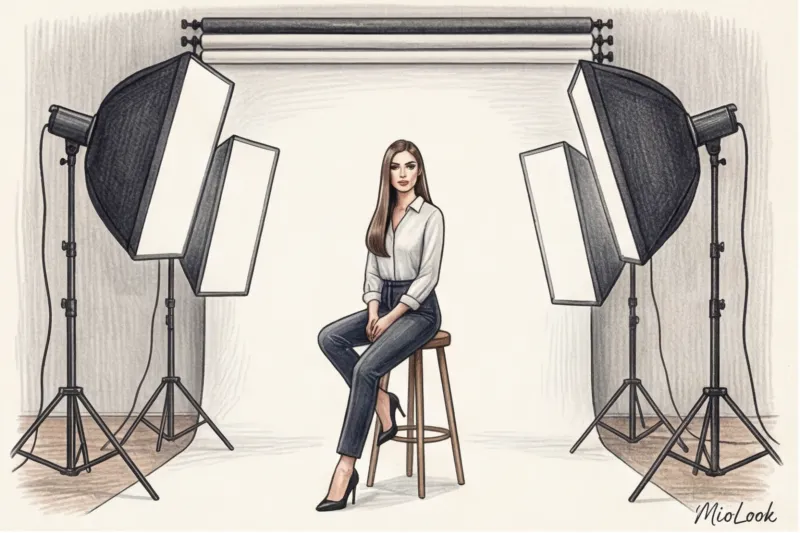
You're sitting in the makeup artist's chair. In the mirror, your hair looks vibrant, voluminous, and flawless. But as soon as you take your first test shot under the studio softboxes, a woman with flat hair and a glowing halo of fine fluff appears on the photographer's monitor. Sound familiar?
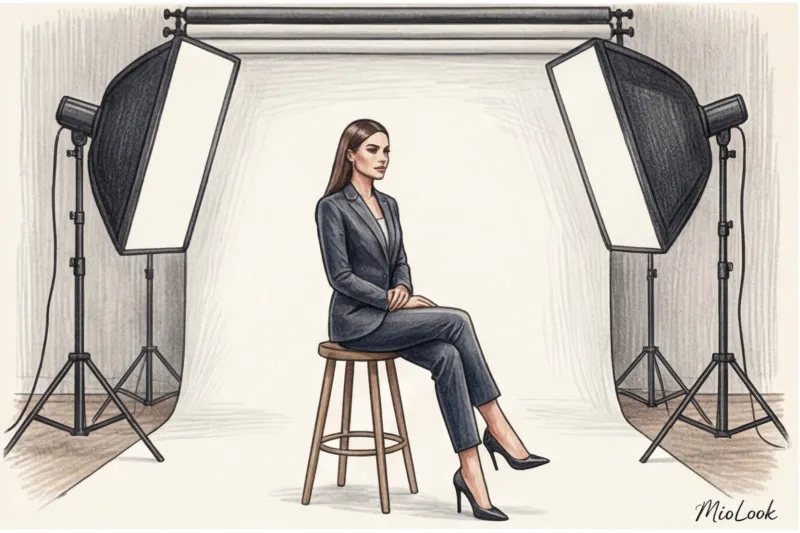
Over 12 years of working on film sets, I've seen hundreds of senior managers and experts panic when looking at the first raw, untouched shots. The problem isn't your hair or the stylist. The problem is that the perfect hairstyle for a business portrait is built on completely different principles than a hairstyle for real life. What flutters beautifully in the wind looks sloppy in a static shot.
We've written more about how clothing and beauty work in tandem in our A complete guide to looks for a business photo shoot And today we'll look at your hair through the eyes of a photographer and retoucher.
Frame Optics: Why Your Regular Hairstyle Looks Cheap
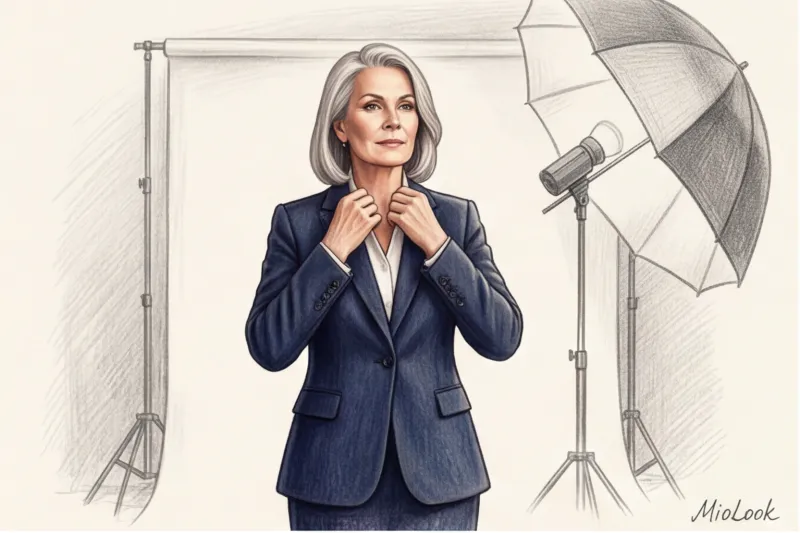
The dynamism of life forgives a little carelessness. The camera never does. Studio photography is the translation of a three-dimensional object into a flat 2D image using aggressive light.
A pulsed flash with 500-1000 joules of power literally penetrates the hair. As celebrity stylist Chris Appleton often notes, harsh light "removes" up to 30% of the thickness and texture. While your hair may appear normal in real life, in photos it may appear thin and stuck to your scalp. But that's not all.
The second enemy is the "dandelion" effect (baby hair). Everyone has tiny, new hairs along the hairline. No one notices them in the office. But under backlit studio lighting, this fluff literally begins to glow, creating an unkempt effect. The retouching time for a single portrait increases two to three times simply because of the need to remove these flyaways.
Your perfect look starts here
Join thousands of users who look flawless every day with MioLook.
Get access — €0.99 onceThe formula for "expensive" styling: architecture, density, and shine
According to Vogue Business's 2024 analytical report, corporate dress codes have finally shifted from relaxed casual to so-called corporate polish. And a sleek, architectural hairstyle has become the primary status marker.
The camera loves clean lines and clear geometric silhouettes. For a hairstyle to look expensive, it must meet three criteria:
- Architectural design. The silhouette should be instantly readable. No jagged edges.
- The illusion of density. Root volume is created not by backcombing (it will be visible), but by hidden corrugation of the lower layers or texturizing powders.
- Gloss against oily shine. Hair should reflect light like silk.
"One of my favorite tricks on set is using a regular toothbrush generously sprayed with strong-hold hairspray. This is the only way to perfectly 'smooth' the hairline without creating the greasy look that gels can cause." It's a professional secret that will save your nerves.
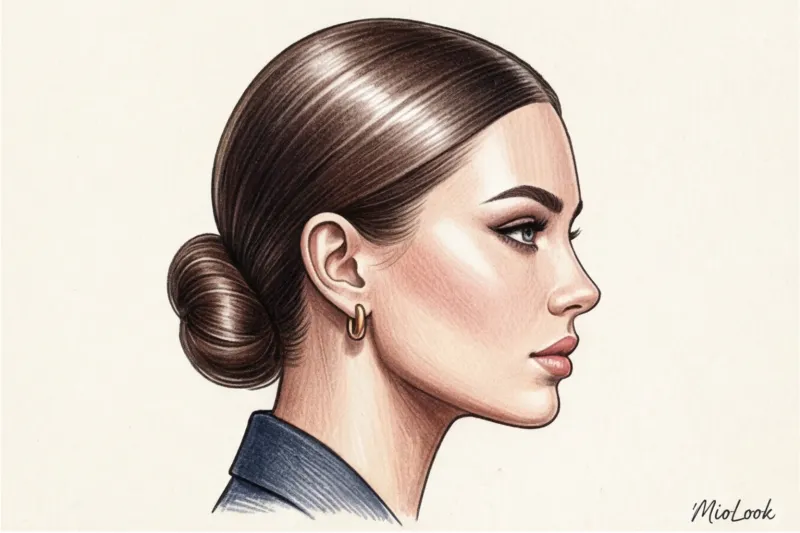
Top 5 status hairstyles for a business photo shoot
The choice of styling depends directly on your industry and archetype. A financial director might prefer strict geometry, while a creative producer might prefer a controlled texture.
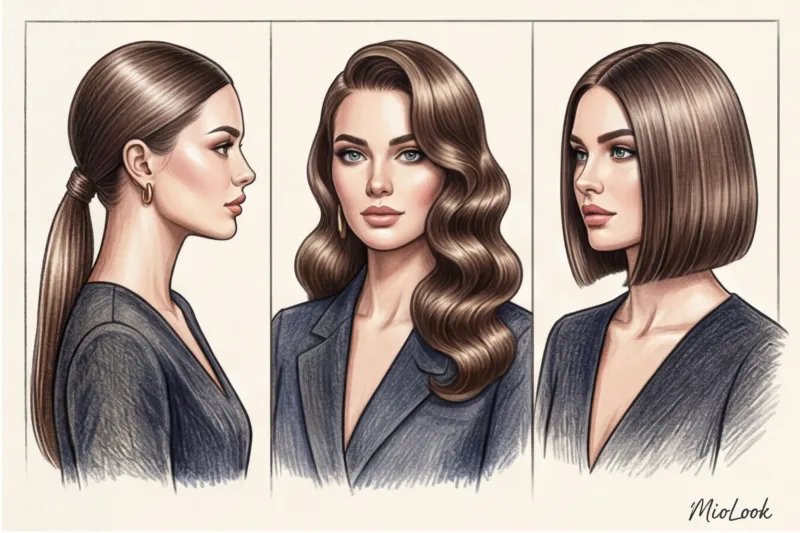
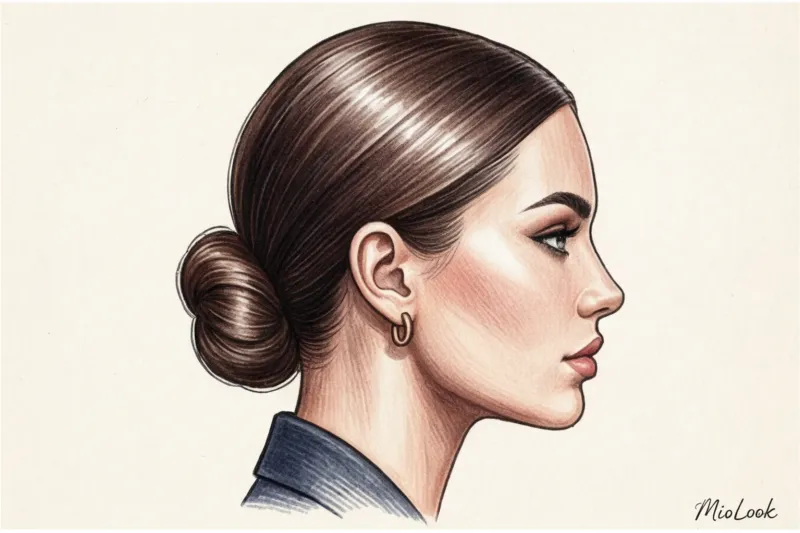
1. Sleek Low Bun
An absolute classic and the ideal choice for strict, conservative niches (lawyers, top management, finance). A low bun conveys composure, intelligence, and control.
The secret lies in the parting. A straight, center parting creates strong symmetry and suits those with perfectly oval faces. A deep, side parting works like a sculptor, visually elongating a round face and softening a heavy jawline. To avoid the "stern schoolmistress" look, the bun should be positioned at the very back of the head, almost touching the neck, rather than in the middle.
2. Structured waves (Not to be confused with beach waves!)
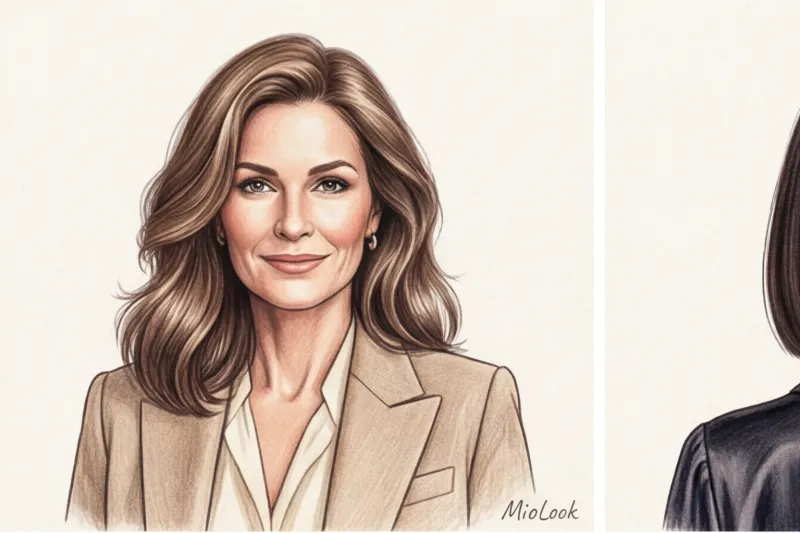
The Hollywood wave, in its business interpretation, is a softer yet completely controlled style. All strands are curled in the same direction and carefully brushed into a single piece.
Why am I so against "beach waves" in business portraits? The technique, where strands are twisted in different directions with the ends left straight, looks stylish in real life. But in photos, it looks like you slept with wet hair and didn't have time to comb it. Save the beach texture for vacation.
3. Perfectly straight hair (Glass Hair)
The "glass hair" trend is all about absolute smoothness and mirror-like shine. It's perfect for those with thick, heavy hair and haircuts with a straight, thick cut.
To achieve this effect, simply straightening your hair with a flat iron isn't enough. Using a heat protectant with a laminating effect (such as heat-activated sprays) before shooting is essential. Your hair should fall in a single, heavy cascade.
4. Modern "Shell" (French Twist)
A classic French shell can add 10 years to your age if it's too tight and high. How can you adapt it for 2024?
We remove the mothballs by adding subtle texture at the crown (a little natural volume) and making the twist itself slightly looser, but securely held in place with hidden pins. This hairstyle works phenomenally with jackets with broad, masculine shoulders—it opens up the neck and balances out the massive top.
5. Styling for short haircuts (Pixie and Bob)
A short haircut can look flat and slanted in a photo if it's deprived of its dynamic qualities. The key here is to emphasize texture.
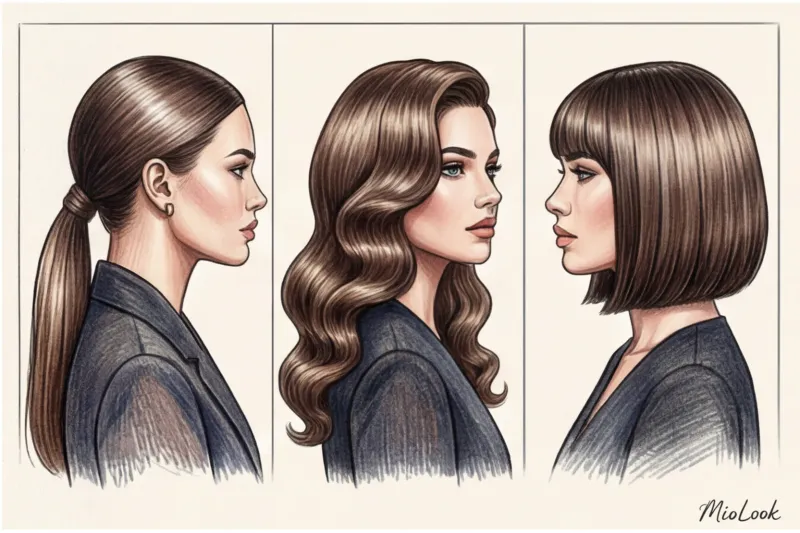
Use texturizing pastes with a matte finish to accentuate individual strands near the face and at the crown. Another crucial detail: get your hair cut 3-5 days before the shoot. A fresh cut the day before a photo shoot always looks artificial; the hair needs time to adjust to the shape of your head.
Access to MioLook for €0.99 — one-time payment
A smart AI stylist will select the perfect look for your next photo shoot.
Get access — €0.99 onceThe Main Mistakes: What Irrevocably Cheapens the Image in the Lens
Let's bust some dangerous myths that ruin 80% of corporate portraits.
Myth number one: you need to come to the shoot with freshly washed hair.
It's counterintuitive, but squeaky-clean hair is your worst enemy. This "clean" texture is too fluffy, too light, and won't hold its shape under hot lights. The ideal base for a long-lasting, "expensive" salon style is hair washed the night before. It regains its natural volume overnight.
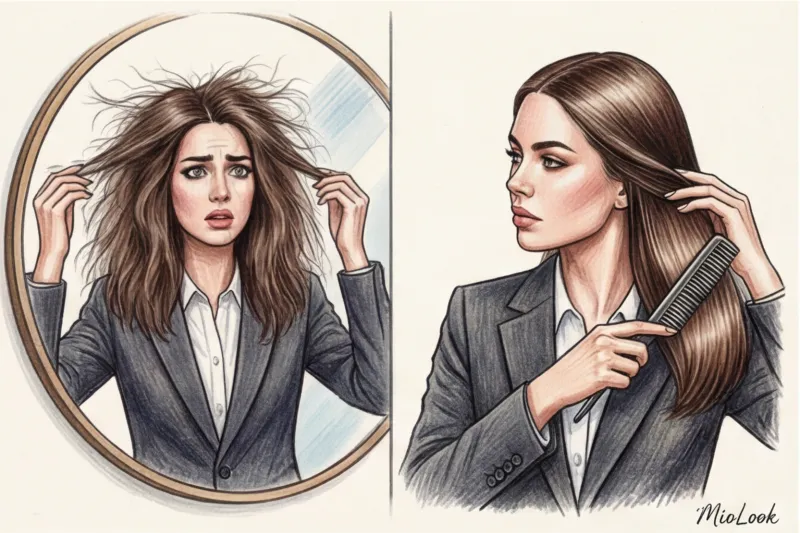
Myth two: the “I just woke up” hairstyle is quick.
It's a paradox, but the notorious "effortless hair" requires a colossal amount of styling. If you simply blow-dry your hair, it will fall apart into unkempt strands when you change poses during a photo shoot. What appears natural in Vogue is cemented in place by flexible hairspray.
Cheap fittings and regrown roots.
A macro lens sees everything. If you use bobby pins, they should be truly invisible (hidden within the hairstyle), not sticking out like black clips on light hair. The camera will highlight and add contrast to the 2-millimeter roots you might not notice in the mirror.
To be fair, I would like to point out a fair limitation: The total-smoothness rule doesn't work for naturally curly hair (types 3C-4C). Light physics works differently there: trying to "smooth" such curls will ruin their beauty. The key for curly hair is maximum hydration with curl-defining creams to ensure the light reflects off each curl.
Integrating Hairstyles with Wardrobe: The Rule of Lines
Your hairstyle doesn't exist in a vacuum. It works in conjunction with the geometry of your outfit. One of my clients came to a shoot wearing a chic black turtleneck and luxurious, shoulder-length hair. In the photo, we got a "floating head"—her black hair blended into the black background and turtleneck, and her neck completely disappeared.
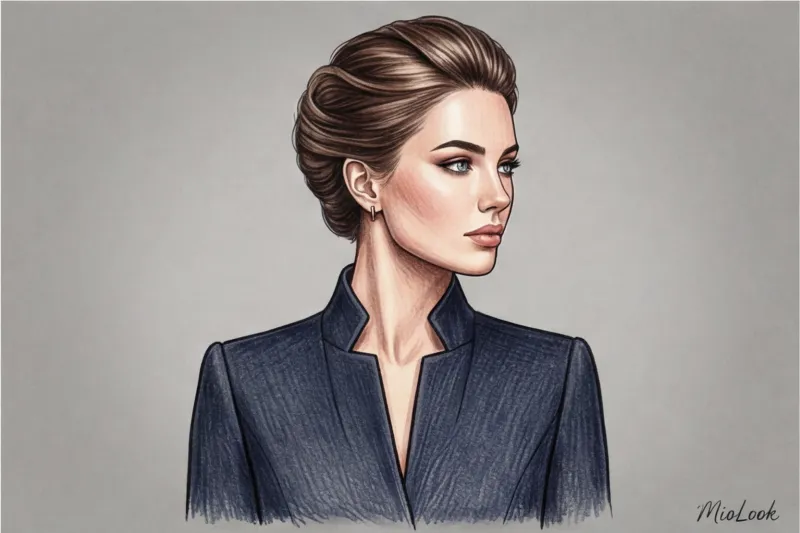
- High collar or turtleneck: Only hair pulled back (bun, ponytail, or bun). Your neck should be visible.
- Complex cut of the jacket (ruffles, asymmetry, epaulettes): A minimalist, sleek hairstyle. Complexity + complexity = visual noise.
- V-neck: Pairs perfectly with loose, structured hair. The deep neckline elongates the neck, offsetting the volume of the hair.
By the way, to check in advance how the jacket neckline matches or harmonizes with the length of the hair, I recommend using MioLook app Upload your items, and a smart AI stylist will show you the geometry of your look before you even get in front of the camera.
Preparation checklist: from booking a salon appointment to going on set
A beautiful picture is the result of proper timing. Based on the riders of professional speakers, I created a strict preparation schedule.
A week before the shoot:
Color refresh and haircut. Hair needs time for the color to fade a bit and become more natural, and for the cut to stop being so unsightly.
The day before the shoot:
Wash your hair properly. Avoid heavy, nourishing oil-based masks—they'll weigh down your roots, and your hair's volume will plump up after 20 minutes under the lamps. Use a lightweight conditioner only on the ends.
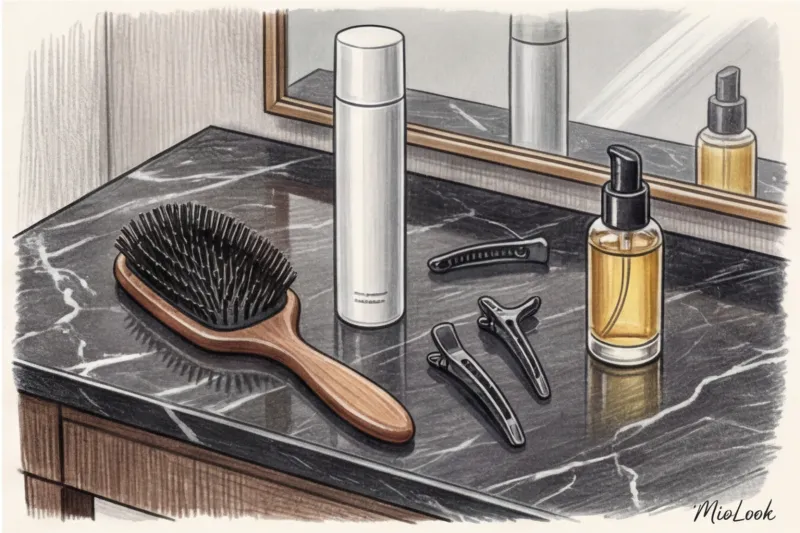
On the site, your cosmetic bag should contain:
- Anti-static hair spray (or regular anti-static clothes spray sprayed onto the brush - an old modeling trick).
- A brush made of natural boar bristles (only this one perfectly smoothes the top layer of hair).
- Dry shampoo (not for cleanliness, but to create a matte texture at the roots so they don’t shine from sweat under the spotlights).
Ready to get started?
Try a free plan—no commitments. Create the perfect wardrobe for life and work.
Get access — €0.99 onceA professional portrait is an investment in your personal brand that will work for you for years to come in publications, at conferences, and on social media profiles. Remember the key rule of studio styling: what seems too rigid, fixed, and tight in the dressing room mirror will transform into that confident, luxurious naturalness in the final photo.