Demi-season essentials: types of outerwear for the transitional season
Have you ever noticed the paradox? We're ready to spend 400 euros on a winter down jacket that we wear for maybe two months a year, but we stubbornly skimp on a fall jacket, making do with occasional purchases. Over 12 years of working as a personal stylist in Europe, I've developed a strict rule: it's the transitional basics that define the status and visual value of your look. Studying types of outerwear Women often underestimate the demi-season segment. Yet, in today's climate, we wear these items for six months at a time.

When you calculate the cost per wear, demi-season clothes are the most profitable investment in your closet. You throw them on on a cool September morning, wear them all through October, and then take them out again in March. One of my clients recently loaded her wardrobe into MioLook And I was surprised to discover that I wear a light coat three times more often than the most expensive sheepskin coat. So, it's worth investing wisely here.
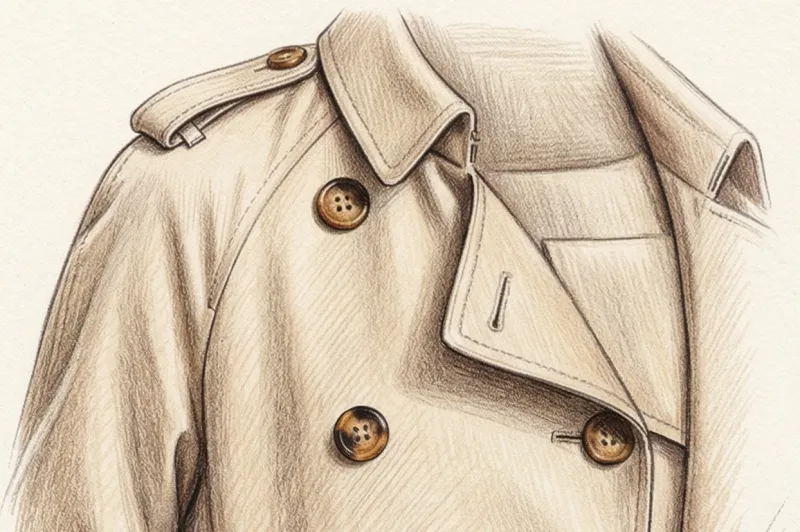
Let's start with an absolute classic. Many people confuse a trench coat with a macintosh, although they are completely different in design. The macintosh, created by Scotsman Charles Macintosh in 1823, was originally made of two layers of fabric bonded with rubber. Today, it's a simple, single-breasted coat with a closed placket (buttons hidden) and a turn-down collar. It lacks unnecessary details—it's the perfect choice for minimalists. The trench coat, on the other hand, is a legacy of Thomas Burberry and the British Army. Its cut is functionally more complex: double-breasted fastening, epaulettes, a back yoke, and a gun flap in front. Historically, each detail served to channel water away from a soldier's body in the trenches.
Herein lies the main catch: not every trench coat is created equal. Let's compare current mass-market collections. If you pick up a basic trench coat from Zara for €49-€59, it's likely to be made of a thin cotton blend with a high percentage of polyester (or lyocell). This fabric flows, but doesn't hold its shape at all—after a couple of weeks of wear, the shoulders will sag and the collar will lose its stand. For contrast, consider a classic model from COS for €175-€190. It uses dense 100% cotton gabardine. The density of the gabardine weave is critical: the stiff cotton creates a defined shoulder line and a well-defined silhouette that visually sculpts the figure, even when worn with a shapeless, bulky sweater.
While raincoats fulfill the need for elegance, leather biker jackets and bomber jackets provide dynamism. It's astonishing how a strictly masculine uniform has evolved into the foundation of women's smart-casual. The biker jacket (created by Irving Schott in 1928 for motorcyclists) and the MA-1 jacket (the bomber jacket worn by American military pilots) have long since lost their marginality. In my experience, when a client first tries on a rugged vintage biker jacket over a flowing silk midi skirt, magic happens. The contrast of textures takes the edge off overly dressy pieces. Today, we wear the right oversized nylon bomber jacket not with jeans, but with tailored, pleated suit trousers.
But if I had to keep only one item in my demi-season wardrobe, it would be a classic, below-the-knee, heavy cotton trench coat. A cost-benefit analysis shows that it pays for itself faster than any other jacket because it's so versatile. Throw it over a hoodie, joggers, and sneakers, and you'll look like an off-duty model. Wear it over a tailored jacket, and you're ready for the boardroom. It pulls any look together, provided you don't skimp on the fabric's thickness.
Elegant Protection: Classic Coats and Their Architecture
According to 2024 reports from the analytical agency WGSN, the classic wool coat remains the most cost-effective investment in a woman's wardrobe. When exploring different types of outerwear, many women make the same mistake: choosing color and texture, completely forgetting about the cut. But a coat is more than just a warm layer; it's the architectural façade of your look. It can either bring together a relaxed jeans and hoodie combination, adding a touch of class, or completely ruin the impression of even the most expensive silk dress.
Let's break down four fundamental silhouettes that never go out of style and understand how they work with body proportions.
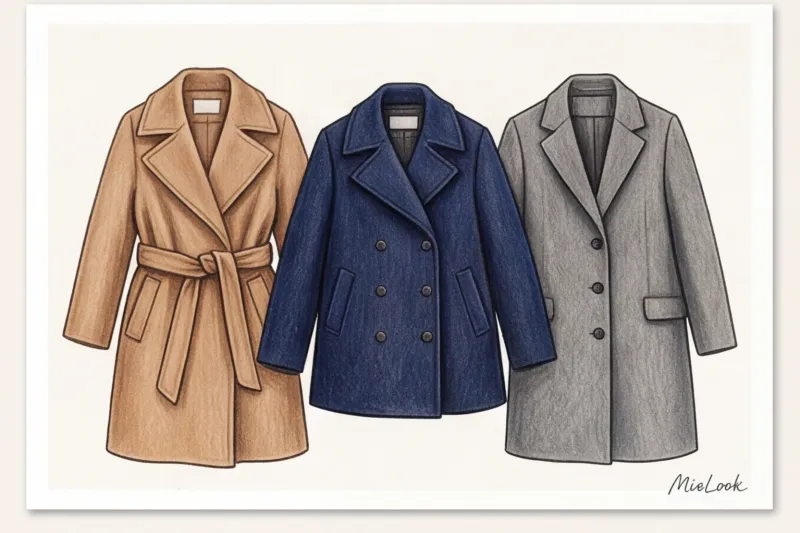
Chesterfield coat The Chesterfield is a strict British classic, originally borrowed from the men's wardrobe. It is easily recognizable by its straight cut, single-breasted (less commonly double-breasted) fastening, peak lapels, and crisp, almost military-style shoulders. Historically, the Chesterfield was complemented by a velvet collar, but today brands like COS or Massimo Dutti offer more minimalist versions. It is an ideal choice for a business wardrobe. The Chesterfield's rigid shape disciplines the silhouette: even when worn with a soft knit suit, you still look composed and authoritative. In the 200-300 euro price range, you can find excellent wool-blend models that will last for decades.
If a chesterfield is a rigid frame, then wrap coat — is like flowing water. Introduced to the mainstream by the fashion house Max Mara, this style has become a true all-rounder for any figure. The secret to its phenomenal fit lies in the complete absence of a rigid shoulder girdle. Thanks to the raglan sleeves or dropped shoulders, the robe coat softly hugs the contours of the body.
It's forgiving in weight fluctuations and allows for complex layering: you can effortlessly layer it with a thin blouse, a chunky knit sweater, or even a lightweight down vest. A wide belt accentuates the waist, creating a feminine hourglass silhouette even in areas where it's not naturally defined.
Stylist's rule: hem overlap technique. In my practice, I constantly see how the wrong length of outerwear visually cuts off legs. Remember the golden rule: the hem of a basic coat should either completely cover your dresses and midi skirts or be longer. A gap where 5-10 centimeters of a contrasting skirt peeks out from under the coat creates horizontal lines that shorten the height. The ideal modern length is mid-calf or maxi. It works flawlessly with both wide palazzo pants and flowy dresses.
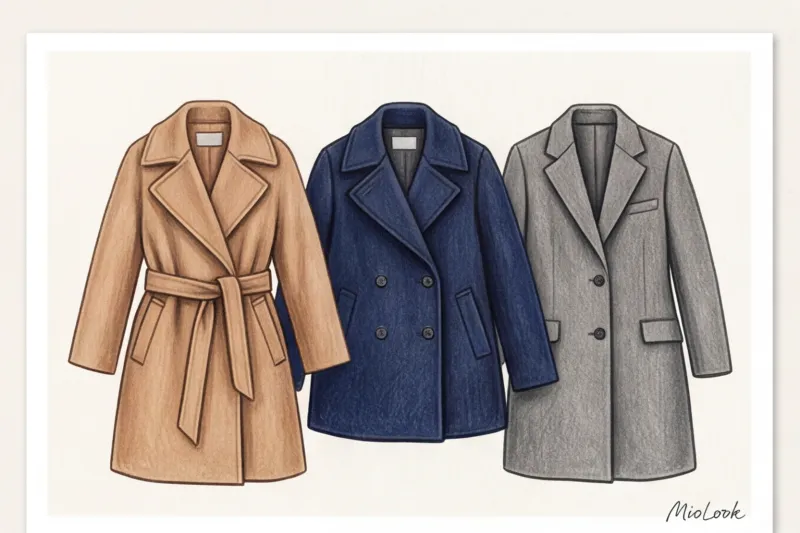
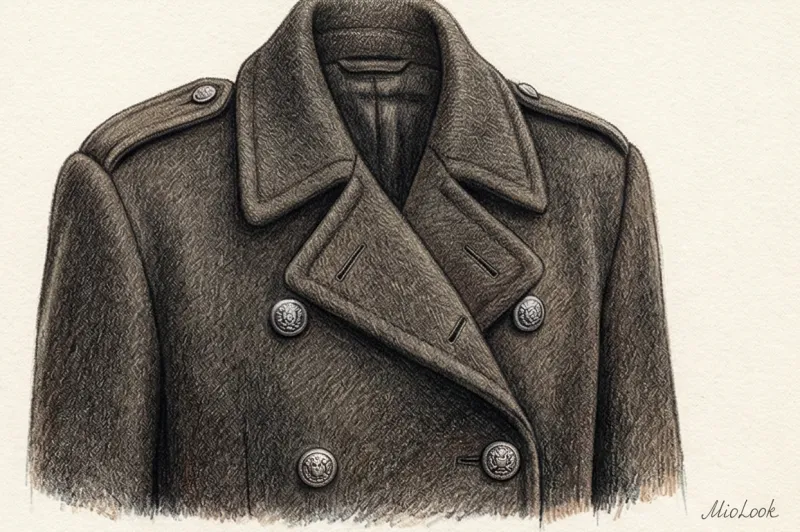
The maritime aesthetics deserve special attention, as they blend incredibly seamlessly into the city's everyday life. I'm talking about peacoat And duffle coat Originally designed for sailors in the British Royal Navy, the pea coat is made from dense, windproof melton wool. Its wide lapels and double-breasted closure complement smart-casual styles perfectly, pairing them with Breton tops, cashmere turtlenecks, and straight-leg jeans.
The duffle coat, on the other hand, is a more relaxed affair. Its distinctive wooden or bone "fang" buttons were designed to allow the coat to be buttoned without removing thick gloves. The hood makes it indispensable for those who don't like wearing hats. The duffle coat fits perfectly with preppy style: wear it with loafers, thick tights, and pleated skirts.
Not sure which coat style is right for you?
Try MioLook for free: A smart AI stylist will analyze your measurements and existing wardrobe and select the perfect outerwear silhouette for any weather.
Get access — €0.99 onceFinally, cocoon coat — an architectural masterpiece gifted to the fashion world by Cristóbal Balenciaga in the 1950s. This is oversized at its most elegant: voluminous at the shoulders and waist, but tapering slightly toward the bottom. Many of my clients are initially wary of the cocoon, believing it will make them look bulky. In fact, it's a brilliant solution for apple-shaped figures or those with broad shoulders.
To maintain the proportions of a cocoon coat, the principle of volume contrast works: we should emphasize the thinnest parts of the body. Roll up or pull up the sleeves slightly to reveal delicate wrists (you can add a chunky bracelet or watch), and pair this style with ankle-flattering shoes like ankle boots or loafers. This way, the voluminous coat will look like a stylish cover-up, not like a throwback.
Winter arsenal: jackets, parkas, and down jackets
There's an unspoken rule of mass-market manufacturers that salespeople will never tell you: total savings on insulation always start with the shoulder area. A brand can claim a superior down composition on the label, but if the down is unevenly distributed, your shoulders will freeze within ten minutes at the first frost. How can you check this before buying? Simply squeeze the jacket with two fingers near the shoulder seam. If you can immediately feel the lining, the jacket isn't worth the money. Choosing a winter base layer requires technical expertise, so when disassembling types of outerwear For the cold season, we must start with the materiel.
Down Jackets: Reading the Label Like a Pro
According to the International Down and Feather Testing Laboratory (IDFL), the quality of a down jacket is determined by just two parameters, which you should look for on the inside label.
The first one is Fill Power (FP) , a measure of down's elasticity and its ability to recover from compression. The higher the number, the more air the insulation traps, and it's the air layer that keeps us warm.
- FP 550–650: Ideal for city winters and running from the metro to the office.
- FP 700 and above: Extreme insulation for severe frosts. Buying such a jacket for a European winter is a mistake; you'll simply fry in it on public transport or in stores.
The second parameter is the down-to-feather ratio. The industry gold standard is 90/10 (90% down, 10% feather). Why not 100% down? Fine feathers are essential: they act as a rigid frame, preventing the down from clumping after washing. If the feather content is more than 20% (for example, 70/30), the jacket will be heavy, stiff, and not warm enough.
How to avoid becoming a caterpillar
Why do some down jackets look like elegant cocoons, while others make you look like a Michelin tire? The answer lies in the texture of the fabric and the stitching.
The secret to visual correction: glossy nylon acts like a magnifying glass. It reflects light, highlighting every curve and adding unnecessary volume to the figure. Matte fabric, on the other hand, absorbs light, creating a crisp, sculpted silhouette.
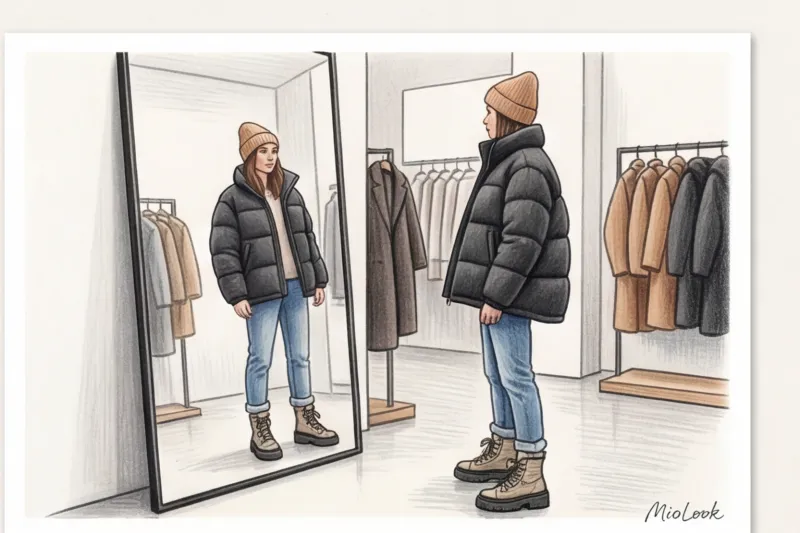
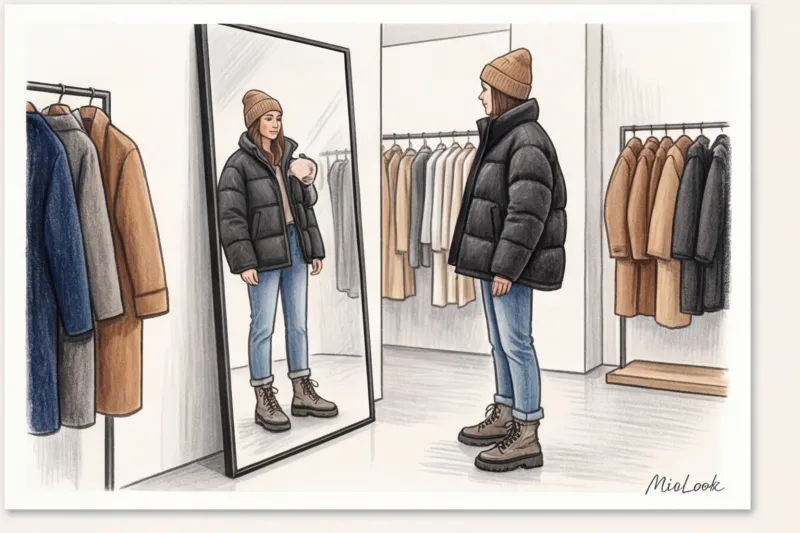
Choose fabrics with added cotton or dense matte polyester. The second critical point is hidden quilting. The most stylish models from the basic COS or & Other Stories lines have stitching hidden inside, leaving a completely smooth surface on the outside. If the quilting is visible, look for wide sections (at least 15 cm). Fine horizontal stripes inevitably distort the proportions. If you're unsure which silhouette suits you, photograph two options in the fitting room and upload them to MioLook — the outfit evaluation function will help you look objectively at your proportions from the outside.
Parka: Utilitarian Chic vs. Gear
The parka has long migrated from the wardrobe of polar explorers to city streets, but it is important to understand the difference between urban and expedition models.
Expedition parka (Inspired by classic Woolrich silhouettes) – made of heavyweight, water-resistant nylon, with chunky patch pockets, a deep, fur-trimmed hood, and a drawstring waist. It's perfect for long winter walks with the dog, but too casual for the office.
City Park — is a celebration of minimalism. A straight or A-line cut, hidden hardware, high-tech blended fabrics (often with a Gore-Tex membrane), and a complete absence of fur. This item costs around 200-250 euros, but easily fits into a business dress code and looks impeccable over a structured jacket.
Anorak and Husky: Solutions for Mild Winters and Female Drivers
For those who primarily travel by car, or for those living in regions with mild winters (where temperatures rarely drop below -5°C), classic down jackets are overkill. They restrict movement while driving and cause overheating.
This is where light alternatives come into play. Anorak The modern take on the over-the-head jacket is made of windproof ripstop. The lack of a central zipper prevents heat loss, and the shortened front hem prevents bunching up on the stomach while riding.
Quilted jacket (Husky) With its distinctive diamond quilting and corduroy collar, this jacket is a legacy of British equestrianism. Today, it's a staple of European smart casual. It's thin, incredibly lightweight, and works brilliantly in layering. Layered over a voluminous cashmere turtleneck, the Husky jacket provides ample warmth without feeling bulky.
Texture and status: fur coats, sheepskin coats, and capes
Let's be honest: when the temperature drops to -15°C, most of us capitulate. We reach for our shapeless down jackets, sacrificing elegance for the sake of simple survival. However, types of outerwear For harsh cold weather, don't limit yourself to quilted jackets. A winter wardrobe can be both warm and stylish if you use textures wisely.
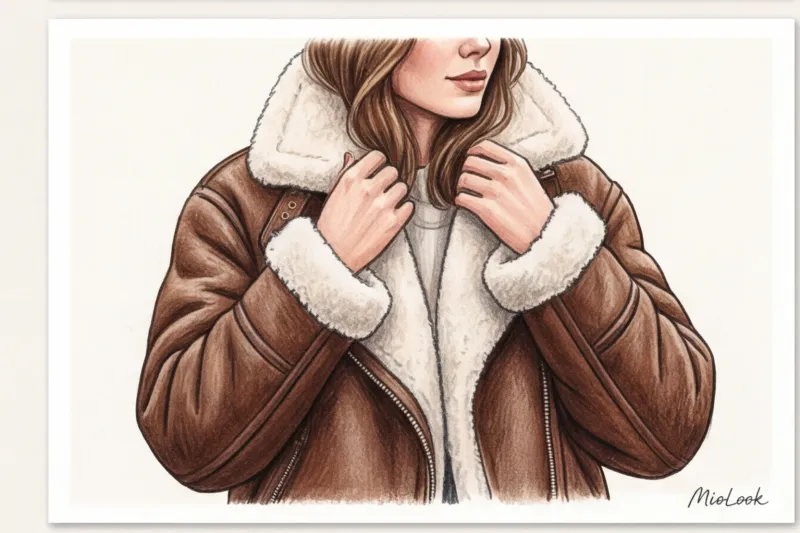
My client Anna fell into the same trap for three winters in a row. She'd buy trendy "cheburashka" jackets from H&M, trying to look stylish, but she'd end up freezing in the wind and always returning to her old down jacket. We radically changed our tactics: we sold three unsuccessful synthetic fur coats on a resale platform and invested in a high-quality aviator shearling coat from Massimo Dutti for 800 euros. The result? She finally stopped freezing. An aviator shearling coat is the best alternative to a down jacket for those who want to maintain a streamlined silhouette in freezing temperatures. The secret lies in its historical origins: this jacket was designed for open-cockpit pilots, so its windproof properties are phenomenal. The dense sheepskin with a nappa coating is windproof, and the wide collar protects the neck better than any scarf.
Since we're talking about fur, it's time for an honest analysis: eco-fur or real fur? Marketers have successfully convinced us that artificial fur will save the planet. But let's look at the facts. From an environmental perspective, cheap acrylic, which takes hundreds of years to decompose and releases microplastics with every wash, causes colossal damage to the environment. Buying vintage mink or karakul at a second-hand store is much more environmentally friendly and conscious. In terms of thermal insulation, mass-market fur offers us a kind of "greenhouse": you sweat on public transportation and instantly freeze outside. Moreover, the cheap sheen of acrylic always betrays the cost of a garment per mile. If you absolutely refuse real fur, look for high-tech eco-friendly options from brands like Stand Studio, whose base contains at least 50% natural sheepskin.
What about the iconic Teddy Bear coat? Since its triumphant Max Mara show in 2013, this style has survived the hottest trend phase and firmly established itself as a winter staple. Its secret lies in its composition: the original, voluminous camel hair on a silk base creates a relaxed yet incredibly expensive look. Mass-market brands have copied the silhouette but replaced it with 100% polyester. My advice: if your budget is limited to €150-200, it's better to buy a good wool coat with high-tech insulation than a synthetic teddy. How to wear the right Teddy Bear coat? Play with contrasts. A voluminous, fluffy top calls for graphic bottoms—straight-leg jeans made of thick denim, pointed-toe ankle boots, and a sleek, leather bag with a crisp shape.
Access to MioLook for €0.99 — one-time payment
Start creating perfect looks with the help of artificial intelligence and get your winter wardrobe in order.
Get access — €0.99 onceFor special occasions, when utility takes a back seat, there's the cape and the poncho. These are complex yet stunning outerwear pieces. It's important to understand the architectural difference: a poncho is a single piece of fabric with an opening for the head, a nod to '70s aesthetic that works perfectly with relaxed country looks paired with suede Cossack boots. A cape, on the other hand, features a tailored shoulder line and armholes—always a sign of strict urban aristocracy. A cape requires perfect posture and precise styling—long leather gloves and a slim hem. Sure, you wouldn't wear one to the grocery store, and carrying a bag over your shoulder would be physically impossible. But draped over an evening tuxedo, a cape made of thick, heavy wool creates a level of dramatic elegance unmatched by any classic coat.
Mythbusting: Why You Don't Need the Thickest Jacket
Every November, the streets of European capitals fill with women wrapped in enormous down jackets. Looking at them, I always ask myself: are we really preparing for a polar expedition, or are we just looking for a comfortable 10-minute walk from the metro to the office? Buying the thickest jacket in the store is the most common and, paradoxically, expensive mistake when building a winter wardrobe.
The counterintuitive approach is that a huge down jacket is objectively harmful to a city dweller. In reality, we spend perhaps 20% of our time in extreme cold; the rest is spent running, in heated cars, in public transportation, and in stuffy shopping malls. In a giant cocoon, you'll instantly sweat on the subway, and when you step out onto the dank street with a damp back, you'll freeze to the bone even at a measly -5°C.
The solution to this problem has long been devised in mountaineering, and it translates perfectly to a casual wardrobe. The athletic "three-layer rule" ingeniously adapts to any type of outerwear, allowing you to look elegant and stay warm. The system works like a smart construction kit: the base layer wicks away moisture, the insulating layer retains body heat, and the protective layer (your coat or light jacket) blocks wind and precipitation. Instead of a single, unwieldy shell costing €500, you get a flexible climate control system that can be adjusted on the fly.
The foundation of a smart winter wardrobe begins not with outerwear, but with what you wear next to your body. Forget thick, itchy sweaters that only add extra pounds to your silhouette. The impact of quality thermal underwear on your outerwear selection is colossal. Modern long sleeves made from a blend of merino wool and silk (Intimissimi and Falconeri have excellent basic lines) are a game-changer. The finest silk-blend fabric works like a second skin: it doesn't add a millimeter of bulk under a thin office shirt, but increases your overall cold resistance by a comfortable 5-7 degrees.
Professional life hack: For winter street style shoots, when the model must pose for hours in an open demi-season coat in near-zero temperatures, we never use bulky pieces. The stylists' secret is invisible layering. We dress the models in ultra-thin thermal underwear with a deep U-neck, and apply Japanese thermal patches (kairo) to the lower back and between the shoulder blades. They top the look with a thin cashmere turtleneck and a structured wool jacket. The silhouette remains fluid, delicate, and elegant, and the model physically doesn't have time to freeze.
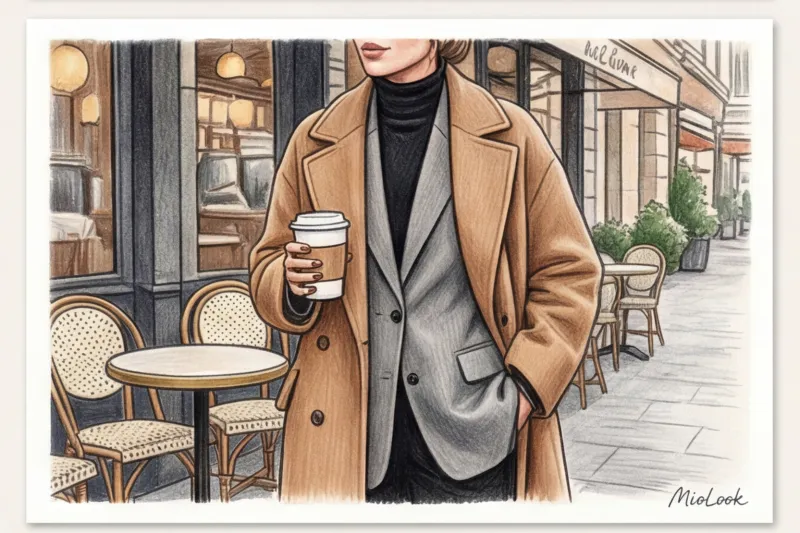
Thin down vests are a brilliant choice for an ideal insulating layer in the city. Uniqlo's renowned Ultra Light Down line or Massimo Dutti's more formal counterparts are absolute must-haves, worth every penny (on average, such a vest costs just 40-60 euros). They're your secret weapon: layering this lightweight vest under a classic fall coat instantly transforms a transitional garment into a fully-fledged winter piece. You no longer rely on the thickness of the jacket's insulation.
The key is to properly integrate the vest into your outfit without looking like a tourist on a camping trip. Choose models with a V-neck (many brands have special internal snaps to tuck and hide the round collar) and buy them in a color that matches your outerwear. A matte graphite liner under a black coat will be completely invisible to others. To avoid getting lost in layers and always know which items in your closet go perfectly together, I recommend using the "smart wardrobe" feature in MioLook — it will help you create ready-made multi-layer formulas before leaving home, saving you hours in the morning.
Stylist's Checklist: How to Test Outerwear Before Buying
Imagine a typical situation: you're standing in the fitting room of a Massimo Dutti or & Other Stories flagship store. You see three visually similar coats, but with a €100 price difference. How do you know which one is truly worth the money and will last more than one season? According to a 2023 study by the European Fashion Institute, more than 60% of outerwear returns and disappointments are due not to a dislike of the style, but to the rapid deterioration of the garment.
To avoid adding to these statistics, I offer you a step-by-step algorithm—a strict checklist by which I test every item before purchasing.
Step 1: Read the Ingredients: Finding the Golden Mean
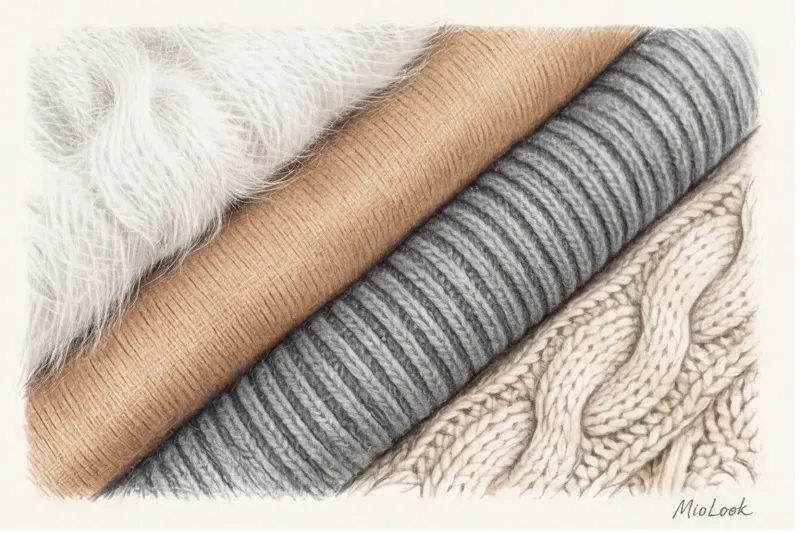
Many people mistakenly chase the "100% wool" label, believing it to be an absolute sign of quality. I always discourage this illusion when it comes to mass-market products. Pure wool made from inexpensive raw materials (using short fibers) quickly becomes covered in pilling in areas of friction, such as a crossbody bag or a car seat belt. We strive for the right balance: 70-80% wool and 20-30% polyamide. It is the polyamide (never cheap acrylic!) that acts as an invisible reinforcing frame, ensuring the coat's strength and maintaining its original shape.
Step 2: Mobility test and fit check
After putting the item on, perform a rigorous crash test. My favorite fitting room technique is the "self-hug" exercise. Button up your coat or jacket and firmly grasp your opposite shoulders with your arms. If the fabric at the back is so tight that the seams are bursting and the sleeves have ridden up to mid-forearm, the armholes are cut incorrectly and are too narrow. You simply won't be able to wear a thick cashmere sweater or jacket under this item. Be sure to check the shoulder seams: they should be completely flat, with no gathers or loose threads. The slightest asymmetry in the shoulder girdle will ruin the entire silhouette.
Step 3. Inspect the backside
Now let's look inside. The lining is the true identity of the product. Why does viscose always outperform polyester, even if the coat is quite expensive? Polyester is impermeable and creates a greenhouse effect: you'll sweat unbearably on the subway and instantly freeze when you step outside on a windy day. Viscose (or cupro in the premium segment) breathes, wicks away moisture, and glides comfortably over the layers underneath. Pay special attention to the quality of the lining in the sleeves—that's where it tends to tear first if the manufacturer has skimped on the material's density.
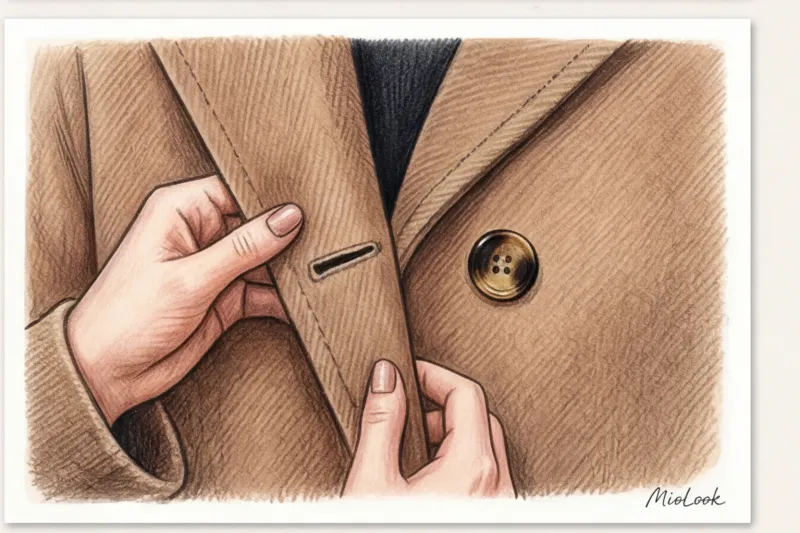
Step 4. Fittings as a status indicator
The final step in checking is the details. They are the ruthless giveaway of a cheap item. Shiny plastic buttons with jagged edges, flimsy snaps, or sticky metal zippers can ruin even the most refined cut. But here lies my main secret to smart shopping: if a coat fits perfectly, has the right composition and viscose lining, don't hesitate to take it to the checkout. Replacing cheap buttons with high-quality horn, tortoiseshell, or accent metal ones at your local tailor will cost you a maximum of 15-20 euros. This small investment will visually increase the value of a mass-market item several times over.
Your ideal image
it begins Here
Join thousands of users who look flawless every day with MioLook.
Get access — €0.99 onceTo conclude our detailed analysis of outerwear types, I want to give you one practical task for today. Open your closet and examine the tags on the jackets and coats you wear most often. You'll be surprised how many answers lie in these little labels—you'll immediately understand why one parka always feels hot, while another coat has lost its shape within a month. To conduct a proper inventory, weed out the unnecessary, and create an accurate shopping list for next season, digitize your best basics using inventory in MioLook Research items thoroughly, invest in smart cuts rather than fleeting trends, and remember: outerwear is your main calling card for the next six months. Choose it wisely.
Guide Chapters
Spencer: What is this jacket, its cut and style features?
Norfolk jacket: what it is, its features, and what to wear it with
What is a trench coat: its distinctive features and what to wear it with
What is a down jacket: types, materials, and combination rules
What is a bomber jacket: definition, types, and what to wear it with
Parka: What it is, its distinctive features, and what to wear it with
What is a leather jacket: history, features, and what to wear it with
What is a sheepskin coat: types and what to wear it with | Fashion Dictionary
Aviator jacket: what it is, its origins, and what to wear it with
Teddy coat: what it is, its features, and what to wear it with
Windbreaker: What it is, the main types, and what to wear with it
Quilted Jacket: What It Is, Types, and How to Wear It
What is a cape in clothing: types and rules of combination
Anorak: What it is, its distinctive features, and what to wear it with
Cocoon Coat: What It Is, History, and Style Rules
Duffle coat: what it is, the history of the coat, and what to wear it with
Poncho: What It Is, Types, and How to Wear It | Glossary
What is a pea coat: its cut and what to wear it with
What is a track jacket: definition, history, and what to wear it with
Macintosh: What is it, its history, and what to wear it with
What is a greatcoat: cut features and what to wear it with
The balloon silhouette in clothing: what it is and what to wear it with
Dust coat: what it is, its cut, and what to wear it with
Harrington Jacket: What It Is, Its Features, and What to Wear It With
Chesterfield coat: what it is and its style features
French manicure: what is it, its features, and what to wear it with
What Is a Crombie Coat: Meaning, Features, and How to Wear It
Learn about the history, distinctive tailoring, and modern styling of the classic British Crombie coat.