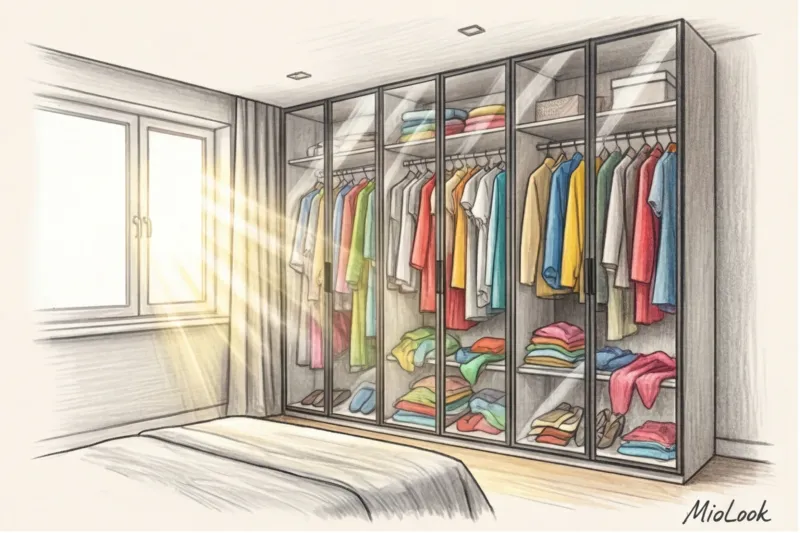
Planning a dressing room starts not with a tape measure, but with analysis
Have you ever noticed that most closets in interior design magazines look like sterile boutiques where no one truly lives? Over 12 years of working as a style coach, I've seen dozens of luxurious closets on which clients spent between €5,000 and €15,000, yet still complained every morning that "they don't fit," and the process of packing felt like a nerve-wracking quest. Remember the main rule: smart dressing room layout It doesn't start with calling a measurer with a laser tape measure, but with a ruthless analysis of your current wardrobe and lifestyle.
The biggest mistake I see all the time is delegating closet interior design to cabinet makers. Why can't they plan your perfect closet? The answer lies in their responsibilities. Furniture designers think in terms of facade symmetry, the rigidity of MDF structures, and factory standards. They're completely unaware of your morning habits. They're unaware that you hate folding T-shirts in piles, preferring to hang them on thin hangers. They have no idea that your collection includes 40 pairs of sneakers and only one pair of high boots. The end result is a standard set of three identical hanging rods and deep shelves, which instantly turn into Bermuda triangles for your clothes.
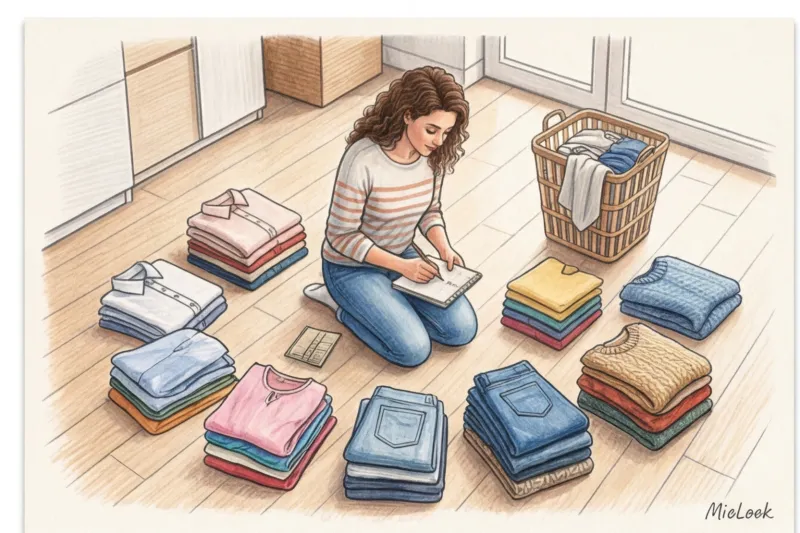
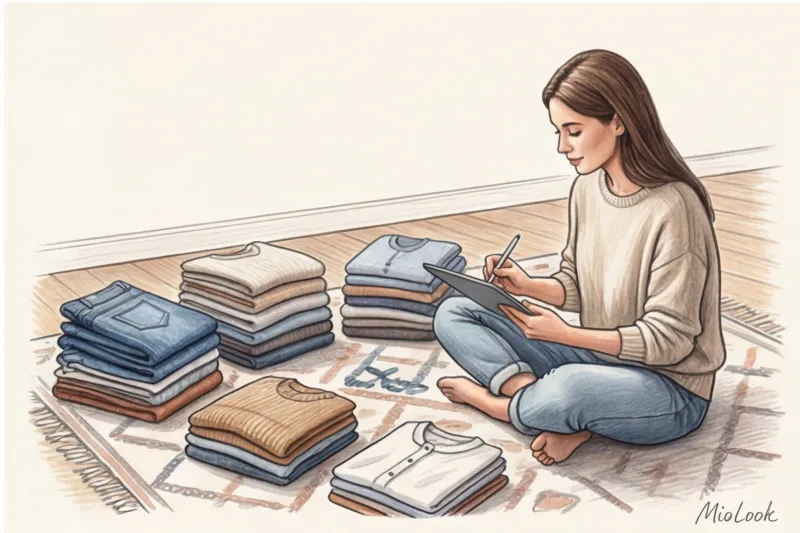
The first step to renovating and creating the perfect space is a complete digital inventory. Before you commission a project, you need to physically count your belongings. Literally grab a notebook and write down how many pairs of shoes you have, how many long, floor-length dresses you have, and how many chunky, chunky knit sweaters you have (by the way, if you have a lot of knitwear, be sure to study it). How to properly store knitwear (so it doesn't stretch out). Only if you know the exact dimensions and quantities of items in each category can you start drawing.
When I started tracking my looks, I realized I only had three long dresses, but they each had a one-meter-long hanging rod dedicated to them. Data saves square footage. A whole meter of wasted space that could have been used for convenient pull-out drawers for linens!
Today, the integration of physical space and smart wardrobe management apps has ceased to be the preserve of geeks and has become a basic necessity. Instead of rummaging through items manually or trying to remember how many shirts you own, savvy users are entrusting this task to technology. By digitizing their clothes through MioLook smart wardrobe , you get precise analytics: for example, 40% of your closet is taken up by bottoms, and outerwear makes up only 10%. You simply show these statistics to the architect. If you collect minimalist capsule wardrobe The app will clearly demonstrate that all you need is one 80 cm rod and a compact chest of drawers, rather than a built-in wardrobe that takes up the entire wall.
The 80/20 Rule in Space Organization
Now that you have the numbers in hand and you have gotten rid of all the unnecessary things (about that, How to get rid of unnecessary things without regret (I wrote about this in a separate guide), we move on to zoning. In ergonomics, Pareto's principle reigns supreme. A study of consumer habits in fashion retail, published by McKinsey (2024), confirmed what I see every day during wardrobe reviews: we wear only 20% of our clothes 80% of the time.
Your primary design goal is to designate a "sweet spot" exclusively for this active 20%. The sweet spot is located between your waist and eye level (approximately 70-160 cm from the floor). This is your closet's prime time, its most valuable "airtime." It should absolutely not contain those sequined dresses you wear once a year to a corporate event or thermal underwear for winter sports. This area should be used only for those items you wear daily, whether getting ready for work or for routine errands that take just a few minutes.
The remaining 80% of clothing is strictly archived in hard-to-reach areas. Seasonal down jackets, complexly cut outfits, and special occasion items should be placed on the very top shelves in closed trunks or on lower shelves that are awkward to constantly tilt. The rationale for this optimization is simple: reaching for an item you only need once every three months isn't a big deal. But if you have to stand on your tiptoes or bend over every morning in a rush to reach a basic white T-shirt, the storage system is designed against you.
Ergonomics and gold standards: sizes you need to know by heart
Ernst Neufert's architectural handbook, "Construction Design," published back in 1936, remains the bible for professional designers. Why am I, a stylist, mentioning this rigorous construction tome? Because competent dressing room layout is based on the strict laws of physics and anthropometry. If you ignore these figures, even the most expensive custom cabinet made of Italian veneer will turn into a daily obstacle course.
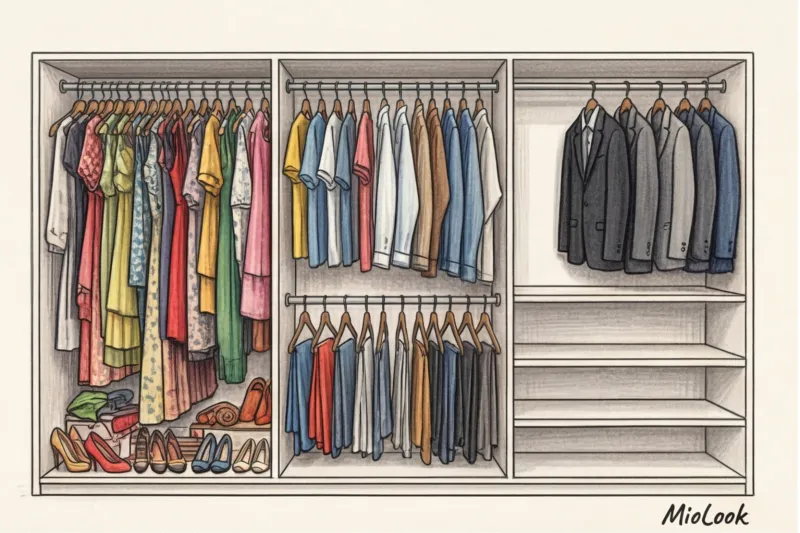
Let's start with the fundamental basics—the depth of the hanging sections. The gold standard for outerwear is exactly 60 cm. Hangers with bulky down jackets, winter coats, and men's blazers physically require this space. Any less, and the sleeves will constantly rub against the doors or bulge unattractively into the aisle. For lightweight clothing (silk blouses, summer dresses, thin cardigans), a depth of 55 cm is sufficient. These five centimeters of difference seem insignificant, but in a narrow space, they can make a significant difference in maintaining a comfortable aisle width.
The height of the hanging rods isn't something a furniture maker should just guess at. It's pure math, based on the length of your items:
- 150–170 cm: Maxi zone. This is where long evening dresses, trench coats, coats, and jumpsuits go. Lower the rod—hemlines will collect dust on the shelf underneath.
- 100–110 cm: Sections for shirts, blouses, skirts, and cropped jackets. This is enough to allow items to hang freely and without wrinkling.
- 80–90 cm: space for trousers, provided you store them draped over a hanger bar or use a pull-out trouser rack.
Let's move on to the most insidious design mistake—the vertical spacing between shelves. Clients often request taller shelves, naively believing that this will allow them to fit more clothes. But ergonomic standards are unforgiving: 35 cm is the ideal maximum for an open shelf.
Why exactly that much? It's all about the mechanics of fabric friction. A stack of 5-6 cotton T-shirts or sweaters is about 25-30 cm high. If the distance between the shelves is 45-50 cm, you'll inevitably be tempted to add a couple more items on top. And then physics comes into play: the center of gravity of a tall stack shifts. When you try to pull out the bottom T-shirt, friction drags the top layers down with it, and your perfectly stacked pile instantly collapses.
The domino effect in a closet is a direct consequence of improper proportions. You won't be able to maintain order if the shelf height encourages you to build half-meter-high towers of clothes. 35 centimeters limits the stack to a physically manageable volume.
Deep shelves are the graveyard of your wardrobe.
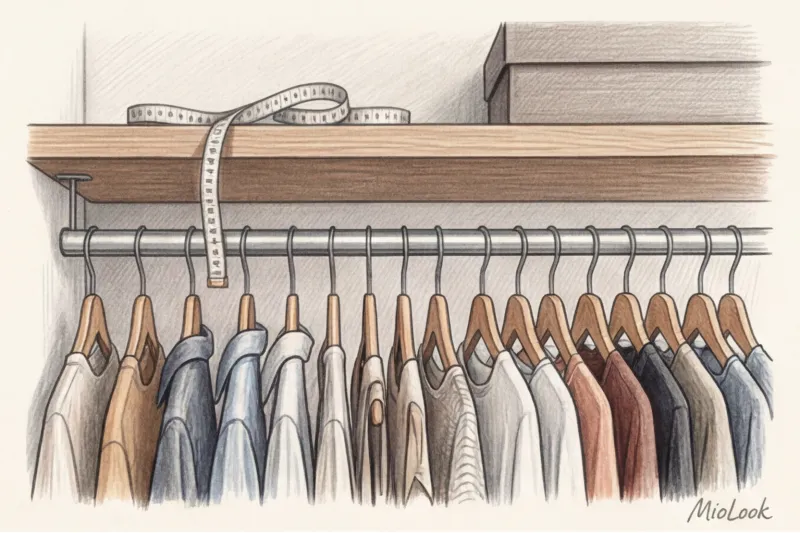
Let's bust one of the most persistent myths in interior design: deep shelves (60 cm and deeper) supposedly provide maximum storage. As a practicing stylist, I can officially declare: a 60-centimeter-deep shelf is a black hole that swallows up your things and your money.
The problem lies in the inevitable second row. At this depth, sweaters and jeans line up in two columns. You see the front one and wear it regularly, but the back one becomes a blind spot. The basic rule of a capsule wardrobe is: a thing hidden from view is physically excluded from your style You forget about your favorite cashmere sweater simply because it's hidden behind a stack of hoodies. So, you end up going to the store and buying duplicates of things you already own.
What's the solution? If the room's architecture dictates a niche depth greater than 40 cm, categorically avoid fixed shelves. They should be replaced with full-extension drawers. Yes, high-quality concealed metal drawers will increase the budget (good mechanisms cost between €50 and €120 per set). But it's an investment that pays for itself every day.
By pulling out a drawer, you can see your clothes from top to bottom—so-called vertical storage allows you to see every item of clothing at a glance. No more getting lost in the darkness of the second row of clothes. If you're already stuck in a deep closet from a developer and renovations aren't on the horizon, here's a budget-friendly life hack: use rigid fabric trunks 50-60 cm deep. They'll work like a drawer—pull out the entire box, grab the item you need, and push it back in.
Tired of forgetting what's on the back shelves?
Digitize your wardrobe. MioLook, the smart AI stylist, will help you create a virtual catalog of your items, so you always know what to put together an outfit—even if it's hidden deep in your closet.
Get access — €0.99 onceTypes of dressing room layouts depending on the area
The most frustrating thing about designing storage systems is spending your budget on a separate room only to discover it's inconvenient to use. Planning a walk-in closet is a rigorous mathematical problem, where the geometry of the walls dictates the rules. The choice of configuration directly depends on the width of the room, and trying to squeeze the desired format into inappropriate dimensions is guaranteed to lead to failure.
Industry standards for residential interior design (specifically, the NKBA—National Kitchen and Bath Association, whose guidelines also apply to walk-in closets) identify four basic scenarios.
Linear layout A linear system is considered the ideal solution for wide alcoves, long bedrooms, or spacious hallways. In this case, the entire storage system is arranged along a single blank wall. It's essentially a large built-in closet, but without fronts (or hidden behind a single sliding partition). The main advantage of a linear system is complete visual control. Open the doors or step into the alcove, and your entire wardrobe is immediately visible. For this system to be functional, the depth of the unit should be approximately 60 cm, with at least 70 cm of clear space in front of it, allowing you to comfortably pull out drawers and reach the lower shoe shelf.
Corner (L-shaped) layout — this is the most popular solution for small square rooms or partitioned corners in the bedroom. However, this is where the biggest headache for any designer lies: how to properly utilize a "blind" corner. Simply joining two rows of shelves together creates a dead zone that's impossible to reach.
There are two professional ways to solve the problem of a blind corner:
- Overlapping rods. The most cost-effective and practical solution. One clothes rod extends all the way to the wall, and the perpendicular rod rests against the first. We hang out-of-season clothes (for example, winter down jackets in the summer) on the deep rod in the far corner. It's hard to reach every day, but it's the perfect spot for passive storage.
- Rotating elements (carousels). At recent trade shows in Europe, I witnessed a real boom in 360-degree corner rotating mechanisms. They transform a dead corner into a rotating display case for shoes or bags. Yes, such a mechanism will add an average of €250–€400 to the project's cost, but it pays off with stunning ergonomics and instant access to every item.
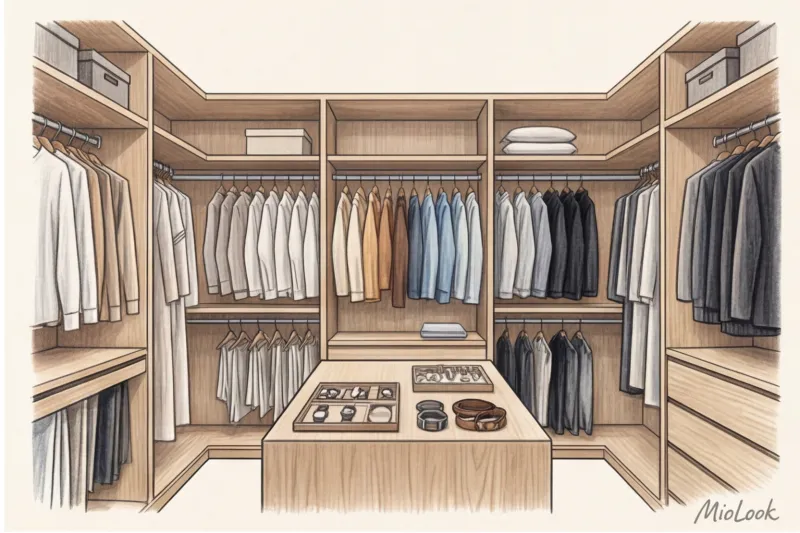
U-shaped and parallel layouts Considered the pinnacle of premium storage, they offer maximum capacity and allow for visual separation of the wardrobe into men's and women's halves. However, they have strict aisle width requirements.
For a parallel or U-shaped wardrobe to be comfortable, the distance between rows of clothes should be at least 80–100 cm. The ideal standard for comfortable fitting is 120 cm of free space in the center.
One of my clients, the director of a fintech startup, commissioned a luxurious U-shaped unit in a long room just 1.6 meters wide. The contractors completed the order without complaint. Ultimately, we encountered a classic and very painful mistake: a narrow "pencil case." After installing the sections (60 cm deep on each side), only 40 centimeters remained for circulation. In such a space, it's impossible not only to place a pouf but even to simply step away from a full-length mirror to assess the proportions of the room. To visually create a silhouette, we need distance. We had to remove one row of expensive units, transforming the room into an L-shaped one, so the client could properly get dressed in the morning.
Micro-dressing rooms (up to 3 sq. m.): how to get the most out of them
Many people believe that allocating a tiny storage room of 2-3 square meters for clothes is pointless - they say it’s better to install a regular wardrobe. As a stylist who specializes in optimization, I strongly disagree. A micro-dressing room can be incredibly functional if designed like a cockpit, where every cubic centimeter is utilized.
The first rule of micro-spaces: We use vertical storage up to the ceiling using pantographs (Furniture lifts). If the ceiling height is 2.7 meters or higher, the top 60–80 cm are usually empty or filled with shapeless bags. A pantograph allows you to lower the top rod with blouses or shirts directly into your hands, doubling the useful hanging area.
The second iron rule: complete rejection of massive chipboard bodies A standard chipboard wall is 1.6–1.8 cm thick. In a small room, multiple vertical partitions eat up precious space, block light, and create a feeling of oppression. Replace them with lightweight, hanging mesh or aluminum systems. They are attached to a single support rail, visually float, and provide excellent ventilation. A high-quality mesh system for a 3 square meter space will cost approximately €300–600, and its geometry can be customized as you update your wardrobe.
Finally, the key strategy for a tiny closet isn't squeezing hangers, but rather managing your items wisely. The role of a capsule wardrobe in optimizing a small space cannot be overstated. If you put together a well-thought-out capsule wardrobe of 35–40 items and digitize it using an app, MioLook , you'll have access to hundreds of stylish combinations even in just 2 square meters. The program will automatically suggest ready-made looks from what's already hanging in front of you, eliminating the need to store mountains of duplicate items "just in case."
Space zoning: three-level storage system
Do you know why even the most expensive closet layout sometimes fails to save you from the morning panic of "I have nothing to wear"? The problem lies in cognitive overload. When we stare at a solid wall of clothes, our brains encounter a phenomenon psychologists call the paradox of choice: the abundance of options paralyzes decision-making. To ensure the outfit-choosing process takes the promised five minutes, the physical space must be strictly divided into functional and logical blocks.
Upper, middle and lower tiers: distribution rules
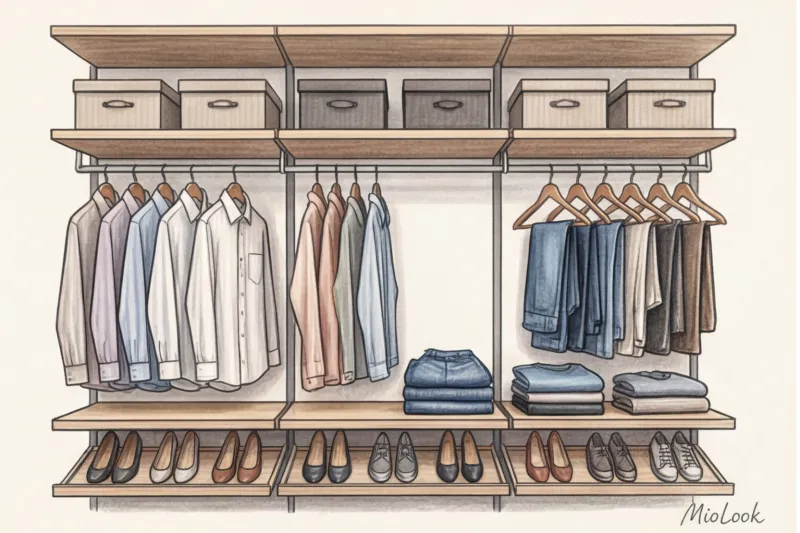
Any smart layout is based on simple human anatomy. Without taking your height and comfortable reach into account, your walk-in closet will become an obstacle course. Divide your room's height into three functional "floors."
- Mezzanine (above 190 cm): This is a dead zone for daily use, but an ideal base for long-term storage. Suitcases and seasonal clothes go here. The main rule for the top tier: no unmarked cardboard boxes or thick black bags. Use only fabric trunks with clear windows or clearly labeled items. Pro tip: Don't vacuum pack wool or cashmere. Natural fibers need to breathe. Investing in high-quality sweaters made of dense spunbond will cost around €25–€40 per set, but it will protect expensive sweaters from wrinkling and losing their shape.
- Golden zone (60–190 cm): Your active wardrobe. Eye and arm's length are your closet's most valuable "airtime." Only your most relevant, everyday clothes should be kept here. Accessories, sunglasses, and your favorite perfume should be positioned strictly at eye level (usually a shelf at 150–160 cm) so that the finishing touches of your look can be applied intuitively, without bending or stretching.
- Lower tier (below 60 cm): This is the area for heavy items and shoes. We integrate laundry baskets here, place heavy tote bags here (so they don't deform the lighter shelves above), and organize shoe storage. Slanted shelves (at an angle of 15-20 degrees) with a small edge or pull-out units work best for shoes. Why slanted? On a straight, fixed shelf right at the floor, you'll never see what's in the second row.
So, we've organized our items vertically. But how exactly should we organize our clothes within the most important, golden zone? This is where the battle of concepts begins: storing by category versus storing by ready-made looks.
When I first started working as a style coach, I often succumbed to the temptation to arrange my clients' closets according to a color wheel. Here's a professional life hack: while a gradient color-coded closet looks stunning in photos, organizing them by category or pre-made capsules makes morning preparations three times faster.
Let's look at both working strategies so you can choose the one that best suits your thinking style.
The principle of "like to like" (storage by category)
This is a classic approach where pants hang with pants, jackets with jackets, and blouses with blouses. This method is ideal for those who like to create their look from scratch every day. You can clearly see your measurements: for example, it's immediately noticeable if you have five white T-shirts but not a single basic long-sleeve top.
The "ready-made images" strategy and capsule storage
Instead of sorting by item type, you group clothes by lifestyle. You dedicate one meter of the clothes rail to an "office capsule," another to a "weekend out of town" section. Inside the capsule, you can hang items in complete sets: a jacket over matching trousers, and the perfect top next to it.
For example, if you're interviewing at an IT company with a casual dress code, you don't need to scan the selection of formal evening dresses or sporty joggers. Instead, you focus on a specific section of the wardrobe, where relaxed blazers, high-quality knitwear, and basic straight-leg jeans are already gathered. Your focus narrows, and the choice becomes clear.
Access to MioLook for €0.99 — one-time payment
Start creating perfect images with the help of artificial intelligence
Get access — €0.99 onceIf physically hanging clothes and forming capsules on a rod is too much of a hassle for you, transfer this task to digital. smart wardrobe feature in the MioLook app , you can keep your closet organized by category and curate your ready-made looks and capsule collections on your smartphone screen. Simply open the app in the morning, choose a pre-saved look, and know exactly what items you need to reach for.
Technical equipment for a dressing room: light, air and protection of things
Open the door to any closet, and eight times out of ten you'll smell a faint, barely perceptible scent of dust. Often, closet planning is reduced to mere beautiful drawings of shelves and cabinets, but we forget the most important thing: clothing is an organic material that vitally needs to breathe. Without proper engineering, even the most expensive closet becomes a death trap for your belongings.
Why does this notorious smell occur? The answer lies in the simple lack of ventilation. Fabrics constantly shed microfibers (especially wool, cotton, and linen). In a closed space without air circulation, this dust settles on shelves, clings to knitwear, and creates an ideal environment for dust mites. To prevent this, an exhaust duct should be installed during the rough-in stage, and a ventilation grill or undercut in the closet door should be installed to allow fresh air to enter.
According to the Textile Care Institute, an improper microclimate destroys cashmere and genuine leather fibers in just 2–3 seasons. Temperature fluctuations and lack of ventilation reduce the lifespan of garments by half.
Humidity is the second invisible enemy of your style. In winter, radiators dehydrate the air to a critical 20%. Under these conditions, expensive leather bags and shoes (especially those priced between €300 and €500 and above) lose their elasticity, dry out, and develop microcracks. The opposite situation—excessive humidity—promotes mold growth on the backs of closets and attracts moths. The solution: maintain a stable humidity level of 45–55% and use cedar blocks (rather than toxic mothballs) to protect woolen items.
My personal life hack: to remember about seasonal care for demanding materials, I use MioLook You can add storage instructions directly to the item card and set reminders—for example, when to treat leather jackets with moisturizing balm or refill the mothballs on the shelves.
Lighting: The End of the Yellow Bulb Era
How many times have you stepped out into the daylight and discovered, to your horror, that you were wearing a navy blue jumper with black trousers, even though at home they seemed like the perfect pair? Warm light with a yellow undertone turns morning fittings into a real lottery.
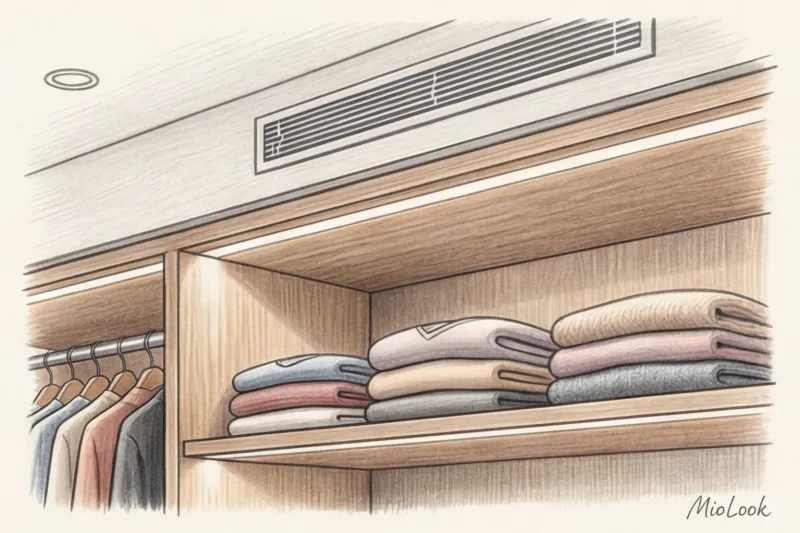
A strict avoidance of warm incandescent bulbs is a golden rule for stylists. To ensure you can see the true shades of fabrics, technical lighting must meet two strict parameters:
- Light temperature: Exactly around 4000K (Kelvin). This is the so-called neutral white light, as close as possible to natural daylight on a clear day.
- Color rendering index (CRI): Choose LED strips or spotlights with a CRI > 90 (ideally 95+). Only this kind of light allows the eye to perceive the finest nuances: the difference between bottle green and emerald, or graphite and black.
Another important technical detail: the light source should be positioned between you and your clothes, or integrated into the shelves themselves (in aluminum profiles with matte diffusers). If the light hangs directly above your head, it will cast harsh shadows on your clothes, plunging the lower tier of your wardrobe into complete darkness.
Accessories and organizers: where to save and where to invest
When clients show me rough estimates from furniture manufacturers, I usually ruthlessly cross out half of the items. Walk-in closet layout At the design stage, things often become overloaded with completely unnecessary but incredibly expensive mechanisms, while people try to save on truly essential basic things. Let's prioritize so your budget works for your comfort.
Let's start with the basics. A must-have is high-quality concealed drawer slides. This is absolutely not an expense where you should look for cheap alternatives. The difference between reliable European hardware (in the range of €40–€80 per set) and budget options is palpable every morning when you open a heavy drawer lined with thick knitwear, either with irritation or, conversely, with perfect glide.
The next essential investment is pull-out trouser hangers. They prevent creases in the hands and provide instant visual access to all your pairs. And for small items, I highly recommend planning built-in velvet trays for jewelry and watches. The soft padding carefully protects the metal from micro-scratches, and the clear sectional organization eliminates the problem of tangled chains forever.

But where real, often underestimated, potential for optimization lies is in the hanging area. Mismatched hangers—heavy wooden ones from the mass market, flimsy wire ones, thick plastic ones with brand logos—create colossal visual noise. Our brain automatically interprets this chaos as clutter, even if the clothes themselves are ironed and hanging straight. Replacing all hangers with identical, thin ones (velour or simple wooden) visually enlarges a walk-in closet by 20%. And this isn't just an optical illusion: replacing 50 plastic hangers from the dry cleaner with thin velour ones freed up 15 cm of length on my client's clothes rail. Imagine how much extra space you could gain across the entire room!
Now, about the items that are frankly overpriced and a drain on your budget. Top of the list are complicated built-in ironing boards. Convertible mechanisms costing €200–€400 are often wobbly, difficult to position in a narrow aisle, and their covers wear out quickly, ruining the aesthetics of the space. A good handheld steamer will solve the problem of getting your clothes ready for the day much faster.
The second disappointment from the fancy catalogs is the expensive tie and belt mechanisms. Bulky pull-out designs take up precious space, and in practice, returning the belt to the complex, narrow grooves is simply a pain. Trust me: simple, stylish hooks attached to the inside of the cabinet door or a free side wall work much better and cost a couple of euros.
Once the right hardware is selected and visual clutter is eliminated, maintaining order becomes a breeze. Matching hangers and clear display trays perfectly prepare the closet for digitization. All that's left to do is take a few photos in good light and upload them to MioLook so that the smart algorithm can suggest exactly which belt or pendant from your updated wardrobe will perfectly complete your look for today.
Your ideal image
it begins Here
Join thousands of users who look flawless every day with MioLook.
Get access — €0.99 onceMerging offline and online: smart closet planning
We're used to syncing work calendars with the cloud and managing our homes via smartphone, yet most people's closets remain relics of the last century. A progressive closet layout today isn't just about precise ergonomics; it's about creating a hybrid environment where physical items are easily managed through modern digital tools.
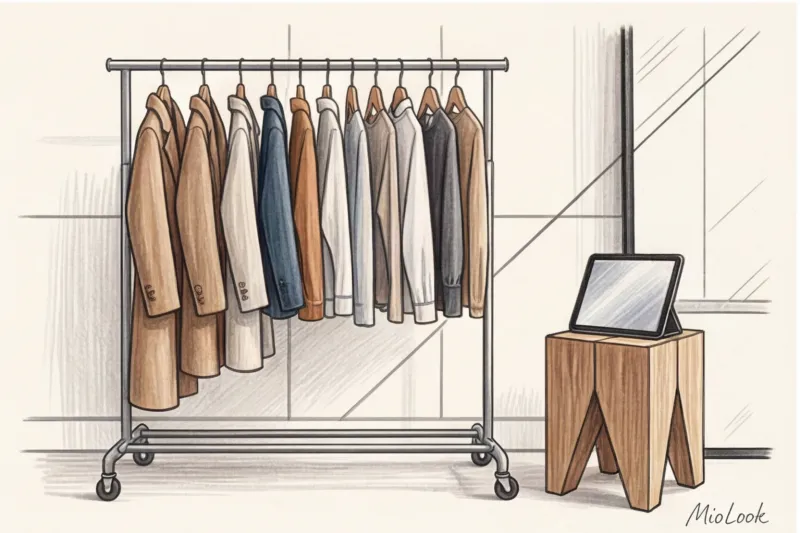
The first thing I always incorporate into my clients' projects is a dedicated "style station." This isn't just a full-length mirror in the corner, but a well-designed, technologically advanced fitting area. You'll need a directional front light and a fixed phone holder mounted directly to the wall or mirror frame at chest level. Installing such a bracket costs a mere €30-50, but it dramatically changes your approach to your image. Having a convenient vantage point for high-quality selfies of your looks allows you to objectively evaluate proportions from a distance and develop a personal visual base of successful combinations.
The second innovation solves the problem of the most difficult area—the mezzanine. Blind boxes under the ceiling are the classic "black hole" of any closet. A client of mine, a top manager at an IT company, once spent about €200 on luxurious, minimalist trunks for the upper tiers, but she kept forgetting which one held her ski accessories and which one held her vintage bags. The solution is simple: label the boxes on the upper tiers with QR codes. You simply stick a micro-sticker on the front of the box and link it to a digital catalog in MioLook Now, to find the item you need, you don't need to drag a stepladder and rummage through dusty lids—just point the camera, and the app will show you everything inside the box.
Digitizing your routine reduces your cognitive load in the morning by almost threefold. You make decisions about your appearance in the evening, looking at a screen, rather than standing in a panic in front of open doors.
The third essential element of a smart space is planning a pull-out valet rod or a separate open niche for "tomorrow's look." This is your physical embodiment of digital planning. In the evening, you create a capsule wardrobe. MioLook app , checking your schedule and weather forecast, and then hang your chosen outfit on this rod. Your chosen accessories also go here, on a special hook. This simple combination of the app and the right furniture hardware is guaranteed to save you up to 20 minutes of sleep in the morning.
This approach transforms the very philosophy of clothing storage. You stop relying on visual memory and start using precise data. A smart wardrobe becomes a fully-fledged assistant, suggesting the right combinations and turning daily dressing into a predictable, calm ritual.
Checklist: 10 Steps to Creating the Perfect Wardrobe
One of the architects with whom we regularly design luxury homes once told me, "A walk-in closet without a filling plan is just a very expensive warehouse." And he's absolutely right. Many of my clients admit that the final stage before ordering furniture leaves them paralyzed. The abundance of options for fittings, heights, and materials is daunting, and the fear of making a mistake is paralyzing.
To prevent a well-designed walk-in closet from turning into a chaotic mess of shelves, you need a strict roadmap. Over the years of working as a style coach, I've developed a strict sequence of actions. These aren't just tips—they're a step-by-step algorithm that must be followed strictly in order.
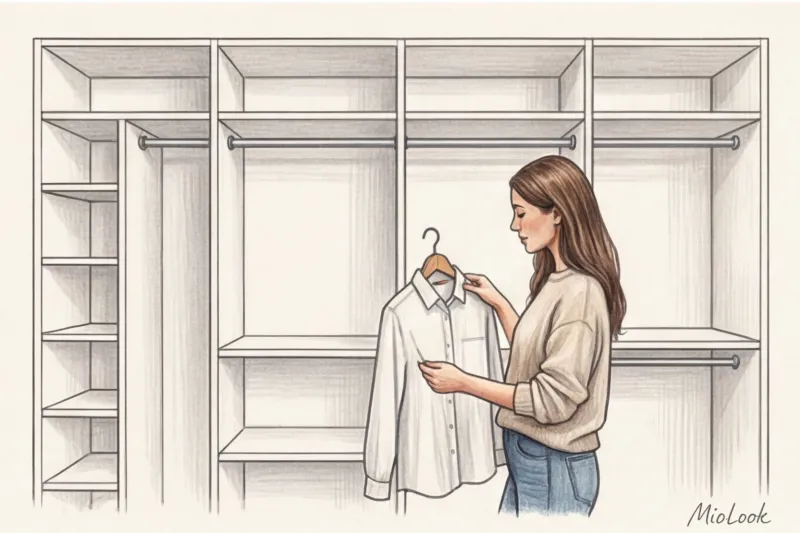
- Audit and ruthless filtering of things. Set aside a weekend and remove absolutely everything from your old closets. Sort them carefully: anything that hasn't been worn for a year, doesn't fit, or requires complex repairs goes to a resale or recycling center. You shouldn't have to pay for square footage to store your illusions.
- Digitization of the remaining wardrobe (counting units). You can't design a closet for abstract "clothes." Bring things into MioLook app This way, you'll be working with solid data: you have exactly 14 blouses, 5 long skirts, and 22 pairs of shoes. The numbers dictate the drawing, not the other way around.
- Measuring the longest and most voluminous items. Take a tape measure and measure your longest coat from collar to hem, the height of your tallest boots, and the dimensions of your suitcase. These measurements will serve as a starting point. There's nothing worse than having a dress end up on the closet floor because of a 5-centimeter error.
- Selecting a layout type based on the room's geometry. A narrow hallway, 1.5 meters wide, requires a linear layout along one wall. A niche at least 2 meters wide allows for a U-shaped design. Focus solely on structural ergonomics, leaving at least 80 cm for clear passage.
- Design of ventilation and sockets at the rough work stage. This should be done before plastering and finishing! Be sure to install outlets for supply and exhaust ventilation (to prevent clothes from smelling musty) and power outlets for a steamer, a robot vacuum cleaner base, or a phone charger in the fitting area.
- Calculation of rods (at least 60% of the space should be on hangers). Furniture manufacturers love to design endless rows of shelves—it's easier and cheaper to assemble. But I insist: devote maximum space to hanging rods. Clothes on hangers are best displayed, don't require ironing before going out, and create a clear picture of your style.
- Replacing deep shelves with pull-out drawers. Eliminate "blind spots." Fixed shelves deeper than 40 cm are only suitable for storing out-of-season sweaters in trunks or suitcases on the mezzanine. For underwear, T-shirts, and knitwear, use only full-extension drawers.
- Setting neutral bright light (4000K). Avoid cozy, warm lighting, which distorts colors. To accurately assess shades and select makeup, a temperature of around 4000K and a high color rendering index (CRI > 90) are required. The light should fall on you and your clothes, not shine directly on the top of your head.
- Purchasing identical organizers and hangers. Visual noise can kill even the most expensive design. Investing in 100 identical thin velour hangers (costing approximately €40–€50 per set) will not only transform your closet aesthetically but also save up to 20% of your hanging space.
- Synchronization of a physical cabinet with a digital catalog. Once the furniture is installed and the items are hung, complete the process: link physical storage areas to digital categories. A smart closet is a symbiosis of organized shelves and analytics on your smartphone.
"Organizing your wardrobe is a finite project with a never-ending outcome. You spend two weeks planning, only to save 15 minutes of stress getting ready each morning."
The ideal storage space is a living machine. It will evolve slightly with your lifestyle and trends. But if you've laid the right foundation of math, ergonomics, and digital accounting, you'll never again stand in front of open doors thinking, "I have nothing to wear." You simply walk to your closet, grab a ready-made outfit, and go conquer the day.
Guide Chapters
A dressing room island: who needs it and what size to choose
A classic walk-in closet island looks like a Pinterest dream, but it often steals up to 30% of the space. We'll explore the ergonomics of a central island.
Walk-in closet for two: how to divide the space
Why is a symmetrical closet the biggest mistake couples make? Learn how to intelligently divide your closet space to keep your belongings organized and your family peaceful.
Dressing room mirror: where to hang it for perfect fittings
A dressing room mirror isn't just a decorative element; it's your most important style tool. Learn how to avoid mistakes in its placement to always look impeccable.
Wardrobe Doors: How to Choose the Perfect Facade
Furniture blogs evaluate closet fronts for space-saving reasons, and we'll take a look through the eyes of a stylist. Find out which doors will protect your belongings and save you time in the morning.
U-Shaped Wardrobe: How to Avoid Design Mistakes
Find out why the classic U-shaped layout often becomes a trap for beginners. We'll explore common mistakes and secrets for perfect storage.
Storing Bags in the Closet: How to Avoid Ruining Accessories
Improper storage can permanently ruin an expensive bag. We'll explore common mistakes and learn how to store accessories according to materials science principles.
Storing Out-of-Season Items: How to Avoid Ruining Your Clothes
A mezzanine isn't a warehouse, it's your personal boutique waiting to be opened. We'll show you how to organize your upper shelves so your expensive fabrics don't get ruined.
Corner Closet Layout: Secrets of Smart Storage
Why do standard corner cabinets become a "Bermuda Triangle" for storage? We explore common mistakes and share space-organizing secrets.
Wardrobe Ventilation: How to Avoid Mustiness
A lack of ventilation can ruin even the most expensive clothing collection. We'll explain how to properly organize ventilation in a windowless dressing room.
Bedroom dressing room: zoning and layout
Planning a storage system? Find out why Pinterest images often don't work in real life and how to create a truly functional closet.
Walk-in Closet Lighting: Stylist Tips
Lighting in a dressing room isn't just decoration, it's a working tool. Learn how to choose the right lighting to avoid choosing the wrong shades for your clothes.
Ideal shoe storage in the closet: stylist tips
How to design shelves to fit actual shoes, not just to fit furniture? We'll share a stylist's professional tips for organizing a shoe closet.
Digitizing Your Wardrobe: Preparing Your Closet for MioLook
Digitizing your wardrobe isn't just a photo of your items; it's a thorough physical inventory. Learn how to properly organize your closet so your virtual capsule wardrobe works for you.
Wardrobe storage systems: mesh, modules, chipboard
Massive custom-made wardrobes often become a trap for a changing wardrobe. We explore which solutions best suit your lifestyle.
Converting a Closet into a Closet: Organizing Without Mistakes
Transform a cramped utility room into a functional storage system. Find out why standard cabinets aren't suitable for small spaces and where to start with a storage audit.
Wardrobe room layout: diagram and dimensions
How can poor closet ergonomics ruin your treasured items? We explore the ideal shelf and rod sizes to extend the life of your clothes and speed up packing.