Why a dressing room mirror is an analytical tool, not a decorative one
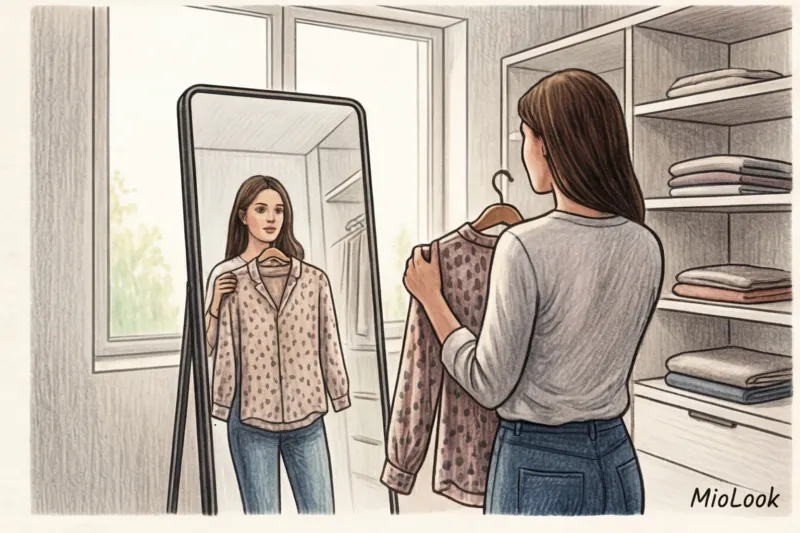
Do you know why one of my clients almost threw away three perfectly fitting COS sheath dresses? Because every time she wore them in her new €12,000 walk-in closet, she felt two sizes too big and five centimeters too short. The problem wasn't her diet or the cut of the clothes. The problem was how and where the builders hung them. mirror in the dressing room.
Planning storage space is always a matter of data and ergonomics. We covered this in more detail in our The complete guide to the perfect walk-in closet layout But today I want to focus on an element that many perceive solely as decorative. This is a huge mistake.
A mirror is your primary analytical tool. It's the final step in your daily style check before leaving the house. If it distorts your proportions, you start sabotaging your own style: you reject successful layered looks, discard great pants, and end up wearing "safe" (and boring) jeans and a hoodie. When I started tracking my outfits, I noticed something striking: I disliked the looks I put together in front of a narrow mirror in my closet, while the same items worn in front of a large mirror in my spacious hallway garnered compliments. The only difference was distance and lighting.
The main mistake: the "corridor" effect and optical illusions
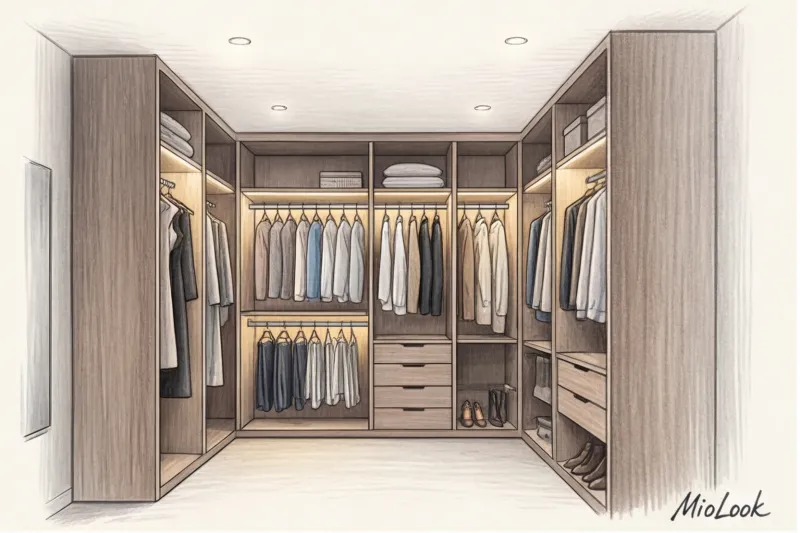
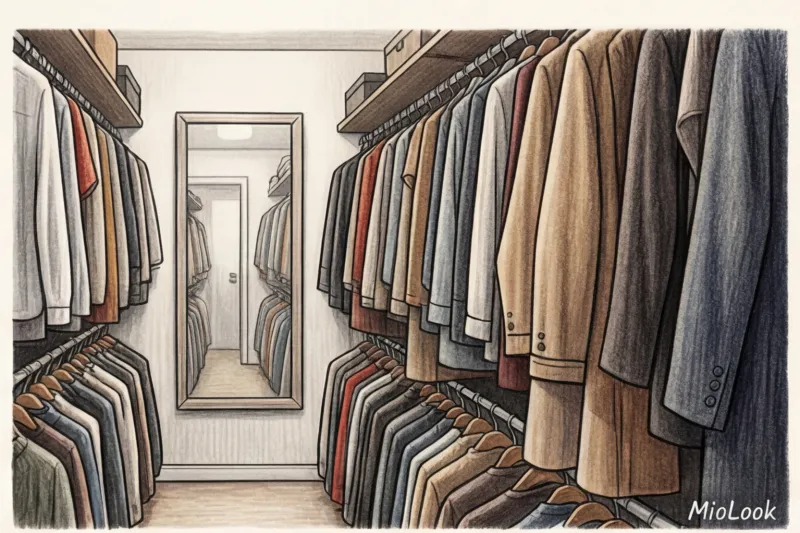
Let's bust one of the most popular interior design myths. If you have a narrow, elongated walk-in closet (a so-called U-shaped or parallel layout), the worst thing you can do is hang a mirror at the very end of this "hallway."
Why do designers do this? Because it makes sense from the perspective of filling a blank wall. Why are stylists horrified by it? Because of the physics of optics. According to ergonomic standards, established in the classic reference book by architect Ernst Neufert (Neufert Architects' Data), a minimum distance of 150 to 200 centimeters is required to adequately assess the full-length human figure without distortion.
"If you stand closer than 1.5 meters to a mirror and try to examine shoes, your gaze falls at an acute angle. This creates a fisheye effect: your legs appear shorter, and your hips appear wider than they actually are."
In a narrow corridor between rows of clothes, you physically can't take a step back. As a result, every morning you receive distorted feedback about your body. The psychological factor here is colossal: a distorted reflection directly affects your self-confidence. When choosing a mirror for your dressing room, you're choosing not the glass, but the mood with which you'll leave the house.
Access to MioLook for €0.99 — one-time payment
A smart AI stylist will select the perfect look based on your real wardrobe.
Get access — €0.99 onceWhere to Place a Mirror in a Dressing Room: 4 Ergonomic Scenarios
So, if a narrow room's end wall is a bad idea, where should it be placed? The choice depends on the room's geometry and your budget. Over 12 years of practice, I've identified four effective scenarios that save both proportions and stress.
Scenario 1: Free wall with escape zone
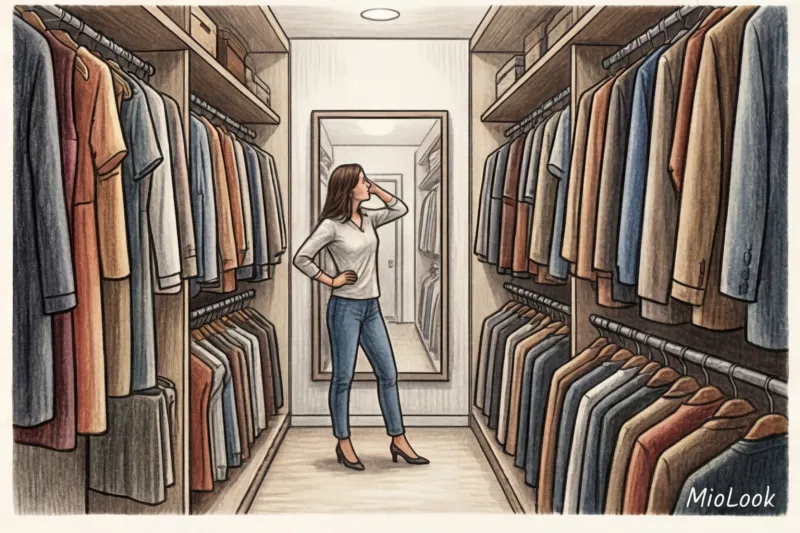
An ideal option for spacious U-shaped and L-shaped walk-in closets, you dedicate one wall exclusively to the mirror, leaving at least 1.5 meters of clear space in front of it.
The "clear background" rule is crucial here. Pay attention to what's reflected behind you when you look in the mirror. If there are colorful, open hangers filled with mismatched clothing, your silhouette will be lost in the visual noise. Assessing a complex, layered look against a rack of colorful shirts is an impossible task. Ideally, the reflection behind you should be of closed, solid-colored closet fronts.
Scenario 2: Mirrored Cabinet Fronts (Pros and Cons)
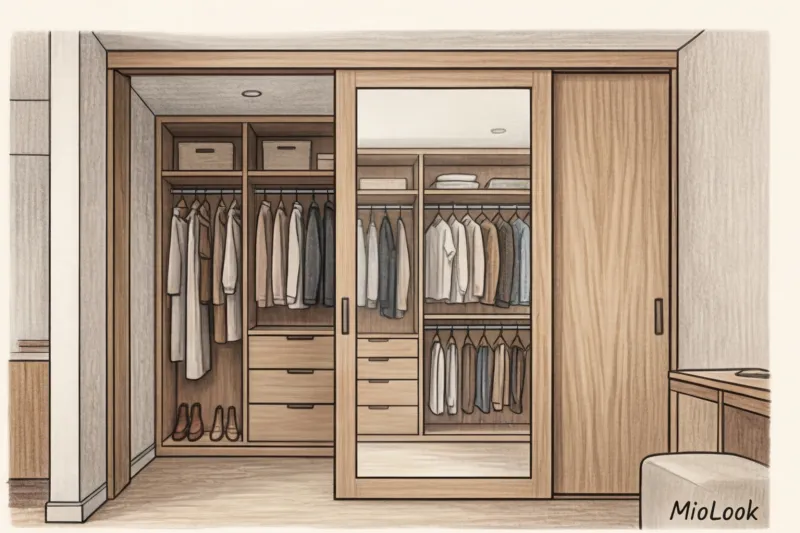
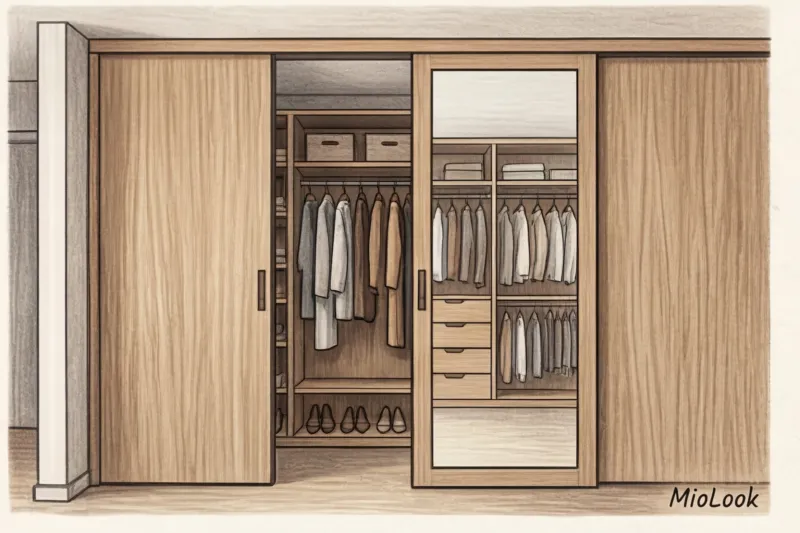
A great space-saving solution, mirrored doors visually double the space and solve the problem of finding a free wall.
But this method has its limitations. It doesn't work if the width of one panel is less than 50 centimeters. Narrow mirror strips fragment the silhouette: you'll see yourself in parts, which interferes with the overall image. Also, be honest with yourself: if you're annoyed by having to wipe fingerprints off the glass every two days, consider switching from handleless (push-to-open) doors to traditional hardware.
Scenario 3: Sliding and rotating mechanisms
A real lifesaver for micro-dressing rooms up to 3-4 square meters. The mirror is hidden in a narrow niche (usually 5-8 cm wide) between the sections containing clothes.
When you need to assess the image, you extend it on telescopic rails and rotate it 90 degrees toward the center of the room or toward the doorway—wherever there's that extra bit of space to step back. A high-quality swivel mechanism will cost between €150 and €300, but it's the best investment in the ergonomics of a small space.
Scenario 4: Floor-standing mobile mirror (psyche)
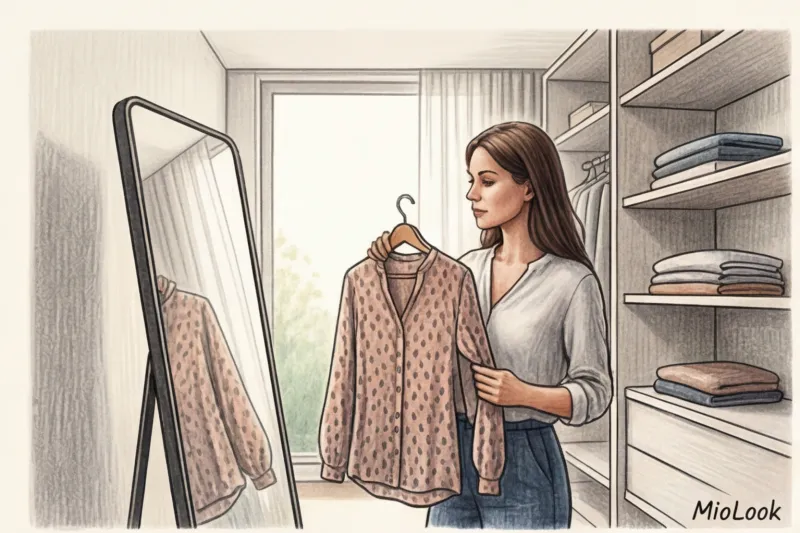
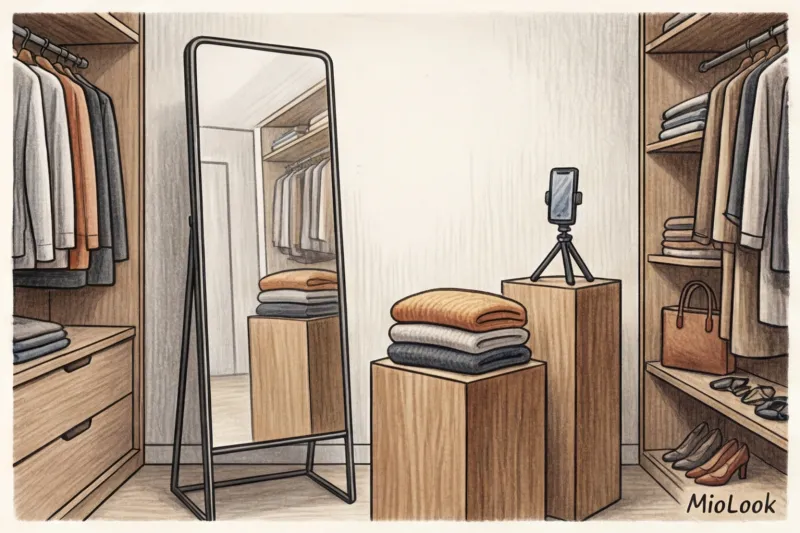
A classic framed mirror with adjustable tilt. The main advantage of a psyche mirror is that you can tilt it to perfectly view your shoes and trouser length without having to move two meters away.
However, this scenario is absolutely unsuitable for narrow spaces. The legs of such a mirror consume approximately 40-50 cm of floor space. This is a luxury that can only be afforded in rooms with a completely clear center.
Light is Everything: How Lighting Changes Your Reflection
Even the most expensive dressing room mirror becomes useless in poor lighting. The most common mistake made during renovations is installing powerful ceiling spotlights directly above the fitting area. Directed overhead lighting creates harsh shadows under the eyes (the "panda effect"), accentuates nasolabial folds, and highlights cellulite even where it isn't present.
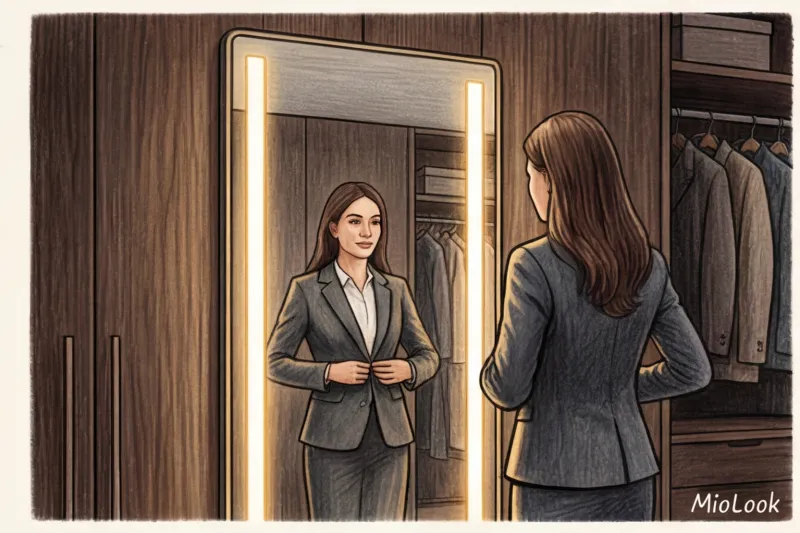
The secret to fitting rooms in luxury boutiques is frontal lighting. The light should fall on you from the front, evenly illuminating your figure from head to toe. This is achieved by using vertical LED profiles on either side of the mirror.
There are two technical parameters that you should personally check when purchasing lamps:
- Color rendering index (CRI): It must be strictly greater than 90 (CRI > 90). If the value is lower, the colors will be distorted.
- Color temperature: Choose bulbs in the 4000K–4500K range (neutral white light).
One time, a client of mine went to an important meeting wearing a dark blue jacket and black trousers, believing he was wearing a black suit. The warm light (2700K) in his dressing room simply ate up the difference between the dark blue and black. Proper lighting is a matter of your professional reputation.
Your perfect look starts here
Join thousands of users who look flawless every day with the help of a virtual fitting room.
Get access — €0.99 onceTechnological approach: mirror and virtual fitting room
A modern dressing room isn't just a storage area; it's your personal styling station. And the mirror area is ideal for digitizing your wardrobe. MioLook app.
To minimize the time spent loading items into the virtual fitting room, organize the space properly. A valet rod—a pull-out rod on which you can hang a hanger with a shirt and pants—is a must-have next to the mirror. After hanging the item, take a photo in good frontal light against a neutral background, and upload it to the app.
Why is this important? Because planning looks in an app is much faster than physically changing clothes in front of a mirror five times, trying to find the perfect combination. My personal stats: the combination of the app's AI recommendations and a final try-on in front of the right mirror saves up to 20 minutes every morning. You know what you'll wear in advance, and the mirror simply confirms your choice, rather than forcing you to start over.
Checklist: Testing the Fitting Area Before Repairs
Don't trust designers' pretty 3D visualizations. Before ordering furniture and drilling holes in the walls, conduct a physical test of the space. Here's a practical guide that will save you money:
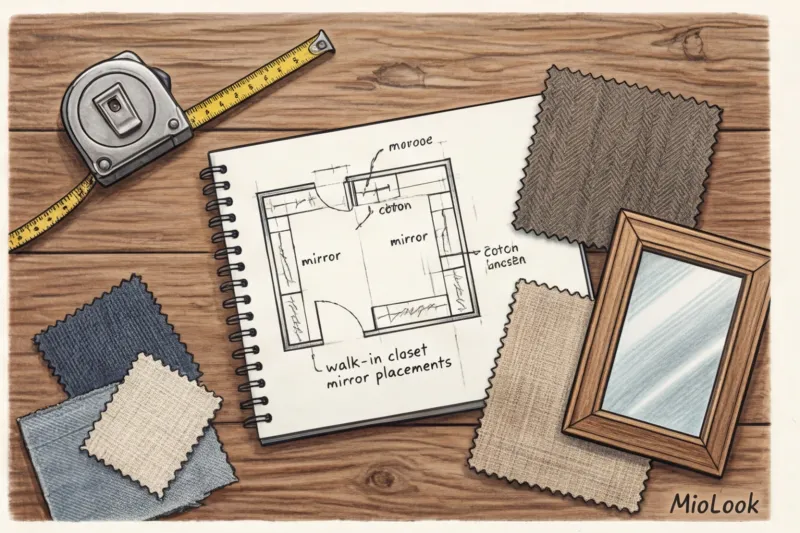
- Masking tape test. Tape the outline of your future mirror to the wall or cabinet door (the ideal size is 160 x 50 cm). Measure 1.5 meters perpendicular to it with a tape measure. Can you stand there? Is your back against the shelving?
- Lighting test. Stand at the fitting point. Turn on the flashlight on your phone and shine it on yourself from above (imitating a ceiling spotlight), and then from the front at chest level. Notice the difference in the shadows on your face and figure.
- Full growth test. Ask someone to hold a small mirror at the right height. Check the viewing angles: you should be able to see your shoes and hat at the same time without tilting your head.
- Background analysis. Stand with your back to the mirror. What do you see directly in front of you? If it's open shelves filled with colorful sweaters, the background will be "messy." Consider closed-off fronts in this area.
A dressing room mirror isn't the finishing touch of a renovation, but the starting point around which the entire ergonomics of the space should be built. Treat it like a precise measuring device. If you ensure the right distance, a neutral background, and high-quality frontal lighting, you'll stop doubting your looks and start wearing the 80% of your wardrobe that previously seemed "somehow off."