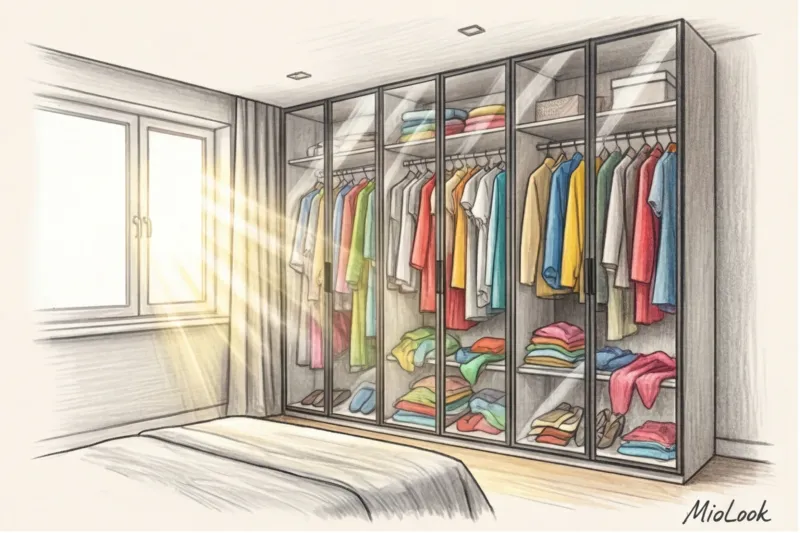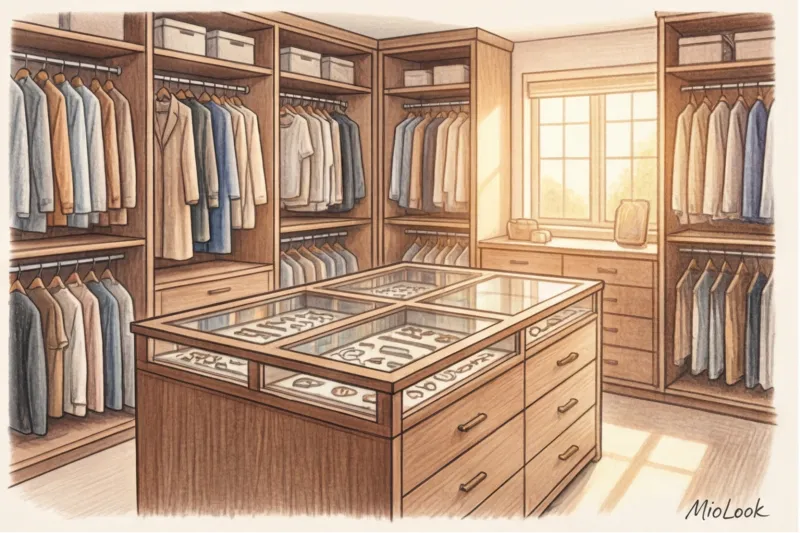
You open Pinterest, type in "dream closet," and there it is: a huge, luxurious island in the center of the room, covered in glass, beneath which gold watches and sunglasses are perfectly arranged. It looks like an expensive Italian boutique. Mesmerizing, right? But as a digital stylist and practitioner who has helped organize hundreds of closets, I'll tell you the hard truth. In 80% of average apartments, the classic island in the dressing room - This is a costly mistake that steals up to 30% of usable space.
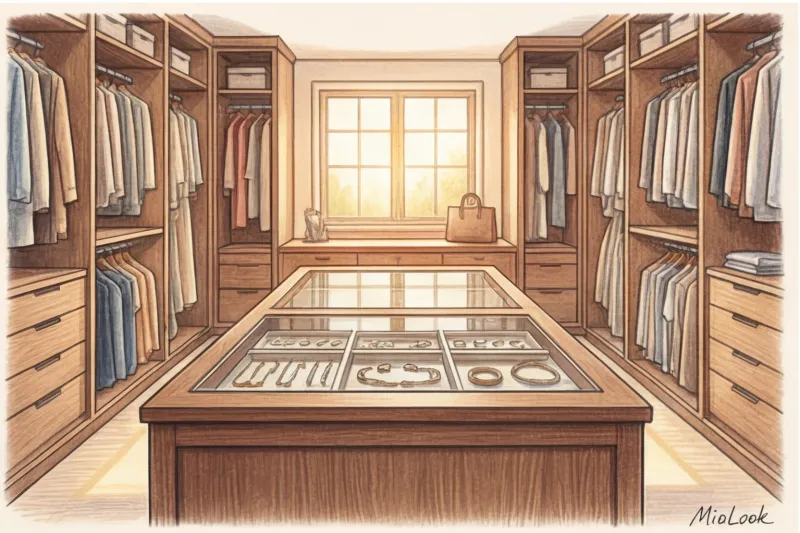
Instead of blindly copying the glossy aesthetic, I suggest viewing this element as a functional engineering unit—a unit with very strict requirements for ergonomics, dimensions, and your living habits. We've already discussed the general principles of zoning in more detail in our The complete guide to the perfect walk-in closet layout , and today let's arm ourselves with a tape measure and take apart only the central module.
The Illusion of Luxury: Who Really Needs a Closet Island?
One of my clients spent around €4,000 on a stunning island with walnut veneer fronts. Just six months later, she tearfully begged the cabinet makers to take it down. Why? The clearance between the island and the main cabinet was only 55 centimeters. She couldn't pull the lower drawers all the way out to reach her sweater without bumping her back against the opposite wall. Every morning began with irritation and bruises on her thighs.
The main rule, learned from bitter experience: you need an island, only If your dressing room is at least 14-15 square meters, you'll need to be careful. Any smaller space will turn into a cramped warehouse where you won't even be able to stretch your arms while changing.
The second problem is the psychological trap of "horizontal surfaces." Have you ever noticed how any empty countertop in your home magically attracts things? If you tend to throw your clothes on a chair at the end of a long workday, an island will exacerbate the problem tenfold. It will instantly become a mountain of "not-yet-dirty-but-not-clean" textiles.
Before ordering heavy furniture, I always ask clients to rely on data. Digitize your wardrobe in an app. MioLook And check your statistics. You might find that you only have enough space for one small tray of small accessories (which is what glass display cases are usually built for). And it's definitely not worth taking up two square meters of scarce floor space for a dozen belts.
Use Cases: 4 Tasks This Element Solves
If you have the square footage and are committed to discipline, this element can transform your routine. An island solves four specific problems that wall cabinets are much less effective at:

- Sorting station: The wide tabletop is ideal for carefully folding cashmere and silk. You don't have to do it while hanging or throwing things on the bed in the bedroom.
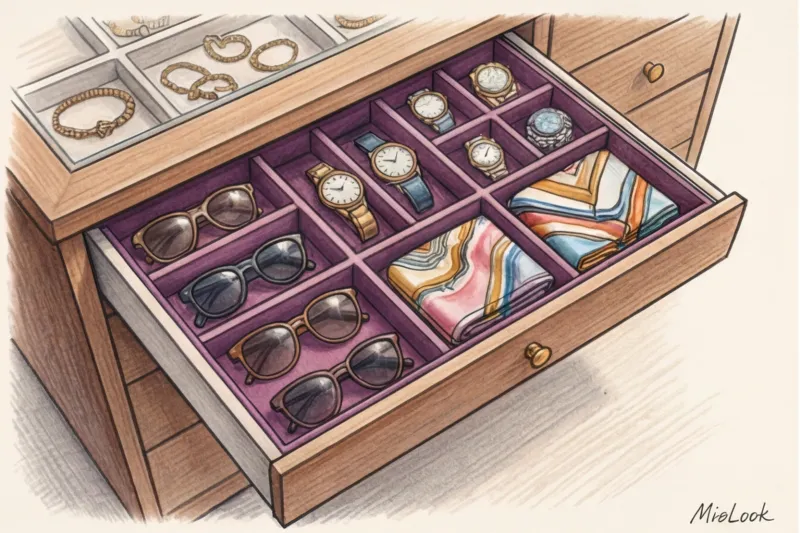
- Storage of small accessories: The island allows for aesthetics store and organize jewelry at home You can see the entire collection at a glance, which increases the percentage of accessory usage by 40% (according to my personal statistics from working with clients).
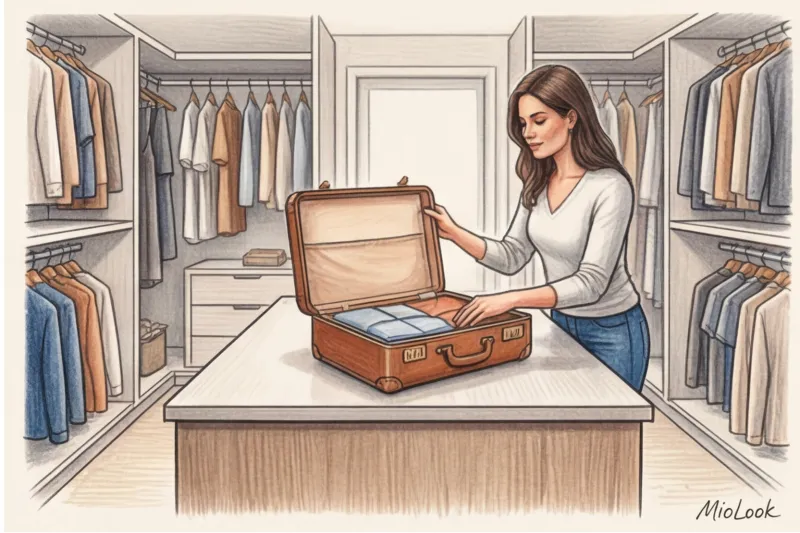
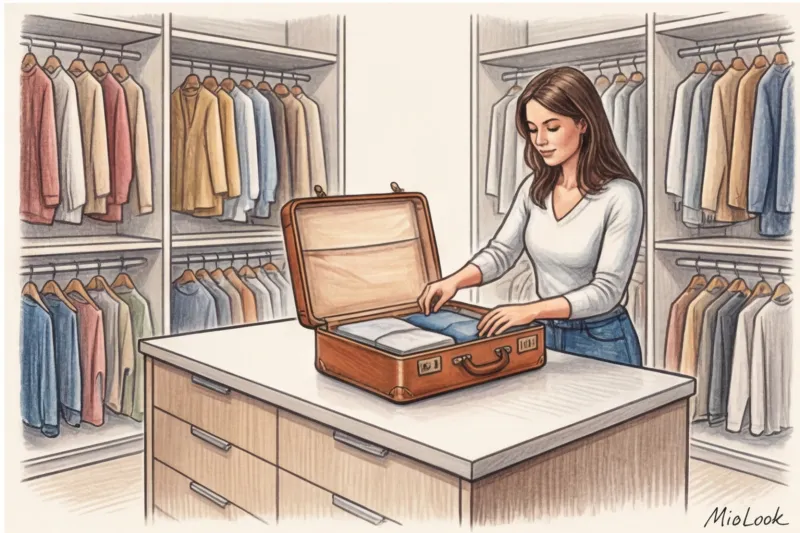
- Packaging area: An open suitcase on the bed stains the bedspread, and on the floor it forces you to hunch over. A countertop solves this problem—you can pack for a business trip with a straight back.
- Stream Separator: In shared dressing rooms, an island physically and visually separates the male and female halves of the space, minimizing morning clashes.

My favorite use case for bridging the gap between technology and the physical world: I create a capsule wardrobe for tomorrow in the evening in my virtual wardrobe, then lay out the selected items on the island countertop. This allows me to appreciate the textures of fabrics in real life under room lighting, and in the morning I don't have to waste a second choosing an outfit.
Ergonomics and dimensions of a dressing room island: the mathematics of comfort
Never trust furniture makers blindly. Designers often create impressive 3D visualizations, forgetting about the biomechanics of the human body. When designing, we must rely on standards: according to the architect Ernst Neufert's handbook (building design, current edition 2023), space should serve people, and not the other way around.
My personal ergonomics test, which I make every client do before approving the plans, is the "full squat rule." Stand in the proposed aisle between the island and the cabinet. Now squat down as if you were searching for shoes on the bottom shelf. Does your back or buttocks hit the imaginary barrier? If so, the project goes in the trash.
The ideal dimensions of the island itself
There are no universal sizes; they depend on your height and arm span. However, there are clear mathematical boundaries:
- Height: It's calculated individually using the formula "the distance from the floor to your bent elbow minus 15 cm." Typically, this is a standard 85–90 cm, but for taller women, it's better to raise the countertop to 95–100 cm.
- Depth: If you're planning drawers on only one side, 60 cm is sufficient. If you need access from both sides (a double-sided island), allow 80 to 100 cm. Don't go deeper than 100 cm, otherwise you won't be able to reach the center of the countertop to dust.
- Length: A minimum of 90 cm is recommended to avoid the structure looking like a lonely nightstand. The maximum is limited only by the length of the room, but structures longer than 2.5 meters require a reinforced metal frame.
The 90-centimeter rule: passages and opening radius
The most critical metric is the aisle width. Leaving it at 60 cm, as some blogs recommend, is a recipe for misery. Let's calculate: a standard bottom cabinet drawer extends 45–50 cm. If the aisle width is 60 cm, you'll have exactly 10 centimeters left to squeeze between the open drawer and the island. This is physically impossible.
The golden ratio of the passage is at least 90 centimeters Clear area from front to back. Ideally, 100–120 cm. Also, be sure to check for "facade clashes": the main cabinet doors and island drawers should not block each other when opened simultaneously.
Access to MioLook for €0.99 — one-time payment
A smart AI stylist will select the perfect look based on your items.
Get access — €0.99 onceInterior Contents: What's Hidden Under the Countertop
A walk-in closet island isn't just a box; it's a high-tech storage mechanism. The way you design the tiers determines how well your belongings are kept.
Upper tier (under glass): Velvet trays and eco-suede sections for jewelry, watches, and eyeglasses reign supreme here. Important: order concealed drawer slides with soft-close mechanisms (for example, according to the technical specifications of Blum or Hettich). If the drawer closes with a bang, your expensive watches will bang against the dividers every day.
Middle tier: Thin pull-out sections (up to 15 cm high) for ties, belts, and underwear. Honeycomb organizers work great here.
Lower tier: Deep drawers (from 25 cm) to how to store knitwear correctly Sweaters shouldn't be hung on hangers—they'll stretch out. Thick cashmere thrives best in the island's deep baskets. If budget allows, the bottom tier can be left open and filled with beautiful leather trunks for off-season storage.
Is it worth integrating a pouf directly into the structure (the cutout with the seat)? In my experience, no. A built-in bench eats up a huge amount of usable storage, and sitting squeezed into the furniture niche is frankly uncomfortable. It's better to place a lightweight, portable pouf in the corner of the room.
Alternatives: What to do if there is no room for an island
What if your walk-in closet is a modest 6-8 square meters, but you really want a countertop? The design industry has long come up with clever compromises. When a classic island doesn't fit, I use one of these three techniques:
- Peninsula. The structure is attached to the wall with one short side. You lose the ability to walk around it from all sides, but you save at least 90 cm of space. Ideal for narrow, elongated rooms.
- Pull-out tabletop shelves. A brilliant invention! It looks like a regular closet front, but behind it lies a reinforced shelf on telescopic rails. You pull it out when you need to put things away or pack a suitcase, and then push it back in.
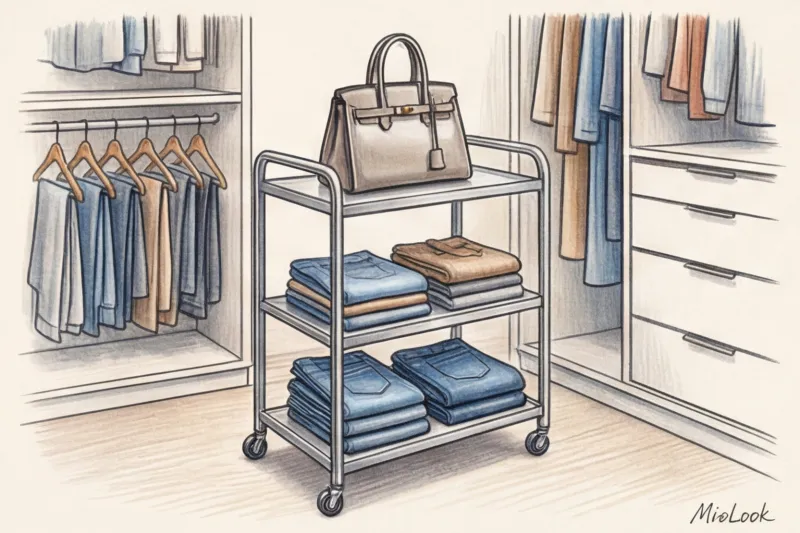
- Styling cart. My favorite stylist lifehack: a compact metal or wooden serving trolley on wheels. A budget-friendly one will cost you €50–€100, while a premium solid wood one will cost around €300. A trolley gives you a mobile horizontal surface that you can roll up to the mirror and then tuck away in an empty corner.
Ready to start digitalizing?
Try MioLook's free plan—no commitments or hidden fees.
Get access — €0.99 onceChecklist: Are you island-ready?
In short, an island is a great organizational tool, but only if it's installed in the right place. Before you hand over the advance payment to a carpenter, go through this checklist:
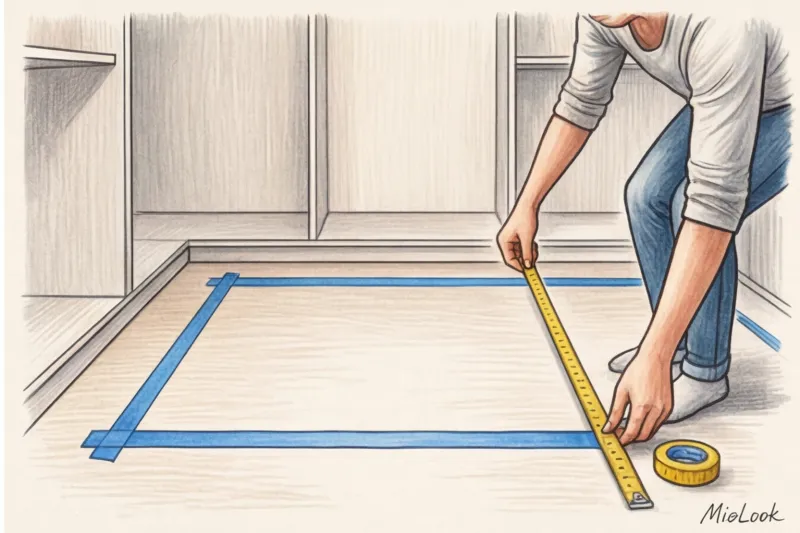
- Masking tape test. Take some brightly colored masking tape and trace the outline of your future island directly onto the floor of your walk-in closet, taking the actual dimensions into account. Try walking around it for a couple of days. You'll immediately see if it's too cramped.
- Habit audit. Ask yourself honestly: do you know how to keep tables and dressers perfectly organized? If not, ditch the tabletop for additional closed drawers.
- Estimating the volume of small items. Gather all your accessories in one place. If they fit in a shoebox, building a separate unit for them isn't practical.
- Digital test drive. First, tidy up virtually. Upload your items to the app. MioLook Intelligent analysis will reveal which items you actually wear and which should be donated. The less clutter, the more transparent your layout.
The main point to remember: a walk-in closet is there to make getting ready quick and enjoyable. No piece of furniture, no matter how beautiful, has the right to complicate your life. If an island turns the room into a maze of obstacles, feel free to eliminate it from the plan and invest in impeccable hardware for the main cabinets and high-quality lighting.