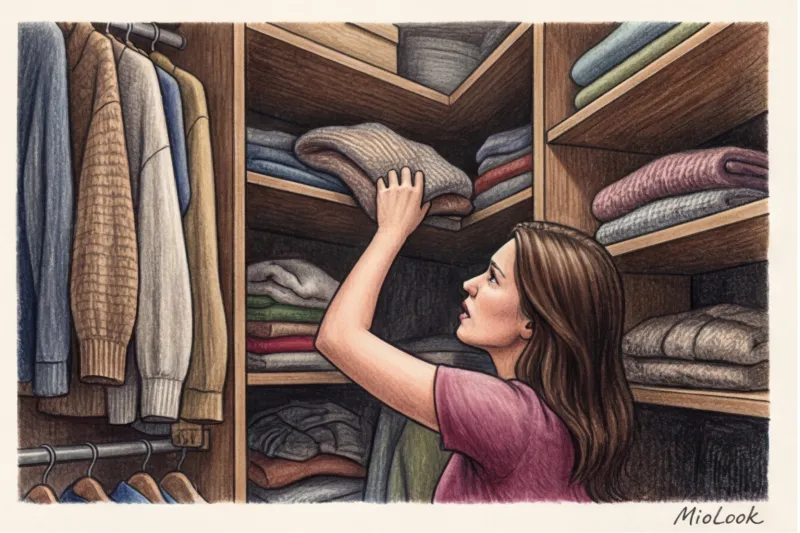
Over 12 years of working as a style coach, I've seen hundreds of closets filled with expensive clothes that no one wears. And you know what the problem often lies? It's not a lack of taste or budget. The problem begins when a woman physically can't even look around her closet due to a poorly designed closet door. Furniture blogs typically evaluate closet doors solely from the standpoint of saving square footage. But as a textile expert, I suggest looking at this issue differently: through the prism of preserving your belongings and the psychology of getting ready in the morning.
We discussed architectural nuances and area calculations in more detail in our The complete guide to the perfect walk-in closet layout Today, we'll be looking at the front section. The system you choose will determine not only your bedroom design, but also whether your favorite cashmere sweater will develop a musty smell and how many minutes you'll spend searching for the right pants before heading out.
How Wardrobe Doors Affect the Safety of Your Items
Most people think of a closet as a sealed box. Close the doors, and your things are safe. In reality, the opposite is true. Natural fibers like merino wool, silk, linen, and cashmere require air circulation to survive.
According to the International Council of Museums (ICOM, 2023) standards for textile conservation, a complete lack of ventilation in storage areas leads to the accumulation of residual moisture. If you wear a wool jacket once and then hang it in a closed, unventilated closet, microscopic particles of sweat and skin lipids become an ideal breeding ground for bacteria. This is how items acquire a characteristic "musty" odor, even if they are visually clean.
"Moths don't just eat dirty clothes. They seek out dark, unventilated, warm corners with keratin residue. Solid doors with rubber seals are a five-star hotel for clothes moths."
On the other hand, a complete lack of doors (open rails) exposes clothing to dust and UV rays. If your favorite black, heavy cotton T-shirt is exposed to direct sunlight from a window every day, a reddish, faded spot will appear on the shoulder within six months. Ideal wardrobe doors should balance dust/light protection with air circulation.
Sliding doors (coupe): the illusion of saving space
If you go to any furniture store, there's a 90% chance you'll be offered a sliding wardrobe. Furniture manufacturers adore sliding systems for their ease of installation and ability to conceal uneven walls. But stylists hate them.
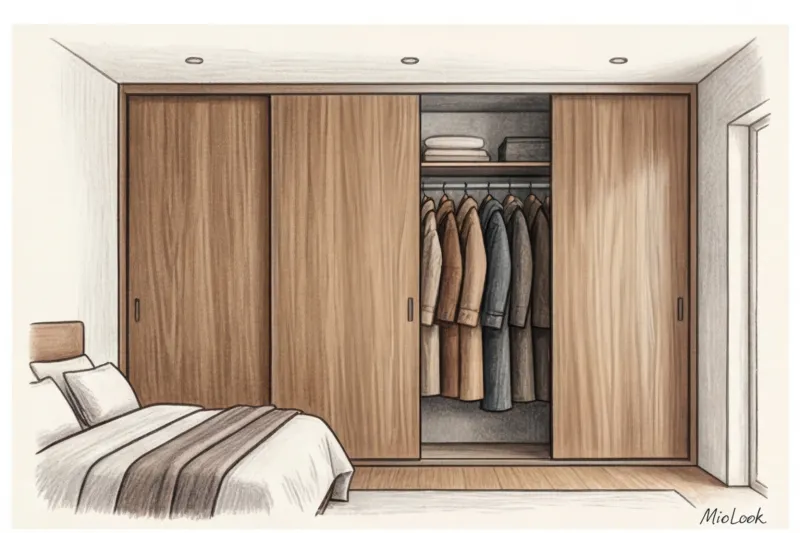
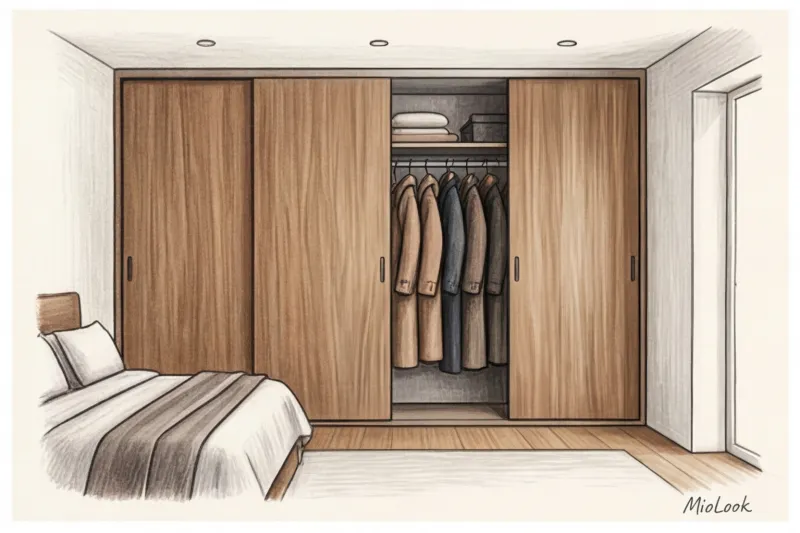
A key technical detail that's often overlooked is that the guide rail system "eats up" 8 to 10 centimeters of usable interior depth. This means that if you order a standard closet with a depth of 60 cm, you'll only have 50 cm left inside. Standard hangers for a man's jacket or a bulky women's coat are 45–48 cm wide. Add the thickness of the sleeves, and you have the classic problem of sliding wardrobes: every time you close the door, you catch and rub the sleeves of your clothes.
Ready to get started?
Try a free plan—no commitment—and organize your closet like a pro.
Get access — €0.99 onceThe main disadvantage of a coupe: "blind spots" in your wardrobe
One of my clients complained that she had "nothing to wear," even though her closet was overflowing with items. When we began sorting through her wardrobe, it turned out she wasn't wearing about 30% of it simply because it was hung in the center of her closet. Because of the overlapping fronts, the center section was always in the shadows.
The psychology of packing is simple: you only wear what you see. Sliding doors hide at least 33-50% of your clothes at any given time. You can't take in your entire arsenal to create a complex, layered look. Of course, if you use MioLook To digitize your wardrobe, the app will show you all your items on your smartphone screen. But physical access to your clothes should still be convenient.
Hinged doors: a timeless classic for a smart wardrobe
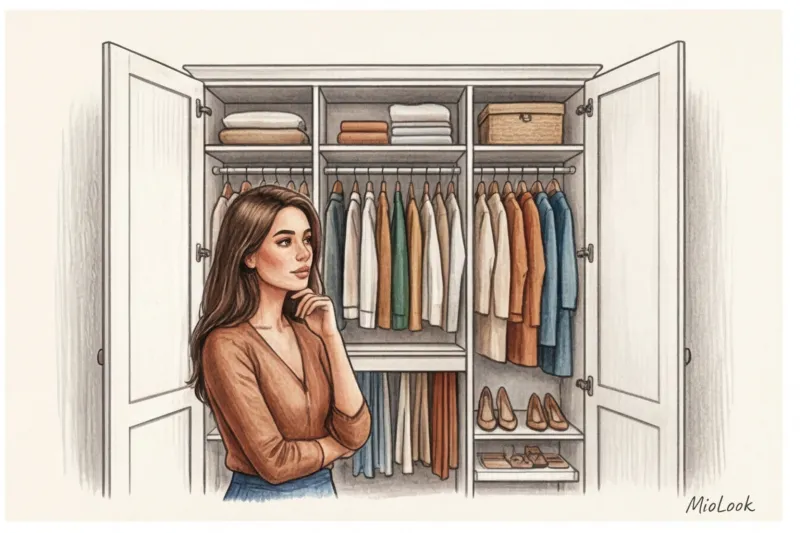
For creating a functional capsule, there's nothing better than good old swing doors. Their main and undeniable advantage is the ability to open all doors simultaneously.
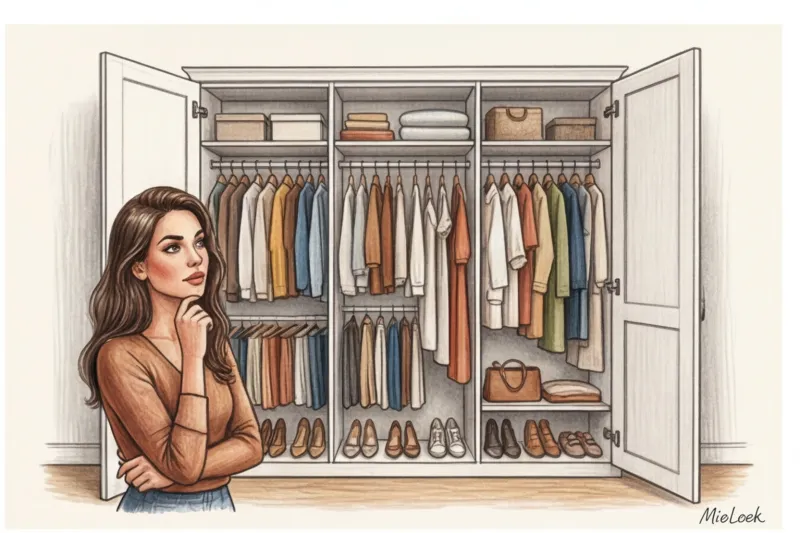
When you see your tops, bottoms, and shoes all at once, your brain automatically starts generating new combinations. In 15 minutes, you'll create an outfit that would take half an hour of endlessly sliding doors back and forth with a wardrobe.
Moreover, the inside of hinged doors is valuable space. I always recommend clients install flat velvet belt organizers, thin silk scarf hooks, or even narrow full-length mirrors there. Sliding systems deprive you of this valuable space.
However, swing doors have a strict ergonomic limitation: 80 centimeter rule This is the minimum amount of free space you should have in front of your closet. The open door will take up 50–60 cm, and you'll need another 30 cm to stand comfortably in front of it. If your bedroom's entryway is narrower, hinged doors will turn your life into a daily obstacle course.
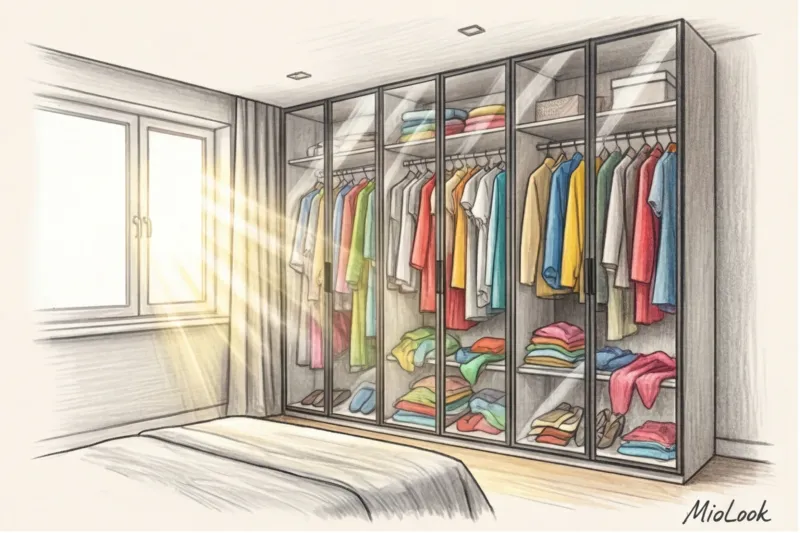
Glass display cases: is it worth turning your home into a boutique?
The glass walk-in closet trend originated in the interiors of Italian palazzos and luxury boutiques. These images are pinned millions of times on Pinterest: tinted glass, warm LED lighting, perfect symmetry. But let's face it.
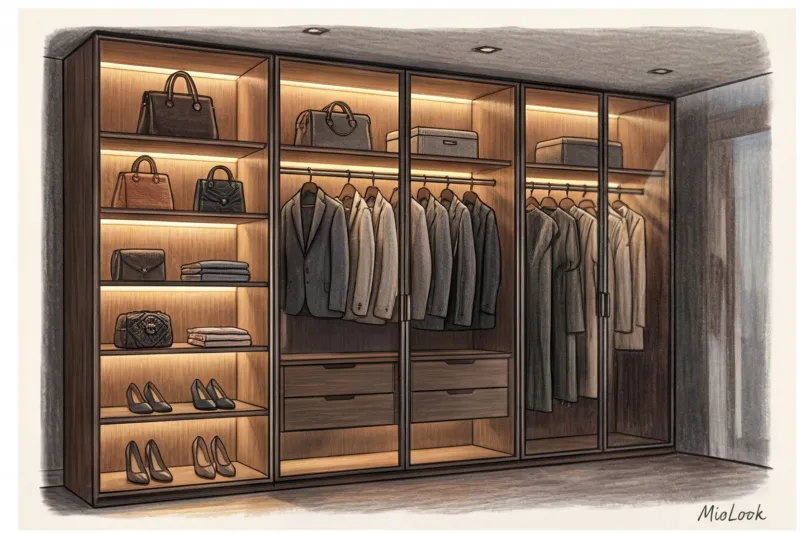
A boutique looks perfect because it displays items from the same collection, color-coordinated, on identical hangers, perfectly spaced. Your real wardrobe is a motley mix of down jackets, colorful summer dresses, lounge hoodies, and jeans in various shades. Behind the transparent glass, this chaos of life creates a powerful visual noise that will tire you out every evening.
I warn my clients frankly: glass facades only work for perfectionists with iron discipline, willing to spend time sorting items by gradient. If you're not one of them but still really want glass, choose heavily tinted (graphite, bronze) or ribbed options (flutes glass). They create a beautiful architectural highlight but blur the silhouettes of items, hiding any slight clutter.
Your perfect look starts here
Join thousands of users who look flawless every day with MioLook. Digitize your wardrobe and forget about the "nothing to wear" problem.
Get access — €0.99 onceTextile curtains: an unexpected favorite of stylists and eco-activists
Using a curtain instead of a closet door is considered a cheap student compromise for a rented apartment. This is a dangerous misconception. Today, heavy textile curtains are the choice of premium brands, architects, and eco-activists.
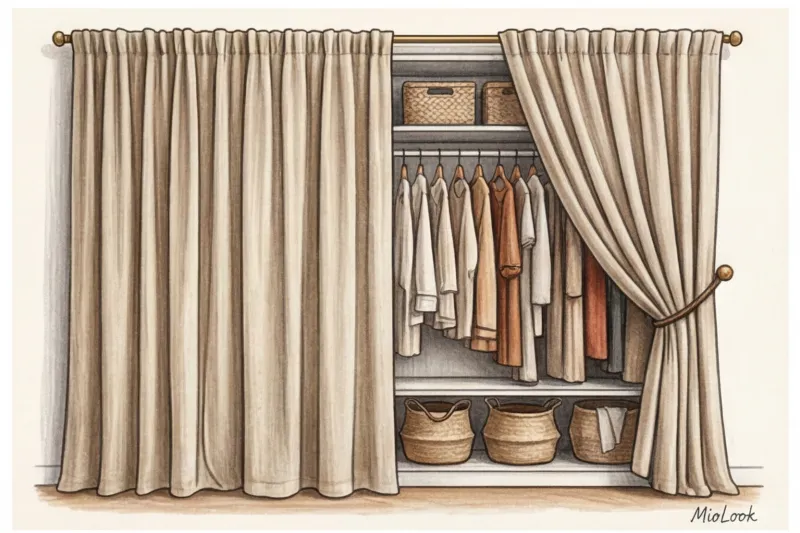
When I first suggested to a client using the Loro Piana cashmere collection that she replace her glass doors with thick linen curtains, she was shocked. But a month later, she called with gratitude. The fabric solved three problems at once:
- Ideal ventilation: Natural curtains allow air to pass through, preventing moisture from stagnating, but at the same time serve as a reliable filter against household dust.
- 100% availability: One movement of the hand, and the curtain moves to the side, revealing the entire wardrobe without a single “dead zone”.
- Interior texture: Modern minimalist bedrooms often lack softness. Heavy fabric adds coziness and absorbs sound.
What fabrics to choose for a dressing room
Forget thin tulle or 100% polyester. Synthetics accumulate static electricity and act as a magnet for dust and cat hair. Choose thick, softened linen, heavy cotton (canvas), or matte cotton velvet.
A good dressing room curtain will cost between €150 and €400, depending on the length and fabric, which is often comparable to the cost of high-quality MDF curtain panels. Be sure to invest in a good metal curtain rod with concealed runners—the curtain should slide with a light touch and not get caught at the seams.
Checklist: How to Choose Wardrobe Doors to Suit Your Layout
To avoid making a mistake in your choice, analyze the room's geometry and your habits. Here's a quick cheat sheet based on my experience sorting through hundreds of wardrobes:
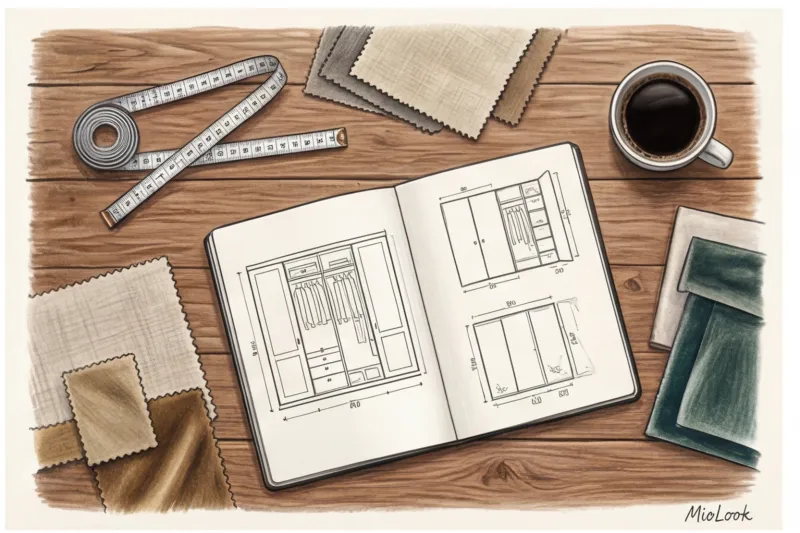
- You have a narrow corridor (less than 60 cm of passage): Swinging doors are out of the question. Your choice is thick curtains on a ceiling cornice or high-quality sliding doors (but remember the 10 cm loss in depth).
- You have a full-fledged dressing room: The ideal scenario is for hinged doors with louvered inserts or completely open storage (if the room is windowless and has a good exhaust fan).
- Your closet is filled with premium wool and silk: Avoid solid laminated chipboard fronts with rubber seals. Choose louvered doors, rattan mesh fronts, or fabric curtains to allow the fabric to breathe.
- You are prone to creative chaos: No glass. Choose solid matte facades in calming shades. Let chaos remain your little secret behind closed doors.
Your closet isn't just a storage box. It's a tool that should work for you every morning. When choosing between sliding doors, hinged doors, or curtains, think not only about how it will look in photos, but also about how the clothes will feel inside. And to truly take control of your style, delegate the routine to technology—for example, by uploading your looks to MioLook smart wardrobe The right doors will preserve the quality of your belongings, and the right organization system will save you hundreds of hours in front of the mirror.