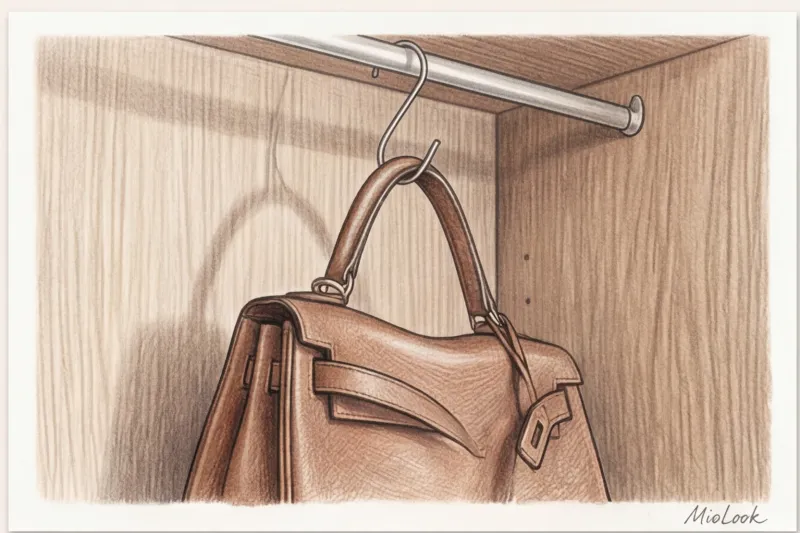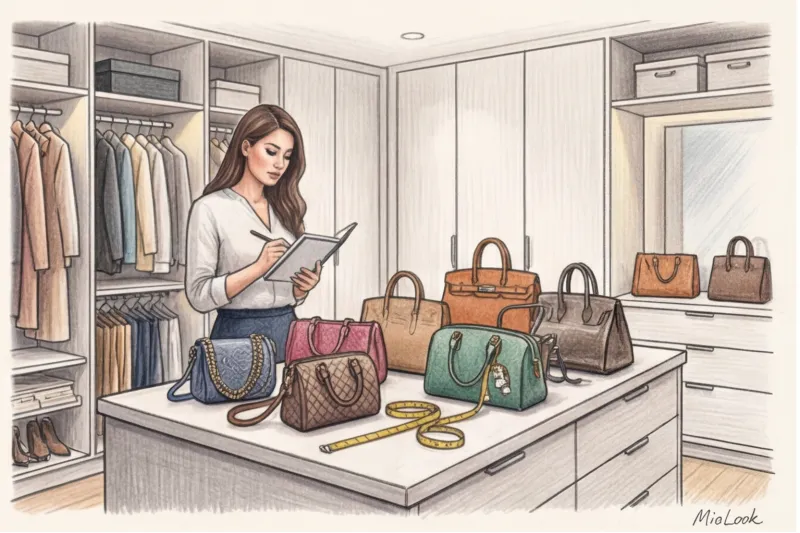
One day, a client came to me in utter despair: her beloved structured tote bag, purchased for €3,000, had hopelessly lost its shape. The handles had stretched, the smooth calfskin had creases, and the rubber edge (the edge of the handle) had cracked. When I asked how she'd stored it, her answer was like a death sentence: "It hung on a pretty hook in the closet for six months."
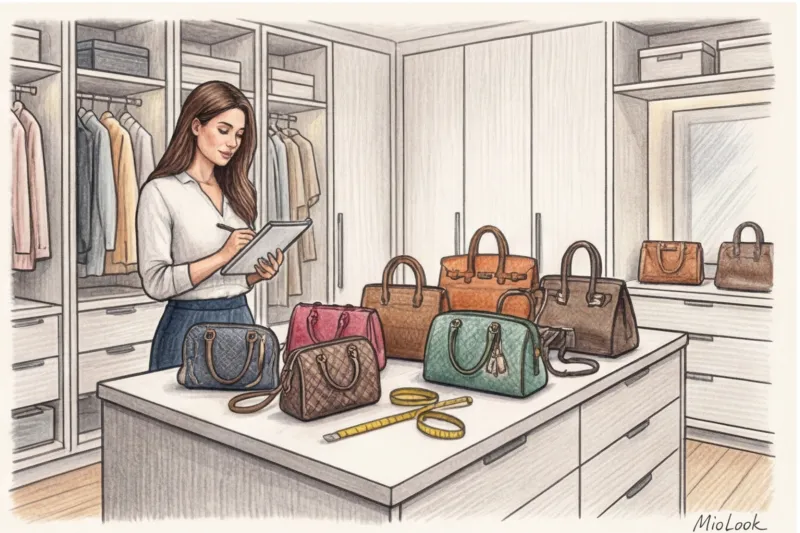
As a textile expert and style coach, I see this mistake all the time. We invest significant sums in accessories and then ruin them with improper storage. Properly storing bags in your closet isn't about buying plastic organizers of dubious quality. It's about understanding textile materials science: how gravity, humidity, and the chemical composition of materials interact in a confined space.
We have discussed the basic principles of zoning in more detail in our The complete guide to the perfect walk-in closet layout , but today I want to focus exclusively on saving your accessories. Let's look at how to design shelves even during the renovation stage and why traditional storage methods may be costing you your favorite things.
Analysis Before Planning: Why Standard Shelves Don't Work for Bags
Over 12 years of working with clients' closets, I've learned one rule: never trust cabinet makers to design accessory shelves blindly. By default, contractors make shelves 30 centimeters high. This standard migrates from project to project.
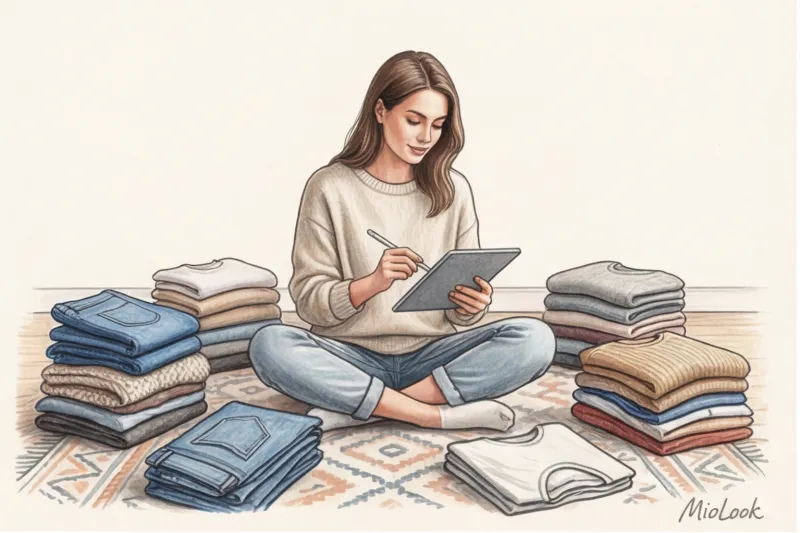
But here's the harsh reality: no modern shopper from COS, Massimo Dutti, or hard tote will fit on a 30 cm high shelf when standing without the handles snapping. Planning should begin with digitizing your current collection.
Divide your collection into four categories:
- Hard totes and briefcases: require a shelf height of 40–45 cm and strictly vertical storage.
- Soft hobos and shoppers: can be stored horizontally (flat lay) in stacks of 2-3 pieces.
- Evening clutches and micro bags: Ideal for shallow drawers or narrow shelves 15–20 cm high.
- Backpacks: the largest elements requiring deep lower sections.
"To comfortably accommodate 10 average-sized bags, you need at least 1.5 linear meters of shelves. If you have 20 bags, allow for 3 meters. Trying to squeeze them in tighter is guaranteed to scratch the hardware and warp the corners."
The Biggest Myth: Why You Shouldn't Hang Bags by the Handles on Hooks
Storing bags on hooks or hangers to save space is the worst crime against leather. Many people believe that if a bag is empty, its weight doesn't matter. This is an illusion.
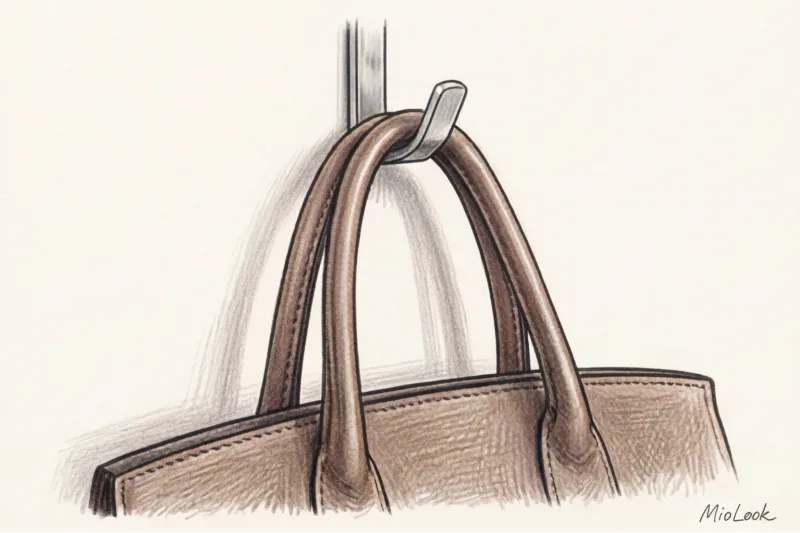
An empty, structured tote bag made of thick leather weighs between 0.8 and 1.5 kg. When you hang it on a narrow hook, all this weight presses down on one or two tiny contact points. The physics of this process are merciless: gravity stretches the leather fibers. After a few months, you'll notice that the handle has become thinner where it hangs, and the frame of the bag has "floated" downward, forming unsightly folds at the base.
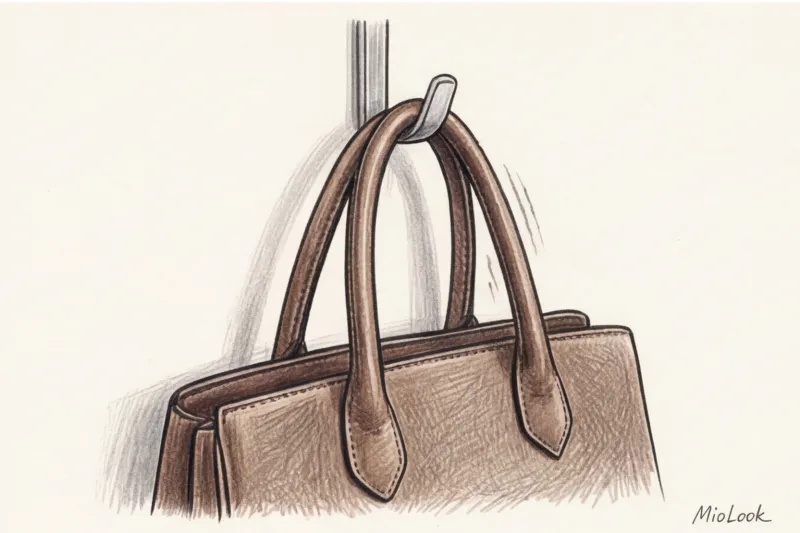
When this rule does NOT work (fair exception):
You can confidently hang lightweight cotton shopper bags (up to 200 g/m²) and lightweight Prada-style nylon crossbody bags on the hooks. Nylon is resistant to this type of deformation, and the weight of these items is minimal.
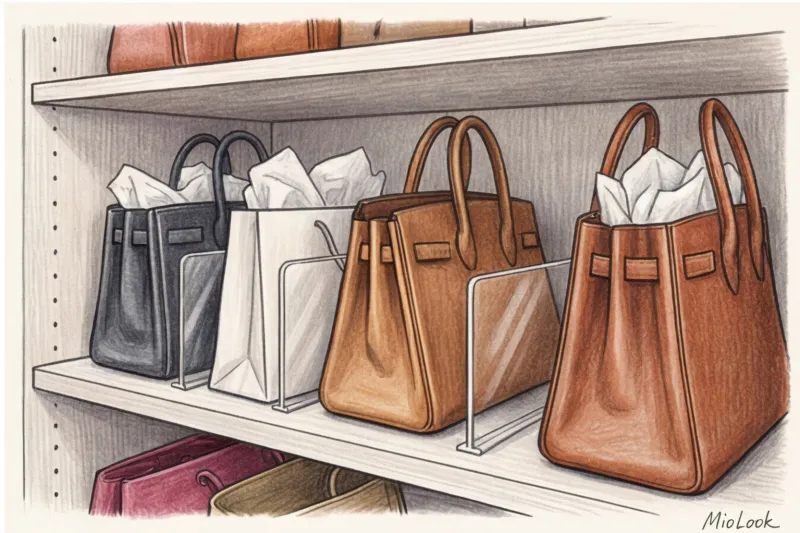
Instead of hooks, use acrylic dividers on regular shelves. They create individual compartments for each bag, preventing them from collapsing.
Access to MioLook for €0.99 — one-time payment
A smart AI stylist will select the perfect look from your items and remind you of bags you haven't worn in a while.
Get access — €0.99 onceRules for storing bags in a dressing room, taking into account the materials
A basic rule of sustainable fashion states that 80% of a garment's longevity depends on its off-season care. Before putting a bag away, even for a week, it should be completely emptied. A forgotten tube of hand cream or a heavy set of keys will leave permanent dents in the soft lining.
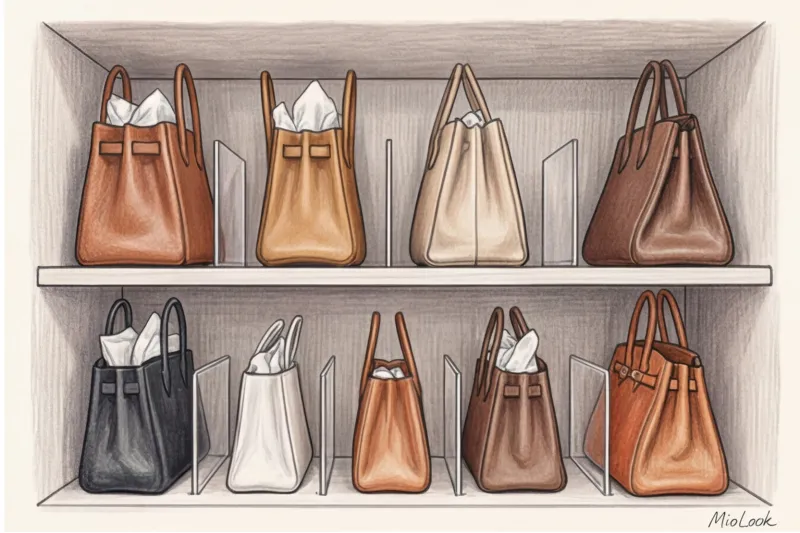
Rigid shapes and structured leather
Saffiano leather, smooth calfskin, and patent leather surfaces are unforgiving when it comes to losing their shape. If a rigid bag sags, restoring its frame will be virtually impossible.
Be sure to use padding. But forget about old newspapers! Printing ink easily transfers to light-colored linings, and the acidity of newsprint will destroy textiles over time. Use a special acid-free paper (acid-free tissue paper) or ready-made silk bag shapers. Stuff the bag until it returns to its original store-bought shape, but do not overtighten the zipper.
Soft hobos, shoppers and textiles
Soft bags without a rigid bottom are best stored horizontally. Folding them flat will save you a ton of space and prevent unnatural creases.
Pay special attention to suede and nubuck. These materials have a pronounced nap that easily wears down (or becomes bald) with the slightest friction. Suede bags should never come into contact with the hard hardware of adjacent bags. Summer straw and woven raffia bags require protection from drying out—in an overly dry environment, the natural fibers become brittle and begin to crumble.
Climate Control: How to Save Leather and Hardware from Destruction
The most subtle problem with walk-in closets is their location. Modern layouts often have walk-in closets adjacent to the master bathroom, either without an additional door or with poor ventilation. This spells a slow death for your bags.
According to the Museum Conservation Institute's standards for the storage of museum textiles and leather, and the Leather Care Institute's recommendations (2023), The optimal humidity for storing leather goods is 45-55% If humidity is above 65%, expect whitish mold to appear on genuine leather. If it's below 30% (which often happens in winter when the heating is on), the leather will dry out, lose elasticity, and crack.
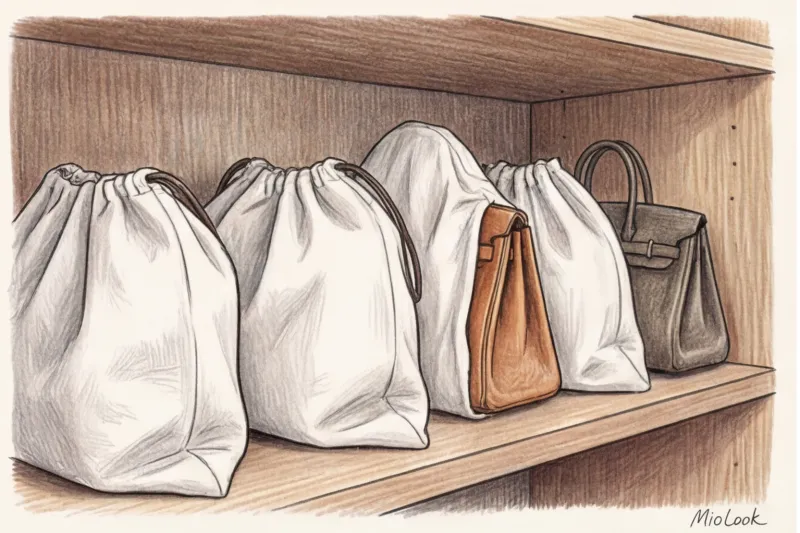
That's why I'm categorically against storing bags in the popular transparent plastic boxes. Plastic creates a greenhouse effect. The slightest temperature change causes micro-condensation inside. Leather needs to breathe! The ideal packaging is an original cotton duster. If you want to see your bags, simply store them on open shelves, protected from direct sunlight (UV light fades the pigment within one season).
High humidity also triggers the oxidation process of hardware. Metal chains, locks, and rivets become dull, and in severe cases, become covered with a greenish film that penetrates the surrounding leather.
Your perfect look starts here
Join thousands of users who look flawless every day with MioLook. Digitize your wardrobe in just a few clicks.
Get access — €0.99 onceOrganizing small accessories: belts, scarves, and glasses
Even the most expensive wardrobe will look like a second-hand store if small accessories are scattered haphazardly across the surfaces. The visual noise of dozens of tangled belts and slipping scarves instantly ruins the overall impression of the space.
Belts: Roll or Hang?
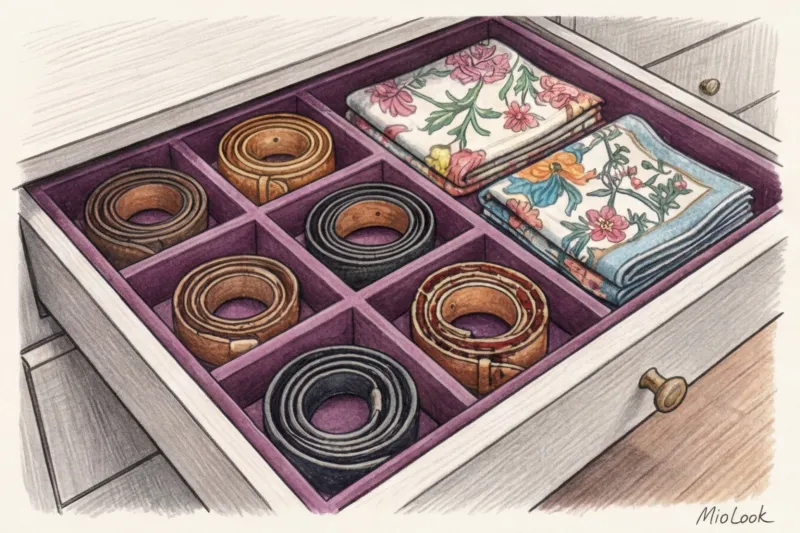
My verdict is clear: high-quality leather belts are best stored rolled into a coil. Why? If you hang a belt by the buckle on a belt hanger, the heavy metal buckle pulls down on the leather. Over time, the leather becomes thinner where the buckle attaches.
When rolling a belt, start with the buckle, tucking it inside the "snail" to prevent the metal from scratching the leather. Ideally, store these rolls in a shallow drawer divided into square compartments (approximately 10 x 10 cm).
Glasses and silk: protection from scratches and snags
For sunglasses, I always recommend clients order a single drawer with a velvet or suede lining. This allows them to store their glasses without bulky cases, allowing them to see their entire collection at a glance, and without worrying about scratching the lenses.
Silk squares and twills (narrow ribbons) require delicate handling. The slightest snag on a wooden shelf edge and an expensive scarf is ruined. Fold them according to Marie Kondo's method into neat rectangles and store them in fabric storage bags, or use special multi-tiered hangers with rounded, rubberized edges.
Checklist: How to organize your closet bags over the weekend
If your bags are currently sitting in a shapeless pile on your top shelf, here's a step-by-step plan to fix the situation in one weekend.
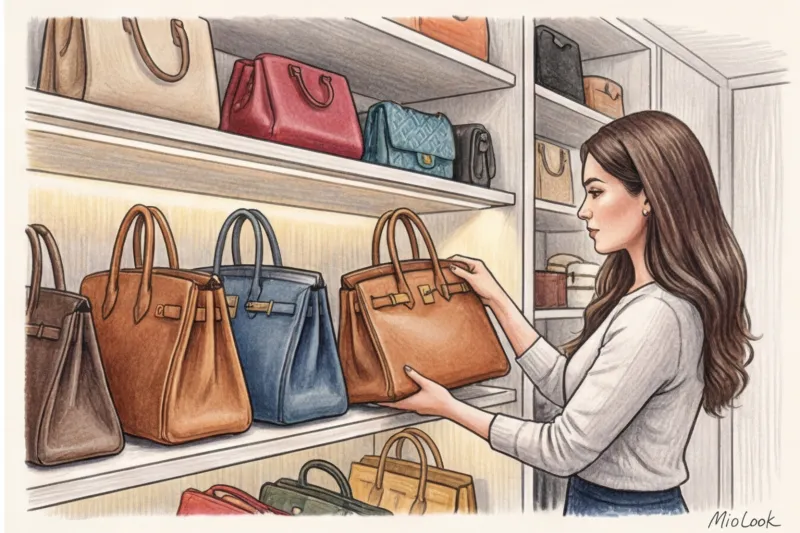
- Conduct an audit. Remove all accessories. Shake out crumbs from the linings and wipe the leather with a slightly damp soft cloth (no alcohol wipes!).
- Get back into shape. Fill structured bags with acid-free paper or clean cotton t-shirts you no longer wear (great eco hack).
- Zone by frequency of use. Place everyday crossbody bags and work totes on shelves at eye level (the golden zone). Store evening clutches and off-season bags (like winter fur shoppers or summer wicker baskets) in dust bags on the very top tiers.
- Set boundaries. Buy clear acrylic shelf dividers (budget options cost €20–€40 per set). They'll instantly give your shelves the look of a boutique display.
And the main advice from a stylist: to prevent bags from languishing in the back of your closet, digitize them. I personally use an app MioLook For accessory rotation. When you upload photos of your bags to the smart wardrobe, the algorithm suggests new combinations with your basics. This reduces the cost-per-wear of each bag and makes your collection work 100% for you.
Ready to get started?
Try the MioLook plan for free—no commitments required. Organize your closet and your mind.
Get access — €0.99 onceTreat your bags not as utilitarian sacks, but as works of art. The right temperature, protection from gravity, and a little care can extend the life of a quality leather bag for decades, turning it into a true vintage piece you can pass down as an heirloom.