Two years ago, a client of mine brought me a panicked Loro Piana cardigan she'd bought in Milan for €1,500. The elegant garment, which should have lasted for decades, had disproportionately long "ears" on the shoulders, and the silhouette resembled sad, shapeless pajamas. The reason was simple: the cardigan had spent three months on a thin metal hanger in a cramped closet.
For many, a sweater is simply a warm jacket. But after 12 years of working as a stylist and visiting dozens of factories, I've learned to look at knitwear differently. Knitwear isn't fabric. It's a complex, fluid engineering construct, a system of interwoven loops. If you don't understand the laws that govern this structure, even the most expensive cashmere will lose its prestigious appearance after the first wash. We discussed the conceptual foundation of knitwear in more detail in our article. A complete guide to creating a basic knitwear wardrobe.
Today we will look at, How to properly store knitwear and care for it through the lens of "coziness architecture." Forget the instructions on the tags—we're going to talk about the physics of fiber.
The Physics and Chemistry of Yarn: Why Knitwear Loses Its "Architecture"
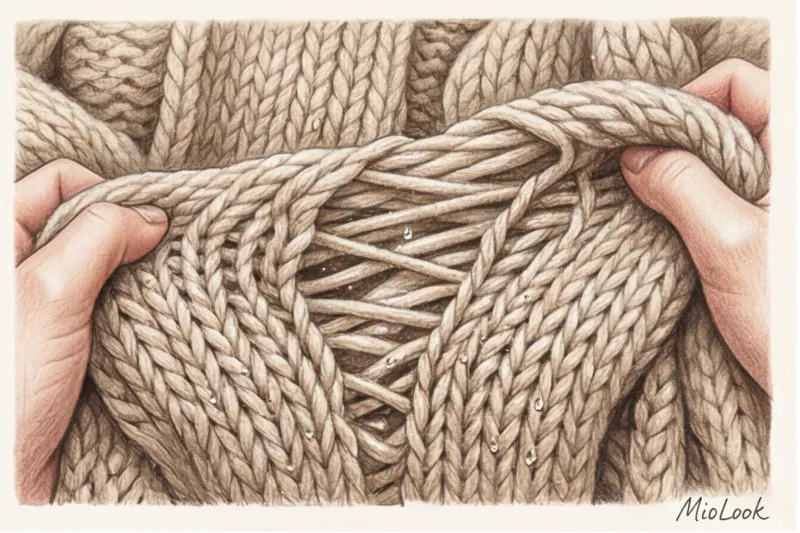
When I visited family-run factories in Umbria, an Italian region famous for its cashmere, local technologists explained a fundamental point to me. The architecture of a sweater is based on the elasticity of each individual loop and the hydration level of the hair. If the fiber is overdried or subjected to improper stress, the architecture collapses.
According to the Textile Institute, over 70% of deformation in knitwear occurs not during wear, but rather during drying and storage. The number one enemy of any knitted garment is gravity. The sweater's own weight, multiplied by the force of gravity, inexorably pulls the stitches downward, distorting the designer's original intent.
How to Properly Store Knitwear: The Golden Rule of Gravity
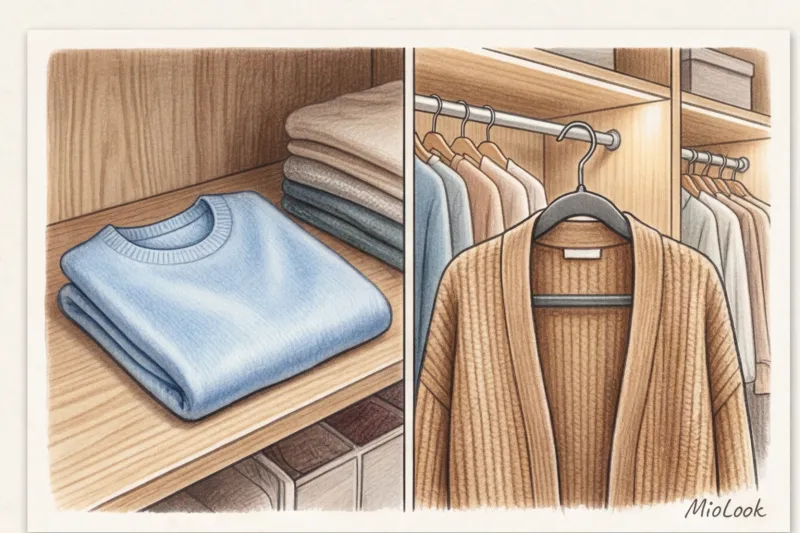
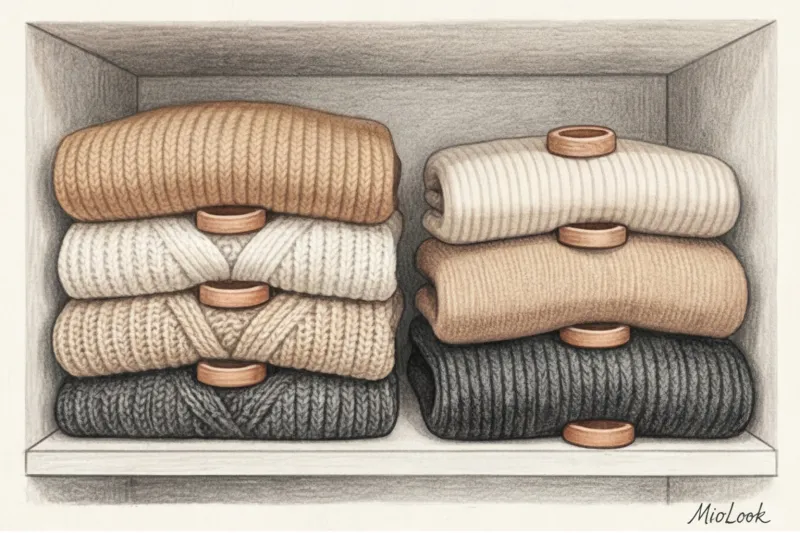
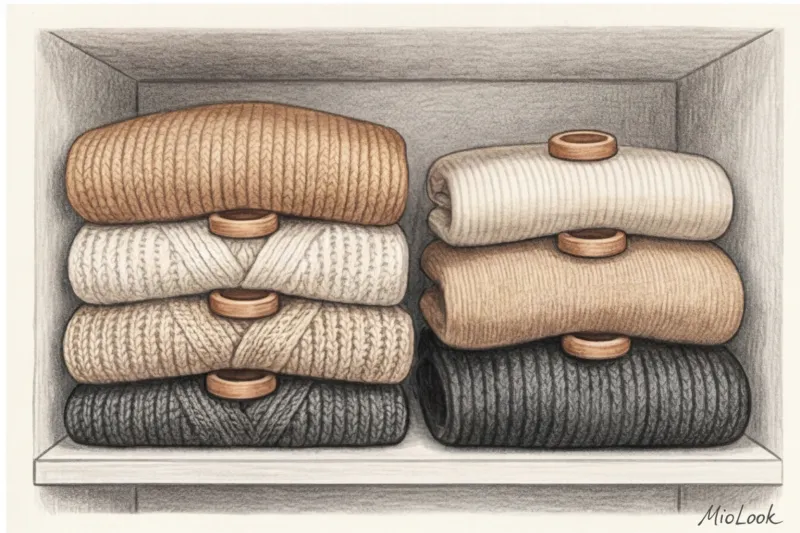
The stylist's golden rule is: hanger for fabric, shelf for loops. Even so-called "soft" or anatomical velvet hangers pose a huge risk for 90% of your sweaters.
But simply throwing things on a shelf isn't enough. The closet must adhere to strict geometry. Wool vitally needs air circulation. If you pack ten sweaters tightly, the bottom items will lose volume under the pressure of the top ones. The ideal stack is a maximum of three or four items, arranged with some air between them.
Ready to digitize your wardrobe?
Try MioLook's free plan and organize your belongings like a professional stylist—no commitment.
Get access — €0.99 onceThe Art of Folding: Marie Kondo's Method vs. Boutique Organizing
Many people are currently obsessed with the KonMari method—storing things vertically in drawers. I admit: for T-shirts and thin, smooth knits (like viscose-blend turtlenecks), this works great. We already mentioned this method when we discussed How to quickly digitize your wardrobe over the weekend.
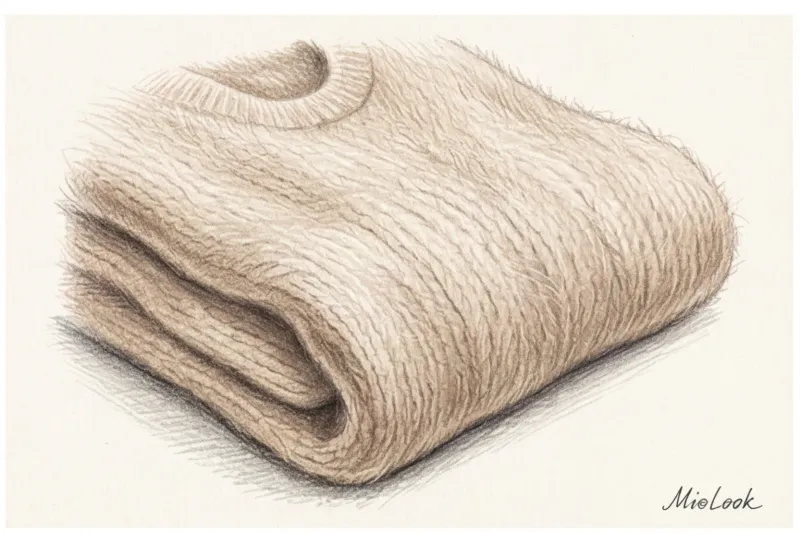
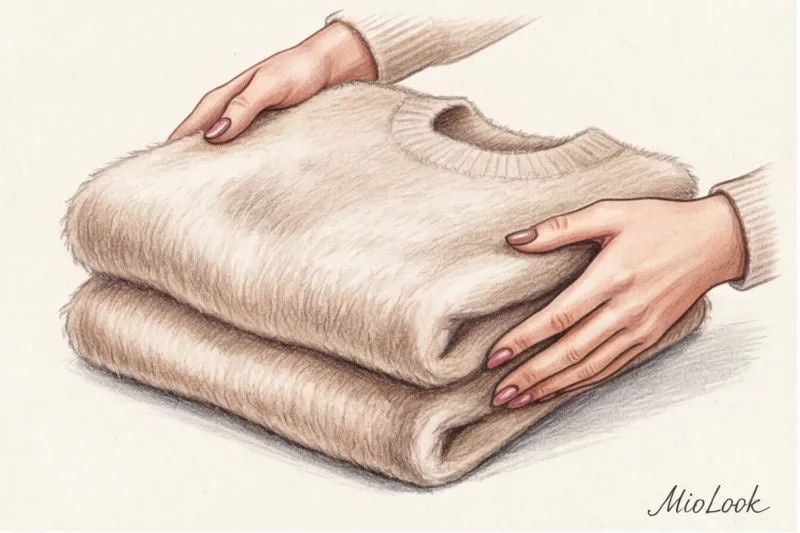
But when it comes to chunky knits or fluffy mohair, the Marie Kondo method is disastrous. Rigid twisting and pressing in a drawer squeezes all the air out of the yarn. For high-status items, I always recommend boutique display: neatly folded into a square with the sleeves tucked back, where each item lies freely on the shelf, preserving its natural volume.
Exceptions to the Rule: When Can You Hang Knitwear?
My advice isn't absolute. There are times when knitwear should be hung up. Can And it's even necessary. This applies to thick, viscose-like dresses or blended turtlenecks with a high elastane content. Their shape is already fixed with synthetic threads, and gravity won't affect them. By the way, Care instructions for modal and tencel work on similar principles of rigid fixation of the fiber.
Life hack from stylists: If shelf space is at a premium, you can hang the sweater, but not by the shoulders. Fold it in half lengthwise along the spine, place the hanger bar under your armpit, and cross the sleeves and bottom over the bar. This will distribute the weight evenly.
Cleaning Myths: Why Cashmere Loves Water More Than Dry Cleaning
Perhaps the most dangerous myth propagated by glossy magazines is: "Expensive items should be dry cleaned." This is a huge mistake when it comes to animal hair.
The technicians at Brunello Cucinelli and Loro Piana unanimously agree: perchloroethylene (the main solvent used in dry cleaning) mercilessly dries out hair. It washes away natural lanolin—the animal wax that makes cashmere soft, water-repellent, and vibrant. Proper hand washing, on the other hand, opens the hair cuticle, allowing cashmere to become softer with each passing year.
Washing must be done in a controlled manner 30 degree rule According to The Woolmark Company, a temperature of 30°C mimics the natural conditions of animal wool. The main enemy is temperature shock. If you washed a sweater in warm water and then rinsed it in ice-cold water, the fibers would instantly shrink (felted), and your size 14 sweater would become like a five-year-old's. The water temperature during washing and rinsing should be identical.
Regular powder or even baby shampoo (which has a pH level designed for human skin, not fur) won't work. Use only specialized liquid products with a neutral pH.
The Anatomy of Drying: How to Get the Right Silhouette
In English, knitters have a term blocking Blocking is the process of imparting moisture to a knitted garment's final shape. Every time you wash a sweater, you re-block it.
Here I'll share my favorite professional trick that separates the expert approach from the everyday one. Take a measuring tape and Measure the sleeve length and chest width BEFORE washing Knitwear is incredibly flexible when wet. Knowing the initial parameters, you can manually adjust a wet sweater to the desired parameters, and it will dry perfectly.
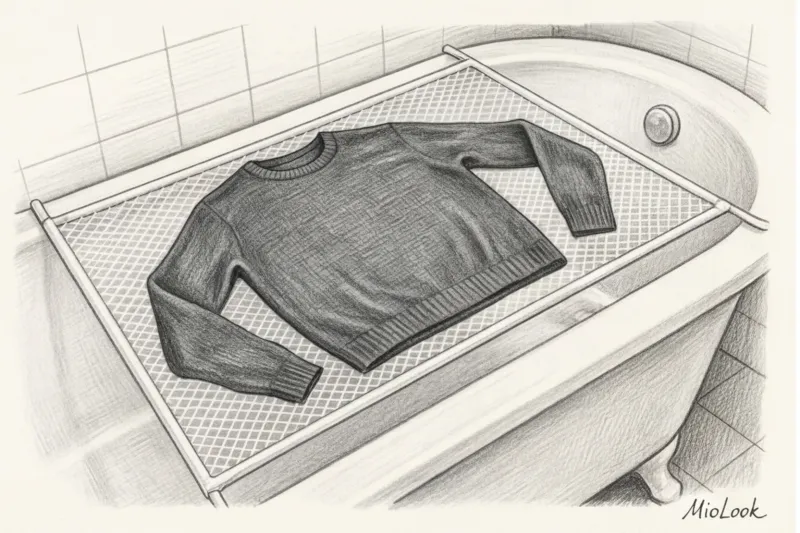
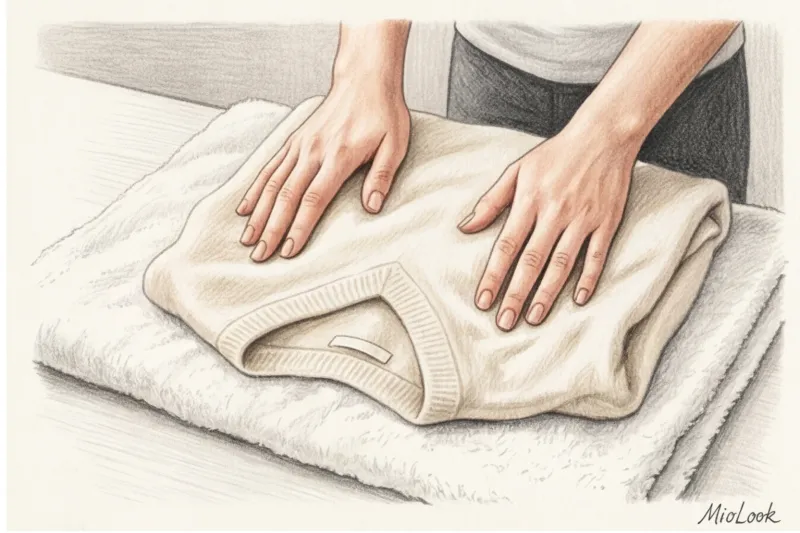
The process of removing water also has its own anatomy. Avoid wringing—this physically breaks the thread. Use the "dry towel rule": lay the damp sweater on a thick terry towel, roll them together into a tight roll, and press gently. The towel will absorb 80% of the moisture.
Drying clothes on a radiator or a regular clothesline is not recommended (it will leave creases). Buy a special horizontal drying rack for sweaters (they cost around €15–20)—it provides 360-degree air circulation.
Your perfect look starts here
Join thousands of users who look flawless every day and organize their wardrobe with MioLook.
Get access — €0.99 onceFighting pilling: Pilling is not a sign of cheapness
Now let's dispel another stigma. Pilling isn't a sign you've been sold a cheap item. Paradoxically, the most expensive 100% mountain goat cashmere will pill faster than a cheap wool blend with stiff acrylic.
The physics behind the process are simple: pilling is the natural release of short, unspun fibers in very soft yarn. It occurs in areas of high friction: where a crossbody bag strap rubs against your side, under your arms, or from a car seat belt.
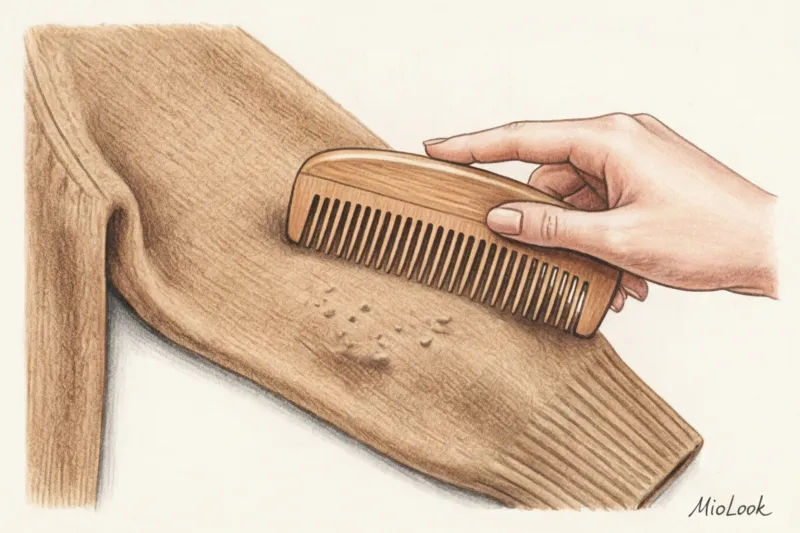
How to combat this? Many people swear by electric pilling clippers. But be careful: they're fine for a thick cardigan, but a thin merino turtleneck can be easily cut through, catching the thread. For delicate fabrics, I always use a special wooden cashmere comb or a professional pumice stone. It takes five minutes longer, but it guarantees the garment's safety.
Seasonal preservation: protection from moths and loss of volume
Have you ever noticed how your favorite winter sweater becomes flat and stiff after using vacuum bags? Vacuum bags are the death knell for premium wool. Under pressure and without air, the elastic, spiral-shaped fibers of wool break. After one such winter, an item can permanently lose up to 30% of its natural volume.
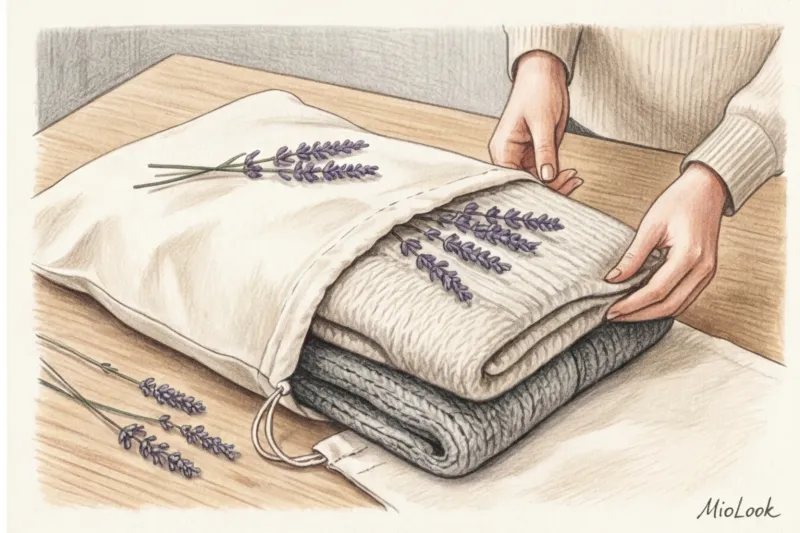
The right packaging for seasonal storage is breathable trunks made of undyed cotton or linen. And the main rule: you can put them away for the summer. only washed items Even if you've only worn a sweater once and it doesn't smell, moths don't eat wool itself—their larvae feed on microscopic particles of human skin and sweat left behind in the fibers.
As for repellents, forget about toxic mothballs. Use natural cedar blocks. To ensure they last year after year, lightly sand them with fine-grain sandpaper before each season—this will renew the release of essential oils.
Stylist's Checklist: A Knitwear Wardrobe Care Routine
Wardrobe maintenance doesn't have to be a chore. Over the years, I've developed a comfortable routine that keeps my clothes looking new.

- Daily habit: After taking off your sweater after work, don't put it away in the closet right away. Hang it over the back of a chair in a ventilated room for 24 hours. Animal fiber can self-clean and regain its shape if allowed to "breathe."
- Weekly: Do a quick visual inspection of friction areas. It's easier to remove three pilling combs today than to shave the entire sweater in a month.
- At the end of the season: Perform a washing ritual: measure items before they become wet, dry them on a grid, remove the pilling, and place them in cotton bags with cedar.
Knitwear is the most vibrant part of your closet. Treat it not as a piece of fabric, but as a material that requires moisture and air. To always know exactly which sweaters you already own and what to pair them with, try digitizing your shelves using smart wardrobe feature in MioLook When you have your things in plain sight, putting together stylish and cozy looks becomes a matter of minutes.