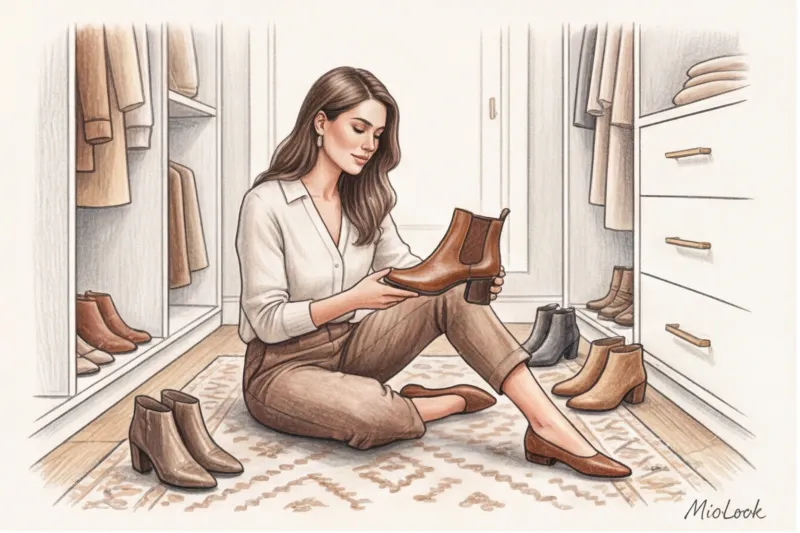
I was once invited to sort through the wardrobe of a client who had just completed a luxurious renovation. The new closet cost her approximately €15,000. Do you know what the main architectural tragedy of this space was? Perfect designer pumps and expensive boots were simply dying on the standard 60-centimeter-deep shelves. Shoes in the back row were covered in a thick layer of dust, and to find the right pair before going out, you had to rush and play Tetris.
Proper shoe storage in your closet isn't about buying identical transparent boxes on marketplaces. We've already covered closet architecture in more detail in our The complete guide to the perfect walk-in closet layout , but a shoe section requires a fundamentally different approach. As a stylist with 14 years of experience, I'll show you how to design shelves for real shoes, not for the convenience of cutting furniture boards.
Digitizing your shoe inventory: where to start storing shoes in your closet
The worst thing you can do is tell a cabinetmaker, "Build me a shoe rack here," and then go get some coffee. The craftsman will design it based on standard material dimensions, not your needs.
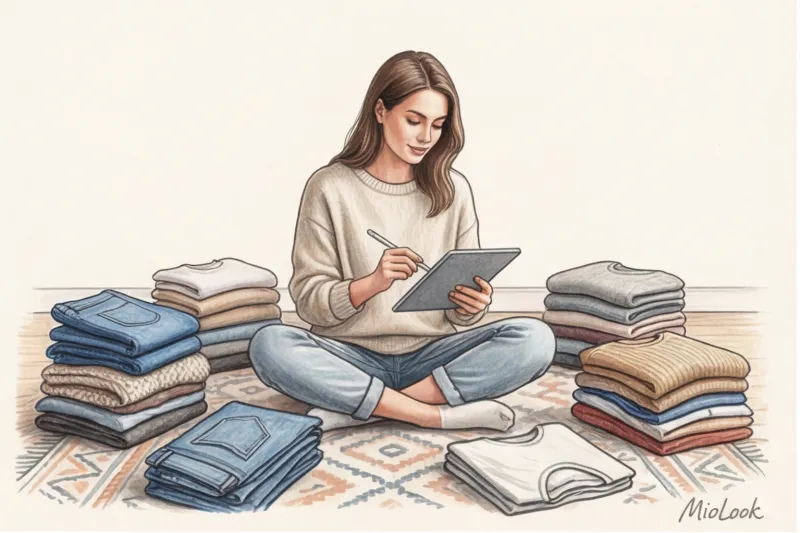
Before drawing shelves, you need to take a complete inventory. I always have my clients pull out all their shoes and separate them into three categories:
- By season: winter, mid-season, summer.
- By height: over-the-knee boots/high boots, ankle boots/high-tops, low shoes/sneakers.
- By frequency of use: Daily base, sports, evening outings.
It helps a lot here MioLook You can take photos of your pairs, add them to your virtual closet, and see how many sneakers and heels you have. This immediately gives you an idea of the height of shelves you need the most.
Create a "shoe core" by identifying the most accessible hot spot between your waist and chest. This should contain 5-7 pairs of the current season that you wear weekly. Everything else is distributed above or below.
The 60-Centimeter Trap: Why Standard Shelves Don't Work
The standard wardrobe depth is 60 cm (to accommodate coat hangers). Furniture makers often, out of habit, make shoe racks the same depth. This is a fatal mistake.
Women's shoes rarely exceed 27–28 cm in length. A shelf 60 cm deep creates a dead zone. You start stacking shoes in two rows. You stop wearing the shoes in the back because you simply can't see them. The ideal shelf depth for women's shoes is 30–35 cm, and for men's shoes, 40 cm. If your closet is deep, use pull-out mechanisms, otherwise the back row will turn into a graveyard of forgotten shoes.
The biggest myth of interior design magazines: why open storage kills shoes
Pinterest and glossy magazines have conditioned us to dream of a boutique-style dressing room—massive floor-to-ceiling shelving, flooded with light, where every pair is on display. I'm here to shatter this illusion: open storage is the worst thing you can do for your favorite shoes.
I had a painful experience. A client had beautifully displayed her collection of pumps (including suede Manolo Blahniks) on an open shelf directly in front of a window. Six months later, we discovered that the side of the shoes exposed to the light had faded two shades. The shoes were hopelessly ruined.
UV rays and even powerful halogen lamps in the dressing room can discolor suede and nubuck within 3-6 months. Furthermore, household dust clogs the pores of genuine leather and textiles, drying them out. The Italian tanners' guild, Assomac, clearly states in its standards that genuine leather requires protection from direct light and fluctuations in humidity.
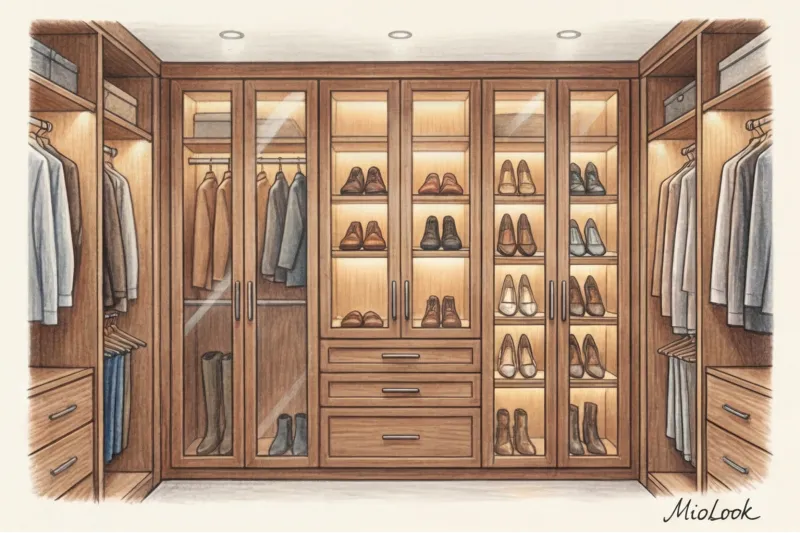
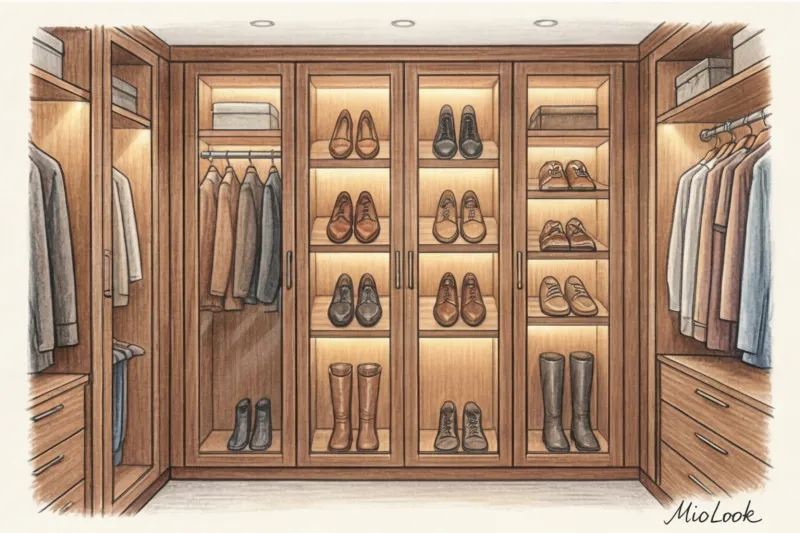
The perfect compromise: Cabinets with tinted glass fronts. You can see your collection (important for quickly assembling a look), but it's protected from dust and harsh light.
Ergonomics and dimensions: planning the ideal shoe storage in the dressing room
If we turn to Ernst Neufert's classic architectural design guide and adapt its standards to modern dressing rooms, we obtain strict rules for the ideal view.
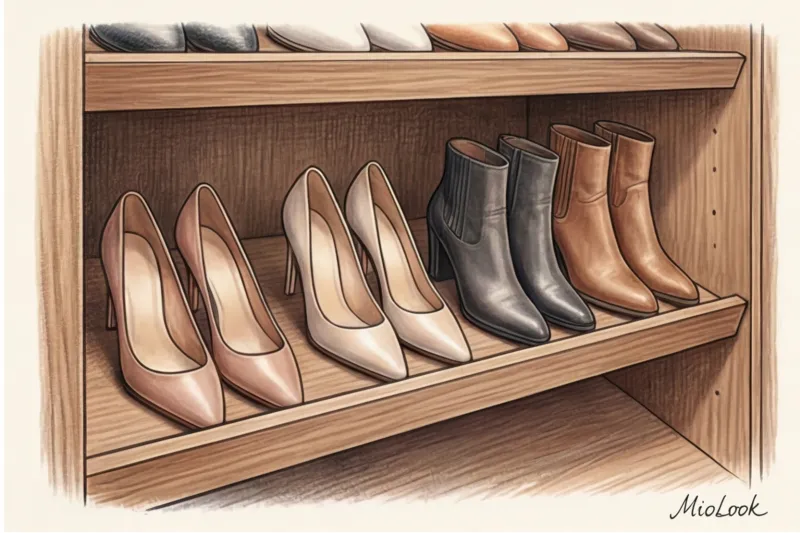
The main debate always revolves around straight versus inclined shelves. Straight shelves are cheaper and hold more, but if they're positioned below knee level, you only see the toes of your shoes. The optimal solution for the hot zone and lower tier is inclined shelves at a 15-20 degree angle with a small edge to stop them from sliding. This angle is ideal for viewing and prevents the heel from deforming under the weight of the shoe.
Winter boots and over-the-knee boots
For tall boots, you'll need sections between 45 and 60 cm high. Never store tall boots folded in half—this will quickly cause irreparable creases in the ankle area, and the zipper may fail.
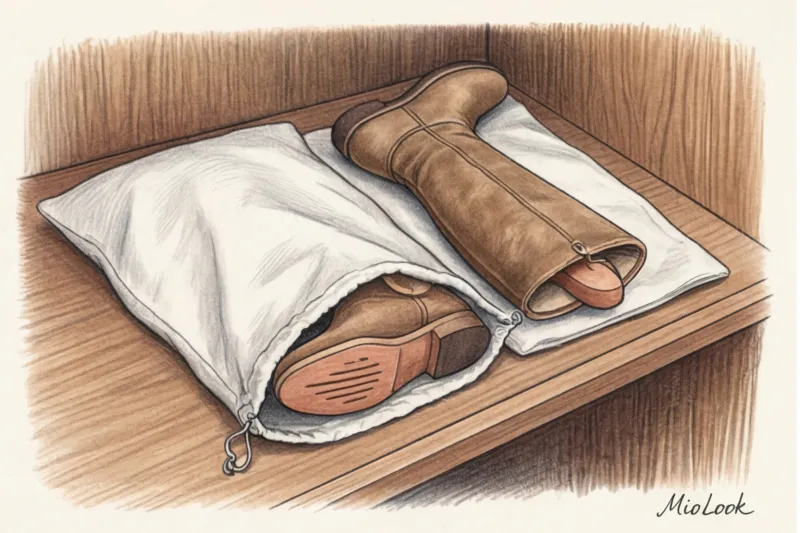
To keep the shaft straight, use shoe trees. If you're on a budget, avoid plastic tree trees—it's better to insert a rolled-up glossy magazine or special inflatable inserts inside.
High heels and casual shoes
For pumps, loafers, and sneakers, a distance of 15–20 cm between shelves is sufficient. Most people use the standard 25–30 cm shelf spacing, wasting a huge amount of usable space.
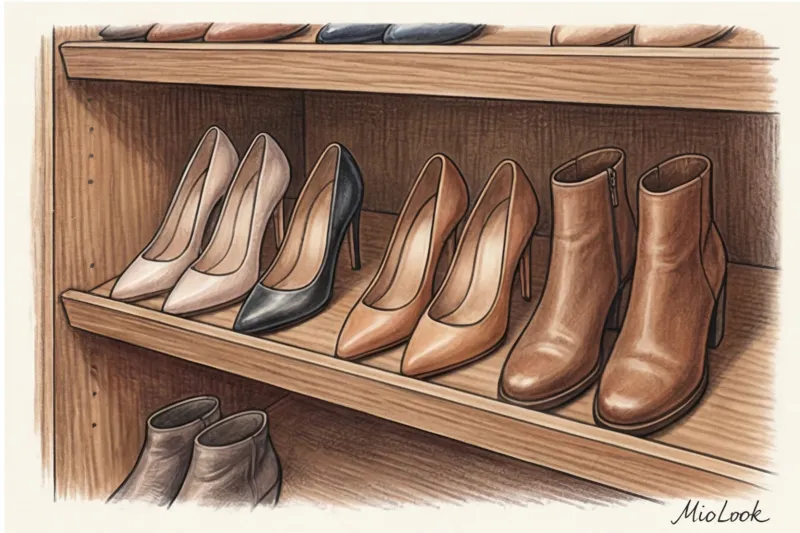
There's an elegant life hack for stiletto heels: thin metal rails on the back of the closet that the heels of your shoes can hook onto. It looks stunning and saves space.
Your perfect look starts here
Join thousands of users who look flawless every day with MioLook. Digitize your wardrobe in just a few clicks.
Get access — €0.99 onceSeasonal Rotation: How to Store Shoes So They Last Until Next Year
My statistics are relentless: about 80% of women ruin good shoes during seasonal storage, not while wearing them. Throwing dirty shoes in a plastic bag for six months is a surefire way to end up with dried-out leather and mold in the spring.
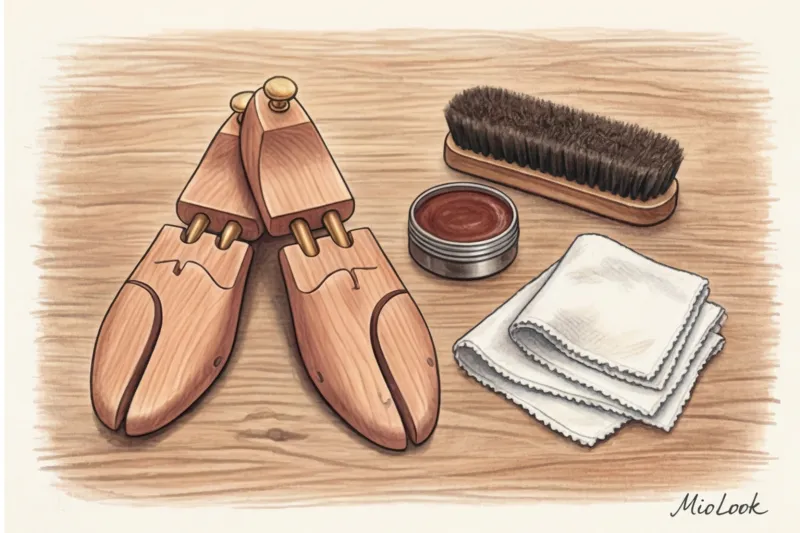
Before putting your shoes into hibernation, they should be washed, thoroughly dried away from the radiator, and generously treated with cream or wax (except suede). Each leather pair should always have shoe trees inserted into it. I highly recommend cedar ones (they can be found for €30-€50). Unvarnished wood absorbs residual moisture from the lining and has a mild antibacterial effect.
Why Plastic Containers Are the Enemy of Genuine Leather
Transparent plastic boxes are all the rage on marketplaces right now. Sure, they protect against dust and are easy to stack. But they're detrimental to natural footwear.
Air circulation is impaired in solid plastic. The slightest temperature change in the room causes micro-condensation to form inside the box. The greenhouse effect leads to the adhesive drying out and, in the worst case, mold growth.
Important exception: Plastic boxes are great for storing synthetic sneakers, rubber boots, or flip-flops. However, for leather Oxfords, only cardboard boxes with holes, cotton dust bags, or breathable spunbond cases are suitable.
Smart organizers and life hacks for small closets
Not everyone has the luxury of dedicating an entire wall to shoe storage. If you're working with limited space, you need to make every cubic centimeter of your closet work.
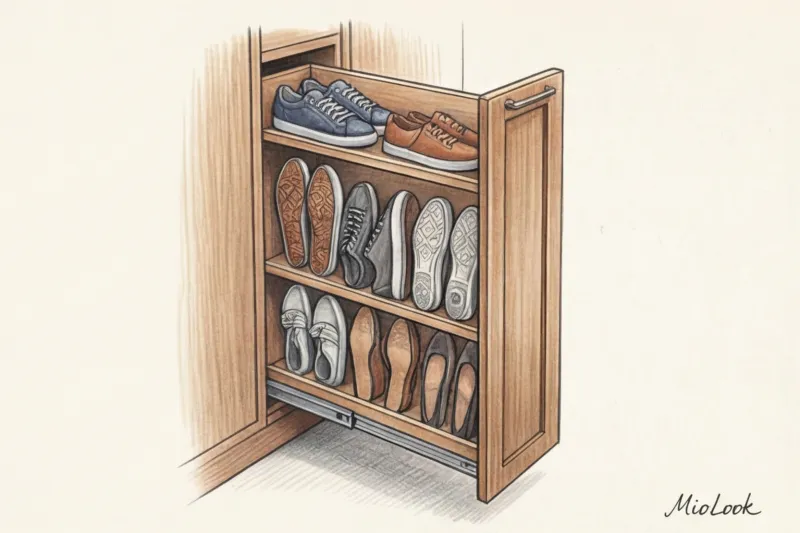
Here is my personal ranking of space saviors:
- Pull-out vertical systems (cargo). They're only 20-30 cm wide, but can hold up to 10-12 pairs when stored sideways. Ideal for narrow spaces that are typically left open when designing a closet.
- Twin organizers. These plastic stands allow you to stack one shoe on top of another (like a jack). They instantly double the capacity of a regular flat shelf. They only work with flat shoes (sneakers, slip-ons, and ballet flats).
- Hanging fabric cases. If you have extra space on your clothes rail, hang a soft, compartmentalized trunk there. These are perfect for storing soft summer espadrilles, fabric ballet flats, and house slippers.
Checklist: 5 Steps to the Perfect Shoe Closet
Any theory is dead without practice. If your shoe inventory is currently a mess, take these 5 steps this weekend:
- Conduct a ruthless audit. If you haven't worn shoes for two years, haven't been to a repair shop, and the lasts are uncomfortable, donate them to charity or throw them away. In the article Where to recycle clothes and shoes We have described this process in detail.
- Divide the remainder. Separate strictly seasonal items (winter moon boots, beach sandals) from all-season items (office pumps, basic white sneakers).
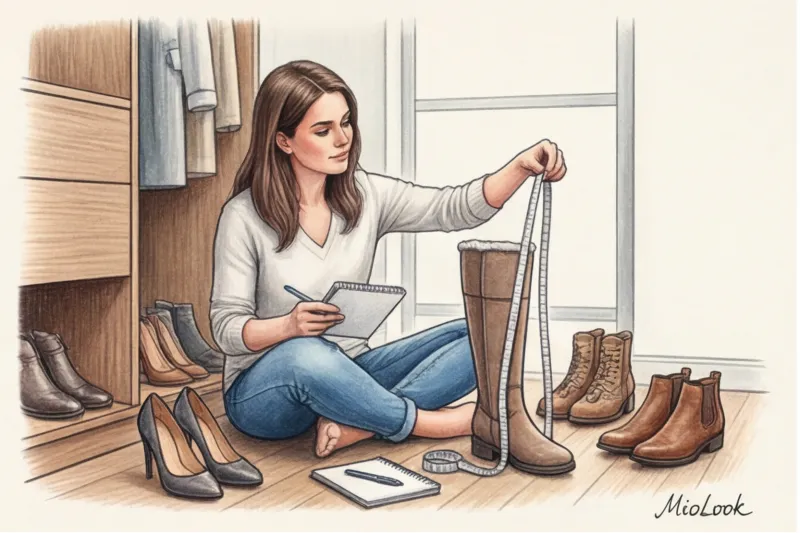
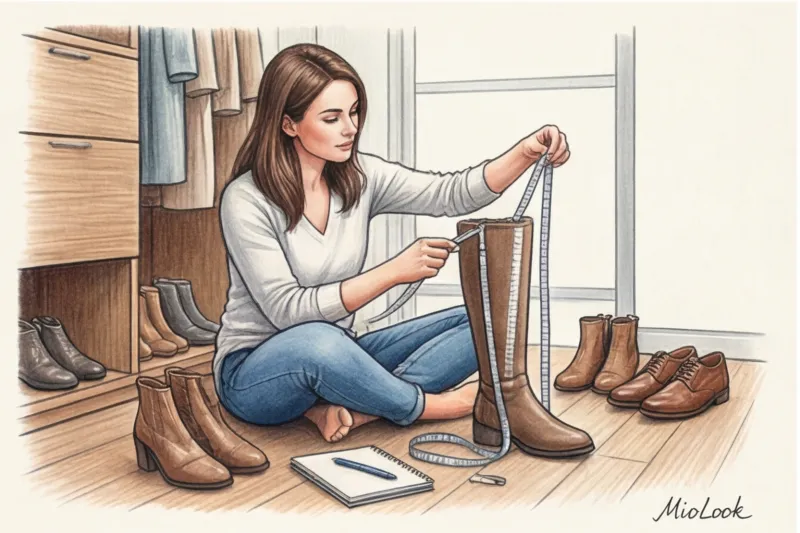
- Measure the dimensions. Take a tape measure and measure the height of your tallest boots and the length of your largest man's shoe. Order your furniture with these numbers in mind.
- Purchase the correct inventory. Cedar shoe trees for expensive leather, breathable cotton dusters and shaping inserts for boot shafts.
- Set up a "hot zone". Place 5-7 of the season's most popular pairs at eye level and at arm's length. You should be able to reach them in one second without bending over or standing on tiptoe.
Think of organizing your storage not as a boring chore, but as an investment in your style. A pair of beautiful, high-quality shoes can save even the most basic outfit, but only if they look impeccable and not like they've been languishing at the bottom of a dark drawer for six months, buried under a pile of other items.