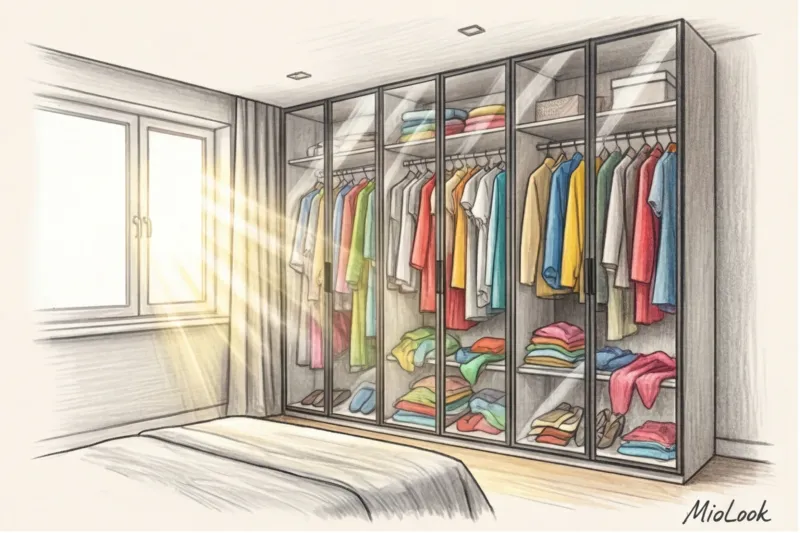
Last year, a client came to me in utter despair. She had just completed a renovation of her new Milan apartment, where a luxurious custom-made €8,000 walk-in closet became the focal point of the bedroom. The cabinet makers had thought of everything: illuminated shelves, glass fronts, velvet jewelry trays. They'd forgotten just one detail—a range hood. Just three months later, in the fall, her suede shoe collection was covered in a whitish film of mold, and the lingering smell of an old basement hung in the air. We covered the architectural nuances in more detail in our The complete guide to the perfect walk-in closet layout , but today I want to talk about physics.
Wardrobe ventilation isn't just a boring engineering task for builders. It's a critical factor in preserving your clothing investment. In this article, we'll explore the relationship between proper hanging, the right microclimate, and the longevity of your favorite pieces.
Why ventilation in a windowless walk-in closet is a matter of investment safety
Let's face it: a windowless walk-in closet is like a sealed cube. When you wear something for even just a couple of hours, the fabric absorbs your body's natural moisture and skin microparticles. If you return the item to a closed space without refreshing the air, the humidity inside the closet begins to rise rapidly.
The musty smell that many mistake for a "natural closet odor" isn't just discomfort. It's an indicator of active bacterial and microscopic mold growth. Cabinet makers design closets in terms of beautiful facades and drawer ergonomics; the microclimate isn't their responsibility. That's why saving your closet falls on your shoulders.
Saving money on installing a simple €20 ventilation grille often costs you a favorite cashmere sweater worth €150. The math is simple: it's cheaper to keep the air moving than to replace a damaged base each season.
According to museum textile storage standards (ICOM recommendations), the optimal humidity for preserving natural fibers is 45–55%. In a closed wardrobe after a rainy day, this level can reach 75–80%, turning your closet into a tropical greenhouse.
Access to MioLook for €0.99 — one-time payment
A smart AI stylist will help you find the perfect look and organize your closet to give your clothes a chance to breathe.
Get access — €0.99 onceThe main myth: fragrances and sachets will save you from odor
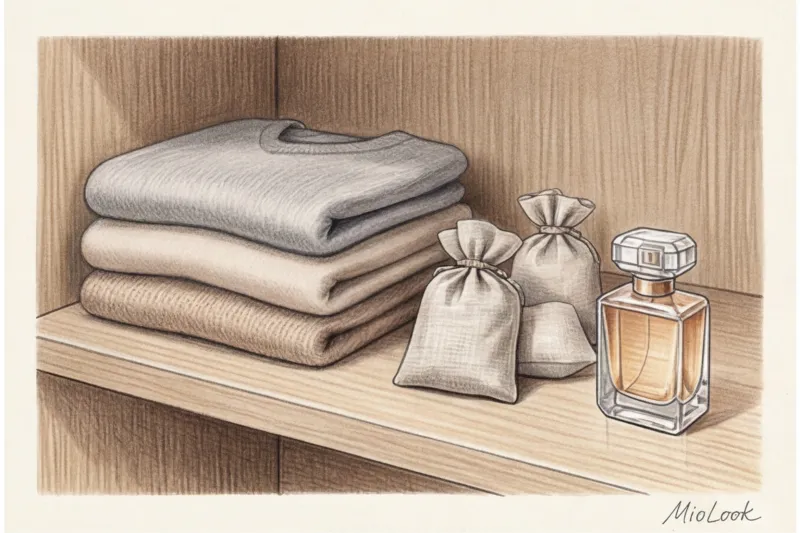
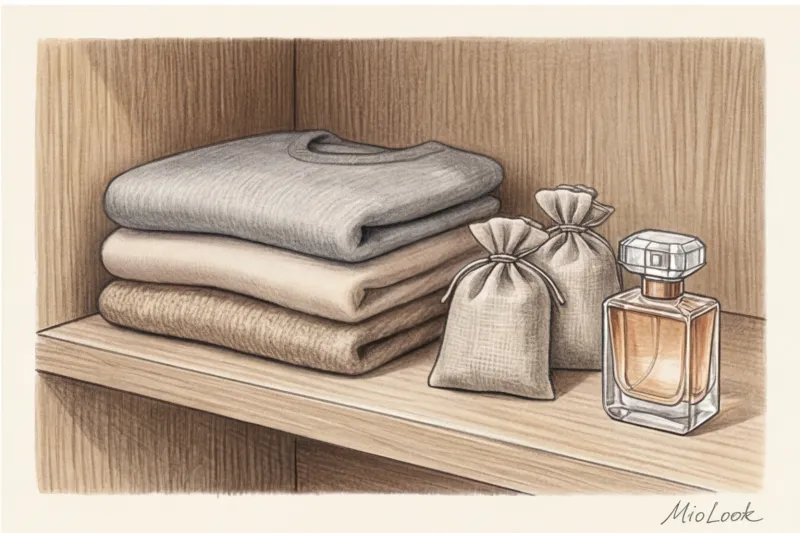
One of the most common mistakes I see in practice is trying to "mask" the problem with home fragrance. Clients buy expensive diffusers, pack lavender sachets, and spray liberally with textile sprays in the hopes of restoring their freshness.
It doesn't work. In fact, it makes things worse. Natural fibers—wool, cotton, linen—are porous. They act like microscopic sponges. A mixture of stagnant, moist air, bacteria, and expensive perfumes penetrates the fabric fibers, creating an incredibly long-lasting "cheap vintage store" effect.
Viscose and wool blends from mass-market clothing (such as basic Zara or H&M lines) are particularly sensitive to aerosols in humid environments. The chemical components of fragrances can react with fabric dyes in high humidity, causing discoloration at the folds. Remember: masking a problem is never a solution. Clean air has no odor.
Technical Solutions: How to Make Air Move
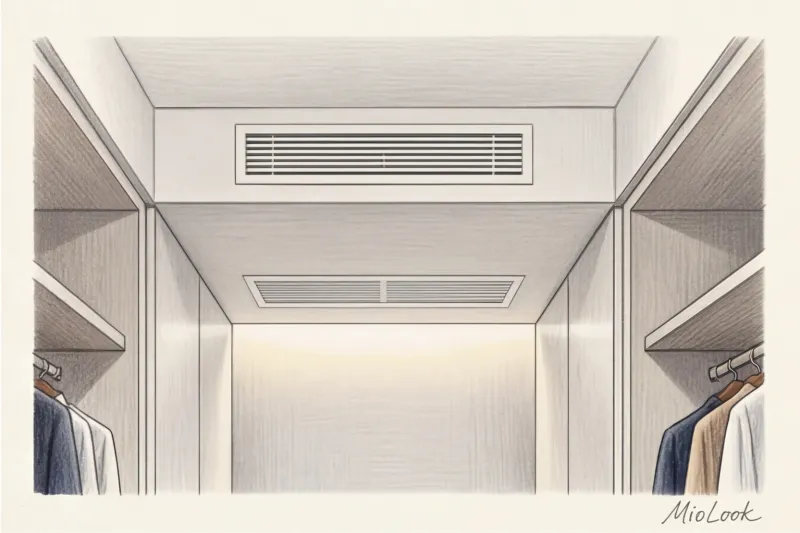
A basic rule of physics states that for stale air to leave a room, fresh air must come in from somewhere. You can't simply place an exhaust fan in a closed room and expect a miracle—it will just run idle, creating nothing but noise.
The ventilation system must be planned strictly before ordering furniture. If the cabinets are already mounted to the ceiling, installing a ventilation duct will cost several times more.
Passive ventilation: door gaps and transfer grilles
For small walk-in closets (up to 3 square meters), properly designed passive ventilation is often sufficient. The most important rule often forgotten when installing doors is that a walk-in closet door should never be flush with the floor. Leave a so-called "overflow gap"—a gap of 1.5–2 cm between the floor and the bottom edge of the door.
If your walk-in closet is integrated directly into your bedroom, louvered doors are the ideal solution. They not only look stylish and add a relaxed European feel to the space, but also provide a constant flow of air throughout the entire closet.
Active exhaust: when you can't do without a fan
Passive ventilation doesn't work If your walk-in closet is larger than 3 square meters or adjoins the bathroom (which is common in modern master bedroom layouts), moisture from the shower will immediately migrate to your clothes.
In such cases, an active exhaust system is necessary. Installing a low-noise duct fan (costing around €50-100) will solve the problem completely. In my experience, the best option is to synchronize the fan with the light switch, but set the timer to delay shutting off for 15-20 minutes after you leave the room.
Your perfect look starts here
Join thousands of users who look flawless every day with MioLook. Digitize your wardrobe and create capsule collections in one click.
Get access — €0.99 onceThe Bermuda Triangle Fallacy: How Hanging Density Kills Circulation
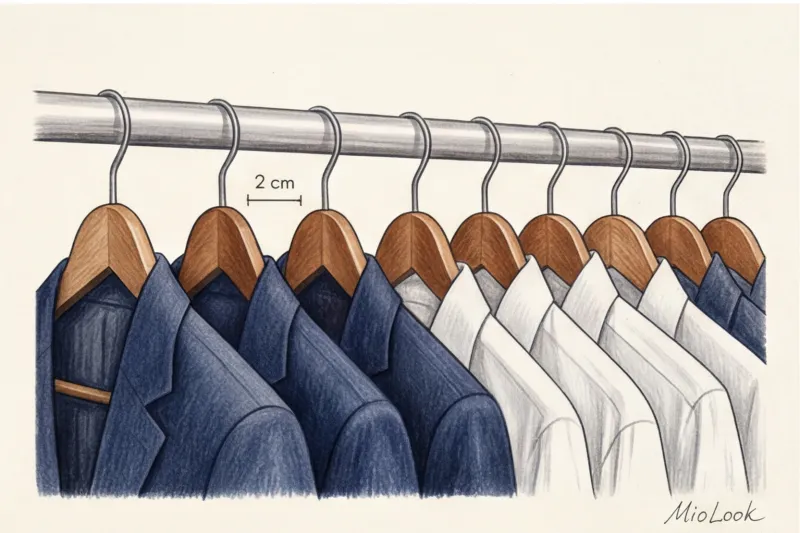
You can install the most expensive Swiss HVAC system, but it will be completely useless if the clothes on the clothes rail are so tightly packed that you can't fit your hand between them. I call this the "Bermuda Triangle of the wardrobe" effect—things get in and out of your sight, losing their shape and acquiring a musty smell along the way.
Over 12 years as a stylist, I've seen hundreds of closets where excellent Massimo Dutti jackets and heavy COS shirts were losing their shape solely due to poor air circulation. Moisture doesn't evaporate for weeks in areas where fabrics touch.
This is where it comes into effect The 2-centimeter rule Air must circulate freely between hangers. The minimum gap is 2-3 cm. This can be achieved in two ways: either by increasing the closet's area (which is rarely possible) or by reducing the number of items.
That's why planning a walk-in closet should always start with a thorough analysis. I recommend using the digitization function in the MioLook app When you see your entire wardrobe on your smartphone screen, it becomes clear which 20-30% of items you haven't worn in years. By removing them, you'll create those airy corridors for the clothes you truly love.
And another absolute no-no: never store items in plastic dry cleaners' bags. They create a greenhouse effect, trapping residual perchloroethylene vapors and moisture. Remove the plastic as soon as you bring the item home.
Microclimate for different fabrics: who suffers first?
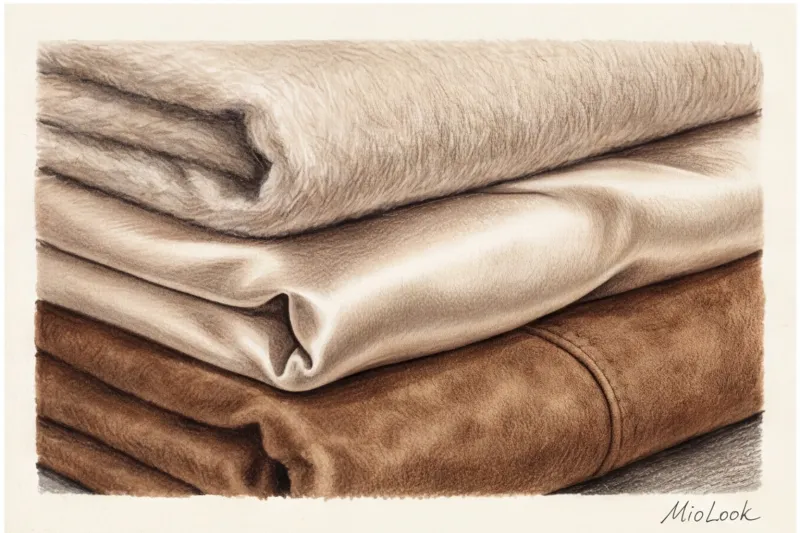
Different materials react differently to oxygen deficiency and excess moisture. Knowing these characteristics will help you organize your closet properly:
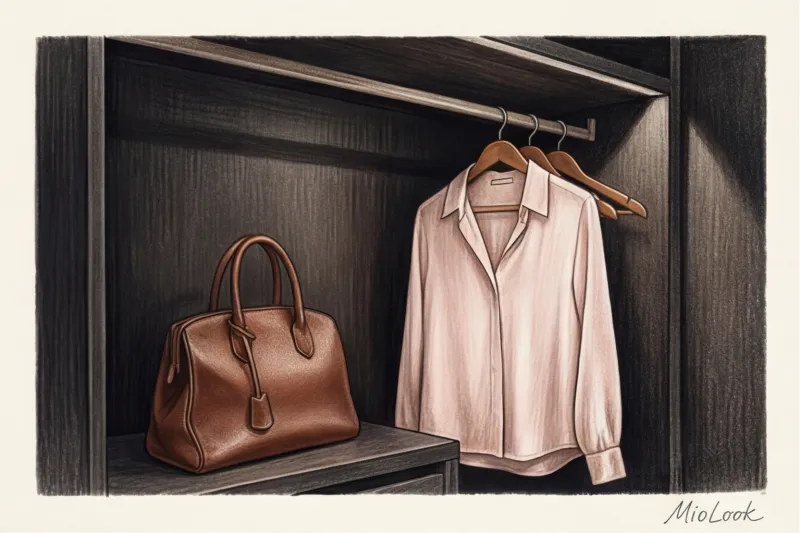
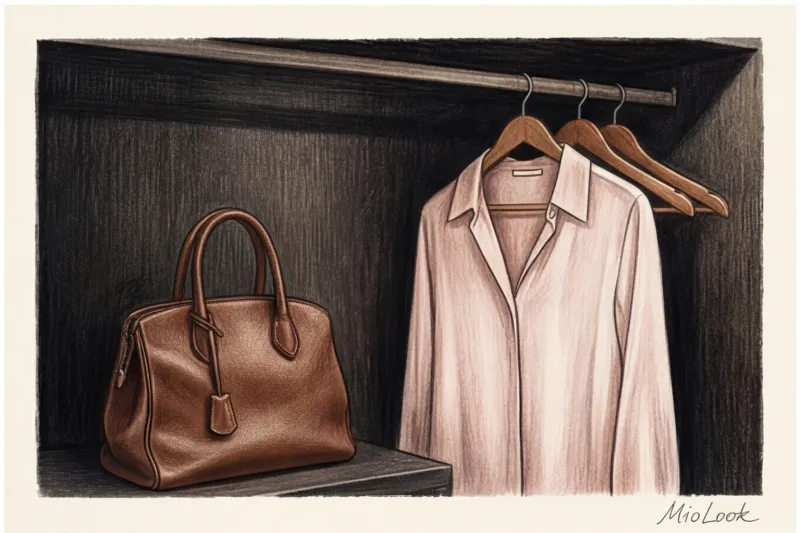
- Leather and suede: At humidity levels above 60% and without ventilation, active fungal growth begins on genuine leather, appearing as a white, powdery coating. This is especially true for bags and shoes stored on lower shelves, where air circulation is minimal.
- Cashmere and wool: Did you know that moths don't feed on clean fur exposed to light? Moths thrive on damp, slightly soiled fur (even with invisible sweat particles) found in dark, unventilated corners. Stale air is a signal for them to breed.
- Silk and viscose: These delicate fabrics lose their tensile strength when exposed to musty conditions for extended periods. White silk, exposed to poor ventilation and high humidity, inevitably develops persistent yellow stains (called "fiber oxidation").
Katarzyna's Checklist: 7 Steps to Freshness in a Closet
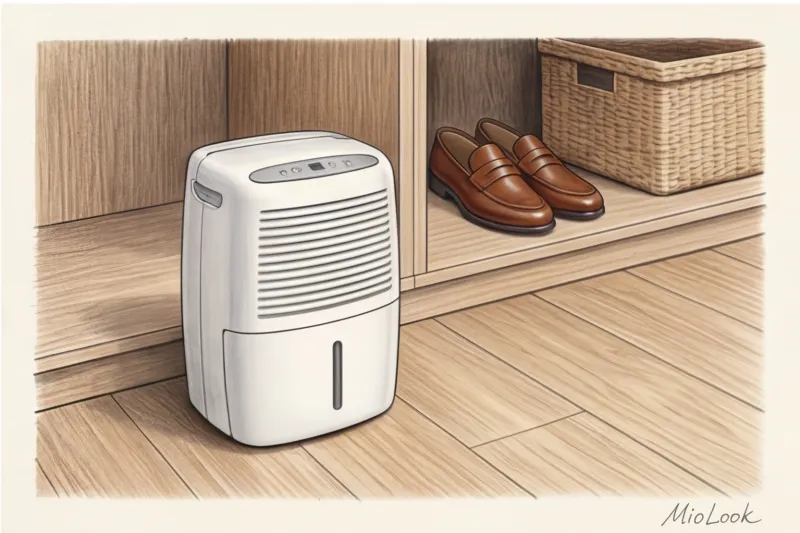
If a major renovation with ventilation duct installation isn't on your radar right now, you can significantly improve the situation with better household habits. Here's my personal checklist that I give to every client after a wardrobe review:
- Quarantine rule: Never hang slightly damp (after rain) or worn-even-once items directly into the closet. Let them air out on an open floor hanger in your room for at least 12 hours.
- Localized moisture control: Place compact desiccant containers (calcium chloride containers) or large silica gel sachets on the lower shelves and corners of your closet. You'll be surprised how quickly they fill with water.
- Breath for shoes: Replace solid shoe racks with wire mesh structures. Shoes retain moisture the longest.
- Proper seasonal storage: Store out-of-season items only in breathable bags made of spunbond or cotton. Vacuum bags are only suitable for down jackets, and then for no more than 6 months—natural fabrics suffocate and lose their elasticity in a vacuum.
- Ventilation according to schedule: Keep the closet door fully open for at least 30 minutes each time you clean your apartment.
- Air corridors: Take stock of your closet, replace thick wooden hangers with thin velvet ones, and remove 20% of your outdated items. Air should flow around every item.
- Natural repellents: Ditch the chemical perfumes and opt for natural cedar wood blocks. They not only repel moths but also absorb excess moisture without leaving a lingering odor on your clothes.
Ready to get started?
Try a free plan at MioLook—no commitments required. Digitize your items, get rid of excess, and give your wardrobe a fresh start.
Get access — €0.99 onceConclusion: A smart wardrobe should breathe
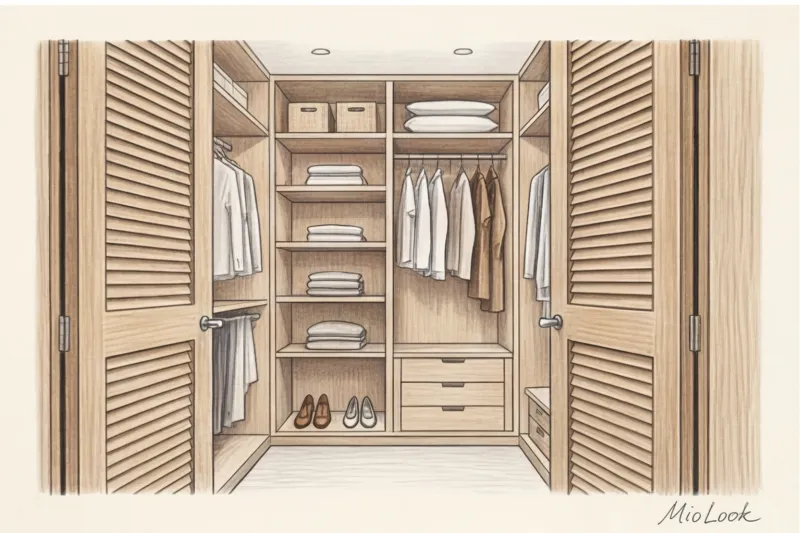
Wardrobe ventilation isn't a one-time option you can simply buy and forget about. It's a comprehensive system consisting of the right ventilation openings, carefully selected furniture, and, most importantly, your daily clothing storage habits.
Before calling a ventilation specialist and cutting grooves in your walls, count your belongings and critically evaluate the density of your hanging space. Often, the solution isn't a powerful fan, but an honest conversation with yourself about how much clothing you really need. Remember my main rule: every item deserves a place in your closet and a breath of fresh air.