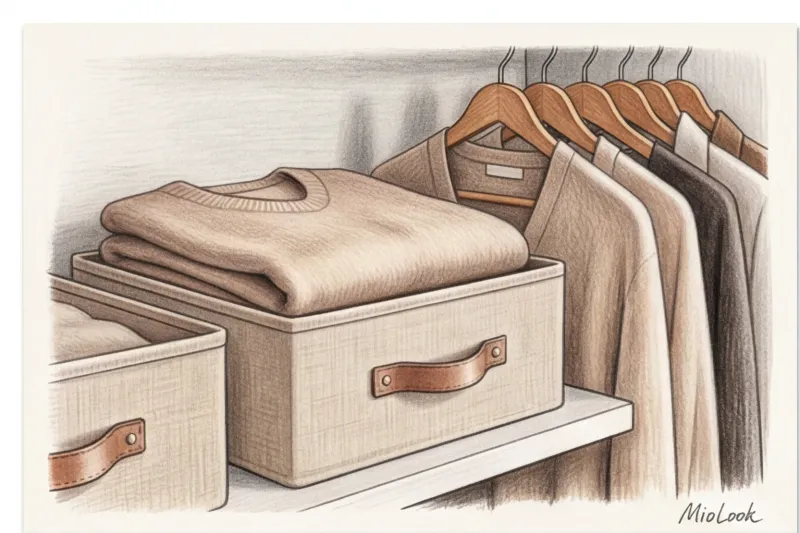
One of my clients in Milan spent €8,000 on a luxurious dark wood walk-in closet. It was truly "heavy luxury," with symmetrical sections and monumental shelves. Two years later, she traded the strict dress code of a bank for a flexible schedule at an IT startup. And guess what? Her new oversized hoodies, long down jackets, and oversized jackets simply couldn't fit into the narrow, rigid niches for blouses and pencil skirts. The monolithic closet refused to adapt to her new life.

It's commonly believed that massive wardrobe storage systems made of chipboard or custom wood are a status symbol. In practice, however, for today's dynamic style, they're a real static trap. According to statistics from European resale platforms for 2024, over 80% of women radically change the proportions of their clothes (lengths, volumes) every 3-5 years. Your closet should be prepared for these changes.
We talked about the first stage of creating such a space in more detail in our The Complete Guide to the Perfect Walk-in Closet Layout: Where to Start Today, we'll explore the key technical question: which to choose—mesh, modular profile, or classic chipboard—by evaluating each option through the lens of "Cost per Change."
The main illusion of renovation: why you shouldn't start choosing a storage system for your closet with the design
Over 12 years of working as a style coach, I've realized one thing: the biggest mistake when planning a walk-in closet is calling a cabinet maker before you've taken stock of your belongings. Cabinet makers and closet designers focus on the symmetry of front panels, structural rigidity, and MDF cutting. They don't consider your morning habits.
This is where the notorious "Bermuda triangle" comes from—standardized shelves with a depth of 60 cm. This is the factory standard for closets, but for an open wardrobe, it's a disaster. You put a stack of sweaters behind it, and a blind spot forms, where T-shirts and scarves are forever lost. The rule of visual merchandising is that clothes should be stored in a single layer, and the ideal shelf depth for knitwear is 35–40 cm.
Your closet should adapt to your clothes, not fold your maxi dress in thirds because the rod is too low. Before creating beautiful renderings, digitize your wardrobe. To avoid doing this in Excel, I recommend my clients use the "smart wardrobe" feature in the MioLook app When you know for sure that you have 15 items longer than 120 cm and 40 bulky sweaters, the conversation with any contractor becomes substantive.
Chipboard and laminated chipboard: “heavy luxury” or a static trap for your things?
Classic cabinets made of laminated particleboard (LDSP) are the most popular and straightforward option for contractors. They create a sense of solidity, a boudoir-like space where every item has its own "home."
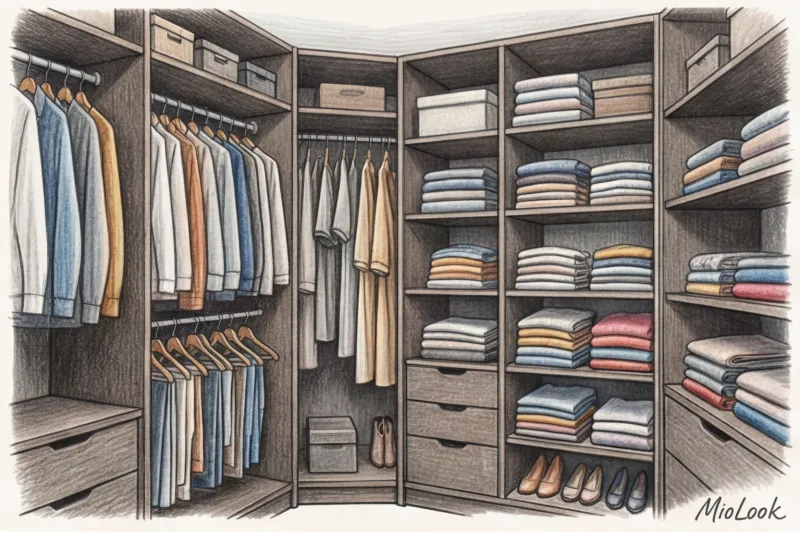
But let's do some space math. The standard thickness of a laminated chipboard wall is 16 mm, while premium options are 25 mm. If you have a small U-shaped walk-in closet of 4 square meters with six vertical sections, the partitions alone will take up to 30% of the usable wall space! You're literally paying for sawdust storage, not for your belongings.
When does this work? Chipboard structures are ideal for storing heavy, structured bags, a shoe collection in rigid boxes, and closed pull-out drawers for linens and accessories.
Hidden disadvantages of cabinet wardrobes
The main drawback of cabinet furniture is its lack of adaptability. Shelves are tightly fastened with screws (Euro screws) to maintain the overall cabinet's geometry.
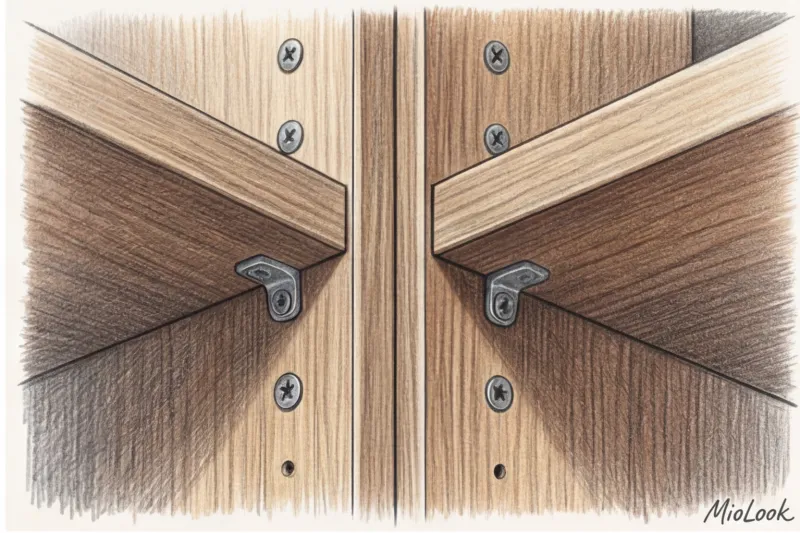
If you've bought a long coat, you can't simply lower the shelf—you'll need a screwdriver, new holes, and the old ones will have to be covered with plastic plugs, which always look cheap. Furthermore, closed, solid sections impede air circulation. In my experience, it's precisely in such closets that expensive cashmere and natural wool quickly develop a characteristic musty odor unless the room is equipped with forced ventilation.
Access to MioLook for €0.99 — one-time payment
A smart AI stylist will select the perfect look based on what's already hanging in your closet.
Get access — €0.99 onceMesh Wardrobe Storage Systems: Breathable Minimalism for a Smart Wardrobe
If chipboard is a floppy disk, then grid systems (like the Swedish Elfa or affordable alternatives like Larvij and systems from DIY hypermarkets) are cloud storage. Their principle is ingenious in its simplicity: a single horizontal support rail is attached to the wall, vertical posts are hung on it, and brackets for shelves, baskets, and rods are simply clicked into place.
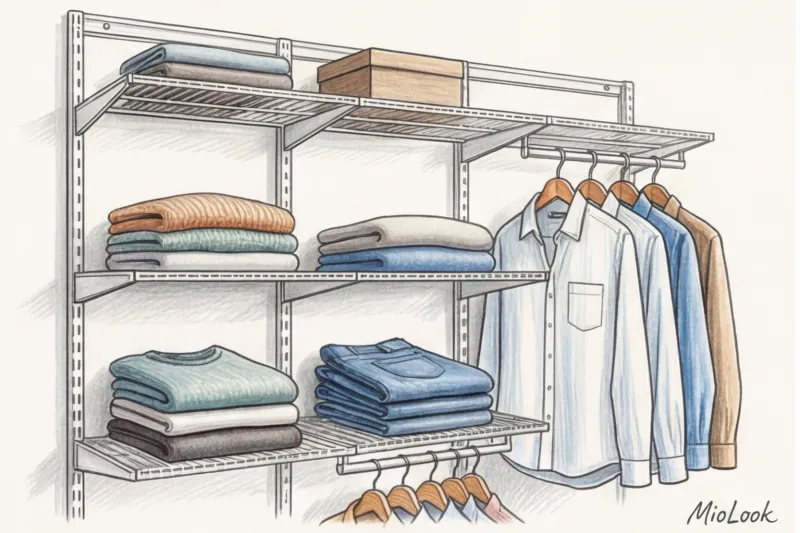
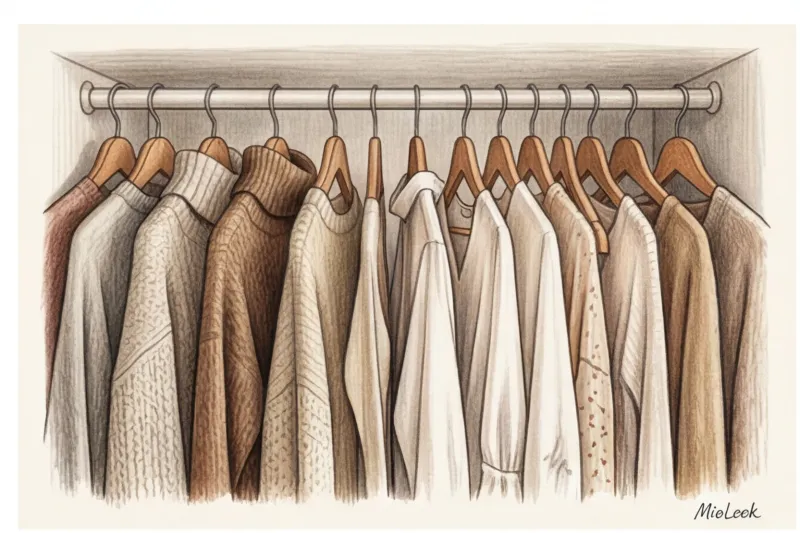
Mesh is knitwear's absolute best friend. Air circulates on all sides, preventing the fibers from clumping and reducing the risk of moth infestations (moths love the dark, unventilated corners of closed closets). Visually, the system blends in with the light wall. Your belongings, not your furniture, become the star of the space.
My personal life hack: I reconfigure my wire closet twice a year. In the fall, I lower the rods in 15 minutes, without a single tool, for long trench coats and overcoats, and in the spring, I raise them back up, freeing up space below for baskets with summer sandals and shorts.
The main myth about the cheapness of mesh shelves
Many people are afraid of mesh because of the stereotype: "It will look like a storage room in the garage." This is a misconception.
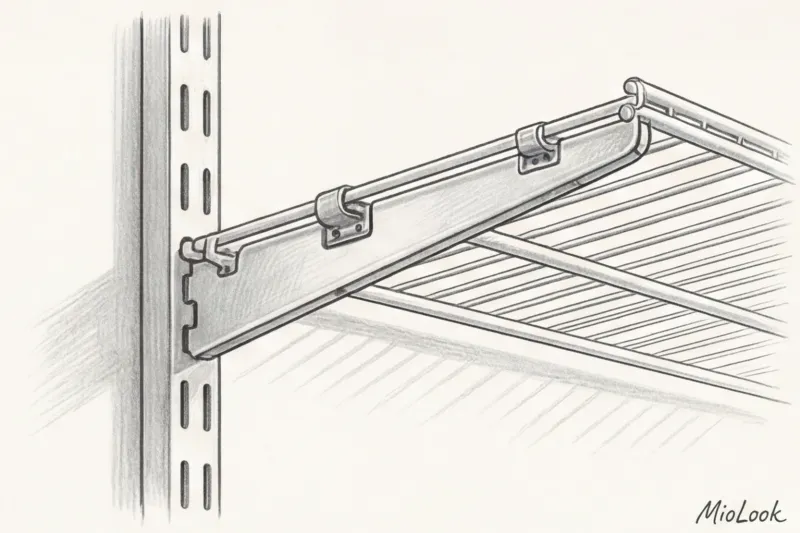
Firstly, modern systems allow for the installation of elegant wooden overlays (fascia) over the mesh, concealing the metal edge. Secondly, high-quality epoxy enamel is not scratched by hangers. And most importantly, load-bearing capacity. European standards stipulate that one good metal bracket can withstand up to 40 kg of distributed load. Chipboard shelves sag under weight faster than high-quality Swedish steel.
Modular systems on metal profiles: the golden mean?
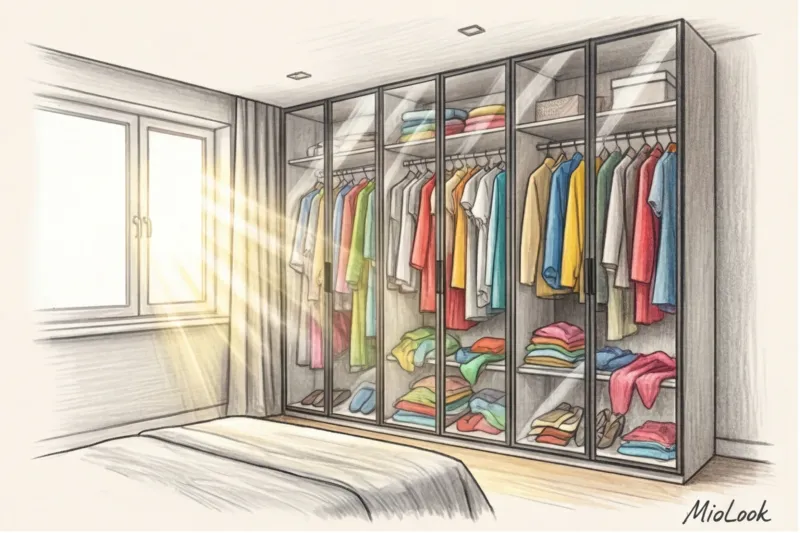
If you're looking for the aesthetics of Massimo Dutti or COS flagship boutiques in your own bedroom, consider profile systems. These are aluminum posts that can be mounted either ceiling-to-floor or wall-mounted. Glass, veneer, or painted MDF shelves are installed between them.
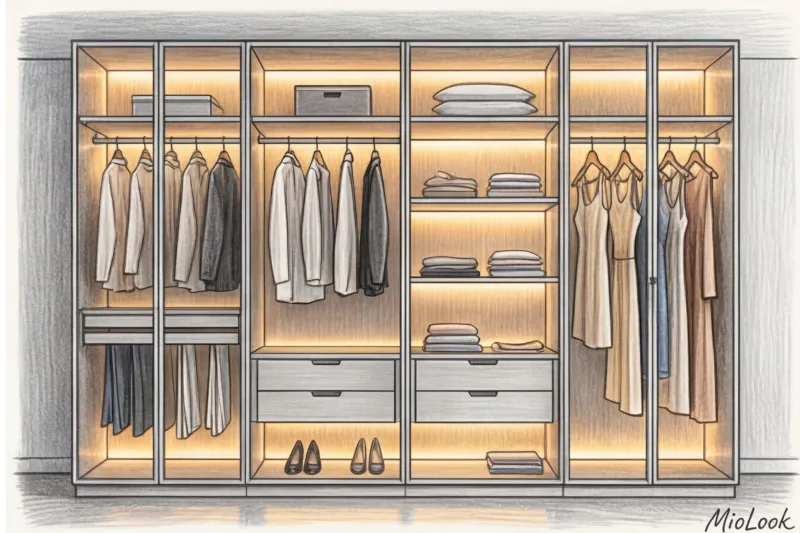
It's the perfect compromise between the airiness of mesh and the classiness of wood. Strict visual merchandising standards apply here: clothes on the rods are given ample airflow, and hidden LED lighting is often integrated into the aluminum profiles themselves, turning choosing an outfit into a ritual.
"Profile systems look incredibly expensive, but they have one severe technical limitation. Unlike curtain wall mesh, which tolerates uneven walls, profiles require perfect, mathematically precise floor and ceiling geometry. If you have a height difference of even half a centimeter, installation will be a nightmare."
— Katarzyna Nowak, style coach
Your perfect look starts here
Join thousands of users who look flawless every day with the smart MioLook organizer.
Get access — €0.99 onceThe battle of budgets and features: which one is right for you?
Let's talk numbers, which interior design magazines so often avoid. When planning a budget, I teach clients to consider not only the cost of materials, but also the concept. Cost per Change - How much does it cost to change the height of one shelf in a year?
Here's a rough breakdown (based on prices for high-quality components on the European market in 2024):
- Mesh systems: From €100 to €150 per linear meter. Cost per change = €0 (you simply change the shelf manually in 10 seconds). Ideal for rented apartments (the system can be taken with you, removed from the supporting rail).
- Cabinet wardrobes (chipboard): From €250 to €350 per linear meter for basic quality. Cost per change = a repairman call (from €50) or a damaged wall unit. Suitable for a stable wardrobe and dedicated large rooms where space is at a premium.
- Modular systems on the profile: From €400 to €800+ per linear meter (due to aluminum, glass, and lighting). Cost per Change = €0, but requires care (moving heavy glass shelves through the grooves is more difficult than light mesh).
If you're renting or planning to move in the next 3-5 years, investing in a custom-built chipboard wardrobe built to fit a crooked wall exactly to the millimeter is a waste of money.
Katarzyna's Checklist: 5 Questions to Ask Before Buying a Storage System
Before making a down payment to a contractor, honestly answer these five questions. This will save you hundreds of euros and a lot of stress when you move into your new closet.
- How many pieces of clothing do you have that are longer than 120 cm? (Coats, maxi dresses, long cardigans). If you have more than 10-15 pieces, you'll need a whole section with a tall rod, without shelves below.
- Are you ready to transform your closet as the seasons change? If yes, your choice is a hanging net.
- How much of your wardrobe is knitwear? If sweaters and cashmere make up more than 30% of your base, you absolutely need an open, ventilated system rather than closed drawers.
- Are the corners and walls in your dressing room ideal? If the walls are made of plasterboard or have a curvature, choose systems with fastening on one upper horizontal rail (it takes on the entire load).
- Are you planning to move? The mesh system is assembled in several boxes and moves with you. A chipboard cabinet loses its rigidity forever after the second disassembly and reassembly.
Summary: How the Right Storage System Affects Your Style
There's an ironclad rule in styling: "If you don't see it, you don't wear it." You can invest in amazing basics, but if they're buried in a deep, dark chipboard drawer under a stack of t-shirts, in your morning rush you'll end up wearing the same jeans and hoodie that were hanging over the back of your chair.

An adaptive wardrobe system—whether a smart, airy grid or a stylish metal frame—grows with your style, career, and lifestyle. Invest in flexible space, not rigid, sawdust-like rigidity. Allow your items to breathe, and allow yourself to easily reconfigure your closet to suit new fashion trends.