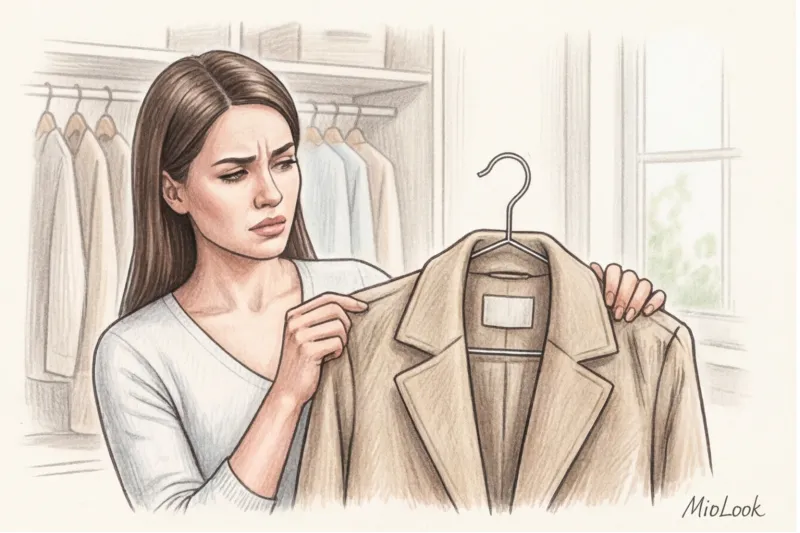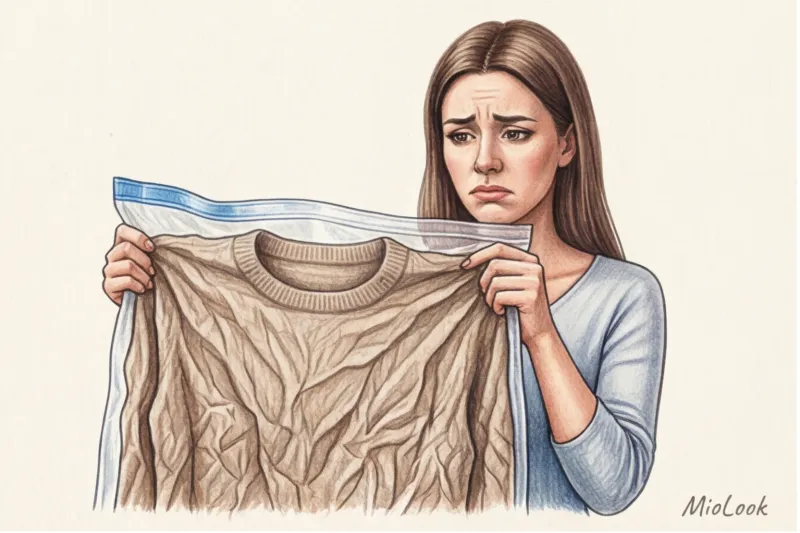
One of my clients, a top manager at an IT corporation, tearfully retrieved five Loro Piana sweaters from the attic. They had spent the entire summer there. To save space, she carefully folded them into vacuum bags and vacuumed them out. The result? Cashmere worth over €6,000 had turned into stiff, lifeless felt. The fibers were irreparably damaged. This incident forever changed my approach to properly storing out-of-season items.

We're used to thinking of the top shelves of our closets as a "black hole" where everything out of season gets shoved out of sight. But the mezzanine isn't a warehouse. It's your personal boutique, waiting for its moment. If you organize it correctly, you'll not only save your expensive fabrics from ruin, but also eliminate the stress of lack of space every morning. We covered this in more detail in our The complete guide to the perfect walk-in closet layout.
Forget the typical internet advice like "just wash and bag it." Today, we'll explore seasonal storage architecture from a professional style coach's perspective: from digitalization to strict museum textile standards.
The Anatomy of a Mezzanine: Why Storing Out-of-Season Items Starts with Analytics
Organizing a closet doesn't start with buying pretty boxes at a mass market, but with dry analysis. The top shelves are a strategic archive. In 12 years of sorting through closets, I've constantly encountered the phenomenon of "blind spots." If you don't see an item for more than three months, your brain genuinely believes it doesn't exist.
It's precisely because of these blind spots that we buy a fifth white T-shirt or a third pair of black ankle boots. To break this vicious cycle, we need to digitize our off-season wardrobe. to before it goes up. Calculate the volumes: how many bulky down jackets, how many pairs of shoes, how much thin knitwear do you have? Only with precise figures can you buy panniers.
"You can't organize what you don't control. Digitizing your wardrobe saves up to 30% of usable space and hundreds of euros on impulse purchases."
To automate this process, I always recommend clients to use MioLook — a smart wardrobe manager that lets you manage your entire wardrobe right on your phone. You'll always know exactly what's waiting for you on the top shelf.
Access to MioLook for €0.99 — one-time payment
A smart AI stylist will select the perfect look and help you digitize your wardrobe.
Get access — €0.99 onceThe Biggest Myth: Why Vacuum Bags Are Ruining Your Wardrobe
It's time to tell the truth that plastic organizer manufacturers keep silent about: vacuum bags are your wardrobe's biggest enemy. Yes, they magically flatten a mountain of clothes to the thickness of a pancake. But at what cost?
According to research by the Textile Care Training Centre (2023), vacuum compression breaks down the structure of natural fibers. Wool and silk require residual moisture and air circulation. When you remove the air, the fibers dry out and crack. As for natural down, vacuum compression compresses it by 70%, of which 15–20% is never regained. Your expensive winter down jacket will permanently lose its insulating properties after such a "hibernation."
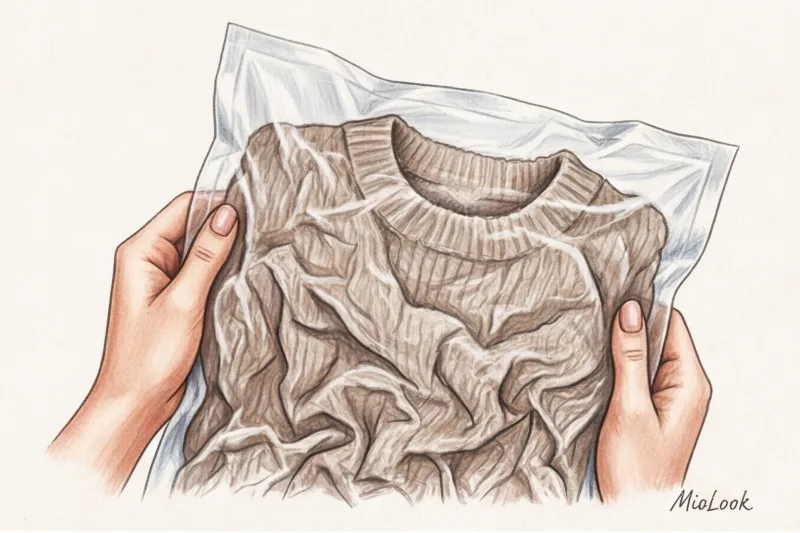
The second hidden threat is condensation. Temperature fluctuations occur on top shelves (especially in apartments with central heating). In tightly sealed plastic, even the slightest residual moisture turns into condensation, which then turns into mold.
What can actually be stored in a vacuum? Only 100% synthetic textiles: polyester ski suits, acrylic throws, and synthetic guest pillows. Everything else requires air.
Proper preparation: 3 steps before your item goes on the top shelf
Never, under any circumstances, put away items you've worn even once. This is my "zero tolerance" rule. Even if a sweater appears clean and smells only of your perfume, it still contains microscopic particles of sebum and deodorant.
After six months in a dark closet, the aluminum salts in antiperspirants undergo a chemical oxidation reaction. What was an invisible mark in May will turn into a tough yellow stain in October, impossible to remove with dry cleaning.
- Wool and silk: We take it to a professional dry cleaner. Home washing leaves detergent residue in the fibers, which attracts moths.
- Cotton and linen: We wash at home, but without using fabric softener (it creates a sticky film on the fabric).
- Repair: sew on buttons, change heels and mend tiny holes to Storage. There's nothing more demotivating than taking out your favorite coat in the fall and realizing that its pocket is missing.
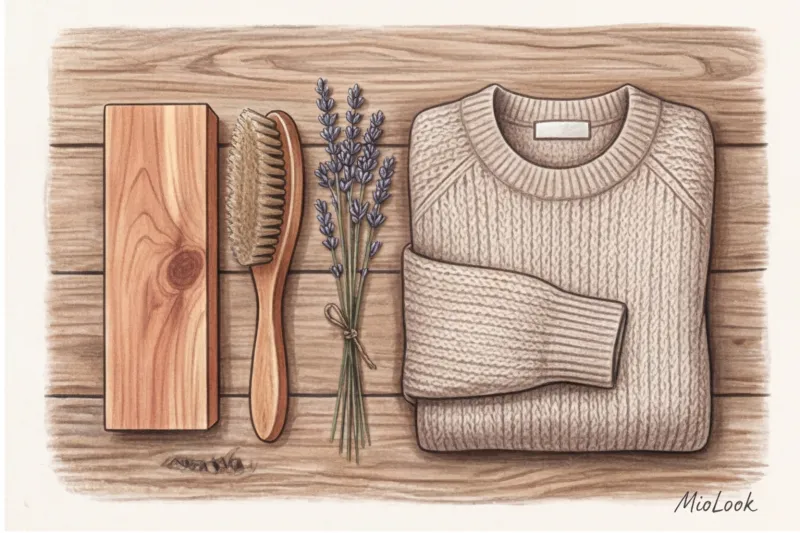
Moth and moisture protection without toxic odors
Mothballs are hopelessly outdated. A respectable, well-groomed woman shouldn't smell like grandma's trunk. Replace chemicals with eco-friendly alternatives: cedar blocks (they need to be lightly sanded once a season to refresh the scent), sachets of dried lavender and cloves.
Here's my personal professional tip: don't throw away the silica gel packets you find in shoe boxes. Stuff them into the pockets of your coats and down jackets before putting them away. Silica gel perfectly controls humidity and prevents musty odors.
Your perfect look starts here
Join thousands of users who look flawless every day with MioLook.
Get access — €0.99 oncePackaging strategy: cases, boxes or covers?
If plastic is banned, what should I pack my items in? I always follow museum clothing storage standards. The main rule is that the materials must be breathable.
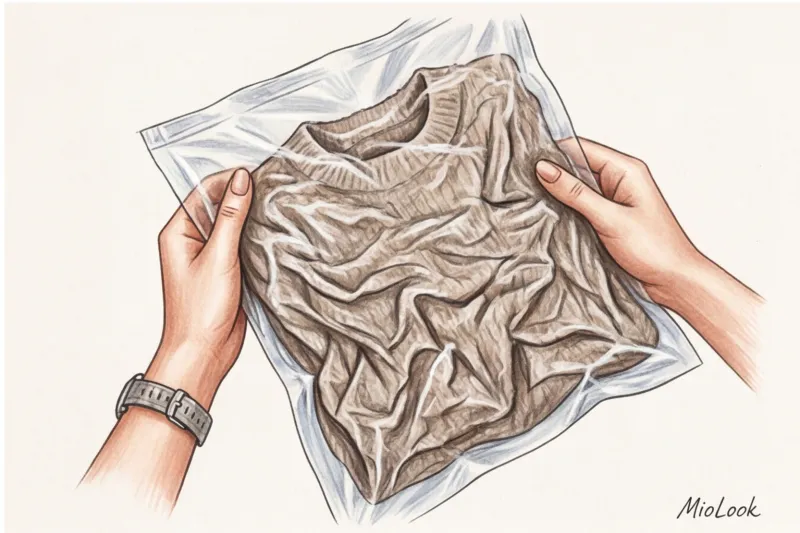
Cases made of spunbond and cotton. This is the perfect choice for sweaters, jeans, and T-shirts. Spunbond (non-woven fabric) allows air to pass through but traps dust. Invest in cases with a rigid frame—they hold their shape and can be stacked.
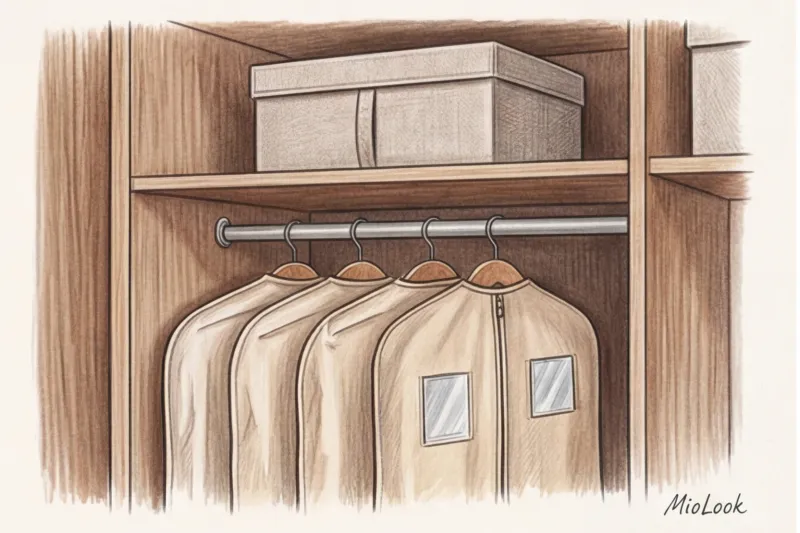
Rigid boxes. They're ideal for items that are easily deformed, such as structured bags, hats, and shoes. If you use cardboard boxes, make sure they're acid-free, otherwise they can leave yellow marks on light-colored fabrics over time.
Clothes covers. The length of the cover should be 10-15 cm longer than the garment itself to prevent creasing. For evening dresses and expensive coats, choose covers made of 100% cotton. Plastic bags from dry cleaners should be removed immediately upon arrival home—they suffocate the clothes.
Upper Shelf Geometry: How to Organize Space Ergonomically
Mezzanine shelves obey the laws of physics and visual harmony. The basic rule of ergonomics is: "heavy down, light up." Even on the top shelves, the heaviest boxes of winter shoes should be lower than the lightest trunks filled with summer linen.
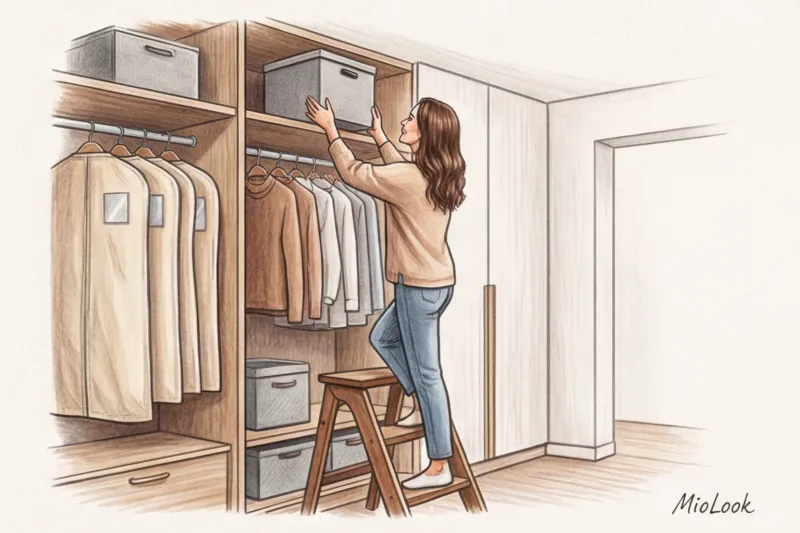
Modularity is your best friend. Buying mismatched boxes "on sale" is a recipe for chaos. Identical rectangular organizers (for example, standard modules from IKEA or Zara Home, priced between €15 and €30) fit flush against each other, saving up to 20% of space. Furthermore, a consistent color scheme (beige, gray, or white) eliminates visual clutter. Style psychology proves that visual order in a closet directly reduces morning cortisol levels.
Labeling that really works
Marking "Summer 2023" with a marker isn't going to work. You won't remember which dresses are in there anyway. Replace the text with visual markers: attach Polaroid photos of the contents to the boxes or print QR codes that link to the folder on your phone. For coat cases, use zippered luggage tags—that way, you can find the right coat in a second without unzipping each case.
The specifics of complex items: down jackets, cashmere, and shoes
Certain wardrobe items require a special protocol. If you want your clothes to look expensive (and well-groomed appearance is the foundation of a prestigious look), follow these rules.
Down jackets. They shouldn't be hung on a hanger for six months—the filling will sag under its own weight. The ideal method is to carefully roll the down jacket (squeezing out any excess air by hand, not using a vacuum!) and place it in a breathable cotton or mesh bag.
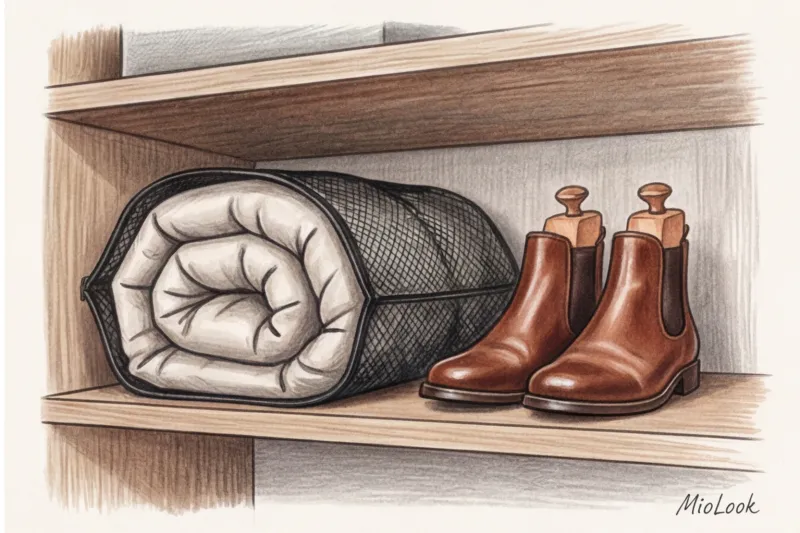
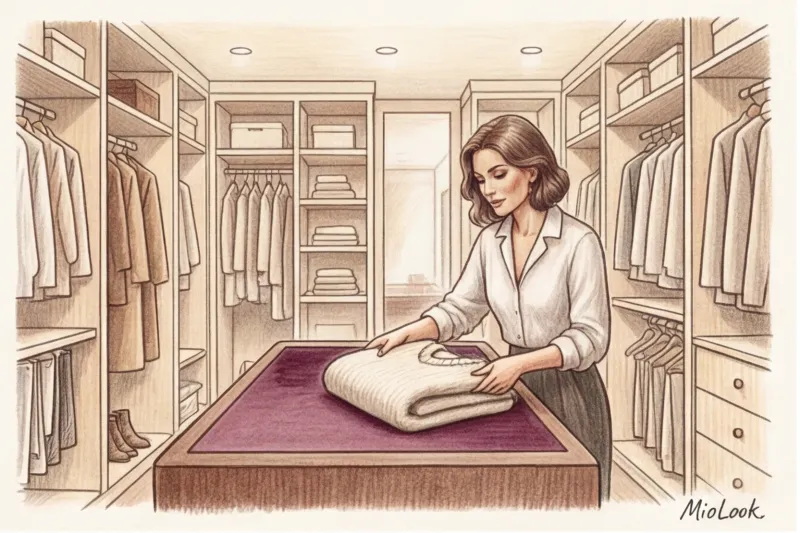
Cashmere and heavy knitwear. These fabrics should never be stored on hangers—they'll stretch out the shoulders. Stack them in piles of no more than 4-5 items. I always place sheets of acid-free tissue paper between expensive sweaters—it prevents the fibers from rubbing and causing pilling. You can find more information in our a complete guide to caring for knitwear.
Shoes. Storing tall boots folded in half is a crime against the leather. The folds will inevitably cause creases, which will eventually develop into cracks. Invest in wooden boot trees and inflatable or plastic boot shaft inserts.
Ready to get started?
Try the MioLook free plan—no commitments. Digitize your wardrobe in just a few clicks.
Get access — €0.99 onceChecklist: Changing Your Wardrobe Seasons in One Weekend
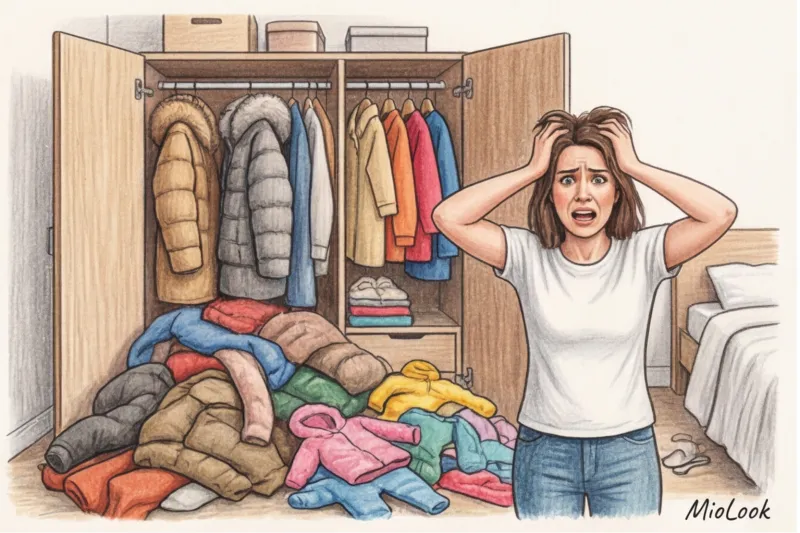
The change of seasons isn't a punishment, but a therapeutic process. Set aside one weekend for it and follow a strict algorithm. Don't try to sort through your clothes one by one, taking them out of the closet. Unload All on the bed. This is shock therapy that will force you to finish the job.
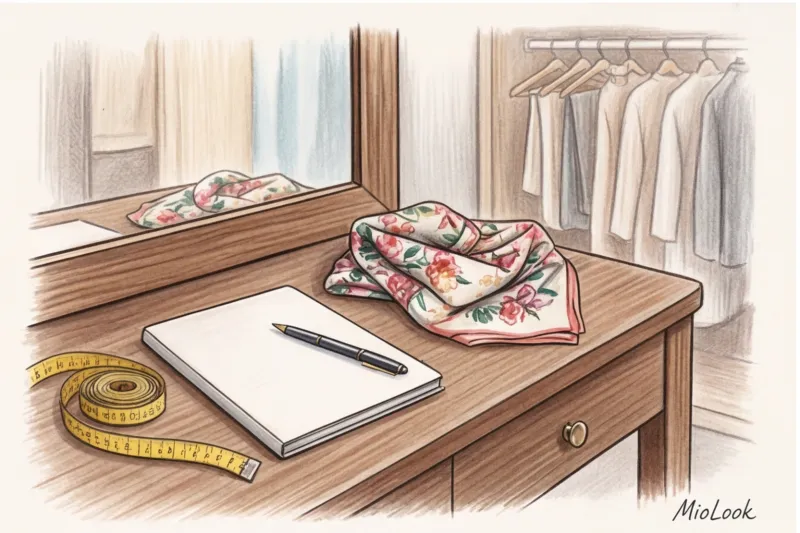
Divide things into three categories: to keep for storage, get rid of without regrets , take it to the repair shop or dry cleaner. Something you haven't worn all season has no right to take up valuable space on the attic. Sell it, donate it to charity, or recycle it.
The final step is inventory. While you're packing your things, write down what you missed last season. Are your favorite white sneakers looking out of place? Add them to your shopping list for next spring right now. This will save you from a frantic shopping spree six months from now.
Storing out-of-season items is an investment in the longevity of your wardrobe. Treat your clothes with respect, allow them to breathe, and avoid damaging plastics, and your favorite pieces will delight you for years to come, maintaining their impeccable, premium appearance.