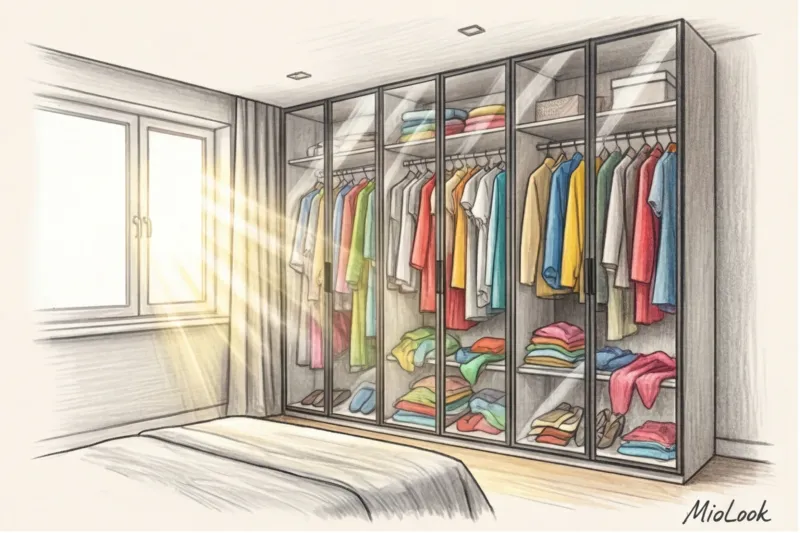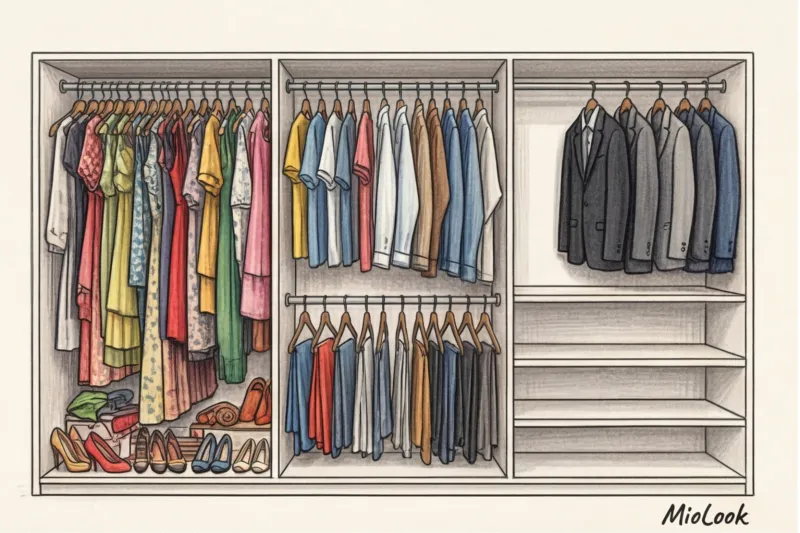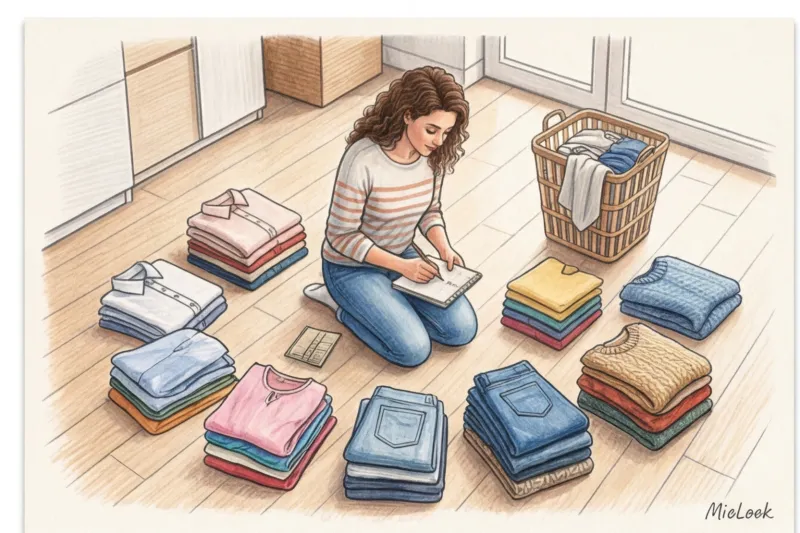
Do you know what happens when you try to squeeze a standard closet into a tiny utility room? You end up with a very expensive, cramped wooden box where your clothes are irrevocably wrinkled, and you're forced to stand on one leg trying to reach for a sweater. Transforming a closet into a full-fledged wardrobe isn't a matter of buying new shelves. It's an engineering challenge to optimize the logistics of your morning routine.
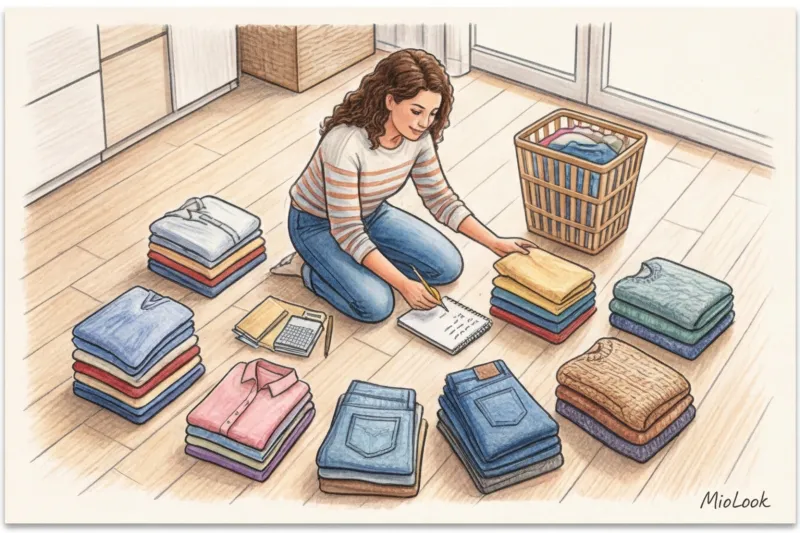
We discussed the basic principles of creating storage systems in more detail in our complete guide to ideal wardrobe room layout But when it comes to micro-spaces (1.5 to 3 square meters), classic rules break down. Forget those pretty Pinterest pictures of huge walk-in closets. What we need here is cold calculation, a tape measure, and an honest audit of your habits.
A Walk-In Closet: Why Furniture Standards Don't Work Here
The biggest mistake when remodeling a small closet is calling a furniture measurer before you've analyzed your closet. Furniture measurers think in terms of particleboard standards and beautiful cabinet fronts. You should think in terms of "how quickly can I find a white shirt at 7:30 a.m."
One of my clients spent about €1,200 on a U-shaped closet layout of exactly 2 square meters. The surveyor did everything "to standard." As a result, a 50 x 50 centimeter space remained in the center. The client had to stand at attention when entering her new closet, and could only pull out the lower drawers by stepping out into the hallway. Standard solutions mercilessly "eat up" valuable space.
The difference between a furniture-based approach and a stylistic one is colossal. A cabinetmaker will ask, "What color profile should we use?" A stylist will ask, "How many long dresses do you have, and do you wear trousers full-length or fold them in half?" By answering the second question, you'll save meters of space.
Access to MioLook for €0.99 — one-time payment
A smart AI stylist will select the perfect look.
Get access — €0.99 onceDigitizing Your Wardrobe: Counting Items, Not Square Meters
It's impossible to design a storage system without knowing the exact inventory volume. Research into consumer habits (in particular, the global Fashion Transparency Index 2023 report) confirms the classic Pareto principle in fashion: 80% of the time, we wear only 20% of the items in our closet. This "core" should dictate the closet's architecture.
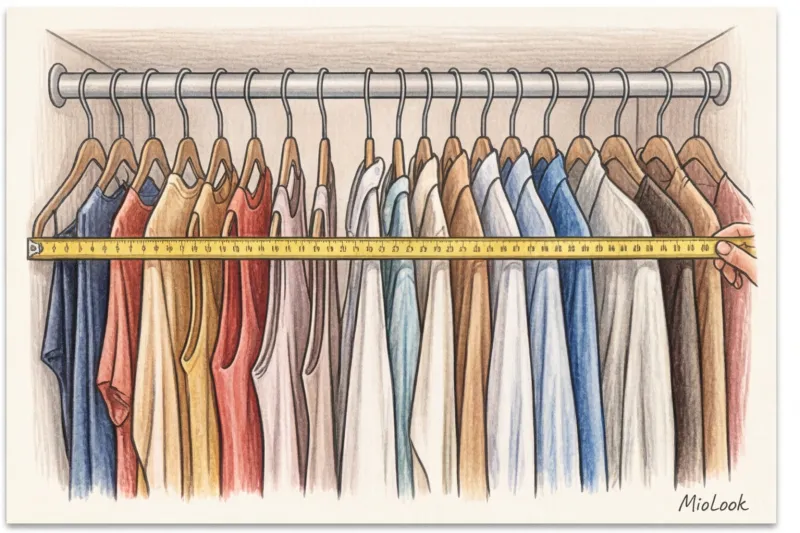
I always have clients do a total-counting method. We take a tape measure and measure not the walls, but the clothes. Here's my tried-and-true formula for calculating the length of a rod for micro-spaces:
- 1 thin hanger with a blouse or shirt = 3-4 cm of rod width.
- 1 hanger with a thick jacket or sweater = 5–6 cm.
- 1 hanger with a bulky coat or jacket = 6-8 cm.
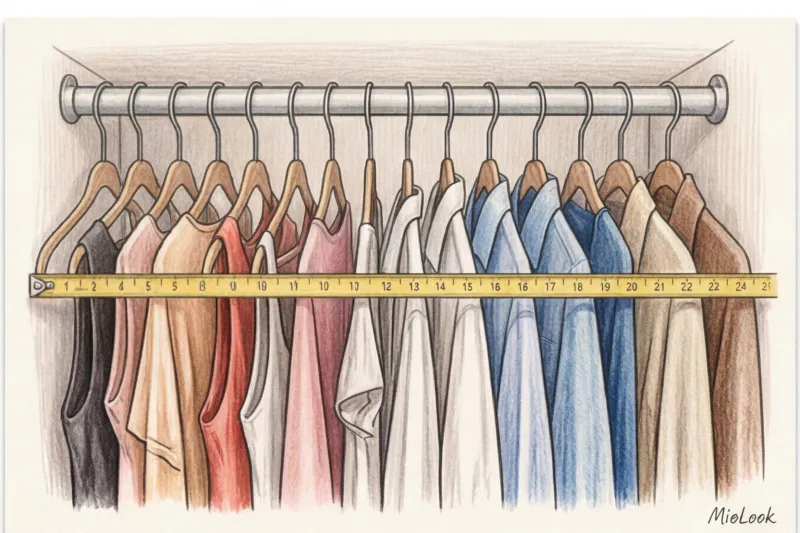
If you have 20 shirts, you'll need at least 80 centimeters of free barbell space. No guesswork. To make this process easier, I recommend using MioLook app You simply photograph your items, the program categorizes them, and before you start renovating, you know exactly: you have 15 skirts, 40 T-shirts, and 10 pairs of shoes. You build shelves for specific items, rather than trying to squeeze things into abstract shelves.
Ergonomics of micro-space: breaking stereotypes
It's time to debunk the biggest furniture myth that's killing small walk-in closets: the standard shelf depth of 60 centimeters. Manufacturers profit from cutting boards to this standard, but for you, it's a disaster. Deep shelves create "black holes" where the back row of items disappears without a trace, gets crumpled, and is forgotten.
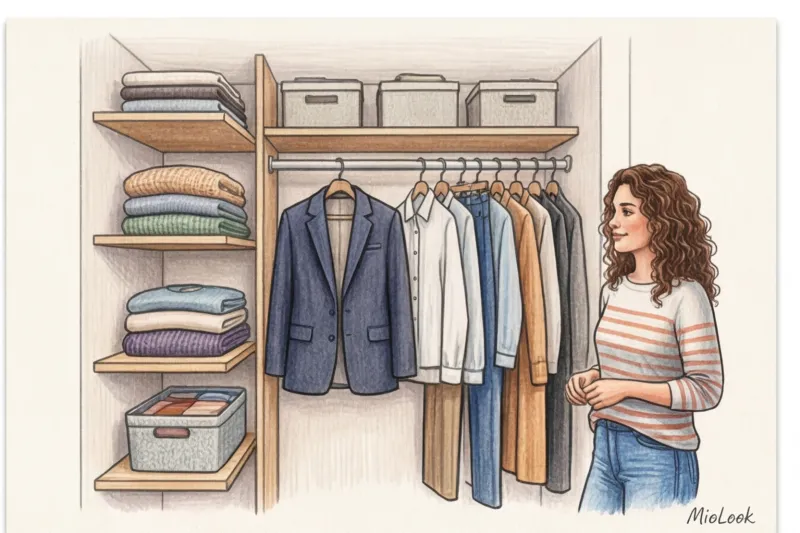
Based on Neufert's ergonomic standards (the bible of architects) and adapting them to modern micro-spaces, I insist: the depth of shelves for knitwear and T-shirts should not exceed 35–40 cm. A stack of jumpers fits neatly in a single row on such a shelf. You see everything. You wear everything. If you want to learn the nuances of working with such fabrics, check out our guide on How to properly store knitwear.
The second rule of pantry ergonomics: no doors on interior sections and no solid vertical chipboard partitions if they can be avoided. Use open mesh or profile systems—they're visually lighter and don't steal 1.5 cm from each wall.
Front-mounted display as a solution for narrow niches
What if your former closet is less than 55 cm deep? A traditional wall-mounted clothes rail won't work—shirt sleeves will rub against the back wall, and the doors (if present) won't close. The solution: pull-out end hangers (front-facing).
Yes, you'll only see the first item in a row. But for tight spaces, this is the only viable option. A styling lifehack: use front-mounted rods for assembly. capsule wardrobe For the current week. Hang your ready-made outfits up front, and getting ready in the morning will take exactly one minute.
Your ideal image
it begins Here
Join thousands of users who look flawless every day with MioLook.
Get access — €0.99 onceTechnical base: ventilation and light, which 90% of people forget about
You can buy the most expensive storage system, but if your closet isn't ventilated, within six months your favorite clothes will develop a musty smell, and your leather shoes will become moldy. Stale air is the biggest killer of clothes in closed, windowless spaces.
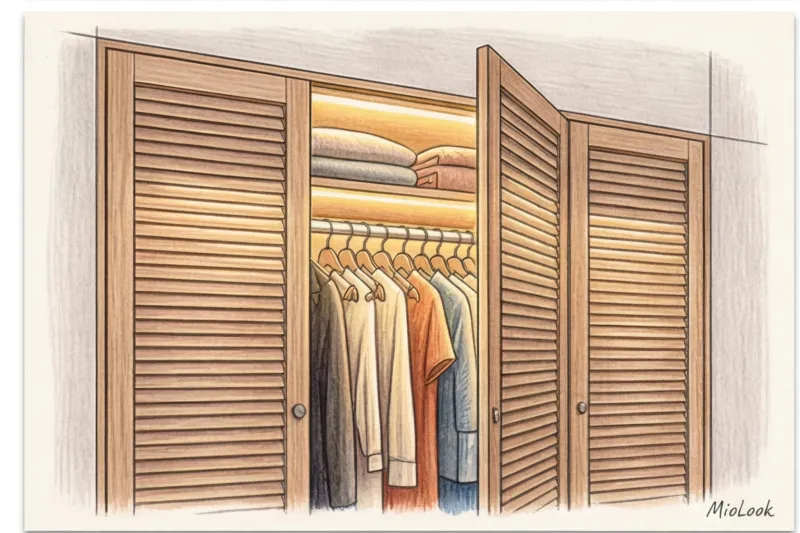
According to building codes for ventilation (such as ASHRAE residential standards), closed walk-in closets require constant microcirculation. How can this be achieved in practice? Replace solid interior doors with louvered ones. If louvered doors don't fit the interior, install a transfer vent at the bottom of the door and, if possible, a compact exhaust fan mounted on the ceiling.
The second technical pain point is lighting. One of my clients once showed up to an important business meeting in a dark blue jacket and black trousers, completely convinced she was wearing a formal black suit. The reason? Her small dressing room had a single, dim lampshade with a cheap yellow bulb.
A single light source in the center of the ceiling creates harsh shadows: upper shelves are overexposed, while lower drawers are drowned in darkness. For smaller spaces, use recessed LED profiles vertically along the sides of the sections or under each shelf. Critically important parameters: the color rendering index (CRI) should be greater than 90, and the light temperature should be neutral white (4000K). Only then will you see the true colors of the fabrics.
Smart zoning: the three-tier rule for spaces from 1.5 to 3 square meters
A small space requires strict zoning discipline. Think of your dressing room as a work desk: what you need most is within easy reach; archives are tucked away.
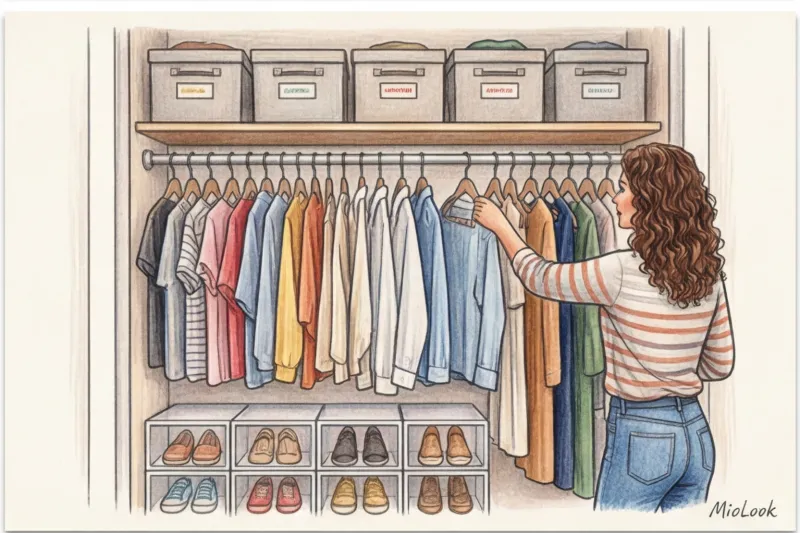
- Lower tier (up to 60 cm from the floor): Heavy-item area. Here we design slanted shoe shelves and pull-out linen drawers. Pull-out drawers at the very bottom are a must. You won't be able to see into the deep bottom shelf without kneeling.
- Middle tier (60–190 cm): The "Golden Zone." What you're wearing this season. This is eye level and arm level. This is where the dress rails and shallow shelves for sweaters are located. The perfect place for your minimalist capsule.
- Upper tier (above 190 cm): Archive area. Access here requires a stepladder, so we store out-of-season items, suitcases, and rarely used accessories here.
Rotation of items and off-season work
It's time to voice an honest limitation that bloggers often keep silent about: a walk-in closet made from a 2-square-meter storage room not capable to accommodate clothes for all four seasons at once. If you try to do this, it will turn into a warehouse.
Your key to success is seasonal rotation. Twice a year, unused items should be vacuum-sealed (to save up to 60% of space) and placed in identical fabric storage boxes on the top tier. Identical, of course: the visual clutter of colorful boxes eats up as much space as the items themselves. And if during the sorting process you find something you haven't worn in over a year, I recommend reading our article on... How to get rid of unnecessary things without regret.
Checklist: A Step-by-Step Plan for a Pantry Makeover
To prevent your project from becoming a long-term project, follow this strict algorithm:
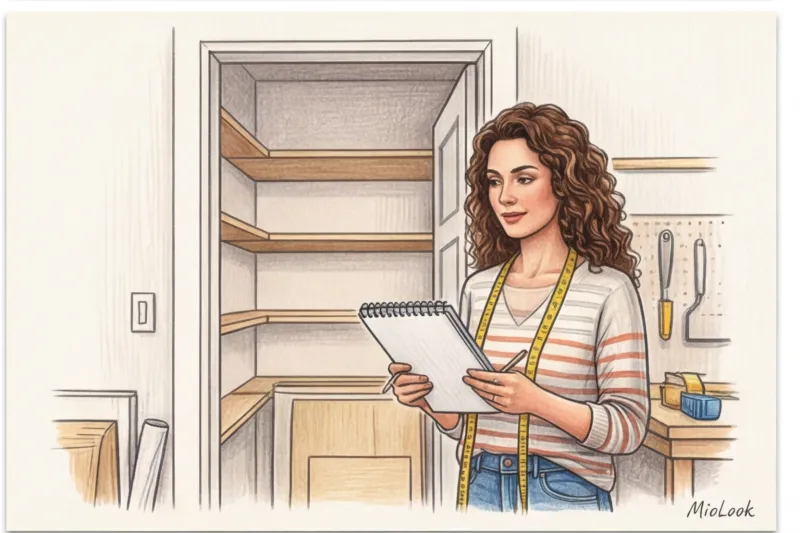
- Step 1: Cleaning and measuring. Empty the closet completely. Measure the width, depth, and height. Be sure to check the corners—in older buildings, the walls are rarely straight.
- Step 2: Digitization. Take photos of your items and sort them into categories. Make a list of the sections you need (X cm for rods, Y cm for shelves).
- Step 3: Technique. Run the LED strip wiring and install the ventilation grille before you start painting the walls.
- Step 4: Select a system. In the budget segment (around €150–250), suspended mesh systems (like Elfa or similar) lead the way. They offer excellent ventilation and are easy to reposition.
- Step 5: The Stylist's Secret Weapon. The cheapest way to increase the capacity of a ready-made clothes rail is to replace mismatched hangers with identical ultra-thin velvet hangers. An investment of €30–€40 will instantly free up to 20% of the space and create perfect visual harmony.
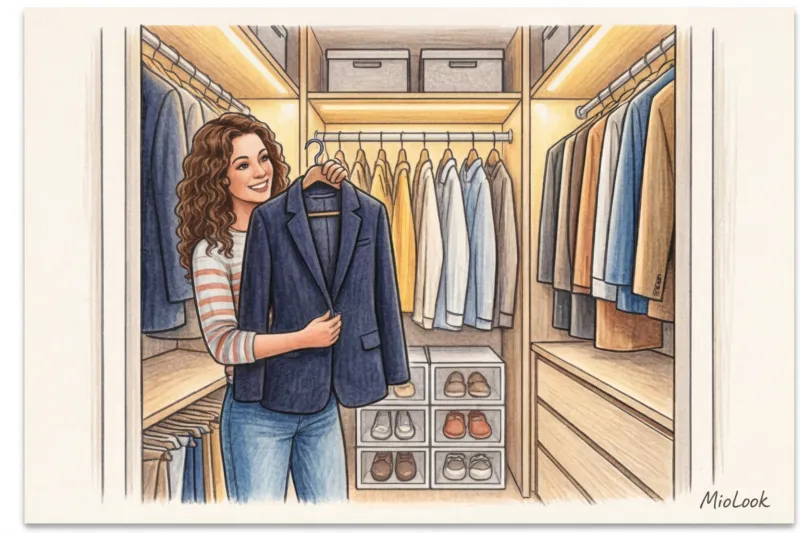
Results: A space that suits your style
A walk-in closet isn't a place for mindless hoarding. With the right approach, these 1.5 to 2 square meters become a powerful productivity tool. Investments in a smart layout, proper lighting, and ergonomics pay off with every morning saved, when you don't have to iron a wrinkled shirt in a cramped closet.
Don't rush into buying furniture. Start with an inventory. Digitize your current wardrobe, remove unnecessary items, calculate the required hanging rod length, and your formerly dark closet will transform into a personal, functional boutique, where everything is tailored to your style.