Your Closet's Bermuda Triangle: Why the Standard Corner Closet Layout Doesn't Work
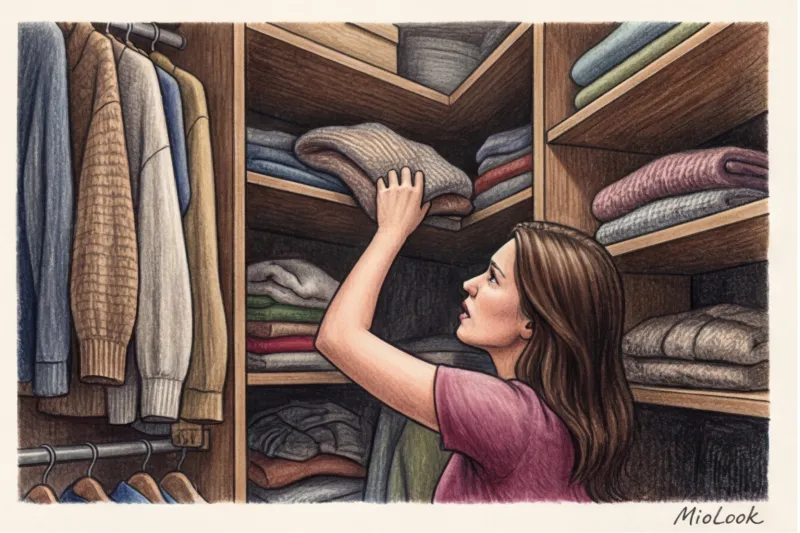
Three years ago, my client Anna, while cleaning out her closet before moving, screamed and pulled out a vintage Prada bag. The problem was, she'd thought she'd lost it in a taxi back in 2020. The bag had been lying peacefully in the farthest, darkest corner of her deep L-shaped closet, weighed down by out-of-season sweaters.
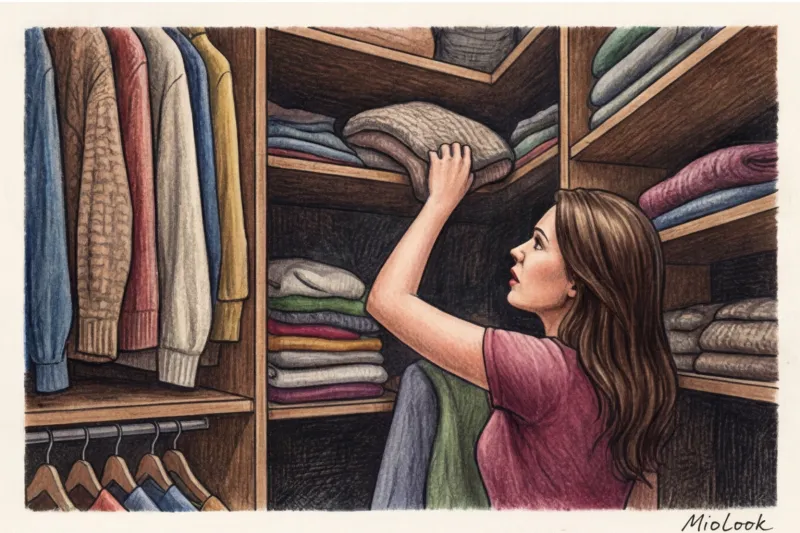
As a style coach, I see this picture all the time. A standard corner closet layout often turns into a "Bermuda Triangle," where your favorite things disappear without a trace, along with your money and morning peace. We've covered the basics of organizing space in more detail in our The complete guide to the perfect walk-in closet layout , but the angle deserves special, very close attention.
There's a fundamental conflict of interest here. When a cabinetmaker draws up a project for you, they think in terms of structural rigidity and MDF cutting. For them, a deep corner shelf (80–90 cm) is a great way to connect two walls. But for you, it's dead zone According to Ernst Neufert's (Architects' Data) classic ergonomic standards, the optimal comfortable viewing depth for a person is no more than 40 cm. Anything deeper than 60 cm in a corner is simply no longer perceived by your brain as an existing wardrobe.
"A corner wardrobe should be designed around the geometry of your clothes and your habits, not the most convenient way to roll up sheets of chipboard." — Isabella Garcia
Digitization before drawing: what exactly are we going to hide in the corner?
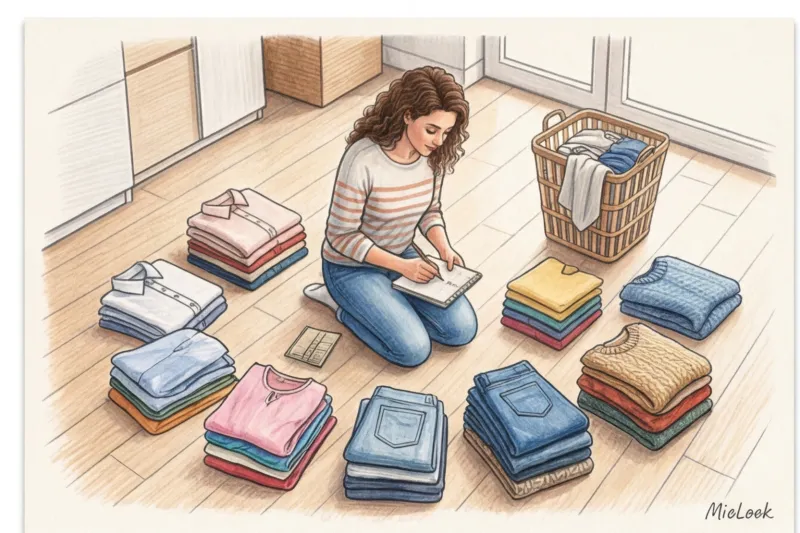
The biggest mistake is ordering furniture before you've taken stock of your belongings. You can't plan a space without knowing exactly how it's going to be filled. A corner is, by definition, a low-accessibility area. It's absolutely not the place to hang that white shirt or those Massimo Dutti trousers you wear to the office twice a week.
The strict "arm's length" rule applies here. What you wear frequently should be accessible with one movement. A corner requires two or three movements (pull, reach, and grab). That's why before meeting with a designer, I always have my clients digitize their closet. You can use it for this. smart wardrobe feature in MioLook to accurately understand the ratio of seasonal and everyday items.
The Perfect Angle Formula from a Stylist
Over 12 years of practice, I have developed a simple formula for the ideal filling for complex corner areas:
Bulky items (suitcases/down jackets) + Strict seasonality = Ideal angle.
Deep sections are perfect for storing travel bags (which can hold off-season items), ski suits, or bulky winter coats in their covers. But what to store there? it is forbidden , these are knitwear and small accessories. Cashmere and wool require air circulation, otherwise moths will breed, and stacks of jumpers will turn into a shapeless heap. If you have a lot of knitwear, I recommend checking out our guide on How to properly store knitwear.
Access to MioLook for €0.99 — one-time payment
A smart AI stylist will help you find the perfect look and organize your virtual closet so you know exactly what you have.
Get access — €0.99 onceThree Major Mistakes When Designing a Corner Area (and How to Avoid Them)
When you look at a beautiful 3D render, everything seems perfect. But in reality, corner closet layouts often contain critical errors that will turn your morning routine into a nightmare.
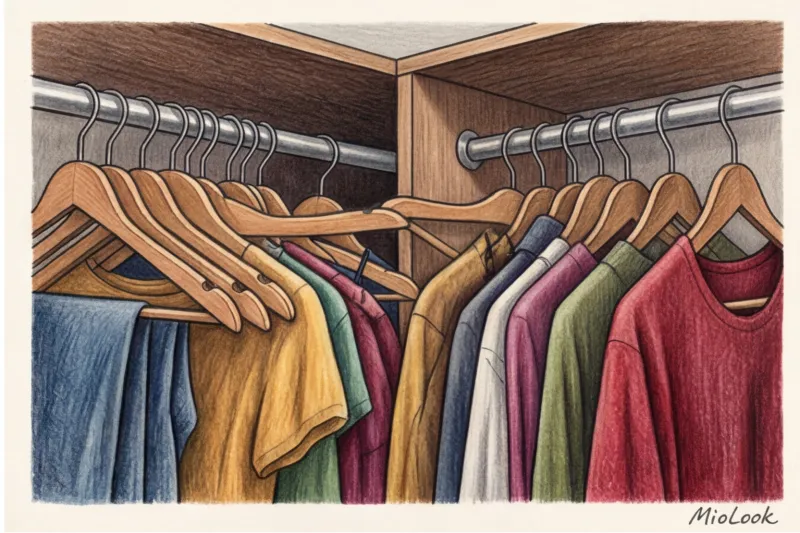
Mistake 1: Crossing Bars (L-Trap) This is my personal nightmare. Furniture makers love to place two hangers at right angles to each other, claiming it "saves space." It's counterintuitive, but it's the worst possible solution! The hangers will inevitably block each other where they meet. The sleeves of your jackets will bunch up, creating creases, and to get an item out of the corner, you'll have to push the adjacent garments apart with both hands. Alternative: Make a blind corner with access from only one side, or use a curved (radius) rod.
Mistake 2: Deep fixed shelves (deeper than 50 cm). As we've already established, this is a black hole. If a shelf is deeper than 50 cm, you physically can't see what's in the second row. Things you don't see, you don't wear—that's the law of visual merchandising. If the space requires depth, it absolutely must have full-extension pull-out drawers.
Error 3: No local backlight. A corner is always darker than the rest of the closet. It's impossible to tell a black and blue sweater from a dark gray one in such a corner. An integrated LED strip running the entire height of the corner unit isn't a luxury, but a basic necessity.
Top 4 Smart Solutions for a Blind Corner
Modern hardware has come a long way. If your budget allows (budget between €200 and €600 for high-quality European-brand mechanisms), you can transform a dead spot into the most striking part of the room.
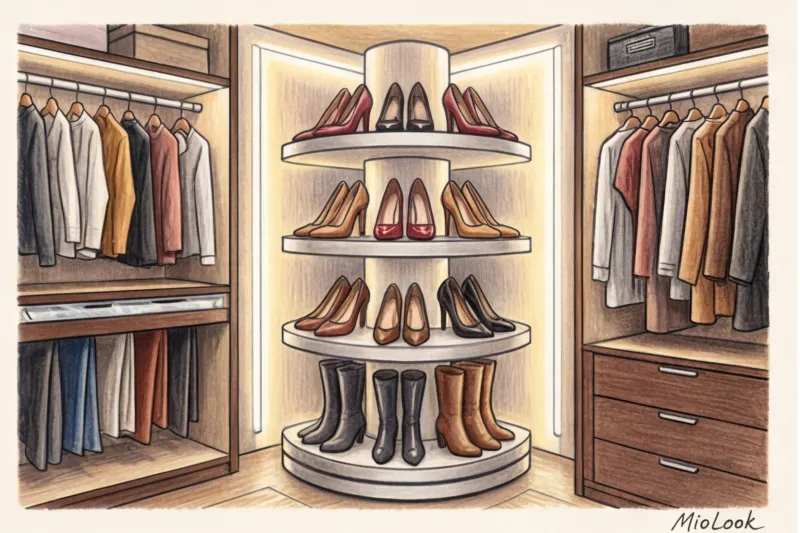
- Rotating carousel (360 degrees) for shoes and bags. This solution transforms your closet into a boutique. You stand still, and the shoes come to you. Perfect for shoe collectors.
- Pentagonal corner module (diagonal cut). Instead of a 90-degree angle, a diagonal door is installed. This creates a "mini-room" effect inside, where you can literally step into it. This solves the problem of accessing the back wall.
- Spiral clothes hangers. An excellent solution for summer dresses and blouses. But be careful (fair limitation): This mechanism is completely unsuitable for heavy winter coats or men's suits - under their weight, the coil will quickly fail.
- Pantographs (elevators) in high sections. If the ceilings are higher than 2.5 meters, a pantograph is installed in the upper corner. With one movement of the handle, you lower a bar containing out-of-season clothes. A good pantograph typically costs €150–250, and the savings pay for itself in back pain.
Your perfect look starts here
Join thousands of users who look flawless every day with MioLook. Plan your looks in advance and save time in the morning.
Get access — €0.99 onceThe Anatomy of the Ideal L-Shaped and U-Shaped Wardrobe
The shape of your room dictates the rules of the game. How you fit your capsule wardrobe into space depends on the geometry of the walls.
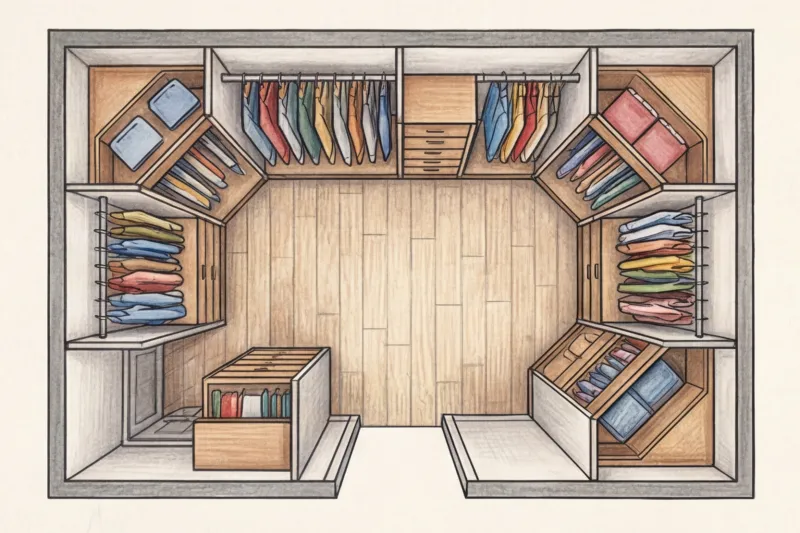
L-shaped layout has only one "difficult" corner. My favorite stylistic trick here is to make that corner a visual focal point. For example, instead of trying to squeeze clothes in there, place a tall, full-length, backlit mirror there, and on the sides, shallow, open display cases for perfume and jewelry (by the way, you can get some ideas from the article about How to store jewelry ). The corner ceases to be a problem and becomes a beauty zone.
U-shaped layout The space challenges with two corners. The principle of strict zoning works brilliantly here. For example, the left corner and the adjacent wall are the "feminine" zone (with tall sections for dresses), while the right corner is the "masculine" zone. Alternatively, divide the space according to the "seasonal/casual" principle. The main thing is to avoid repeating the same mistakes in both corners.
Checklist: Checking your corner wardrobe project before ordering
Before you sign off on the drawings and make a down payment, conduct this mental crash test. A corner closet layout is unforgiving of mistakes on paper.
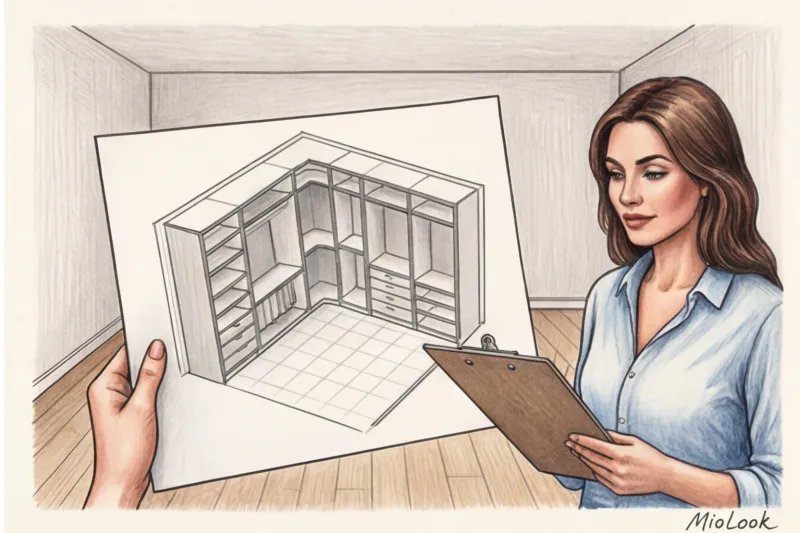
- Wingspan Test: Can you reach the back wall of the corner without a stepladder? If not, ask for a roll-out mechanism.
- Box conflict: This is a classic! Do drawers on one wall block drawers on a perpendicular wall? Open them simultaneously in the drawing. Often, the handle of one drawer scrapes the front of the other.
- Maxi dimensions: Have you accounted for the dimensions of your longest dresses (usually 150 to 170 cm) and your tallest over-the-knee boots? I've had furniture makers redo projects more than once because they'd specified the standard 110 cm height, forgetting to consider the client's evening wardrobe.
- Lighting scenario: Is a flush-mounted (not surface-mounted, so as not to catch on the hangers!) LED strip planned across the entire height of the corner module?
Conclusion: The angle that works for your style
According to surveys by the National Association of Professional Organizers (NAPO), people waste up to 20 minutes each morning simply searching for the things they need in a poorly organized closet. Multiply that by a year, and you get days wasted frustratingly in front of the mirror.
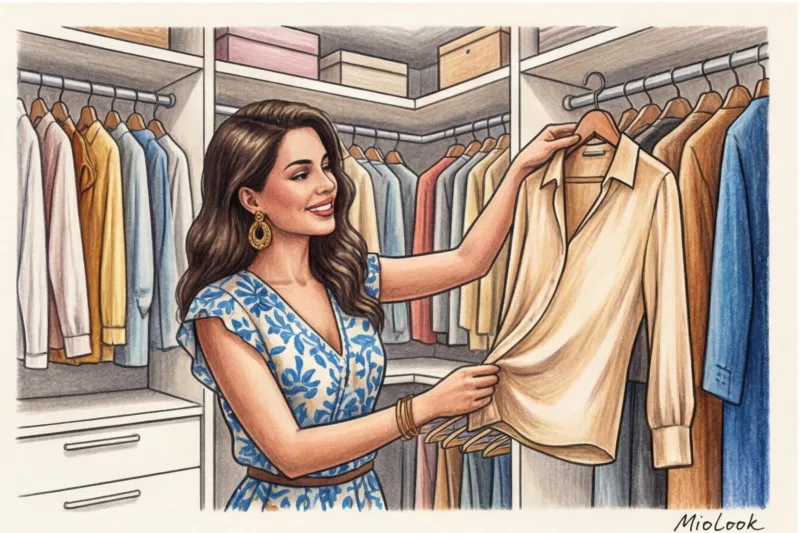
A smart corner wardrobe layout isn't just a matter of beautiful furniture. It's an investment in your confidence. When every item has its place, doesn't get creased in the cramped space of crossed rods, and is easily accessible, your personal style begins to work for you, not against you. Start with an honest review of your belongings, digitize your database, and only then head to a furniture showroom. Trust me: an organized closet is the strongest foundation for impeccable taste.
Ready to get started?
Try the MioLook free plan—no commitments required. Organize your wardrobe and create stylish looks in just a few clicks.
Get access — €0.99 once