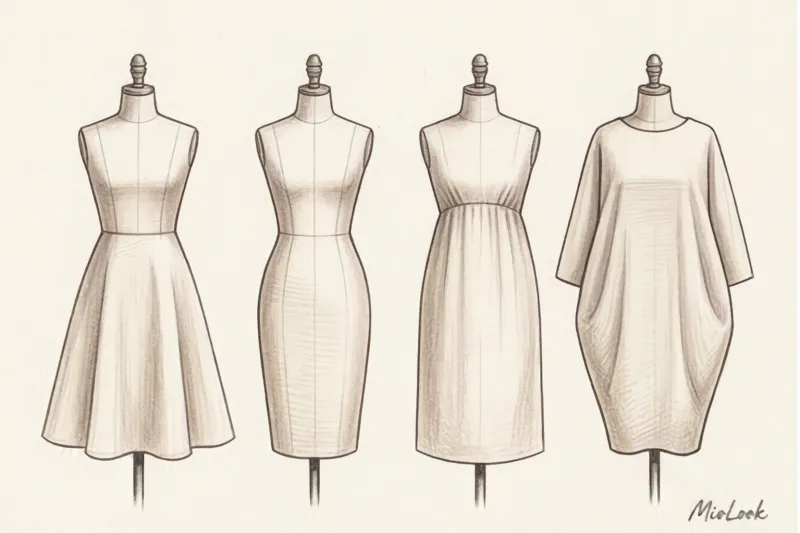
What are clothing silhouettes: more than just an outline
Close your eyes, and now squint slightly as you look at your reflection in the mirror. What do you see? You won't discern the texture of the premium €300 cashmere, nor will you notice the intricate gradient or the intricate stitching. You'll only see the outline—a dark spot against a light background. It's with this technique, which we stylists call the "shadow test," that I begin my first meeting with every new client.
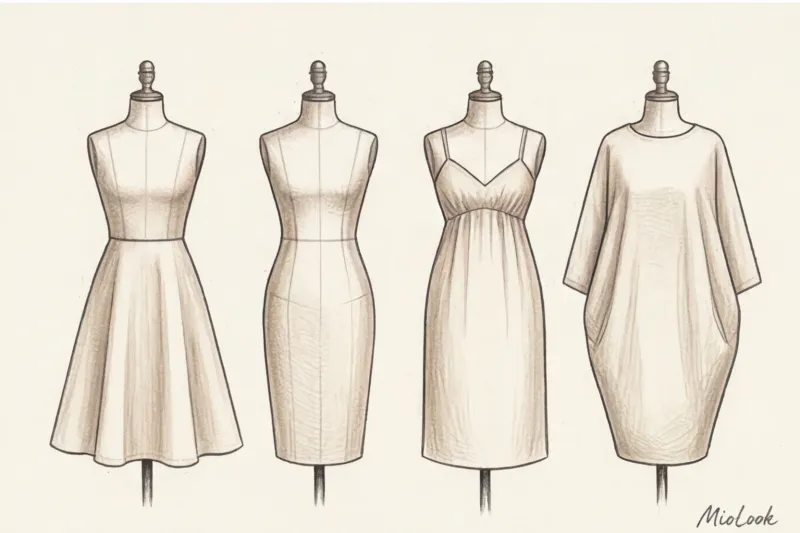
Our brains are evolutionarily programmed to read shapes in milliseconds. Before someone even realizes the color of your suit or the brand of your bag, their subconscious has already "read" yours. clothing silhouettes and drew conclusions. Silhouette works as a powerful first impression because geometry is primary to the human eye.
Over the years of working as an image consultant, I've noticed one common problem: we often confuse basic concepts, leading to purchases that then hang in our closets for years with the tags still attached. Let's once and for all clarify the three key terms: silhouette, cut, and style.
- Silhouette - this is the outer frame, the shadow, the two-dimensional outline of your figure in clothing.
- Cut — is an engineering solution, the way the fabric is cut and sewn to create volume (for example, raglan sleeves, bias cut, darts).
- Style — this is a specific model of clothing with its historical and functional details (trench coat, pencil skirt, slip dress).
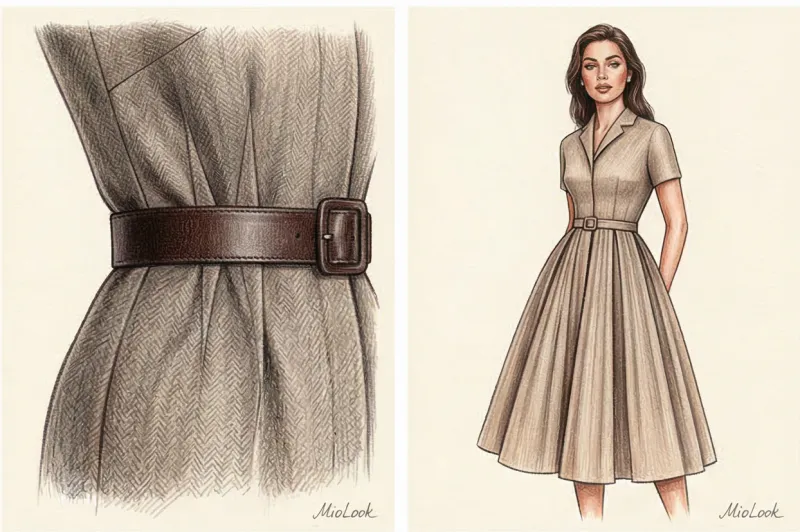
A simple example: a classic trench coat ( style ) may have a set-in sleeve or a raglan ( cut ). But if you wear it open, it creates a straight silhouette , and if you tighten the belt too tightly, it's an X-shaped one. Understanding this difference gives you control over your wardrobe. You start buying not just "pretty dresses," but the right shape for your body.
"Modern styling isn't an attempt to squeeze a living woman into a mold. It's architecture, where clothing serves as a framework that highlights assets rather than masks 'flaws.'"
That's why modern fashion is finally moving away from rigid, outdated rules like "pears can't wear voluminous bottoms." I hate this fruit-and-vegetable classification. Today, we work with the individual architecture of the body. Instead of ruining our proportions for the sake of some artificial "hourglass" ideal, we use clothing silhouettes as tools for creating the desired visual balance.
Basic silhouettes in modern fashion
To manage an impression, you need to know your palette of tools. In contemporary styling, we operate with six basic shapes that can be created from any fabric and in any size.
- Straight (H-silhouette): The shoulders, waist, and hips are visually equal. This is the basis of minimalism and old-money style.
- Fitted: Clothing closely follows the curves of the body. Today, it is used sparingly, more often in evening wear.
- Semi-adjacent: The Holy Grail of the modern wardrobe: clothes that follow the contours of the body but leave 2-3 centimeters of air.
- A-line silhouette (Trapezoid): A narrow top that flares out at the bottom. Christian Dior's ingenious 1955 invention, which still works well when it comes to balancing broad shoulders.
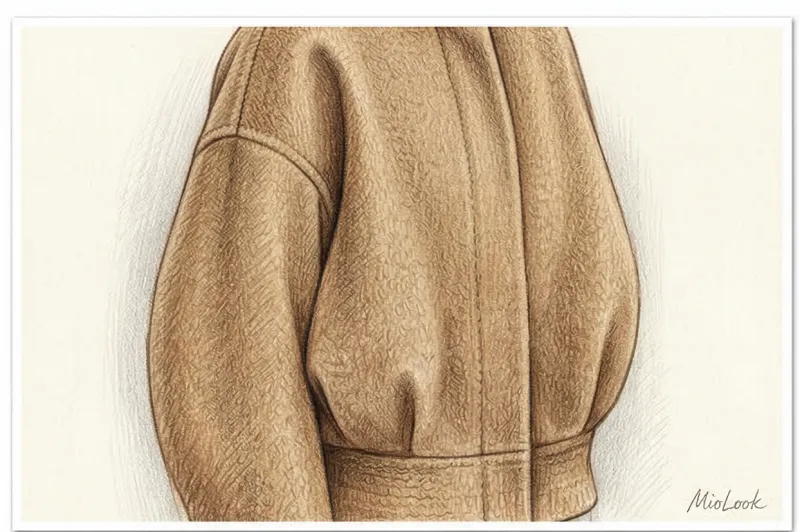
- O-silhouette (Cocoon): Volume in the center of the figure, tapering toward the shoulders and knees. A triumph of Cristóbal Balenciaga, who gave women freedom from corsets.
- X-silhouette (Hourglass): Accentuated shoulder line, emphasized waist and voluminous hips.
It's fascinating to observe the evolution of these shapes. In 1947, Dior's famous New Look dictated a rigid X-line silhouette. To achieve it, women had to cinch their waists to 50 centimeters with painful corsets and wear heavy, layered skirts. It was a beautiful, but merciless, checkered pattern.
Today, this rigid framework has given way to relaxed forms. Look at the collections of The Row or Jil Sander: the modern X-line silhouette is created not by a corset, but by a voluminous jacket worn over a man's shoulder, casually cinched with a soft leather belt. We've retained the geometry, but added oxygen and freedom of movement.
The Psychology of Form: What Your Clothing Silhouettes Say
In psychology, there's a classic experiment called "Bouba and Kiki." When people are shown two figures—one round and one angular—and asked to guess their names, 95% say the pointed figure is "Kiki" and the softer one is "Bouba." This same principle of phonetic and visual symbolism works reliably in clothing. Form speaks louder than words.
Hard lines and angles (square, inverted triangle) They convey authority, distance, and expertise. Peaked lapels, accent shoulder pads, and a well-defined fabric—these are your visual armor. When a client comes to me with a request to prepare a wardrobe for a complex board meeting or an investment project defense, we always rely on the geometry of an inverted triangle (broad shoulders, narrow hem). This is a silhouette of authority, reminiscent of 80s power dressing in the style of Giorgio Armani. It literally says, "I'm in control, respect the chain of command."
Soft, draping lines (oval, smooth A-line) On the contrary, they convey empathy, accessibility, and creativity. The absence of stiff shoulder seams (the aforementioned raglan cut), flowing fabrics, and cozy, cocoon-like silhouettes break the distance. If you're a psychotherapist, an HR director facing a difficult conversation with a team, or a helping professional, a stiff, rectangular jacket will work against you. You need "oval" silhouettes, which subconsciously signal safety and a willingness to engage in dialogue.
Understanding this psychology will help you avoid situations where you're seemingly impeccably dressed but feel out of place. Your body image is your nonverbal message to the world. And it's up to you to decide whether it's a stern statement or an invitation to conversation.
The Architecture of Cut: How Clothing Silhouettes Change Proportions
Did you know that most styling principles are based not on ephemeral "good taste," but on the strict laws of visual physiology? Any outfit is, in essence, a controlled optical illusion. Well-designed clothing silhouettes They act as a navigator for the gaze of others. They tell the observer where to look, where to focus attention, and which areas to skim. When I review clients' wardrobes, we first learn not just how to put things on, but how to consciously manage the focus of attention.
Let's break down the basic geometry of tailoring. Any seam, edge, contrasting print, or row of buttons creates a guiding line. How these lines are positioned on the body is critical to the perception of height and volume.
- Horizontals (A belt at the hips, a contrasting skirt hem, the edge of a sweater, the strap of an ankle boot) act as visual barriers. They catch the eye and visually expand the area they intersect. If the hem of your jacket ends at the widest part of your hips, you've just added a few visual pounds to that area.
- Verticals (Crease lines on classic trousers, an open coat, a long scarf, or even a deep V-neckline), on the contrary, draw the eye up and down. They prevent the gaze from getting caught by the width, thereby elongating and slimming the figure.
- Diagonals — my absolute favorite way to style an outfit. Wrap dresses, asymmetrical hemlines, or bias-cut draping create dynamism. They slim more effectively than any other technique because they gently draw the eye along a tangent, without cutting off the body with harsh lines.
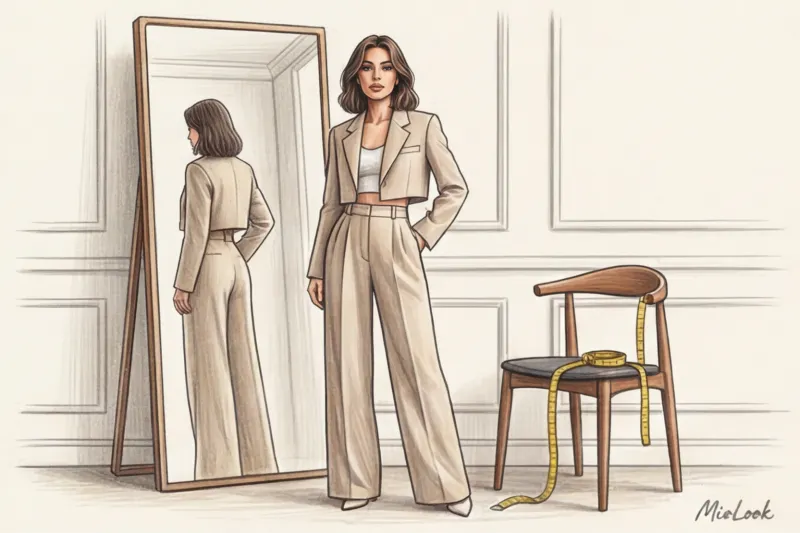
The most common and perhaps most annoying mistake I see on the street every day is dividing the figure in half, that is, creating a 1/2 to 1/2 ratio. Imagine a typical everyday look: mid-rise jeans and a thick, untucked shirt over them. This combination cuts the body right down the middle. Our brain interprets this square block as a heavy, squat structure, lacking in dynamics.
In art, architecture and photography, there has long been an elegant solution to this problem - rule of thirds In the context of a wardrobe, this means creating a 1/3 to 2/3 ratio. And this is where the real mathematical magic begins, which I love demonstrating in my workshops.
If you take that same shirt and just tuck it into high-waisted trousers (or at least make it casual French tuck (Tuck in only the front part), you instantly restructure the entire look. The upper body takes up one-third of the visual space, and the lower body two-thirds. This simple mathematical trick visually lengthens the legs by 10-15 cm compared to an untucked shirt. And it works flawlessly, even if you're standing in loafers with your feet completely flat. The inverse ratio also works—2/3 to 1/3 (for example, a long tunic over skinny trousers). This is also harmonious, but requires more skill, as it can shorten the legs if not complemented by heels or monochrome shoes.
Access to MioLook for €0.99 — one-time payment
A smart AI stylist will select the perfect look.
Get access — €0.99 onceAs researchers at the Fashion Institute of Technology (FIT, 2023) rightly point out, modern tailoring is increasingly moving away from rigidly constraining the body to creating illusory proportions. We're not simply covering up our nakedness; we're constructing a new framework. When creating your clothing silhouettes, always ask yourself, "Where is my waist right now?" If your waistline is lost in a shapeless hoodie or artificially lowered by an ill-fitting cut, you're voluntarily giving up your rightful inches of height.
Fit vs. Size: The Main Mistake When Choosing
How many times have you given up on a stunning dress because you had to ask for a size up in the fitting room? According to the True Fit analytical report (2023), over 70% of online shopping returns are due to fit issues, not simply because they don't like the style. The reason for this widespread frustration lies in our psychological dependence on the letter on the tag.
Let's get this straight once and for all: the size on the label is a complete illusion. In today's fashion industry, size rules. vanity sizing (Size vanity). Brands intentionally change their labeling to make customers feel slimmer and more willing to buy. That same size M you wore in 2010 might well be labeled as an S or even an XS today.
Industrial fact: Due to vanity sizing, standard patterns in popular mass-market clothing have increased in volume by an average of 5-8 centimeters over the past 20 years, while maintaining the same letter markings.
Moreover, patterns vary dramatically from brand to brand. While you can barely button a pair of European size 40 trousers at Zara, you might be literally drowning in similar markings at Swedish COS or Massimo Dutti. The tag is simply the manufacturer's internal factory code, not a death sentence for your figure.
Fear of being "large" often leads women to make a fundamental mistake: confusing the concepts of "too big" and "to fit well." There's a huge gap between the two. If your skirt's zipper is slit, but you can't take a full step, raise your arms to call a taxi, or sit down without holding your breath, then the garment is simply too big. That's not a fit; that's a wrapping of the fabric around your body.
The paradox is that clothes that are too tight visually add pounds. When the fabric is stretched to its limits, it creates horizontal folds. Our brain instantly reads these horizontal lines of tension as a signal: "The body is tight, it's trying to escape." Even the most carefully considered clothing silhouettes They lose their architectural strength if the garment is bursting at the seams. A woman of size 42 will look larger in a tight-fitting XS shirt with buttons that flare out at the chest than in a loose-fitting size M shirt that flows softly along the body.
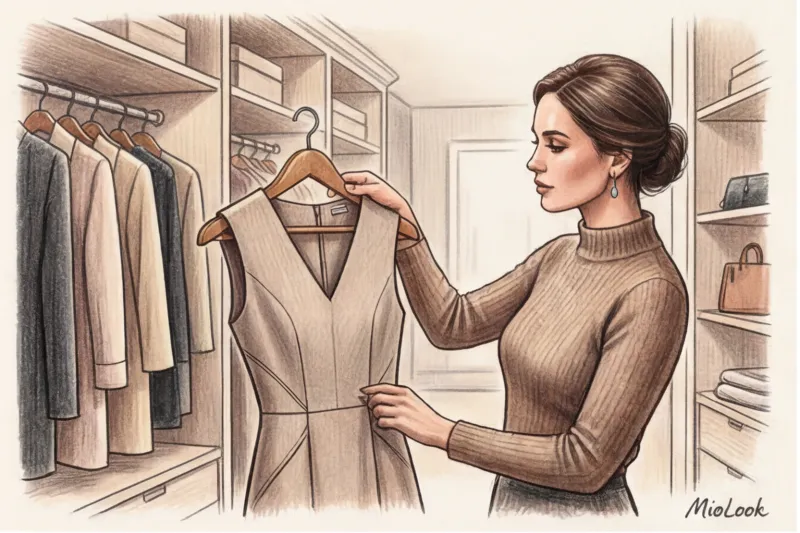
Here I want to share the main professional secret that we use in shopping support. Stylists Always They buy clothes based on the widest part of the client's body, and have the rest adjusted by a tailor. If your hips require a size L and your waist requires a size M, you'll take an L without a second thought. Having the waistband of trousers or a skirt taken in at a tailor costs around 15–20 euros, but this small investment transforms a standard mass-market item into a bespoke piece. Trying to squeeze size L hips into size M trousers will hopelessly ruin the proportions.
Signs of a Perfect Fit: A Stylist's Checklist
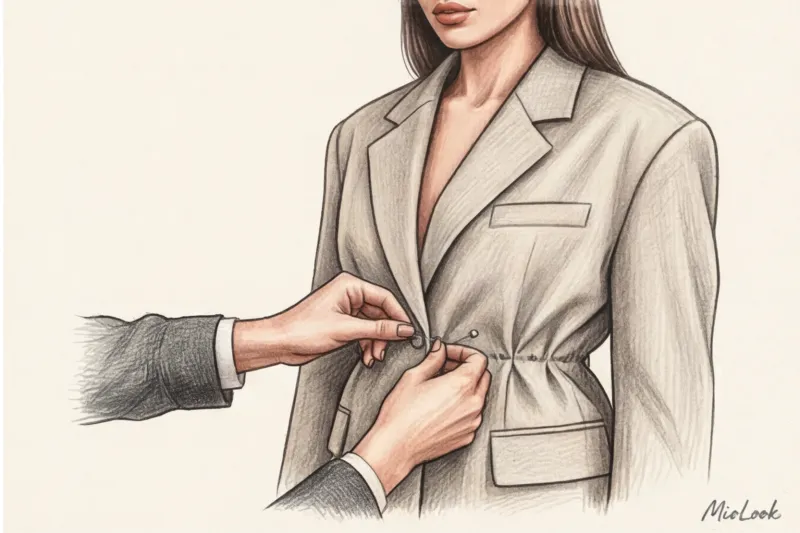
To avoid being reliant on the whims of branded patterns, it's important to learn to read fit by key stress points. Here are three key markers I always look for in the fitting room:
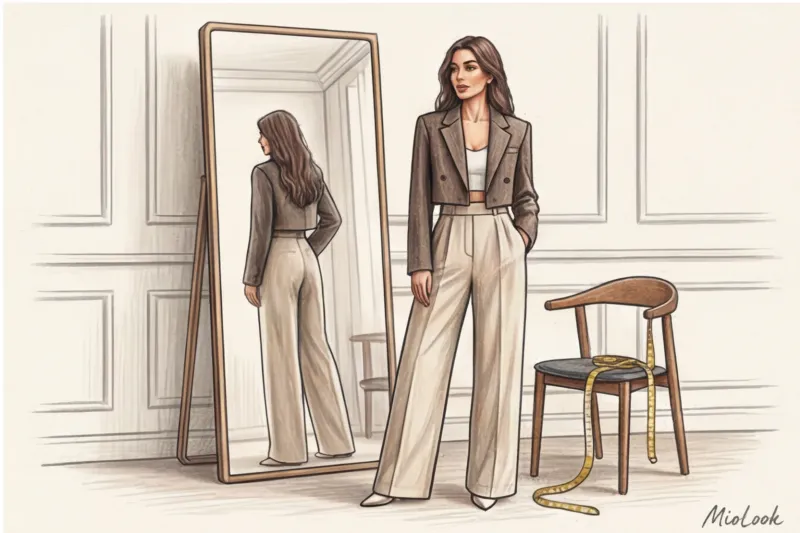
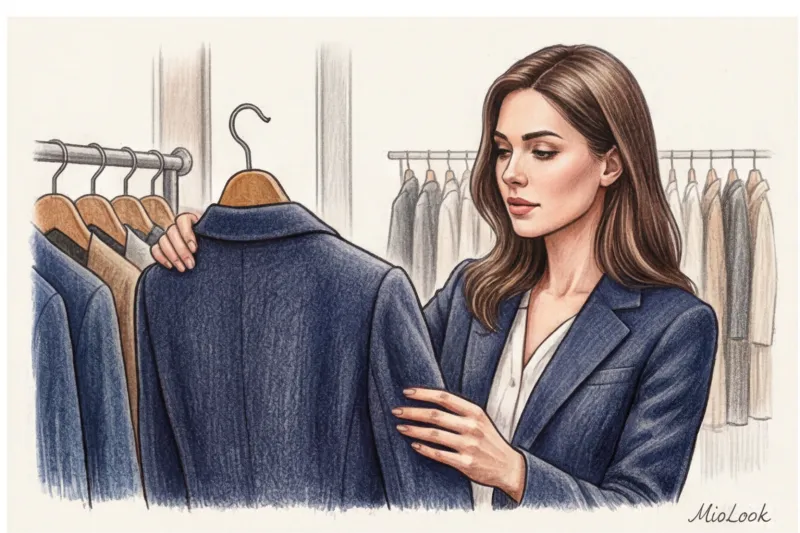
- Shoulder seam: In structured garments (classic jackets, tailored coats), the seam should be positioned directly on the acromion bone—where your shoulder ends and your arm begins. If it's slipped 1-2 centimeters down, the garment looks like you're wearing it from an older brother. The exception is a dropped shoulder cut: in this case, the seam should fall gently to the middle of the biceps, without creating hard angles.
- Armhole and sleeves: The armhole shouldn't dig into your armpit, but it shouldn't hang down to your ribs either (unless it's a dolman style). Test this: cross your arms in front of you, as if hugging yourself. If the back seam is treacherously popping and the sleeves are cutting into your forearms, the garment is too small in the shoulder girdle, even if there's some room at the waist.
- Fabric tension: The golden rule of styling is the complete absence of horizontal wrinkles. If the buttons radiate across the chest, if the crotch area is creased, or if the fabric gathers in horizontal creases at the hips, you're too small. A perfect fit means the fabric falls in clean vertical or soft diagonal lines, leaving air between your body and the garment.
Debunking the myths: who suits oversized and fitted clothing silhouettes
There are two polar camps in the styling industry, and both regularly provide me with work: those who like to hide in an oversized robe and those who desperately try to "slim down" to their desired size. Let's examine the two most destructive illusions that are ruining your clothing silhouettes and visually distort the proportions of the body.
Myth number one: plus size girls should absolutely not wear oversized clothes.
The truth is different: curvy girls need structured Oversized. The problem isn't the volume itself, but the texture. If you wear a shapeless cardigan made of thin, flimsy knitwear, the fabric will simply cling to your curves, and the excess volume will hang like a sad sack. But if you choose a menswear-style jacket made of thick wool or a trench coat made of stiff cotton, optical magic will occur. The dense fabric creates a rigid frame within which the body appears more fragile. People around you will read the shape of the suit, not your actual figure.
But herein lies the most common and fatal mistake I see in fitting rooms: trying to create an oversized look by simply buying an item two sizes too big. As a colorist and stylist who works with body architecture, I always explain the difference in pattern. A garment cut initially oversized and a standard XXL basic T-shirt are completely different geometries.
A properly oversized sweater has a deliberately dropped shoulder seam, but the neckline remains in place, neatly and tightly framing the neck. The balance of the garment is calculated so that it doesn't fall back. If you simply go a couple of sizes too big, the neckline will treacherously slip to the sides, exposing your straps, and the armhole will drop almost to the waist. With the slightest lift of your arms, such a garment will pull your entire hips down, turning you into a solid square. Invest in the right cut, not in random letters on the tag.
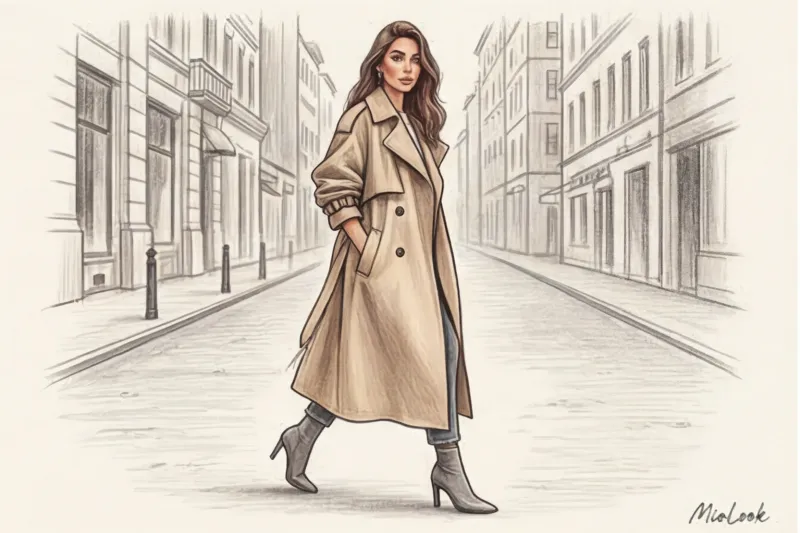
Myth two: tight clothes make you look slimmer and sexier.
This misconception costs women thousands of euros spent on bandage dresses and ribbed turtlenecks, which then sit on the back of their wardrobe for years. Tight clothing made of thin, elastane-rich fabric acts like a merciless magnifying glass. It highlights absolutely everything: the contours of lace lingerie, the slightest puffiness after a heavy dinner, and the creases that aren't actually there (they're created by the fabric itself, clinging to the body). The real secret to a slimmer appearance isn't shaping, but a well-designed semi-fit.
Anatomy of a semi-fitted silhouette: the golden mean
If you analyze the collections of brands in the "quiet luxury" segment or look at the street style chronicles of Fashion Week, you'll notice one common feature. Expensive clothing silhouettes never burst at the seams. The secret lies in the professional tailoring term "free fit"—that saving air between the body and the fabric.
The ideal semi-fitted silhouette requires a gap of 2-3 centimeters between your skin and the inseam of the garment. The fabric should glide smoothly over your figure, hinting at feminine curves without sinking into your curves. This "airiness" conveys status, calm, and confidence. Subconsciously, this fit signals that you're completely comfortable in your own skin, not trying to appear someone else, and not skimping on quality fabric.
A silk blouse that flows freely down the back always looks ten times more elegant than a top pulled tight across the chest, leaving gaping holes between the buttons. A straight midi skirt with just the right amount of freedom looks better than an extremely tight pencil skirt that rises with every movement. The semi-fitted silhouette creates a smooth, uninterrupted vertical line, allowing the observer's gaze to glide freely. It is this continuity of lines, rather than a "second skin" effect, that produces the coveted result—an elongated stature and a visually slimmer figure.
Access to MioLook for €0.99 — one-time payment
Start creating perfect looks with the help of artificial intelligence and find your ideal silhouettes without tedious fittings.
Get access — €0.99 onceClothing silhouettes for different scenarios and dress codes
A colleague of mine, a television producer and public speaking coach, likes to say, “The audience decides whether to believe you or not before you even say your first word.” And here, the right choice clothing silhouettes They act as your invisible, yet very eloquent, press secretary. We dress not only for the weather, but for a specific psychological task.
In the business world, our main currencies are trust, status, and competence. Why has the classic two-piece suit with a sharp shoulder line remained the uniform of power for centuries? It's all about geometry and the properties of fabrics. Structured jackets with shoulder pads and straight-leg trousers with creases create a rigid rectangular frame. In visual semiotics, right angles are associated with stability, discipline, and clear boundaries. By wearing a jacket made of thick gabardine or suit wool (even in the mid-range, you can find perfectly formed styles for 150-200 euros), you literally create a physical distance. You convey, "I'm in control." Soft, shapeless knitwear, in the same situation, conversely, blurs boundaries and makes you appear too "homey," diminishing your sense of expertise.
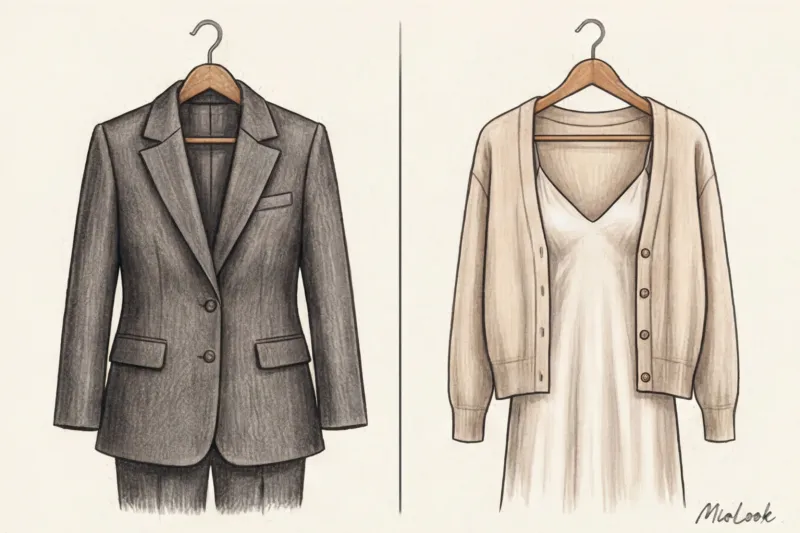
But what works flawlessly at the negotiating table can backfire on stage or on camera. Preparing speakers for large-scale conferences is a science unto itself, governed by the strict laws of optics.
According to professional speaker training guidelines (including TED standards), the main rule of stage design is that the silhouette should be clearly visible from a distance of 10 meters. Small details, complex deconstructed cuts, and delicate drapes can turn the spotlights into a blur.
Moreover, television and photo camera lenses are unforgiving. Due to their focal length, they optically flatten the figure, often making us appear wider and fuller on video than in real life. To compensate for this effect, I always use architectural cuts. No blurry oversize—only large, clear shapes. A deep V-neckline will elongate the neck, and contrasting dark panels on the sides of the dress (a famous technique popularized by Stella McCartney) will visually trim away excess volume, creating the illusion of a chiseled silhouette even through the distorting lens of the camera.
When we move to casual style, the formality level drops, and dynamism takes center stage. Here, the golden rule of style is: balance of volumes If you're wearing a voluminous top (a chunky knit sweater, a men's shirt, or a hoodie), keep your bottoms compact: straight jeans, leggings, or a pencil skirt. Conversely, wide palazzo pants call for a fitted top, bodysuit, or cropped jacket. For example, if you've bought trendy wide-leg jeans, don't try to wear them with a long, oversized sweater untucked. Pair them with a fitted turtleneck made of fine merino wool, and you'll achieve that same expensive, everyday chic. Breaking this rule will make your figure look like a shapeless box.
Even if you're opting for a totally relaxed look, don't forget about the "French tuck"—a casually tucked shirt or T-shirt into the waistband. This micro-trick instantly defines your waist and restores your silhouette's proper proportions without sacrificing comfort.
To avoid racking your brain every morning in front of your closet trying to remember what goes with your new wide-leg pants, I recommend digitizing your most successful combinations. Upload your items to MioLook — it's very convenient to assemble ready-made looks based on volume balance. A smart wardrobe will clearly show you which elements (structured or relaxed) are missing from your base for perfect everyday combinations.
The Art of Tailoring: Why a Custom Fit Changes Everything
Glossy magazines often write about the "rule of thirds" or investing in expensive accessories, but I'm willing to argue: the main secret to a prestigious look lies in the millimeters of fabric. The factory patterns of any mass-market brand (be it Zara, Mango, or COS) are based on an average figure that doesn't exist in reality. When you bring a garment from a store to a skilled tailor, you're essentially turning an assembly-line product into a bespoke tailor.
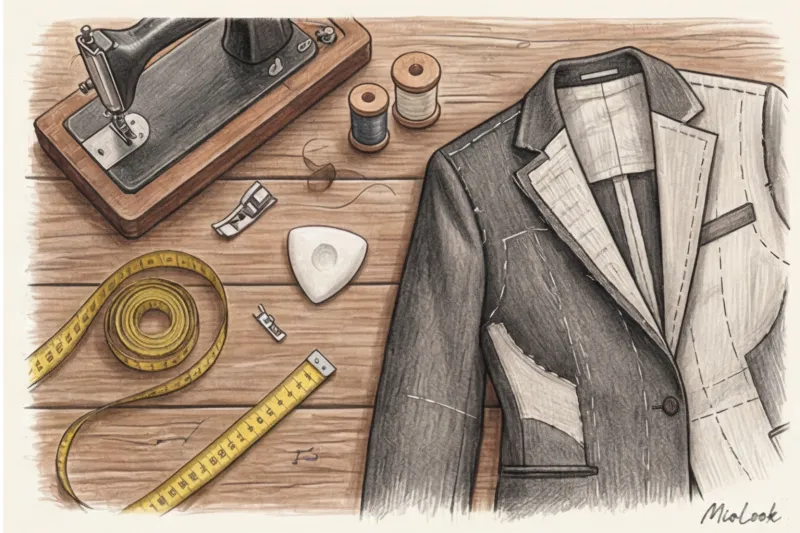
It's the precise fit, tailored to your personal curves, that makes basic clothing silhouettes look like they were crafted by a luxury house's design team.
Let's do some wardrobe math. One of my clients recently bought a basic double-breasted jacket for €70. It fit well in the shoulders, but the sleeves obscured the wrist bone, and the waist was a bit too tight. We took it to a tailor. Shortening the sleeves and moving the buttons cost €25, and adding additional darts in the back cost another €15. The final cost was €110. But visually, this jacket now looks like a solid mid-up €400-500. The investment in tailoring a basic jacket pays off 100%, because a perfectly fitted garment won't be worn twice a season, but will become the foundation of dozens of looks.
"The difference between something your size and something your shape is colossal. The former simply fits, while the latter physically changes your posture and how you feel."
But there's a strict rule here: a tailor is an artisan, not a magician. To ensure a successful shopping experience, you need to clearly understand what in the cut can be altered and what shouldn't even be attempted.
- What's easy and inexpensive to fix: Shorten the sleeves (if there's no complex vent at the bottom), adjust the hem length, and slightly taper the legs. A separate must-have is to take in the waist of trousers or jeans. That annoying "loose waistband" at the back can be eliminated with a couple of darts for 15-20 euros, forever eliminating the need to tie the fabric with a belt.
- What is best to absolutely not buy: items that are too small in the shoulders, pull at the chest, or dig into the armhole area (under the arms).
Why do we avoid shoulder problems? The shoulders and armholes are the supporting structure that holds the entire garment together. To widen the shoulders or deepen the armholes, the tailor will have to completely rip the garment apart, remake it (if there's even enough fabric left in the seams, which is a rarity in mass-market garments), and reassemble it. Such a complete remake will cost you €80-150, which is often more than the original purchase price.
This leads to my golden rule of fitting room: Always buy a garment that fits perfectly in the shoulders and chest, and have a tailor trim any excess volume at the bottom..
Your ideal image
it begins Here
Join thousands of users who look flawless every day with MioLook.
Get access — €0.99 onceWardrobe Management: How MioLook Helps You Find Your Clothing Silhouettes
A mirror is the most unreliable advisor when it comes to personal style. When we look at ourselves in a fitting room at home or in a store, we unconsciously deceive ourselves: we instinctively suck in our stomachs, straighten our backs, hold our breath, and turn only the "working" side of the mirror toward the glass. Furthermore, our brains have a built-in filter for selective attention: it can focus on a beautiful shade of fabric or a shiny button, completely ignoring the fact that the garment throws off our body proportions.
A camera lens works completely differently. A static shot, taken from a distance of two to three meters (ideally at a focal length of 50–85 mm, which matches human vision and doesn't distort perspective), reveals the harsh truth. The camera dispassionately records where exactly the fabric gathers into treacherous horizontal folds, how the volume is distributed, and how the chosen clothing silhouettes are read by others in real life.
To transform this process from a one-time stress in front of the mirror into a systemic analysis, I strongly recommend digitizing your daily images. smart wardrobe feature in MioLook , you start collecting personal statistics that work like a fitness tracker, but for your style.
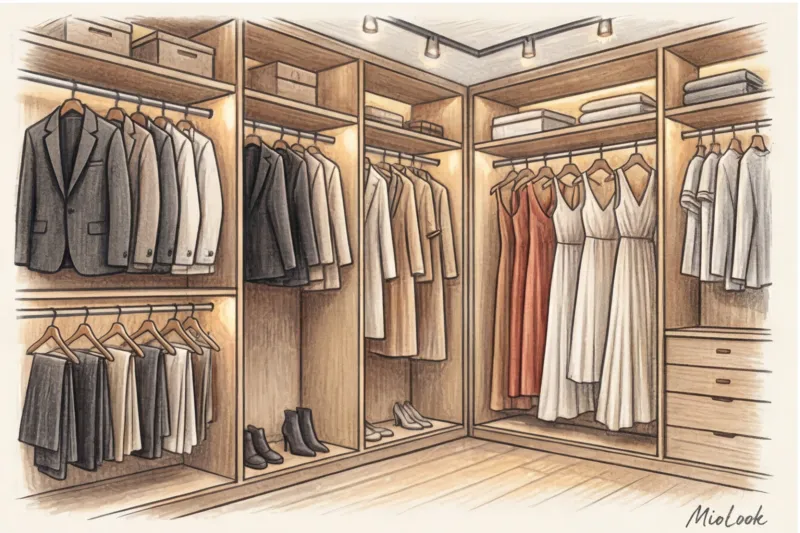
The point isn't just to create a pretty catalog of things on your phone. It's about tracking patterns. When you regularly use the app to track what outfit you wore today and how many compliments you received (or, conversely, how self-conscious you felt), the magic of data begins to work in your favor. You'll clearly see that, for example, a trendy O-line silhouette (like a cocoon) always makes you slouch and tire faster, while a structured, semi-fitted jacket invariably attracts questions like "Where did you buy that?" and gives you confidence in work meetings.
Most popular online guides teach you to assemble a capsule wardrobe solely by color: "Pick a beige trench coat, a white shirt, and black trousers." This is a dead end if these basic pieces clash in shape and volume. A professional, truly work-ready capsule wardrobe is always built on proven fits, not random micro-trends.
If you've empirically determined that your ideal bottom is a full-length, straight-leg, mid-rise pair (creating a strong vertical line), then the entire shoulder section of your capsule wardrobe should be tailored to this specific volume. You stop buying items just because velvet or a drop waist are in fashion this season. You buy architectural pieces that are guaranteed to fit your body.
According to retail analytics for 2023, approximately 74% of purchased items end up dead in closets due to discomfort in the cut and fit, and not because they are no longer visually pleasing.
To avoid contributing to these sad statistics and stop spending hundreds of euros on clothes that don't last, take a simple, practical step today. Pull out three items from your closet that make you feel like a million bucks and attract the most attention. Photograph them and upload them to your smart wardrobe. Digitize your most successful finds so AI can help you find the mathematical patterns in their cut. You'll likely discover that your personal secret to success lies in a consistent fit, a consistent shoulder line, and the right balance of volumes. Clothes are just fabric, but how they're cut determines whether you control the impression or it controls you.
Guide Chapters
Low-rise clothing: what is it?
Empire style clothing: what it is, its features, and what to wear it with
Relaxed-fit: What is this fit in clothing?
A-line silhouette: what it is, types, and what to wear it with
What is a flared dress: history, cut types, and combination rules
X-Silhouette (Hourglass): What is it in fashion?
Straight cut (H-silhouette): what it is, its features, and what to wear it with
What is baggy clothing: a description of the style
Mermaid silhouette (godet): what it is and its cut features
What Is a Bootcut? Meaning, Fit, and How to Style It
A complete guide to the bootcut silhouette, explaining its origins, fit characteristics, and the best styling combinations.
Semi-fitted silhouette: what it is and its cutting features
Cocoon silhouette: what it is and distinctive features of the cut
Tapered fit: what it is and what to wear it with
Balloon skirt: what it is, its cut, and what to wear it with
O-Silhouette in Clothing: Definition, Cut Features, and Style
Mom-fit: What is this style of jeans and what to wear it with?
High-rise: What is it in fashion?
Slim-fit: What is this clothing style and how to wear it?
Regular-fit: What is this clothing cut?
Boyfriend jeans: what they are and how to wear them
What Is Cropped Clothing: Types, Features, and Styling Rules
A comprehensive guide to understanding and styling cropped garments, including tops, jackets, and trousers, to create balanced and modern silhouettes.
What is oversized clothing: cut and style features
What is an A-line silhouette in clothing: definition and features
What Are Skinny Jeans: Cut Features and Styling Rules
Learn about the defining characteristics of skinny jeans and how to style this tight-fitting denim silhouette.