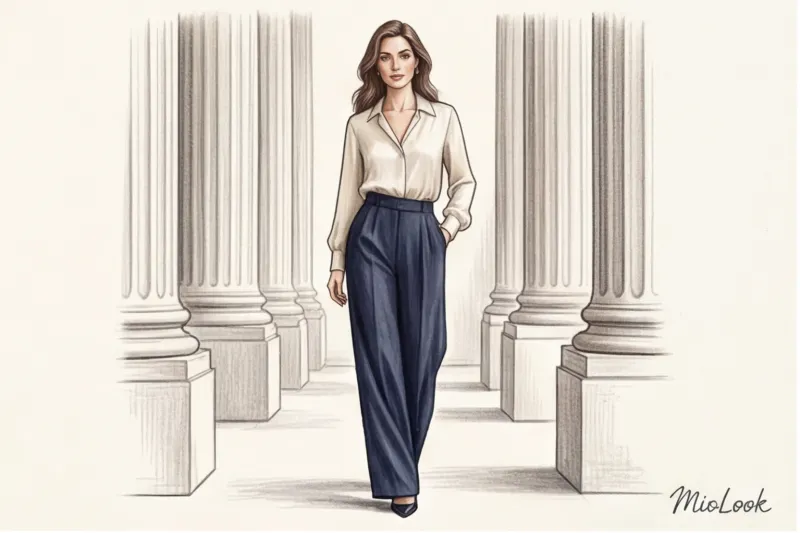
Geometry of Style: How Clothing Visually Corrects Your Figure
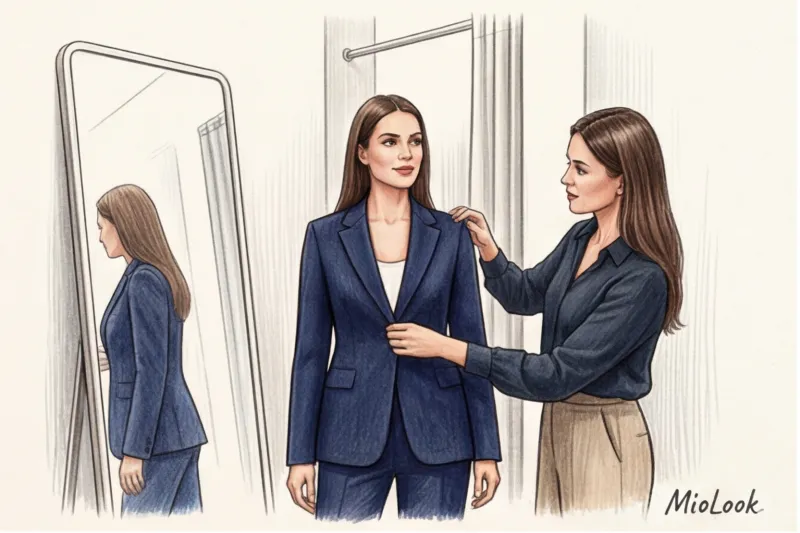
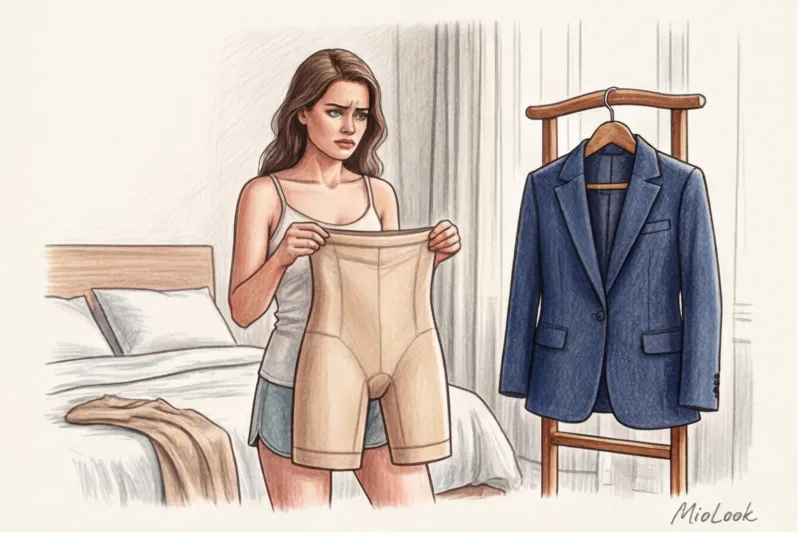
Over the course of 12 years as a stylist, I've thrown dozens of my clients' shapewear shorts and rigid corsets into the trash. Why? Because we're used to solving problems radically: trying to physically "flatten" the body in places where it's enough to simply redirect the gaze. A smart approach visual correction of the figure with clothing It's not an attempt to squeeze into a dress a size too small at the expense of your own comfort. It's pure wardrobe architecture.
"Treat your body not as an imperfect piece of clay to be reshaped, but as a lush landscape upon which we construct a building. We're not demolishing mountains; we're carefully designing the façade, working with the supporting structures, and setting the right lighting."
Visual correction is the art of directing the attention of others. When you enter a meeting room or a restaurant, it's the geometry of your belongings, not the number on the scale, that dictates where your interlocutor should look. Our app's analytics MioLook reveals a striking trend: users who switched from the neurotic "hide flaws at all costs" tactic to the "highlight their best features with lines" strategy are 40% more likely to report being completely satisfied with their daily looks.

The first thing I ask you to do in my sessions is forget about "apples," "pears," "inverted triangles," and other fruit salad. This system is hopelessly outdated and only breeds insecurities. Modern stylists don't think in terms of fruits; we think in vectors, lines, and areas of color. The figure is the canvas. Look at Kate Middleton's style: her team does not frantically try to “correct” narrow hips, they build a powerful architecture of the shoulder girdle and set the correct verticals, balancing the entire silhouette.
This approach is based on the basic law of illusion: the human eye perceives not actual volumes in centimeters, but rather how light and shadow fall on fabric. You can buy a perfectly tailored dress for €200, but if it's made of thin, shimmering satin, the fabric will act as a magnifying glass, reflecting light and adding visual volume. Conversely, dense, matte cotton or high-quality suiting wool absorb light, creating a crisp, defined outline without unnecessary highlights and shadows.

Müller-Lyer optical illusions in the wardrobe
Let's move from theory to the pure physics of perception. You probably remember the Müller-Lyer illusion from your basic psychology course: two segments of exactly the same length appear different if one has arrows pointing inward at the endpoints, while the other has arrows pointing outward.
This illusion works every day in your closet, and nowhere more so than in the portrait section. The classic V-neckline is the same "arrow" that creates a downward vector. It elongates the neck and visually narrows the chest. By comparison, the boat neckline acts as a horizontal guide, broadening the shoulders. You haven't lost or gained weight—you've simply changed the vector, forcing the eye to follow a different trajectory.
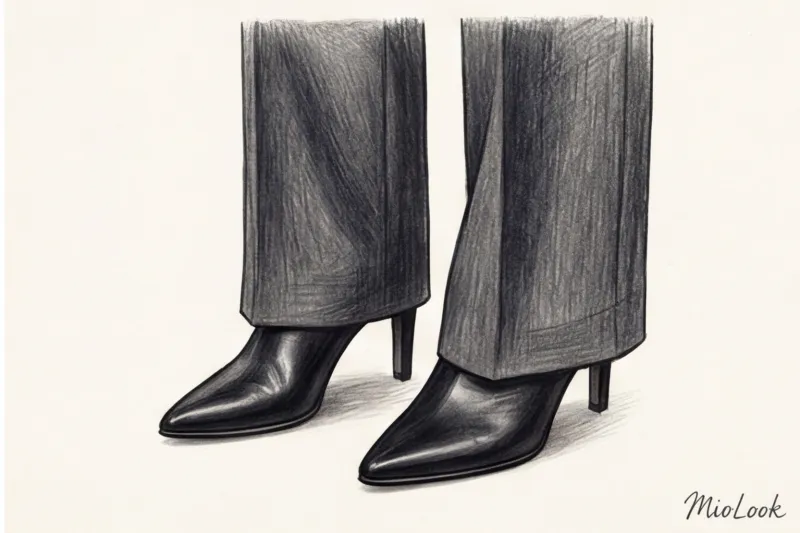
Moving down to the shoes. The point where your pants end and your shoes begin is critical for the perception of height and leg length. If you wear black cropped pants and white sneakers, the sharp contrast creates a harsh horizontal line. This mercilessly "cuts" your leg, taking at least 3-5 centimeters off your height. Want to create the illusion of endless legs? Wear shoes that match your skin tone (if your legs are exposed) or the color of your pants. If you're looking for women's casual shoes as an alternative to sneakers , choose suede loafers or ankle boots that match the shade of your bottoms. This way, the line is unbroken, the eye moves from top to bottom without obstruction, and the brain processes this long, continuous stretch of color as a single whole.
Myths about correction that are long overdue to be forgotten
Have you ever caught yourself instinctively reaching for an oversized dark sweater when you're feeling dissatisfied with your figure? According to consumer psychology research (2023), approximately 68% of women use oversized clothing as a means of camouflage. We're accustomed to relying on rules passed down from generation to generation, yet they're hopelessly outdated. As a stylist who works with body architecture every day, I want to address three major misconceptions that have the exact opposite effect.
Myth 1: Black is always slimming.
This is the most persistent dogma of the fashion industry, which, in practice, breaks down against the laws of physics. In reality, black acts as a marker: it creates the most rigid, uncompromising outline. If you're in a bright office or walking down a sunlit street, black, contrasting with a light background, will literally "cut out" your silhouette. As a result, any unevenness, crease, or curve will be emphasized by this rigid frame.
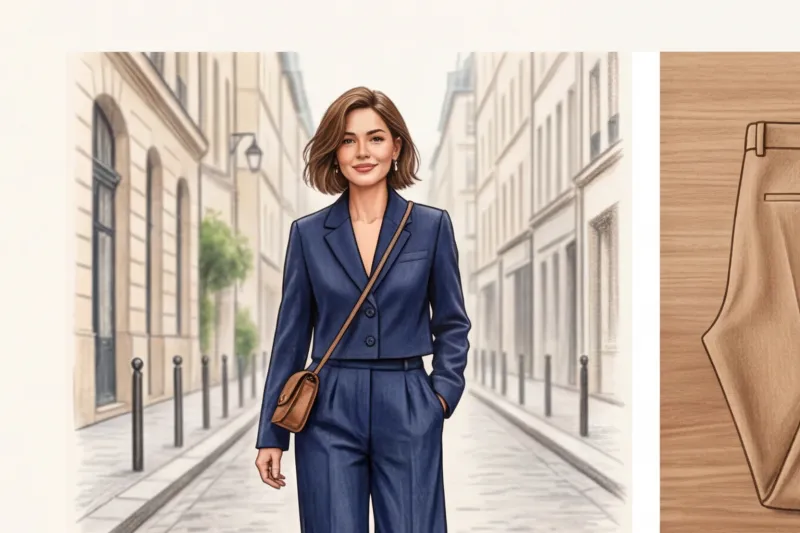
Moreover, matte black often looks heavy and flat. Instead of all-black, deeper, but less contrasting shades are much more effective: saturated navy (dark blue), pine, wine, or dark chocolate. They absorb light beautifully, narrowing the silhouette without creating the effect of a cardboard cutout against a light background.
Myth 2: Oversized clothing will reliably hide excess weight
"When I go through wardrobes, I often remove the shapeless black robes that clients wear like armor."
Women think that if nothing is visible under meters of fabric, unwanted bulk disappears. In reality, the human eye works differently: the brain doesn't imagine your actual fragility under a sweater, but automatically calculates your body volume to the outer limits of the garment. By hiding in a baggy hoodie or tent dress, you voluntarily add 5-7 visual kilograms to your figure.

The secret to a successful shape isn't in huge volumes, but in leaving a little "air" between the body and the fabric (a semi-fitted cut) and the right texture. A structured jacket made of thick wool, priced between €100 and €150, which perfectly holds the shoulder shape and creates clean, straight lines, will flatter your figure incomparably better than thin, shapeless knitwear.
Myth 3: Vertical stripes make you look slimmer, horizontal stripes make you look fatter
It's time to definitively disprove this stereotype from a scientific perspective. Back in the 19th century, the German scientist Hermann von Helmholtz discovered an optical illusion that proved a paradoxical fact. The Helmholtz illusion clearly demonstrates that a square filled with dense, narrow horizontal lines appears visually taller and narrower than an identical square with vertical lines.
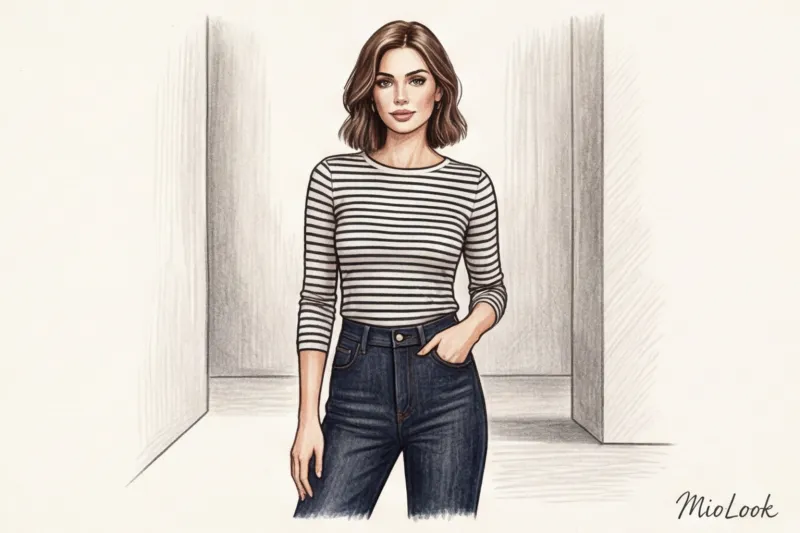
This law of physics works flawlessly in a wardrobe. When you wear a garment with a tight, narrow Breton stripe (where the lines are no more than 1–1.5 cm wide), the viewer's gaze rhythmically glides up and down these "steps," visually elongating your height. Two or three wide, contrasting vertical stripes on a dress, on the other hand, will force the eye to dart left to right, subconsciously assessing your width. The only exception when horizontal stripes are truly dangerous is with single, wide color blocks on the largest parts of the body.
Try MioLook for free
A smart AI stylist will select the perfect look based on your proportions, eliminating items that make you look bulkier.
Start for freeAttention Management: The Focal Point Rule
The human eye is remarkably predictable: our optical system unconsciously searches for the highest point of contrast in space. This biological reflex underlies a powerful, yet often underappreciated, styling tool: the principle of distraction.
The eye is literally drawn to the lightest, brightest, or most textured spot in an outfit. If you wear a monochrome gray outfit and neon pumps, 90% of everyone's attention will be focused on your feet. That's why a well-chosen visual correction of the figure with clothing It's not just about disguising physical dimensions, but also about intelligently directing the gaze of others. We can divert attention from areas that make you feel insecure simply by creating a visual magnet elsewhere.
Let's say your goal is to tone down the bulk around your hips. Instead of agonizing over the perfect trouser width or cardigan length, shift the focus upward. A large geometric brooch on a jacket lapel, a statement collar with contrasting piping, or a silk scarf will instantly draw people's attention to your face, not your figure. Incidentally, a high-quality, thick silk scarf (it's quite possible to find excellent basic options for €50–€80) works as an ideal reflector, further brightening your complexion.

This technique works flawlessly in a business setting and on stage. I recently prepared a plus-size executive for a keynote address at a specialized IT conference. The client was very concerned about her midsection and asked me to "hide" it in her usual voluminous dark suit. We took a completely different approach: we chose a matte pantsuit with a perfect semi-fitted cut in a deep graphite shade, but added a chunky architectural necklace in crushed metal and a rich ruby lipstick.
“People listened to me looking straight into my eyes, rather than looking at my silhouette,” she wrote to me after a successful presentation.
For public speaking and important work meetings, I recommend using the following algorithm for creating a focal point:
- Create a neutral canvas. Basic clothing should be of a simple cut, without bold prints or glaring textures in problem areas.
- Select one attraction zone. Place the accent exclusively in the portrait area (from the chest line to the crown).
- Keep an eye on the scale. The size of the accessory should be proportionate to your facial features—a thin chain with a teardrop pendant will simply be lost on a stately figure.
To check if the illusion worked, I always recommend digitizing your outfits. Take a photo of the finished look and analyze it through MioLook smart wardrobe On your smartphone screen, without the usual reflection in the mirror, you'll immediately and very objectively see where the focus falls first—your face or, say, an unfortunate shiny belt buckle.
Proportions and Lengths: The Mathematics of the Ideal Silhouette
Architects and artists have been using the Golden Ratio for millennia, but when it comes to their own wardrobe, most women rely on intuition or mood. And in vain. Style isn't magic, but applied mathematics, and its most important tool is rule of thirds The idea is extremely simple: to create a harmonious figure, you need to visually divide it vertically into three equal parts. The optimal and most complimentary silhouette formula is a proportion of 1/3 (top) to 2/3 (bottom).
When I ask my clients to simply tuck the front edge of their jumpers (French tuck), restoring the 1/3 to 2/3 ratio, we visually add 10 centimeters of leg length. It's the fastest, most effective, and absolutely free transformation of all.

In contrast to this rule, there is the most common and destructive mistake - the danger of dividing a figure in half (proportion 1/2 to 1/2) Imagine a long tunic worn untucked or a contrasting belt draped over the hips (a throwback to the 2000s). This kind of horizontal line literally cuts the body into two identical squares. The viewer's eye can't tell where the legs begin, so the brain automatically assumes the worst-case scenario. Last week, I was sorting through the wardrobe of a woman who'd bought several luxurious basic shirts costing between €150 and €200, but stubbornly wore them untucked with mid-rise trousers. This made her appear half a head shorter than she actually was. Once we defined the waist and converted the proportion into thirds, the silhouette instantly elongated.
A separate science - choosing the right length of skirts and trousers In styling, the ironclad rule of horizontals applies: the edge of a garment always draws maximum attention to the area it intersects. That's why a hem should never end at the widest part of the leg.
- If you're wearing a midi skirt, its hem should be at its narrowest point, just below the knee or just above the ankle. If the fabric cuts right down the middle of your calf, it will visually transform your leg into a massive column.
- When choosing cropped trousers, culottes, or Bermuda shorts, pay close attention to the cut line. Look for the length where your leg begins to taper.
- Sleeve length works on the same principle: a 3/4 sleeve is ideal because it reveals a thin, graceful wrist, while a short sleeve that ends at the fullest part of the forearm adds unnecessary bulk to the figure.
The problem is that our own brains often deceive us in the mirror—we focus on individual flaws rather than the silhouette as a whole. To see your true proportions without distortion, I strongly recommend digitizing this process. If you upload your everyday images to the "smart wardrobe" feature of the MioLook app , you will be able to objectively evaluate the lengths from the side. The app's algorithms are excellent at detecting where the balance of thirds is disrupted and help you create combinations from your own clothes that will work for your figure, not against it.
Try MioLook for free
Start creating perfect looks with the help of artificial intelligence and assemble a wardrobe with ideal proportions.
Start for freeColor, Print, and Texture: Tools of Optical Illusions
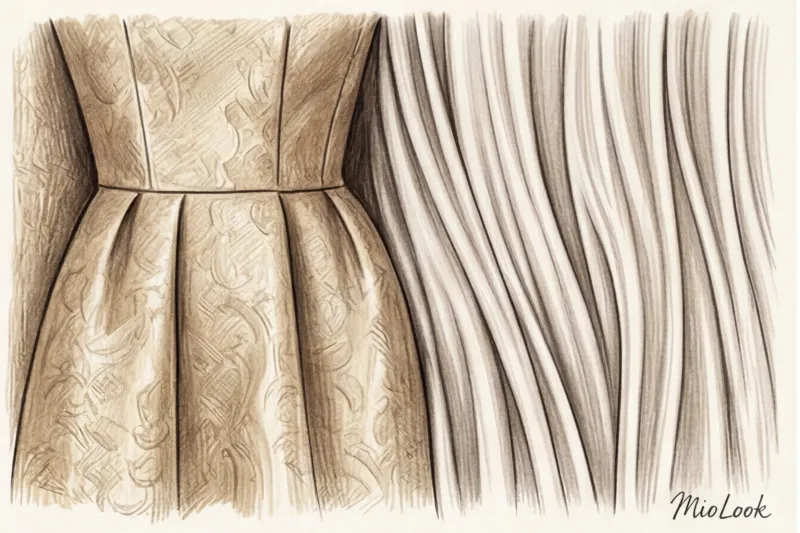
One of the most insidious enemies of a silhouette isn't excess weight, but the wrong fabric texture. If we consider the basic physics of light, it becomes clear why some clothes make us look slimmer, while others transform us into a vast cloud. Matte surfaces (thick suiting wool, high-quality cotton, crepe, suede) absorb light rays. They create a clear, stable contour that visually gathers the figure and makes it more compact.
But shiny fabrics—satin, silk, sequins, velvet, or lurex—work like hundreds of tiny mirrors. In 2022, the Pantone Color Institute, in collaboration with stage lighting researchers, published interesting data: under directional studio lighting at events (or even in bright sunlight), glossy textures visually add up to 15% additional volume to an object. Reflections on the curves of shiny fabric highlight the slightest irregularities and create a 3D expansion effect. That's why a popular bias-cut silk skirt often makes even slender women look fuller. Save the shine for areas where you want to add volume—for example, a satin blouse perfectly balances narrow shoulders.
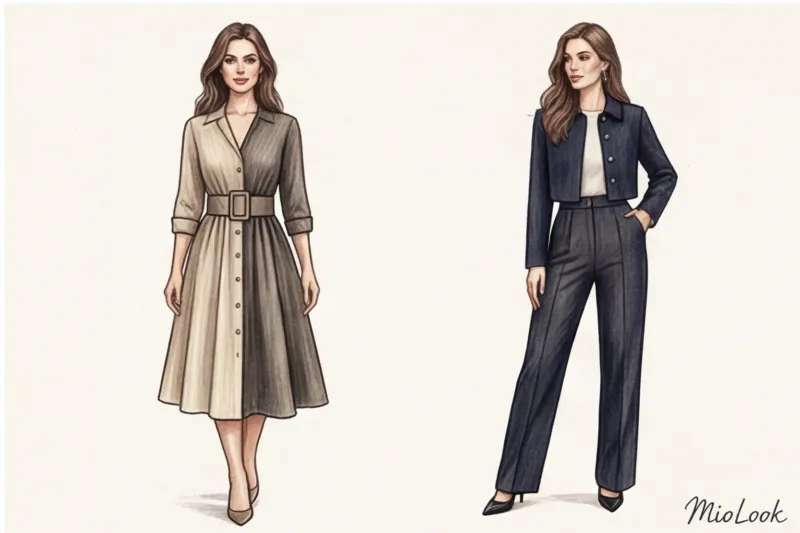
Now let's move on to the magic of color distribution—color blocking. You're probably familiar with Stella McCartney's iconic illusion dresses (prices start at €800 in boutiques), which literally "drawn" waists on half the stars on the red carpet. This technique works flawlessly: the central part of the garment is made of a light or bright fabric, with curved, contrasting dark panels (black, navy blue, or graphite) placed on the sides.

Our brains are wired to only notice the central light spot, completely ignoring the dark sides, which optically blend into the background. The result is a distinctive hourglass silhouette. You can create the same optical illusion yourself by wearing an unbuttoned dark cardigan over a light basic T-shirt—two vertical dark lines on the sides will instantly trim off those extra inches.
The third crucial element, without which visual figure-shaping with clothing would be incomplete, is the scale of the print. The rule of proportionality, which many forget in the pursuit of trends, applies here. The essence is simple: the size of the print should be strictly proportional to the scale of your figure.
The most common mistake I have to correct during shopping sessions is a small millefleur print (that tiny flower or tiny polka dot) on women with a size L or larger. Against a scattering of tiny buds, a larger figure appears monumental and massive—the merciless law of contrast comes into play. Conversely, giant geometric blocks or enormous flowers on a petite woman 155 cm tall will simply crush her, making her look like a child in her mother's clothes. If you're unsure about your choice, choose a print that's roughly the size of your fist—this is a universal measurement that won't distort your proportions.
To avoid wasting hundreds of euros on unsuccessful experiments with textures and patterns, I advise clients to test them digitally first. Upload your photos and desired items to MioLook — the app will allow you to visually see how satin sheen or large checkered patterns change the geometry of your body on your smartphone screen, even before you go to the checkout.
Targeted visual correction: solving specific problems
"Apples," "pears," and "inverted triangles" are an outdated stereotype from the glossy magazines of the early 2000s that's long overdue for a relegation. Why is an individual approach more important than rigid typing rules? It's simple: two women with the conventional "pear" body type can have completely different torso lengths, knee heights, and shoulder shapes. By forcing yourself into the confines of a single "fruit" body type, you lose sight of the nuances of your own anatomy and deprive yourself of freedom of choice.
"We don't correct abstract figures; we solve specific geometric problems. Typing kills individuality, while understanding cut lines gives you absolute control over your look"—this principle underlies my approach to styling.
The principles of harmonizing a silhouette based on the desired result are always based on managing focus and creating the necessary vectors. Over 10 years of work, I've compiled this matrix of stylistic solutions, which is now used by our app's AI. It's free of dogma, but contains clear algorithms that operate according to the laws of optics. Below is my personal professional cheat sheet for the three most common requests my clients make.
How to visually lengthen your legs and increase your height

The most common request from petite and average-sized women is to add a touch of grace and elongate their silhouette. The secret here isn't exhaustingly wearing 12-centimeter stilettos, which only ruin your posture, but rather cleverly crafting a vertical color scheme. The optical illusion of elongation works best with a monochrome look.
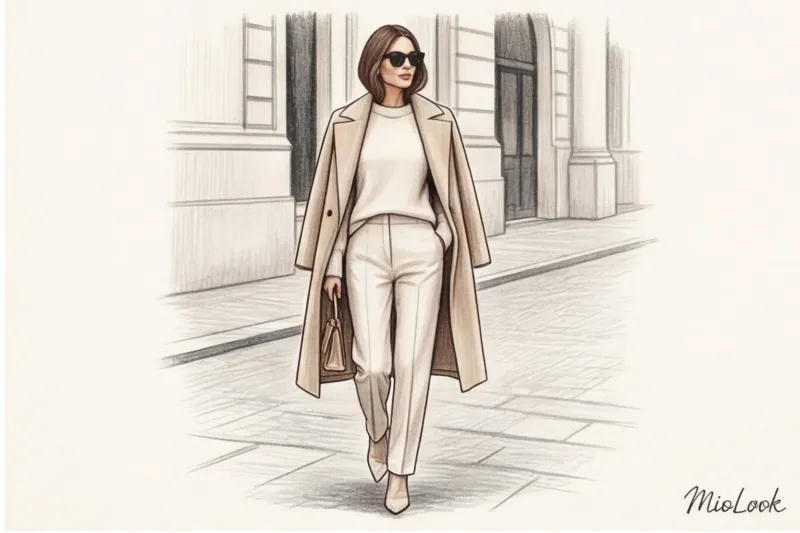
When your top, pants, and shoes are all the same or a similar shade, the observer's gaze moves from top to bottom without obstruction. As soon as you wear black ankle boots with light-colored jeans, you mercilessly shorten your legs at the ankle. Matching your shoes exactly to your bottoms is a crucial rule for those who want to appear taller.
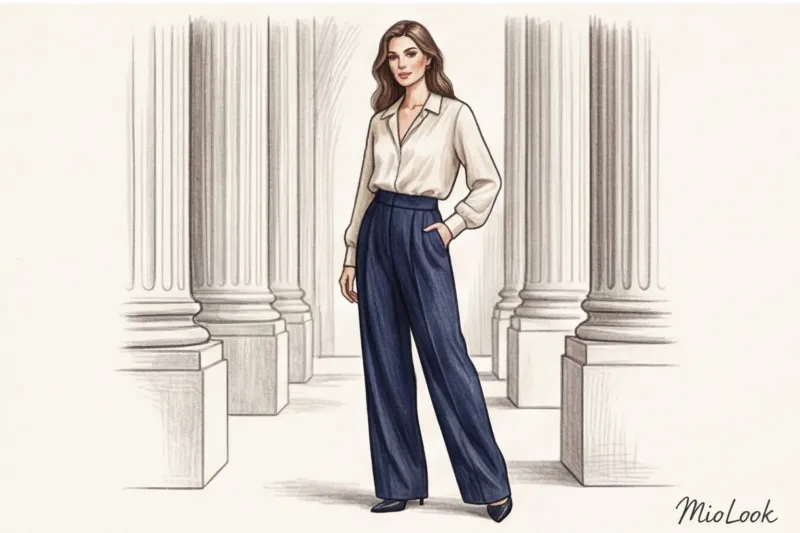
Add to this the high waist and vertical lines of the cut: classic pressed creases on trousers or a long row of contrasting buttons. High-quality suit trousers with creases made of thick wool (excellent basic options are easy to find in the €120–€180 range from brands like COS or Arket) visually add those coveted 5–7 centimeters of leg length without the slightest physical discomfort.
How to create the illusion of a smaller waist
Even if you don't have a pronounced curve between your ribs and pelvis, you can literally "draw" one through fabric design. My favorite stylistic trick, which works flawlessly on straight body types, is wearing straight-cut jackets open.
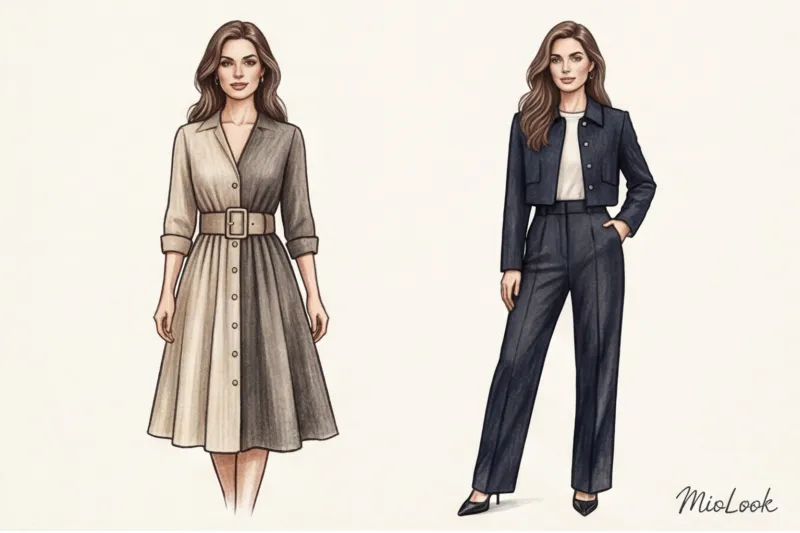
This is called the two-vertical rule. By wearing a contrasting basic top under an unbuttoned structured jacket, you're cutting off the actual boundaries of your torso. People around you will only judge your width by the narrow, open center of your top. Another ingenious tool is the wrap dress, whose iconic cut Diane von Furstenberg popularized back in 1974. The diagonal line naturally creates an X-shaped silhouette on any figure.
For those willing to experiment with trends, the peplum is back on the runway. This architectural element creates artificial, bold volume on the hips, making a real waist appear ashen. But accent belts are a double-edged sword. They should only be used safely if you don't have a prominent belly. Otherwise, a tightly cinched belt will act like a magnifying glass, highlighting volume where you intended to hide it.
Your ideal image begins Here
Join thousands of users who look flawless every day with MioLook. Digitize your wardrobe and receive personalized recommendations.
Start for freeCorrection of shoulder width and hip volume
This is where the law of visual balance, or the "rule of counterweights," comes into play. If your goal is to offset a heavy bottom and voluminous hips, our goal is to draw the focus to the portrait area. Balancing the heavy bottom is achieved with a light top and a dark, matte, slightly flowing bottom.
Jackets with wide, accent lapels or tops with a flared collar work well. They visually widen the shoulders, making them proportionate to the hips. As a result, the figure is seen as a harmonious hourglass, rather than a bottom-heavy pyramid.
The opposite situation is an athletic figure with broad shoulders and a narrow hips. To balance this silhouette, we "break up" the wide horizontal shoulder line with a deep V-neck (it directs the eye vertically). And we compensate for the missing volume at the bottom with the right cut: balancing broad shoulders is ideally achieved with A-line skirts, thick fabrics, waist darts, and palazzo pants. This mathematical algorithm for finding balance is precisely what's behind MioLook smart filters: the system itself analyzes your proportions and suggests styles that will optically balance the top and bottom.
Technology Guards Style: How to Digitize Your Proportions
A 2023 study from the University of New South Wales on the neuroscience of visual perception confirmed what many stylists have suspected for years: we're physically incapable of accurately assessing our own size. Our brain functions as a biased filter. When you look at your reflection in a fitting room, your gaze immediately focuses on the area that triggers your greatest insecurity—be it your shoulders, stomach, or hips. Because of this "tunnel vision" effect, subjective self-assessments in the mirror are often inaccurate: in the context of your entire silhouette, the problem area appears 15–20% larger than its actual size.
It's this cognitive trap that drives women to repeatedly buy unflattering clothes, trying to hide what shouldn't be hidden. To turn off destructive emotions and embrace the pure mathematics of proportion, I shifted my silhouette work to the digital realm.

Smart wardrobes and modern virtual try-on apps help you see your silhouette objectively, like an architectural drawing. When you upload photos of your clothes to your phone, you become abstracted from your body. You begin to appreciate solely the interplay of geometric shapes on the screen. MioLook app We've implemented algorithms that analyze the geometry of your closet and suggest combinations that adhere to the golden ratio.
Creating a capsule wardrobe using pre-programmed optical correction algorithms transforms an intuitive (and often disastrous) morning ritual into a precise, systematic calculation. The program categorizes your items based on key parameters: hemline, contrast level, texture density, and the presence of directional vectors. Let's say you have a pair of great wide-leg trousers (averaging around €90) and several jackets in your closet. The AI won't let you wear a contrasting cropped jacket so that its hem visually cuts your figure in half.
"The machine doesn't care at all about your mood or self-esteem. It only reads lengths, volumes, and color blocks, assembling them into a harmonious puzzle."
Of course, we need to be honest: even the most advanced virtual fitting room can't yet predict how a specific blended fabric will behave dynamically during walking—this limitation of the digital format must be compensated for by knowledge of the materials. However, the basic visual correction of the figure with clothing begins with the correct proportions. After digitizing my closet for six months as an experiment, I realized the main thing: when you hand over the routine of choosing proportions to technology, you finally have time for creativity and self-confidence.
Checklist: Audit your wardrobe for distorted proportions
Theory is dead without practice. You can memorize the laws of color and focal point rules, but as long as your closet is full of clothes that disrupt your body's geometry, your daily get-ready routine will end in disappointment. Right now, I suggest you set aside 40 minutes, stand in front of a full-length mirror, and conduct a ruthless technical audit. Our goal is to find and neutralize the "spies" that are secretly stealing your height and adding non-existent volume.
Step 1: Checking the division points: the "sawed" effect
The most critical mistake I regularly encounter during wardrobe reviews is incorrect horizontal lines. Put on basic trousers or jeans, then grab your favorite tops, cardigans, and jackets. Now look: where do their hemlines end?
Hard rule: The horizontal hemline of a jacket should never cut across the widest part of your hips. The human eye perceives horizontal lines as a width marker. If a jacket ends exactly at the peak of your hips, the viewer's brain automatically "contracts" this width to form a square.

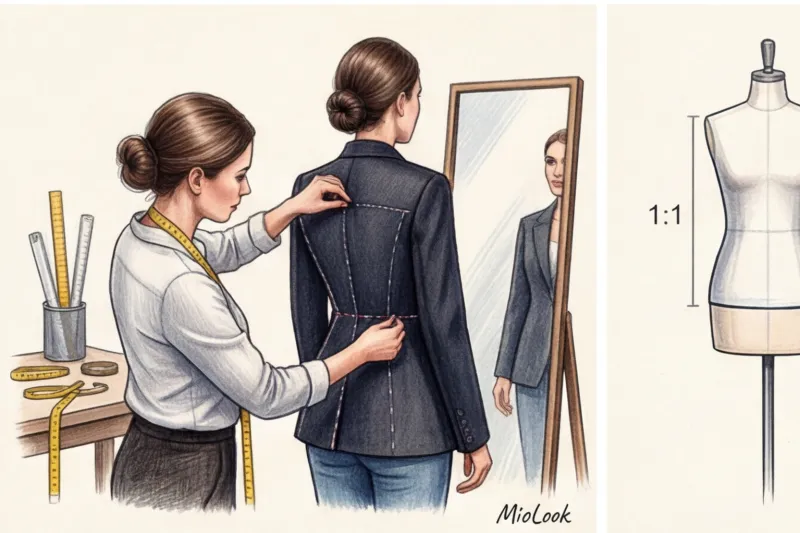
What to do: Take some sewing pins (or regular masking tape) and fold the hem of the jacket 3-5 centimeters above the problem area, then look in the mirror. The silhouette will instantly become more streamlined. A tailor's service to shorten the jacket will cost you approximately €15-€20, but it will save you a €150 garment you've been instinctively avoiding.
Step 2. Oversized revision: finding a balance of volumes
Oversize is a brilliant invention when managed correctly, but an absolute disaster when left unchecked. Remove any deliberately loose-fitting items from your closet. The problem with most wardrobes isn't the presence of oversize clothing, but the lack of counterweights.
To maintain proportions, a strict balance of volumes is necessary: a voluminous top always requires a narrow bottom, and vice versa. If you wear a bulky hoodie with wide-legged palazzo pants, you blur the contours of your body and turn into a monolithic rectangle (which visually adds 5-7 kg). Check: do you have straight pencil skirts, tapered trousers, or thick leggings to pair with chunky knit sweaters?
Step 3. Footwear Fleet Audit: The Horizontal Strap Trap
Shoes are often overlooked when discussing figure proportions, but they shouldn't be. Get out all your pumps, ankle boots, and sandals. Look for the biggest height-deficit culprit: contrasting ankle straps.
- How does this work: The contrasting strap creates a sharp horizontal line that visually "cuts off" the foot from the shin. As a result, your legs appear at least 5 centimeters shorter and your calves appear larger.
- Exceptions: A belt is acceptable if it blends perfectly with your skin tone (nude shades) or matches the tone of thick tights/pants.
- Alternative: To elongate your legs, choose shoes with a deep V-neck (like d'Orsay pumps) or classic pumps. They reveal the instep, making it appear to be an extension of your leg.
It's difficult to track all these micro-nuances on your own, especially when your eyes are jaded. That's why I strongly recommend digitizing the results of your audit. Take photos of your best and worst combinations of items, and then analyze them.
Ready to get started?
Try the free plan—no commitments required. Upload photos of your items to the smart wardrobe and let the algorithms find the perfect proportions.
Start for freeIn the appendix MioLook You can assemble a capsule wardrobe of tried-and-true, mathematically calibrated outfits. When you know in advance that a particular jacket will pair flawlessly with these particular trousers, the risk of throwing off proportions is reduced to zero. Your wardrobe shouldn't be a warehouse of random purchases, but a set of intelligent tools. Clothes are just fabric, but how you construct lines and silhouettes from them is a skill that will forever change your reflection in the mirror.
Guide Chapters
Short torso: how to dress with long legs
Long legs are a gift, but a shortened torso requires a more sophisticated approach. Learn how to choose a wardrobe that visually balances your proportions.
Color blocking in clothing: figure correction with color
Forget boring black. Learn how to use color blocking to create the perfect silhouette and effectively command attention.
How to hide crooked legs with clothing: choosing trousers and skirts
Hiding your figure in shapeless robes is a major mistake. We'll explain how to choose the right style and fabric density to create the perfect vertical line.
Long torso, short legs: how to dress correctly
Forget about uncomfortable armpit-length jeans and the "apples and pears" theory. We explore an architectural approach to style for non-standard proportions.
How to visually lengthen your neck: clothing, jewelry, and hairstyles
A short neck isn't a death sentence, but rather an opportunity to achieve the right proportions. We reveal stylist secrets for choosing the right clothes, jewelry, and hairstyles.
How to visually enlarge your buttocks with clothing: jeans and skirts
Forget about uncomfortable, foam-filled shapewear. We'll show you how to create a beautiful push-up effect with the right cut of jeans and skirts.
How to visually reduce breast size with clothing: techniques and mistakes
Forget shapeless pieces and dark tones. We're exploring an architectural approach to silhouette that will help you stylishly flatter your curves.
Prints that make you look slimmer: stripes, checks, polka dots
Forget the outdated rules of gloss. Learn how to use stripes, checks, and polka dots as powerful tools for visually shaping your figure.
How to visually enlarge your breasts with clothing: stylist tips
Forget about uncomfortable push-ups and rigid corsets. Learn how to create beautiful volume and flatter your figure with the right cuts and details.
How to make your waist look thinner with non-corseted clothing
Forget about uncomfortable corsets! We'll show you how to create a beautiful waistline with proper shoulder and hip alignment.
How to Hide Full Arms with Clothes: Secrets of the Perfect Cut
Forget shapeless cardigans and hoodies. Together with a stylist, we'll explore which styles and sleeves will help visually correct problem areas.
How to Hide Broad Shoulders: A Style Guide for Your Body Shape
Baggy sweaters only emphasize volume. Learn how to use architectural tailoring to transform an inverted triangle into the perfect hourglass figure.
How to Look Taller with Clothes: Tips for Short People
The secret to looking tall isn't in heels, but in the right silhouette. We'll explore the basic rules of visual enhancement for petite women.
How to hide wide hips and balance your figure
Forget black leggings and hoodies. A personal stylist shares secrets for an architectural approach to wardrobe that will help shift the focus away from voluminous bottoms.
How to Hide Your Belly with Clothing: The Best Styles and Tricks
Forget about stiff shapewear and shapeless robes. We'll show you how to effectively conceal a protruding belly with the help of geometric cuts and the right fabrics.
How to Look Slimmer with Clothes: 10 Illusions
Buying clothes a size too small doesn't make you look slimmer, but has the opposite effect. Discover 10 optical illusions in clothing that actually work without dieting.
How to visually lengthen your legs: secrets of proportions
Long legs aren't always a matter of genetics, but rather the result of careful silhouette management. Learn how clothing and proper proportions can visually enhance your height.