Why "apples" and "pears" are a thing of the past: the evolution of typing
Let's be honest: comparing a woman's body to fruit isn't just outdated; it's an aesthetic crime. Remember those glossy magazines of the 2000s? Every style article began by asking you to measure yourself with a tape measure and classify yourself as a pear, apple, or banana. Searching for " Body types: how to choose clothes " , we still frequently encounter these culinary metaphors. But in 12 years of working in fashion journalism, I've never heard a stylist say behind the scenes at Dior or Prada, "We urgently need a pear-shaped model for this dress."
This "fruity" theory, popularized by makeover shows in the late 1990s, was built on a deeply toxic premise. It implied that there was only one ideal body shape—the infamous "hourglass" (a legacy of Christian Dior's 1947 New Look silhouette)—and that all other bodies were inherently "wrong." Styling was all about rigidly concealing these so-called flaws. Wide hips were to be hidden under tight black skirts, and any lack of a waist was to be immediately cinched with a wide belt, even if it disrupted the natural harmony of the silhouette.
Fortunately, the industry has changed. Watching model castings before shows in Paris and Milan, I see how the modern approach works. Casting directors and designers are looking not for a standardized mannequin, but for an interesting body architecture They're interested in your bone structure, lines, angles, how your head is positioned, and how the fabric falls from your collarbones. Today, we've finally moved from flat associations to three-dimensional geometry.
"There are no bad figures, only lazy tailoring and a lack of understanding of one's own geometry," the chief cutter of a Milanese fashion house once told me, and this phrase perfectly describes the modern approach to personal style.
A major paradigm shift has occurred: we no longer try to "hide" or "drag down." We learn wisely. balance proportions and control the gaze. For example, if you choose office-style jeans , your goal is not to disguise the volume of your hips, but to choose a rise and denim density that will create a beautiful vertical line and establish the right visual balance with the upper body.
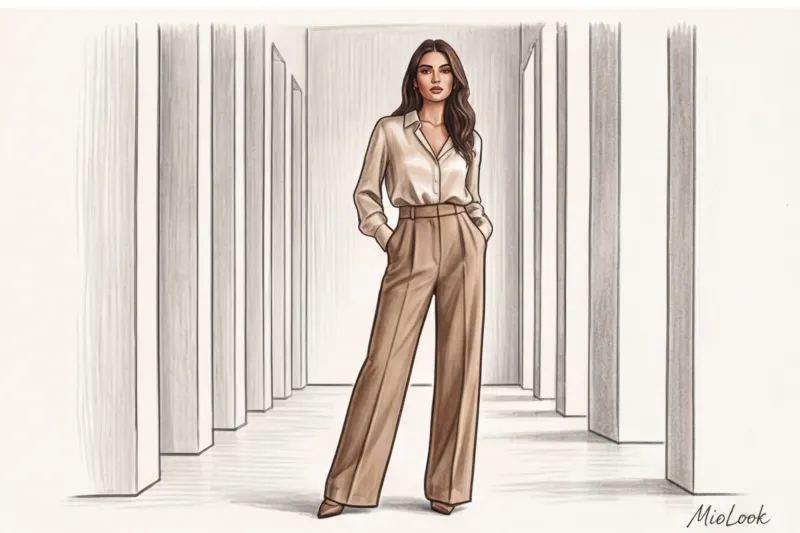
The modern standard is that every body has its own unique power silhouette. This is the cut that allows your natural geometry to shine brightest and most confidently. If you have broad, defined shoulders, you don't need to slouch or hide them behind soft, shapeless cardigans. Think of Yves Saint Laurent's iconic Le Smoking jacket: it was created precisely to transform the straight line of the shoulders into a symbol of absolute strength. Understanding your own architecture is liberating—you no longer need to squeeze yourself into someone else's mold if you're naturally built like an elegant, ancient column.
Body Architecture: How to Redefine Your Body Type
At a closed workshop at Central Saint Martins in London, we conducted a revealing experiment. Two models with identical measurements (90-70-100) were asked to try on the same pair of straight-cut wool trousers by Jil Sander, priced at around €800. On one, they fit perfectly, elongating the silhouette; on the other, they hopelessly distorted the proportions, bunching up in the crotch. Why did this happen? Because a regular measuring tape is incredibly misleading.
It measures circumference, while our clothing is always perceived by others in 2D—from the front or in profile. Frontal projection, that is, how we look from the front, is far more important than the bare numbers on a measuring tape.
This is where the concept of visual weight and bone structure comes into play. When examining body types for clothing, the first thing to consider is whether your skeleton is delicacy or stately. Thin wrists, a narrow chest, and sloping shoulders create a delicate visual weight. For example, actress Tilda Swinton, with her sharp and delicate bone structure, can wear oversized architectural jackets because her frame easily "cuts" through the fabric. Conversely, a broad bone structure, broad shoulders, and a massive chest convey a stately appearance. Those with a stately figure should avoid shapeless oversized clothing; they require a crisp, sculpted fit that restrains bulk.
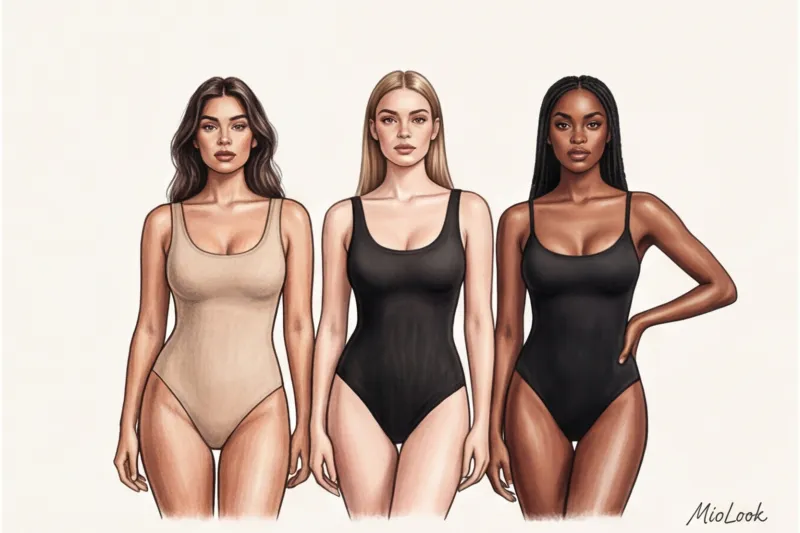
To see your true geometry, I always ask my clients to do a "shadow analysis." Forget about a mirror—it can dramatically distort proportions due to perspective and our habit of sucking in our stomachs or shifting our posture when looking at ourselves. Here's my step-by-step guide for an objective check:
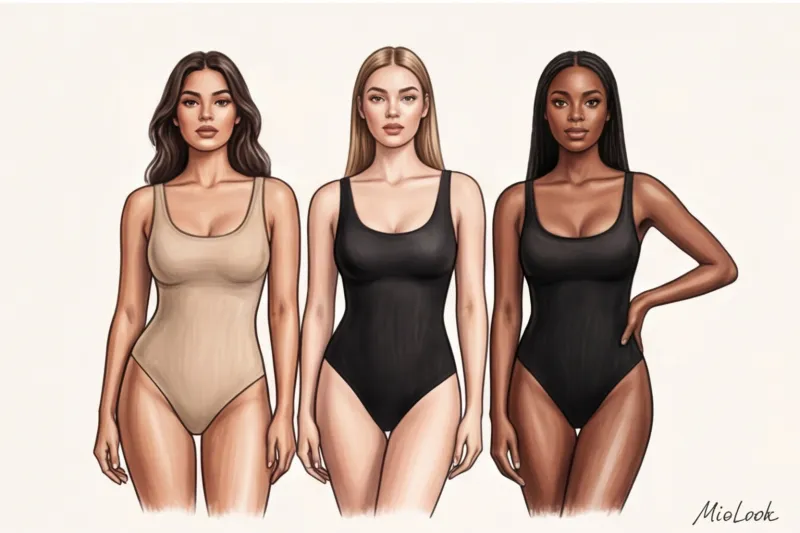
- Wear tight-fitting seamless underwear or thin leggings with a top. Pull your hair into a high bun to reveal your neck and shoulders.
- Stand with your back to a window or a bright light source (your goal is to be backlit, turning into a dark silhouette).
- Ask someone to take a photo from 2-3 meters away. The camera should be positioned exactly at chest level, without tilting. Important: use a 50mm lens (often a 2x zoom or portrait mode on a smartphone) – a phone's default wide-angle lens will stretch your legs and narrow your top, ruining any analysis.
- Convert the photo to a high-contrast black and white mode or completely paint over your outline with a black brush in any photo editor.
"The shadow contour is merciless to our illusions, but brutally honest with proportions. Only by seeing your silhouette as a solid architectural blob will you understand where your true angles, vectors, and curves lie," notes fashion historian Valerie Steele.
Measurements that really matter
So, you've got your shadow contour. Where do you look next? Traditional tailoring measurements are used exclusively for creating patterns, but for visual styling, we evaluate completely different lines.
First, the line of the shoulders relative to the iliac bones. Compare your shoulder width not to your hip measurement at the fullest point of your buttocks, but to the width of your pelvic bones from the front (they're easily felt just below your waist). If your shoulders are visually wider than your hip bones, your body shape leans toward an inverted triangle, and you'll need to visually ground your bottom.
Secondly, high and low hip. This is a critical marker that 90% of women ignore. Look at your shadow contour: where does the flare begin? A high hip (the volume starts just below the waist, a "violin" shape) requires flowing fabrics and a high rise, otherwise you'll end up with stiff creases. A low hip (the flare at the breeches, the waist smoothly transitioning to the hips) pairs perfectly with palazzo pants and A-line skirts.
Thirdly, the legginess index. This is the ratio of your torso length to the length of your legs from the hip joint. If you have a short torso (the distance from your lowest rib to your pelvic bone is minimal), wide belts at the waist will literally "eat" your height. If you have a longer torso, you need an ultra-high rise and a French tuck (a loosely tucked-in hem of a top or sweater).
Calculating these micro-nuances on your own can be tedious. In my practice, I increasingly see how technology simplifies this task: for example, algorithms MioLook They analyze bone structure and geometry, not just centimeters. This allows us to eliminate styles that mathematically conflict with your architecture even before the fitting.
Access to MioLook for €0.99 — one-time payment
A smart AI stylist will analyze your body structure and select ideal looks that will fit flawlessly the first time.
Get access — €0.99 onceGeometry of Style: Modern Body Types and Clothing Selection Guidelines
While researching the archives of Cristóbal Balenciaga in Paris, I found his working notes with calculations of the so-called "guide lines" ( lignes directrices ). For the great couturier, the body wasn't just a collection of volumes—it was pure architecture, where seams, darts, and fabric edges served as strict vectors. When exploring the topic of "body types and how to choose clothes," we must think like high-class tailors and designers, rather than relying on outdated household advice.
Professional design is based on two key concepts: guide lines And focal point.
Leading lines are the optical tracks along which the observer's gaze glides. Any seam, the edge of a jacket, a row of buttons, or a crease on trousers draws the eye in a specific direction. Vertical lines accelerate the gaze, creating the illusion of height and lightness. Horizontal lines (belts, contrasting hems, cuffs) sharply slow the gaze, expanding the area where they are located.
A focal point is the visual anchor of your look. It's where the observer's eye lingers longest. Styling mastery lies in consciously shifting the focal point to your most prominent feature, whether it's graceful collarbones, a slender waist, or long legs.
"Cutting is a form of polite control. You decide where your interlocutor will look, guiding their gaze with the correct lines of the garment," the head cutter at one of the oldest tailors on London's Savile Row explained this principle to me.
Vertical direction is the key to creating luxurious looks. To keep the eye moving continuously, stylists use monochrome blocks, unbuttoned hems of long coats (creating a so-called "inner column"), and shoes that match the hem of the trousers. Let's explore how these laws of physics and optics work for five basic geometric silhouettes.
Descending triangle (V-silhouette): emphasis on dynamics
Characteristic: A pronounced, strong shoulder line that appears wider than delicate, narrow hips. It's often accompanied by slender, long legs. For years, women with this shape were advised to "hide" their shoulders in every possible way, which is fundamentally wrong.
Strategy: You have two brilliant options. The first is to add volume at the bottom for classic balance. The second is to create a tough, uncompromising look. power silhouette In the spirit of Saint Laurent shows or Thierry Mugler's iconic '80s collections, powerful shoulders aren't a flaw; they're a sign of stateliness and catwalk geometry.
Solutions and patterns: If your goal is to balance proportions and shift the focal point downwards, palazzo pants in heavy, flowing fabrics (such as thick crepe or viscose) are your best bet. The fabric should be hefty enough to create dynamic, fluid volume at the hips as you walk, without looking stiff. In the $150 to $300 price range, you can find excellent wool-silk blends that hold a crease perfectly.
Pleated skirts also work in your favor: the fine pleat, widening at the bottom, creates the necessary A-line geometry in the lower third of the body. As for the top, opt for deep V-necklines. This is the perfect leading line: it cuts through the broad horizontal line of the shoulder girdle and draws the eye downward, toward the center of the chest.
- What to exclude: Boat necklines (bateau), raglan sleeves (they visually round and weigh down the shoulders, making them look massive rather than architectural), thin knitted tops with horizontal stripes.
- Best fabrics: Heavy silk, dense suiting wool for the bottom; matte crepe and cashmere for the top.
Ascending Triangle (A-Silhouette): Balance of Volumes
Characteristic: A delicate shoulder girdle, graceful arms, and collarbones, accentuated by expressive hips. This incredibly feminine geometric shape requires meticulous proportions to ensure the lower half doesn't appear visually heavier than the upper half.
Strategy: Our goal is to shift the focal point to the portrait area (from the chest up). We use light shades, bold embellishments, and an architectural cut for the top half of the look, while keeping the bottom half as minimalist, matte, and flowing as possible.
Solutions and patterns: The ingenious solution for this silhouette has historically been the jacket Bar , invented by Christian Dior in 1947. Its secret lies in the structured shoulder line, which artificially equalizes the width of the top with the width of the hips. Jackets with shoulder pads (even minimal ones), epaulets, or textured sleeves are essential.
For the lower body, look for flowing bias-cut skirts. This technique, popularized by Madeleine Vionnet, creates phenomenal stretch by cutting the fabric at a 45-degree angle to the grain. It gently curves around the hips without adding a millimeter of excess horizontal bulk, and falls smoothly. Choose trousers that are straight or slightly flared from the knee down, and always full-length.
- What to exclude: Culottes (they cut into the leg and widen the lower part), patch pockets on the hips, tulip skirts made of stiff taffeta.
- Focal point: Massive earrings, silk scarves, asymmetrical necklines – make people look at your face.
Rectangle (H-Silhouette): Creating Architecture
Characteristic: The shoulders, waist, and hips are almost vertical. The figure looks athletic and stately, but the curves are subtle. This is a favorite style among modern minimalist designers.
Strategy: There are two opposing approaches here. Either we artificially create the illusion of curves, or we elevate the natural straight line to the absolute, creating an elegant "column" silhouette, as Calvin Klein did in the 90s.
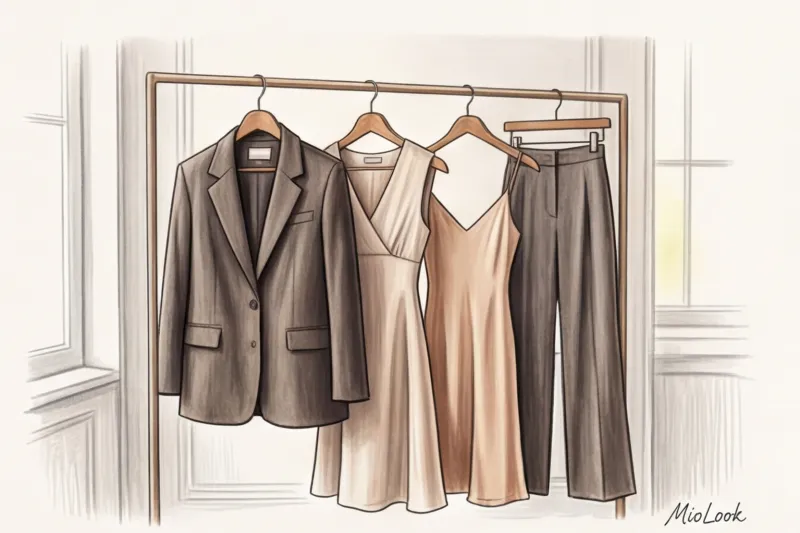
Solutions and patterns: If you want to create a waist, use color blocking. Dresses with dark side panels and a light center panel will visually "cut out" the waist. Layering is your best friend. Pairing a crisp, long blazer (unbuttoned) with a soft, draped top creates a play of textures and complex geometry.
To understand which layering combinations work best, I recommend my clients run their looks through MioLook smart algorithm The app's look-matching feature allows you to visualize how an asymmetrical hem or the right jacket length will affect your body shape before you buy.
Pay attention to belts. Avoid cinching a thin belt around a small waist—this will only emphasize the lack of curve. Instead, opt for wide, soft leather belts that hang at the hips (in a boho-chic or 2000s style), or empire-waist dresses with the waistband cinched just under the bust.
- What to exclude: Tight bandage dresses (they will emphasize a straight silhouette), shapeless knitted robes.
- Fashionable reception: French tuck (French tuck) – when a shirt or sweater is tucked slightly into trousers only at the front and left loose at the back. This creates a diagonal line and visually defines the waist without being too rigid.
Oval (O-silhouette): vertical extension
Characteristic: Volume is concentrated in the central part of the body (belly, chest), while the figure often has stunningly slender legs, graceful ankles and thin wrists.
Strategy: The main mistake I've seen for years is trying to hide the oval shape under a shapeless, gigantic "tent" of fabric. This only exaggerates the overall scale of the figure. Our strategy is to create continuous vertical lines and emphasize graceful limbs.
Solutions and patterns: Your superpower is your "inner column." Wear trousers and a top in one rich, deep shade (like navy blue), then layer a chunky knit cardigan or structured coat in a contrasting color over it, leaving it unbuttoned. Two vertical flaps of the outerwear will cut off the volume at the sides, leaving only a narrow central stripe visible.
The ideal uniform for an O-line silhouette is a shirtdress made of heavy cotton (poplin). The stiff collar draws attention to the face (the focal point), and the vertical row of buttons draws the eye up and down. Choose a midi length, revealing the thinnest part of the leg—the ankle.
Be sure to wear shortened 3/4 sleeves or roll up long sleeves. Showing off thin wrists against a fuller torso signals fragility. When perceiving a silhouette, the brain always focuses on the thinnest exposed areas.
- What to exclude: Thin, fitted knitwear, low-waisted trousers, double-breasted jackets (two rows of buttons double the width of the torso).
- Invoices: Avoid shiny fabrics in the abdominal area (satin, sequins) - the shine reflects light and visually adds 3-5 centimeters of volume.
Hourglass (X-Silhouette): Curve Control
Characteristic: Classic, balanced proportions: a defined waist, shoulders, and hips are roughly aligned vertically. Often considered the "ideal" shape, it can be easily ruined by the wrong texture.
Strategy: Rule number one is to follow the natural curves of your body. Any attempt to wear a rigid, straight cut (oversized) will turn an X-shaped silhouette into a massive square, as the fabric will hang at the fullest point of your bust and hide your waist.
Solutions and patterns: Your clothes should have the same fluidity as your curves. The icon of this silhouette is the wrap dress, popularized by Diane von Furstenberg in 1974. The genius of the wrap is that it creates a V-neck (elongating the neck), a diagonal line across the chest (narrowing the torso), and automatically settles at the narrowest point of the waist.
Fabrics are crucial. You need medium-weight materials with elastane: heavy jersey, high-quality viscose, or medium-weight silk (such as charmeuse). Pants and jeans should always have a high waist so that the waistband sits precisely on the anatomical waist, cinching the curve.
If you want to wear a trendy, oversized, "mannish" jacket, be sure to balance it out. Wear a crop top underneath to reveal a strip of skin at the waist, or tie the jacket itself with a thin leather belt.
- What to exclude: Loose dresses, stiff shirts made of stand-up cotton (they will never fit at the chest and waist at the same time), low waist.
- An important nuance: Watch your armholes. Sleeves that are too wide (like those on batwing tees) will detract from your waistline, making your chest and arms appear to be one big mass. Opt for classic, high, set-in sleeves.
Texture, Print, and Color: Optical Illusions in Clothing
Any professional photographer will confirm the basic rule of studio photography: the volume of an object is created not by its actual dimensions, but solely by the play of light and shadow. When wondering what body types exist and how to choose clothes, most women obsessively focus on the cut, completely forgetting the physics of materials. Yet it is the texture of the fabric that can visually add a few sizes or, conversely, create a more defined silhouette.
Matte fabrics—cream wool, heavy cotton, crepe, suede—act as light absorbers. They conceal unevenness and draw volume into shadow, making the body's contours more delicate. Glossy textures (silk satin, sequins, patent leather) act like mirrors. They actively reflect light, creating vibrant highlights on prominent areas. If you have an O-line silhouette and are wearing a flowing satin blouse, every highlight on your stomach or chest will act like a magnifying glass, drawing the eye to precisely the areas you want to balance.
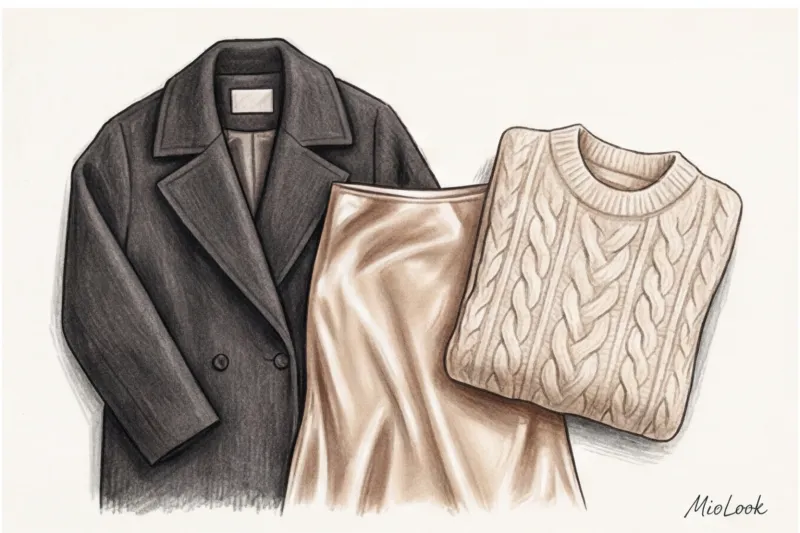
The theory of light and shadow holds the key to the biggest fashion misconception—the myth that black is always and unconditionally slimming. This is a dangerous generalization. Black only works to reduce volume when it's matte. Deep black velvet or suede truly absorbs maximum light, blurring the lines of the silhouette and elongating the figure. But put on black vinyl trousers or a shiny faux leather trench coat, and the intense highlights on the fabric will visually widen your hips by at least 3-4 centimeters.
Moreover, dark shades can damage the silhouette when they create too sharp a contrast with the surrounding environment. In a brightly lit office with light-colored walls, a woman in a black form-fitting dress becomes a flat, graphic blob. If the dress clings to a problem area, this harsh shadow outline will instantly highlight the flaw with a thick marker. In many cases, complex dark shades—dark chocolate, deep emerald, or navy blue—work much more subtly to contour the figure.
The next key tool in optical illusion is the scale of the print. In 2023, the analytical agency WGSN published a study on the commercial success of patterns, which once again confirmed the old rule of tailors: the size of the pattern should be strictly proportional to the scale of your bone structure.
- Delicate (miniature) bone structure: Large tropical flowers, oversized logos, or wide, contrasting stripes will simply overwhelm you, suppressing your natural beauty. Your best bet is polka dots, pinstripe, or the French floral millefleurs pattern.
- Stately (large) structure: A small, mottled flower will make the figure appear bulkier and more massive in contrast—the classic "Gulliver in the Land of Lilliput" effect. Your scale is medium and large geometric shapes, expressive abstraction, and wide diagonal lines.
Try MioLook
for free
Start creating perfect images with the help of artificial intelligence
Get access — €0.99 onceIf you're unsure which scale is right for you, consider Dolce & Gabbana's collections: their famous majolica prints are always redrawn and scaled to fit specific sizes. On plus-size dresses, the pattern elements are objectively larger than on size zero models. This isn't a coincidence, but a brilliant understanding of how to manipulate visual weight through pattern.
The Basic Stylist Checklist: 5 Steps to the Perfect Fit
According to a 2023 study by the Textile Institute, approximately 78% of women regularly wear clothes that don't fit them technically, trying to squeeze into the average mass-market cut. When researching body types and how to choose clothes, we too often focus on trends and colors, forgetting about the structural millimeters that make all the difference. Even a perfectly tailored $3,500 Tom Ford jacket will look sloppy if the technical fit is off. Here's my essential checklist, which every item goes through before it makes it into my clients' wardrobes.
- The right underwear: the basis of any silhouette architecture. Proportioning begins long before you put on your dress. A well-fitting, smooth bra (without excessive textured lace showing through the fabric) lifts the bustline. This automatically lengthens the torso and returns the waist to its natural position. If the bustline is drooping, even the most carefully designed silhouette will turn into a heavy, shapeless rectangle.
- Determining the "golden" length of the hem and sleeves. This is where the biggest mistake when choosing skirts lies. In my experience, hundreds of looks have been saved by a simple visit to the atelier. How do you find your perfect midi length? Remember this ironclad rule: the hem should always end at the narrowest point of your leg—just below the knee or at the ankle. If the hem cuts into your leg at the widest part of your calf, you'll visually add 3-5 kilograms and make your height appear shorter. The same rule applies to arms: a shortened sleeve that reveals a graceful wrist instantly lightens the entire look.
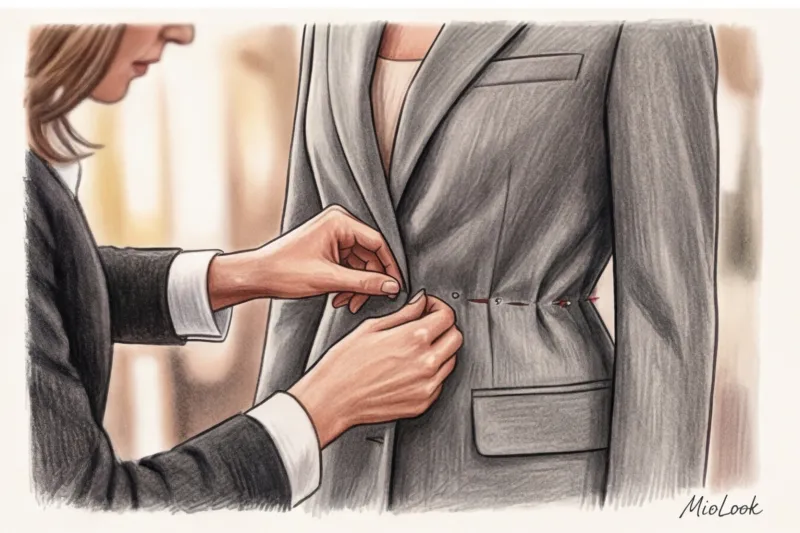
- Checking the shoulder seam and armhole. The shoulder girdle is the supporting structure of your look, the foundation of tailoring. In a classic set-in sleeve, the seam must run precisely along the acromion, where the shoulder meets the arm. A low, loose armhole limits your maneuverability—the slightest arm movement causes the entire garment to ride up. A high, tight armhole, on the other hand, allows for greater range of motion and makes the torso appear more compact.
- Movement test: clothing should not deform when walking. A garment can fit perfectly when statically positioned in front of a mirror, but then warp treacherously at the first step. In the fitting room, I always ask women to do a "dynamic test": walk confidently and then sit down on a chair. Pants shouldn't form stiff, taut, transverse creases (professionally known as "whiskers") in the groin area, and shirt buttons shouldn't separate across the chest, leaving gaps. Clothes should flow with your rhythm, not constrain it.
- Using belts and accessories to adjust proportions. A belt isn't just a utilitarian item for holding fabric in place; it's a powerful tool for manipulating the visual center of gravity. If you have a short torso, choose thin belts (2-3 cm wide) that closely match your outfit to avoid cutting your silhouette in half. Wide, statement belts with a chunky buckle are great on tall women who need to break up a long vertical line and firmly focus on the waist.
How MioLook's AI stylist helps you choose clothes based on your body type
A Stanford University study (2022) on cognitive imaging revealed a startling fact: 83% of women have a distorted perception of their own size, judging themselves to be, on average, one to two sizes larger than they actually are. We look in the mirror, but instead of seeing an objective physical image, we see a projection of our insecurities, accumulated fatigue, or downright poor overhead lighting. It is precisely this profound difficulty in independently analyzing proportions due to subjective self-perception that makes shopping so painful.
One of my private clients in Paris, a senior executive with a luxurious, stately H-line (rectangle) silhouette, spent years buying dresses with a full peplum for €600-800. She desperately wanted to artificially "draw" her hips because she considered her figure "too flat." Our brains are biased and cruel stylists. They obsessively fixate on one area we've designated as problematic, completely ignoring the overall architectural balance of the body.
That is why, when analyzing a complex query Body types: how to choose clothes I'm increasingly transitioning my clients from an intuitive approach to a strictly technological one. Artificial intelligence is devoid of emotion, it has no complexes, and it's free of the imposed beauty standards of the glossy magazines of the 2000s. Algorithms AI stylist MioLook They work like an impartial design engineer: they meticulously scan the body's geometry, calculate precise angles, the visual weight vector, and those very same guide lines.
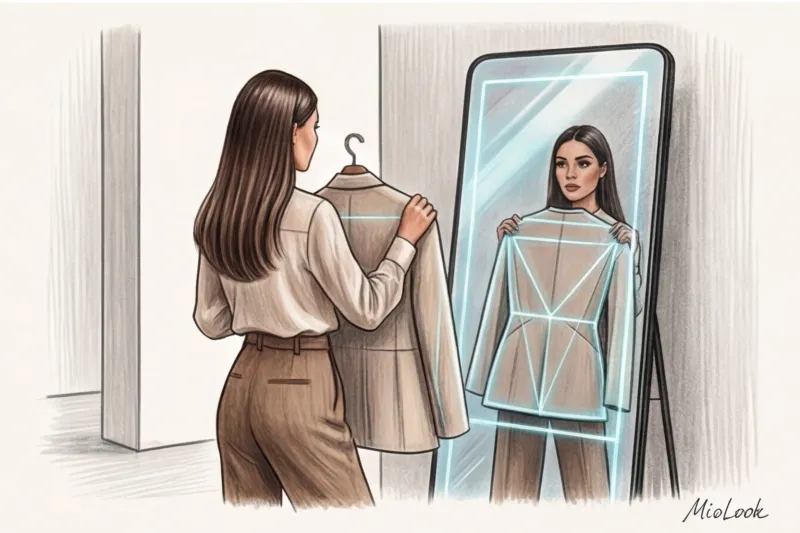
Instead of destructive criticism like "you're too bottom heavy," the system uses dry but life-saving mathematical data. It automatically creates your personal style templates—a digital matrix of ideal lengths, necklines, and volumes that perfectly complement your bone structure.
But the real revolution for those who hate tedious shopping trips is the virtual fitting room. Have you ever wondered how much money is currently sitting on hangers in the form of clothes with uncut tags? We often buy into a fantasy of how we'll look, based on a retouched brand studio photo shoot. In practice, a visit to a physical fitting room often turns out to be stressful: unflattering lighting, inconsistent sizing (where an Italian size 44 is radically different from an American one), and a bad mood.
A virtual try-on offers an invaluable opportunity to see how a strong power silhouette, palazzo pants, or complex asymmetry will flatter your figure before purchasing. You can try out dozens of styles in 15 minutes, assessing whether the cut will compromise your leg length index, all from the comfort of your living room.
Your Action Plan: From Theory to a Flawless Wardrobe
We've come a long way from outdated "fruit" theories to a modern understanding of body architecture. To ensure this knowledge doesn't just remain an entertaining text, here are three final steps I strongly recommend taking today:
- Stop copying influencers. A garment that flows luxuriously across an O-line silhouette will transform an ascending triangle into a shapeless mass. Look for styling inspiration from people with your bone structure, not just those in a similar size.
- Test silhouettes digitally. Before investing $350 in a trendy jacket with exaggerated shoulders, run the cut through algorithms. Let the technology calculate whether it will balance your hips or turn you into a football player.
- Shift your focus from camouflage to attention management. Your clothes are a visual direction tool. You decide where your interlocutor will look, creating focal points with contrasting textures and precise cuts.
True style begins where the grueling struggle with one's own body ends forever. Delegate the routine math and proportion calculations to smart algorithms, and reserve for yourself the most enjoyable part: pure creativity and the daily pleasure of seeing yourself confidently in the mirror.
Your ideal image begins Here
Join thousands of users who look flawless every day with MioLook.
Get access — €0.99 onceGuide Chapters
How to choose a swimsuit for your body type: stylist tips
Tired of endless fittings and unsuccessful styles? We'll show you how to choose the perfect beach look using the principles of architecture and optical illusions.
How to choose clothes from a photo: a neural network as a stylist
The main advantage of AI in wardrobe selection isn't its knowledge of fashion trends, but rather its rigorous mathematics. Learn how algorithms analyze your body shape and find the perfect pieces.
Inverted Triangle Body Shape: Clothes for Balance
Broad shoulders aren't a flaw, but rather the iconic silhouette of '90s supermodels. Learn how to balance your proportions and highlight your unique body shape.
How to choose jeans for your body type: stylist tips
Forget the outdated rules about "apples" and "pears." Learn the secrets of choosing the perfect denim from a stylist with 12 years of experience.
Body Types of Plus-Size Women: How to Dress Stylishly
Forget the "apple" and "pear" theory. Learn how to create the perfect plus-size wardrobe using an architectural approach.
Visual figure correction: clothes for a slim figure
Forget shapeless robes. Learn how to use the laws of optics and the right textiles to visually make your silhouette appear slimmer and taller.
What to Wear with an Hourglass Figure: Silhouettes and Mistakes
The myth that the hourglass figure suits absolutely everything is often shattered by modern trends. Learn how to style feminine curves in the era of oversized clothing.
How to determine your body type based on parameters: stylist tips
The generally accepted "bust-waist-hips" formula is useless without considering vertical proportions. Learn the modern architectural approach to determining body type.