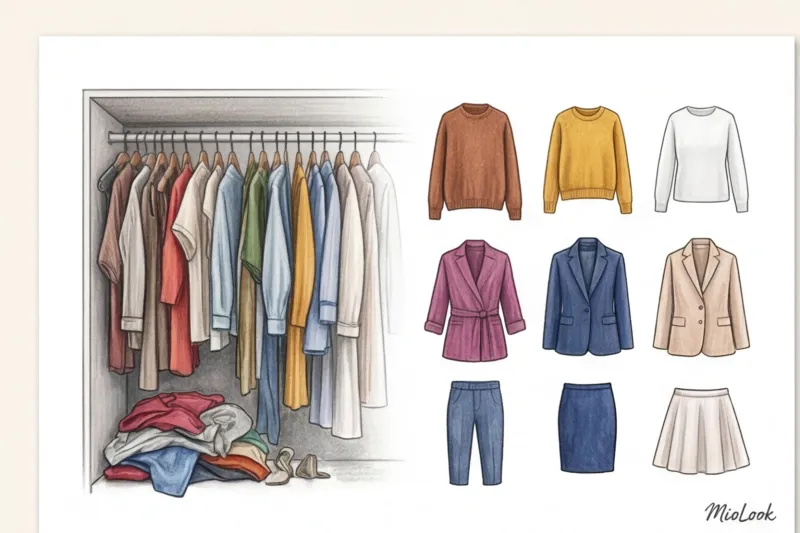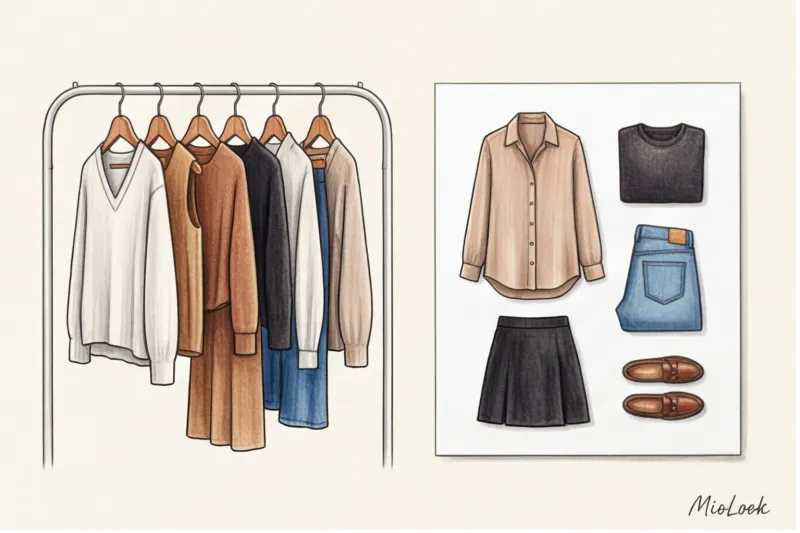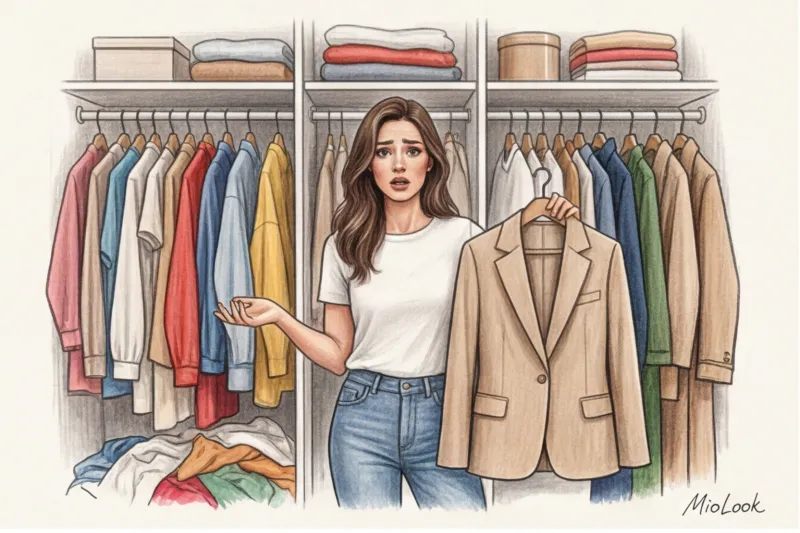
Why a Physical Closet Loses to Digital: The 'Nothing to Wear' Problem
Over 12 years of working as a personal stylist, I've discovered a frightening pattern. When I open a new client's closet, I almost always find items with store tags that were purchased two or even three years ago. They look at these finds with genuine surprise: "Wow, I completely forgot I had that silk top!" Sound familiar? That's exactly why. capsule wardrobe app Today, it's becoming more than just a fashionable toy, but a necessary tool for managing your assets. Buying another €50 blouse that will just hang like dead weight on a distant hanger isn't an investment in style, it's a waste of money.
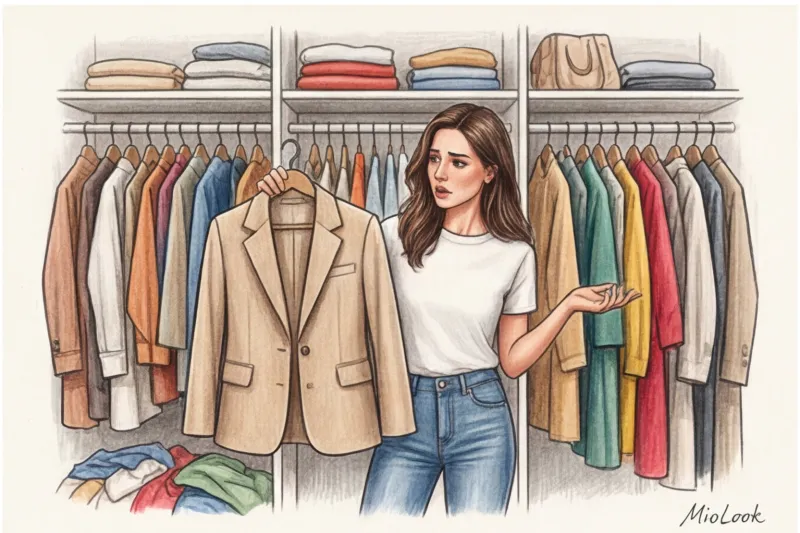
The problem of "a full closet, but nothing to wear" isn't rooted in a lack of taste, but rather in simple neurobiology. Our brains are physically incapable of holding more than 30-40 items of clothing in active memory at any one time. If your wardrobe consists of 150-200 items (the average for a modern woman), about 80% of them are in your blind spot. We simply don't remember them when we're rushing to get ready for work.
According to a large-scale study by the British environmental organization WRAP (Waste and Resources Action Programme), millions of tons of clothing are sent to landfill every year simply because their owners forgot they were there at the bottom of their closets.
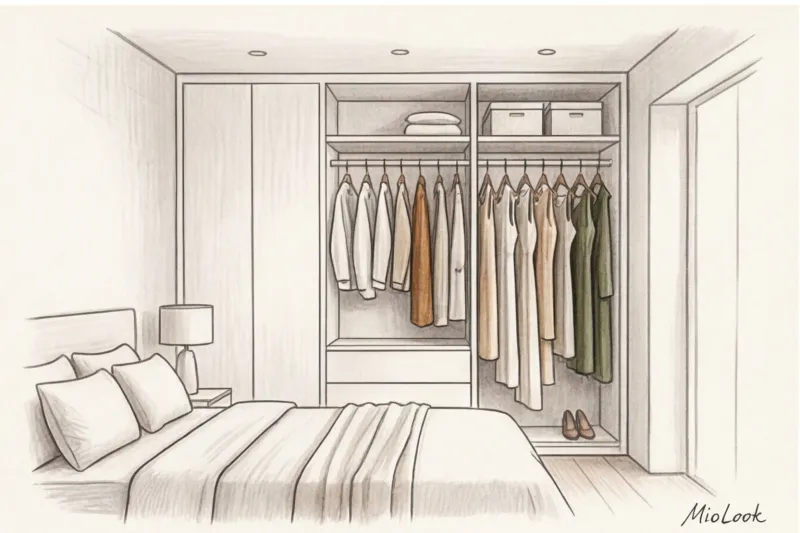
Adding to cognitive overload is the problem of visual noise. When clothes are layered on top of each other, we only see the sleeve of a jacket or the collar of a shirt. Under these conditions, creating a complex, multi-layered outfit is virtually impossible—the brain refuses to solve this puzzle at 7:30 a.m. Moreover, this type of storage is detrimental to the fabrics themselves. Heavy denim, squeezed between a delicate cashmere sweater and a thin viscose blouse, inevitably leads to creases, fiber distortion, and a loss of its original luster. The item is ruined before you even have a chance to wear it properly.
How does the digital environment change the rules of the game? When you transfer your wardrobe to your smartphone, for example, using MioLook , you completely eliminate visual chaos. The phone screen displays each item in isolation, against a clean background. This instantly reduces cognitive load: you begin to see not a shapeless mass of textiles, but specific elements of a stylistic construct.
Algorithms help bring "forgotten" items back into active rotation, suggesting unobvious combinations that you would never have thought of standing in front of an open closet. By the way, the right wardrobe digitization — this is the first step to making your clothing investments work 100%. You stop buying duplicates and start consciously building a base, whether it's a formal capsule for the office or a comfortable home wardrobe The digital one doesn't wrinkle delicate fabrics, doesn't hide your favorite cardigan under a bulky down jacket, and, most importantly, remembers absolutely everything.
Anatomy of a Smart Capsule: What AI Sees That We Don't
Take a look at your favorite, most flattering look. What do you see? You'll likely remark on "a beautiful combination of colors" or "a comfortable silhouette." But the algorithm sees pure math and physics. When you upload your items to capsule wardrobe app , the neural network breaks down each detail into data vectors that are inaccessible to the naked eye.
Digital styling is based on strict mathematics of style The program analyzes your clothes through the prism of Itten's color wheel, instantly calculating complementary (contrasting) and analogous (related) combinations. But color is only the base level. Far more important is how the algorithms work with proportions. You've probably noticed that sometimes a tucked-in shirt makes a figure appear slimmer, while other times it hopelessly disrupts the silhouette. The AI relies on the classic rule of thirds. If you try to pair a bulky sweater with wide-leg pants in a 1:1 ratio, the system recognizes the risk of adding bulk and suggests using this technique. French tuck (partial tuck-in at the front) to shift the visual border to a harmonious 1:2 ratio.
But the real magic of a smart wardrobe is revealed at the stage texture analysis That's why, when digitizing items, it's crucial to indicate their composition: silk, cashmere, denim, or corduroy. Smooth textures (satin, silk, fine leather) reflect light, making the look more dynamic, while loose materials (bouclé, mohair, suede) absorb it, adding depth. AI understands this and mixes textures so the look doesn't appear flat.
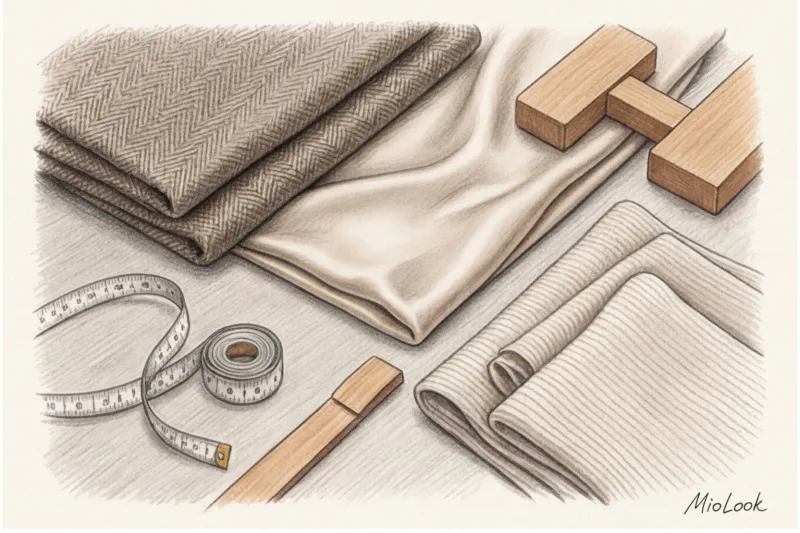
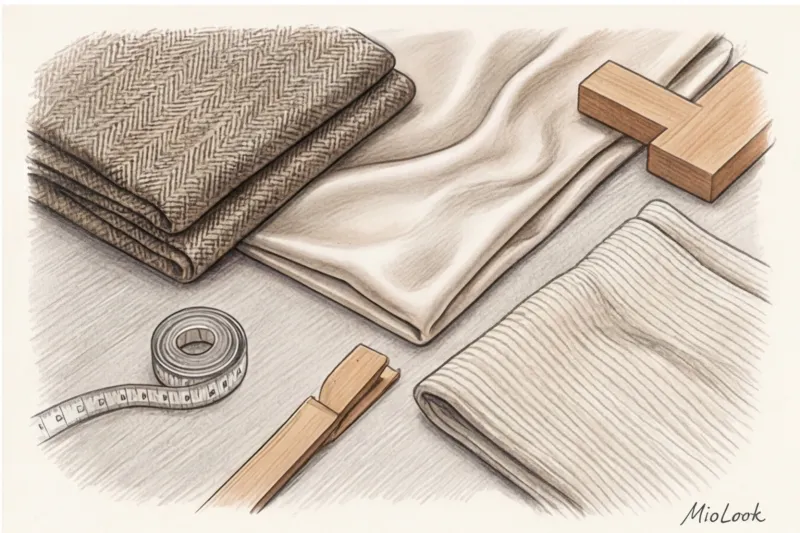
As a textile expert, I want to share my professional insights on how layering algorithms work in high-quality applications. In the textile industry, there is a key metric— GSM (Grams per Square Meter) , or fabric density. Fine summer linen typically has a density of around 110–130 gsm, while high-quality autumn tweed has a density of 350–450 gsm.
The human eye is often fooled by color matching, attempting to combine items from completely different "weight categories" into a single image. But the algorithm relies on the physics of drapery.
A smart system will never suggest you wear a thin linen shirt under a heavy tweed jacket. Why? Because a low-gsm fabric will instantly lose its shape under the pressure of a dense texture, crumple, and create unsightly creases. The algorithm understands that tweed requires either smooth silk (which glides and doesn't create friction) or cotton of a comparable weight (at least 180 gsm). Taking seasonality and weight into account, the AI protects you from the stylistic mistakes we often make when rushing in front of a mirror.
Access to MioLook for €0.99 — one-time payment
A smart AI stylist will select the perfect look.
Get access — €0.99 onceCost Per Wear Index (CPE)
Understanding the physical properties of clothing inevitably leads us to assess its real value. One of my clients in Berlin struggled for a long time to decide whether to buy a classic wool coat for €350. Instead, she bought trendy mass-market jackets every season for €60–80, which would lose their appearance after the first dry cleaning. To break this vicious cycle, we started using automatic tracking of worn items.
This is where the index comes into play. Cost Per Wear (CPW) — cost per wear. It's a simple formula: the cost of an item is divided by the number of days you wear it. That "expensive" basic item for €350, worn 120 days a year for three years, will only cost you €0.97 per wear. Meanwhile, a €70 polyester jacket, worn 10 times before the first indelible pilling appears, has a CPW of €7.
When a capsule wardrobe app clearly displays these statistics, your approach to shopping changes dramatically. Automatic tracking transforms you from an impulsive consumer into a thoughtful curator of your own style. This is the foundation of a truly eco-friendly approach: by investing in high-quality, long-lasting fabrics (heavyweight cotton, merino wool, lyocell) and tracking their rotation, you reduce your carbon footprint. An expensive but high-quality basic item, according to the app's raw numbers, always appears significantly "cheaper" than disposable fast fashion.
MioLook Capsule Wardrobe Builder: A Step-by-Step Guide
Have you ever noticed that trying to put together a capsule by dumping all your clothes on the bed usually ends in chaos? You take out half the closet, get tired after twenty minutes, and desperately put everything back. Last month, a client of mine, a systems analyst, and I conducted just such an experiment. Until we transferred the process to the digital space, her style architecture simply didn't work out. It's difficult for the human brain to handle dozens of variables simultaneously, but for algorithms, it's a piece of cake.
However, before yours capsule wardrobe app Before your design begins to generate ideal images, you need to lay the foundation. I call this stage the rule of three tactile stacks: base, accents, and "candidates for elimination."
- Base: Structured pieces in neutral tones with a perfect fit.
- Accents: Intricate prints, vibrant colours and on-trend cuts that reflect your individuality.
- Candidates for elimination: things that need repair, have lost their shape, or are waiting for a mythical “weight loss”.
Assess your clothes not only visually but also by touch. If the fibers of your favorite sweater have felted, or the denim has lost its elastane and is billowing at the knees, feel free to consign them to the third pile. Only the most current pieces should make it into your digital closet.
Once the quality selection is completed, the process comes into play MioLook The app's AI integration isn't just about randomly generating outfits. The neural network thoroughly analyzes your preferences and lifestyle. For example, if you indicate that 80% of your time is spent working in a corporate environment with a strict dress code, the algorithm won't suggest a silky lingerie-style top for your Tuesday morning meeting. Moreover, the system learns: every time you swipe a suggested look or save it to your favorites, the AI calibrates its understanding of your personal level of contrast and love of experimentation.
Creating your first capsule collection always begins with choosing a core piece. This is the load-bearing wall of your wardrobe, around which the rest of the composition is built. In my styling practice, the ideal core piece is almost always a piece with impeccable physical properties.
"The core of your wardrobe should be a stylistic chameleon. It doesn't shout about itself, but allows other pieces to speak louder."
Let's examine the core logic using the example of a high-quality merino turtleneck (in the €120-€150 range). Why choose this and not, say, a bulky, chunky knit sweater? From a textile engineering perspective, smooth merino offers unique adaptability. It's thin enough to serve as a base layer under a heavy tweed jacket or leather shirt without adding bulk. At the same time, it's dense enough to be worn on its own with wide palazzo pants. The AI recognizes this versatility and begins to construct dozens of combinations around the turtleneck, varying contrasting bottoms, layering, and matching footwear.
Rules for the ideal digitization of things
For the algorithms to work flawlessly, the clothing must be correctly transferred to the smartphone. Digitization translates the physical properties of the fabric into mathematical language. Two factors are critical here: lighting and geometry.
The first rule is clear light and a contrasting background. How do light and background affect a neural network's color recognition? Enormously. If you photograph a cool gray sweater under the yellow light of an evening incandescent lamp, the camera's sensor will distort the white balance. The AI will classify the item as warm (for example, a taupe shade) and start suggesting inappropriate complements from a warm autumn palette, creating disharmony. Photograph items only in daylight, diffused light from a window. Use a solid-colored background—a white sheet or a smooth wall. A wood floor with a pronounced texture will create visual noise, preventing the algorithm from accurately "cutting" the item along its contours.

The second rule, which many people ignore in their haste, is why do items need to be steamed before photographing? The answer lies in the way machine vision perceives silhouettes.
A wrinkled silk blouse or wrinkled linen trousers appear to a neural network as a shapeless blob. Deep folds create false shadows, which the algorithm may mistake for structural seams, asymmetrical cuts, or even pattern defects. A steamed garment, on the other hand, reveals its true geometry, cut lines, and natural drape. According to 2023 fashion-tech research, the accuracy of style detection drops by almost 40% if the fabric is heavily wrinkled. Spend an extra 15 minutes using a steamer—it's a direct investment in the quality and versatility of your future everyday looks.
Myths about virtual stylists and AI apps
When we first discuss wardrobe digitalization during masterclasses, I invariably encounter a wall of skepticism. The main fear is that an algorithm will deprive me of my individuality. But let's face it: AI doesn't replace your taste; it merely automates routine. You remain the creative director of your style, while the neural network takes on the role of a meticulous assistant who remembers every button in your closet. There are several persistent stereotypes surrounding the fashion-tech industry that are long overdue for dispel.
Myth 1: "AI offers boring, formulaic images." Many people think a capsule wardrobe app will spit out a standard outfit of a beige trench coat, a white shirt, and blue jeans, completely ignoring personal aesthetics. In fact, AI works with the exact level of creativity you give it.
One of my clients bought a complex vintage jacket made of thick tapestry with massive shoulders at a Parisian flea market (it cost her about €150, but looked like a museum piece). It was a stunning piece, but it sat in a bag for six months—she had no idea what to wear it with, other than boring black trousers.
By uploading it to MioLook We asked the algorithm to assemble images using the principle of texture contrast. The result? The neural network paired this complex theatrical jacket with 10 perfectly wearable everyday looks: with a basic silk slip dress, with distressed denim, and even over an oversized cotton hoodie. Is it formulaic? Not at all.
Myth 2: “It takes too much time.” "I don't have free time to sit and compose outfits on my phone," I often hear from busy women. Let's do the math. According to consumer behavior research, we spend, on average, 15 to 20 minutes a day getting ready in the morning and agonizing over choosing in front of the open closet. Over the course of a year, that adds up to a whopping 120 hours of simply standing in front of the mirror.
Yes, the initial digitization will require a weekend investment. But after that, choosing an image is reduced to two minutes. You're still lying in bed, opening the app, checking the weather forecast, and choosing one of the pre-made options. The time invested in implementing the system pays for itself within the first month.
Myth 3: "The app will make me throw out my favorite things, but not my essentials." There's a deep misconception that a smart wardrobe is a strict dictatorship of minimalism. It seems as if the system will force you to get rid of an item if it doesn't match five others. This is fundamentally wrong.
A smart algorithm, on the other hand, helps you salvage those "single items" you dearly love but avoid wearing for fear of looking awkward. It analyzes your inventory and, using color theory, suggests unexpected combinations. For example, the algorithm might apply the principle of complementary colors to pair your favorite emerald cardigan with terracotta pants you never even considered.
Access to MioLook for €0.99 — one-time payment
Start creating perfect images with the help of artificial intelligence
Get access — €0.99 oncePlanning and smart shopping with the app
According to McKinsey & Company's 2023 State of the Fashion Industry report, over 60% of the world's clothing ends up in landfills or incinerated within the first year of production. The main reason for this colossal overproduction lies not only in the aggressive marketing of fast-fashion brands, but also in our own closets. They are overflowing with so-called "lonely items"—spontaneous purchases that looked great in studio photos or on a mannequin, but categorically refused to integrate into your real wardrobe.
It is at the shopping stage that a well-configured capsule wardrobe app Transforms from a convenient visual catalog into a powerful analytical tool. It changes the very pattern of consumption: you stop buying clothes for the instant dopamine rush and start investing in the missing elements of a complex system.
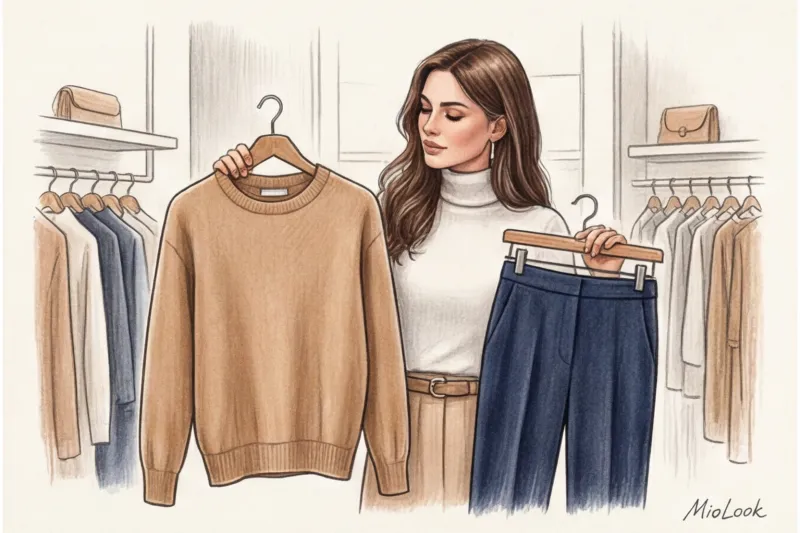
The first thing the algorithm does after fully digitizing your items is identify your stylistic blind spots. In my consulting practice, the same scenario regularly plays out: a woman is convinced she has absolutely nothing to wear to work and goes to the mall to buy her fifth basic jumper (in the mid-price range, this would cost around €80-120). However, the neural network, after analyzing the loaded database, paints a completely different picture. The app clearly demonstrates exactly what you need to achieve 100% combinations.
For example, the algorithm can highlight a structural imbalance: you have a dozen excellent silk blouses, thin cashmere turtlenecks, and cotton shirts, but not a single solid, form-fitting bottom. There's simply nothing to wear lightweight tops with in the cooler season to create a put-together look. The AI will suggest: instead of another blouse, you need high-quality wool palazzo pants or a thick gabardine skirt. By purchasing just one correct item based on the system's recommendation, you instantly unlock 10 to 15 new combinations from the clothes already hanging in your closet.
This brings us directly to the concept of sustainable fashion. Your personal carbon footprint depends not only on whether your jacket is made from recycled polyester, but also on how intensively each thread is used. Producing a single cotton shirt requires approximately 2,700 liters of water. When that shirt is worn just twice and ends up on the back shelf for lack of companionship, the planet's resources are wasted. Digital planning radically reduces this environmental impact by preventing the purchase of items that only last a few days.
To protect yourself from stylistic mistakes, I strongly recommend taking a test drive before each transaction. MioLook A virtual fitting room feature is built in: you simply save a photo of a jacket you like from an online store and virtually add it to your digital closet before you even pull out your bank card.
Wishlist as a filter against impulse purchases
A digital wishlist within a smart wardrobe functions completely differently than a shopping cart on a retailer's website. A shopping cart is designed by marketers to create an artificial sense of urgency ("only one item left in your size!") and encourage immediate payment. A wishlist, on the other hand, engages the prefrontal cortex—the area responsible for analytical thinking and long-term planning.
I teach all my clients to apply the "72-hour rule" in a strictly digital format. See a stunning asymmetrical top for €150? Don't buy it right away. Add a screenshot to the app and wait for three days. During this time, the emotional tension will subside, and you'll be able to evaluate the potential upgrade with a cool head, based on your style math.
The main criterion for this assessment is the classic "Rule of Three Looks." Stylists used to advise visualizing what you'd wear with your new outfit. Now, there's no need to strain your imagination: just run the AI look generator using this sample top.
If the algorithm easily, without any stylistic stretches, assembles three completely different sets with it (for example, a strict one for the office with a jacket, a relaxed one for Sunday brunch with thick denim and an accent one for an evening out), using exclusively Your current base—you're looking at a brilliant investment. If the neural network only produces one viable option and requires you to buy new shoes, a belt, or matching pants to create others, that's a typical single item. By keeping it in the virtual space and not transferring it to your physical closet, you're preserving your budget and taking a real step toward conscious consumption.
Checklist: Transfer your closet to your smartphone in one weekend
At a recent wardrobe intensive, one participant confessed, "I've been trying to digitize my closet for three months now. I photograph one item a day, and there's no end in sight." This is a classic motivation-killing mistake. Digitalizing your wardrobe is a sprint, not a marathon. Based on the experience of hundreds of my clients, the ideal approach is to use timeboxing and dedicate one full weekend to the process. Let's explore a step-by-step plan to help you do this effectively.
Stage 1: Audit and rigorous physical cleaning
The main rule of digitalization: we don't transfer illusions to our phone. Items with stubborn stains, sweaters that have lost their shape, or pants that are waiting for you to lose two sizes shouldn't end up in your capsule wardrobe app Conduct a ruthless filtering process. If hardware repair or professional dry cleaning would cost more than €30–€40, and the item doesn't have high stylistic value to you, feel free to send it for recycling.
Professional care advice: During a major sorting process, we often throw clothes onto the bed in a huge pile. Please be gentle with delicate textiles. Heavy, bulky knits and cashmere should not be hung on hangers, even temporarily, during sorting—their own weight can cause the natural fibers to deform in the shoulder area within just a couple of hours. Fold them flat.
Step 2: Batch Shooting
Don't photograph items randomly. Organize the process like a professional e-commerce production company—use a batch shooting method. Choose one spot with soft, diffused daylight (ideally, on the floor by a window or against a neutral, solid-colored door). First, photograph all the bottoms (jeans, pants, skirts), then the tops, then the outerwear and shoes. This life hack saves up to 40% of your time, since you don't have to constantly readjust the camera angle, change the lighting, or adjust the background.
Step 3: Categorize and set up tags
Uploading photos to MioLook Pay close attention to metadata. The algorithm is incredibly smart, but to work correctly, it needs your precise input. Be sure to include the fabric composition (for example, "100% heavy cotton" or "fine silk"), the season, and the dress code (casual, office, evening). These tags form the neural network's logic. They will prevent the AI from suggesting you wear a light summer skirt in subzero temperatures or pair a formal office wool jacket with relaxed linen shorts.
Stage 4: Generating the first 20 looks for the week
This is your ultimate reward for all your hard work. Once your wardrobe's core is digitized, don't put off testing its functionality. Launch the look generator and let the app put together a capsule wardrobe for the upcoming workweek. Generate and save your 20 most successful combinations. You'll be amazed how this mathematically precise analysis of your items will yield fresh, innovative combinations you never would have come up with while simply rummaging through your hangers in your morning rush.
Your ideal image
it begins Here
Join thousands of users who look flawless every day with MioLook.
Get access — €0.99 onceThe Future of Personal Style: Why a Digital Wardrobe Will Become the Norm
According to a confidential forecast by the WGSN trend bureau for 2025–2026, the era of mindless clothing accumulation is officially over. We are entering the era of curation. Previously, status was determined by the size of the closet and the number of bags left after a Saturday shopping spree. Today, the new luxury is open space, transparency, and 100% functionality on every shelf.
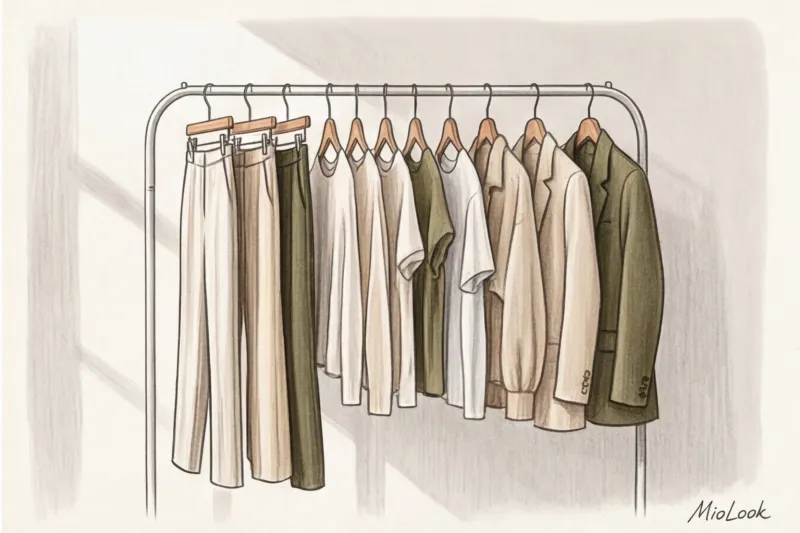
We're no longer just blind consumers of fast fashion and are becoming thoughtful curators of our own collections. In this new paradigm, a quality capsule wardrobe app acts not just as a utilitarian catalog, but as your personal gallery manager. It helps you cut through visual noise, identify your true stylistic core, and showcase only those pieces that truly enhance your image. Statistically, most people wear only 20% of their items 80% of the time. Digital curation aims to break this pattern and maximize wardrobe usage.
But current digitalization capabilities are just the tip of the iceberg. As a textile specialist, I'm keen to see where the fashion-tech industry is heading in relation to sustainability. The next global frontier for algorithms is predictive analytics of fabric condition and micromanagement of garment care.
Imagine: a neural network analyzes the composition of your favorite cashmere sweater (say, a basic premium model for €250) and compares it with your wear schedule and weather conditions. Based on this data, the AI not only generates images but also sends timely notifications: "After 7 washes, cashmere fibers need a 48-hour rest to regain their elasticity." or "The algorithm is temporarily removing this silk top from active rotation—time for a delicate hand wash." Technologies will predict fiber wear, thread curl, and color loss, helping to extend the life of items two to three times. This is no longer just a convenience for getting ready in the morning; it's a profoundly practical eco-friendly approach that reduces your carbon footprint.
The future, where your physical closet is perfectly synchronized with its digital twin, is already here. And you don't have to wait for next decade's technologies to become part of it. You can start transforming your style today.
Here is your starting micro-plan for working in MioLook for the coming weekend:
- The rule of five things. Don't try to photograph your entire closet at once—you'll burn out by the second hour. Choose exactly five items: the perfect pair of straight-leg jeans, a high-quality cotton T-shirt (at least 180 g/m²), a structured jacket, basic loafers, and one statement bag.
- Metadata detailing. When adding items to the app, be sure to specify the fabric composition, brand, and seasonality. This is critical for the smart algorithms to work correctly—the AI must understand the textures it's working with.
- Generator test. Let the neural network generate initial combinations from this mini-kernel. You'll be surprised how the algorithm will extract maximum combinatorics from even just five elements, suggesting styling options you hadn't considered (for example, using a jacket as a standalone top with a stiff belt).
Switching to a digital wardrobe isn't a restriction, but a liberation. You stop wasting cognitive resources on your morning routine and redirect them to what's truly important.
Your style deserves to be smart, eco-friendly, and impeccably organized. Take the first step toward curating your wardrobe—and you'll never return to the chaos of overflowing shelves again.
Guide Chapters
Smart Casual Capsule Wardrobe: A Balanced Style
Creating a smart casual style isn't just about a set of basic pieces, but a precise balance of textures and fabric densities. We'll explore common mistakes and learn how to assemble the perfect capsule wardrobe.
Shoes for a capsule wardrobe: how many pairs do you need?
40 pairs of shoes or just your favorite sneakers? Learn how to choose the right shoe base so it complements your looks rather than creating visual chaos.
A Basic Wardrobe for a 40-Year-Old Woman: Dos and Don'ts
How to put together a stylish capsule wardrobe after 40 without looking a decade older? We'll explore the key rules for choosing the right fabrics and silhouettes.
A basic wardrobe for a stay-at-home mom: stylish and comfortable
Tired of shapeless tracksuits and unsure what to wear for a walk with your baby? Find out how a stylist creates comfortable and beautiful looks for new mothers.
Capsule wardrobe for plus-size women: rules for a slimming capsule wardrobe
Forget shapeless hoodies and boring black. Learn how to create the perfect capsule wardrobe with structured tailoring for a slimming effect.
Budget Capsule Wardrobe: Smart Shopping Guidelines
Real savings aren't about buying cheap items, but rather a strategic approach. We're sharing an algorithm for creating a visually expensive capsule wardrobe without overspending.
Minimalist Wardrobe: 15 Items Instead of a Full Closet
Is your closet overflowing with clothes, but you have nothing to wear? Learn how to create a functional capsule wardrobe with just 15 high-quality pieces that will last for years.
The difference between a capsule wardrobe and a basic one: what to choose
Why doesn't buying the perfect basics always solve the "nothing to wear" problem? We'll break down the difference between a basic and a capsule wardrobe so you can put morning panic behind you.
Digitizing Your Wardrobe: How to Photograph Your Clothes Properly
Tired of crookedly cropped backgrounds in the app? We're sharing practical instructions on how to properly photograph clothes for a digital capsule collection.
Summer Capsule: Building the Perfect Wardrobe
Tired of standing in front of a full closet with nothing to wear in 30°C weather? We'll tell you how to build a quality summer wardrobe and stop wasting money on clothes that don't last.
Spring Capsule: How to Update Your Wardrobe After Winter
Do you buy the same things every spring? Learn how to avoid mid-season mistakes and create a smart capsule wardrobe using a digital wardrobe.
Winter Capsule Wardrobe: Warmth Without the Cabbage Look
Forget about shapeless sweaters and the "cabbage" effect. Discover how the right fabrics and micro-layering can help you create a chic and super-warm winter look.
Capsule Wardrobe for the Office: Everyday Style
Do you spend time every morning staring at your full closet but have nothing to wear? Learn how to effectively assemble an office capsule wardrobe and turn your wardrobe into a career investment.
Vacation Capsule Wardrobe: Packing Your Carry-On Luggage
Tired of heavy suitcases and the fear of losing them? Learn how to pack a stylish vacation capsule that fits easily into your carry-on.
Ideal Capsule Wardrobe Colors: How to Combine Them
Tired of wasting your morning time choosing clothes? Learn how the right color palette can help you create stylish looks in just 3 minutes.
The Perfect Fall Capsule: Cozy Looks
How to wear oversized sweaters and classic coats without looking like you're wearing a stuffed sausage? Learn the secrets to creating a stylish layered fall wardrobe.
How to build a capsule wardrobe: a step-by-step guide
Learn how to stop buying unnecessary things and create a smart wardrobe. A step-by-step guide to creating the perfect wardrobe for your real life.
Clothing Look Generator: How MioLook AI Works
Forget about the "nothing to wear" problem. We'll show you how AI algorithms create stylish outfits from your clothes, taking into account proportions and textures.