Why Home Wardrobe Is More Important Than Street Wardrobe: Psychology and Statistics
Have you ever wondered how much of your life you actually spend at home? According to global statistics (in particular, the Global Time Use Survey), modern city dwellers spend 60% to 70% of their time within the walls of their apartments. Now open your closet and look at the hangers. I bet 90% of that prime space is taken up by "going-out" items: tailored jackets, jeans, and evening dresses. That's why a consciously put-together wardrobe home wardrobe — this is not a whim for Pinterest pictures, but the most rational investment in your daily comfort.
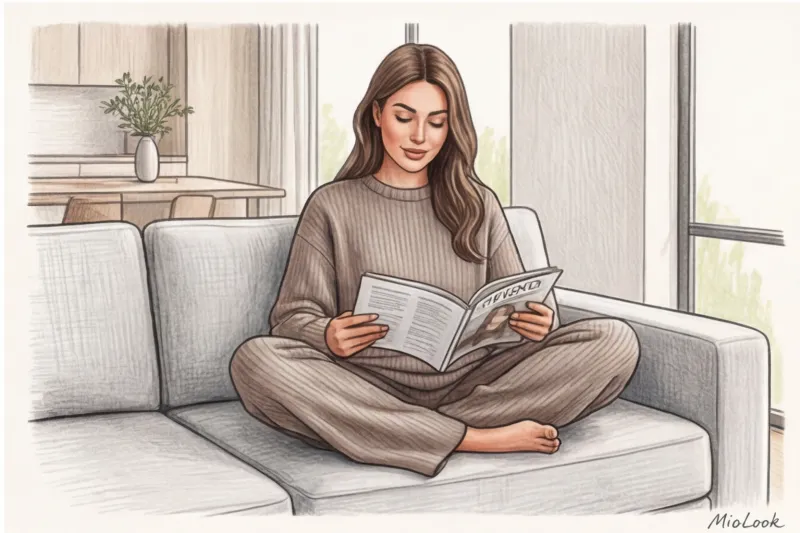
Let's do the math. In my practice, I constantly use the cost-per-wear concept. Most of my clients have no qualms about shelling out $250 for a stunning dress for a New Year's corporate party that they'll wear exactly twice (the actual cost per wear is $125). But they sincerely regret spending $100 on a quality lounge suit. But you'll wear lounge pants and a long-sleeved top at least 150 nights a year! The math here is absolutely ruthless: investing in loungewear pays for itself the fastest. The cost per wear of a quality lounge item is often mere cents. I discussed how to properly calculate the benefits of purchases in the article about cost per wear formula.
However, the biggest mistake beginners make—and I see it in 9 out of 10 women during their first closet audit—is the notorious "wear-it-out" principle. Items that have lost their shape are consigned to the couch. T-shirts with faded prints, sweatpants stretched at the knees, once-dressy blouses with indelible coffee stains. This approach creates a destructive psychological trap. By assembling a Frankenstein wardrobe of items you "can't bear to throw away," you're literally telling yourself: "Nobody sees me, so I don't deserve to look good.".
When I ask girls to transfer their real everyday images into MioLook For analysis, the visual statistics in the app are sobering. It turns out they spend more hours of their lives in that "comfortable" pilling T-shirt than in their favorite cashmere coat, which they're so proud of.
The "clothed cognition" effect: how clothing affects productivity and relaxation
In 2012, researchers from Northwestern University in the United States, Hajo Adam and Adam Galinsky, published a groundbreaking study that introduced the term into scientific circulation. enclothed cognition ("clothed cognition"). Their experiments proved what we, stylists, have always suspected: clothing directly influences cognitive processes, emotions, and human behavior.
Our brain constantly reads the symbolic meaning of what we're wearing. And mirrors in the house act as triggers. When your gaze accidentally glides over the outstretched elbows of an old sweater, the brain instantly registers a signal: sloppiness, fatigue, a decline in status.
Loungewear should act as a clear psychological switch, a boundary between "achievement" and "restoration" modes. When you come home from work, take off your tight pencil skirt, and put on a stylish long-sleeve top made of thick micromodal and loose, flowing trousers, you're sending a signal to your nervous system: "Survival mode is off, we're safe, we can breathe."
But the paradox is that it's harder to rest well in an old, stretched-out T-shirt. Shapeless, worn-out clothes promote a feeling of lethargy and apathy rather than healthy relaxation. You don't recharge, but rather slump. Have you noticed how your posture changes? Your shoulders instinctively slump when you're wearing untidy clothes. Conversely, a stylish, clean, and tactilely pleasing home capsule maintains your inner strength and self-esteem, even when you're simply sipping your morning coffee in the quiet of your kitchen.
The formula for the perfect capsule wardrobe: zoning your home clothes
One of the most common mistakes I see when sorting through wardrobes is treating loungewear as a single, indivisible category. We buy a so-called "lounge suit" and plan to do absolutely everything in it. But let's be honest: does your home life consist of a single scenario? You don't try to chop salad, conduct work calls, and sleep in the same position. So why do we demand such versatility from clothes? It is impossible to cook dinner, sleep and work fully in the same set — this is a direct path to blurring the boundaries between rest and routine.
"Clothing is a physical switch for our psyche. By changing textures and silhouettes, we send a clear signal to the brain: now we're stressed, and now we're recovering."
Marina, a freelance graphic designer, recently approached me for a consultation. Her request sounded like a cry from the heart: "I've been working from home for two years now, and I no longer feel like I'm relaxing here at all." It turned out that her 24/7 uniform for everything—from morning coffee to editing layouts to evening TV series—was the same oversized $120 gray hoodie and stretched-out leggings. Her brain simply stopped registering the transitions between work stress and personal time.
We completely overhauled her approach and implemented a strict wardrobe zoning system. We chose structured pieces for work and soft, enveloping ones for evenings. After just two weeks, Marina wrote to me that her insomnia had disappeared. The simple ritual of changing after closing her laptop restored her sense of home as a safe haven.
To make this system work and not require you to allocate a separate room for household items, we use The basic rule of a capsule collection: all tops should match perfectly with any bottoms. It's the math of style. With just 3 bases and 5 tops in a single color temperature (for example, only warm, earthy tones or only cool pastels), you get 15 unique combinations. As a colorist, I always recommend choosing complex, slightly dusty shades for the base—they blend best and don't create visual noise.
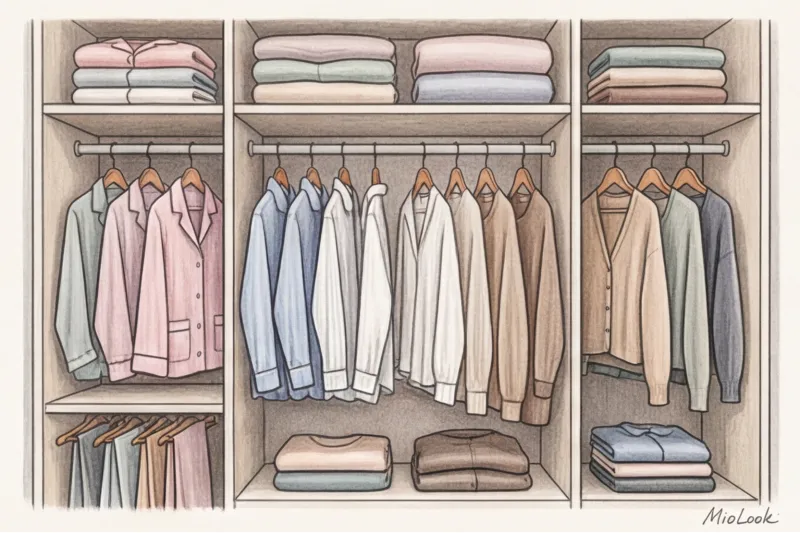
Sleep and morning routine zone: maximum tactile comfort
Clothing for this zone has strict shelf life limits. It is intended exclusively for bed and the first 30 minutes after waking up You woke up, drank a glass of water, did your morning routine in the bathroom, and changed your clothes. Eating breakfast in your pajamas every day is a bad habit that makes you sleepy for half the day.
The cut requirements here are uncompromising. Save pajamas with stiff English collars and mother-of-pearl buttons for photo shoots. In real life, a button that digs into your ribs when you accidentally turn it in your sleep guarantees you'll be a wreck in the morning. The main rule of a nightcap is absolute the absence of rigid seams, tight elastic bands that disrupt lymph flow, and any fittings.
Ideal choices include micromodal, silky tencel, or bamboo fiber. These materials have a slightly cooling effect and glide over the body, creating a weightless cocoon-like sensation.
Activity zone: cleaning, cooking, and playing with children
Cleaning, cooking dinner, playing with the kids on the floor, or unpacking grocery bags—this is your home workout. Freedom of movement without sacrificing style is paramount. No sweatpants stretched out at the knees or t-shirts with faded prints.
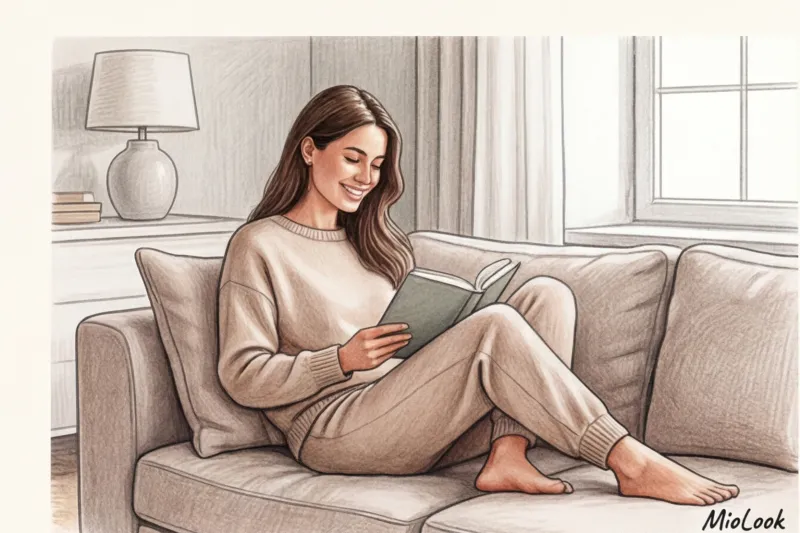
Invest in quality joggers made of heavy cotton (the loop-back weave holds its shape well and prevents the knees from stretching out) and structured long sleeves in basic shades. The silhouette should be semi-fitted—loose enough to maneuver the vacuum cleaner, but not so baggy that you'll catch on door handles.
For this area, I always use a crash test with my clients, which I call random courier test Imagine: you're washing dishes, and suddenly the doorbell rings—a package has arrived, or a neighbor has come in for salt. Are you ready to open the door right now, without hesitation or frantically trying to throw something decent on? If your answer is "no," it's time to relegate this item to the dust rag category. Being ready to open the door without hesitation is the main indicator that your active wardrobe is well-organized.
Access to MioLook for €0.99 — one-time payment
A smart AI stylist will analyze your items and select the perfect capsule for your home based on your preferences and lifestyle.
Get access — €0.99 onceHome Office Zone: A Balance of Relaxation and Focus
Remote work is incredibly insidious. Working from bed in plush pajamas inevitably conveys this lethargy in our voice, posture, and decision-making speed. But sitting at the kitchen table in a formal office suit is the other extreme, bordering on the absurd.
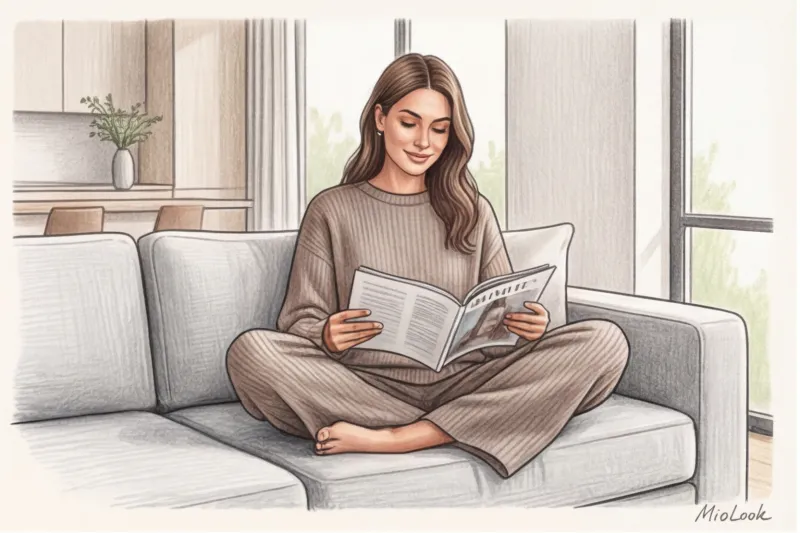
Here a proven principle saves us Smart top, comfortable bottom Smart tops and comfortable bottoms are the perfect balance for Zoom calls. Since the webcam only captures portraits, your top should be structured and set a professional tone. Soft, chunky-knit cardigans with a V-neck (they visually lengthen the neck), thick flannel shirts that maintain the collar's shape, and chunky knit polos work well.
But down below, out of sight of your colleagues, you can wear your favorite joggers, loose viscose palazzo pants, or sleek culottes without a tight waistband. You feel physically comfortable, nothing pinches your stomach during long hours in front of the monitor, and in the mirror you see a composed professional.
Home Color Palette: The Effect of Shades on the Nervous System
According to the Pantone Color Institute and neuroaesthetics research, light wavelengths are directly processed by our brain, bypassing conscious analysis. Light reflects off tissue, hits the retina, and transmits electrical impulses to the hypothalamus, the part of the brain that controls our endocrine system and hormonal balance.
As a certified colorist, I often explain to my clients the simple physiology of color: pure, spectral, and high-contrast hues cause the sympathetic nervous system to work at peak intensity. For example, highly saturated red can increase your heart rate by 2-3 beats per minute and subtly stimulate an adrenaline rush. This is a great tool for an office presentation or a workout, but in the comfort of your own home, such color stimulation works solely against your relaxation.
That's why the first rule of my signature wardrobe decluttering system is to ruthlessly remove items in vibrant colors and T-shirts with bold, "cheerful" prints. Neon shades (magenta, electric blue, and acid green) have historically been associated in nature with toxicity or danger. Wearing a colorful sweatshirt with acid-pink flamingos or chaotic slogans at home forces your psyche to constantly process this micro-stress.
Here the most important concept for modern man comes into play: visual noise A city dweller processes thousands of visual cues daily: flickering gadget screens, advertising banners, endless social media feeds. At home, our eyes desperately need a detox. If your loungewear consists of leopard-print leggings and a T-shirt with a contrasting pattern, you're creating a portable source of visual noise right on yourself. Your gaze, accidentally falling on your hands or lap, is constantly "stumbled" by the colorful pattern, preventing your visual analyzer from relaxing and entering background recovery mode.
However, giving up neon colors and vibrant prints doesn't mean going all-out with a bland gray. The most important step to a stylish and flattering wardrobe is to align your palette with your natural skin tone. color type of appearance At home, we often go makeup-free, meaning the fabric near our face directly interacts with our skin's natural undertone.
"The right temperature and color saturation work at home like a subtle filter on a camera—you look in the mirror and see a fresh, rested face, which instantly programs your brain for a positive mood."
If you have a cool complexion (a bright "winter" or a muted "summer"), a warm peach, brick, or mustard top will visually add a sickly yellow tint to your face and highlight dark circles under your eyes. Conversely, those with warm, golden undertones should avoid icy blues and crisp whites, opting for cream, baked milk, or caramel. Besides temperature, consider contrast: if you have a soft complexion, the deep black of a lounge suit will simply wash out your features, making your face look tired.
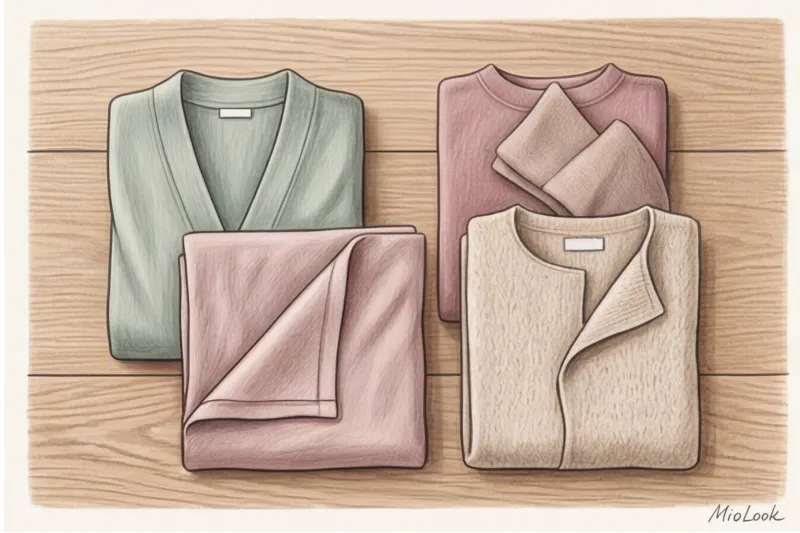
A calming base for the evening
Evening is the time when we vitally need to reduce cortisol (the stress hormone) levels and gradually prepare the body for melatonin production. A natural, low-contrast palette with a touch of gray is ideal for this purpose.
I recommend building an evening, relaxed base around shades like dusty rose, sage, oatmeal, taupe and muted lavender According to research by British color psychologist Angela Wright, low-saturation shades physiologically slow the breathing rate. Sage green is associated with safe, calm flora in our reptilian brain, while soft oatmeal or taupe create a feeling of warmth and security. Lavender is traditionally used in color therapy to relieve muscle anxiety.
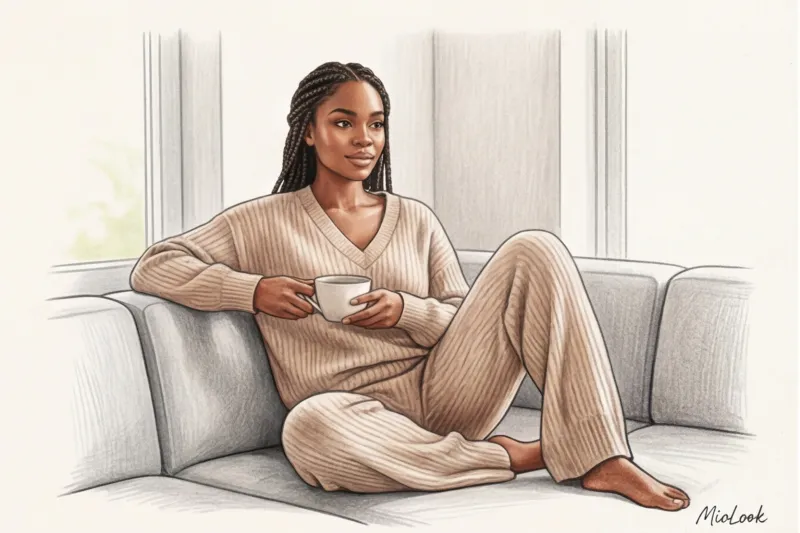
Try incorporating these shades into your evening relaxation zone: for example, choose flowing lyocell trousers in a dusty rose shade or a voluminous taupe cardigan. You'll notice how the process of "grounding" yourself after a stressful workday will be much faster and more effective.
Fabrics That Work for You: A Guide to Home Wardrobe Materials
The most persistent myth I encounter when sorting through underwear and home care capsules is this: "The main thing is that it's 100% cotton." For decades, we've been conditioned to look for the coveted "100% cotton" label, believing it to be an uncompromising guarantee of comfort. But let's look at this dogma through the prism of textile physics.
Thick, 100% cotton isn't always the best choice for the home. Yes, it's completely hypoallergenic, but it has two critical drawbacks for loungewear: low elasticity and poor dimensional stability. Think of your favorite cotton pants—after just a couple of hours of sitting on the couch with your legs tucked in, your knees stretch out, and the fabric itself becomes stiff after every wash. Furthermore, the physics of cotton fiber are such that it absorbs moisture well but releases it extremely slowly. If you get hot while actively cleaning, a thick cotton T-shirt will simply become damp and cool, disrupting your body's natural thermoregulation.
Over the past 15 years, the textile industry has made tremendous progress. Today, innovative synthetic fibers form the ideal foundation for a home wardrobe: modal, tencel and lyocell The raw material used for these yarns is natural wood (eucalyptus or beech), but the thread structure is created technologically. What practical benefits does this provide?
First and foremost, its incredible hygroscopicity. Lyocell absorbs 50% more moisture than cotton and instantly evaporates it into the air. The fabric acts as a micro-conditioner: the smooth surface of the fiber pleasantly cools the skin, and its perfect drape conceals figure nuances. When I select palazzo pants for my clients to wear around the house, I always look for at least 70% Tencel or Modal. A good micro-modal long sleeve (in the $45 to $80 price range) flows over the body, not stiffly. It doesn't fade or shrink, even after fifty washing cycles.
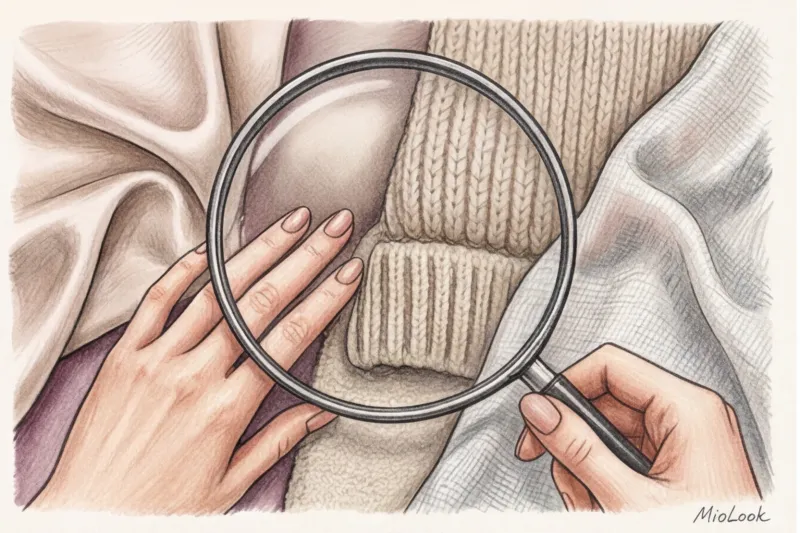
Knitwear, cashmere and fleece for the cold season
As the cold weather sets in, many people make a common mistake: they wear shapeless, oversized sweatshirts, turning into a clumsy, lumpy mess. The secret to stylish layering at home lies in understanding the thermal conductivity of materials. It's not the thickness of the fabric that retains heat, but the amount of air trapped between the fibers.
A thin, lightweight cashmere-blend cardigan (even if it's only 15-20%) will keep you much warmer than a heavy, stiff cotton hoodie. If you're particularly cold, consider modern microfleece (like the original Polartec). Yes, it's synthetic, but its porous structure was developed for intense physical activity: it instantly wicks away moisture and retains body heat, while remaining incredibly lightweight.
For more elegant evening looks, I always recommend investing in premium loungewear—smooth merino wool or fine cashmere. The investment in such a suit (usually around €150-200) will pay for itself many times over if you follow three strict care rules:
- 24-hour rule: Natural wool doesn't tolerate daily wear. The fibers need at least a day of "rest" to restore their elasticity and shape.
- Special cleaning: Forget about regular powders. Wash these items exclusively with liquid detergents containing lanolin—it restores the natural protective layer of the hairs.
- Flat drying: only horizontally, on a terry towel, away from direct heat sources.
Access to MioLook for €0.99 — one-time payment
Start creating your perfect home and manage your capsule with AI.
Get access — €0.99 onceBasic Checklist: 12 Items for a Complete Home Wardrobe
Let's move from theory to the dry, yet incredibly effective mathematics of style. Over the years of working as an image consultant, I've developed a universal formula for a home capsule wardrobe. It works flawlessly, whether you're building a basic wardrobe at a mass-market store like Uniqlo for €30 per item or investing in the premium segment with an average order value of €200.
The secret lies in the strict ratio of elements, which guarantees maximum variability with a minimum of things. Remember the golden rule. The ideal capsule proportions: 3 bottoms, 6 tops, 2 dresses/robes, 1 insulating layer.
Just 12 items of clothing will give you over 30 unique combinations. To avoid having to keep track of all these combinations in your head, I recommend digitizing your new database. Upload photos of the items to MioLook smart wardrobe feature — the app will automatically suggest the best way to pair shorts with a shirt this morning.
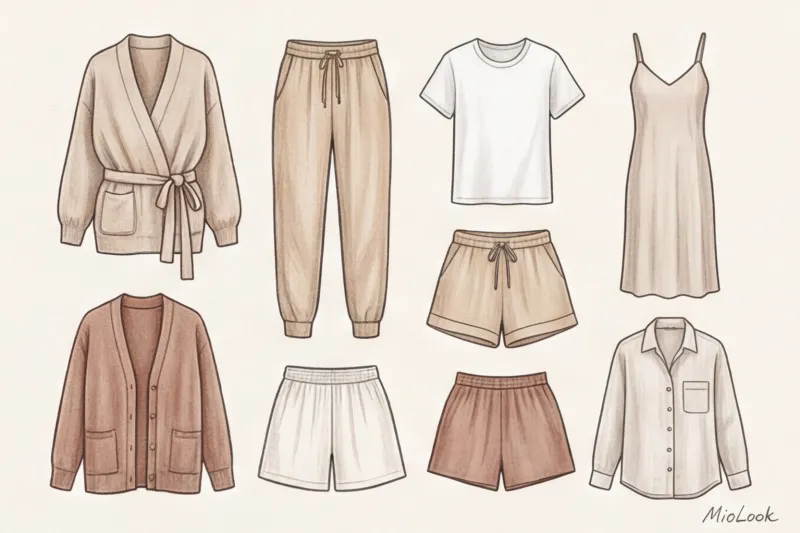
Bottoms: freedom without losing your silhouette
The lower part of a home's look is responsible for our physical comfort. You'll need three fundamentally different textures and shapes:
- Knitted palazzo pants Their straight cut from the hip down creates a phenomenal silhouette, even when worn barefoot or in flat mules. They're a surefire option for any body type.
- Joggers (without tight elastic at the bottom) Last month, during a wardrobe review, I literally coaxed a client to get rid of pants with tight ankle cuffs. Why? Tight elastic bands impede lymph flow at rest and visually shorten the leg, creating a "parachute" effect. Choose styles with a loose, slightly tapered hem.
- Bermuda shorts The just-above-the-knee length is the most elegant alternative to micro-shorts, which often look out of place outside the bedroom.
Upper: tactile base and layering
The rule of perfect pairing is: for every bottom, there should be at least two tops. Our checklist includes:
- Basic straight-cut t-shirts Forget about form-fitting styles—at home, there should be some air between your body and the fabric. A straight silhouette allows for unrestricted movement and looks elegant.
- Micromodal long sleeves I insist on this material. The cellulose fiber flows over the body, is virtually wrinkle-free, and wicks away moisture better than regular cotton.
- Oversized shirt Made from heavy cotton, softened linen, or flannel, it can be worn alone or thrown over a T-shirt unbuttoned.
Independent units and the third layer
The remaining three slots in our scheme are occupied by things that create mood and completeness.
First of all, it is 2 dresses/robes We're not talking about terrycloth bathrobes, but rather simple shirt dresses, knit midi styles, or wrap dresses. These are your go-to for weekends when you want to look feminine without trying too hard.
The final chord is 1 warming layer: a voluminous cardigan or kimono The third layer acts as a visual "puller" of the look. Unlike a hoodie with a kangaroo pocket, which often distorts proportions and hunches the back, the cardigan's V-neck elongates the neck. And a structured, thick kimono (easily found in the H&M Home or Zara home lines for €40-60) instantly elevates the outfit from "loungewear" to "stylish housewife" status.
"The effectiveness of this 12-component scheme lies in its adaptability. If you live in a hot climate, simply swap out your flannel shirt for a muslin one, and your wool cardigan for a silk kimono, while keeping the capsule's mathematics intact."
This ready-made workflow will save you from impulse purchases of random pajamas and will finally allow you to look as classy at home as you do outside.
Slippers and accessories: the finishing touches to a classy look
Do you know what most modern apartments have in common? Perfectly flat, yet anatomically unnatural, hard floors—laminated flooring, parquet, or porcelain stoneware. As noted by renowned American podiatrist and biomechanist Emily Splichal, the human foot is not evolutionarily designed for long hours of walking barefoot on completely flat surfaces. Impact without proper cushioning leads to flattening of the arch, microtrauma to the plantar fascia, and, as a result, poor posture, including chronic lower back pain. That's why high-quality house shoes are not just a whim of aesthetics, but essential for the basic hygiene of your musculoskeletal system.
It's time to ditch those worn-out plush slippers. They don't hold their shape, disrupt your stride pattern, and instantly cheapen even the most well-designed capsule wardrobe. Leather or suede mules, simple slip-ons made of thick felt, or orthopedic flip-flops are a stylish replacement. Classic Birkenstock clogs, which cost around $100–$140, have long been the gold standard for home wear: their anatomical cork insole supports the foot in a natural position, and their minimalist design fits seamlessly into the concept of a modern home wardrobe.
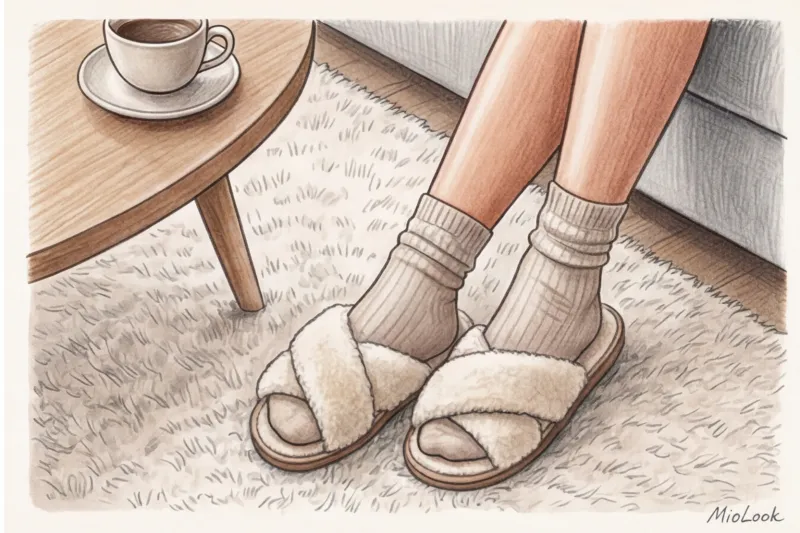
If you absolutely hate wearing shoes in your apartment, proper house socks are a safe compromise. I'm not talking about thin cotton socks that wear out quickly and are slippery. Opt for thicker models with silicone treads and non-slip soles. And for the cold season, cashmere socks are an absolute must-have. An investment of €30-50 per pair will be repaid many times over with the level of tactile luxury that instantly elevates your evenings to premium status.
The final touch of stylish poise is home jewelry. It's that subtle nuance that separates a woman prepared for any day's surprises from someone who just rolled out of bed. There's no need to wear massive rings or statement necklaces at home. Simply wear minimalist stud earrings in a basic metal or add a thin chain around your neck. They won't snag on fabric while changing clothes, won't interfere with sleep, and will create a polished, well-groomed look every time you glance in the mirror.
Your ideal image begins Here
Join thousands of users who look flawless every day with MioLook.
Get access — €0.99 onceHow to re-create and assemble a capsule wardrobe: a step-by-step plan from a stylist
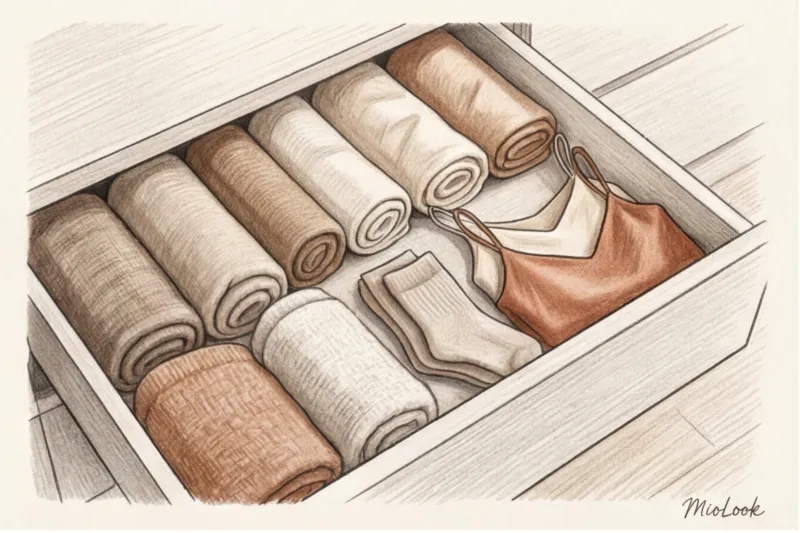
According to statistics from the National Association of Professional Space Organizers (NAPO), about 60% of the items in a chest of drawers with everyday items are just "dead weight." We store them out of inertia. To make your home wardrobe work for you instead of draining your energy, you'll need to conduct a rigorous audit. Here's my signature decluttering methodology, adapted specifically for a home capsule.
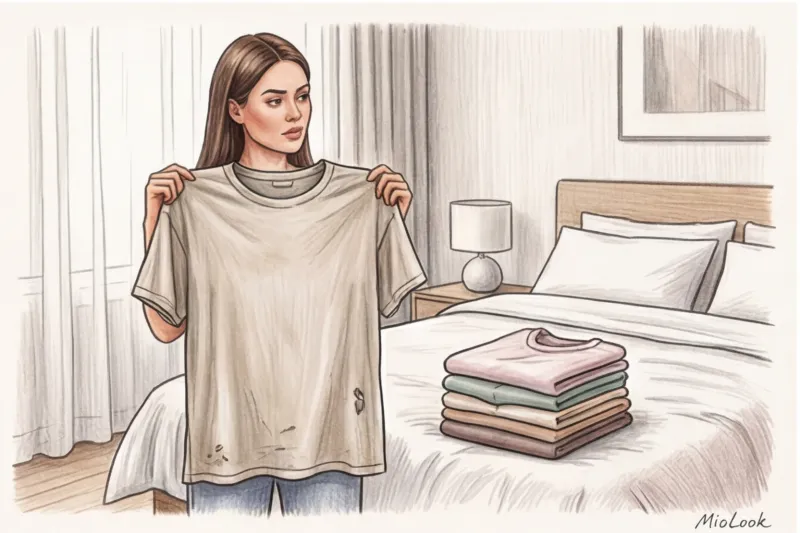
Step 1: Ruthless Decluttering. The "Stains and Pilling" Rule
Start by dumping absolutely all your home clothes on the bed. First, we apply an uncompromising the "spots and pellets" rule Any item that has lost its original appearance, is faded, or misshapen is recycled. No concessions like "I'll save it for when I paint the walls." For messy renovations, an old T-shirt is more than enough, not a whole shelf.
"The 'broken windows theory' works in styling: a single stretched knee on a pair of trousers or a washed-out collar instantly cheapens the entire look and subtly lowers your self-esteem," I always explain this principle to my clients at the very beginning of my work.
Step 2: Assess Real-World Home Scenarios
The biggest mistake is buying clothes for an imaginary life. Take a notebook and honestly write down how many hours a week you spend on various activities at home. If you work remotely for 40 hours and relax on the couch watching TV for only 10, your wardrobe should consist of 80% pre-packaged home office items (like heavy cardigans and shirts) and only 20% relaxed pajama sets. Choose the proportions strictly according to your actual time commitment.
Step 3: Select a color scheme based on your interior and color type
This is my favorite professional trick, which is rarely mentioned in glossy magazines. Loungewear should not only suit your complexion (color type) but also harmonize with the background—your interior. If you have a minimalist apartment with cool concrete tones, a warm neon peach sweatshirt will create visual dissonance and be irritating to the eye. Choose two or three basic colors (for example, deep graphite and dusty rose) that complement your skin tone and the textiles in your living room.
Step 4: Create a shopping list
Only after you've purged the excess and understood your needs can you plan your purchases. Your shopping list should be as specific as possible. Instead of something vague like "buy pants," write: "wide-leg flowy lyocell trousers, mocha color, high waist, budget under €80."
To avoid having to remember what you already have after the purge, I strongly recommend digitizing your current database. Upload photos of your salvaged items to MioLook app. The smart wardrobe management feature will clearly show you which joggers are critically missing a top and help you create an accurate shopping list, eliminating impulsive spending on unnecessary hoodies forever.
Busting the myths: silk peignoirs and leggings aren't always the best idea
Our social media feeds have conditioned us to a glossy image: the perfect morning should begin with a cup of freshly brewed coffee, sipped on the balcony in a flowing silk negligee. Or, conversely, we're aggressively sold the image of a "productive achiever" in tight athletic leggings. But let's remove the rose-colored glasses of Instagram aesthetics and look at these popular solutions through the prism of real physiology and practical style.
Myth 1: “A silk robe is always beautiful.”
Premium natural silk (starting at $150 per piece) truly looks luxurious. But that's until you decide to do some real household chores. Even the slightest drop of water from a washed mug leaves a noticeable dark stain on the smooth silk, which will only disappear after a full wash or dry cleaning. Furthermore, the slippery texture is completely impractical: your shoulders constantly sag whenever you reach for a plate or bend over to look after your child. And if we're talking about budget-friendly polyester alternatives (so-called "rayon"), static electricity adds to the visual drawbacks. In the dry air of a heated apartment, such fabric sticks to your feet, sparks, and attracts dust.
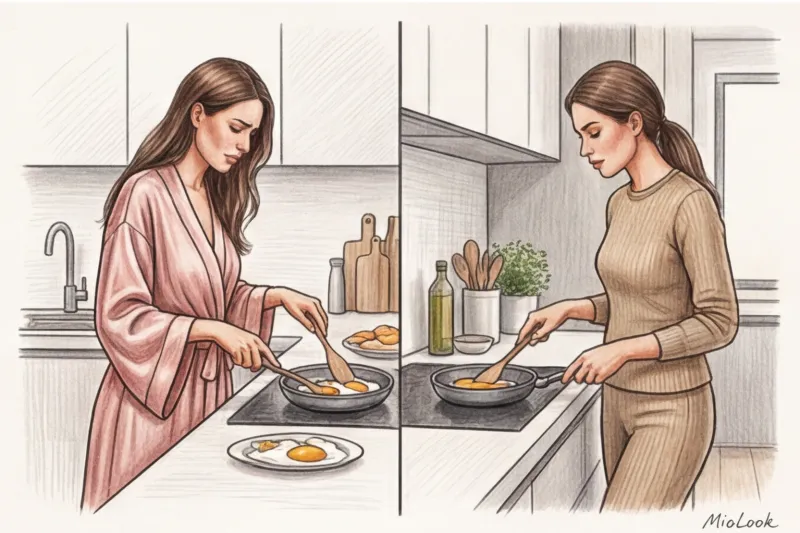
Myth 2: "Leggings are the perfect loungewear"
The vast majority of athletic leggings are made with 15–25% elastane or spandex. This compression works brilliantly during an intense 45-minute workout, keeping muscles toned. But wearing them all evening is a real crime against your circulation. Constantly wearing tight compression fabrics at rest (when you're just sitting on the couch watching a TV show) physically compresses the superficial veins and blocks normal lymphatic drainage. This causes the unexplained feeling of heaviness in the legs and swelling by the end of the day, which phlebologists often warn about. At home, your body needs air and freedom, not athletic support.
Myth 3: “Loungewear should be a size larger.”
"I'll buy an XL instead of my usual Medium to make sure it doesn't pinch anywhere" is a trap many women fall into in their quest for comfort. Baggy clothes don't offer true relaxation; they only cruelly distort your natural proportions. A voluminous, shapeless robe visually lowers your center of gravity, making your silhouette appear bulky and squat. When you repeatedly catch yourself in this way, your brain registers a signal of sloppiness, which directly affects your self-esteem and lowers your overall mood.
"True comfort isn't achieved by adding extra meters of fabric, but by creating the right fit: dropped shoulders, anatomical darts, gussets in trousers, and soft knit waistbands. Your clothes should contour to your body, not hide it in a sheath."
Creating a well-designed vacation spot isn't a whim, but a smart investment in your personal resources. Take a quick test this evening. Look at what you're wearing and ask yourself this honest question: "If a delivery driver rang the doorbell right now or a neighbor walked in, would I want to cover up, or would I open the door with complete confidence?" If the former is closer to the truth, it's time to rethink your habits.
Start small: swap your husband's stretched-out T-shirt for a simple long-sleeve top, and your compression sports leggings for loose, flowing Tencel pants. You'll be amazed at how quickly not only your reflection but also the quality of your rest will change. Your home is your most powerful place, and you deserve to look stylish and classy in it every minute.
Guide Chapters
Maternity Loungewear: A Stylish Mommy Capsule
Coming home from the hospital isn't a reason to wear out your old clothes. Learn how to put together a stylish maternity capsule that's comfortable and beautiful.
How the colors of your home clothes influence your relaxation
We spend most of our time at home, but often wear boring and faded clothes. Find out from a stylist how the shades of your home wardrobe influence the quality of your rest.
Homewear for plus-size women: how to choose a suit
It's time to ditch those faded T-shirts and stretched-out pants! Learn how to choose stylish plus-size loungewear that will flatter and inspire confidence.
Comfortable Clothes for House Cleaning: Stylist Tips
Stop wearing old t-shirts and stretched-out sweatpants while doing chores. Learn how to choose the right stylish and practical home uniform.
What to Wear to Welcome Guests: Stylist Tips
A homey look for entertaining isn't about glossy looks, but about functionality and comfort. We explore stylish and practical solutions with a personal stylist.
Stylish warm clothes for the home: how to stay warm in winter
How to look stylish when it's only 18°C at home? We'll explore what makes a great winter capsule and why you should ditch the plush pajamas.
Summer Loungewear: How to Beat the Heat in Style
Short shorts and tank tops aren't always the best choice for hot days. We'll tell you how the right fabrics and styles of loungewear can help you beat the heat.
Loungewear Trends: What to Wear This Season
It's time to ditch those stretched-out sweatpants and old T-shirts in favor of stylish comfort. Let's explore what's truly worth wearing at home this season.
Beautiful Slippers for Women: A Stylist's Guide
The average woman takes up to 4,000 steps a day at home. Find out why stylish indoor shoes are just as important as outdoor ones and how to choose your perfect pair.
The Difference Between Pajamas and Loungewear: Stylist Tips
Why does working in your favorite pajamas drain your energy and reduce your productivity? Together with a stylist, we explore how clothing programs our brains.
Where to Buy Loungewear: An Expert's Guide
It's time to stop wearing old T-shirts and stretched-out pants. Learn how to choose high-quality, stylish loungewear that will last.
How to Look Attractive at Home: Stylist Tips
Forget about stretched-out T-shirts! Learn how to create a stylish and comfortable home wardrobe to delight yourself every day.
Why You Shouldn't Wear Old Clothes at Home: Psychology
Are you used to wearing stretched-out T-shirts and old sweatpants around the house? A stylist explains how this habit contributes to a life-sustaining mentality and damages your self-esteem.
The Best Fabrics for Loungewear: Stylist Tips
Your home wardrobe affects your self-esteem just as much as your street wardrobe. We discuss with a stylist which materials offer true comfort and why you should forget about 100% cotton.
Work-from-Home Clothing: Style for Zoom Calls
The jacket-over-pyjama joke no longer works. We're discussing with a personal stylist how to create a professional-looking wardrobe for remote work.
Home Capsule Wardrobe: A Basic 10-Item List
Forget about stretched-out T-shirts and uncomfortable clothes. Learn how to create an elegant and functional home wardrobe with just 10 essential pieces.