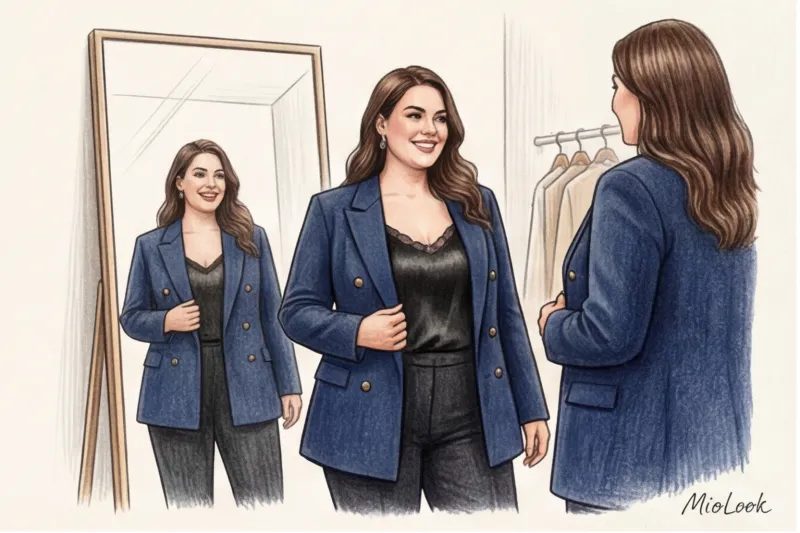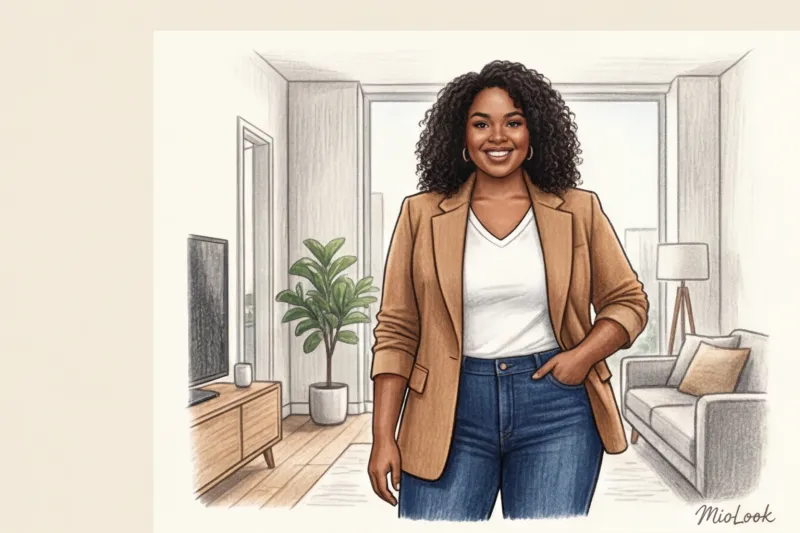
It's a familiar scene: you're standing in a store's fitting room, surrounded by a mountain of shapeless tunics that the brand somehow deems perfect for your size. You put one on—and visually add another ten pounds. In 12 years of working as a personal stylist, I've seen tears of disappointment in fitting rooms hundreds of times. For decades, the industry has sold us a convenient myth, convincing us that plus-size clothing is the art of concealment, complex draping, and drab black.
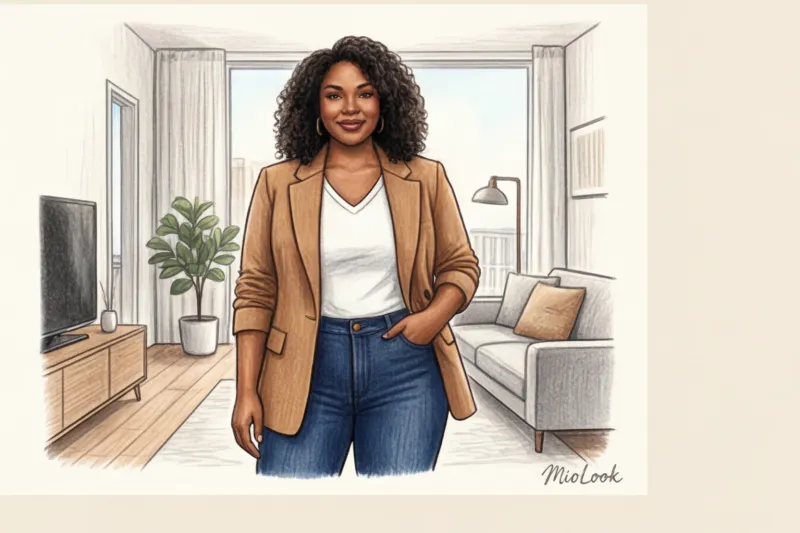
But let's face it: you can't hide volume under even more volume. A well-designed capsule wardrobe for plus-size women is built according to entirely different rules. The laws of fabric physics and structural cuts apply here. We've discussed a more systematic approach to organizing items in our The Complete Guide to the AI-Powered Capsule Wardrobe App , and today we'll look at how to turn your closet into a tool for architectural figure correction.
The Biggest Myth: Why "Black and Robes" Don't Work Anymore
As a stylist, I constantly struggle with the persistent stereotype that "black is slimming." This is absolute nonsense when it comes to thin viscose or cheap, flimsy knitwear. I had a telling case with a client who was a size 52. She came to me for a wardrobe review wearing her favorite black cardigan, sincerely believing it subtly concealed her hips.
We removed this shapeless garment and put on a structured, double-breasted camel-colored jacket made of heavy gabardine. The effect was shocking—the client visually "dropped" two sizes in one minute, despite the light shade. Why did this happen?
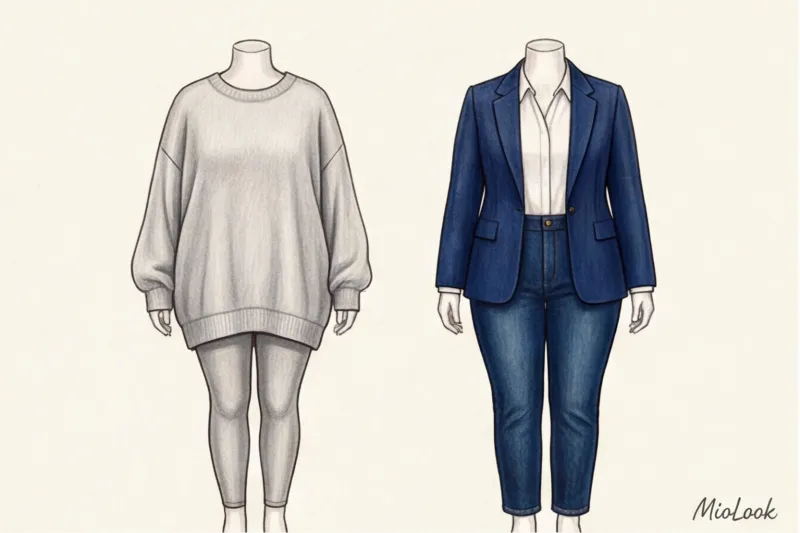
Oversized clothes, bought a couple of sizes too big in the hopes of hiding a belly, transform a woman's figure into a monolithic square. A plus-size capsule wardrobe isn't a tank cover. It's an architectural project where your body acts as a framework, and the right clothing defines a clear geometric shape.
The Architecture of Slimness: 3 Rules for Choosing Fabrics
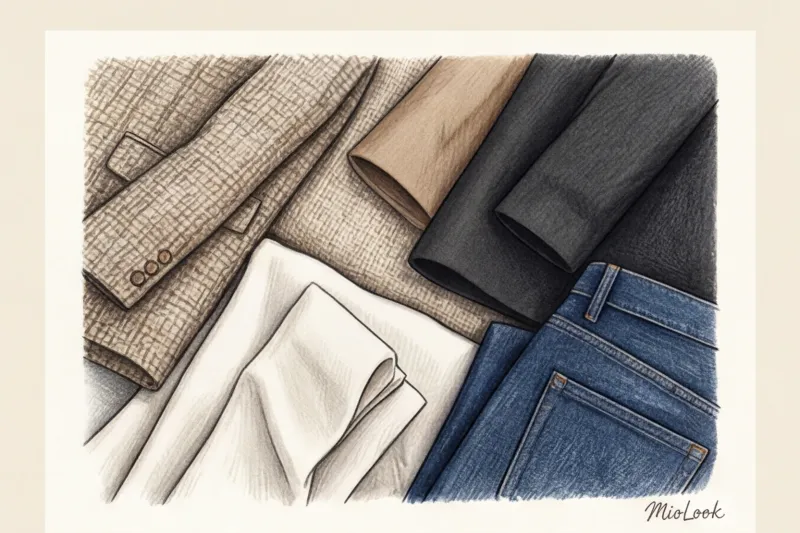
In professional clothing design, there's a term called "drapeability." Simply put, the fabric should hold its shape, not cling limply to every fold of your body. The laws of physics work reliably in the closet: 90% of the time, the density of the material is more important than its color.
Density vs. Stretch: The Elastane Trap
About 80% of plus-size women adore jeggings, which contain 5–7% elastane. They seem incredibly comfortable. In reality, this type of denim is a traitor: it stretches in the largest areas, highlighting uneven skin, and by evening, it hangs treacherously around the knees.
The ideal formula for a slimming base: 98–99% rigid cotton and a maximum of 1–2% elastane for minimal comfort. Yes, these jeans are a little more difficult to put on, but they work like an expensive corset. To check the fabric in the store, try my favorite "fist test": squeeze the fabric of your pants or skirt tightly in your fist for 10 seconds and then release. If it remains wrinkled and doesn't immediately return to its shape, return it to the hanger.
Matte textures and their optical effect
According to the PANTONE Color Institute, reflective surfaces can visually enlarge an object by 15–20%. Satin, cheap rayon, and fabrics with lurex or a wet sheen are powerful optical magnifiers. They catch the light and create highlights on the most prominent points of the figure, drawing maximum attention to them.
A refined matte finish works differently. Dense crepe, suit wool, matte silk, or gabardine absorb light, creating a sense of visual depth. Matte surfaces create a more composed, understated, and visually expensive silhouette.
Access to MioLook for €0.99 — one-time payment
A smart AI stylist will select the perfect look based on your proportions.
Get access — €0.99 onceA Basic Capsule Wardrobe for Plus Size Women: A 12-Item Checklist
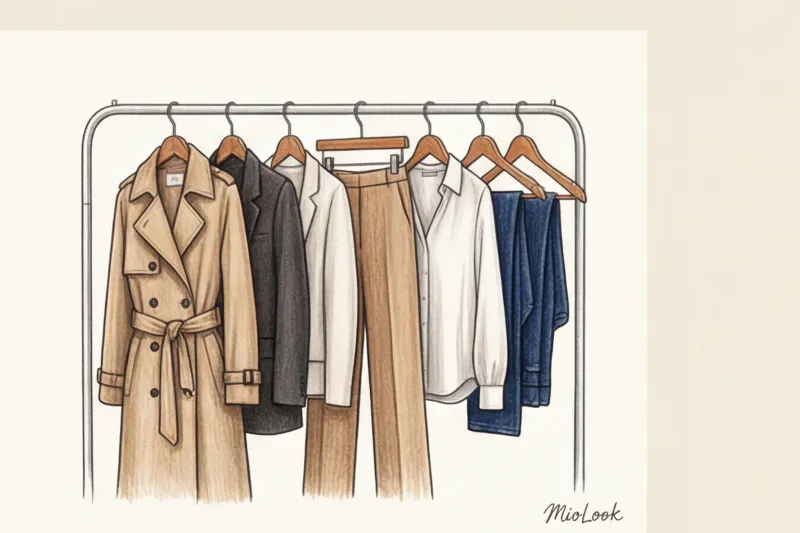
Creating the right capsule collection begins with a rigorous selection process. Each item must be worth its cost-per-wear value. A high-quality structured jacket for €150 will last four times longer and add a touch of class to your look than a flimsy €30 sweater.
Here's a minimal checklist of the ideal base that I put together for my clients from European brands (such as COS, Massimo Dutti, the Violeta by Mango line, and H&M+):
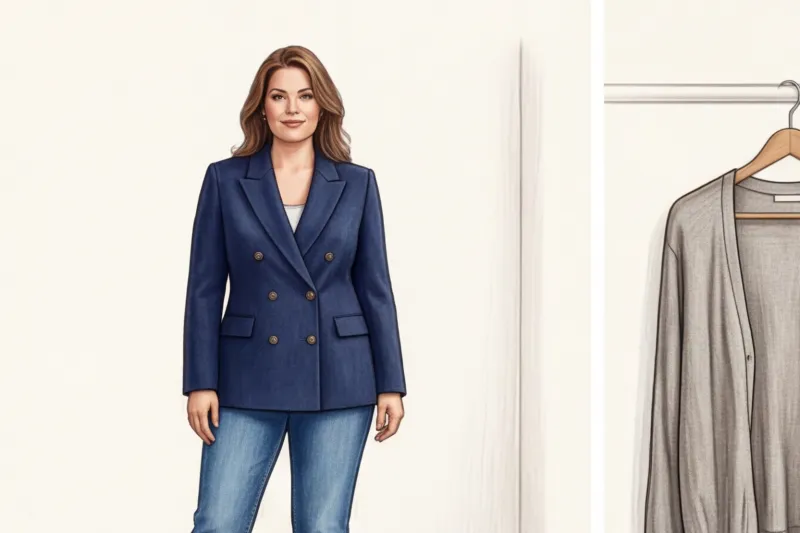
- Structured straight-cut jacket. The most important detail is length. It should cover the groin and end just below the widest part of the thigh.
- Straight or slightly flared jeans full length in rigid denim.
- Wrap dress made of thick, flowing fabric (specifically thick viscose or cupro, definitely not thin jersey!).
- Basic blouse with a V-neck. Open collarbones and neck visually remove at least 3-5 kg.
- A thick white or light blue shirt loose men's cut (cotton from 180 g/m²).
- Classic trousers with creases. The ironed arrow is a rigid vertical line that infinitely lengthens the legs.
- A-line skirt made of thick cotton or matte eco-leather, midi length.
- Smooth basic t-shirt loose fit.
- Classic straight cut trench coat length below the knee.
- Thick, smooth knit sweater (no braids, buns or voluminous decorations).
- Leather belt medium width (3–4 cm) with a simple geometric buckle.
- Classic straight coat made of structured wool.
Let me be clear: this checklist isn't a one-size-fits-all solution. It won't work if you have a pronounced apple-shaped figure with a very prominent belly. In this case, a classic wrap dress can create unnecessary emphasis on the waist, so we'd replace it with a straight-cut shirtdress.
Image Formulas: Creating Verticals Without Visual Noise
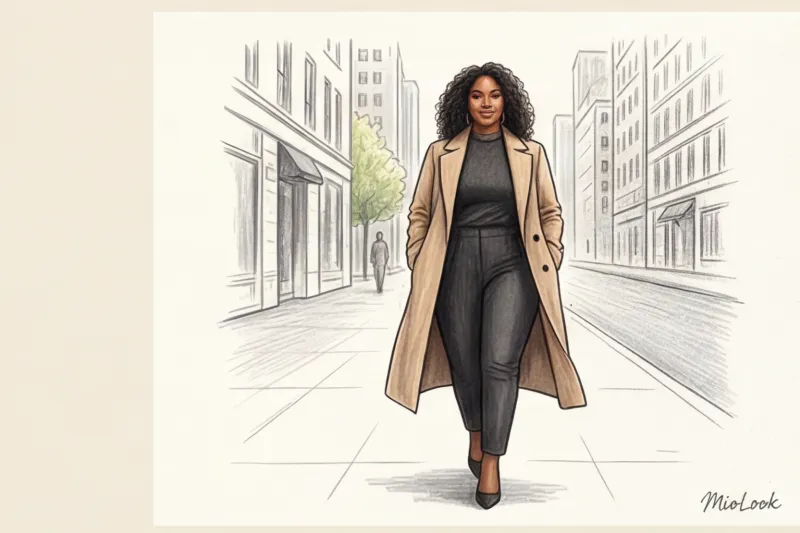
How does neuroscience relate to your closet? It's simple. Our brains are lazy; they spend a split second assessing someone else's silhouette and prefer to read continuous lines. If an image is fragmented (white blouse, black belt, blue jeans, contrasting red ankle boots), visual noise occurs. The gaze "stumbles," and the figure is fragmented into short, wide blocks.
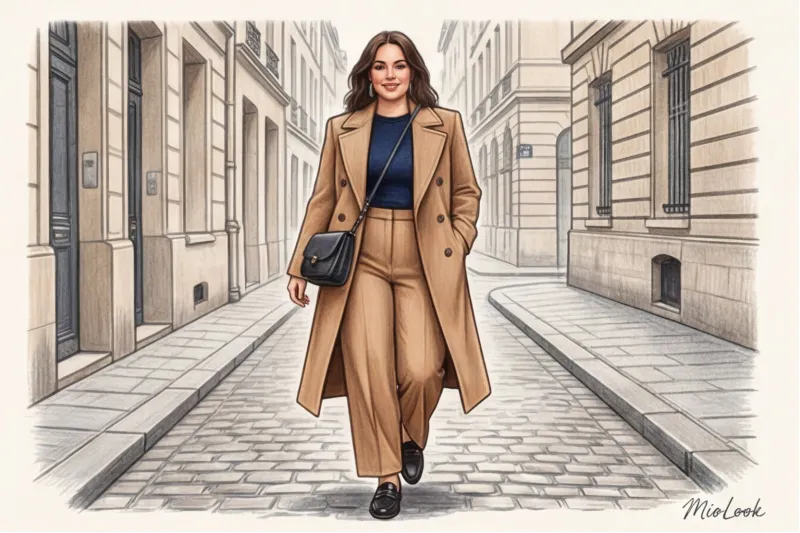
A stylist's secret weapon is the "inner column" rule. You wear a monochrome base layer (for example, a top and pants in the same deep, dark shade) and throw on a contrasting, unbuttoned top (a light jacket, a thick-knit cardigan, or a trench coat). The two vertical flaps of the unbuttoned top literally "cut" 5-7 centimeters from your sides, leaving a narrow strip of color in the center.
"What should I do in 30-degree heat? What jacket?" clients often complain. I personally tested the layering rule in August in Milan on a client who was a size 54. Swap the wool jacket for a long, lined, thick linen vest or a loose cupro shirt left unbuttoned. You'll get the same slimming vertical line, but the fabric will breathe.
Shoes and accessories: hidden reserves of the right capsule
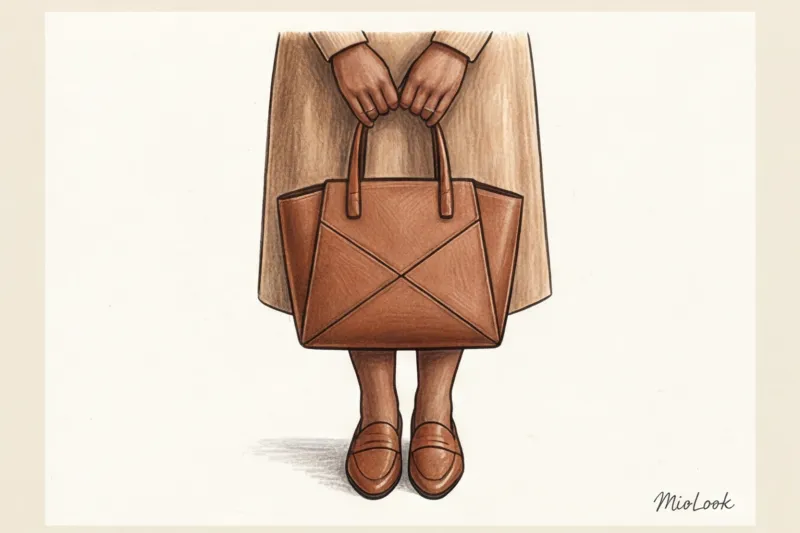
Accessories can make or break an entire architectural design. David Kibbee's theory, adapted to the modern wardrobe, has an ironclad rule of proportionality. If a larger woman picks up a trendy micro bag, the tiny accessory will make her figure seem gargantuan in contrast.
Choose medium or large bags (at least 25 cm wide). They should have a rigid, geometric shape (such as a tote or satchel). Soft hobo bags or shapeless sacks add a sloppy, bulky look.
When it comes to footwear, they should be a logical extension of your foot. Choose pumps and loafers with a deep V-neck (vamp)—they reveal the instep and elongate the leg. Thin stilettos are strictly prohibited: not only are they uncomfortable, but they also create a comical contrast between the heavy upper and thin heels, throwing off the proportions. Choose a stable block heel, a platform, or a chunky, simple sole.
Your perfect look starts here
Join thousands of users who look flawless every day with MioLook.
Get access — €0.99 onceDigital Fitting Room: How AI Solves the "Full Closet, Nothing to Wear" Problem
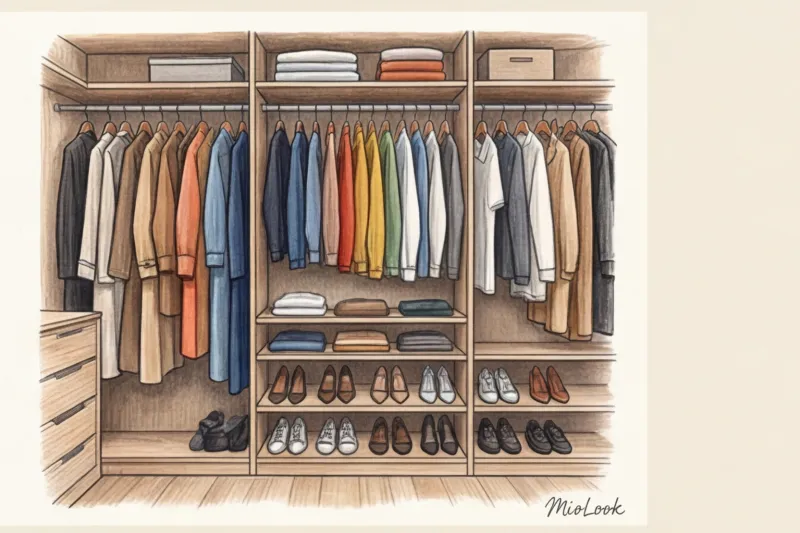
We've already established that a capsule wardrobe for plus-size women requires clever combinations. But here's where a problem arises. According to data from the British organization WRAP (Waste and Resources Action Programme) for 2023, approximately 30% of the clothes in the average closet haven't been worn in the past year. Our brains simply can't hold more than 30–40 items in our memory at once.
A "blind spot" develops. You forget that you have the perfect burgundy top that would create that perfect "inner column" with your new jacket. Physical chaos in your closet leads to cognitive overload.
That's why I highly recommend digitizing your wardrobe. In the app MioLook You see all your assets in the palm of your hand. You upload items to your virtual closet, and the built-in AI stylist automatically puts together outfits for you based on your body shape. You don't have to stand in front of your open closet in the morning, wondering how to pair a thick skirt with a shirt—the algorithm will handle this routine for you, taking your preferences into account.
Rookie Mistake: What You Should Never Add to a Capsule
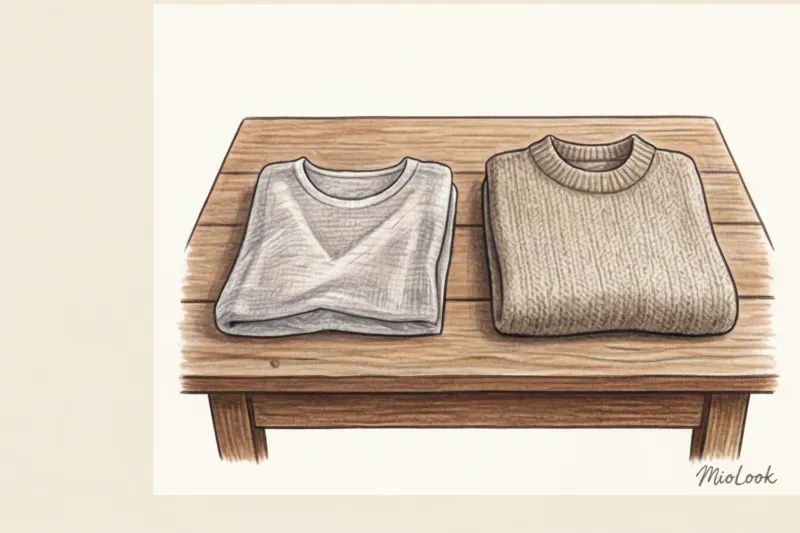
When I audit my wardrobe, I regularly come across the same staples. If you've decided to put together a capsule wardrobe that works, immediately remove the following items:
- Thin, flimsy knitwear. Those ribbed turtlenecks and cardigans that are see-through and cling to every crease on your back. This is the main enemy of a slim figure.
- Trousers and skirts with elastic waistband and gathering. Often sold in the plus-size section under the guise of "extra comfort," these garments are also popular among fashionistas. The gathered fabric at the waist visually adds at least 5-7 centimeters to the belly. Choose only a smooth, firm waistband or a hidden elastic band inside a classic waistband.
- Small contrast print. Polka dots, small florals, or variegated checks. Optical illusion studies confirm that a small, contrasting pattern over a large area begins to "ripple" and visually expands the object. Choose a medium-sized print that's proportionate to your figure, or elegant solid colors.
- Horizontal decorative seams on wide areas. Cargo pockets at mid-thigh, contrast stitching, or a horizontal yoke at the chest are lines that mercilessly cut the silhouette in width.
Step-by-step plan: where to start assembling your wardrobe
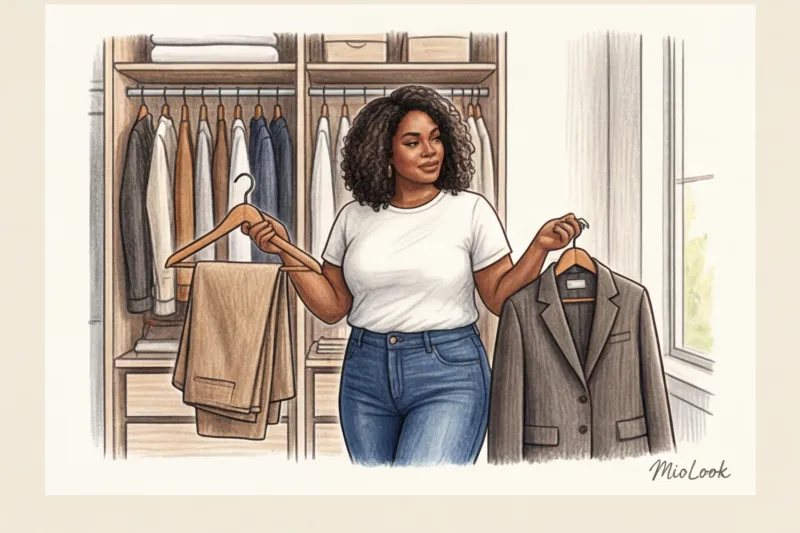
How do you move from theory to practice? Forget about impulse purchases during emotional sales. Creating a style requires cold calculation and a clear algorithm:
- Step 1: Get rid of illusions. Get all those black hoodies out of your closet. Measure your actual waist size with a tape measure today. Stop buying things with the idea of "when I'll lose weight by summer" in mind—you deserve to look fabulous in the body you have now.
- Step 2: Create an invisible foundation. Invest in smooth, high-quality base layers. No €200 structured jacket will fit well if the underwear is tight around your back and creates unnecessary bulges.
- Step 3: Purchase an "architectural frame." Start with a quality, structured top—a heavyweight jacket or a men's shirt made of heavy cotton. This is your first and most important investment.
- Step 4: Digitize the result. Take photos of your new successful things and upload them to MioLook so that algorithms can help you create the maximum number of combinations from a minimum number of clothes.
When putting together a capsule wardrobe, always keep one thing in mind: you're not trying to apologize for your size or hide your body. You're creating a dignified, polished look for it. The right lines and sleek fabrics can work their magic, restoring your confidence every time you look in the mirror.