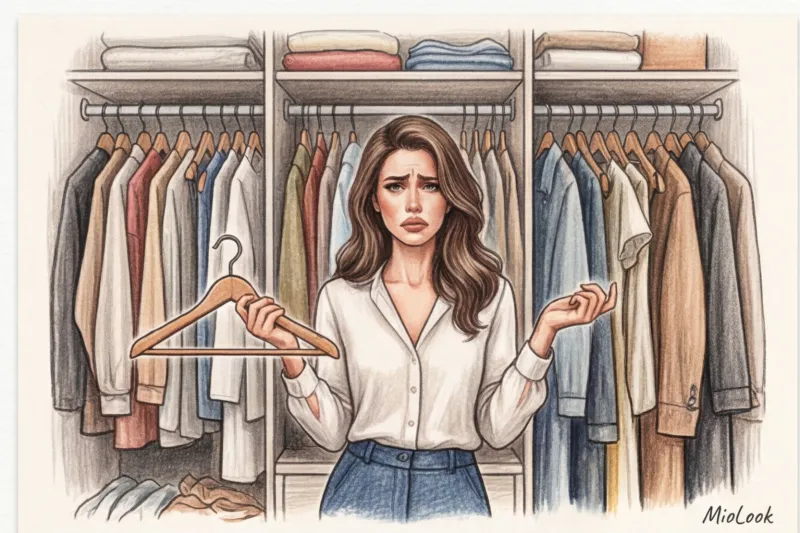
The Closet Paradox: The Wardrobe as a Mirror of Our Psyche
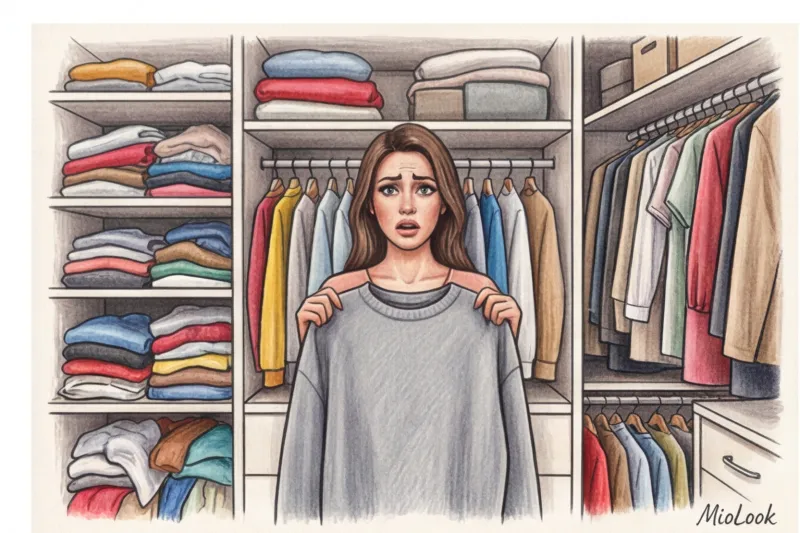
Over 12 years of working in the fashion industry and practicing personal styling, I've seen hundreds of closets—from minimalist closets in tiny Parisian studios to gigantic walk-in closets the size of apartments. But one scene repeats itself with alarming, almost mathematical regularity. One of my clients once opened her closet doors to reveal dense rows of luxury items with their tags still intact: silk slips, architectural jackets, stilettos costing €500 and up. Meanwhile, she greeted me wearing the same faded jeans and her favorite oversized sweater—her daily "uniform." This colossal gap between the contents of the shelves and the actual reflection in the mirror is a clear marker of internal dissonance. This is where the dissonance begins. psychology of shopping — a discipline that explains why we buy one thing and wear something completely different.
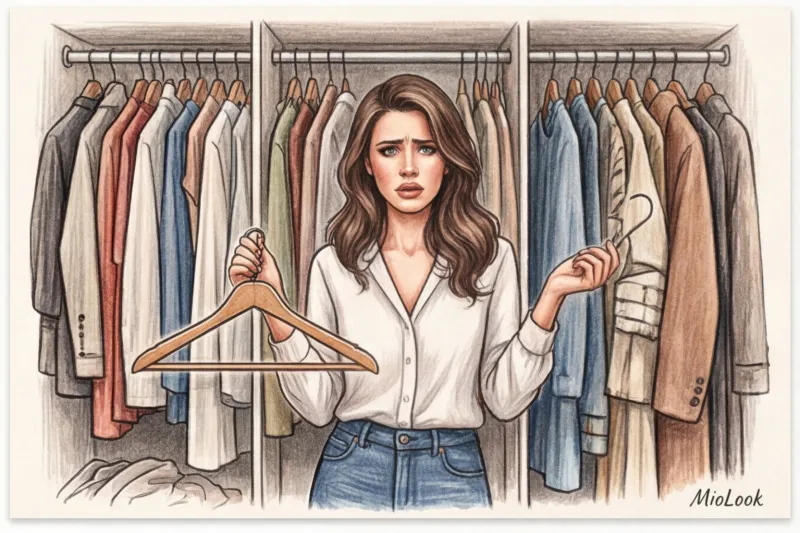
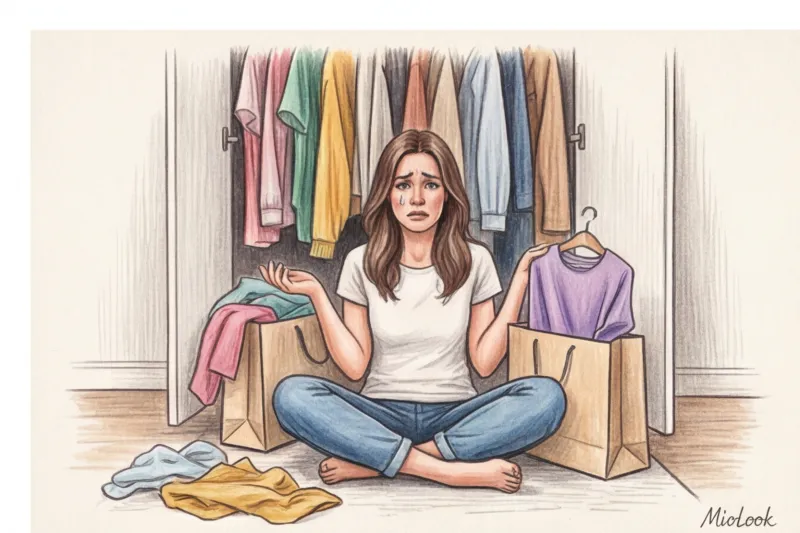
We're used to thinking that the "nothing to wear" problem stems from a lack of clothes. The logic seems ironclad: buy more clothes, and you'll have more options. However, in practice, an abundance of clothes not only doesn't solve the problem, it actually makes it worse. When your closet is overflowing, you stop seeing it as a tool for self-expression. It becomes a storehouse of unsolved problems.
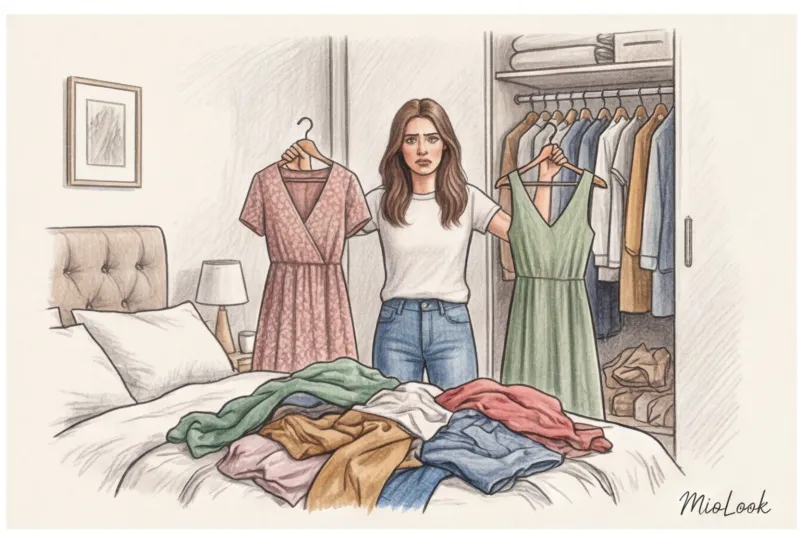
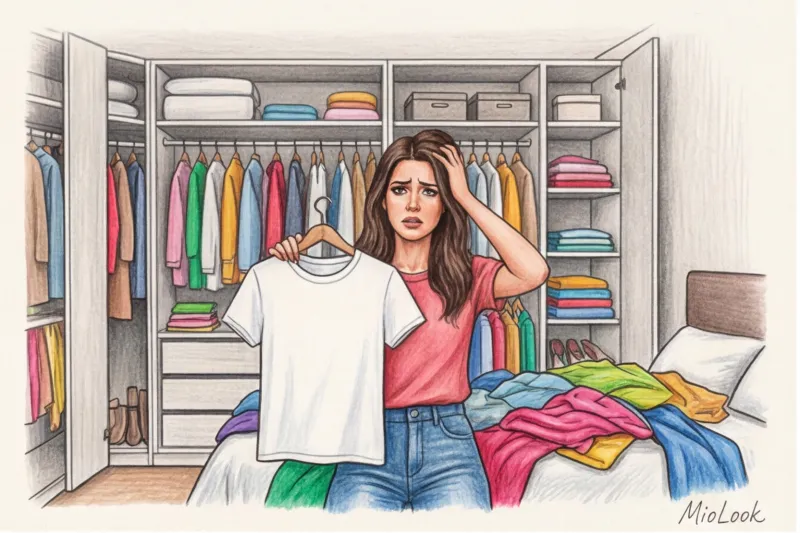
In behavioral economics, this state is called overchoice (overchoice). When we have three shirts, our brain makes a decision in seconds. When we have thirty shirts in front of us, "wardrobe paralysis" sets in. An excess of options physiologically blocks our ability to make decisions early in the morning. Neuroscientists confirm that willpower and decision-making resources are exhaustible. Spending mental energy choosing between five similar white T-shirts exhausts us before we even leave the house. If you want to delve deeper into the mechanics of this phenomenon, I recommend reading our article. "A Full Closet, But Nothing to Wear: Causes and Solutions".
Moreover, visual chaos is closely linked to our underlying anxiety levels. Every item in the closet carries a certain emotional weight. A tight dress whispers, "You've gained weight." An expensive but never-worn blouse reproaches, "You wasted your money." Trying to get dressed in the morning turns into a self-flagellation session, triggering micro-surges in cortisol. We close the closet door, grab a trusted, safe sweater, and escape the stress.
Fantasy Self Syndrome
When analyzing those very same items with tags, I always ask my clients one question: "Where were you planning to wear this?" And the answer almost always describes the life of a completely different person. This is the "Fantasy Self" syndrome—an idealized version of ourselves.
Your fantasy self is the woman in your head who runs marathons every morning, spends her weekends at art galleries with a glass of champagne, and mysteriously smokes on a Parisian balcony in the evenings, wrapped in a silk kimono.
The problem arises when a wardrobe is purchased for this fictional muse, rather than for a real woman whose routine consists of remote work, trips with children to activities, and evening trips to the supermarket. A stark conflict arises:
- Reality: You spend 80% of your time at home or in casual meetings.
- Closet: 60% consists of complex cuts, high heels and fabrics that require dry cleaning.
Why do we persistently invest in fantasy, ignoring reality? Because through clothing we are trying to buy not the fabric and cut, but lifestyle We lack that sense of belonging. When we make a transaction at the checkout, we experience a brief euphoria from being one step closer to our ideal. We think that if we buy that €300 sequined evening dress, we'll immediately be invited to social events. But the dress goes into the closet, and we return to the laptop on the kitchen table. Recognizing this gap is the first step to recovery. We wrote about this therapeutic effect in detail in the article about Decluttering your wardrobe as a therapy for anxiety.
The Diderot Effect and the Endless Race
Another psychological trap that turns our closets into storage bins is the Diderot Effect. The term is named after the French philosopher Denis Diderot, who in the 18th century received a luxurious scarlet robe as a gift. Upon putting it on, he discovered to his horror that his old desk, worn chairs, and tapestries looked shabby in comparison to this magnificent piece. Diderot ultimately went into debt to completely redecorate his office.
In a modern wardrobe, it works like this: you buy a stunning pair of architectural shoes for €250. You bring them home and realize your basic trousers look cheap next to them. You buy new trousers. They need a different belt. And your old bag now ruins the entire look. One new item that's out of line with your usual aesthetic or price range makes us devalue the rest of our wardrobe and sets off a chain reaction of purchases.
The fashion industry is well aware of this cognitive bias. Brands don't want to sell you just one item. That's why lookbooks are always styled as a total look, and online retail algorithms aggressively suggest "Customers Also Bought" sections. They sell you a complete look, knowing that buying just the jacket will leave you feeling visually dissonant and prompt you to return for more trousers from the same collection. Understanding how your brain reacts to such triggers is your best weapon against impulsive spending and overflowing hangers.
The Psychology of Shopping: Why We Buy Unnecessary Items
Have you ever noticed your physical state as you checkout or click "Checkout"? Your heart rate quickens, you lose track of time, and suddenly feel euphoric. You're not buying a cashmere sweater or a pair of new jeans. You're buying a chemical reaction. The psychology of shopping It has long been proven that for most of us, buying clothes has become a deep mechanism of emotional compensation.
In the academic community this phenomenon is often referred to as retail therapy (retail therapy). According to a classic study by behavioral economists from the University of Michigan (2014), shopping can indeed temporarily reduce background sadness. Why? Because in moments of stress or chaos, the act of choosing and paying for something gives us the illusion of complete control over our lives. You can't control deadlines at work or the behavior of your loved ones, but you absolutely have the power to buy that €120 silk dress.
This is where neurotransmitters come into play. Shopping is a legal, socially acceptable, and aesthetically pleasing way to get a quick dopamine rush. Brands are well aware of this neurophysiological characteristic and design their spaces to stimulate this surge. Have you noticed how fast fashion giants design their stores? It's no coincidence.

Mass-market stores employ principles borrowed from casinos. Bright, stage-like lighting focuses exclusively on new collections, leaving the aisles in partial shadow. Upbeat music plays at around 120 beats per minute—this tempo artificially accelerates our heartbeat, forcing us to move faster and make more impulsive decisions. The constant rotation of items on the rails creates a disorienting effect: you can't find an item where you saw it a week ago, which creates a sense of urgency. The brain receives the signal: "You need to get it now, or it will disappear."
However, the main triggers for impulse buying remain stress, chronic fatigue, and the insidious thought, "I deserve it." One of my Parisian clients, a successful corporate lawyer, consistently bought expensive shoes after every grueling court case. When we sorted through her wardrobe, we found eight pairs of shoes that had never been worn. She wasn't buying shoes to wear. She was buying comfort and tangible proof that her hard work was rewarded.
The Illusion of a Good Deal: The Sale Trap
No marketing tool works as reliably as the crossed-out price. In behavioral economics, there's a concept called "transaction utility"—the pleasure we get not from the item itself, but from the knowledge of how well we got it.
When you see a jacket marked down from €250 to €75, your brain perceives it not as spending €75, but as earning €175. The yellow price tag or "Sale" sticker literally hacks our neurobiology: it activates the nucleus accumbens (the brain's pleasure center) while simultaneously suppressing the insula, which normally signals the "pain" of losing money. You're under a kind of discounted anesthesia.
It's in this foggy state that we fall victim to FOMO (Fear of Missing Out). Driven by the thought "I won't get that price again," we make the most absurd fashion mistakes. Have you ever bought pants a size too small because they're out of your size, but the 60% discount feels like a crime against your wallet? At that moment, we justify it with the classic "just in case" or "the incentive to lose weight for summer." In reality, these items settle at the bottom of the closet like dead weight, a reminder of our irrationality.
Over the years of styling, I've developed one ultimate rule for my clients that instantly sobers them up at the checkout. Ask yourself just one question: "Would I buy this item right now for its full, original price?" If the answer is no, put the item back. You're not trying to buy clothes, but the thrill of a great deal.
Access to MioLook for €0.99 — one-time payment
A smart AI stylist will select the perfect look from what you already own and help you avoid unnecessary purchases.
Get access — €0.99 onceWardrobe Anatomy: What Things We Hide From Ourselves
A study by the Fashion Psychology Institute, led by Dr. Carolyn Mair (2023), confirmed a long-held industry axiom: on average, we only regularly wear 20% of our closets' contents. The remaining 80% constitutes what's known as a "blind spot." The anatomy of our wardrobe is literally the geography of our attachments and insecurities. While our most popular items hang at eye level, the far corners and hard-to-reach shelves are where the things we physically hide from ourselves accumulate. Looking there is uncomfortable, because it's not just fabric that hangs there. It's our emotions.
Over the years, I've noticed that "dead weight" in the closet rarely appears by accident. Every unworn item has a purpose. I identify two main categories of these psychological anchors that paralyze our wardrobes:
- Clothes as a fixer of the past. These are the things that anchor us in a past stage of life. For example, the formal wool suits from our former corporate days that we keep "just in case," even if we've long since transitioned to freelancing. We don't save them for the office; they serve as tangible evidence of our former status: "I handled high-level negotiations." Getting rid of them mentally means erasing part of our identity. Silk blouses given to us by former partners or dresses worn during a painful breakup also fall into this category. The emotional charge of such things is so strong that they subconsciously drag you back.
- Feeling guilty about spending money. In behavioral economics, this is called the "sunk cost fallacy." Imagine: you bought a designer asymmetrical jacket with a complex cut for €350, put it on one day, realized you couldn't lift your arms in it, and put it away in its bag. Your brain refuses to acknowledge your financial mistake. We hold on to this jacket not to wear it, but to delay the final admission of our mistake. Every time you stumble upon it, you subconsciously punish yourself for your wastefulness.
These categories turn getting ready in the morning into an emotionally draining process. You open doors and instead of inspiration, you receive a dose of reproach.
Slimming clothes as a source of stress
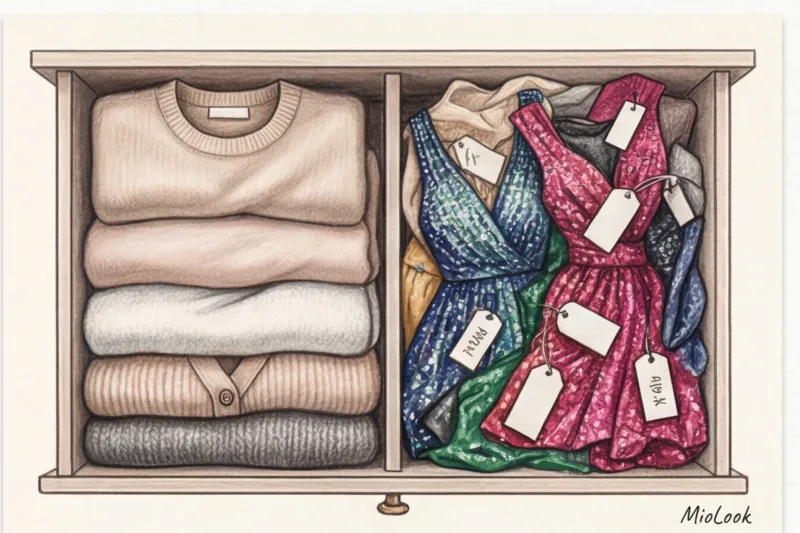
But the most destructive type of “dead weight” is what I, as a stylist, directly call toxic clothing Almost every other time we analyze a garment, we find a shelf or drawer full of items a size or two smaller than the client's current measurements. These could be the perfect pair of European size 36 jeans bought ten years ago, or a form-fitting sheath dress.
Women sincerely believe that these clothes will act as a motivator. However, shopping psychology and self-perception research prove otherwise. According to a publication in Journal of Eating Disorders (2022), having smaller sizes in your closet doesn't motivate you to exercise. On the contrary, it systematically destroys your body image and provokes chronic background stress.

I always repeat: a wardrobe is a utilitarian tool. It must accommodate your body TODAY, with all its unique features, not in a year, not after a grueling diet, and not in some hypothetical future. A "slimming" dress isn't an incentive. It's a daily visual reproach to your own imperfections, voluntarily hung in your bedroom.
The therapeutic effect of getting rid of these reproachful items is immediate. If you're too afraid to part with them forever, I suggest an eco-friendly compromise: vacuum-seal them and put them on the attic, completely out of your daily sight. And to maintain control of your archives, digitize these items using an app. MioLook Your closet should be your personal support zone, a resource from which you draw confidence every morning, not a minefield of unmet expectations.
The myth of the universal base: why stylists' advice sometimes hurts
Open any fashion magazine from ten years ago, and you're guaranteed to find the same ultimate list: a white straight-cut shirt, a beige trench coat, and classic black pumps. For a long time, this standardized set was sold as the ultimate panacea for the "nothing to wear" problem. But let's be honest: this universal uniform doesn't suit everyone. An externally imposed shopping list is perhaps the most insidious trap into which the psychology of shopping regularly leads us.
In my practice, I constantly encounter "victims" of fashion lists. One of my clients—a woman with a stunningly vibrant, expressive style and a luxurious collection of vintage prints—one day decided it was time to "grow up." She went to an expensive boutique and spent about €1,200 on a perfect beige capsule wardrobe, because "that's how it's supposed to be." The result was disastrous: a month later, she admitted to falling into a real depression every time she opened her closet doors. These perfect, expensive, high-quality pieces had literally stripped her of her identity.

The thing is, if your stylistic archetype (for example, the Creator or the Rebel) is inherently resistant to minimalism, buying classic "basics" will be a waste of money. A Rebel will feel like a stranger in a beige trench coat, while for the Creator, a classic white shirt will feel like a hospital gown. Trying to squeeze yourself into someone else's mold leads to a classic scenario: the perfect basics hang untouched, while you impulsively buy another leopard print dress to quell this "proper" boredom. Ultimately, you're wasting your money twice.
A basic wardrobe isn't a list of specific items handed down from above by fashion experts. It's an architectural principle that should be built exclusively around your individual style and DNA.
Think of your wardrobe as a building. The foundation must withstand the weight of your real lifestyle. According to research by WGSN (2024), the concept of a "basic wardrobe" has shifted from impersonal classics to hyper-personalization. For a Dramatic woman, the ideal basic shoe would be a pair of €250 metallic leather Cossack boots that she wears for three seasons in a row, not nude ballet flats. For a grunge lover, a basic jacket would be a voluminous, distressed biker jacket, not a fitted blazer.
A basic piece is simply a connecting link, a backdrop for your accents. And this backdrop doesn't have to be gray, beige, or white. Your personal "base" could be a deep emerald, a rich wine, or even a dark plum.
To figure out your true, rather than imposed, base, you need to analyze what things you intuitively reach for. I recommend digitizing your most beloved, well-worn items in an app. MioLook and take advantage of the smart analysis feature. Artificial intelligence will quickly identify your true patterns: and you'll be surprised to discover that your personal "white T-shirt" is actually a striped shirt, and your perfect "black pumps" are actually chunky lace-up boots.
Try MioLook
for free
Start creating perfect images with the help of artificial intelligence
Get access — €0.99 oncePsychological Detox: How to Break the Vicious Cycle of Consumption
Any experienced stylist will confirm: simply forbidding yourself from buying new things is like going on a strict diet a week before a vacation. A breakdown is inevitable, and it will be devastating. We've already explored how the industry and our own brains trick us into accumulating unnecessary items. Now it's time to move from reflection to action. A psychological wardrobe detox is a step-by-step framework that I implement with every client. It's built not on guilt and prohibitions, but on conscious slowing down and reflection.
The first and most severe law in my practice is The 24-Hour Rule In the era of one-click shopping, we've catastrophically lost the ability to wait. When you add an item to your shopping cart, whether online or in person, your brain is already celebrating its ownership. Dopamine—the hormone that anticipates rewards—peaks at that exact moment, not when you put the dress on. To break this cycle, simply let the dopamine subside. Leave the item in your cart or ask the salesperson to put it aside at the checkout, and go home. Within 24 hours, your hormone levels will stabilize, and your prefrontal cortex, responsible for rational thinking, will kick in. My personal statistics are relentless: about 70% of items left "to think about until tomorrow" are never purchased.
The second step is a harsh encounter with reality through real-life audit This is a classic professional styling technique for creating a wardrobe matrix. I ask you to take a piece of paper and draw a pie chart of your monthly workload. Distribute your time fairly: what percentage is spent working in an office with a dress code, what percentage is spent working remotely, how much is spent on walks with the kids, sports, and evening outings?
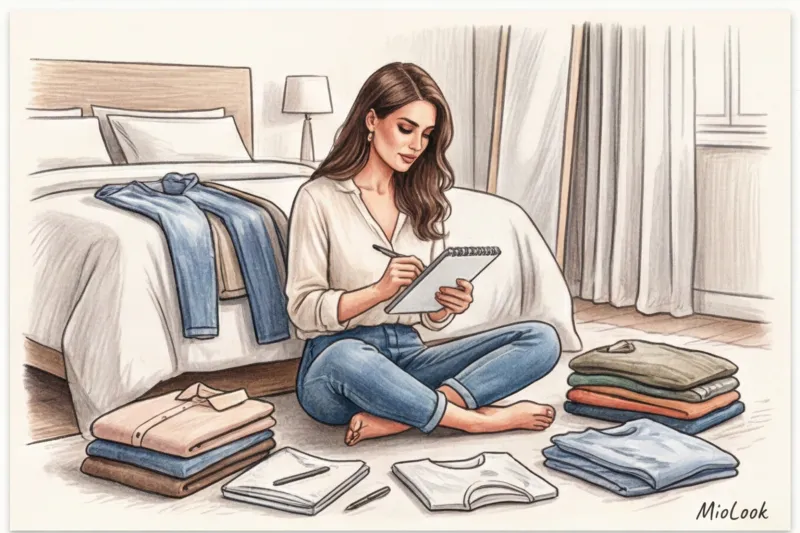
Now open your closet and compare the diagram with its contents. Visualizing your belongings through MioLook When your entire wardrobe is visible on your phone screen, the statistics become clear. If you work from home 80% of the time and take walks in the park, but 60% of your closet is taken up by formal three-piece suits and evening blouses, you're dealing with a systemic failure. Your wardrobe isn't serving your life. Recognizing this dissonance instantly sobers you up before your next purchase.
The third stage of detox is searching for alternative sources of joy The psychology of shopping is such that we often use it as a compensation mechanism. It's a kind of fast food for the psyche: fast, exciting, but with a heavy aftertaste of guilt. If you go to the mall because you're incredibly tired, you don't need a new trench coat, but a good night's sleep or a massage. If you're bored, your brain needs a new neural pathway: a workshop, an exhibition, a challenging workout. Make a list of ten activities that bring you pleasure that aren't related to consuming things. Keep it in your notes and open it every time your stressed-out hand reaches for a marketplace.
Cost-Per-Wear (CPW) Metrics as a Sobering Factor
No psychological trick works as reliably as mathematics. The main tool that will forever change the approach to shopping is the transition to metrics. Cost-Per-Wear (CPW) , or "cost of one exit."
The formula is incredibly simple: the item's price (plus potential dry cleaning or atelier alteration costs) is divided by the expected number of wears. This exercise completely shifts the focus from the "purchase price" to the "cost of use."
The true value of an item is determined not by the price tag at the time of transaction, but by how many times it will earn back the investment over its life in your closet.
Let's use a concrete example to calculate the cost. Imagine a luxurious, perfectly fitting cashmere sweater for €300. For many, this price seems prohibitive for a single item. But it's a high-quality basic that you'll wear for at least two or three seasons in a row, wearing it a total of about 100 times. Total cost: €300 / 100 = 3 € per exit.
Now let's take a look at that trendy asymmetrical synthetic top you impulsively snagged on sale for a measly €15. You wore it exactly once to a party, after which it lost its shape after washing, became covered in pills, or simply became unfashionable. Its wearable cost is 15 € The paradox is obvious: a "cheap" top from a sale cost you five times more than premium cashmere!
This metric is the best way to combat the illusion of a bargain. Every time you stand in front of the dressing room mirror with yet another "incredibly good deal" find, mentally divide its price by the realistic number of days you'll actually wear it. Once you start thinking in terms of CPW, your closet will stop filling up with "disposable" junk, and the freed-up budget will allow you to invest in truly valuable pieces.
From impulse shopping to a smart wardrobe powered by AI
In cognitive behavioral psychology, there's a concept called the "illusion of scarcity"—a state where, despite objective abundance, our brain panics and signals a lack of resources. This is precisely the mechanism at work when you stand in front of a closet overflowing with clothes, desperately thinking you have absolutely nothing to wear. The fast fashion industry has exploited this blind spot in our perception for decades, but today, technology offers us a reliable defense. As soon as you transfer items from the physical space to the digital, a powerful therapeutic shift occurs. Digitizing your wardrobe gives you back control: you cease being a passive and confused consumer and become a thoughtful curator of your own collection.
In my practice, I regularly observe how visualization of one’s things through an app MioLook Literally reduces background anxiety before your eyes. When your entire fashion arsenal is clearly laid out on virtual shelves on your smartphone, your psyche finally receives a calming signal: "I already have enough." This works as a surefire antidote to compulsive spending and prevents duplicate purchases. Imagine a classic situation: after a hard day at work, you walk into a boutique and see a flawless cashmere sweater for €150. Your hand instinctively reaches for the payment terminal—you're just craving a quick endorphin rush. But a quick glance at the app sobers you up: the algorithm gently reminds you that you already have three gray sweaters of a similar cut.
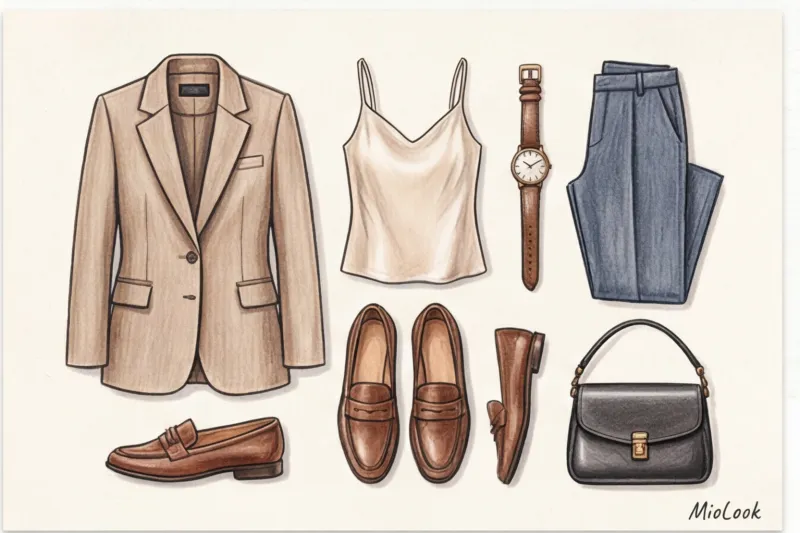
However, the real stylistic magic begins at the next stage. The main reason we wear only a tiny fraction of our closet is routine. We become accustomed to wearing clothes according to memorized, safe formulas. AI-powered image generation breaks this stagnation. Technology can analyze your clothes and suggest unexpected combinations that a tired eye simply wouldn't have thought of. An algorithm can pair a tailored jacket you've only worn to business meetings with relaxed joggers and chunky sneakers, producing a trendy street style look.
This is how you make the things you already bought work instead of running out to buy new ones. Modern psychology of shopping It proves that the intellectual pleasure of creating a fresh, unexpected combination from existing clothes provides the same powerful dopamine rush as buying a new outfit, but without the devastating guilt the next day. You start shopping in your own closet, falling in love with your purchases all over again.
Your ideal image
it begins Here
Join thousands of users who look flawless every day with MioLook.
Get access — €0.99 onceChecklist: 5 questions to ask yourself before buying something new
There's a brilliant concept in behavioral design called "positive friction." It's a deliberately created artificial barrier that forces us to slow down, break out of autopilot mode, and switch from emotional perception to analytical thinking. When it comes to our closets, this method works flawlessly. Instead of strict spending bans that often lead to failure, I suggest my clients implement this "friction" right before the checkout—whether it's in a physical store or an in-app shopping cart.
Save this list and make it your personal security filter. Before you tap your card at the terminal, honestly answer these five questions.
- What specific situation from my real (not fantasy) life is this thing for?
The answer "just for going out" or "I'll wear it somewhere" is unacceptable—it's a marker of illusion. Be as specific as possible: "for client meetings on Wednesdays" or "for Sunday walks with the dog in November." Since the widespread transition to remote work, I regularly see dozens of formal sheath dresses in wardrobes, awaiting mythical corporate events. If your current schedule doesn't allow for that elaborate architectural top, no matter how artistic it is, you're buying a ticket to a non-existent life.
- Can I, right now, without thinking, create 3 complete looks with her from what is in my closet?
In professional styling, this is the gold standard for integrating new items. If an item requires the immediate purchase of new shoes, special seamless underwear, or a different bag, it's not a new purchase, but a financial black hole. This is where digital assistants work best: open MioLook and virtually add a potential purchase to your digital arsenal. If three viable combinations don't come together within a minute, leave the item on the rail.
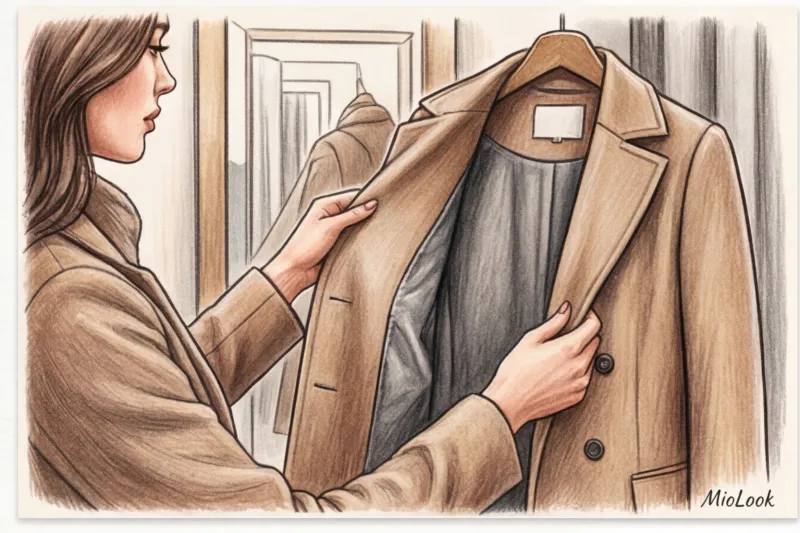
- Does this thing solve a problem or just lift your spirits in the moment?
This is where the insidious psychology of shopping lies. We often head to the mall not for clothes, but for comfort, a distraction, or a reward after an exhausting project. Buying a heavy cashmere coat to fill a gap in your winter wardrobe is a solution. But buying a fifth silk blouse because you're tired is an attempt to buy a short-lived dopamine rush. Learn to distinguish between the physical needs of your wardrobe and the emotional needs of your psyche.
- Is it comfortable to sit, bend and move in?
One of my mandatory fitting room practices is to get the client moving. I ask them to sit on a ottoman, simulate working on a laptop, or drop their phone on the floor and pick it up. A static reflection in the right fitting room light is deceptive. If the tight waistband digs into your ribs when you sit down, the armholes tug at the slightest arm lift, and the fabric rustles or sparks uncomfortably, the garment is destined to become an expensive museum piece. Clothes that require constant tugging steal your confidence.
- Would I have bought it if it wasn't on sale?
The most sobering question of the sale season. Imagine a gorgeous wool-blend jacket, originally priced at €280, now with a red price tag of €65. If you saw it for the full €280, would you even want to pick it up? Would you appreciate its cut and texture? If the honest answer is "no," then you're not attracted to the jacket. You're buying the discount itself and the feeling of "victory" over the brand's pricing.
The wardrobe as a living ecosystem
In concluding our conversation about closet transformation, I want to emphasize a key point: your wardrobe isn't a repository of random trophies acquired in moments of boredom, anxiety, or excitement. It's a living, breathing ecosystem that should work exclusively for you, conserving your morning resources and conveying your true personality.
Every item you allow into your personal space should regularly pay "rent" in the form of wearing it with pleasure. As the legendary Vivienne Westwood so aptly put it: Buy less, choose better, make it last. Stop catering to the fast fashion industry and make your clothes cater to your real lifestyle. And the next time your hand reaches for the "Checkout" button, take a deep breath and simply give yourself a 24-hour break. Your ideal style begins not with what you bring home, but with what you choose to leave at the store.
Guide Chapters
Clothes with Tags: Why Don't I Wear What I Buy?
Is your closet overflowing with clothes, but you're still holding on to items with the tags still intact? Learn about the psychological reasons behind the phenomenon of unworn clothing and how to regain control of your wardrobe.
Shopping as an Antidepressant: Why We Buy to Escape Stress
Emotional shopping isn't a lack of willpower, but a search for control and security. We explore how retail therapy works and what to replace it with.
Decision Fatigue: Are Clothes Sapping Your Energy?
Do you spend time agonizing over your outfit every morning, only to find yourself wearing your trusty jeans? Find out why this happens and how to stop wasting energy on your wardrobe.
Feeling Guilty After Buying Clothes: How to Stop Regretting
Bought an expensive item and hid it away out of regret? Find out where post-shopping guilt comes from and how a stylist advises dealing with it.
How Clothing Affects Self-Esteem: The Neuroscience of Style
Do we choose clothes based on our mood, or do our clothes dictate our state of mind? Learn how to use your closet to manage your emotions and reduce anxiety.
Don't like your figure in the fitting room? It's not you.
Walked into a store in a great mood, only to leave in tears because of your reflection? Discover how fitting room architecture intentionally distorts body proportions.
How to overcome shopaholism: tips from a stylist
Uncontrolled shopping isn't a sign of poor taste, but rather a symptom of "style amnesia." Learn about a working wardrobe rehabilitation system from a personal stylist.
Clothes for when I lose weight: how to organize your wardrobe
Having small items in your closet isn't motivation, it's a source of daily stress. We'll tell you how to let go of these illusions and declutter your wardrobe in an eco-friendly way.
How to part with old things: decluttering tips
A closet full of clothes, but still nothing to wear? A pragmatic approach will help you easily declutter and organize your wardrobe.
A Full Closet, But Nothing to Wear: Psychology and Solutions
Why do we buy things we never wear? We explore the psychology of wardrobe and explain how to break out of this vicious cycle.
How to Stop Buying Unnecessary Clothes: Mindful Shopping
Shopping diets don't work. Learn how to overcome the "closet full, nothing to wear" syndrome and transition to mindful, stress-free shopping.