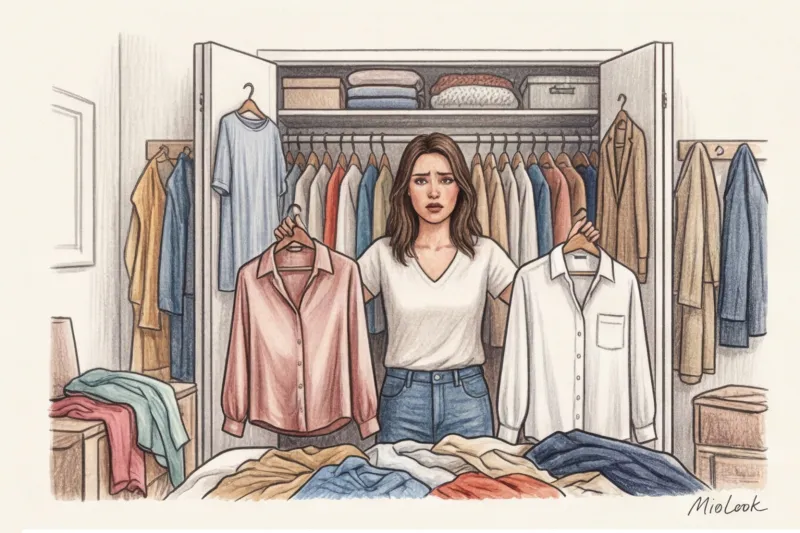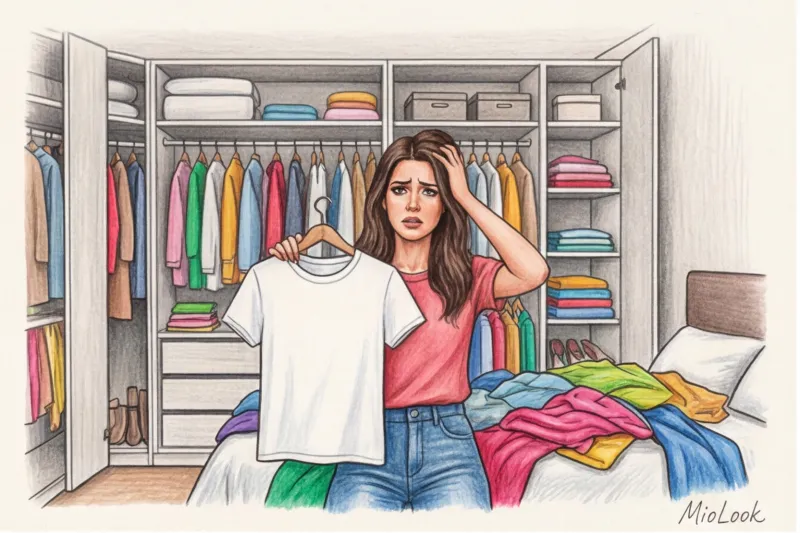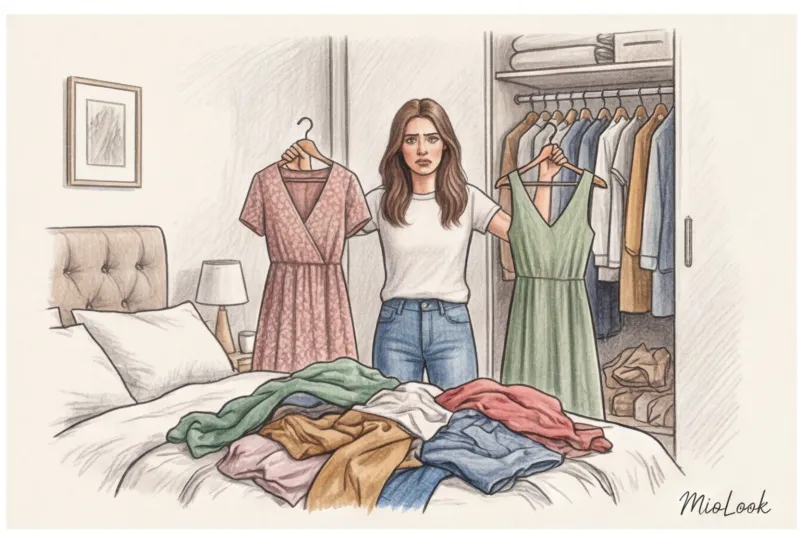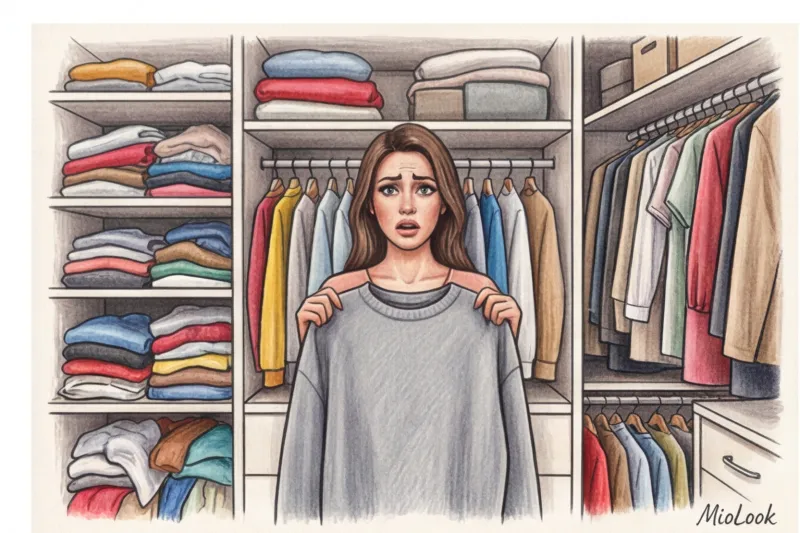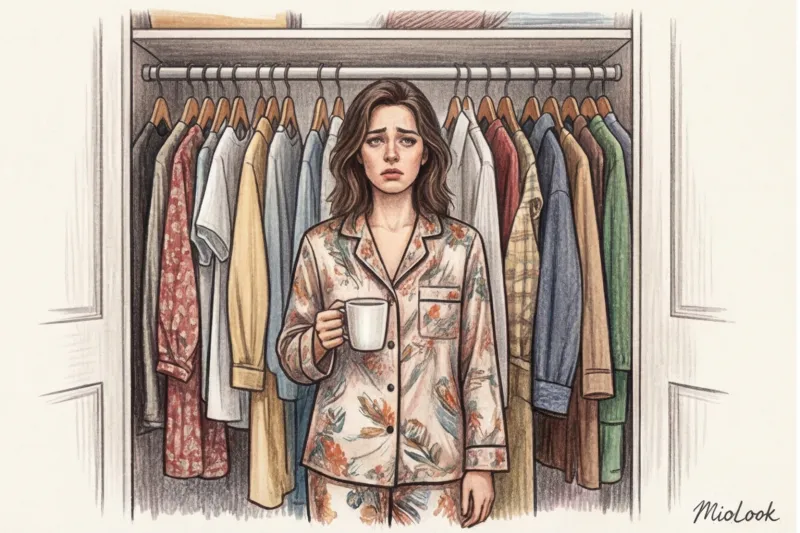
It's seven in the morning. Your coffee is cooling on the kitchen counter while you stare at the tightly packed hangers. You have a stunning silk blouse, but you need a perfectly smooth beige bra to go with it, which is currently in the wash. You have gorgeous wool trousers, but they require heels, and it's pouring rain outside. And so, after fifteen minutes of agonizing fittings and frustration, you give in and put on those trusty jeans and black sweater again.
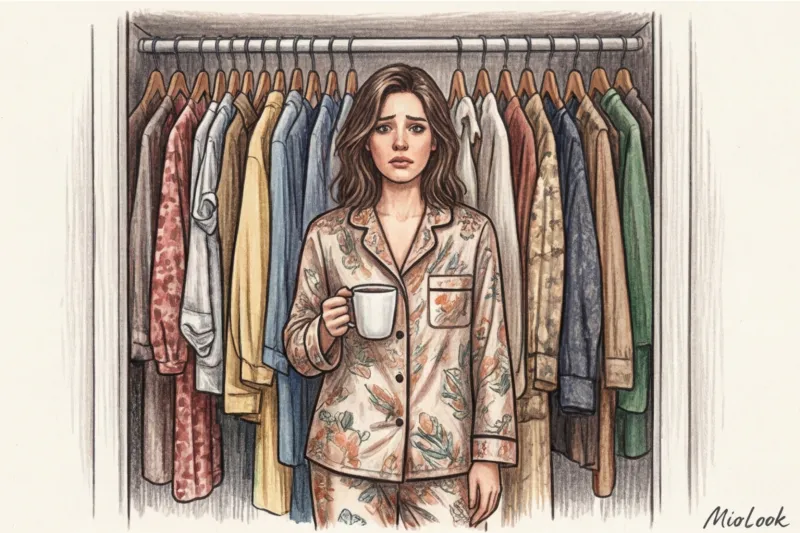
Sound familiar? We often chalk this morning paralysis up to a lack of taste or a shortage of basic items, heading to the store once again for "salvation." We explored this destructive cycle in more detail in our complete guide to the psychology of shopping and impulse buying However, in reality, your main enemy is decision fatigue: clothing here it acts merely as a daily trigger, exhausting your nervous system before you even leave the house.
While most glossy articles advise simply "throwing away all the excess" or assembling a standardized capsule wardrobe, over 10 years of working as a fashion journalist and stylist, I've realized one thing: the problem isn't the quantity of clothes. The problem is the number of hidden conditions dictated by each specific item.
The Anatomy of Morning Stupor: What is Clothing Decision Fatigue?
Term decision fatigue The term "decision fatigue" was coined by social psychologist Roy Baumeister in the late 1990s. His research demonstrated that our ability to make quality decisions and exercise willpower is a finite resource. It's like a smartphone's battery: it's fully charged in the morning, but with each choice, it steadily declines.
According to statistics, an adult makes approximately 35,000 conscious and unconscious decisions a day. When you open an unstructured closet, your brain is forced to process an avalanche of micro-tasks in a split second. You're not simply choosing what to wear. You're performing complex analytical calculations: texture compatibility, temperature control, dress code appropriateness, physical comfort, and cleanliness.
"The brain uses the same amount of glucose to decide whether to sign a multimillion-dollar contract as it does to choose between a blue and a gray sweater," neuroscientists confirm.
The symptoms of this condition are obvious. You start buying duplicates (a fifth white T-shirt because you forgot about the previous four). You wear only 20% of your wardrobe 80% of the time. Your closet turns from a tool for self-expression into a repository of unfinished business.
The Illusion of Freedom: Why the Enormity of Choice Works Against Us
In his famous book, The Paradox of Choice (2004), psychologist Barry Schwartz explains that when there are more than five to seven options, the brain enters a state of cognitive overchoice. Instead of a sense of freedom, we experience anxiety and fear of making a mistake.
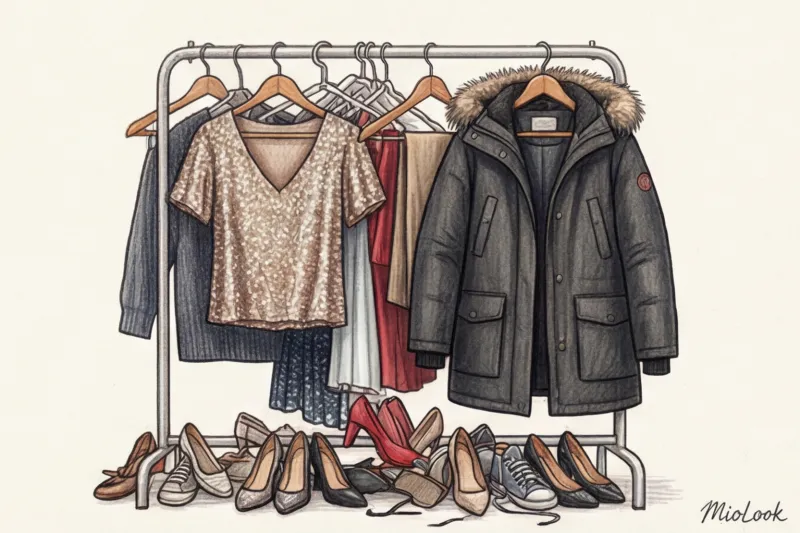
I regularly observe this phenomenon in practice. One of my clients, the CEO of a large IT company, had a stunning wardrobe filled with premium items (ranging from €300 to €800 per item). But every morning, she was reduced to tears. Her closet was perfect for Vogue shoots, but toxic for the life of a real-life executive.
When, during an audit, we removed 70% of her clothes into opaque trunks, leaving only one rail with perfectly fitting items, she physically exhaled. Paradoxically, limiting her choice gave her back her freedom.
Hidden micro-decisions that burn energy
The real cognitive trap lies in a concept I call wardrobe friction These are the invisible demands that clothing makes on its owner.
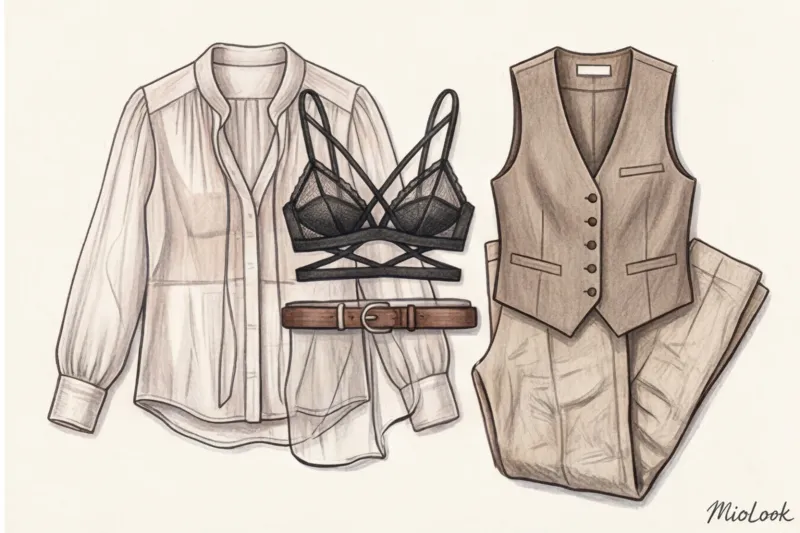
Let's take a regular white cotton T-shirt with a density of 200 g/m². The friction level is zero. You can put it on with any jeans and go.
Now let's take a linen wrap dress with intricate ties. Friction level: 10. The brain begins to generate a chain of micro-decisions:
1. Did I pet him?
2. Will it get wrinkled in the car while I'm driving to the office?
3. What seamless underwear should I wear underneath it?
4. And if the wind rises, won’t the hem fly open?
My agency's analytics show that a "complex" item drains a client's cognitive resources four times more in the morning than a basic one. Decision fatigue about clothing is precisely caused by such "vampire" items.
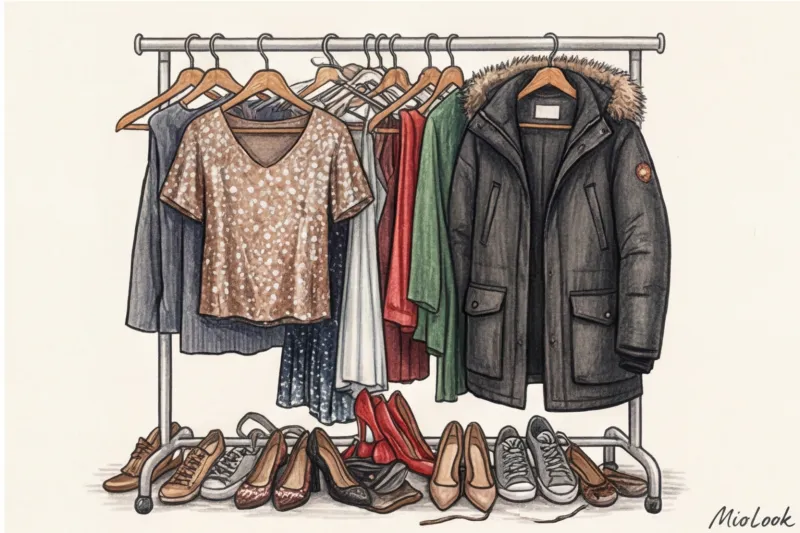
The Capsule Myth: When Decision Fatigue Is Exacerbated by Clothes
"Just create a capsule wardrobe of 15 items!" scream the headlines of most fashion blogs. But as a practicing stylist, I'm obligated to debunk this myth. A capsule wardrobe doesn't always work.
If your ideal, color-coordinated capsule wardrobe consists of wrinkle-prone linen, layers that require constant tugging, and trousers that require delicately tucking silk blouses (that French tuck), you'll be expending as much energy as someone with a completely overstuffed closet.
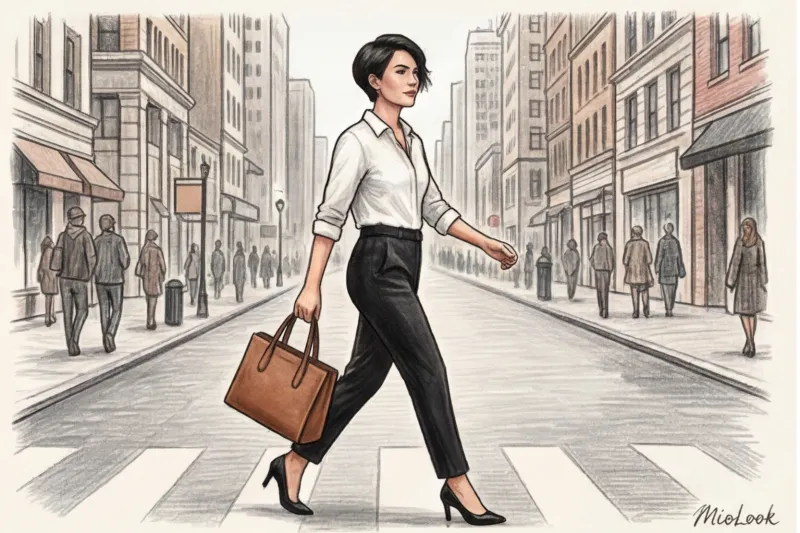
I've seen hundreds of perfectly composed mood boards on Pinterest that are completely unworkable at 7 AM on a rainy November Tuesday. A "toxic" item remains toxic, even if it perfectly matches your color type. If your skirt constantly twists when you walk, or your cheap mohair sweater leaves lint on your coat, your brain will register discomfort every second you wear it.
Your perfect look starts here
Join thousands of users who no longer waste their morning energy choosing clothes. Trust the MioLook algorithms with your routine.
Get access — €0.99 onceThe Power of Uniform: The Secret of Fashion Editors and CEOs
While working at Paris and Milan Fashion Weeks, I quickly noticed an interesting pattern. People not directly involved in the industry (influencers, guests) dressed extremely elaborately, flamboyantly, and layered. But the key insiders—magazine editors, buyers, stylists—looked almost identical day after day.
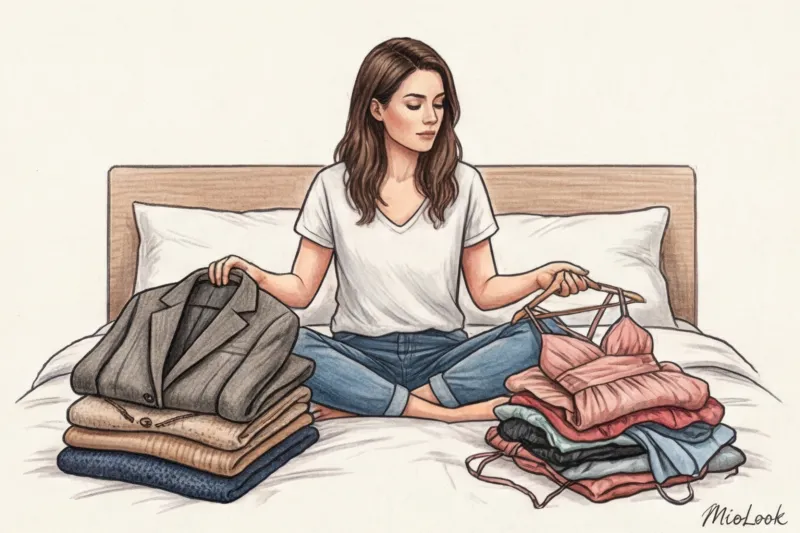
Anna Wintour wears printed midi dresses and identical Manolo Blahnik shoes. Emmanuel Alt (former editor-in-chief of French Vogue) has been a staple of skinny jeans, perfectly tailored men's jackets, and Isabel Marant ankle boots for decades. Steve Jobs, with his black Issey Miyake turtleneck, is just the most famous example from the tech world.
Why do they do this? To survive a marathon of 10 fashion shows and five business meetings a day, they need all the available RAM. They've created a personal "uniform" (Signature Style). This doesn't mean you have to wear boring, identical pieces. It means finding your ideal silhouette and scaling it across different shades and textures, reducing the risk of a stylistic error to zero.
But there is an important limitation here: This advice is completely ineffective if your "uniform" consists of items that are physically uncomfortable. A jacket that restricts your shoulders will never be a good base, even if it's an impeccably tailored Yves Saint Laurent.
Delegate the Routine: Wardrobe Automation with MioLook
If we delegate cleaning to robot vacuums and finances to banking apps, why are we still trying to keep track of hundreds of outfit combinations?
The main secret of stylists is fixation. We never rely on memory. Created a successful look? Take a photo right away. This is precisely the logic that technology is automating today. the "smart wardrobe" feature in MioLook , you essentially transfer the cognitive load from your own brain to algorithms.
The golden rule I teach my clients is: one bottom = three ready-made, already worked-out tops You digitize your items, the program remembers these combinations, and in the morning you only need to make one choice instead of twenty—simply open the lookbook on your phone and click on a ready-made set.
Checklist: 5 Steps to a Zero-Friction Wardrobe
You can start reclaiming your morning energy this evening. Here's a step-by-step system based on hundreds of self-assessments:
- Conduct a toxicity audit. Ruthlessly remove from sight all items that require ironing for more than 2 minutes, complex steaming, or constant dry cleaning.
- Eliminate the "orphans". Get rid of (sell or donate) items that need a new pair. If a gorgeous emerald skirt has been hanging in your closet for two years because there's no matching top, it drains your energy every time you look at it.
- Create 5 reinforced concrete "emergency" images. Create outfits for each day of the work week. They should consist of comfortable pieces that make you feel 10/10 confident, even if you haven't had much sleep.
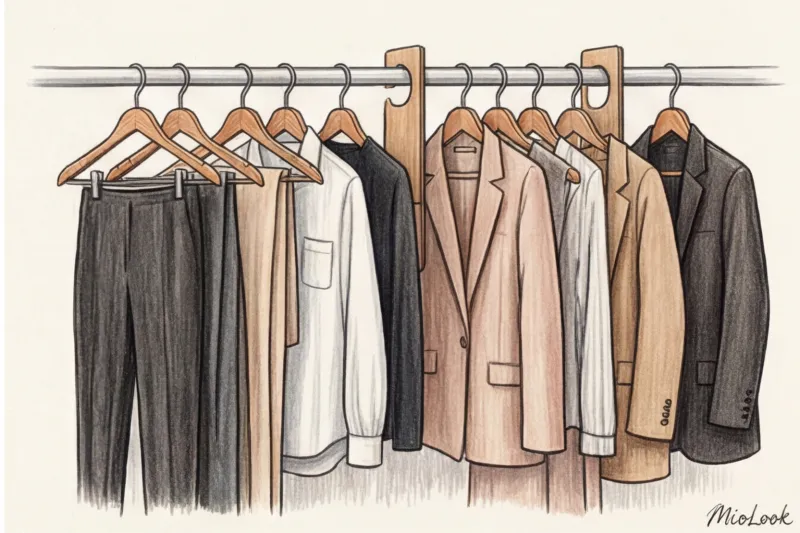
- Implement a grab-and-go system. Hang your finished outfits (pants, top, and jacket) on one sturdy hanger. In the morning, simply remove the entire hanger.
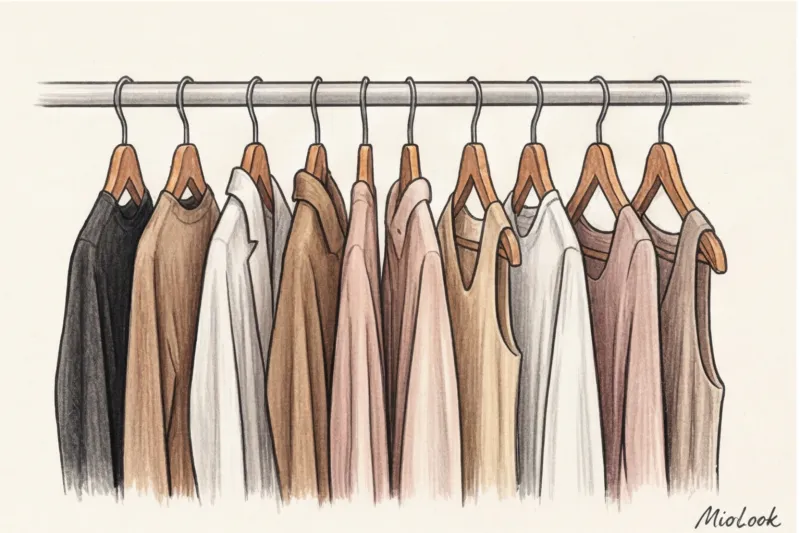
- Limit your base palette to 3-4 shades. Stick to basic shades like graphite, navy, off-white, and camel. Add bright accents only through accessories—this way, you won't be able to wear clashing colors.
Instead of a conclusion: take back your morning
Remember the most important rule of conscious style: clothes should serve you, not be served by you. Every time you buy something difficult to care for or with a questionable fit, you're taking a loan from your future morning life.
Eliminating clothing fatigue isn't just a step toward organizing your closet. It frees up a tremendous amount of energy for the truly important things in your life. Set up your wardrobe so it works in the background, and you'll be amazed at how much more productive and calm each day becomes.