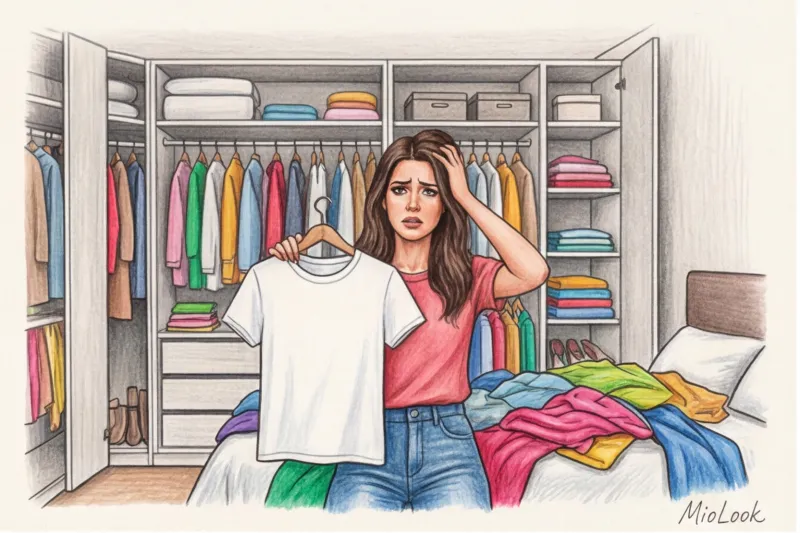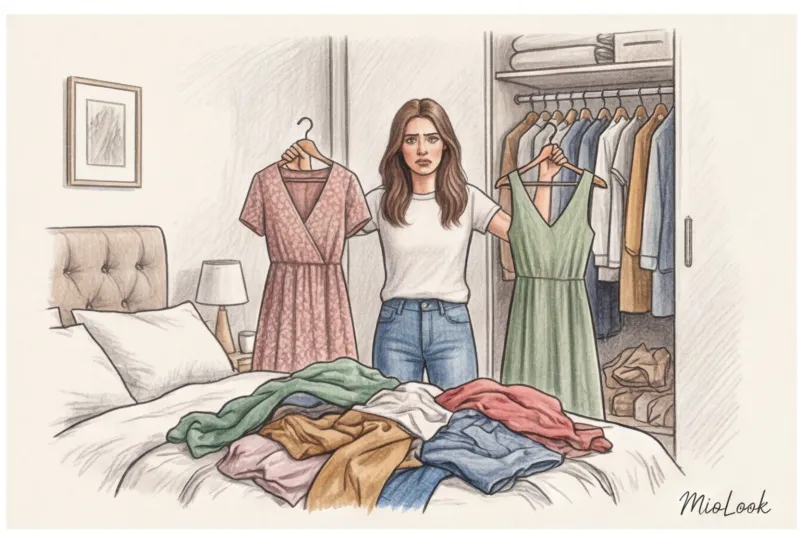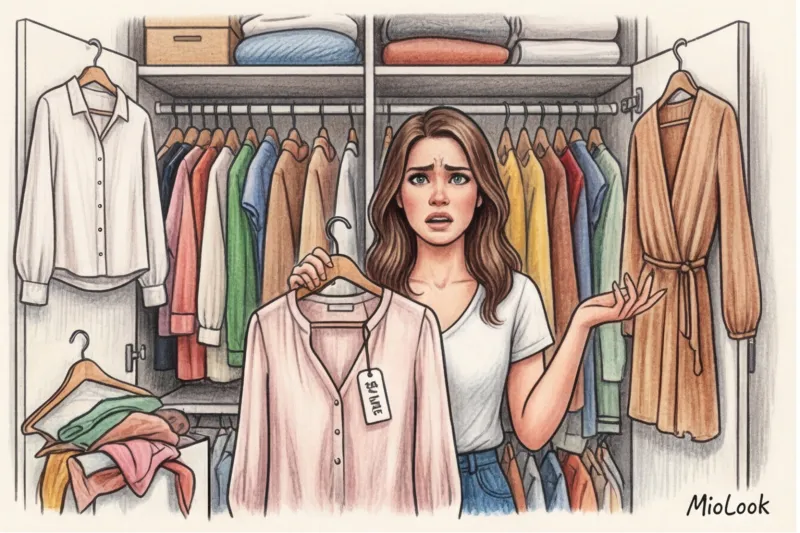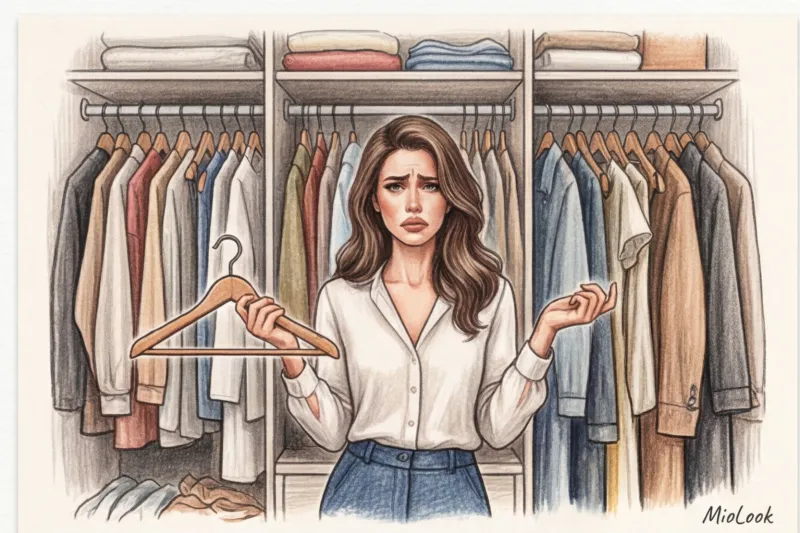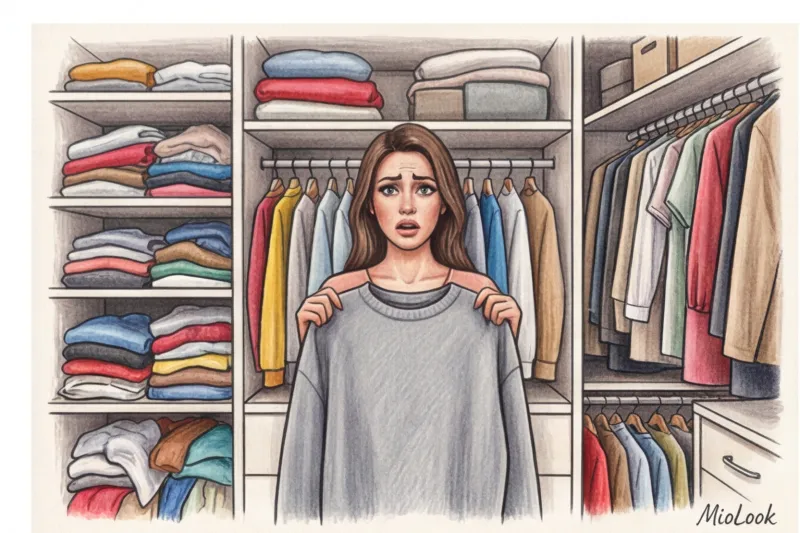
Over twelve years of working as a personal stylist, I've examined hundreds of women's closets—from compact walk-in closets in Parisian attics to enormous "safe rooms" in Milan. And everywhere I saw the same paradox. My client Anna once opened the doors of her three-meter closet to me: inside hung immaculate silk dresses with tags, on the shelves adorned €500 shoes, yet every day she wore the same faded Levi's jeans and gray sweater to work. A classic diagnosis: a full closet, but nothing to wear.
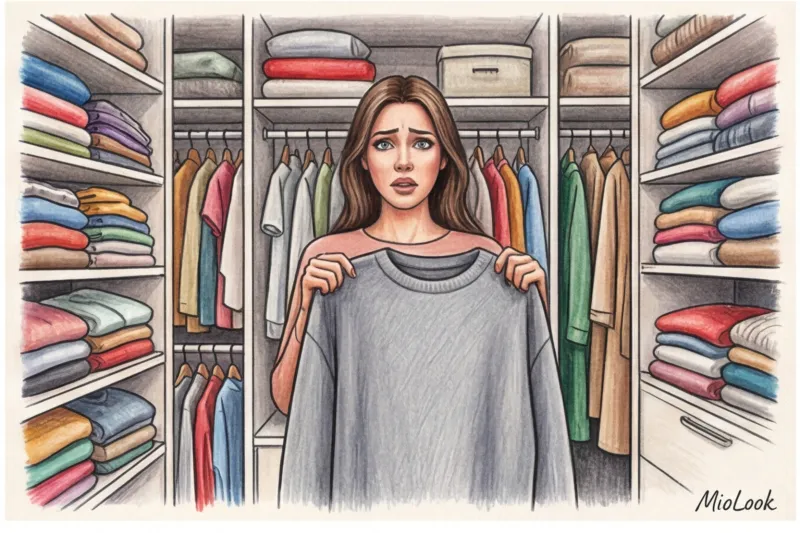
Sound familiar? We covered this in more detail in our the complete guide to the psychology of shopping The problem of overcrowded shelves is rarely due to a lack of taste or money. A wardrobe is often an honest reflection of our fears, unfulfilled ambitions, and everyday stress. Let's explore why we continue to buy clothes we'll never wear, and how to break out of this vicious cycle with the help of cold calculation and Italian philosophy.
Diagnosis: a full closet, but nothing to wear - why does this happen?
You might think that if you had five more new blouses, getting ready in the morning would be easier. In fact, neuroscience proves the opposite. American psychologist Barry Schwartz, in his book The Paradox of Choice (2004) brilliantly described the state of cognitive overchoice. When you're faced with a choice of 50 shoulder products in the morning, your brain literally refuses to expend energy on making a decision.
Willpower and decision-making are finite. If you have a challenging workday ahead, your brain sabotages the clothing selection process and forces you to reach for the safest, most tried-and-true option. This is why the Pareto principle works so ruthlessly in your wardrobe: We wear only 20% of our clothes 80% of the time.
"Wardrobe paralysis isn't a lack of necessary clothes. It's the brain's physiological inability to filter out the visual noise of 80% unnecessary clothes in the 15 minutes you have to get ready in the morning."
The gap between the contents of your shelves and your actual reflection in the mirror is a key marker of internal dissonance. You buy things for one life, but live a completely different one.
Psychological Traps: 3 Illusions That Make Us Buy Unnecessary Items
In my practice, analyzing "wardrobe cemeteries" (items with intact tags) reveals three consistent patterns of behavior. We don't buy fabric with seams—we buy emotions.
The Illusion of the "Imaginary Self" (Fantasy Self)
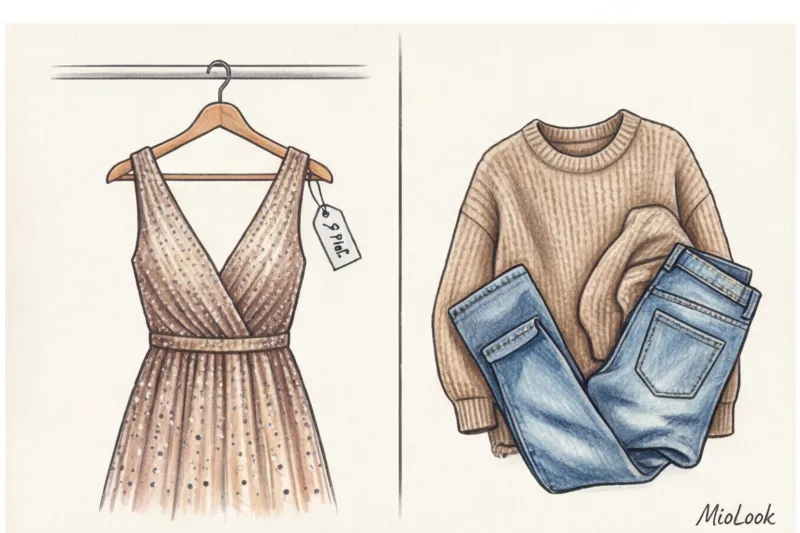
Each of us has an "Imaginary Self" living in our heads. It attends theater premieres, drinks champagne on yachts, and wears 4-inch stilettos. The problem is, the real you is a freelancer working out of a cozy coffee shop near your home. You buy a luxurious sequin dress for your fantasy, but there's no one to wear it.
Another form of this trap is using clothes as a symbol of hope. Buying jeans two sizes too small "to motivate me to lose weight" or a smart business suit "for when I get promoted" hangs in your closet, silently reproaching you every day for not yet losing weight and becoming a CEO. They generate feelings of guilt, not style.
The Trap of Discounts and False Investments
"I couldn't pass it by, it's cashmere, and it was only €40 instead of €150!"—how often I hear this phrase. Buying something just because of the red price tag is a guaranteed path to clutter.
Let's do the math. You bought a weird mustard-colored sweater that doesn't suit you, simply because it was 70% off. You wore it once. You didn't save €110. You just threw away €40. The difference between a quality investment in a basic item and an impulse purchase on sale is colossal. An investment meets a need; a discount creates the illusion of a benefit.
Emotional shopping as a band-aid
For many women, fast fashion has become a legitimate and socially accepted antidepressant. The dopamine loop works relentlessly: stress at work → impulsive online order → momentary joy upon unpacking → disappointment when trying it on at home → the item is consigned to the bottom of the closet.
Clothes often act as band-aids to cover up real-life problems. But a new €25 top from Zara won't solve a conflict with your partner or cure burnout.
Access to MioLook for €0.99 — one-time payment
A smart AI stylist will help you create looks from what you already own, stopping the cycle of impulse buying.
Get access — €0.99 onceWhy Radical Decluttering Works Against You

Here I'll disagree with the popular organization gurus. The universal advice to "throw out everything that doesn't bring you joy" is a huge mistake for 90% of women. A radical purge without a preliminary psychological assessment has a harsh effect. "wardrobe yo-yo".
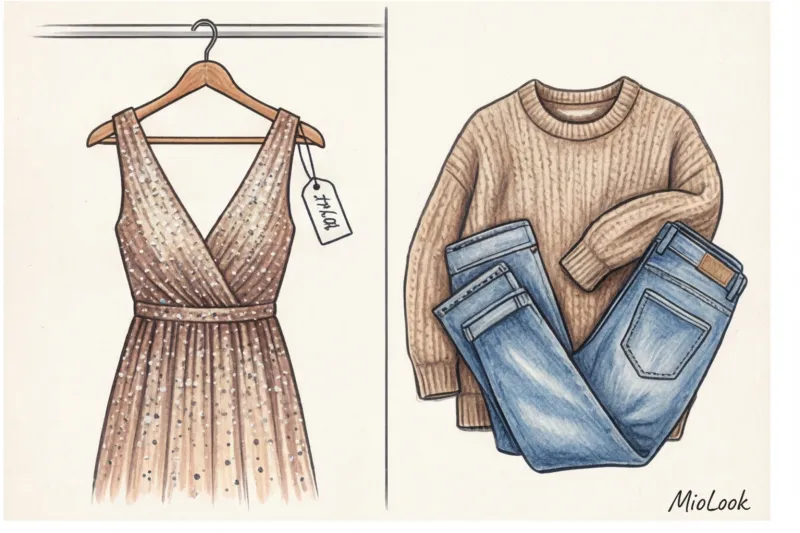
It works exactly like a strict diet. You throw out five bags of clothes. The next day, you open your empty closet, experience a sudden panic (because now you literally have nothing to wear), and head to the mall, where you frantically buy the exact same trash. The cycle is complete.
Before you recycle, you must perform an autopsy of your "wardrobe graveyard." Examine every item with its tag. What style do you buy and never wear? What color attracts you on the hanger but leaves you bland in person? Until you acknowledge your mistakes, you are doomed to repeat them at your own expense.
From Impulse to Strategy: The Cost-per-Wear Formula and the Philosophy of Luxury
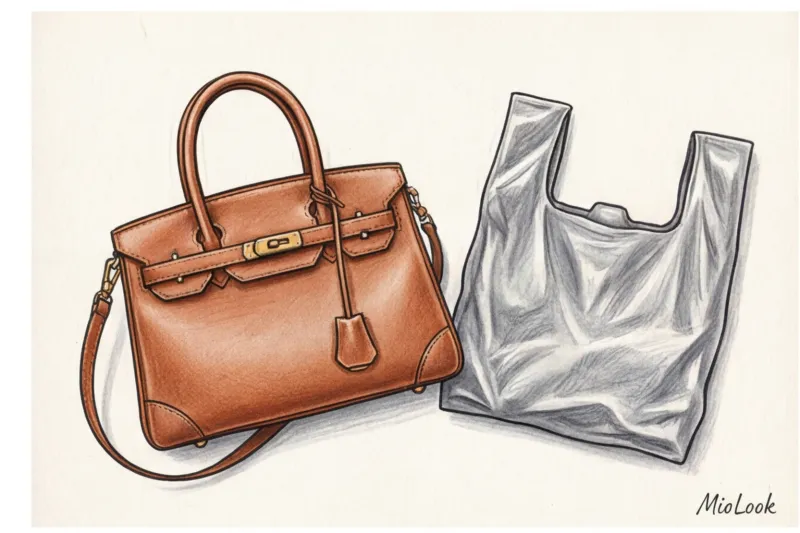
In Italy, where I studied styling, there is a wonderful concept: "meno ma meglio" (Smaller, but better). Italian women don't have huge wardrobes, but they invest in impeccable tailoring and premium fabrics. Why? Because they know how to count money using a formula. Cost-per-wear (CPW) - the cost of one wearing.
The formula is simple: divide the price of the item by the number of days you wore it.
- Scenario A (Mass Market): You buy 10 fashionable polyester coats for €150 each. Total spend: €1,500. You wear each coat maybe 10 times before it starts pilling. CPW = €15.
- Scenario B (Premium): You invest €1,500 in a classic Max Mara coat made of 100% natural camel wool. You wear it 100 days a year for 5 years (500 wears). CPW = €3.
High-quality cashmere, heavy cotton (from 180 g/m²), silk, and trim are worth the money. They hold their shape, don't shrink after the first wash, and convey status. However, This does NOT work when it comes to fleeting trends. I always tell my clients: invest in structured bags, coats, shoes, and jackets. A basic white T-shirt can easily be purchased at COS or Uniqlo for €30–€40—it's a consumable item.
Breaking the Vicious Cycle: A Real Lifestyle Audit
The main secret of a functional wardrobe: it should serve your real life, not the fantasies of stylists in glossy magazines. There's no universal list of "10 essential items every woman should own." If you work from home, you don't need a pencil skirt, even if Vogue (2024) called it the season's trend.
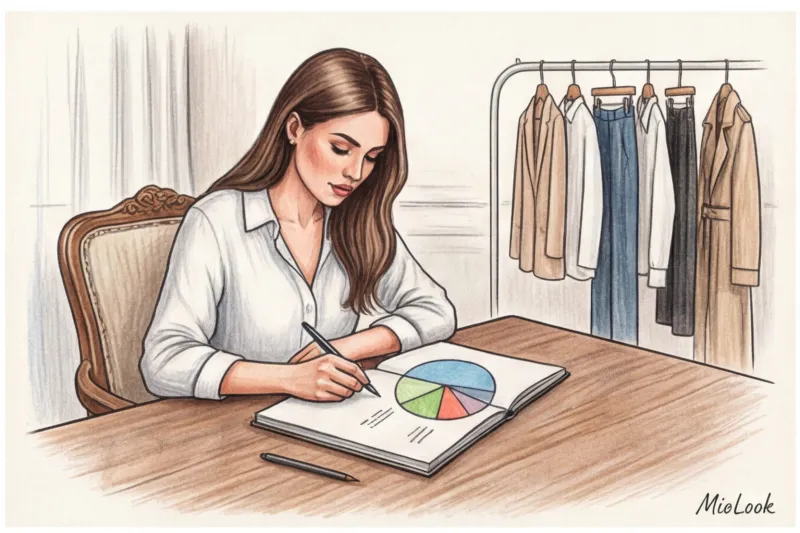
Do the exercise "Diagram of Life" Draw a circle and divide it into sections proportionally based on how you spend your time during the month. For example: 60% – office with a casual dress code, 20% – walks with the child, 10% – relaxing at home, 10% – going out.
Now take an honest look at your wardrobe. For most of my clients, their proportions are completely out of sync with their lives. Half the closet is taken up by cocktail dresses (for 10% of the time), and for 60% of office wear, they only wear two jeans and three faded shirts. Your wardrobe should mathematically reflect your life diagram.
Your perfect look starts here
Join thousands of users who look flawless every day with MioLook, choosing outfits to match their real lifestyle.
Get access — €0.99 onceA Practical Guide: 5 Steps to a Wardrobe That Works
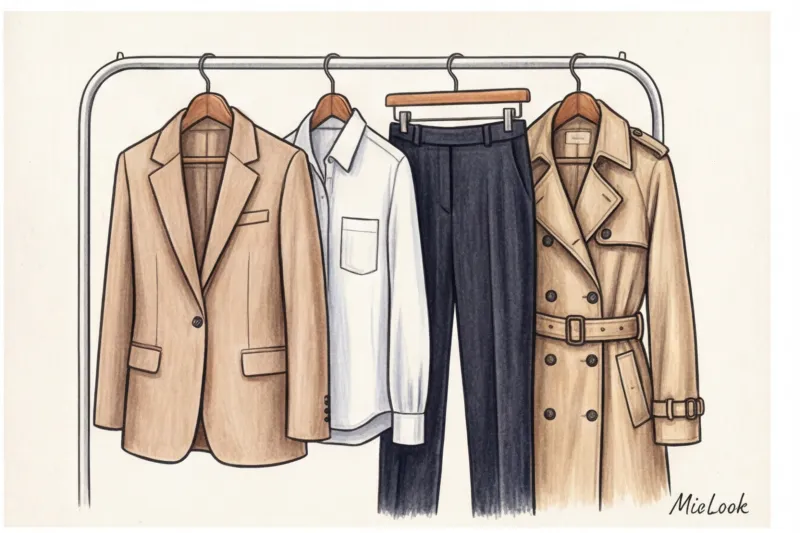
To move from chaos to system, you don't have to throw out half your apartment. Start with the five methodical steps we use with our VIP clients:
- Step 1: Isolate your favorite items. Take out the 20% of clothes you wear regularly. Hang them on a separate rail. This is your "safety capsule." Study it: what fabrics, colors, and styles predominate? This is your real style, not an imagined one.
- Step 2: Enter quarantine. If you haven't worn anything in over a year but are hesitant to throw it away, put it in a box and put it out of sight for three months. If you haven't remembered it in that time, donate it without regret.
- Step 3: Create a strict stop list. Write down the styles and colors you'll never buy again. For example: "No fuchsia, no cropped sweaters, no shoes with heels higher than 7 cm." This list will save you during sales.
- Step 4: Plan to close the gaps. Buy clothes only from your list. If your "safety capsule" is filled with perfect pants begging for a light-colored jacket, you go to the store only for the light-colored jacket, ignoring the dress aisles.
- Step 5: Implement the "one in, one out" rule. Got a new sweater? One old one needs to go. This will physically prevent your wardrobe from growing too big again.
Digitizing Your Wardrobe with MioLook: How Technology is Changing Our Habits
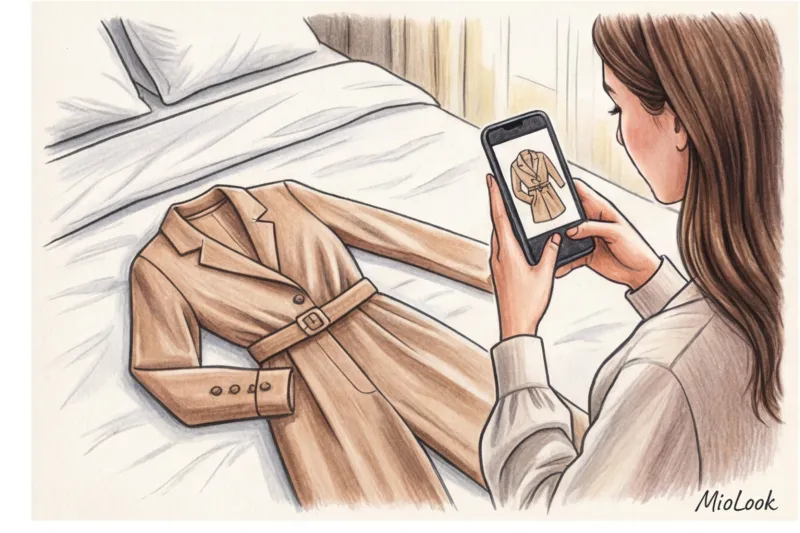
One of the main reasons for morning drowsiness is that we simply don't see our things. What's on the far shelf or hanging under another jacket doesn't exist for our brain. This is where modern technology comes in.
Digitize your belongings with an app MioLook — it's a game changer. When you see your entire arsenal on the glowing screen of your phone, rather than digging through the dark depths of a closet, the cognitive load is significantly reduced.
Moreover, artificial intelligence acts as an impartial stylist. It suggests combinations of old items that you wouldn't have thought of on your own, breaking that "wardrobe paralysis." And built-in wearability statistics will honestly show your personal cost-per-wear: you'll clearly see which items are worth every euro invested in them and which are just sitting there like dead weight.
Ready to get started?
Try the free plan—no commitments. Digitize your wardrobe and let AI create the perfect looks for you.
Get access — €0.99 onceRemember the most important rule of an elegant woman: a wardrobe is a tool for achieving your goals and comfort, not a museum of unfulfilled hopes. By clearing your hangers of random items, you free up energy for your real, authentic life.