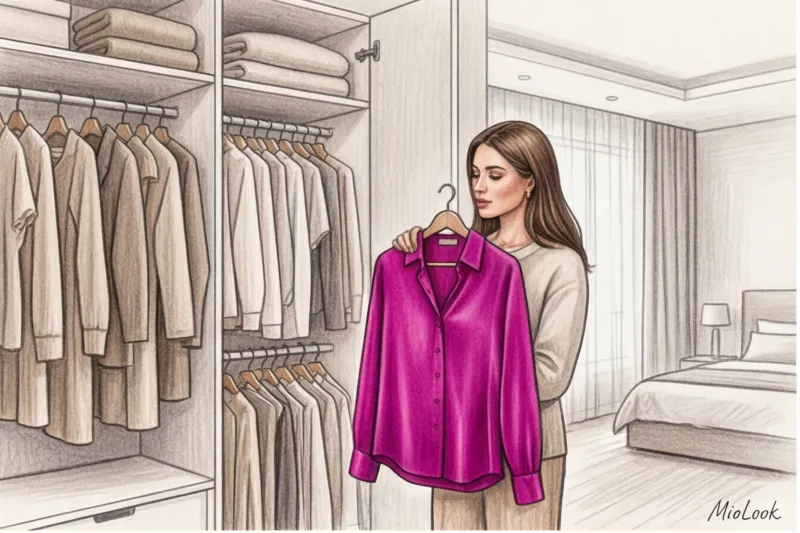
The Anatomy of Color: Why We're Afraid to Go Beyond Beige
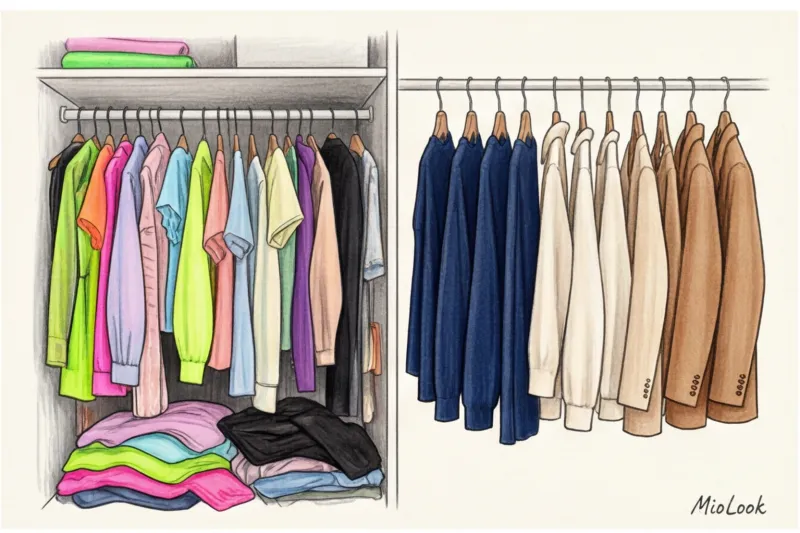
Open your closet right now. We bet you'll be greeted by a sea of calm, safe shades: oatmeal, camel, grey melange, and, of course, all-black. The psychological comfort of a neutral palette is completely understandable—they're easy to buy, they don't attract unnecessary attention, and they create the illusion of a well-thought-out base. We hide behind them for fear of looking out of place or developing a "traffic light" look. But let's be honest: these perfect yet faceless capsules often lack sparkle. Smart color combinations in clothes — it's that stylistic switch that instantly switches your look from the "normal" category to the "unforgettable" category, filling you with a completely new, confident energy.
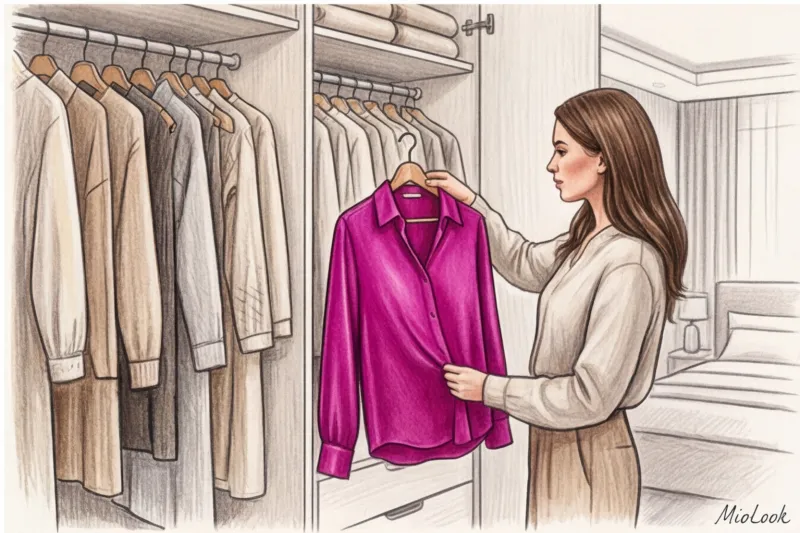
In my 12 years as a personal stylist, I've constantly encountered what I call "beige wardrobe syndrome." One of my clients, a top executive at a tech company, came to me with a typical pain point: "Isabella, I spend thousands of euros on cashmere and silk in the right muted tones, but I feel invisible. My closet looks like an aesthetically pleasing Scandinavian minimalist catalog, and I'm unbearably bored." She'd fallen into a classic trap: buying safe items, hoping for the status of "quiet luxury," but ultimately losing her individuality. Of course, beige color in a business wardrobe has its elegant power, but when it becomes the only instrument, we voluntarily deprive ourselves of our voice.
The secret that glossy magazines rarely talk about is simple: consciously working with color is the fastest and cheapest way to visually elevate your style without buying a single new item. You don't need a €3,000 designer bag to look luxurious. Knowing how to pair the burgundy jumper you already own with navy trousers is enough. When you understand the rules of color, a basic €40 shirt paired with the right contrasting bottoms starts to look like street style straight out of Milan Fashion Week. You start mixing and matching what you already own, and your wardrobe suddenly triples in size without breaking the bank.
"Color is a powerful nonverbal communicator. It conveys your status, creativity, and vitality long before you utter a single word."
Consider the psychology of first impressions. According to a large-scale study by the Color Institute (Colorcom), up to 90% of initial impressions of a person are subconsciously formed solely based on color—the so-called "90 percent rule." By wearing a rich emerald or deep burgundy instead of your usual gray, you're not just changing the fabric; you're making a statement of boldness and ambition. If you're interested, What colors in business attire inspire confidence? We'll definitely explore this further. But your first practical step to a stylish transformation is always the same: allow yourself to move beyond the usual monochrome and recognize that color is your most powerful ally.
Itten's Color Wheel: Adapted for Wardrobe (Not Canvas)
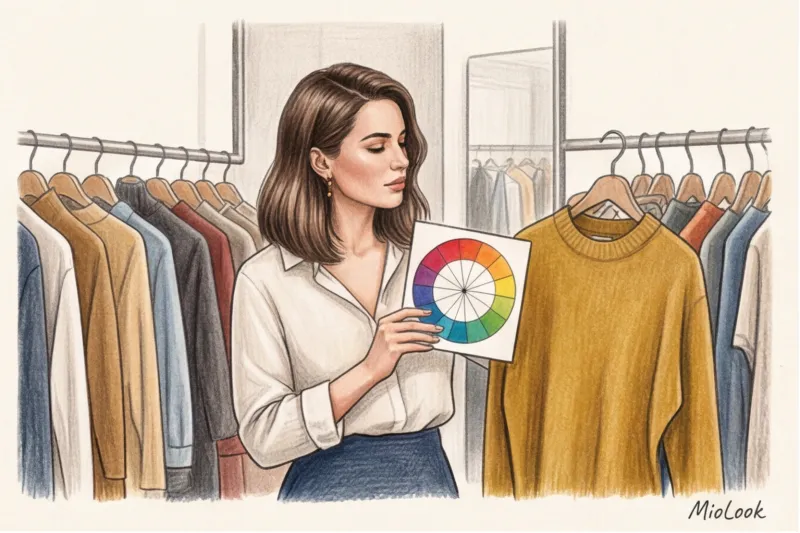
Swiss artist and teacher at the legendary Bauhaus school, Johannes Itten, created his famous twelve-part color wheel exactly one hundred years ago. For painting students, it was a basic primer, and in modern styling practice, it has become the ultimate cheat sheet. Once you understand the logic of this tool, color combinations in clothes It stops being a morning lottery in front of an open cupboard and turns into a predictable system that works for you.
But at coloristics workshops, I regularly observe the same fatal mistake among beginners. Girls try to match clothing shades the same way artists mix gouache on a palette. They forget a crucial detail: we're not wearing pure, flat pigment, but textured fabric. The texture of the material completely changes how the color reflects or absorbs light. A red knitted sweater made of matte wool and a red satin skirt, even if they were dyed at the factory with absolutely identical dyes, will have completely different visual weight and hue in real life.
"A color never exists by itself; its perception depends entirely on its neighbors." — Joseph Albers, "The Interaction of Color" (1963)
In this context, Itten's theory needs calibration. In fashion, the circle is not a rigid set of mathematical laws, but a guide to relationships Between shades. If your look appears disjointed, the problem almost always lies not in the color itself, but in how it interacts with its surroundings.
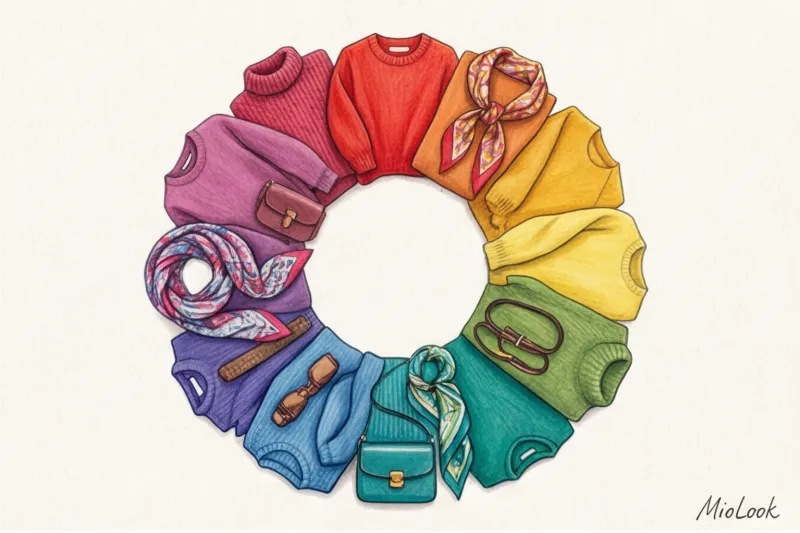
Primary, secondary and tertiary colors in real clothing
At the very center of the circle are the three primary colors: red, blue, and yellow. This is the base, impossible to create by mixing other pigments. However, if we take them in their pure, spectral form and wear them together, we get an outfit reminiscent of Lego bricks. To avoid this, we use their derivatives in our real wardrobe.
Bright blue is transformed into a deep, rich navy. Signal red gives way to noble burgundy or cherry. And in place of garish yellow, elegant mustard or butter yellow, which literally took over the runways of Bottega Veneta and Loewe this season, takes center stage.
Secondary colors (orange, green, purple) and tertiary colors (the result of mixing adjacent sectors) are your main "bridges" in a capsule wardrobe. They tie together basic pieces into a cohesive story. Imagine: you have a navy blue wool jacket and straight khaki trousers. On their own, they might look a bit dry. But add a tertiary blue-green element between them—for example, a seafoam silk top—and the look instantly gains visual depth and polish.
Access to MioLook for €0.99 — one-time payment
A smart AI stylist will select the perfect look based on your color preferences.
Get access — €0.99 onceColor characteristics: temperature, saturation, lightness
If I were asked to stick to just one color rule in styling, it would be this: coincidence. characteristics The colors are much more important than the color match itself. You can combine absolutely any shades from Itten's circle, as long as they speak the same language.
The first characteristic is - temperature Colors are divided into warm (with a yellow undertone) and cool (with a blue undertone). This knowledge explains why some items of the same color clash so mercilessly. For example, cool emerald green (with a lot of blue) paired with warm olive green (with a strong yellow undertone) will create a sense of visual sloppiness. They seem to come from different climates and look "dirty" next to each other.
The second critical characteristic is saturation , that is, the purity of the pigment. In our wardrobes, we rely on pastels, neon, and muted tones (with added gray pigment). Why would an elegant dusty rose look cheap and bland against a neon pink top? Because the neon literally "eats" the complex muted tone.
But pair that same dusty rose with a muted sage (dusty sage), which has an identical saturation level, and you get that very same "quiet luxury" aesthetic. It's precisely this perfect match of muted characteristics that brands like The Row, which sells basic cashmere sweaters for €2,000, build their collections on. They know that luxurious shades are shades with an equal amount of gray.
6 Basic Schemes: The Perfect Color Combination for Any Occasion
Knowing color theory is great, but let's be honest: at 8 a.m., standing in front of an open closet, we rarely think about Bauhaus or the works of Itten. We need ready-made, workable formulas. As a practicing stylist, I call these geometric color wheel diagrams "assembly cheat sheets." They transform morning panic into confident image creation.
Literate color combinations in clothes is based not only on the choice of the shades themselves, but also on the understanding of what it is visual weight (visual weight). This term is often used by architects and top stylists. The idea is simple: a heavy mustard bouclé coat has colossal visual weight, while a translucent mustard chiffon blouse has minimal. Before we move on to specific schemes, remember: we're not just balancing splashes of color; we're balancing textures, surfaces, and the weight of each element.
Monochrome: luxury in one shade
When I say the word "monochrome," many immediately imagine someone dressed head to toe in solid black or a bright red suit. This is a common misconception. True stylistic monochrome is the use of different shades, tones, and tints of a single color (a stretch of color from lightest to darkest).
Why is this particular color scheme so closely associated with the "old money" aesthetic and collections of brands like Loro Piana or The Row? Because monochrome conveys calm, confidence, and absolute thoughtfulness. It's as if you're telling others, "I'm in no rush and I don't need to shout to be noticed."
Isabella's golden rule of monochrome: you MUST mix textures. If you wear smooth cotton trousers with a smooth cotton shirt in a matching color, you'll look like a medical professional. The outfit needs texture.
To make a $100 monochrome look from Zara look like a million bucks, combine matte, shiny, and fluffy colors. The perfect formula: a flowing silk midi skirt (shimmer) + an oversized chunky knit sweater (texture) + suede boots (matte depth). The difference in the reflectivity of the fabrics will make the same pigment play completely differently, creating a deep, luxurious look that begs to be explored.
Analog Circuit: An Elegant Neighborhood
Imagine cutting a slice of Itten's color wheel from two or three adjacent sectors. For example: blue, blue-green, and green. Or warm yellow, peach, and orange. This is an analogous scheme. Related colors flow smoothly into each other, creating an incredibly harmonious and cohesive silhouette.
The key to the analog scheme's success lies in its low-contrast nature. Our brain processes such transitions effortlessly, resulting in a friendly, elegant, and very inviting image. I love using this scheme in my practice for three specific scenarios:
- Romantic dates: The soft transition from dusty pink to lavender doesn't steal attention from your face and eyes.
- Creative Office (Smart Casual): The combination of denim (blue) with an emerald jacket (green) looks professional without being boring.
- Daytime activities: presentations, brunches, exhibitions.
Try putting together a look inspired by the Amalfi Coast palette: a light blue poplin shirt, deep sea green trousers, and a soft mint bag. It looks complicated, but it can be put together in five minutes.
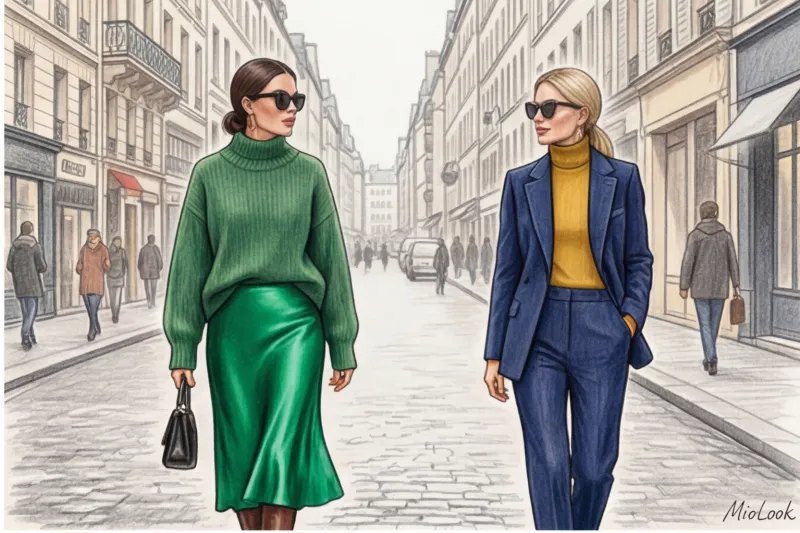
Complementary Scheme: How to Tame Bold Contrast
A complementary scheme uses colors that are directly opposite each other on the color wheel. Blue and orange. Yellow and violet. Red and green. This is the ultimate in energy, boldness, and dynamism. But here lies the greatest danger for beginners.
The main secret of a stylist: never, under any circumstances, use complementary colors in a 50/50 ratio. If you wear a bright blue sweater and bright orange pants, you'll visually "cut" your figure in half and resemble a sports mascot. A complementary look should always have a strict hierarchy of roles.
One color acts as anchor thing (anchor piece) - it takes up 80-90% of your body area and sets the tone. The second color works exclusively as statement accessory (statement accessory), a flash of color that draws the eye. For example, an impeccably tailored navy wool suit (anchor) paired with terracotta suede loafers (accent).
If the sheer contrast feels too aggressive, simply tone down the saturation. Instead of the loud, "New Year's" combination of scarlet and forest green, opt for muted, darkened versions. Deep burgundy (a shade of red) paired with refined olive (a shade of green) will create a sophisticated, luxurious fall outfit that looks expensive and is appropriate for any occasion.
Triad and Tetrad: the pinnacle of coloristics
We've reached the pro level. A triad is three colors that form an equilateral triangle on a circle (for example, the classic combination of red, blue, and yellow). A tetrad is four colors composed of two complementary pairs (forming a rectangle or square). We often see such combinations in street style reports from Milan Fashion Week, but in real life, they can turn you into a walking puzzle.
My advice: approach these schemes with caution. If you want to use a triad for a café or a casual meeting, use the "one bright, two pale" rule. Keep two colors pastel (for example, a soft lemon top and washed-out blue jeans), and the third bold (a bright red crossbody bag).
Another pro trick is to ground complex color schemes with neutral shades. Wrap the riot of colors in a voluminous beige trench coat or add chunky white sneakers and a gray graphite scarf. A neutral base will give the eye a rest.
Before spending hundreds of euros on complex shades to experiment with the triad, I always advise my clients to use MioLook smart wardrobe You can digitize your items and virtually try on these bold contrasts—this way, you can see in advance whether a color scheme works and avoid impulse purchases that end up hanging with the tags in your closet for years.
Stylists' Golden Rules: Proportions and Textures (The Secret Ingredient)
Many people are convinced that the ideal color combinations in clothes — it's all about finding the right colors on a palette. But research into color perception, as well as my personal experience sorting through wardrobes, confirms that the hue itself is only 50% of the success. The other 50% is the mathematics of the proportions in which you use it and the physics of the texture of the fabric on which it lives.
I call this my "Mediterranean rule" of styling. In the south, we adore the sun, energy, and brightness, but to avoid an outfit looking like a carnival costume, we bring it to life through a jewel-like contrast of textures and a strict dosing of areas. If you wear green and pink in a 50/50 ratio, the colors will begin to aggressively compete for attention, cutting your figure in half. Let one color take center stage, and the other delicately complement it, and you'll get a cohesive look straight out of a glossy magazine cover.
The 60-30-10 formula in image construction
Fashion borrowed this ingenious and foolproof scheme from its colleagues in interior design. It creates flawless harmony in the architecture of space, and believe me, it does exactly the same for your body proportions. The idea is incredibly simple: to effectively incorporate several shades into a single outfit, their areas must be distributed strictly according to the 60-30-10 rule.
- 60% - dominant color. This is the base of your look, its visual foundation. Typically, this role is played by the largest pieces: a tailored pantsuit, a flowing maxi dress, a classic trench coat, or a voluminous overcoat.
- 30% - secondary color. It supports the base, creates the necessary contrast, but doesn't overpower the look. A blouse under the jacket, a thick jumper, or trousers paired with a contrasting top serve this function perfectly.
- 10% - color accent. That stylistic icing on the cake. The accent comes from details: a structured bag, shoes, a silk scarf, or even bold red lipstick.
Let's put together a specific, work-ready outfit. We'll start with a solid camel coat (60%). We'll add dark blue straight-leg jeans (30%), paired with a dark blue turtleneck. Now we'll add a bold, delicious accent (10%)—a deep burgundy leather bag. The result? A sophisticated, expensive look that looks thoughtfully crafted down to the last detail.
Try MioLook
for free
Start creating perfect images with the help of artificial intelligence
Get access — €0.99 onceHow fabric texture changes color
We've reached the most delicious secret of stylists. Fabric is the filter through which the world sees your color. At one of the Bottega Veneta shows, I watched in fascination as the designer played with just one shade, creating incredible dynamics simply by changing materials. The fact is that the physics of light directly dictates how colors work in reality.
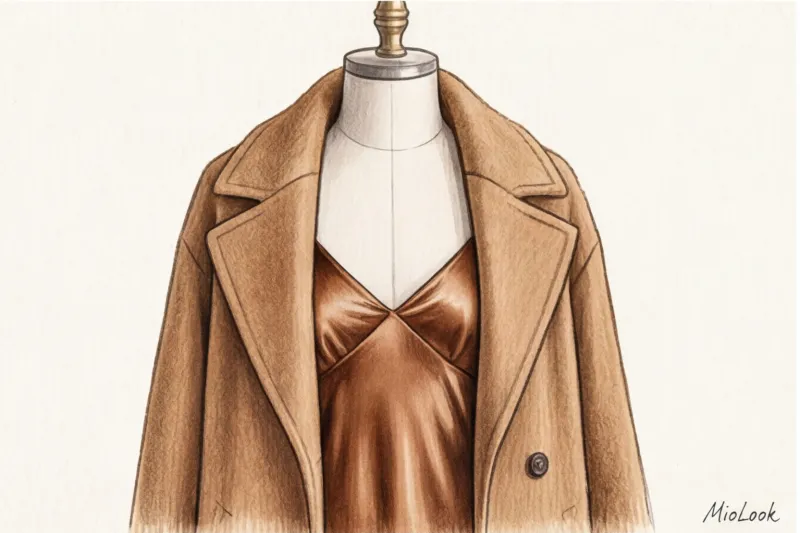
Glossy fabrics (natural silk, satin, smooth leather, vinyl) act like miniature mirrors. They actively reflect light, making any color appear brighter, more vibrant, and more visually vibrant.
Matte fabrics (Thick wool, suede, rough linen, velvet), on the other hand, greedily absorb light. The same shade on a matte surface will appear deeper, darker, and muted, acquiring an aristocratic solidity.
Imagine this incredible experiment: a factory took a single jar of the perfect red dye and dyed two pieces of fabric—silk and suede. If you wear a red silk blouse and a red suede skirt made from these materials, everyone will think you're wearing two completely different colors. The silk will shimmer boldly with every step, while the suede will lie as a heavy, luxurious, and calming stain. It's this difference in texture that will prevent the look from becoming a flat uniform.
"If you're hesitant to introduce a bright color into your wardrobe, buy one in a matte finish. Lemon yellow on linen or wool looks elegant and safe, while lemon satin requires impeccable styling and is perfect for evening occasions."
The Myth of the "Three Color Rule": Why It No Longer Works
You've probably heard this strict fashion dogma more than once: "Never use more than three colors in a single look." For decades, this was considered the gold standard of elegance. Long ago, stylists invented this rule as a kind of "training wheels" to protect inexperienced women from fashion disasters and visual chaos.
But today, flawless color combinations in clothing no longer require such rigorous math. Just look at the street style from Copenhagen or Milan Fashion Week: top influencers masterfully juggle four or even five shades in a single outfit. And it looks fresh, luxurious, and perfectly harmonious.
How do you assemble such a complex, multi-component look without looking like a runaway circus performer? The key to success is a unified approach. saturation You can confidently wear five different colors as long as they all have the same density. For example, a pastel capsule: a mint cardigan, a pale lemon top, a lavender skirt, and peach shoes will work together flawlessly because they all contain the same amount of white pigment. The same goes for deep, muted autumnal tones: burgundy, mustard, emerald, and navy blue create a luxurious combination.
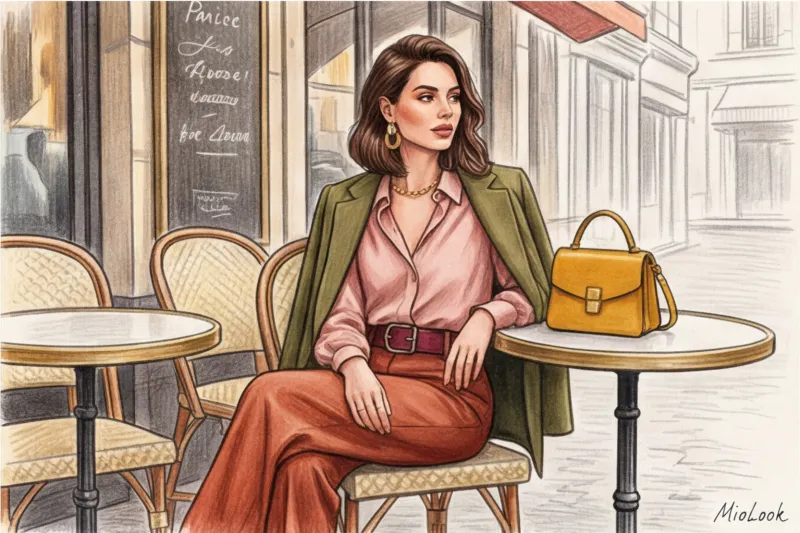
To keep this complex color puzzle from falling apart completely, the pros use the "print bridge" technique. Add a patterned item to your look—for example, a $40 silk scarf or a statement bag—that already features at least three of the colors you're wearing in the pattern. This element will act as the visual glue for the entire outfit.
Since we're starting to shed outdated rules, let's bust another ironclad myth: "When in doubt, wear black—it's always safe." Trying to avoid color mistakes, many resort to all-black, considering it a universal stylistic armor.
In practice, black near the face is one of the most demanding and tricky choices. From a color physics perspective, matte dark fabrics act as light absorbers: they absorb the skin's luminosity and cast micro-shadows on your face. If your natural contrast level is low, a solid black collar will instantly highlight nasolabial folds, dark circles under the eyes, and even the slightest signs of sleep deprivation. Total black truly only flatters women with high-contrast complexions. For everyone else, it's not a safe haven, but a surefire way to accentuate wrinkles and fatigue.
How to combine colors in clothes according to your appearance
Have you ever noticed this cruel styling paradox? You buy a flawless outfit that looked gorgeous on the model in the lookbook, put it on, and suddenly you look tired, and your own facial features seem to blur. According to the Pantone Color Institute's 2023 report, over 70% of women intuitively choose shades for their wardrobe that they like in the abstract, without any consideration of how these colors interact with their natural features.
Remember the ironclad rule: your face is a full-fledged part of the color palette. color combinations in clothes Your face should serve as a precious frame for your appearance, not steal the show. If your outfit has high contrast and your face has low contrast, disaster will follow: you won't be wearing the clothes, but the clothes will be wearing you. People will compliment your bright dress, but they won't remember you at all.
Contrast level of face and clothing
To control attention, we need to align the contrast of our clothes with the contrast of our face. Women with high contrast (for example, those with porcelain-pale skin and jet-black hair, like Dita Von Teese) look stunning in bold, complementary schemes and stark black-and-white blocking. Their vibrant appearance easily withstands such juxtaposition.
Low-contrast colors (light-blond hair, translucent skin, light eyes) are a completely different story. This look thrives in soft analogous schemes and pastel tones. Last year, a client came to me—a classic "Light Summer" in the 12 color types. She adored graphic black-and-white office outfits, but complained that colleagues were constantly asking if she was feeling well. As soon as we replaced this aggressive duo with a soft analogous scheme of sage and dusty blue, her complexion instantly brightened. That same "expensive," well-rested look!
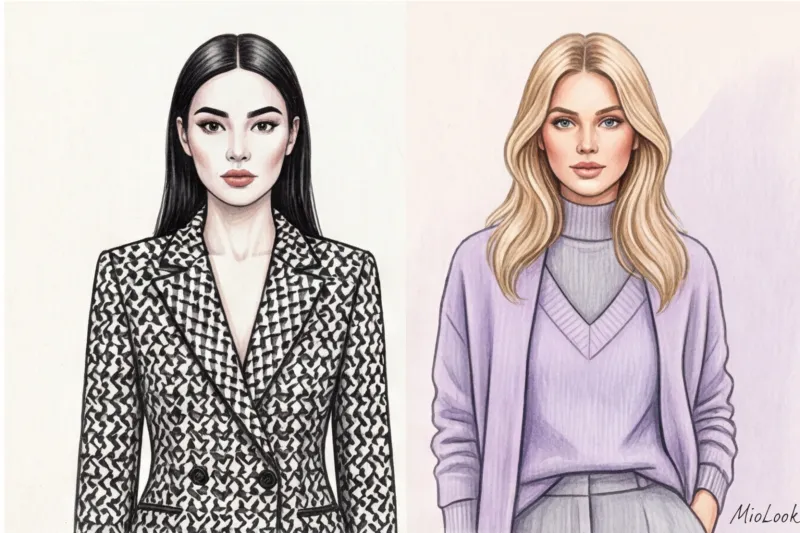
Is it possible to "cheat" nature if you have low contrast, but your dress code or mood calls for a bright outfit? Yes. You need to artificially increase the contrast in the so-called portrait zone Add a vibrant wine-colored lipstick, graphic eyeliner, thick dark-framed glasses, or a contrasting silk scarf. By balancing the volume of your face and outfit, you'll regain control of your look.
Appearance Temperature: Friendship with "Alien" Flowers
I'll be honest: as a stylist, I'm not a fan of strict restrictions. I'll never tell you, "Throw away that sweater forever; it's not your color palette." Any color type system is a guide, not a prison cell. What should you do if you have a cool complexion but are madly in love with a warm mustard or terracotta color?
This is where my favorite distancing trick comes into play. The key lies in managing the area around your face (from the décolleté to the crown of your head). If a shade is completely unsuitable for your skin tone—it makes your skin look sallow or highlights dark circles under your eyes—simply move it away from your face.
For example, you're a "Cold Winter," but you bought a stunning pair of palazzo pants in a warm brick shade (say, at Massimo Dutti for €120). Keep your ideal "safe" color close to your face—wear an icy blue cotton shirt or a sapphire top. And let the brick color play down: let it shine through in trousers, skirts, or shoes. This way, you'll maintain your perfect complexion, visually elongate your silhouette, and satisfy your fashion cravings without sacrificing your beauty.
Your ideal image
it begins Here
Join thousands of users who look flawless every day with MioLook. Experiment with contrasts and find your perfect colors virtually!
Get access — €0.99 onceColor in a Business Wardrobe: Dress Code Without Losing Your Personality
Have you ever stood in front of the mirror in a formal office suit and felt like the clothes were literally erasing your personality? There's a dangerous stereotype in the corporate world: the more serious the position, the more drab the palette should be. However, a smart color combinations in clothes It works as your hidden professional advantage. Analysis by the Pantone Color Institute proves that all-black in business communications is often perceived by partners not as authority, but as distancing, closed-offness, and an unwillingness to compromise.
How can we adapt Itten's bold circle to the strict confines of Business Formal and Smart Casual without looking like a child's party entertainer? We're not abandoning color—we're radically altering its characteristics, pushing spectral tones into deep shadow.
The first and most important step to a prestigious business wardrobe is replacing flat black with the "new neutrals." Try incorporating deep navy, rich burgundy, forest green, and chocolate brown. A chocolate-colored wool jacket for €350 always looks richer and more sophisticated than standard black. Psychologically, brown and green undertones convey stability and financial well-being, while easily passing even the most conservative dress code.

Your color scheme for the day should work as a script for a specific business task.
If the goal of the meeting is to build maximum trust, smooth out rough edges and show yourself as a team player, bet on analog circuit Shades adjacent to each other on the color wheel create a smooth gradient that calms the other person's nerves. A classic formula for building trust that I use on clients before difficult negotiations: navy blue trousers paired with a cornflower blue silk blouse. You appear collected, competent, and completely safe for the other person.
A completely different strategy is required for power dressing—days when you need to capture the audience's attention, such as during a presentation of an important project. Here, we play our trump card: complementary accents. In the office, we use contrasting colors strictly according to the 10% rule. Imagine a perfectly tailored charcoal suit (which has the same temperature as a cool blue base) and a neat red silk scarf around your neck. This pulsating micro-contrast focuses the audience's attention solely on your portrait area and subconsciously establishes your position as a leader.
Before investing in a work capsule upgrade, test your ideas for viability. Upload photos of your everyday business items to MioLook and create looks with new shades virtually. This will save you from impulse purchases and show you how well wine or forest green will fit into your personal dress code.
A practical checklist: incorporating color into your wardrobe step by step
Let's put theory aside. The most beautiful and well-calibrated Itten wheel won't help you at 7:30 a.m. when you're getting ready for an important meeting and frantically rummaging through hangers. A 2023 study by the Pantone Color Institute confirms that people who consciously manage their palette are perceived by others as more confident, competent, and creative. But successful color combinations in clothes It starts not in the fitting room of an expensive boutique, but right in your bedroom.
In my styling practice, I've developed a step-by-step algorithm that allows you to reframe your visual thinking without stressing your psyche or wallet. Here's your action plan for this week:
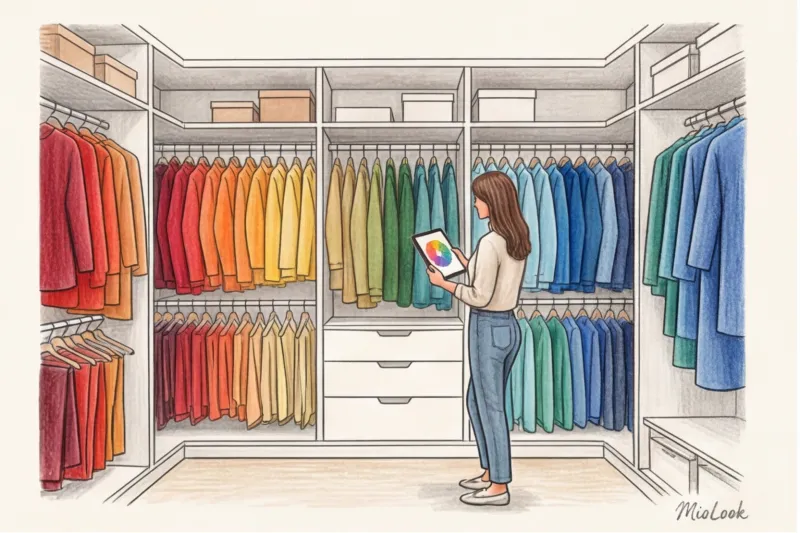
- Step 1: Inventory and group items by temperature.
Take out all your basic clothes and separate them into two camps: warm shades (with yellow, peach, or caramel undertones) and cool shades (with blue, ash, or icy undertones). Lay them out in natural daylight. You'll be surprised, but the lion's share of problems with the phrase "I have nothing to wear" stems from temperature clashes. When you try to pair a warm beige trench coat with a cool steel-gray sweater, the look visually "falls apart." Once you experience this dissonance, you'll begin to intuitively avoid it. - Step 2: Start small by adding one complementary accessory.
Don't rush into a complex color block if you've only ever worn gray. My favorite trick for a smooth transition: choose your most reliable basic (like a classic camel coat) and pair it with an accessory in the opposite color from the Itten circle. A cobalt blue scarf against a terracotta coat or a rich ruby bag with a navy jacket will instantly elevate your look. It's a smart investment, costing around $50-$100, that will instantly liven up a dozen everyday outfits.
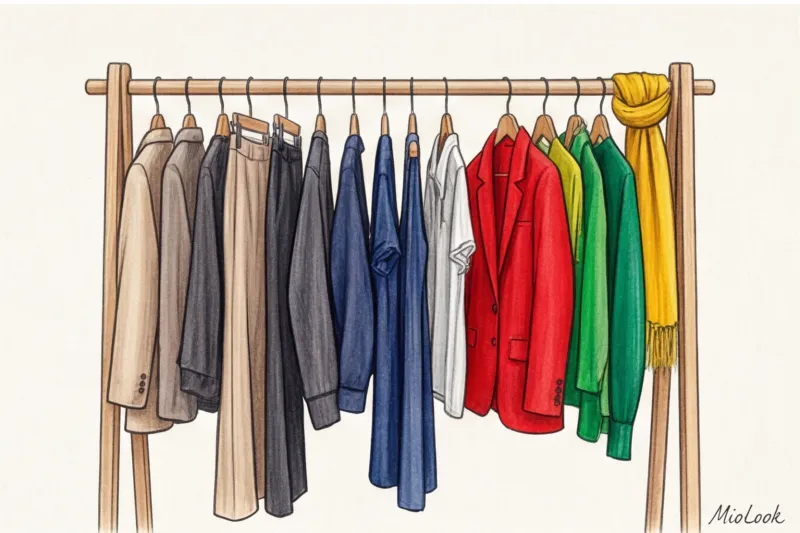
- Step 3: Test the 60-30-10 rule (with your current wardrobe only).
Set yourself an honest challenge: put together at least one outfit this week using this architectural formula, without buying anything new. Let your neutral pantsuit or midi dress take up 60% of the space, a light blouse or cardigan 30%, and dedicate the remaining 10% to a bold statement piece. It could be emerald pumps, a printed silk scarf on your bag handle, or simply a classic red lipstick. You'll see how this mathematically precise proportion instantly brings the silhouette together. - Step 4: Digitize your wardrobe before your next shopping trip.
The "lonely item" syndrome is the main cause of cluttered closets. Statistics show that about 30% of a clothing budget is spent on items that are worn only once due to the difficulty of styling them. You buy a stunning lemon-colored blouse in a fit of passion, only to discover at home that it requires completely different "neighbors." I always insist: test bold ideas virtually. Use MioLook app to digitize your items. You can try out new color schemes on your smartphone screen before even reaching for your bank card. The smart assistant will analyze your capsule and visually show you whether your real items will form a tetrad or complementary contrast.
Color is a muscle. And like any muscle in our body, without regular exercise it weakens, giving way to a safe but completely impersonal routine.
In the Mediterranean style, which I so love and often cite as an example to my clients, color is not just a pigment on fabric; it's a celebration of life. The more you apply these principles in practice, the stronger your style intuition becomes. What seems like a complex coloristic equation today will become an automatic skill within a month.
You'll stop being afraid of saturated colors and start enjoying how they highlight your natural contrasts, refresh your complexion, and transform your mood. Don't be afraid to make a bold statement, break outdated rules, and dress to convey your energy to the world—boldly, confidently, and with impeccable taste.
Guide Chapters
The Psychology of Color in Clothing: How to Manage Impressions
A first impression is formed in 7 seconds, and color plays a key role. Learn how to use shades as a tool for nonverbal influence.
Cool and warm shades in clothing: how to combine them
Forget outdated color type rules. Discover stylists' secrets for combining different temperatures to create luxurious and classy looks.
How to combine prints with solid colors
Why do we buy brightly colored items but only wear them with black? We explore practical tips to help you easily incorporate prints into your everyday look.
Incompatible Colors in Clothing: Debunking Style Myths
Think blue and black can't be worn together? A stylist debunks myths and explains how to boldly mix shades, defying outdated rules.
Related colors in clothing: combinations of shades
Forget boring monochrome and the "beige wardrobe syndrome." Discover the analogous color scheme—stylists' secret weapon for creating luxurious looks.
How to Wear Contrasting Colors in Clothing: Stylist Tips
Tired of your gray and beige wardrobe? Learn how to combine complementary shades and textures to add life to your looks.
Combining Pastel Colors in Clothing: Stylist Tips
Worried about looking childish in light-colored clothes? A stylist with 14 years of experience shares her secrets for elegantly styling pastel shades for a classy look.
Bright Accents in Clothing: How to Add Color to Your Wardrobe
Stylists' tips on how to add color to a minimalist wardrobe. Learn how to choose statement pieces that won't sit in your closet for years with their tags on.
Achromatic colors in clothing: how to wear them expensively
Black, white, and gray aren't just a safe base; they're an architectural style tool. We'll explore how to use textures to create a visually luxurious look.
Premium color blocking in clothing: how to combine colors
Color blocking isn't a chaotic jumble of bright spots, but a true architecture of color. Learn how to create statement looks using deep shades.
Itten's Color Wheel: How to Combine Colors in Clothing
Bought a bright piece and don't know what to wear with it? Let's explore how to apply Bauhaus color theory to create stylish and harmonious looks.
The Three-Color Rule in Clothing: The Ideal 60-30-10 Formula
Why do some combinations look street style, while others turn into a random assortment of items? Discover the secret to the perfect look with the 60-30-10 color formula.
Monochrome Clothing: How to Create a Total Look
The perfect color match in a total look is a myth that ruins style. Learn how to create stylish monochrome looks without looking too uniform.