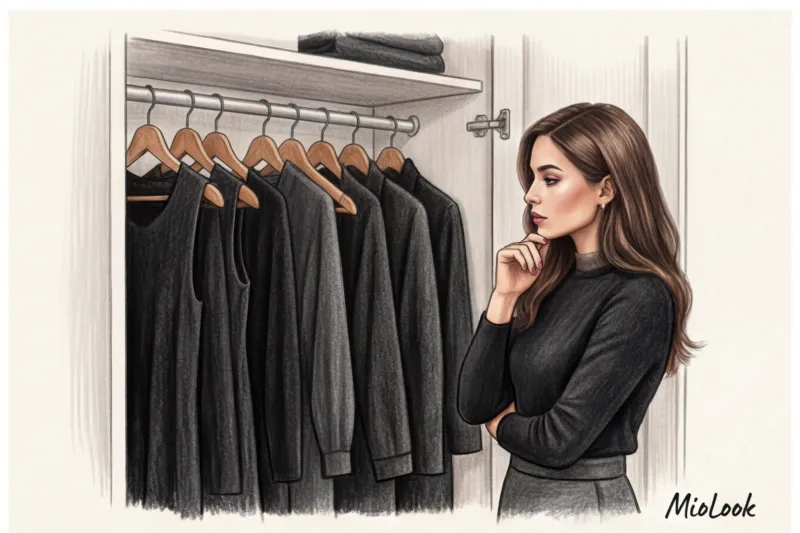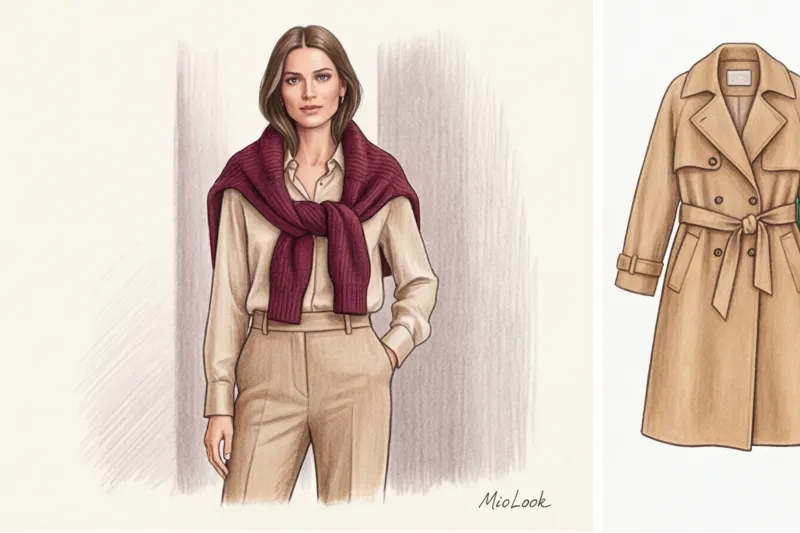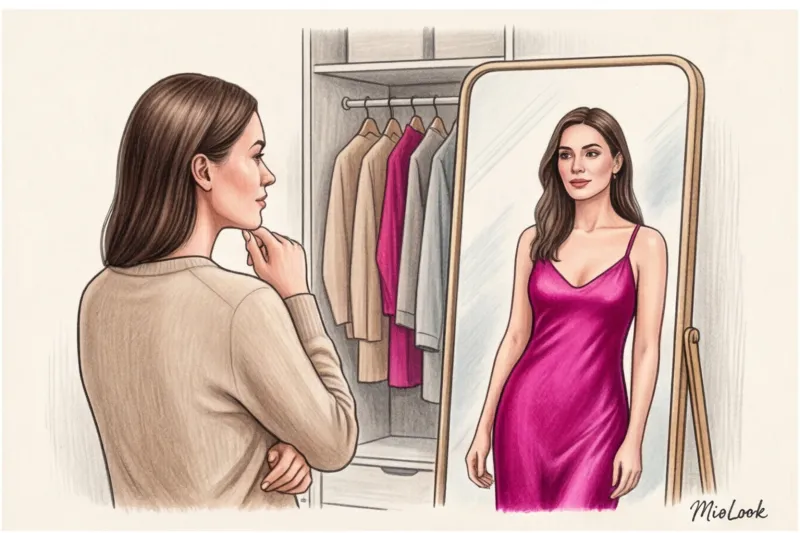
Elena, a senior partner at a major law firm, opened her closet to me. Forty hangers hung perfectly in a row on the rails. Dark gray, light gray, graphite, black, and then black again. "I want to look more confident, Isabella." " she said. "But when I look at colorful things in the store, I start to panic.". This fear of bright clothes Every other client of mine is familiar with this. We buy fuchsia on vacation on the Italian Riviera, and when we return home, we hide it on the farthest shelf, returning to the reliable, Swiss-watch-like beige trench coat.
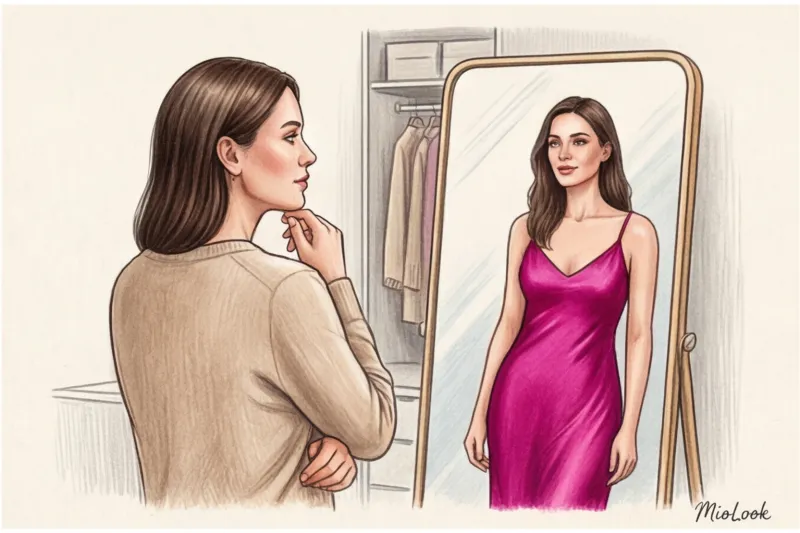
In fact, our closet is a physical reflection of how much space we allow ourselves to occupy in this world. We discussed this profound connection in more detail in our a complete guide to wardrobe psychology and body acceptance Color in clothing is always a statement. It's a microphone you pick up without even opening your mouth. And if you're feeling impostor syndrome, the desire to blend in with the wallpaper is completely natural.
Fear of bright clothes: why do we choose “safe” beige and black?
The desire to hide in achromatic colors (black, gray, white) isn't a lack of taste. It's our psyche's evolutionary response to stress. According to statistics we collect at the agency, 80% of women instinctively switch to a dark palette during moments of life turbulence or career transitions. It's a defense mechanism: "Don't be conspicuous—and you'll be safe."
But there is a tricky trap here, which researchers H. Adam and A. Galinsky called in 2012 enclothed cognition (embodied cognition). Their research proved that we adopt the characteristics of the clothes we wear. By wearing "drab" and inconspicuous clothing, we literally program our brains for social invisibility. We begin to speak more quietly, take less initiative in meetings, and settle for less.
"Clothes with tags still attached are a museum of unfulfilled ambitions. You're buying a bright dress not for the real you, but for that ideal version of yourself you're still afraid to become."
That's why nine out of ten wardrobes I sort through have a "museum section." These are items in bright, pure colors, bought on impulse, that never see the light of day. We look at them, sigh, and then put on our usual gray cashmere again.
Access to MioLook for €0.99 — one-time payment
A smart AI stylist will find the perfect look and help you incorporate color into your wardrobe without stress.
Get access — €0.99 once"Visibility Hangover": What Happens When You Wear Bright Colors for the First Time
Over 12 years of practice, I've come up with a term that explains why most attempts to "start wearing color" end in failure. I call it visibility hangover.
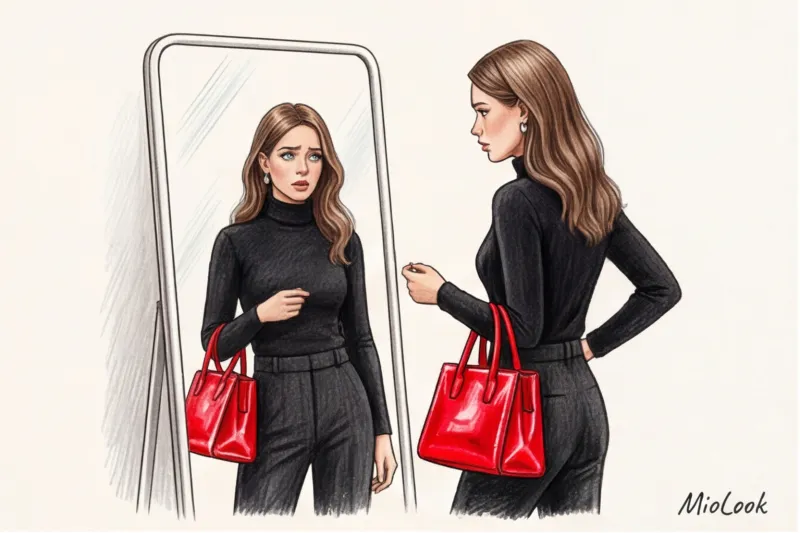
Imagine: you've finally made up your mind. You've bought a luxurious suit in a rich red color. You put it on at home—and the mirror reflects a goddess. You go outside, take the subway, or enter the office, and 40 minutes later, an icy wave of panic washes over you. You feel like you're absolutely right. All They look at you. That you look ridiculous, too provocative, “too much.”
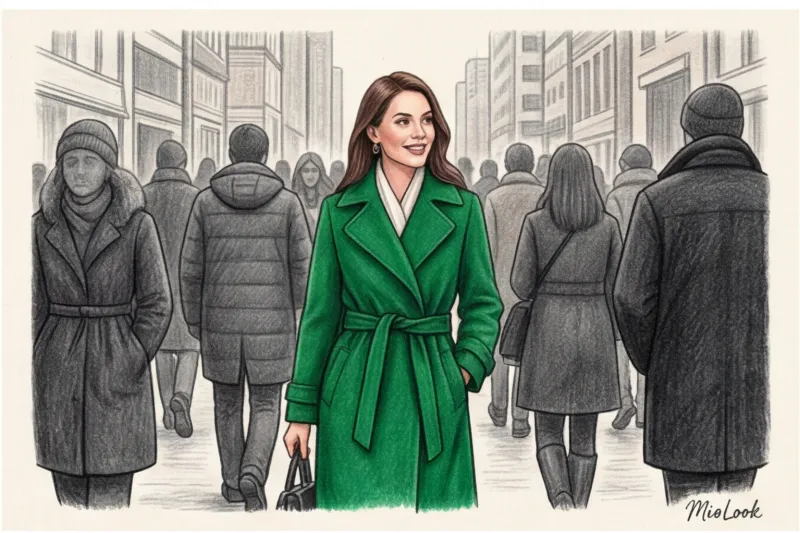
In cognitive psychology, this is called the "spotlight effect." Our brain convinces us that we are the center of everyone's attention. Spoiler: the barista at the coffee shop and the coworkers in the open-plan office are only thinking about their deadlines, not your jacket.
How to treat this? Use the 3-5 exits rule.
The brain requires an adaptation period. For neural connections to rewire themselves and stop perceiving a brightly colored garment as foreign, you need to wear it at least three times. After the fifth time, the red suit will become as much a comfort zone for you as your favorite blue jeans.
The Accessory Myth: Why the "Start with a Scarf" Advice Works Against You
If you search for "how to stop being afraid of bright clothes," 90% of the articles will give you the same generic advice: "Start small! Add a bright accessory: a red belt, a yellow scarf, or an acid-colored bag." As a practicing stylist, I officially declare: forget this advice forever.
Why doesn't this work? Imagine your usual, safe monochrome look: a graphite coat, a black sweater, dark pants. Your nervous system is at rest. And suddenly you tie a bright yellow scarf over this magnificent ensemble.
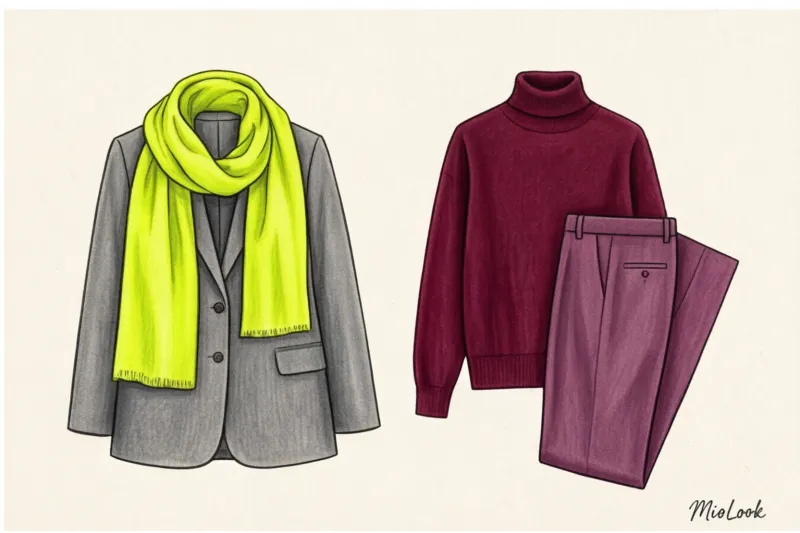
Visually, this scarf acts as an alarm. It creates a stark contrast, cutting into your silhouette. Instead of gently adjusting to the color, you're left with a garish spot right next to your face, reminding you every second that you've stepped outside your comfort zone. Your anxiety level only increases.
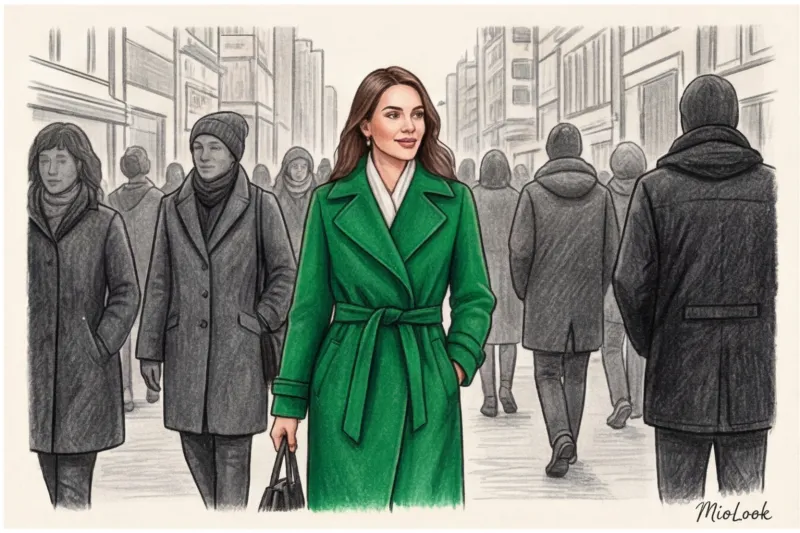
My Mediterranean approach to color teaches something different: tonality and texture are always more important than contrast Italian and Spanish women don't wear color as a form of defiance. They wear it like a second skin, building their look from shades of similar depth rather than placing neon flags on a gray background.
Your perfect look starts here
Join thousands of users who look flawless every day with MioLook. Digitize your closet and discover new combinations.
Get access — €0.99 onceColor Detox: How to Incorporate Color into Your Wardrobe Eco-Friendly
If contrasting accessories are a bad idea, what should you do? Use the "color bridge" technique. This is a smooth transition from familiar achromatic to a complex, elegant palette without stressing your psyche.
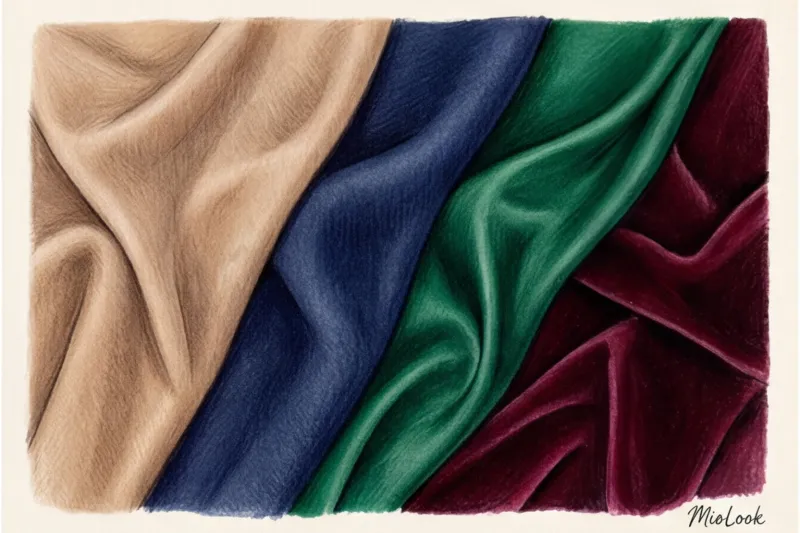
Step 1: Replace black with deep jewel tones
According to PANTONE Institute reports from recent years, deep, natural tones are perceived by the human eye as the most stable and prestigious. Swap your usual black jacket for emerald, sapphire, burgundy, or dark chocolate. These shades have the same grounding density as black, but visually add ten times the value and sophistication to an outfit. They don't shout about themselves, but they confidently declare your presence.
Step 2: Colored "bottom" instead of colored "top"
It's a purely psychological trick. We look at ourselves in the mirror primarily from a portrait perspective. We see what's close to our face constantly. If you wear fuchsia near your face, your brain will process it all day long. But terracotta pants or a pine-green skirt paired with your favorite beige sweater is a brilliant compromise.
Fair warning: This technique won't work if you have a pronounced pear-shaped figure and are terrified of drawing attention to your hips. In this case, we'll instead draw the attention upward, but use deep, muted tones instead of bold colors.
Dopamine Wardrobe: 3 Stylish Formulas for a Confident Appearance
Fashion psychologist Dawnn Karen of the Fashion Psychology Institute introduced the concept Dopamine Dressing — using clothing to specifically boost your mood. I've adapted this theory into three foolproof formulas that my clients use for their most important events.
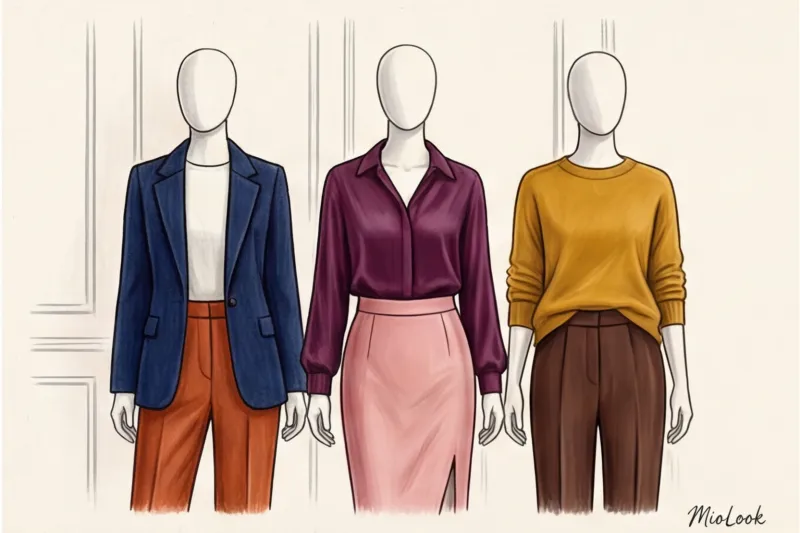
- Formula 1: Monochrome in muted colors. Consider a three-piece suit that's not black, but, for example, a deep burgundy or dusty terracotta shade. The all-over color elongates the silhouette vertically and is perceived as a unified whole. No contrast, no anxiety. You'll look classy, but not outrageous.
- Formula 2: Noble contrast of textures. Combine colors through different materials. An emerald silk blouse (at least 19 momme count) paired with dark blue trousers made of dense merino wool. The sheen of the silk is muted by the matte finish of the wool, shifting the focus from the vibrancy of the color to the luxury of the fabric itself.
- Formula 3: Pastel as neutral territory. For those who still struggle with bright colors, we use muted shades: pistachio, dusty rose, lavender, and sage. They act as a base while adding a fresh touch.
Ready to get started?
Try a free plan—no commitments required. The MioLook virtual fitting room will show you how colors look on your body.
Get access — €0.99 onceHow the MioLook app helps you overcome your fear of style experiments.
One of the biggest fears when buying a colorful item is "What will I wear it with?" We feel like we'll have to buy half the store's worth of clothes to go with just one green skirt. This is where technology comes to the aid of psychology.
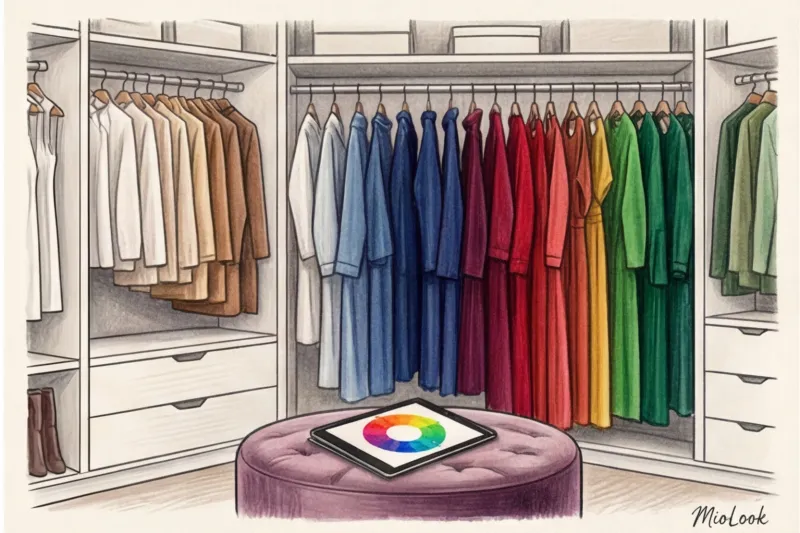
When my clients upload their current wardrobe to MioLook For many, a pie chart often comes as a shock. Seeing that 85% of your clothes are gray is a great trigger for change. But the real magic lies elsewhere:
- Safe virtual fitting area. You can "pretend" a vibrant image on your digital avatar even before you buy. Your brain already begins to adapt to the new color, even while you're at a safe distance from the fitting room.
- Smart capsule generation. AI algorithms show you how to integrate one new burgundy shirt into five existing, safe outfits from your basics. You no longer buy individual items.
Checklist: Your First Stress-Free, Vibrant Look
So, you've bought your first complex, colorful item. How do you take her out for a walk without having to run home to change in ten minutes?
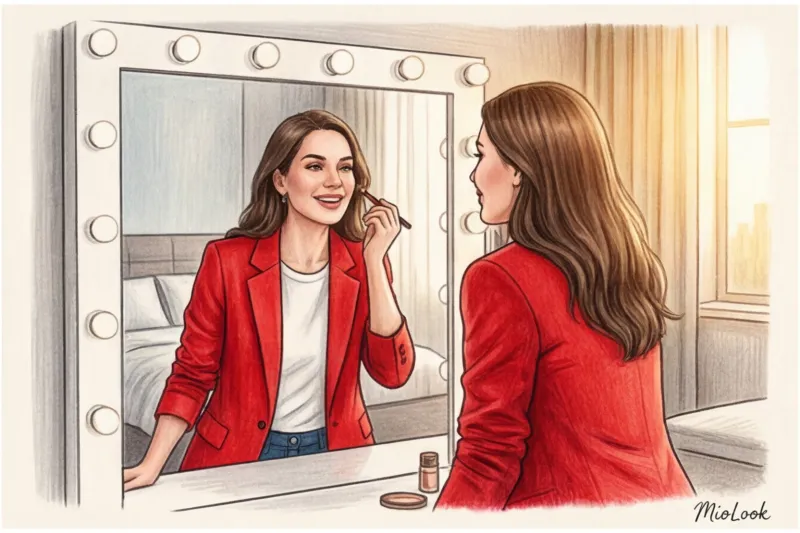
- Take a "home test drive". Try out your new look at home on a weekend. Drink coffee in it, read a book. Let your body get used to the way the fabric hugs your figure, and your eyes get used to the new reflection.
- Keep your face in your comfort zone. If you're wearing a bold color, stick to your tried-and-true makeup and usual hairstyle. There's no need to experiment with everything at once. A familiar reflection in the mirror will act as a safety net for your psyche.
- Select the correct polygon. Don't wear a new, flashy item to an important presentation or a first date where stress levels are already high. The ideal first outing is brunch with a close friend, who's sure to compliment you.
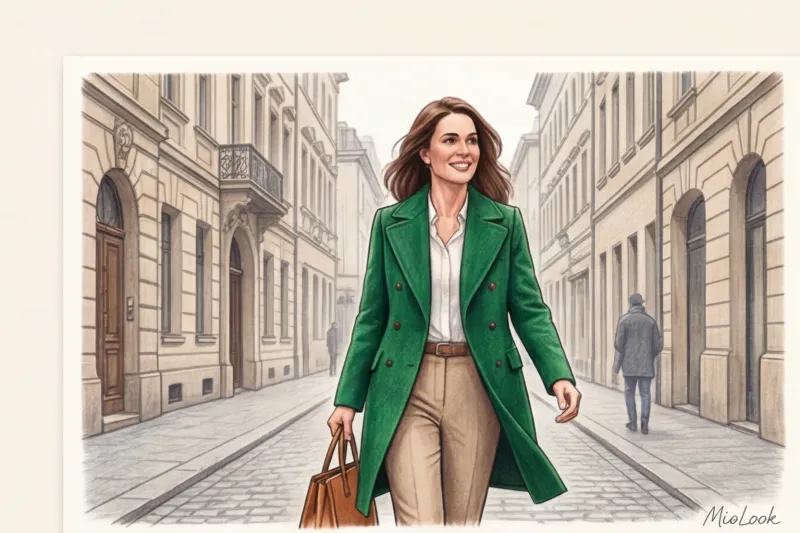
My client Elena, whom I mentioned at the beginning, sent me a selfie after six months of working on her wardrobe. She was standing in her office elevator, wearing a flawless, deep sapphire pantsuit. The caption read: "I won my case today. And you know what? I'm sure that suit did half the work.".
Fear of being noticed is normal. But remember: when you choose clothes, you're not just choosing fabric. You're choosing how you'll sound today. The right to wear color, combine textures, and turn heads is your absolute right to be yourself, in all your glory.