Evolution: From buyer's intuition to analytics for the fashion business
Have you ever wondered why, all of a sudden, mass-market shelves are simultaneously filled with items in complex shades of butter or burgundy? It's not a secret conspiracy of designers behind closed doors. And it's certainly not the notorious "sixth sense" the industry has been praying to for the past half-century. Today, a completely different player rules the roost behind the scenes— analytics for the fashion business based on artificial intelligence.
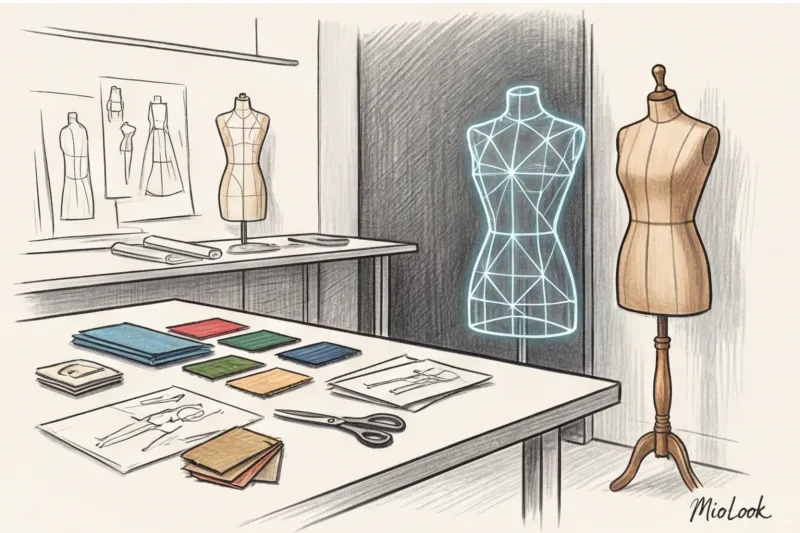
Just ten years ago, the assortment development process seemed magical: a buyer would travel to shows in Milan or Paris, soak up the street style atmosphere, create mood boards, and order fabrics based solely on intuition. Today, this romantic yet completely unpredictable approach has been replaced by a rigorous, data-driven strategy. The industry no longer has the luxury of "guessing."
Over 12 years of working in styling and consulting, I've seen brands squander huge budgets due to the false confidence in stable demand. The most common mistake in my experience is blindly purchasing so-called "perpetual essentials." Brand owners reason: "Classic straight jeans and fitted jackets will always be in demand; we'll produce a batch worth €50,000." And then, season after season, these pieces gather dust in warehouses because, in that particular quarter, their audience suddenly demanded a relaxed baggy silhouette and exaggerated shoulders. Without data analysis, the core collection becomes dead weight.
The price of such mistakes has become too high. The problem of overstock (overproduction) has reached critical mass. According to a major McKinsey report on the state of the industry (2023), approximately 30% of all clothing produced globally never finds a buyer and ends up in landfills or incinerators. Fashion's environmental footprint has proven so devastating that the fashion industry has literally been forced to "smart up." Brands have finally realized that they need to produce not what seems promising to the creative director, but what has already been mathematically proven to be in demand.
So, what is AI analytics for the fashion industry, in simple terms? Forget boring tables with past sales history—they only show what's already happened. Modern AI works differently. It all starts with massive parsing: algorithms scan millions of images from social media, analyzing fashion shows, influencer videos, and search queries. Computer vision breaks down a fashion blogger's image into parameters: hem length in millimeters, collar shape, exact hex color code These data sets are then loaded into predictive models. The machine literally tells the brand: "In three months, demand for asymmetrical tops in your price segment will increase by 45%; start stocking up on fabric."
By the way, we discussed in detail in the article how competent work with data helps brands not only save money but also earn money. How to increase the average order value in a clothing store: a smart approach.
Why was such complexity necessary when we could get by without it before? The answer lies in the radical acceleration of fashion. We've irrevocably passed the era of macrotrends, when Dior's New Look silhouette could dominate an entire decade. Today, microtrends rule the roost, their life cycles shortened to a few weeks—from aesthetics balletcore to style office siren or Tomato Girl The human brain is physically incapable of tracking the emergence, peak, and decline of thousands of such microaesthetics simultaneously.
But algorithms can. They are the ones who decide what will end up on the hangers in stores tomorrow and, ultimately, in your digital wardrobes in the app. MioLook. And if for the deep implementation of technologies on the brand’s website it is necessary personalization in e-commerce and AI stylist , then global trend forecasting begins with machine vision, which already knows today what we will want to wear next spring.
How AI Predicts Trends: A Look Under the Hood of Algorithms
According to a McKinsey study (2024), the implementation of artificial intelligence in retail reduces forecasting errors by 50%. Analytics for the fashion business has ceased to rely on the intuition of top designers and has shifted to precise calculations. But how exactly does a soulless machine "understand" such an ephemeral thing as fashion? It all starts with the eyes—or, in technical terms, with computer vision.
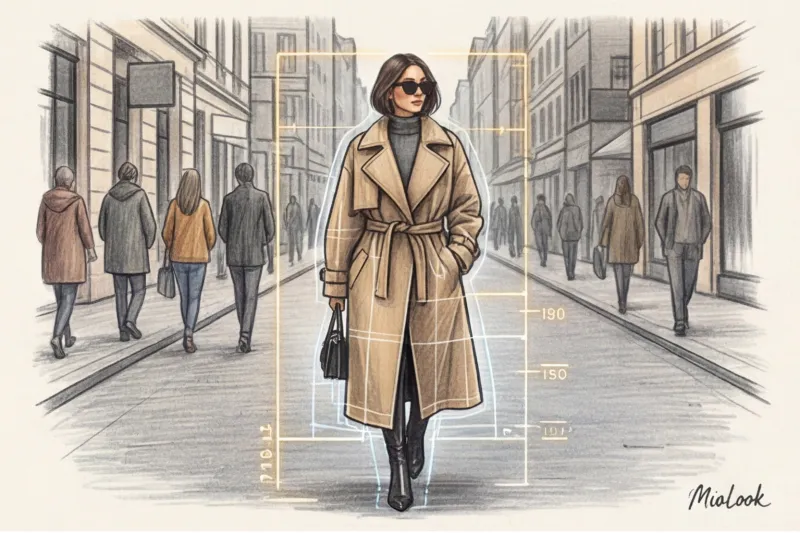
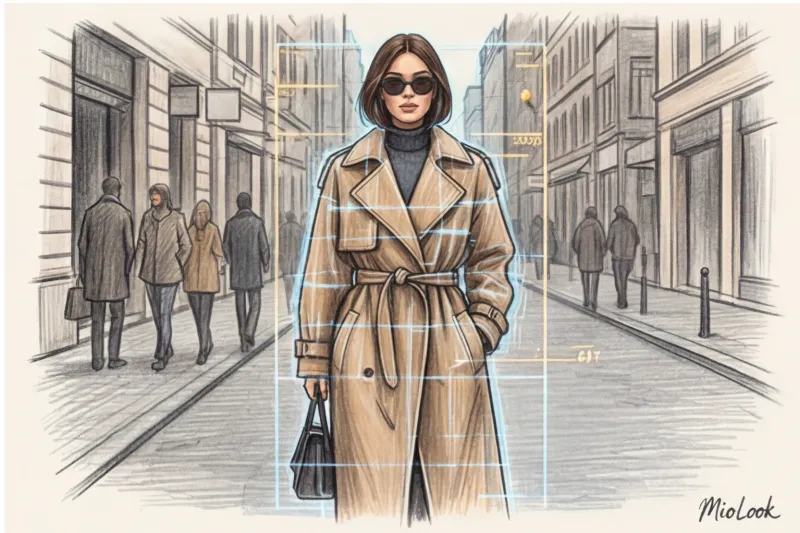
When a neural network analyzes a photo from Paris Fashion Week or a recent street style blogger's shot, it doesn't simply see "a beautiful girl in a stylish coat." It literally dissects the image into hundreds of micro-tags. To clearly understand this mechanics, just look at how the algorithms work. MioLook When a user uploads a photo to the app, the system segments the image in milliseconds: it mathematically accurately recognizes the width of a jacket's lapels, the length of the garment (down to a centimeter below the knee), the texture of the fabric (smooth wool, loose bouclé, or glossy leather), and even the geometry of the buttons. Similarly, global AI platforms parse millions of images online every day, transforming the visual noise of the streets into structured data arrays.
But a single image is categorically not enough. This is where NLP—natural language processing—comes into play. Algorithms continuously scan textual content: search queries, comments under influencer posts, and customer reviews on marketplaces. The neural network is trained to distinguish sentiment (sentiment analysis). It can easily separate the enthusiastic "perfectly elongates the silhouette" from the mass negativity of "the fabric wrinkles terribly after wearing it for an hour." By comparing visual tags with text, the AI understands not only What It is precisely what people wear, but also what emotions they experience this.
The third, and my favorite, level of analytics is heatmaps. This tool reveals which design details people actually notice. You can invest in developing the perfect basic trench coat, but a heatmap of an online storefront will show that a customer's gaze (and subsequently their cursor) lingers exclusively on a unique horn belt buckle or the unusual shape of the epaulettes. By analyzing these micro-movements across hundreds of websites, the algorithm draws an unmistakable conclusion: next season, accent hardware will be the main driver of sales.
And this is where the real magic happens—data synthesis. How does the algorithm understand that the infamous puff sleeves are making a comeback? The process goes like this: first, Computer Vision detects an anomalous spike in the tags "voluminous sleeve" and "gathered shoulder" in street style photos from Copenhagen. Simultaneously, the NLP module notices a 300% jump in searches for "blouse with puff sleeves" on Pinterest, and comment analysis reveals that shoppers are looking for "romantic tops that look good on video calls." The machine combines these visual, textual, and behavioral vectors and delivers a clear signal: the trend is confirmed, it's time to stock up on shape-stabilizing fabrics.
Streetstyle vs. Runway: Who's Winning?
Just ten years ago, the trend-setting chain was strictly linear: a creative director showed a collection in Milan, six months later the mass market copied the patterns, and a month later the item appeared in consumers' closets. Today, runway analytics no longer operates in isolation.
A modern trend isn't born on the catwalk—it's only tested there. The street has become the true and only true examiner.
That's why street style carries far more statistical weight for predictive AI models than official fashion house lookbooks. The algorithm's primary metric today is the speed of a trend's adoption by influencers. If a major brand shows micro shorts on the runway, but within a month, the algorithms don't detect their rise in actual outfits worn by early adopters on the streets of fashion capitals, the trend is labeled high-risk.
A machine simply needs to analyze the profiles of several hundred key micro-bloggers to predict with up to 89% accuracy whether a product will be a mass success. And if street style votes against it, the data-driven brand simply doesn't release the model into mass production. In the current environment, where the average cost of a mistake in launching an illiquid capsule collection on the European market starts at €50,000, listening to algorithms is no longer innovation, but a matter of basic business survival.
Access to MioLook for €0.99 — one-time payment
A smart AI stylist will select the perfect look based on current trends and your preferences.
Get access — €0.99 onceSmart Assortment Management: The End of the Dead Stock Era
The worst nightmare of any brand's commercial director is a warehouse filled with thousands of unsold items. One day, a client (the owner of a European mid-market chain) invited me to an audit and showed me a hangar where about 4,000 neon hoodies hung in dense rows. That was literally €120,000 frozen. Why was this? The buying team had relied on the global street style trend seen on influencers, but completely ignored the local climate and the conservative nature of their core audience.
Today, predictive demand analytics is forever changing this approach, transforming purchasing from an intuitive lottery into precise mathematics. Modern algorithms can calculate, with an error of just a few percent, exactly how many blue double-breasted jackets need to be made for a specific region. Neural networks analyze a colossal array of variables: historical sales data, climate anomalies, local holiday calendars, and even micro-changes in pedestrian traffic near retail outlets.
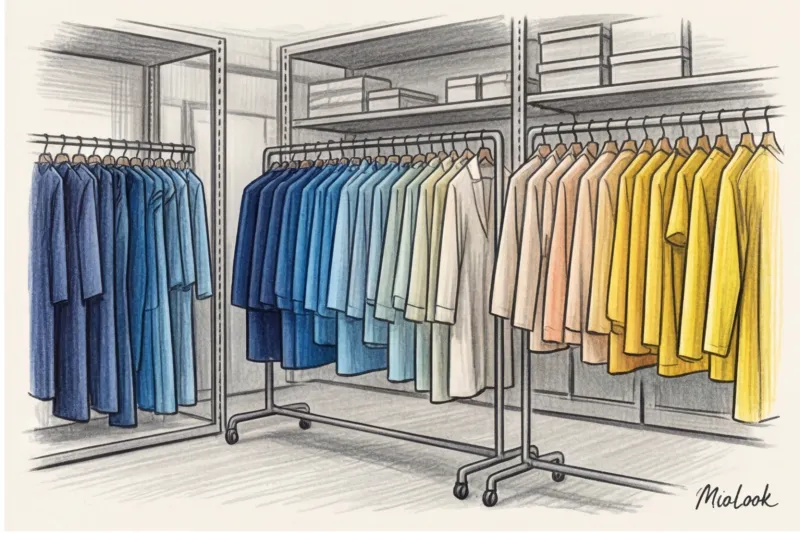
But producing the right amount of goods is only half the battle. analytics for the fashion business It also intelligently distributes products across offline stores, taking into account strict local preferences. In practice, I regularly encountered absurd situations: a boutique in a business district would, for some reason, be dominated by crop tops and ripped denim, while a store in a residential area, frequented by mothers with children, would feature formal office suits. AI completely eliminates the human factor in allocation. The machine clearly understands that at point "A," basic knitwear has the highest conversion rate, while at point "B," the audience is ready for bold fashion experiments.
Responding promptly to the trend's life cycle is key to maintaining profits. AI allows you to adjust your sales strategy before an item becomes irrelevant and becomes a dead weight.
This is where a crucial tool comes into play: dynamic pricing based on interest in the trend. If the system detects a decline in interest in a particular silhouette based on search queries and social activity, the price can be automatically reduced by 5-7% even before the official sales season begins. This stimulates demand without causing critical losses. Conversely, if Zoomers on TikTok suddenly make a specific skirt style go viral, the algorithm will maintain or even slightly raise the price, maximizing profit margins at the peak of the hype. This approach eliminates the need for brands to stage sweepstakes with discounts of up to 70%, which can undermine the perception of brand value.
Speaking of results, the numbers are incredibly telling. According to statistics from the National Retail Federation (NRF) for 2023, the implementation of AI-based inventory management tools leads to a consistent reduction in inventory by 20-30%. In the case of my client, the transition to data-driven purchasing allowed them to reduce overstock by 24% in just two seasons. They simply stopped making items blind.
By the way, collecting pure data on audience preferences isn't just possible through cash registers. In the app MioLook We're seeing how smart wardrobe algorithms are helping to digitize the real-life wearability of items. By understanding what users pair their virtual capsule wardrobes with, brands gain a ready-made analytical base for creating guaranteed-successful future collections.
The Illusion of Color: Where Algorithms Go Wrong Without Stylists
Let's be honest: when it comes to working with color, even the most advanced neural networks are still just fast mathematicians with no real sense of beauty. The main myth of the modern industry is that AI can perfectly predict which shade will be a surefire sales hit. The typical scenario seems simple. An algorithm parses millions of social media posts, detects a sharp spike in interest in a specific HEX code, and delivers a definitive verdict to the sales department: "Sew it immediately!"
But this is precisely where brands fall into the trap of "unwearable" trends. Remember the crazy hype over the acid-neon green color (so-called "bottega green") that swept the mass market a couple of years ago. Machines screamed it was an absolute hit. Companies churned out hundreds of thousands of items. And the result? These flashy pieces garnered great engagement and likes on influencer photos, but in real-life fitting rooms, they decimated conversion rates. The reason is simple: neon mercilessly "eats" the face of most women, highlighting even the slightest skin imperfections. A virtual trend collides harshly with physical reality.
"Where a machine sees a promising trend for color growth, an expert colorist sees a tired customer's face in the fitting room. Data without an understanding of human physiology is a surefire way to a cash flow gap."
In my experience working with product matrices, I encountered a particularly revealing example. Predictive analytics algorithms once strongly recommended that a mid-upper-class brand (with an average order value of around €180 for a suit) release a spring capsule collection in an ultra-fashionable cool lemon shade. The system relied on a mathematical analysis of the latest street style from Fashion Week.
I literally had to veto this purchase. As a colorist, I knew for sure: a cool lemon shade is an aesthetic death sentence for women with soft, muted complexions, which are the overwhelming majority in Northern and Eastern Europe. This specific color instantly brings out the redness of the skin, visually deepens the shadows under the eyes, and gives the face a sickly pale appearance. The customer will simply try on the jacket, decide she looks bad today, and leave empty-handed.
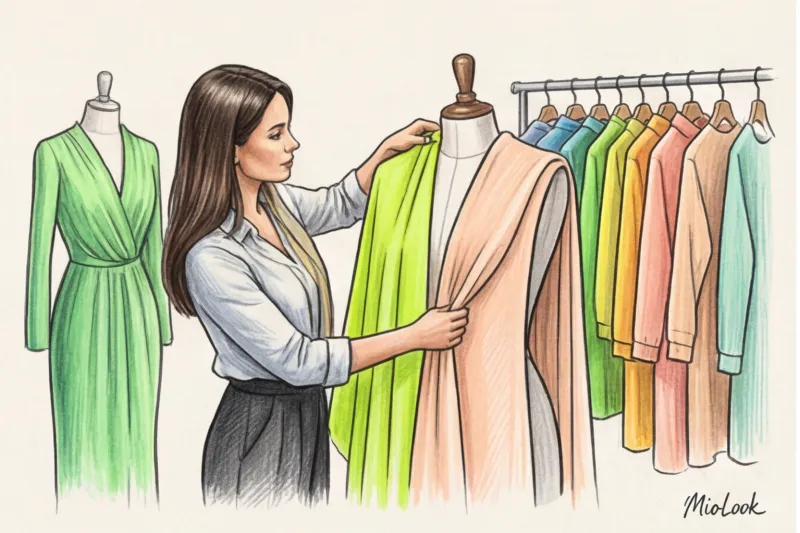
That's why it's deep analytics for the fashion business It can't work in a vacuum—it requires strict color constraints imposed by humans. When we calibrate the model, we translate the laws of color types into very specific variables: temperature (warm/cool undertones), depth, and purity of color. In the case of that particular suit, we didn't completely ignore the global trend for yellow. We simply introduced corrective parameters, and the AI suggested the perfect commercial alternative—a soft, warming shade of butter. The collection sold out with zero stock remaining.
How then can brands work with global hits dictated by the market? Take, for example, Pantone's recent Color of the Year— Peach Fuzz (peach fuzz). The Color Institute called it universal, but let's face it: warm, washed-out peach is downright yellowish on those with cool undertones.
To adapt this trend to different markets and maintain profitability, it needs to be intelligently distributed across the product range matrix:
- For "warm" types: We'll leave Peach Fuzz in the portrait area (blouses, turtlenecks, scarves). Here, the color will highlight the face and act as a social media filter.
- For "cold" types: We're moving the dangerous shade away from the face. We're incorporating it into skirts, wide-leg pants, shoes, or statement bags.
- Compromise solution: We artificially reduce the area of the color spot by using peach only in the form of a small print on a contrasting base background.
We have laid the same approach to assessing individual appearance as the basis MioLook smart wardrobe The system doesn't simply bombard the user with the season's "fashionable colors" like a random roulette. It analyzes your personal contrast ratio and suggests only those trendy shades that are guaranteed to complement your appearance, not counter it.
Access to MioLook for €0.99 — one-time payment
Start creating your perfect looks with artificial intelligence that understands your unique coloring and appearance.
Get access — €0.99 oncePersonalization at the Brand DNA Level: MioLook's Experience and Data
According to statistics from the National Retail Federation (2023), the return rate for clothing purchased online reaches a staggering 24%. Brands spend huge marketing budgets, customers pay for their shopping cart, wait for delivery, and then the item is returned to the warehouse. Why? More often than not, the problem isn't the color or quality of the fabric, but rather that the item doesn't fit or simply has no other options for wearing it. This is where in-depth analytics for fashion businesses comes into play—working with the user experience through wardrobe digitization.
Working with virtual fitting room function in MioLook Our team analyzes huge amounts of anonymized data daily. We see more than just dry purchase histories, but intentions User. This is ideal Big Data about the real-life combinations of items in everyday life. For example, while collecting statistics on business capsule collections, we discovered a surprising pattern: users are much more likely to pair wide-leg palazzo pants not with classic fitted shirts (as many conservative brands insist on in their lookbooks), but with cropped knit tops and structured vests. With such in-house product expertise, a brand can adjust the proportions of its collections even before mass production. If 70% of your audience wears high-waisted bottoms, why produce thousands of long blouses that will ruin the silhouette when tucked in?
An even more valuable layer of information is the analysis of "pent-up demand." Do you know what the most telling metric is? Items that are tried on digitally dozens of times are added to wishlists, but never They don't buy. In traditional retail, you simply see zero sales and write off the item on sale, losing, say, €15,000 on batches. Machine learning algorithms, however, can compare dozens of parameters and find the real reason for rejection, which often lies in the cut.
In my brand consulting practice, I encountered a revealing case: a stunning midi-length slip dress had phenomenal click-through rates but zero sales. A traditional marketer would have blamed the price. However, AI analysis of digital try-ons, comparing the body measurements of those who inquired about the item, revealed a structural anomaly. The dress had an excessively low armhole, which clashed visually with basic lingerie worn by women with bust sizes larger than a B cup. The brand changed the pattern by literally half a centimeter in the next batch—and the dress became a hit, selling out within three weeks.
When we understand actual fit and pairing habits, recommendation algorithms cease to be pushy "also bought" banners. They become a powerful yet subtle upselling tool. A user adds a basic trench coat for €120 to their cart, and the system instantly generates three complete looks for them using items from the same collection, taking into account their personal proportions. We seamlessly transition the customer from a one-time impulse purchase to the conscious development of a capsule wardrobe. The average order value increases exponentially because the buyer sees a complete stylistic solution, not an abstract item on a model with 90-60-90 measurements.
Capsule approach in B2B forecasting
This shift toward ready-made looks is a game-changer in global B2B planning. We're witnessing a massive shift from forecasting sales of a single, isolated item to forecasting entire "look formulas." A look formula is a mathematically precise algorithm for combining lengths, volumes, and textures, for example: "voluminous top + tight bottoms + chunky shoes".
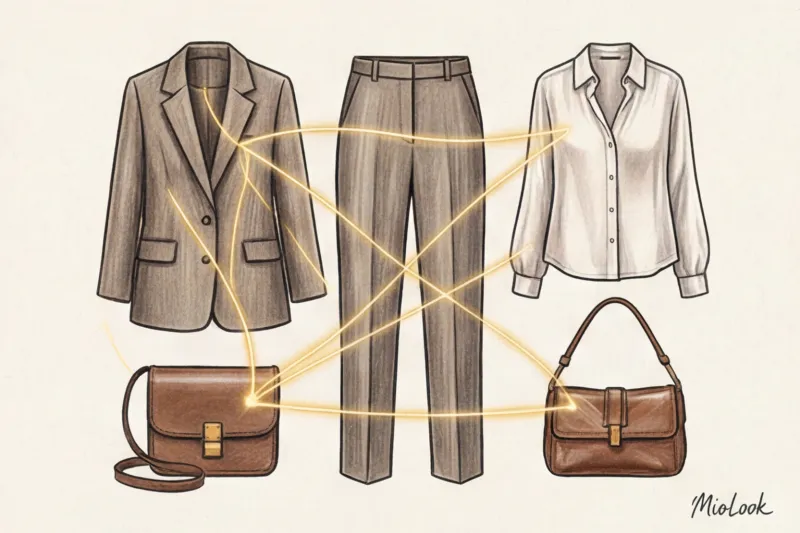
Today, progressive fashion brands no longer think in terms of "we need to release 50 skirt styles and 40 types of tops." Artificial intelligence allows them to build cross-selling matrices right at the fabric procurement stage. Imagine: you're just about to go to the international Première Vision exhibition to buy materials. A predictive model has already calculated that your target audience's fall capsule collection will require exactly 40% dense textures (wool, tweed) for bottoms and 60% flexible materials (viscose, silk) for tops, so these pieces layer perfectly without creating unnecessary visual weight.
Using AI to create perfect capsule collections protects buyers from fatal mistakes. The algorithm, having analyzed millions of successful combinations, will suggest: if you're introducing a complex, statement-making bouclé jacket (with a retail price of around €250) into your collection, you absolutely must also include at least three basic long-sleeved tops in subdued shades in the €30-€50 range. These are the ones that will complement the jacket. Otherwise, the statement piece will sit on the hangers—the customer simply won't understand how to seamlessly incorporate it into their closet.
AI Analytics Implementation: A Checklist for Fashion Brands
Commercial directors regularly approach me with the same problem: "We've invested over €10,000 in a predictive system, and it's telling us to ditch what we already know." When I begin the audit, a classic error is discovered—the algorithm simply has nothing to work with. Any analytics for the fashion business It doesn't start with expensive software, but with the routine, almost tedious, digitization of current inventory and historical sales. It's not enough for the machine to know that you sold "dress item 12345." It needs detailed, annotated data: silhouette, length, neckline, texture, fabric composition (e.g., 80% wool, 20% polyamide), and seasonal temperature conditions.
In my experience, this stage of deep integration with internal PLM (Product Lifecycle Management) systems takes three to six months. Without this strict "data hygiene," even the most advanced neural network will produce random data noise.
The second critical step in our checklist is choosing the right metrics. For years, fashion retail has relied on likes, bookmarks, and adding to carts. But for the algorithm, these are junk, overly superficial signals. The real magic happens when we feed the AI post-try-on conversion data.
I once consulted for a mid-market brand whose absolute hit—wide-leg palazzo pants—had a colossal reach on social media, but for some reason, they were constantly stuck in offline fitting rooms. By integrating data from RFID tags in smart fitting rooms and comparing it with receipts, the system identified a subtle pattern: the pants were being checked into the locker 50 times a day, but were only purchased twice. The problem turned out to be the basic size, which was hopelessly out of proportion on women under 165 cm. The AI immediately adjusted the future purchasing matrix, suggesting a strict gradation of the product lines. Petite And Tall.
The most challenging aspect of fashion consulting is seamlessly integrating AI insights into the work of the design and engineering departments. Creative teams often shy away from dry graphs, so the data needs to be translated into the language of the finished product. If a predictive model predicts a decline in global demand for oversized jackets, the engineering department should receive not just an abstract figure like "-15% sales," but a clear technical brief: "shift the focus to fitted silhouettes and modify the basic waist darts."
AI acts as the perfect, unbiased assistant here. Natural language processing (NLP) algorithms can parse thousands of customer reviews from all marketplaces in seconds and provide the designer with a ready-made summary: "In this model, the viscose shrinks significantly after the first wash, and the armholes pull the shoulder." This allows for correcting a technical error in the patterns or changing the fabric supplier before hundreds of thousands of euros' worth of rolls are ordered for a new collection.
And here we logically approach the main barrier—the human factor. Training the team to work with new technologies is almost always sabotaged by buyers. I constantly hear indignant questions at planning meetings: "Can a soulless machine really understand the aesthetics of our new collection?" My answer is always the same: buyers should never be afraid of machines.
An algorithm won't take away your ability to select key textures and shades at the prestigious Première Vision textile exhibition. It will take over the most monotonous, grueling work: calculating the size chart depth for a store in a southern climate compared to a northern location, optimizing color splits, and mathematically accurately distributing the budget between basic and ultra-fashionable capsule collections. As analysts at the WGSN trend bureau rightly point out, artificial intelligence will replace not creative buyers, but those buyers who refuse to use AI on principle. The machine simply frees up your time for pure creativity, taking over Excel spreadsheets.
Your ideal image
it begins Here
Join thousands of users who look flawless every day with MioLook. Digitize your wardrobe and let algorithms create the perfect combinations.
Get access — €0.99 onceThe Future of Industry: A Symbiosis of Man and Machine
Let's recall the Coperni spring show in Paris. The one where a liquid polymer dress was literally sprayed onto Bella Hadid's body right on the runway. Could the most advanced neural network have predicted or generated such a performance based solely on sales charts and clicks from previous seasons? Obviously not. Deep analytics for the fashion business works brilliantly with probability and historical experience, but great fashion is always built on an emotional break with the mold.
Machine learning excels at mathematical optimization. It will tell you with percentage accuracy that a double-breasted wool-blend jacket in Navy Blue has an 82% chance of becoming a commercial hit in the €150-€250 price range. But artificial intelligence will never replace a creative director for one simple reason: AI doesn't know how to rebel. Creating a revolutionary silhouette, like Christian Dior's New Look or Martin Margiela's radical deconstruction, requires human audacity. An algorithm trained on massive collections of past collections will always strive for a "safe arithmetic mean." And the arithmetic mean is the main enemy of haute couture.
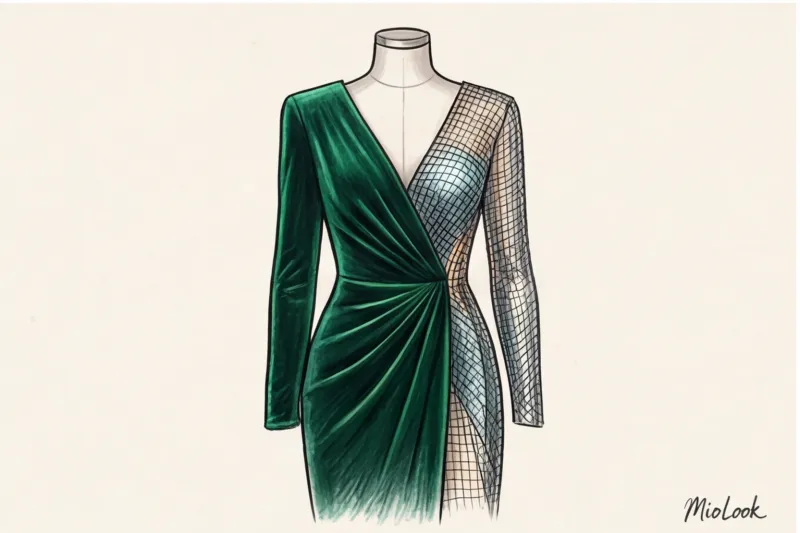
Neural networks generate the expected, while fashion sells the unexpected. Technology can guarantee that something will be bought, but only a person can make someone fall in love with it.
This is where the critical role of humans in emotionally assessing trends comes to the fore. The numbers may scream that metallic fabrics are currently at the peak of search queries. But only a human stylist or designer can grasp the social context of this sheen. An algorithm doesn't know how heavy silk feels against bare skin, how taffeta rustles when walking, or what associations a particular shade evokes in the current global context.
As a colorist and image consultant, I often audit samples generated by predictive models. Recently, an algorithm suggested a European brand launch a batch of midi dresses in a complex mustard shade, drawing on the growing microtrend of 70s aesthetics. Mathematically, everything was perfect. But emotionally, this color, in the proposed dense matte texture, looked "dirty," tired, and visually aged. My team and I adjusted the AI's recommendation: we retained the predicted silhouette and length, but shifted the color toward a more vibrant saffron with a subtle satin sheen. The result: the basic batch sold out in three weeks without a single discount. The machine gave us a commercially safe framework, and human perception breathed life into it.
The true value of digitalization lies not in replacing the creative process, but in freeing it from paralyzing routine. When a brand no longer has to manually calculate regional size charts, guess how many meters of fabric to purchase (say, €10,000 or €50,000 worth), and spend nights worrying about sluggish inventory, the team finally has the resources to create true art.
We've incorporated this same principle into our user experience architecture. When you or your customers use MioLook Algorithms take care of all the wardrobe "math"—combinability analysis, cataloging, and digitizing capsule wardrobes. This frees up time for pure stylistic creativity: choosing accent accessories, playing with proportions, and self-expression.
In the next five years, market leadership will be captured by those companies that stop pitting technology and creativity against each other. The future of the industry is a pragmatic symbiosis. Analytics provides a financial foundation, minimizing risks when releasing core collections (the 70% of the product range that generates the bulk of the revenue). And stability provides the freedom for bold experiments in the remaining 30%. Remember the main rule of the new era: the best result, unmatched by competitors, can only be achieved through one working combination— Data Scientist + Fashion Stylist.
Guide Chapters
Sustainability in Fashion: How to Beat Overproduction
Producing 100,000 eco-friendly T-shirts that will rot in a landfill is a crime. We explain why the future of the fashion business lies in accurate data.
Clothing Market Analysis: How to Adapt Collections
Global trends don't always translate locally. Learn how to intelligently adapt runway hits to regional demand.
Competitor Analysis for a Clothing Store Using AI
Forget about manually monitoring trends. Learn how AI helps fashion brands analyze competitors in seconds and sell items without discounts.
Pricing in Fashion: How to Manage Prices and Discounts
Dynamic pricing in fashion isn't about blind algorithms, but about finding a smart balance. We explore a real-life case study to understand how to manage discounts and maintain customer loyalty.
Personalization in E-Commerce: How Neural Networks Grow Sales
Old algorithms suggest buying a second black jacket, while neural networks assemble ready-made looks. We explore how artificial intelligence is changing fashion retail.
Analyzing the Target Audience of a Clothing Brand: A New Method
Traditional demographic customer surveys no longer work. Learn how behavioral data from virtual fitting rooms helps you understand your real audience.
How to Plan Clothing Purchases: AI for Buyers
Purchasing errors can cost millions. Learn how artificial intelligence helps buyers shift their intuition to precise data.
Loss-free inventory management in clothing retail
Why does relying on a "perpetual inventory" often lead to losses? We explore how consumer psychology and smart styling can help optimize inventory.
AI for Fashion Retail: Implementation and ROI Assessment
How can you stop wasting budgets on blind trust in intuition and start using data? We'll explore the step-by-step implementation of AI analytics in the fashion business.
Fashion Trend Forecasting: How AI Saves Business
How are algorithms and AI saving fashion businesses from millions in losses? We explore how modern technologies accurately identify future bestsellers.
Clothing Store Assortment Matrix: AI Without Illiquid Stock
A pattern error of just a few centimeters can freeze a season's budget. We explore how artificial intelligence is saving the fashion business from illiquid assets.
Forecasting clothing demand using AI
How AI algorithms help fashion brands avoid warehouses overflowing with deadstock and translate buyers' intuition into precise figures. A stylist's perspective on the future of fashion retail.