The Anatomy of the Perfect Sweater: What Determines Price and Quality
A client once came to me indignantly: her new €300 sweater had become covered in unsightly pilling after just two weeks of gentle office wear. Meanwhile, her vintage jumper, bought ten years ago, looked impeccable. This situation is an absolute classic in my styling practice. After 12 years of reviewing wardrobes, I've realized the most important thing: the price tag no longer guarantees quality. To understand, How to choose quality cashmere To avoid throwing money away, you need to learn to evaluate things like a professional buyer—looking not at the big brand name, but at the architecture of the thread itself.
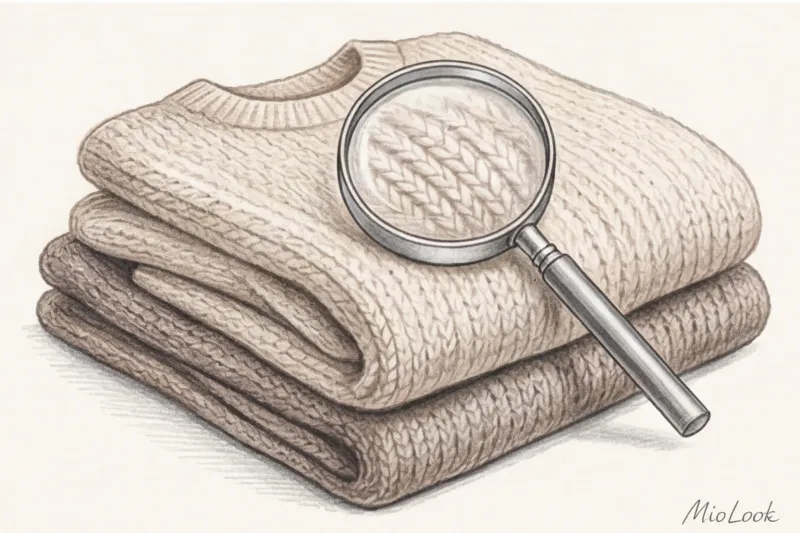
Let's start with the basics. Cashmere isn't ordinary wool; it's the finest down (undercoat) of mountain goats. Its quality is determined by two key metrics: micron thickness and fiber length. According to the strict standards of the Cashmere Manufacturers Institute (CCMI), true premium down must be no more than 19 microns thick. For comparison, human hair is about 75 microns thick. The most valuable and expensive cashmere is between 14 and 15.5 microns thick.
But thickness is only half the equation. Staple length is critical for durability. Premium brands use only long staples—34 to 38 millimeters. This is why Italian yarn from historic factories like Cariaggi or Loro Piana is several times more expensive than raw Chinese thread. It's not a matter of where the goats are grazed—the best raw down is still sourced from Inner Mongolia. The difference lies in the cleaning and spinning technologies: Italian factories ruthlessly discard short down, retaining only the longest and strongest hairs, which are then combed and spun into flawless thread.
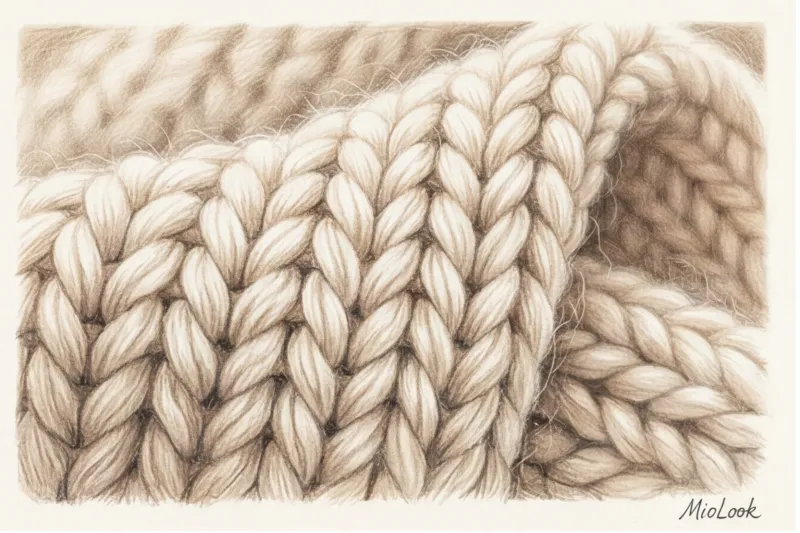
When you look at a description in an online store or at the tag of professional knitwear, look for two terms: ply (number of additions) and gauge (knitting class).
- Ply (additions) shows how many single threads the yarn is twisted from. 1-ply (single thread) is a fragile material that deforms easily. The gold standard for a quality basic sweater is 2-ply Two threads are twisted together in opposite directions, which creates tension balance and prevents seams from sagging after washing. For harsh winters, invest in 4-ply or 6-ply - This is a heavy, dense knitwear that will last for decades.
- Gauge (knitting class) means the number of needles (loops) per inch of a knitting machine needle bed. 12-gauge - This is a thin, smooth knit, ideal for layering in the perfect capsule wardrobe for the office. 5-gauge This will give you a voluminous, textured, chunky knit sweater. The rule is simple: the higher the gauge, the finer the fabric, but the more tightly the stitches are spaced.
Here we come to a counterintuitive rule: a thick sweater isn't always warmer than a thin one if the manufacturing process isn't perfect. The physics of the process is such that it's not the wool itself that retains heat, but the air pockets between its fibers. During my visit to a Milanese knitwear factory in 2019, the chief technologist showed me a vivid example in the test lab. A bulky, low-gauge sweater made of single yarn was completely draughty—it was heavy, but completely insulating. Meanwhile, a thin but tightly knit turtleneck made of 2-ply cashmere created an ideal insulating layer, blocking the escape of body heat.
Why Cheap Mass-Market Cashmere Is a Trap
Today, a sweater with the enticing "100% cashmere" tag can easily be found for $80–$100 in popular mass-market chains. It seems like there's no point in paying $400 for a similar basic item. But this savings is a classic optical illusion. To achieve such a low retail price, manufacturers are forced to make two fatal compromises.
First, they use inferior raw materials—those same short fibers (tow) rejected by luxury brands. These fibers are less than 20 mm long and physically cannot be securely anchored within the twisted yarn. The result is predictable: any friction causes the ends of the short fibers to rise to the surface and clump together. This inevitably leads to instant pilling. Your "bargain" sweater will be covered in pills on the elbows and underarms after just three wears.
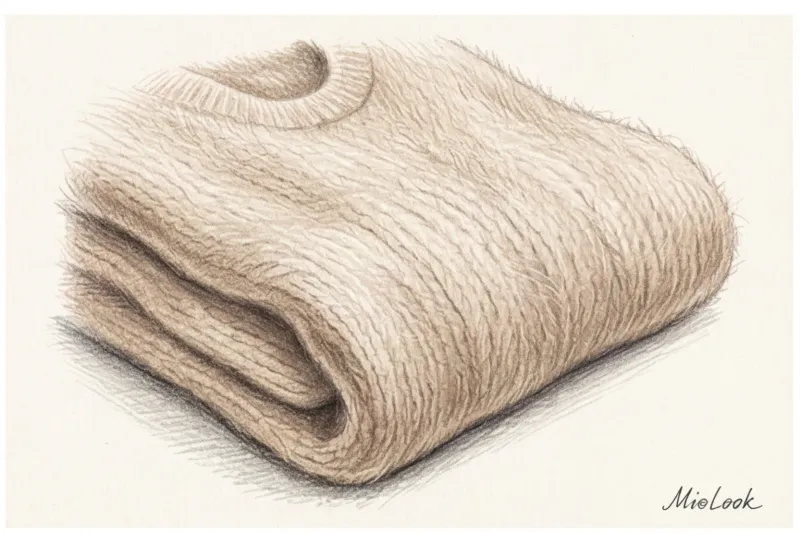
Secondly, it undergoes aggressive chemical treatment. Have you ever noticed how incredibly soft, fluffy, and almost weightless cheap cashmere sweaters seem right in the store? This tactile luxury is artificial. It is achieved through impregnation with chemical softeners and over-milling at the factory. Chemicals literally destroy the natural structure of the hair, depriving it of its natural elasticity. Real, high-quality cashmere shouldn't be excessively fluffy when purchased. When new, it may even seem slightly dense and smooth, but its true softness only truly blossoms after its first proper home wash.
Investing in knitwear requires a mathematical approach. A high-quality jumper made of 2-ply long-fiber cashmere will cost more initially, but its cost per wear (CPR) will approach zero after a few years.
Instead of buying three cheap sweaters for one season that will fall apart after the first wash, I always recommend focusing on one quality item. You can easily track such investment purchases and calculate their return on investment through MioLook — the wardrobe digitization feature clearly shows which basic items you wear most often, helping you wisely allocate your budget for truly worthwhile knitwear, which we discussed in more detail in the guide creating a capsule wardrobe.
Instructions: How to choose high-quality cashmere right in the store
When I assemble a seasonal capsule collection for private clients at Paris's Le Bon Marché or New York boutiques, I have no room for error. A basic piece costing €800 or €1,500 must repay every cent and remain pristine for decades. Too often, during wardrobe reviews, I've seen women with impeccable taste pull out hopelessly ruined, stretched-out pullovers from famous brands, purchased just a couple of months ago. To filter out visual noise, I use a rigorous audit protocol. This style checklist will help you understand once and for all, How to choose quality cashmere and avoid falling victim to marketing, whether you're in a luxury house's flagship store or the premium section of a mass-market store.
Tactile Test: The Fluffiness Trap
The most common mistake shoppers make is instinctively searching for the softest, most weightless, and fluffiest cloud on the shelf. It sounds counterintuitive, but a truly high-quality new item shouldn't It may be excessively fluffy when first tried on. If a jumper looks like it's been combed for a long time, it means the yarn was overwashed at the factory with too many chemical softeners. Manufacturers do this intentionally: the garment instantly becomes tactilely appealing and sells faster.
The hidden problem is that the fiber structure in such fabric is already broken. In practice, this guarantees the appearance of aggressive pilling (pilling) after exactly one week of intensive wear under a coat. The highest-grade thread is always dense, discreet, and even slightly dry to the touch. Its true character reveals itself later: a noble, delicate fuzz (in the industry, we call it a "halo" or "halo" no more than 1-2 mm high) is revealed only after the first proper home wash, when the fibers naturally straighten out.
Translucent Test: Reading the Knitting Density
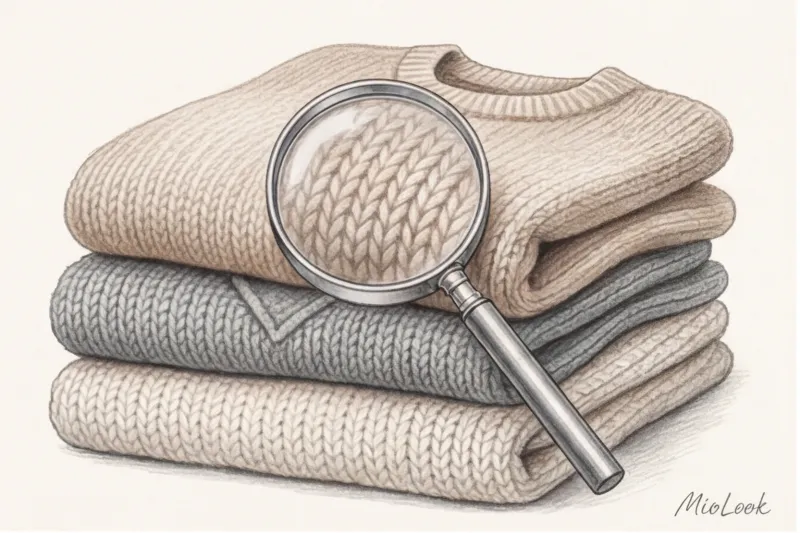
The next essential step is checking the knitting density (or, in professional jargon, tension). Hold the back or sleeve of the garment up to a window or a bright fitting room lamp. If you can easily see the outline of your fingers or the interior details through the stitches, feel free to return the garment to the hanger. Loose, slack knitting is a favorite way for unscrupulous brands to skimp on the weight of expensive materials. The sweater may appear bulky, but instead of the required 300 grams of cashmere, it only used 150 grams.
Historic Scottish knitwear mills, such as Barrie (which produces Chanel knitwear), always use maximum tension on their knitting machines. The right fabric should be solid and noticeably heavy in your hands. If you're investing in a basic wardrobe, a sweater must maintain its structure, resist wind, and not unravel under the slightest tension.
Form Return Test: Checking Vulnerable Areas
The weak point of any knitwear isn't the chest or back, but rather the moving parts—the cuffs, neckline, and hem (elastic). To test their durability, I always conduct a stress test right there in the gym.
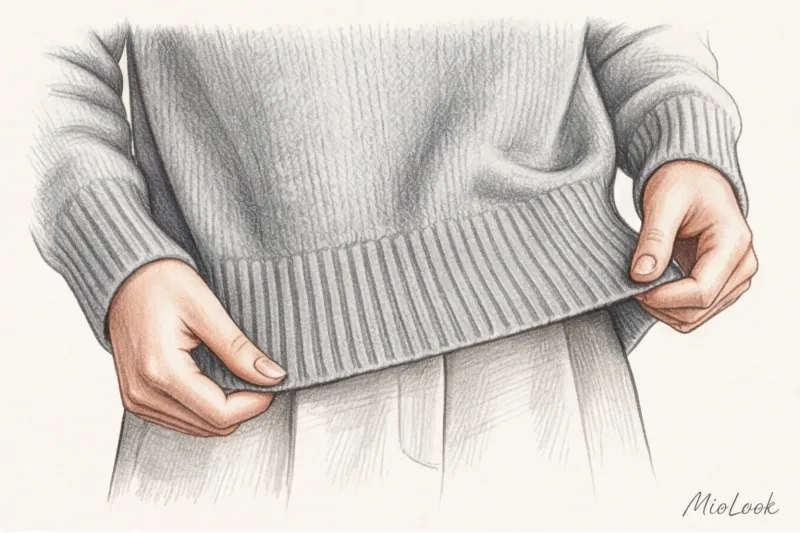
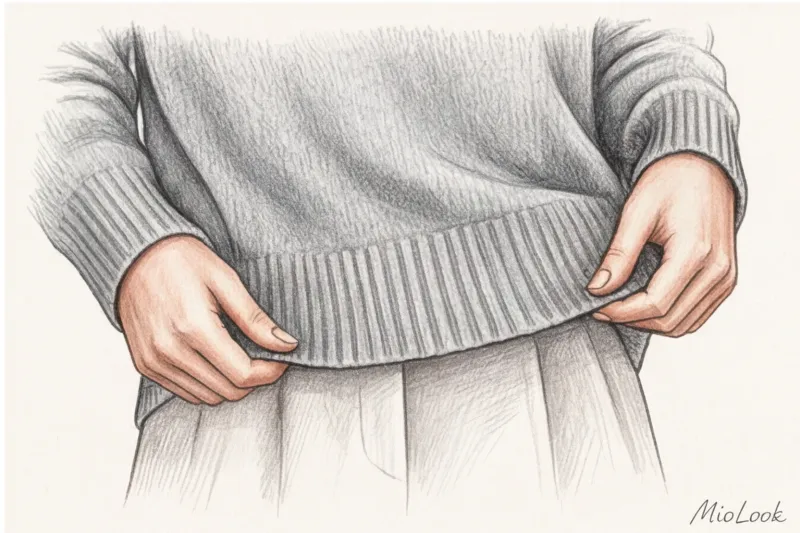
Slide your fingers inside the cuff or collar, gently stretch the elastic outward, and release it quickly. The reaction should be instantaneous, like a tight spring. If the edges close slowly, lazily, or remain even slightly deformed, it's a dead giveaway. With such a turtleneck, your elbows will turn into untidy bubbles by the evening of the first day, and the collar will become untidy and billowy after washing. High-quality, properly twisted yarn has incredible natural elasticity and genetic memory—it always strives to return to its factory-imposed shape.
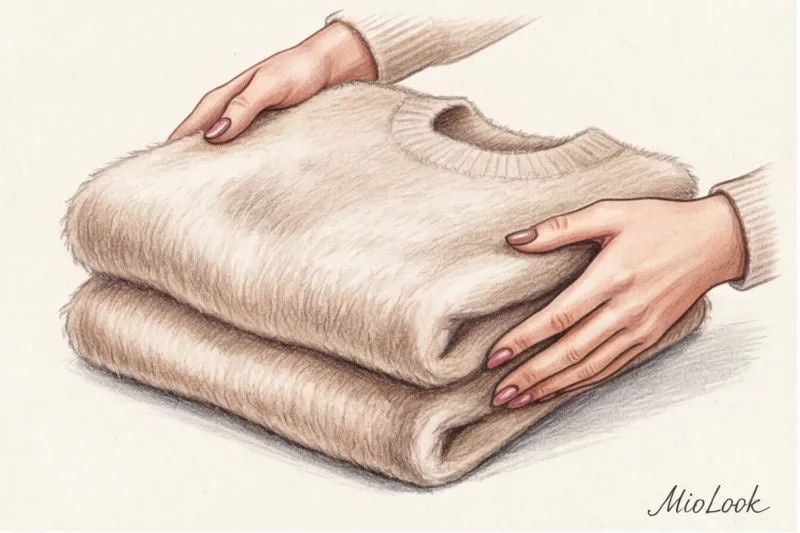
My professional advice: never judge a sweater by how beautifully it's folded on a perfect store display. Interact with the garment: evaluate the dryness of the thread, check the density against the light, pull the cuffs. Only then can you recognize true craftsmanship that will justify your investment.
Access to MioLook for €0.99 — one-time payment
A smart AI stylist will select the perfect look and help you seamlessly integrate new, high-quality knitwear into your wardrobe.
Get access — €0.99 onceWool that doesn't itch: from basic merino to luxurious alpaca
Have you ever wondered why one sweater makes your skin unbearably itchy after five minutes, while another makes you want to live in it 24/7? The answer lies in the fiber geometry. Regular sheep's wool is 30 to 40 microns thick—its stiff ends literally dig into the skin, causing micro-irritations. Working with clients with atopic dermatitis and a tendency toward contact allergies, I've developed a rule of thumb: if we don't use premium down, we exclusively use high-tech merino wool.
Unlike traditional wool, Australian merino fiber (particularly the Extra Fine grade) is finer than 19.5 microns. These fibers bend softly when in contact with the skin, rather than prickling. If you're carefully researching how to choose high-quality cashmere but realize you need something more durable for everyday office wear, Extra Fine merino will be your best investment. It boasts phenomenal wearability: its smooth, almost silky texture doesn't pille as quickly as its fluffier counterparts. A thin merino turtleneck under a jacket looks as classy as a silk blouse, but fits seamlessly into a formal business dress code, maintaining a neat appearance even after a busy workday.
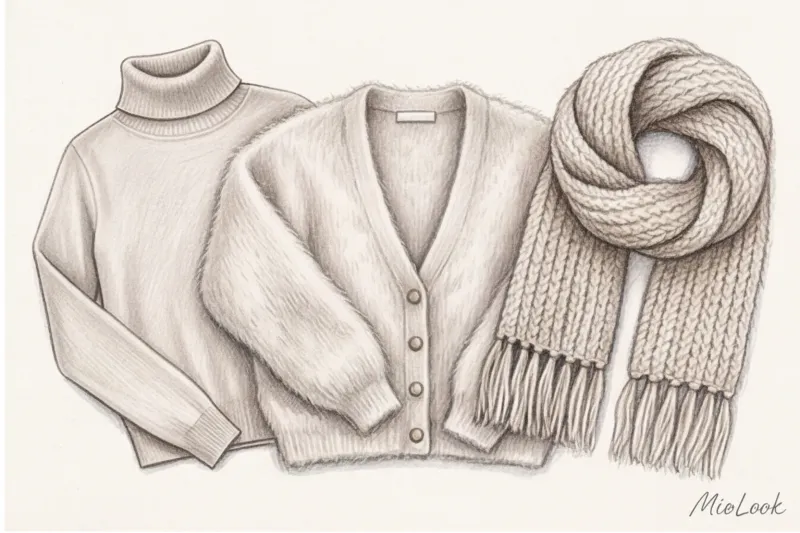
Let's compare the physical properties of the leading fibres on the knitwear scene. According to The Woolmark Company Textile Institute, the thermal conductivity of wool is directly related to the structure of the curls that trap air. Cashmere is undoubtedly the leader in terms of warmth-to-weight ratio, providing eight times more warmth than regular sheep's wool. However, in terms of wear resistance, merino is far superior due to its high natural elasticity – the yarn can stretch up to 30% of its length and return to its original state without deformation.
At the same time, alpaca surpasses sheep's wool in thermal insulation thanks to the microscopic air pockets within the hair itself. It's also completely free of lanolin (animal wax), making it 100% hypoallergenic. If merino is the foundation of a wardrobe, then baby alpaca and mohair are its architectural accents. But here we encounter a stylistic trap: textured, fluffy knitwear visually adds volume. How can you wear it without looking two sizes too big?
- Rule of contrasting textures: Never pair a fluffy mohair cardigan with thick, matte wool trousers. Pair it with smooth, reflective materials, such as a silk slip skirt or leather trousers. The difference in texture will offset the extra weight in the silhouette.
- Exposed areas (micro-exposure): Choose baby alpaca jumpers with a deep V-neck or pull up the sleeves to show off your most delicate features—your collarbones and wrists. This creates the illusion of fragility beneath the voluminous garment.
- Architectural cut: Avoid shapeless "cocoons" made from long-haired yarn. Look for styles with a clearly defined shoulder line or an asymmetrical hem to create geometric lines.
"Oversized knitwear requires airiness. If the top is fluffy and chunky, the bottom should be simple and flowing"—that's the mantra I repeat at every fitting.
To avoid getting confused by complex texture combinations, I recommend planning such looks in advance. Using smart wardrobe feature in MioLook , you can virtually put together outfits with a mohair sweater and make sure the proportions of the silhouette are harmonious and the accent piece really flatters your figure.
The 100% Composition Myth: When Additives Make Knitwear Better
Discover the online boutiques of Brunello Cucinelli or The Row—the undisputed pillars of that very same "quiet luxury." If you carefully examine the compositions of their iconic jumpers, priced at $2,000 and up, you'll be surprised to discover that not every one is made exclusively of pure cashmere or wool. For many of my clients, this is a real revelation. We tend to demonize any additives, instinctively considering them an attempt by the brand to cut corners on production. But in the premium segment, clever blended fabrics are not a financial compromise, but a complex architectural concept.
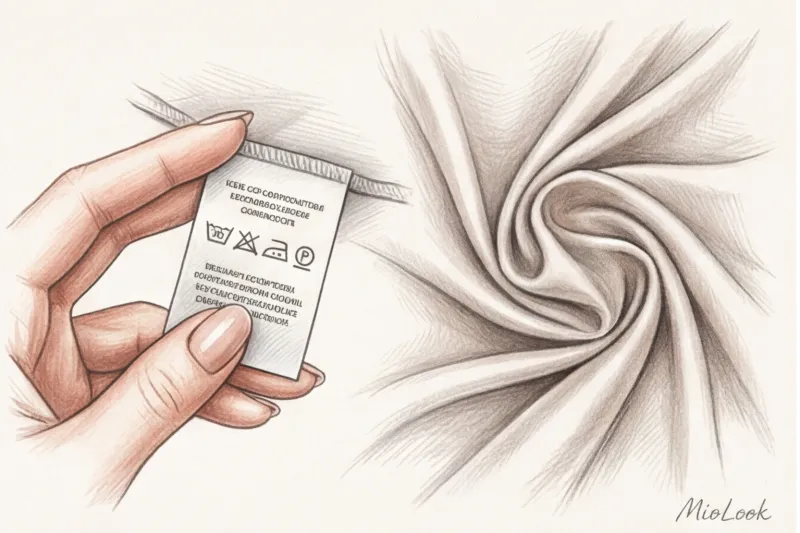
Let's once and for all dispel the stereotype that any synthetic material is an absolute evil. Of course, if you see 70% acrylic and 30% wool on the tag, it's best to leave it on the rail: it will create a greenhouse effect and become covered in hard pilling after a week of active wear. However, technological additives in microdoses work like the steel load-bearing structures in a historic building: they don't alter the noble façade, but they prevent it from deforming.
In my personal capsule collection, I have a basic turtleneck that has served me flawlessly for five seasons now. The secret to its phenomenal longevity lies in its composition: 85% merino wool, 12% polyamide (nylon), and 3% elastane. It's this technical blend—the golden rule dictates that it should make up strictly up to 15% - acts as an invisible frame.
- Nylon (polyamide) It bears the brunt of the mechanical load. It literally saves your elbows from the treacherous strain of an eight-hour workday at the computer and protects the delicate fabric from fatal shrinkage during washing.
- Elastane works like a spring, instantly returning the cuffs and neckline to their original tight shape even after repeated wearing.
While synthetic threads provide durability, the addition of other natural fibers alters the very physics of the fabric. A wool/silk blend (usually 70/30) is a textbook recipe for intellectual chic. Silk acts as an internal porthole, imparting a delicate, luxurious satin sheen to the knitwear that is physically impossible to achieve with matte pure wool.
According to The Woolmark Company Textile Institute, incorporating smooth silk fibers into wool yarn dramatically improves drape. The garment no longer feels stiff and begins to flow gracefully, following the contours of the body.
This property is critical when choosing loose-fitting cardigans, maxi dresses, or wide-leg knit trousers. Run your hand over a quality blended fabric: it should feel slightly cool thanks to the silk or springy under your fingers thanks to the elastane, but it should never produce a characteristic synthetic "squeak." Understanding these architectural nuances of yarn is a key skill for those seeking the answer to the question of how to choose high-quality cashmere and basic wool without succumbing to blind faith in the marketing magic of the "100% natural" label.
Access to MioLook for €0.99 — one-time payment
Start creating your perfect looks with AI. Upload your favorite knitwear pieces and plan your capsule collection in one click.
Get access — €0.99 onceProper care: how to extend the life of cashmere and wool for decades
My first big payday at a Parisian glossy magazine went on a flawless pearl-gray sweater from Loro Piana. I was so afraid of ruining it that after a couple of washes, I took it to the most expensive dry cleaner in the Marais. When I picked it up a week later, I nearly cried: the luxurious fluff had disappeared, and the fabric had become stiff and flat, like cardboard. This painful loss of €800 became my most important lesson. You can meticulously study all the rules governing how to choose high-quality cashmere, but one wrong care decision will ruin even premium yarn in a matter of days.
Washing vs. Dry Cleaning: A Destructive Myth
The tags of most designer sweaters bear the categorical "Dry clean only" symbol. Brands are simply playing it safe, absolving themselves of legal liability for the possibility that a buyer might accidentally boil their garment in the washing machine. In practice, traditional dry cleaning is a slow poison for cashmere. Harsh solvents like perchloroethylene mercilessly strip the natural oils from the fibers. As a result, the thread dries out, loses elasticity, becomes brittle, and begins to break, causing pilling to occur.
A paradox rarely discussed by boutique consultants: cashmere goats live in a harsh, humid climate, so their down literally requires water. Hand washing isn't just safe—it's essential for the regeneration of the fleece. Water helps the fibers open up, restoring their original fluffiness and volume.
Process Chemistry: Temperature and Lanolin
If you still prefer machine washing, use only the certified wool cycle, which doesn't spin the drum fully but gently oscillates the items, simulating hand washing. But this is where the chemistry of the process comes into play.
The main enemy of fur isn't hot water itself, but sudden temperature changes. If you wash at 30°C and rinse in ice-cold water, the hair scales are thermally shocked and shrink dramatically. This is how a sweater in your size turns into a Chihuahua's coat. Maintain a consistently cool temperature throughout the process.
Choosing a detergent requires uncompromising attention. Absolutely no detergents or capsules containing enzymes (proteases). These enzymes are designed to break down protein stains, and wool is made of the protein keratin. Enzymes literally dissolve your knitwear from the inside out. Use only liquid detergents containing lanolin. Lanolin is a natural animal wax that coats each fiber, restoring its dirt-repellent properties.
My professional advice: Wool has powerful natural antibacterial properties. You should wash a sweater a maximum of 1-2 times per season; the rest of the time, it's enough to let it "breathe" in the fresh air or run it over it with a steamer from a distance of 10 cm. To avoid wearing things out and washing them out of inertia, I mark wear cycles in MioLook app This smart wardrobe feature clearly displays usage statistics and protects delicate fabrics from unnecessary mechanical stress.
Drying architecture: the horizontal rule
Wet wool weighs three to four times more than dry wool. If you hang a damp sweater on a hanger or place it through a metal drying rack, gravity will permanently distort the shoulder seams and stretch the sleeves to the knees. Proper drying takes time.
First, gently squeeze out the water without wringing the fabric (think of it as making a snowball). Then, lay the garment on a thick terry towel, roll them together into a tight roll, like a yoga mat, and press lightly with your full weight. The towel will absorb excess moisture without damaging the fibers.
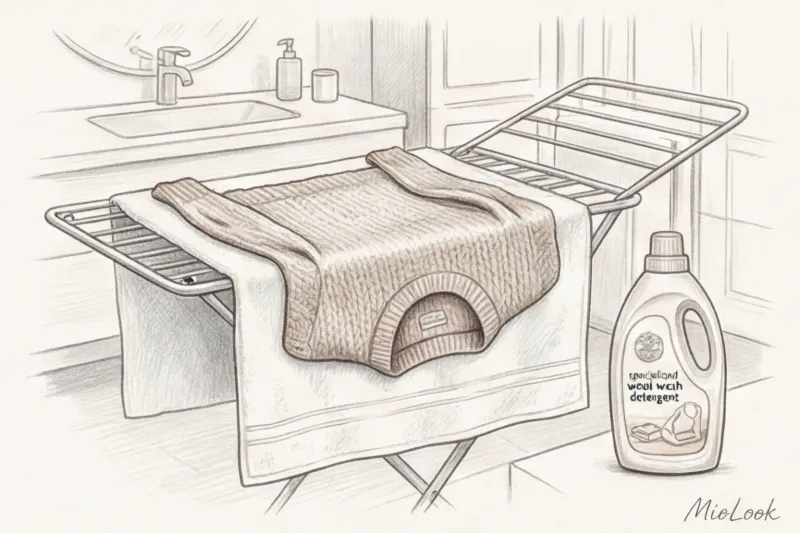
After this, lay the knitwear out on a flat, horizontal surface away from direct sunlight and radiators. Be sure to shape the damp garment by hand: push the seams back into place slightly, and straighten the elastic at the waist and cuffs. Wool has excellent structural memory and will dry exactly as you left it.
Enemies of knitwear: fighting pilling and protecting against moths
Seeing the first signs of pilling on a freshly purchased €600 jumper is not for the faint of heart. Even if you've thoroughly researched how to choose high-quality cashmere and purchased a flawless piece, pilling in the early stages is practically inevitable. And no, the brand isn't lying; it's just a matter of physics. Pilling appears on absolutely any premium knitwear in areas of constant localized friction.
The main culprits of everyday wear and tear are car seat belts and the stiff straps of crossbody bags. When you sling your favorite saddle bag or leather tote over your shoulder, the stiff edge literally pulls short lint fibers to the surface, where they immediately curl into microscopic balls. This natural process of "shedding" excess lint typically ceases after the first couple of washes.
But how do you combat this? Forget about the popular electric pilling machines when it comes to investing in an investment wardrobe. Machine blades can't distinguish where the loosened lint ends and the main thread begins. One too-hard press, and the machine cuts off part of the fiber, leaving a microscopic hole that will inevitably become a run in the next wash. For fine fabrics, only one safe tool is recognized: a special cashmere comb. It doesn't cut, but rather gently combs out the felted lint, smoothing the yarn structure. Lay the sweater on a flat surface, hold the fabric taut, and comb it with short, firm strokes in the direction of the knitting.
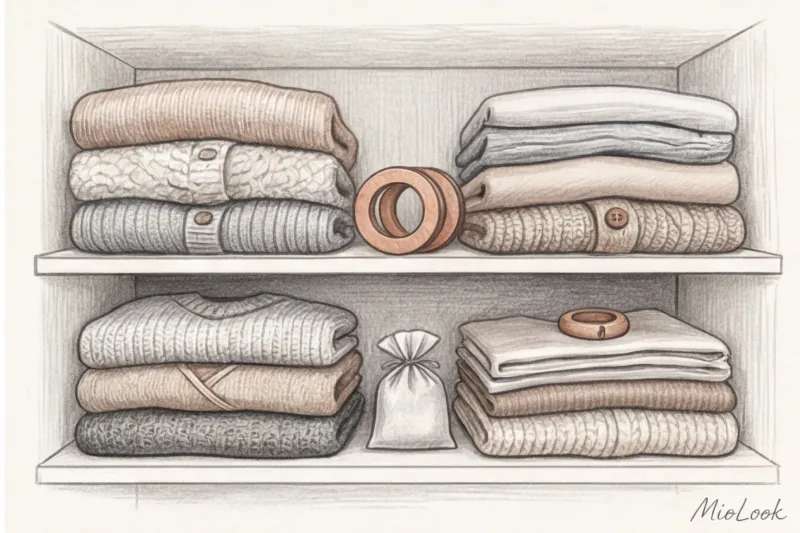
Your knitwear faces another tough test this off-season. While sorting through and preserving my clients' spring wardrobes, I regularly see the results of fatal storage mistakes. Never store wool in vacuum bags or sealed plastic containers. Wool is a natural protein and critically needs to breathe. In plastic, it suffocates, dries out, turns yellow, and develops an ineradicable musty smell. The only reliable solution is to use coffers made of breathable cotton or dense linen.
And, of course, clothes moths, for whom the keratin in your sweaters is a prime delicacy. Grandma's mothballs are long overdue for the dustbin of history: they're toxic and irreparably ingrained into the fibers, clashing with your perfume. Modern care protocols include exclusively natural repellents. Add a cloth sachet of dried lavender or blocks of unsanded red cedar to each trunk. To ensure the wood remains effective and continues to release insect-repellent essential oils, I recommend lightly sanding the cedar blocks with fine-grit sandpaper once a season.
Your ideal image
it begins Here
Join thousands of users who look flawless every day with MioLook.
Get access — €0.99 onceIntegrating quality knitwear into a modern wardrobe
According to the report Vogue Business (2024) on the global transformation of corporate dress codes, the trend toward "soft tailoring" has forever changed our perception of work uniforms. Rigid jacket designs give way to flexible forms, and this is where premium yarns come to the fore.
A thin cashmere turtleneck as an alternative to a formal shirt in a business dress code. The days when office status was emphasized solely by starched poplin are over. Today, a thin rollneck conveys the aesthetic of the Ruler archetype: elegant, uncluttered confidence. The key to a flawless business look lies in the thickness of the thread. Knowing how to choose high-quality cashmere (ideally 16-gauge, which we mentioned earlier) ensures the perfect base layer for a structured, menswear-inspired blazer. Unlike a heavy sweater, a thin rollneck doesn't bunch up at the waist and visually elongates the silhouette. My advice: avoid pure black near the face—in artificial office lighting, it often emphasizes fatigue. Opt for shades of dark chocolate, cool taupe, or rich camel—they look significantly more expensive and softly illuminate the skin tone.

V-neck sweater: proportion correction and layering. While the classic crewneck is far from forgiving of all figure features, the V-neck silhouette is a powerful tool for optical illusion. Stylistically, it acts as a central vertical axis: luxuriously elongating the neck and delicately balancing out volume in the décolleté. This is crucial knowledge for those with an apple or inverted triangle body type, where the primary goal is to lighten the upper body.
This season, I recommend taking inspiration from the intelligent styling of The Row. Wear a pullover with a moderately deep V-neck over a tailored light blue shirt, but don't button the collar all the way up. Let the cuffs casually peek out from underneath the knit. For a more sensual evening look, wear the V-neck solo over a silk lingerie top with lace trim—the contrast between matte and glossy textures is always eye-catching.
Chunky knit cardigans in a smart casual style. The transition from formal office essentials to relaxed outfits requires playing with volume. Chunky knit cardigans are no longer the exclusive preserve of country trips. In contemporary urban styles, they work beautifully in contrast. Pair thick, heavy knits with flowing satin midi skirts or perfectly tailored palazzo pants with pleats. This is the pure aesthetic of the Explorer archetype—free-spirited yet composed.
To prevent a bulky item from turning you into a shapeless square, follow two rules. First, pay attention to the hardware: horn or metal buttons instantly increase the price of the item, while cheap plastic is a sign of mass-market clothing. Secondly, be sure to use the technique French tuck (When the front edge of the cardigan is slightly tucked into the waistband of trousers or a skirt.) This will instantly define the waistline even under the heaviest layer of wool.
Managing such complex layering combinations in your head can be challenging. We often buy a luxurious textured cardigan for $400 and then wear it with the same jeans every time, simply because we don't have time to experiment in the morning. To avoid this style rut, I recommend loading your basics into MioLook app The look designer feature allows you to visualize how a new voluminous top will work with different bottoms from your current capsule wardrobe in just a few clicks.
Knitwear isn't just a functional layer for warmth. It's the most tactile, enveloping, and intimate element of your wardrobe. Your micro-assignment for today: open your closet and take an honest inventory of your essentials. Do you have a flawless, second-skin turtleneck? Does your V-neck fit properly? Are your everyday looks getting enough texture? Fill these gaps thoughtfully, because now you know exactly what makes true quality and how to ensure these pieces last not just one season, but decades.
Guide Chapters
Silk and cashmere for summer: the perfect basic knitwear
Forget about wrinkle-prone linen. We'll tell you how the right knitwear can save you from the heat outside and the freezing air conditioners in the office.
The ideal composition of a quality sweater: how much synthetic material?
Should a good jumper be 100% natural? We'll explore why synthetics in premium items aren't a scam, but a guarantee of durability.
How to store knitwear in a closet: hang or fold?
The golden rule of "fold sweaters" doesn't always work. Learn the key secrets of storing knitwear to prevent them from warping.
Why does a sweater itch and what to do about it: stylist's advice
Bought a beautiful jumper, but can't wear it because it's so uncomfortable? We'll tell you how to save the itchy garment and what kind of wool to choose for sensitive skin.
How to Protect Woolen Items from Moths: The Best Methods
Lavender is no longer effective. We'll tell you how to protect expensive cashmere and premium wool from moths using professional storage standards.
How to Wash Mohair: Secrets to Caring for the Fluffy Knitwear
Washed your fluffy sweater and it turned into a stiff felt boot? Learn how to properly care for delicate knitwear to preserve its weightlessness.
How to wash and dry a cashmere sweater properly
Dry cleaning is ruining your premium knitwear. We'll tell you how to properly care for cashmere so it lasts for years and only gets softer.
How to remove pilling from clothes: tips from a stylist
Forget about razors and dangerous folk life hacks. A professional stylist explains how to properly care for your favorite knitwear.
The difference between cashmere and wool: which is warmer in winter?
Expensive cashmere doesn't always protect you from the cold. We explore the properties of premium yarn and discover which material will truly keep you warm this winter.
A sweater has shrunk after washing: how to stretch it back
Has your favorite wool sweater turned into a baby item after washing? A stylist explains how to save delicate knitwear and avoid common mistakes.
How to check cashmere for authenticity: buyer's advice
A high price tag is no longer a guarantee against disappointment. Learn the secrets of professional buyers to help you distinguish genuine cashmere from cheap counterfeits.