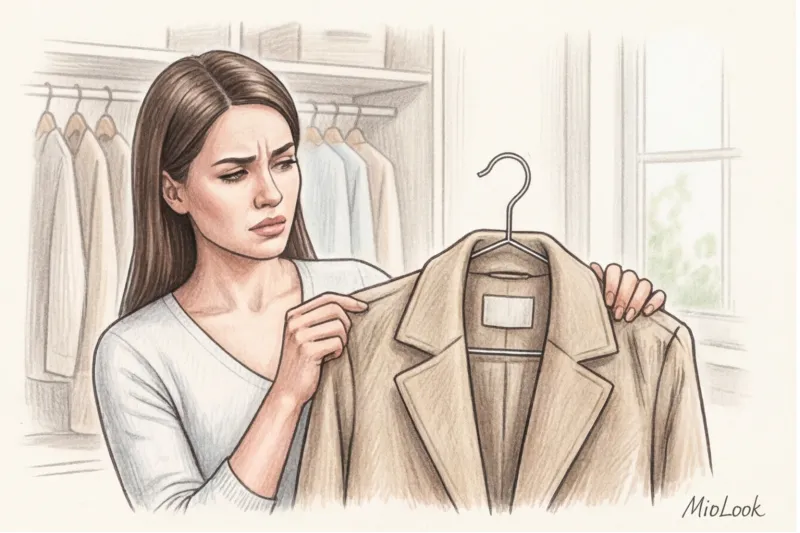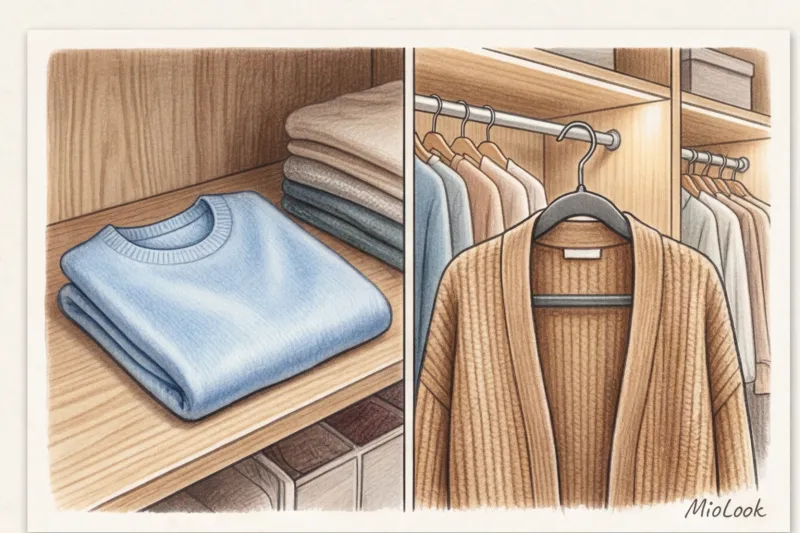
Two years ago, a client came to me with tears in her eyes. She was holding a luxurious €150 Massimo Dutti cardigan, which had transformed from an elegant garment into a shapeless mess with elongated "ears" at the shoulders and a hem of varying lengths. The reason? She'd hung the heavy knitwear on a thin wire hanger from the dry cleaner and left it in her closet for three months. Physics had done its job: gravity had simply destroyed the architecture of the expensive yarn.
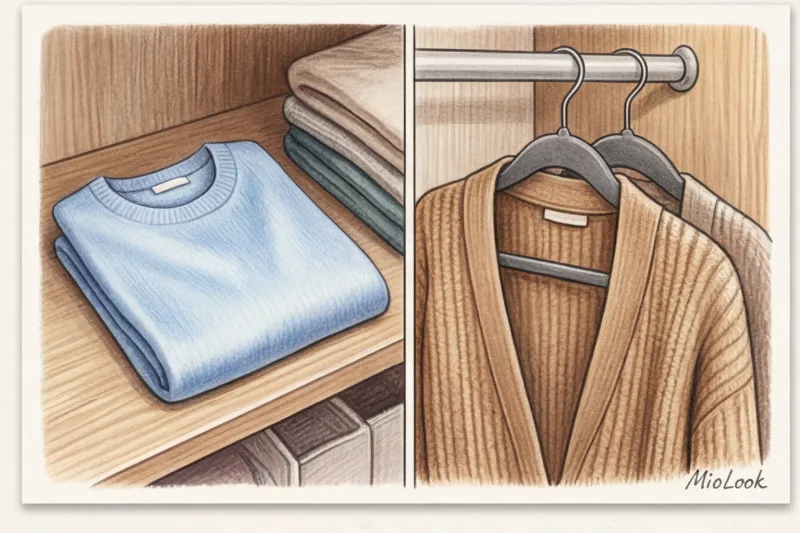
The question is, How to store knitwear in a closet , isn't just a whim of space organizers. It's a question of the longevity of your wardrobe investment. And while the golden rule is "hang shirts, fold sweaters," after 12 years of sorting through European wardrobes, I've realized that in the reality of modern compact closets, this rule doesn't always apply. Sometimes folding is out of the question. And sometimes, hanging requires a completely different logic.
If you want to understand the nature of delicate fabrics, I highly recommend you take a look at our Guide "How to Choose Quality Cashmere: Stylist's Advice" , where we take a detailed look at the structure of thread. And today we'll talk about pure practicality: how to organize storage so that things last for years, not just until the first seasonal cleaning.
Fold or hang: how to store knitwear in a closet without losing its shape
The main secret that buyers and merchandisers in the premium segment are taught: the storage method does not depend on the name of the item (jumper, cardigan, pullover), but on architecture of the thread and the weight of the product itself.
Italian textile manufacturers have strict standards in this regard. Twisted wool thread has what's known as "memory" and elasticity. When you hang an item in the traditional way, gravity begins to pull the thread downward. The heavier the item, the faster it becomes irreversibly deformed.
We're used to thinking that only cheap items can be ruined. In reality, it's quite the opposite. A cheap acrylic sweater from a mass-market store will survive a nuclear winter on any hanger because the plastic holds its shape perfectly. But premium merino or cashmere requires the same care as crystal.
Anatomy of deformation: what things should absolutely not be hung
Never, under any circumstances, hang two categories of items on regular hangers:
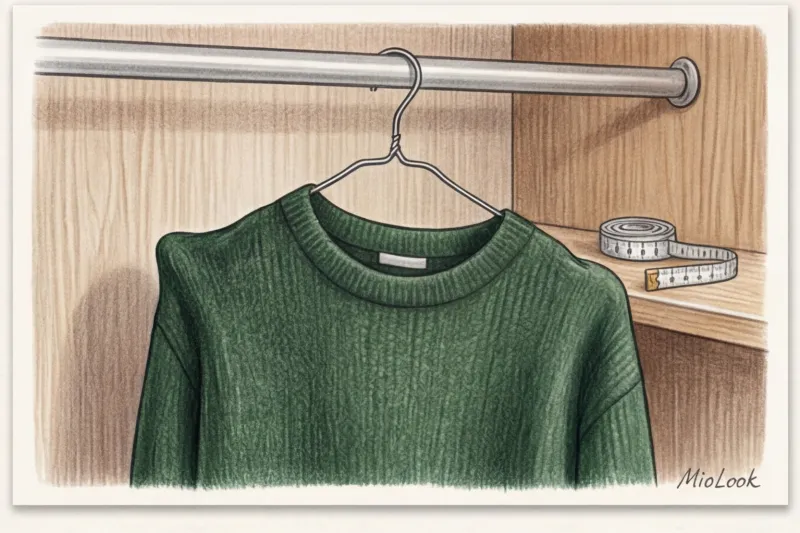
- Chunky knit sweaters. A bulky winter cardigan can weigh between 800 and 1000 grams. Imagine a kilogram weight pulling down the armhole 24/7. After just a week, the loops will stretch by 10-15%.
- Premium fine cashmere. The finest cashmere fiber is less than 19 microns thick. This thread is too delicate for spot loading.
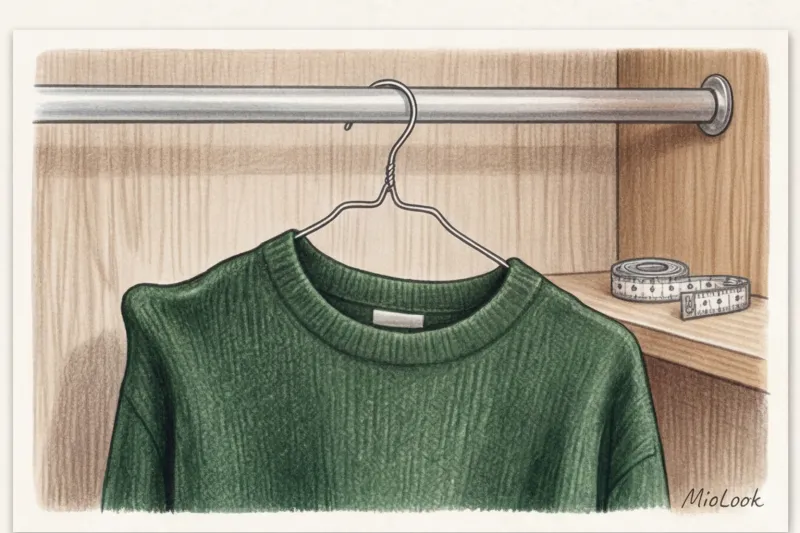
"The development of so-called 'shoulder horns' is a death sentence for knitwear. Once the fiber has burst or stretched where it touches the edge of a cheap hanger, it's impossible to restore it to its original shape with a steamer."
Exceptions to the Rule: What You Can Safely Send to the Barbell
But are there any things that can still be hung the traditional way? Yes. If you collect smart casual office wardrobe and if you need to quickly navigate through your things in the morning, feel free to hang them up:
- Dense knitwear with added synthetics. Items from Zara or H&M that contain 30-40% nylon or elastane. The synthetic frame will prevent the item from stretching out.
- Products made of dense viscose. It is heavy, but its thread is woven differently - it flows rather than springs.
- Fine gauge turtlenecks. But only if you use the right ones wide shoulder pads that follow the anatomical slope of the shoulder, rather than digging into it with sharp ends.
Your perfect look starts here
Join thousands of users who look flawless every day. Let AI organize your closet.
Get access — €0.99 onceBuyers' Secret Method: How to Hang a Sweater Without It Stretching Out
What if your closet has almost no shelves, but three hanging rods? European wardrobes often suffer from this layout. There's an elegant solution to this problem: the Savile Row drape technique. This method allows you to safely store even heavy 100% cashmere on the rails.
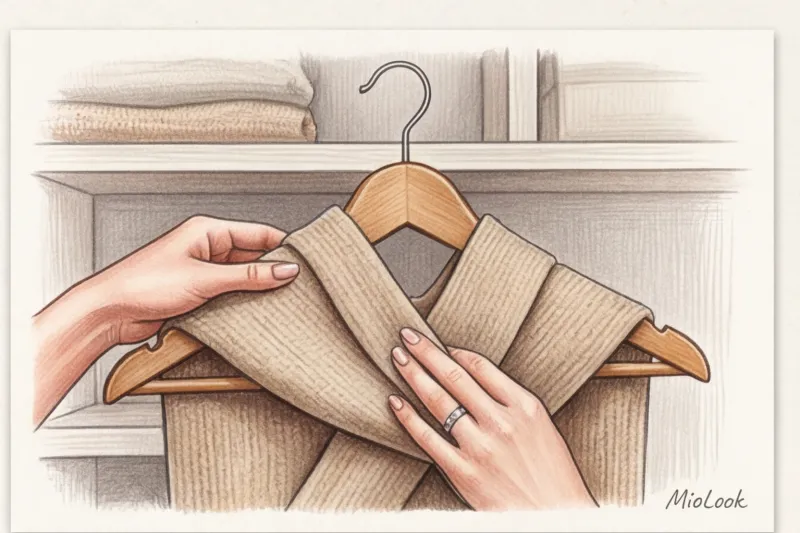
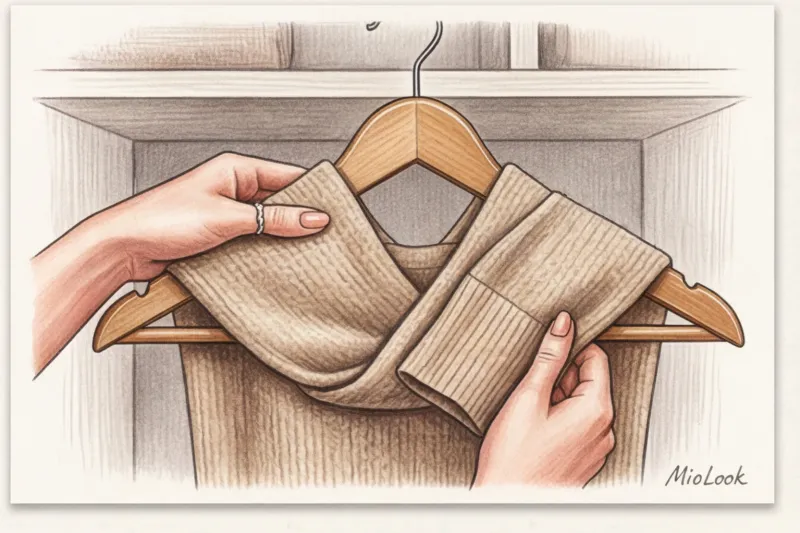
Step-by-step instructions:
- Lay the sweater on a flat surface with the right side facing you.
- Fold it in half vertically (so the sleeves match up). You'll get an "L" shape.
- Take a hanger and place it on top of the sweater so that the hook is in the armpit (between the sleeves and the body).
- Place the sleeves over one shoulder of the hanger and the bottom of the body (hem) over the other.
As a result, the weight is distributed evenly, the seams are not strained, and the garment takes up minimal space. To save space, use thin velvet hangers (flocked)—the friction of the pile will prevent the sweater from slipping. For extremely heavy cardigans, choose thick wooden hangers with a round bar at the bottom.
The Perfect Stack: Shelf Storage Architecture (and the Biggest Mistake Newbies Make)
It would seem that what could be simpler than a shelf? Fold it and forget about it. But this is precisely where the most subtle mistake lies, the one that ruins the properties of natural wool. I call it the "Tower of Babel syndrome."
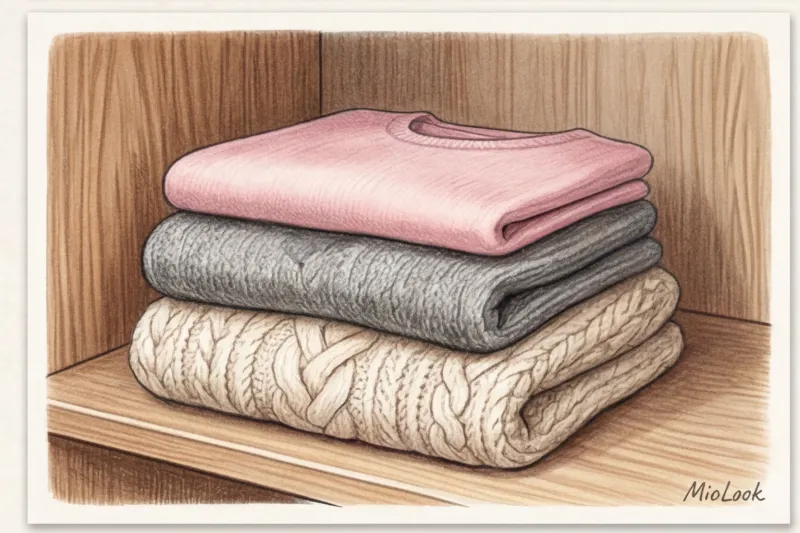
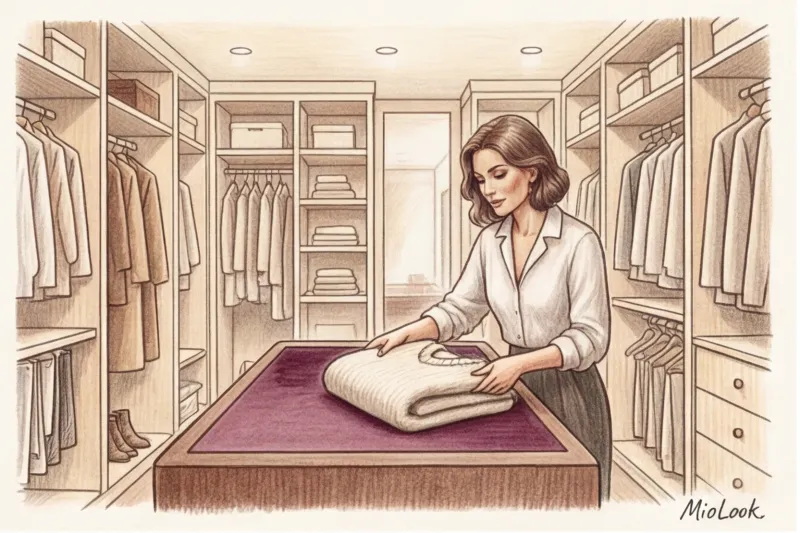
Studies of the thermal conductivity of fabrics show that it's not the wool itself that warms, but the microscopic pockets of air between the fibers. If you stack seven or eight sweaters, the top layers create pressure, which flattens the fibers of the bottom layers. Deprived of air, the yarn becomes matted, thins, and loses its warming properties.
The Three-Four Rule and Weight Hierarchy:
- The maximum stack height is 4 items. Anything more will damage the bottom layer.
- At the very bottom are always heavy, voluminous cardigans and chunky knit sweaters.
- At the very top rests fine cashmere and merino silk.
Many people ask me, "What about the Marie Kondo method of vertical storage in drawers?" The KonMari method is ideal for T-shirts and jeans, but it's often not suitable for bulky winter knitwear. If you roll a thick, chunky knit sweater too tightly, you'll create unnecessary stress in the stitches. Save vertical storage for thin turtlenecks.
To avoid having to remember where everything is and rummaging through stacks looking for the right color, I recommend digitizing your closet. Add your sweaters to MioLook - this will greatly simplify the compilation capsule wardrobe and will allow you to plan looks directly on your phone, without disturbing the perfect order on your shelves.
Seasonal Preservation: How to Protect Wool from Moths and Loss of Volume
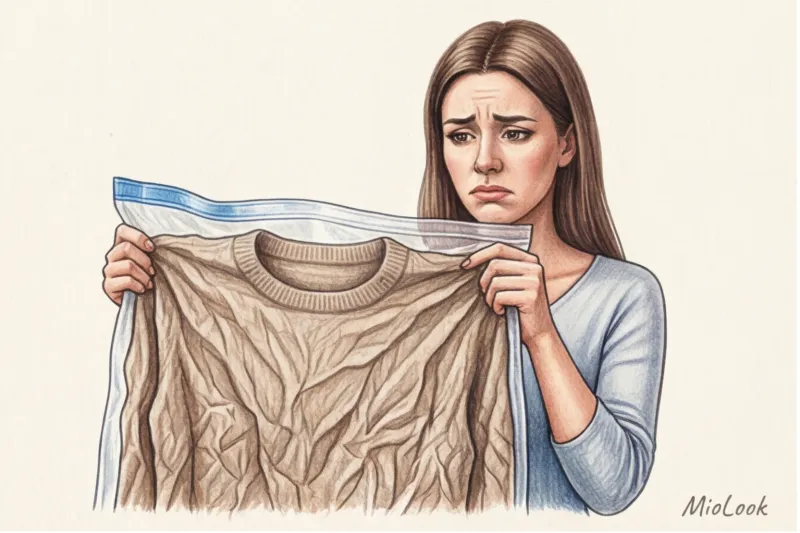
It's April. You're putting away your winter clothes until November. And here we encounter the most pernicious myth of our time: "Vacuum bags are the best space-saving solution."
According to the Cashmere Manufacturers Institute (CCMI) protocols, vacuuming is fatal to staple-length natural wool fibers. By removing air, you create unnatural pressure that literally breaks the hair structure. Cashmere and premium merino wool lose their fluffiness forever after six months in a vacuum. You'll end up with a stiff, flat piece of wool that no dry cleaner can restore.
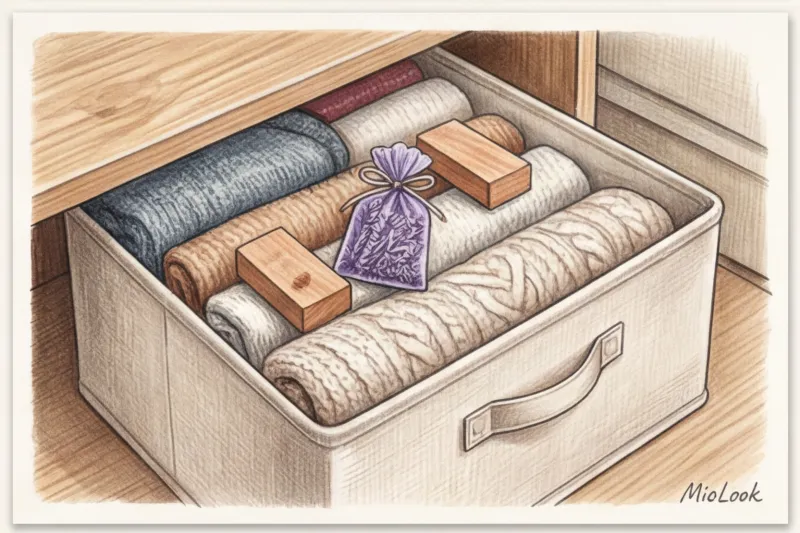
How to properly prepare knitwear for summer:
- Total wash. Did you know that moths don't actually feed on clean wool? Their larvae are attracted to keratin—microscopic particles of our skin, traces of sweat, and drops of perfume. A perfectly clean sweater is of little interest to moths. Never put away an item you've worn even once.
- Breathable packaging. Instead of plastic, use canvas storage boxes made of thick, breathable cotton with zippers. They protect against dust and insects while still allowing air to circulate.
- Natural repellents. Forget the mothballs from grandma's trunk. Add natural red cedar balls or lavender sachets to your trunk. An important nuance: Essential oils evaporate. Cedar balls need to be lightly sanded every three months to renew their scent, otherwise they will become useless pieces of wood.
Ready to get your space in perfect order?
Try the MioLook free plan to digitize your wardrobe and create capsule collections without commitment.
Get access — €0.99 onceChecklist: A Weekend Knitwear Wardrobe Revision
Theory without practice is dead. I don't want you to just read this article and close the tab. Take just 15 minutes this weekend to audit your shelves. It will save you hundreds of euros in replacements.
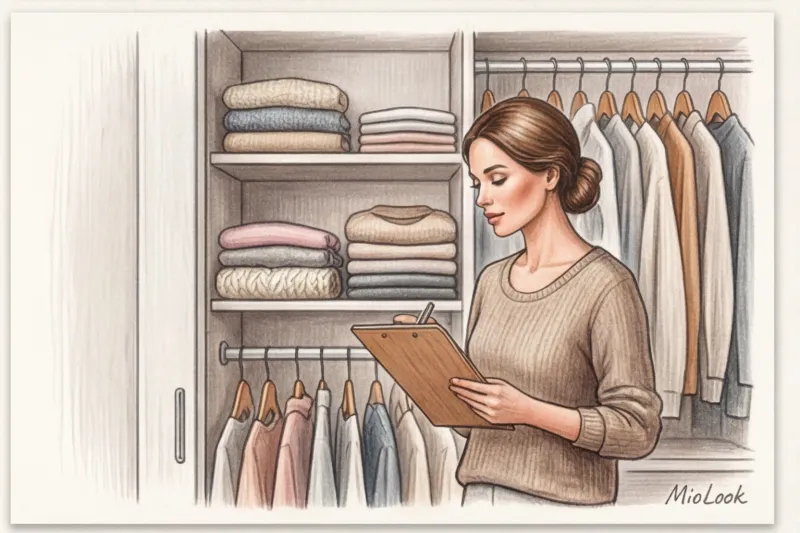
Here's your action plan for Saturday:
- Step 1: Destruction. Go through your closet and collect all the wire hangers from the dry cleaner. Throw them away or recycle them. They have no place in a grown woman's wardrobe.
- Step 2: Sorting. Divide the knitwear into two piles: thick synthetics/viscose and natural wool/cashmere.
- Step 3: Re-weighing. Take everything that should be hanging on the bar and hang it using the Savile Row drape method (over the bar). Free the shoulders of your sweaters from gravity's torture.
- Step 4: Shelf architecture. Create new piles, no higher than 4 items high. Place the thickest and heaviest cardigans at the bottom, and the lightweight cashmere jumpers at the very top.
- Step 5: Check for purity. Smell and inspect items you plan to put away in the back of your closet. If you have the slightest doubt about their freshness, throw them in the wash.
Proper wardrobe storage isn't about an obsessive-compulsive urge to color-code everything. It's about respecting the labor that went into purchasing your clothes and an eco-friendly approach to consumption. When your knitwear breathes and doesn't shrink, your favorite sweater will still fit perfectly in five or ten years.