Why knowing how to care for your clothes is the foundation of a smart, budget-friendly wardrobe
Have you noticed how often we complain about the quality of modern clothes? A sweater shrinks after a month, pants lose their shape, and a T-shirt becomes warped after the first wash. Over the 12 years of working as a personal stylist, I regularly hear clients complain that "they sew worse these days than they used to." There's some truth to that, but the reality is this: How to care for clothes , affects its lifespan far more than the brand name on the tag. We're simply too accustomed to solving every wardrobe problem with daily machine washing.
Let's be honest: why do items from Zara, COS, Massimo Dutti, or & Other Stories often lose their appearance so quickly? It's not because they're inherently disposable. European mid-market brands are now actively using blended fabrics: short-fiber wool, fickle viscose, modal, and elastane. When you throw a viscose blouse from & Other Stories into a universal cycle at 40°C with a 1000 rpm spin, its fibers literally break from the mechanical friction of the drum and the sudden temperature change. There's only one way to prevent this: stop washing items out of inertia and start reading the ingredients.
My closet organization method is based on a simple financial concept. Cost-per-wear (cost per wear). This is the perfect metric, clearly demonstrating the direct link between ecology and savings. Let's calculate this using the example of a basic pantsuit for €150.
Let's consider two scenarios. Scenario one: you wear a suit frequently and machine wash it every two weeks. Due to harsh chemicals and the centrifuge, the adhesive interlining inside the jacket's lapels bubbles, and the fabric fades. After one year (about 30 wears), the suit is thrown in the trash. Your cost per wear is €5. Scenario two: you properly care for the same suit. You air it out after office use, blot spot cleans, and use a handheld steamer instead of an iron. The suit lasts four years (120 wears). The cost per wear drops to €1.25.
Extending the life of just one basic item by a year saves you money. Statistically, extending the life of clothing by just nine months reduces its carbon footprint by 20-30%. And extending the life of your entire wardrobe by one year directly impacts your shopping budget, saving you an average of €300 to €800 annually in expenses previously spent on replacing worn-out shirts and shrunken jumpers.
"A closet isn't a museum or a graveyard of bad purchases. It's your working tool, where every element should earn its keep."
My main rule as a stylist is strict: every item must earn its place in the closet. You've already invested in it, so make that investment last longer. To clearly see which items are truly worth their weight in gold and which are simply taking up hangers, I recommend my clients digitize their wardrobes using MioLook — the app is great for tracking what you wear most often and calculating the actual cost of an item. We've covered more about how to wisely create a base and avoid unnecessary spending in our complete guide to eco-friendly wardrobe.
The Biggest Myth: Why Frequent Washing Is the Enemy of Your Wardrobe
Did you know that about 70% of the wear and tear on everyday clothing occurs not while being worn, but inside the washing machine? A 2020 study from the University of Leeds demonstrated that microfibers are destroyed and washed out by the mechanical friction of the drum and hot water. High temperatures expose the fiber scales, making them vulnerable, while the harsh spinning action acts like sandpaper, stripping the fabric of its color and original shape.
However, the main problem lies not in technology, but in our psychology. Most of us have developed a persistent habit: wear something once, throw it in the laundry basket. Even if you spent two hours dining in an air-conditioned restaurant, your blouse or T-shirt automatically gets thrown in the wash. This reflex stems from a reluctance to hang "stale" clothing back in the closet with clean clothes, which ultimately leads to the infamous "chair-with-clothes" syndrome in the bedroom.
A stylist's golden rule: a washing machine is only for removing physical dirt, not for refreshing items. If the fabric doesn't have stains or a distinct sweat odor, it doesn't belong in the drum.
What alternatives to washing are there? The simplest and most effective is airing them out. Natural fibers (wool, linen, cotton) release odors very well if hung on the balcony for a few hours. Another popular practice is freezing jeans. In 2014, Levi's CEO Chip Bergh publicly stated that he hadn't washed his jeans for a year, preferring to put them in the freezer. But I must warn you: from a microbiological standpoint, this is only partially effective. Low temperatures don't kill odor-causing bacteria, they merely send them into hibernation. As soon as the denim warms up again from your body heat, the odor may return. Freezing is suitable for emergency situations, but it's not a substitute for proper care.
So how do we solve this problem on film sets and at fashion shows? When we have a 12-hour shift and a model needs 15 outfit changes, washing designer clothes is simply impossible. An insider secret I learned from theater costume designers is using a spray bottle with regular, inexpensive vodka. We pour the vodka into a spray bottle (sometimes diluted 1:1 with water) and spray it on the underarms and backs of jackets, dresses, and heavy sweaters. The alcohol instantly kills odor-causing bacteria and then evaporates completely, leaving no trace or vodka-like odor.
Access to MioLook for €0.99 — one-time payment
Digitize your wardrobe to see exactly what items are in active rotation and avoid unnecessary washing. A smart AI stylist will help you find the perfect look for every day.
Get access — €0.99 onceHow to freshen up a suit or jacket without dry cleaning
One of the most expensive mistakes I regularly see in clients' wardrobes is over-dry cleaning structured items. Recently, I received a beautiful double-breasted jacket from Massimo Dutti for €170 that was hopelessly ruined after just one season. Its lapels had developed unsightly wrinkles and bubbles.
Why does this happen? To give the jacket its rigid shape, a special interlining is used—a special material that is fused to the main fabric under pressure. Harsh chemical solvents in dry cleaning (such as perchloroethylene) gradually dissolve this interlining. The fabric peels away from the frame, and the garment loses its appearance. Dry cleaning should be done no more than once or twice a year, at the end of the season.
Instead, make a handheld steamer your best friend. Hot steam not only smooths out creases but also kills 99% of bacteria, restoring volume to the fibers.
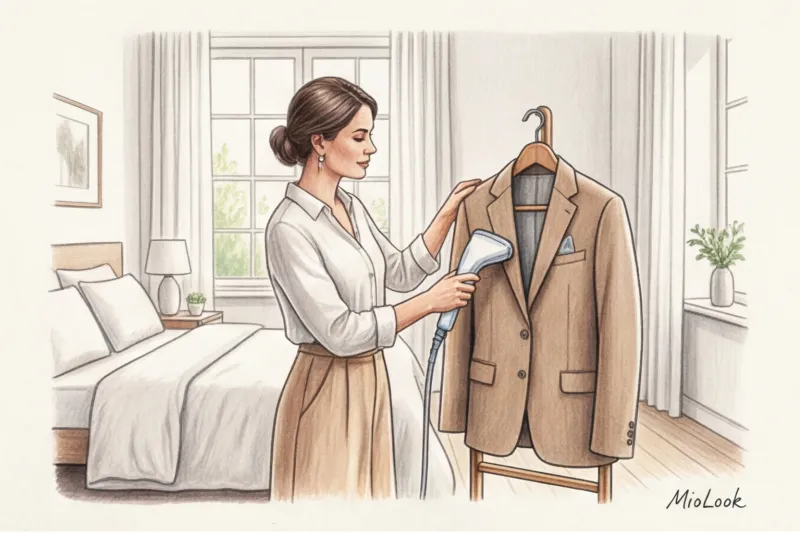
It is important to use the steamer correctly: not just move it through the air, but create tension With one hand, pull the bottom edge of the jacket or trouser leg down, and with the other, press the steam nozzle firmly against the fabric (if the material allows), slowly moving it from top to bottom.
What if you get a coffee stain on your sleeve? Forget about aggressively rubbing with a damp cloth. Intense rubbing will damage the dye and texture of the fabric, leaving a whitish mark that can't be removed. The correct method for spot cleaning is blotting Apply a drop of mild detergent or soapy water to the stain and gently blot (pat) it with a clean white cotton cloth, working from the edges of the stain toward the center to avoid spreading the stain over an even larger area.
Material Specifics: How to Properly Care for Clothes Made from Different Fabrics
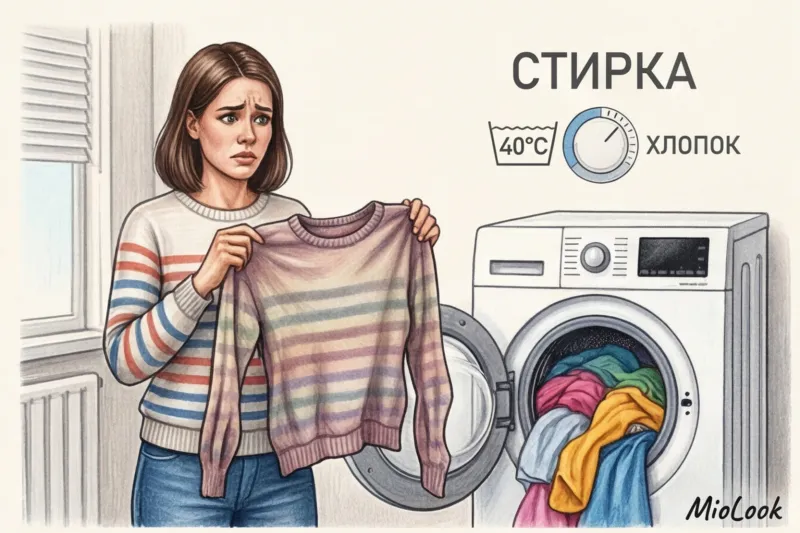
If you peek into the bathroom of nine out of ten of my new clients, the washing machine dial will be permanently locked on the universal "Cotton 40°C" cycle. It's a convenient habit that slowly but surely destroys your investment. Cotton can tolerate a lot, but for 80% of the modern wardrobe—consisting of blended fabrics, capricious viscose, and elastane—40°C and a standard spin cycle are a veritable death sentence. The fibers lose elasticity, the dye bleeds, and the fabric becomes thinner.
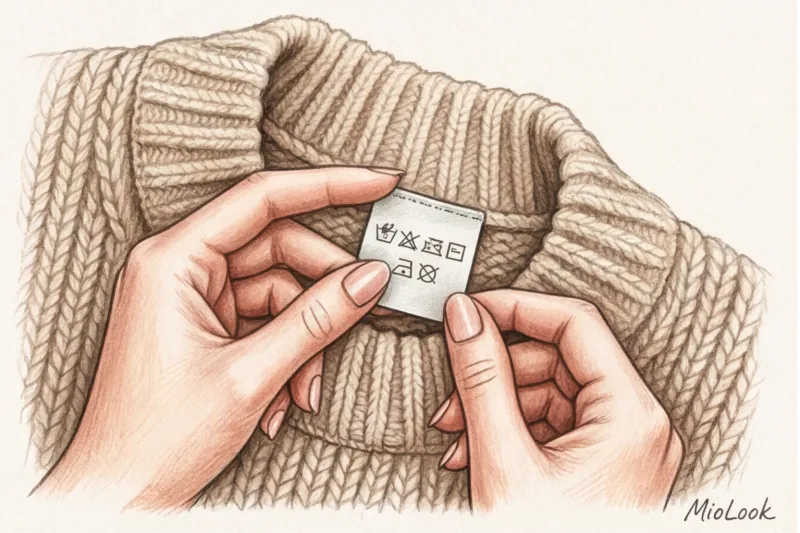
And here a reasonable question arises: how can you wash clothes if half the labels have a crossed-out basin icon? Let's debunk the popular myth about the "Dry Clean Only" label. The mass-market industry, including beloved brands like Zara, H&M, and Mango, is terrified of mass returns of defective items. From a legal perspective, it's much cheaper and safer for a manufacturer to slap a "dry clean only" tag on any complex dress or viscose blouse than to deal with complaints from customers who threw the item in the dryer with jeans. In reality, over 60% of items labeled "dry clean only" can be gently hand-washed at home in cool water, provided you understand the nature of the fiber.
The tag on mass-market clothing is often not a care instruction, but rather a shield from the brand's lawyers against your claims. Read the fabric composition, not the washing instructions.
To understand the cost of a mistake, I'll share a real-life example. Last winter, my client Anna bought a perfect basic 100% merino sweater from Massimo Dutti for €120. A couple of weeks later, she called me almost in tears: after the first machine wash, the luxurious garment had turned into a thick felt boot that would barely fit a small dog. Anna swore she'd chosen the delicate cycle and a special gel. But she hadn't taken into account the basic laws of physics, which no expensive product can circumvent.
Natural wool, cashmere and silk
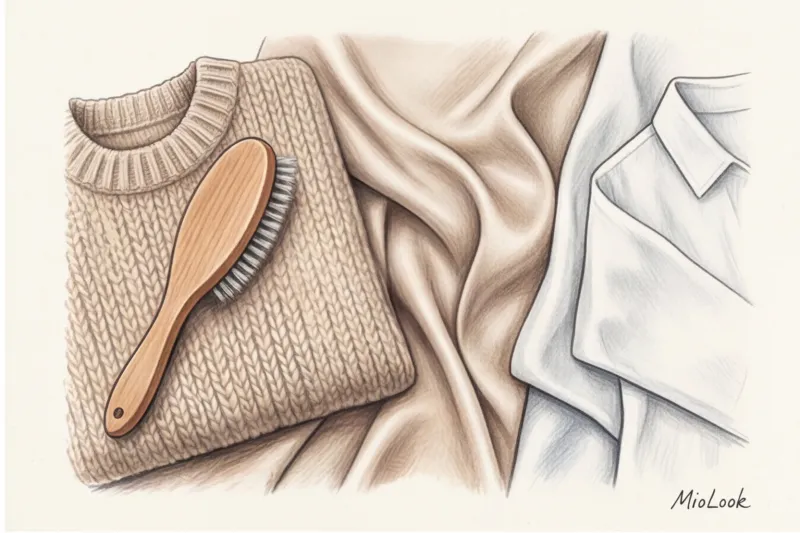
Let's look at the mistake with the merino sweater. What killed the €120 item was temperature shock Woolen items shrink not so much from hot water (although this is harmful), but from sudden temperature changes. A washing machine heats the water to 30-40 degrees Celsius for the main cycle, but begins the rinse cycle with ice-cold water, which comes directly from the pipes. This contrast causes the microscopic scales of the natural wool to suddenly close and become inextricably intertwined. This is the process of felting. The sweater doesn't simply "shrink"; its structure is irreversibly altered.
My top tip for expensive sweaters: wash them as little as possible. Natural wool has a unique self-cleaning property thanks to the lanolin in its fibers. If your cashmere sweater from COS has absorbed restaurant odors, don't throw it in the washing machine. Simply hang it on the balcony on a cool, damp night. Within 8-10 hours, the fresh air will draw out all the odors, and the fibers will be saturated with moisture and restore their original fluffy volume.
Natural silk is a protein fiber similar in structure to human hair. Therefore, I never use washing powders when hand-washing silk items—their harsh alkaline environment kills the shine. My go-to product is regular, clear baby shampoo with a neutral pH. It gently dissolves sebum, preserving the silk thread's natural shine and smoothness.
Synthetics and blended fabrics (viscose, polyester)
While wool is sensitive to temperature fluctuations, viscose is a completely different fabric. Being a man-made fiber made from natural cellulose, viscose dramatically changes its properties in water. When wet, it loses up to 50% of its strength and becomes stiff, literally "wooden" to the touch.
This is where the real tragedy happens: if wet viscose is vigorously rubbed by hand, twisted, or spun at high speeds in a washing machine, the fibers become deformed. After drying, the garment can shrink dramatically. The secret to working with viscose is to wash it with gentle blotting motions in room-temperature water and dry it flat. To avoid having to remember all these nuances for each specific blouse, I recommend my clients record the fabric composition information in their notes immediately after shopping. MioLook - It really takes the strain off your brain when sorting laundry.
Pure synthetics (polyester, nylon, fleece) don't shrink, but they pose two other problems. The first is a global one: microplastics. Every time you wash a fleece sweatshirt harshly, thousands of plastic microfibers are flushed down the drain, unfiltered by wastewater treatment plants. A gentle wash at 30 degrees Celsius not only protects the fabric but also makes a real contribution to the environment.
The second problem is purely practical: static electricity. In winter, synthetic fabrics spark, and you're tempted to pour in more fabric softener. But I strongly advise avoiding this toxic chemical. Industrial fabric softeners coat the fibers with a thick silicone film, which completely prevents the fabric from "breathing," causing the skin underneath to sweat. How can you avoid static electricity without causing harm? Simply run a regular metal hanger or slightly damp hands over the inside of your synthetic dress before going out. Metal and water instantly remove static charge without destroying the properties of the material.
Eco-friendly washing: saving the environment, fabrics, and your budget
According to the European Environment Bureau (EEB)'s 2023 report, lowering the washing temperature by just 10 degrees—from the usual 40°C to 30°C—reduces the carbon footprint of each cycle by 35%. But for me, as a practicing stylist, the second part of this data is far more important: cool water extends the life of fabric by an average of 20%, as the fibers are significantly less susceptible to wear and tear and retain their pigment.
The gold standard of modern care is 30 degrees. Most of us, out of habit, wash our clothes in warm water, forgetting that household chemical manufacturers have long since changed their formulas. Modern laundry detergents contain complex enzymes that effectively break down protein stains (sweat, sebum) in a cool environment. Moreover, aggressive heating above 40 degrees Celsius simply deactivates these enzymes. The habit of "boiling" cotton T-shirts from COS or basic shirts from Zara has long since lost its meaning and only accelerates their journey to the landfill.
However, for the enzymes to work effectively and for the clothes to not turn into a lumpy mess, proper drum loading is critical. This is where the reliable one-palm rule Place the laundry in the machine and slide your hand vertically over the garments. If your hand fits easily between the top of the drum and the items without resistance, the load is ideal. Overloading the clothes will simply compress them in the soapy water without proper circulation, while underloading creates excessive mechanical stress, literally knocking the threads out of delicate blouses.
Now let's talk about the biggest marketing scam of all: fabric softeners. I strongly recommend my clients eliminate them from their routine entirely. Fabric softeners work like a thick hair mask: they coat the strands with an artificial silicone film. This is fatal for many items of clothing. The elastane in your favorite jeans (which gives them a perfect fit) quickly loses its elasticity under the influence of fabric softener, and after just a couple of months, you'll have blisters on your knees. In sportswear (leggings, bras), this waxy film completely clogs the pores of the technological membranes, depriving them of their ability to wick away moisture. And expensive terry towels simply stop absorbing water due to this type of care. If you're looking for softness, add half a cup of regular white table vinegar to the rinse compartment—it washes away residual alkali, restores softness to the fabric, and leaves a completely odorless finish.
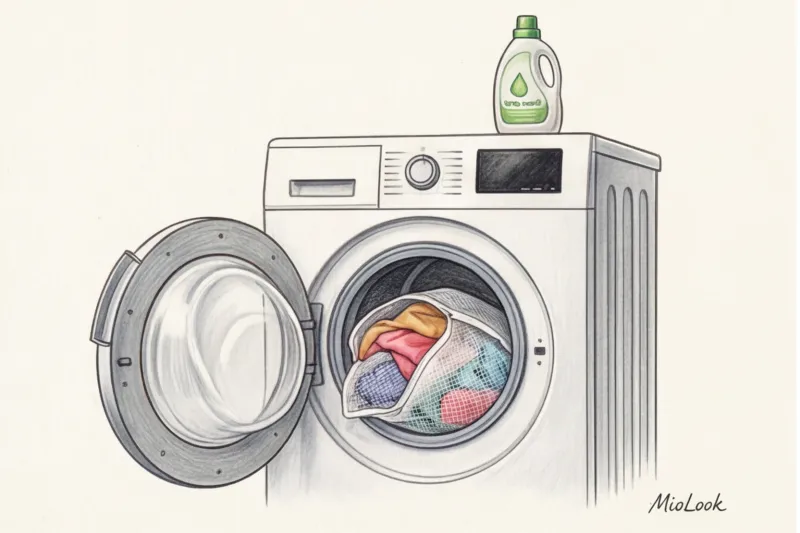
For synthetics and blended fabrics, which dominate mass-market collections, filtration is a must. I recommend investing in high-quality laundry bags (the undisputed leader in the European market is Guppyfriend). This is a brilliant investment, costing around €30, that accomplishes two things at once. First, the patented mesh traps microplastics, preventing them from entering wastewater (polyester and fleece shed invisible plastic fibers with every wash). Second, the bag reliably protects delicate items from zippers and the hard hardware of adjacent garments.
Ultimately, how you care for your clothes before they're washed determines how many seasons they'll look expensive. If you're unsure which items require mesh insulation, get into the habit of categorizing them in advance. See the appendix. MioLook You can create a separate tag for items with a complex blended composition—this way you'll never forget that that particular jumper requires careful handling and a temperature of exactly 30 degrees.
Access to MioLook for €0.99 — one-time payment
Start creating perfect looks with the help of artificial intelligence and extend the life of your favorite items with smart wardrobe organization.
Get access — €0.99 onceDrying and ironing: where we make the most expensive mistakes
Imagine throwing a €50 banknote into the trash every time you run a wash cycle. Sounds absurd? But that's exactly what happens when clothes aren't dried and ironed properly.
Machine drying is the main enemy of elastane, elastic, and viscose. The high temperature in the tumble dryer doesn't just dry them; it bakes and destroys the fine synthetic fibers responsible for stretch. This is why your favorite jeans quickly start to unsightly bag at the knees, and expensive underwear loses its shape. Viscose reacts even more dramatically to hot drying: the fabric can shrink so unpredictably that a size M blouse can turn into a size XS.
The second fatal mistake is hanging wet clothes on hangers to dry. Water makes the fabric several times heavier. Under the merciless force of gravity, the damp fibers inevitably stretch. If you hang a knit top or a basic cardigan this way, by morning you'll have stretched shoulders with marks from the hanger edges (the notorious "ears") and a hopelessly misshapen, sagging hem.
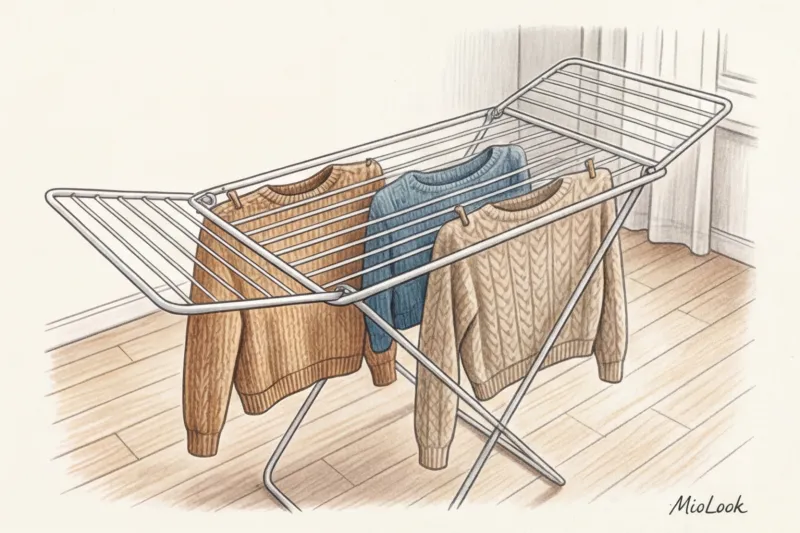
For any knitwear there is only one ironclad rule - flat drying.
In my practice, I often see damaged heavy knitwear. My main advice: if you need to dry a thick, chunky knit sweater or bulky cashmere, never wring it out. Use the professional "rolling" technique.
How does it work? Lay the damp garment on a large, dry terry towel. Gently use your hands to shape the sweater back to its original shape (adjust the neckline to the desired width and align the sleeves). Then, tightly roll the towel and sweater together, like a roll. Gently press down with all your weight onto the roll to absorb excess water. Then, unroll the towel and place the sweater on a dry, flat surface, ideally a mesh drying rack that allows air to pass through underneath.
Now let's move on to the final stage of care. Steaming versus ironing is a battle in which steam wins hands down. Why? An iron physically flattens the fabric fibers with its hot metal soleplate. Over time, this leaves shiny marks on seams (especially on dark fabrics) and makes the material thinner. Steam, on the other hand, is gentle: it penetrates the fibers, causing them to fluff up and assume their natural shape without damaging mechanical pressure.
Steam is also a huge time saver in the morning. In the few minutes it takes to get out the bulky ironing board, a handheld steamer can completely prepare a complex, gathered blouse for the day. When your clothes are properly dried and steamed, they look classy and last three times longer. It's the perfect foundation for a smart wardrobe: for example, putting together a weekly capsule wardrobe. smart wardrobe feature in MioLook , you know for sure that every item is ready to go out, and you won’t have to panic and change your clothes because you suddenly discovered a scorch mark from the iron on your favorite skirt.
Restoration and minor repairs: returning things to their status
In the fashion industry, there's a concept called "fabric fatigue." A garment can be perfectly clean yet look sloppy and cheap. Usually, at this point, the categorical verdict is: "The fabric is pilling, which means the brand skimped on quality." I want to officially debunk this myth and rehabilitate many of your pieces.
Pilling (professionally known as "pilling") is the result of simple mechanical friction, not a sign of low price. You'll be surprised, but premium cashmere, priced at €300 for a sweater, sometimes pills faster and more aggressively than a stiff synthetic sweater. Why does this happen? It all comes down to the length of the fiber. Cashmere is renowned for its unrivaled softness precisely because of its ultra-short pile. With constant friction—in the armpits, on the side of a crossbody bag strap, or on the inner thighs—these short fibers inevitably break free from the twist and curl into tight balls. This is a completely natural physical process, not a manufacturing defect or a reason to throw away an investment purchase.
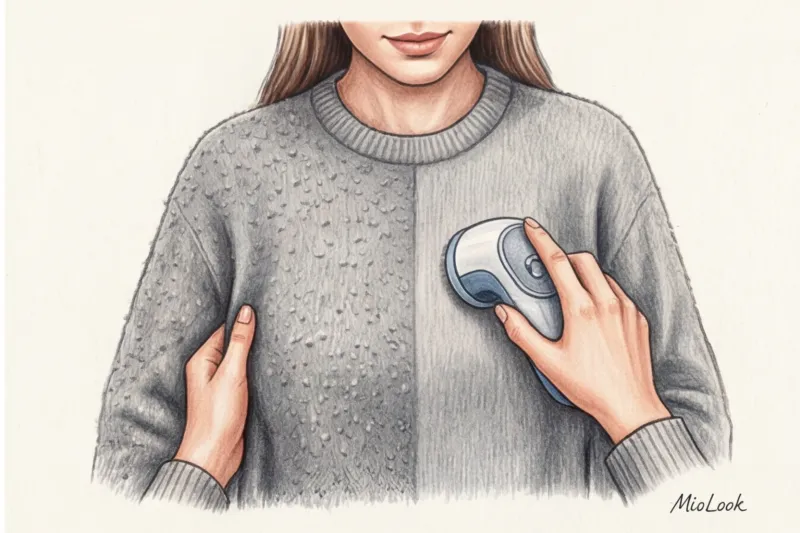
A solution to this problem costs only €15–25—that's how much a quality fabric shaver will cost. Forget about harmful online advice about using regular razors: the blades inevitably leave tiny snags and damage the thread structure. How to use this device correctly? Lay the garment on a perfectly flat, hard surface (an ironing board works well), gently stretch the fabric with your free hand, and carefully shave off any excess using smooth, circular motions. This simple ritual will restore your knitwear to its pristine condition in ten minutes.
Let's move on to outerwear. Many people don't understand why an expensive wool coat loses its luster and becomes matte after a couple of months of wear. The reason is urban dust settling and the nap becoming creased. Invest in a clothes brush made of natural bristles (preferably boar or horsehair). Popular lint rollers are absolutely not suitable here: they leave a microscopic layer of glue on the fabric, which then attracts dirt in droves. A natural bristle brush works differently: it gently combs dust from deep within the fibers and detangles the nap. Just two minutes of vigorous brushing in the direction of the nap before heading out, and your coat will once again look like it came straight from the boutique.
The final, yet crucial, stage of restoration is the hardware. It's often the small details that betray a prestigious garment. A loose button on a double-breasted jacket or chipped enamel on a snap button instantly cheapens the entire look. Make it a rule to regularly check the hardware for secure attachment.
How you care for your clothes, even minor repairs, directly determines how confident you feel in them. To avoid having to keep a mental list of problematic items, I recommend digitizing this process. When you create a database in an app MioLook , immediately mark items that need sewing on a button or removing lint. This will completely eliminate those morning disasters when the perfectly composed look in your head is ruined by a torn hook on your trousers.
Your perfect look starts here
Join thousands of users who look flawless every day and save time in the morning with MioLook.
Get access — €0.99 onceSeasonal storage: protection from deformation and moths
A change of season isn't just a mechanical act of shoving sweaters onto the back shelf; it's a strategic step in managing your style. A smart transition is the foundation of how to care for your clothes with maximum efficiency. When we put away winter items and bring out spring ones, it's the perfect time for a comprehensive review and capsule wardrobe organization. It's during this period that it becomes crystal clear which items have truly lived up to their investment and which have been left hanging with the tags on. To simplify this process and eliminate the need to keep a shopping list in your head, I recommend using MioLook Digitizing your closet helps you conduct an audit in just half an hour and understand exactly what your base is missing for the new season.
But before you put your clothes into hibernation, it's important to remember the golden rule: never, under any circumstances, store unwashed clothing for long periods of time. Even if you only wore a cashmere sweater for a couple of hours and it appears perfectly clean, clothes moths don't target the fabric itself. They're attracted to the microscopic particles of sweat, sebum, and dead skin trapped between the fibers. By leaving a "once-worn" item in your closet for six months, you're literally setting up a smorgasbord for the insects. Before packing, all knitwear should be delicate washed, and outerwear should be dry cleaned.
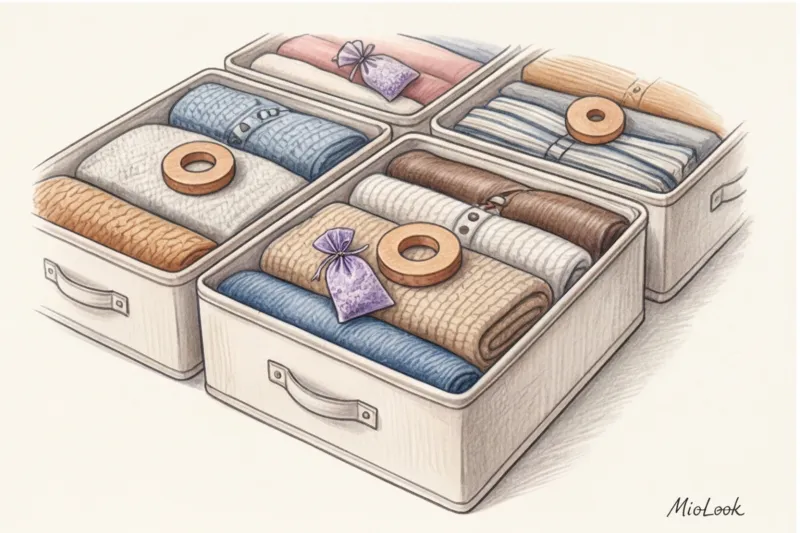
To protect against pests, it's high time to forget about toxic mothballs, whose chemical odor permanently clings to the fibers. Eco-friendly and safe alternatives include cedar balls, wooden hanger rings, or thick sachets of dried lavender. The secret to cedar's effectiveness lies in its essential oils. When the odor begins to dissipate (usually after 3-4 months), simply lightly rub the ball with fine sandpaper, and it's ready to use again. A basic set of these rings costs only €10-€15, but they will reliably protect woolen items worth hundreds of euros.
Another common mistake that leads to irreversible damage to items is the widespread use of plastic vacuum bags. While they're great for saving shelf space, they also mercilessly destroy the structure of high-tech materials. Under harsh vacuum conditions, the natural down in jackets breaks down and loses its ability to retain heat, while membrane fabrics permanently damage their microporous structure. Instead, use spacious, breathable bags made of cotton or dense spunbond. They protect against dust but allow air to circulate freely, preventing musty odors.
"Every item in your closet should have the right support. What your jacket hangs on for six months determines how it will fit in the fall."
Finally, the hanger for your structured items is crucial. A heavy wool coat, trench coat, or jacket with shoulder pads should absolutely not be stored on thin plastic, wire, or even popular velour hangers. The fabric will inevitably stretch under its own weight within six months. The only reliable solution for these types of garments is wide wooden hangers with anatomically flared ends, 4 to 6 cm thick. They take up more space on the clothes rail and cost around €8–12 each, but they support the weight of the garment and guarantee the perfect shoulder line of your favorite suit until next season.
A Stylist's Checklist: A Wardrobe Routine for Busy Women
How often do you toss your work jacket over the back of your chair after a hard day? I understand this urge perfectly. When I was creating a wardrobe for a top manager with irregular hours, her main request was to minimize fussing with clothes. Many people think that properly caring for clothes is the preserve of housewives from the 1950s. But the paradox is that a systematic approach saves time in the morning, while a chaotic one mercilessly burns through your budget.
To avoid panicking over faded pants or a shrunken sweater, I developed an algorithm for my clients. It's not magic, but a simple task-breaking process that turns wardrobe maintenance into a background process.
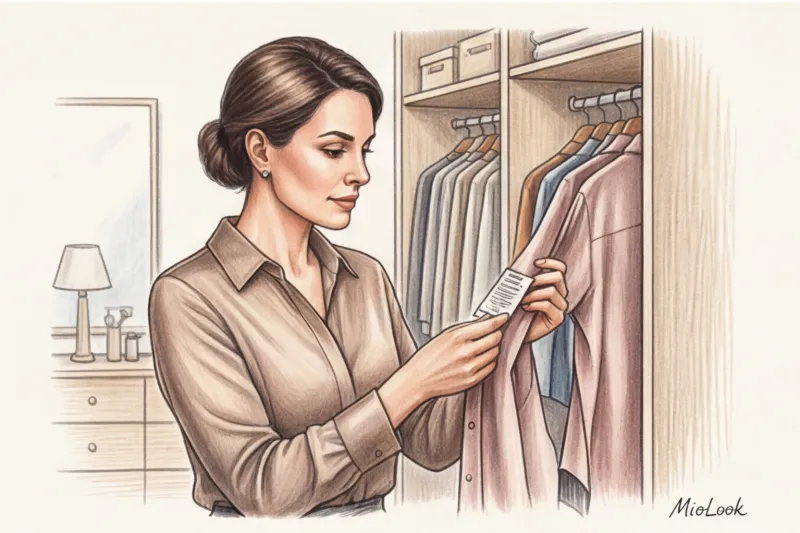
Daily routine (takes 2-3 minutes)
The biggest mistake is automatically throwing a single-worn item into the laundry basket or stuffing it tightly back into the closet. Make it a rule to take these three simple steps as soon as you walk through the door:
- Remove and air: Hang the removed item on a hanger outside the closet (on a floor hanger or on the door) for exactly 30 minutes. During this time, the natural fibers will release accumulated body moisture, and the creases in the elbows will straighten under their own weight.
- Visual inspection: Check cuffs, collar and hem for micro-stains.
- Local cleaning: A fresh drop of coffee or sauce can be removed in 20 seconds with a damp cloth or a drop of cold water. If you leave the stain to marinate in the laundry basket for a week, you'll need a harsh chemical to remove the pigment from the fabric.
Weekly Routine (takes 20-30 minutes)
Sunday evening is the perfect time for tactical planning. According to time management research, so-called "decision fatigue" overtakes us precisely during the morning rush.
- Washing the base with the correct cycles: Gather up your accumulated T-shirts, underwear, and socks. Wash them on a delicate cycle (30°C) with liquid detergent. These are the only categories of items that require weekly washing.
- Steaming the capsule for a week: Gather five outfits for the work week and steam them with a handheld iron. Stylists' secret: steaming an item the night before allows the fibers to cool and set their shape. If you iron pants from H&M or Massimo Dutti five minutes before heading out, the fabric will still be warm—they'll instantly shrink at the knees the moment you get in the machine.
Seasonal routine (twice a year for 2-3 hours)
A comprehensive audit that I absolutely refuse to skip. This is an investment so you don't have to spend €300 on a new coat next fall simply because the old one was ruined by improper winter storage.
- Cleansing before bed: Dry clean all outerwear and wool suits strictly BEFORE they are put into bags.
- Restoration: Treating shoes with cream (to prevent the leather from drying out over the summer) and removing pilling from knitwear with a machine.
- Smart packaging: Use of breathable cases and moth repellents.
To avoid having to remember which sweaters you put away on the mezzanine and which shoes need to be taken to the repair shop in the spring, I recommend writing this down in MioLook Digitizing your seasonal wardrobe before packing gives you a crystal-clear understanding of your assets.
The main conclusion: care as a philosophy
Do you know what separates a truly stylish woman from one who simply buys trends? It's their attitude towards their clothes. Maintaining a wardrobe isn't a household chore. It's a sign of respect for yourself, your work, and your finances.
If you buy a great jacket for €120, it should look like it's worth the money every day, not just the day you take the tag off. Being thrifty and eco-friendly doesn't start with buying a T-shirt made from recycled plastic, but with making the decision to extend the life of the sweater already hanging in your closet.
"Your closet is a reflection of your attitude toward your own boundaries. Maintaining order in your wardrobe directly communicates to others your ability to manage your life."
Your step for today: When you get home, don't throw your jeans in the wash just because you've worn them for two days. Hang them up to air by an open window. You'll be surprised, but they'll look fresh again tomorrow. Start with this small habit, and your wardrobe will reward you with years of impeccable service.
Guide Chapters
Eco-friendly dry cleaning: safe care for difficult items
Home washing and harsh chemicals can permanently ruin expensive fabrics. Learn how eco-friendly technologies can help keep your favorite items in pristine condition.
How to Wash Sportswear: Maintaining Elasticity
The habit of hoarding damp clothing in the laundry basket is detrimental to high-tech synthetics. Learn the secrets of caring for your sportswear so it lasts for years.
Microplastics in Washing Clothes: How to Reduce the Harm
The gray clump in your washing machine filter is dissolving clothes. We'll tell you how to save your wardrobe from deterioration and reduce microplastic emissions.
How to Care for Shoes: An Eco-Friendly Guide from a Stylist
The secret to a luxurious look lies not in brands, but in the impeccable condition of your items. Learn how proper shoe care will extend their life and save you money.
How to wash linen and cotton without shrinkage
Did you ruin an expensive item after just one wash? We'll tell you how to properly care for linen and cotton so your favorite clothes last for decades.
Caring for your clothes: how to remove lint from clothes without damaging them
80% of basic items end up in landfills due to improper care. Learn a stylist's secrets on how to extend the life of your wardrobe and protect it from wear and tear.
How to dry clothes properly to make them last longer
Machine dryer or regular dryer? Find out how improper drying can ruin your favorite items and learn how to keep them looking their best.
How to Wash Natural Silk: Stylists' Tips
Worried about ruining your expensive silk items? Learn the key secrets to safely washing delicate fabrics from a professional stylist.
How to wash a cashmere sweater: home care instructions
Dry cleaning can irreparably ruin your favorite item. Learn the secrets of proper home care for wool and cashmere from a professional stylist.
How to remove stains without chemicals: saving your favorite clothes
Harsh products can permanently ruin delicate fabrics. Learn proven stylist secrets for safe stain removal.
Eco-friendly washing powder: how to choose a safe one
In 80% of cases, it's not time that ruins your clothes, but the harsh chemicals in your washing machine. Let's explore how safe laundry detergents can help preserve your wardrobe.
Laundry symbols on clothes: deciphered by a stylist
It's not cheap fabric that ruins a wardrobe, but improper care. Learn how to read the symbols on clothing labels to keep your favorite items in pristine condition.
How to Store Seasonal Clothes Properly: Stylist Tips
Around 30% of items are thrown away due to storage errors during seasonal changes. Learn professional stylist secrets that will extend the life of your wardrobe.
How to freshen clothes without washing and remove odors
Frequent washing damages fabrics and ruins your favorite items. We'll tell you how to eliminate odors and restore freshness to your clothes while saving on dry cleaning.