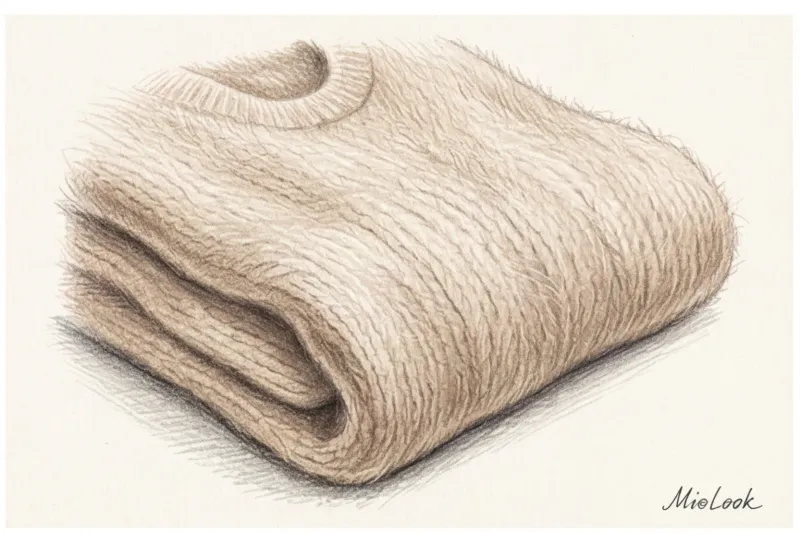
I still remember my client Anna's face when she pulled her favorite €1,200 Loro Piana cashmere jumper out of the bag at the high-end dry cleaner. Instead of a weightless cloud of fluff, she found a stiff, flat piece of fabric vaguely resembling felt. She'd been taking it to the dry cleaners every month, sincerely believing she was providing premium care. In reality, she'd been methodically killing the garment, using her own money.
As a stylist and wardrobe analyst, I often encounter this fear. We fear water like fire, read "P" (Dry Clean Only) labels as the ultimate authority, and overpay hundreds of euros for services that ruin our clothes. We've written more about an eco-friendly and conscious approach to clothing in our the complete clothing care guide.
In this article, I'll combine the knowledge of fabric technologists with cost-per-wear calculations. We'll explore how to wash a cashmere sweater at home, why regular washing powder literally "eats" the yarn, and how the right water makes knitwear even fluffier.
The Anatomy of Premium Yarn: Why Wool and Cashmere Are So Easily Ruined
To understand the rules of the game, you need to look at the fiber under a microscope. Sheep's wool and cashmere (the undercoat of mountain goats) have completely different structures. Cashmere quality is measured in microns: premium fiber is only 14-15 microns thick. By comparison, human hair is about 50 microns. The finer the fiber, the warmer it is, but also the more delicate.
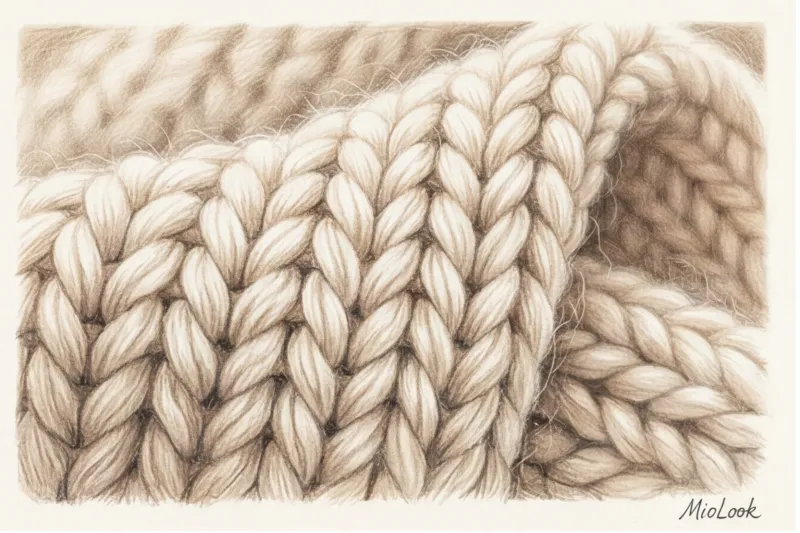
Under a microscope, any natural hair looks like a pine cone—it's covered in tiny scales. Nature intended these scales to be covered in lanolin — a natural animal wax that repels water and dirt, keeping the hair elastic. Your primary care goal is to preserve this lanolin at all costs.
"We pay hundreds of euros not for a logo on a tag, but for the quality of the raw materials. If you bought a sweater for €300 and ruined it after 20 wears, the cost-per-wear would be €15. With proper care, the same item would last 600 wears, reducing the cost per wear to €0.50. Caring for clothes is pure economics," says Darina Marchenko.
A Destroying Myth: Why Dry Cleaning Is Slowly Killing Your Knitwear
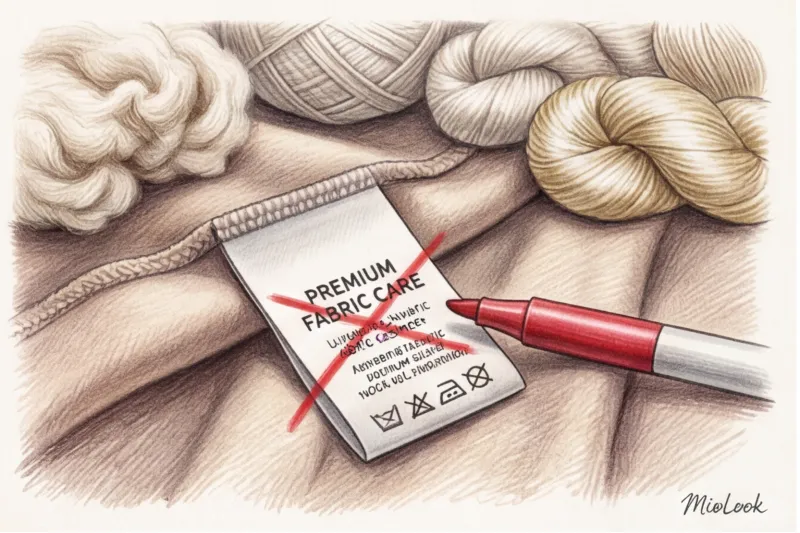
The main myth I've been fighting for 12 years is: "Expensive wool should only be dry-cleaned." Mass-market and even mid-market manufacturers (like Massimo Dutti or COS) often put a "no wash" sign just to be on the safe side. It's easier for them to prohibit water than to be held accountable if a customer washes an item in boiling water.
How do dry cleaning standards work? The most commonly used perchloroethylene — a powerful chemical solvent. It removes grease brilliantly. But the problem is that it completely washes out the natural lanolin. After 3-4 such treatments, cashmere becomes brittle, dull, and itchy.
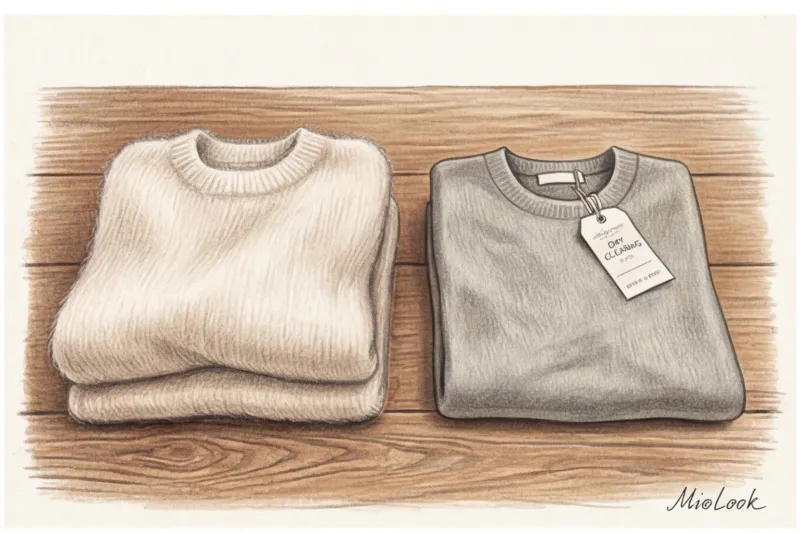
The paradox of cashmere is that it loves water. Proper hand washing opens the fibers, releasing a light fluff (halo), and the sweater only gets softer over time. The only exception is structured items like wool jackets or coats. These have an adhesive backing (dublerin) inside, which will bubble up in water. These cannot be washed at home.
Your perfect look starts here
Join thousands of users who look flawless every day with MioLook. This smart assistant will help you organize your wardrobe and find the perfect combinations.
Get access — €0.99 onceStep-by-step instructions: how to wash a cashmere sweater at home (risk-free)
Forget about the washing machine. Even the most delicate "Hand Wash" cycle on an expensive machine is a game of Russian roulette. The machine can imperceptibly increase the temperature or spin too quickly. I recommend treating this process like a spa ritual for your clothes.
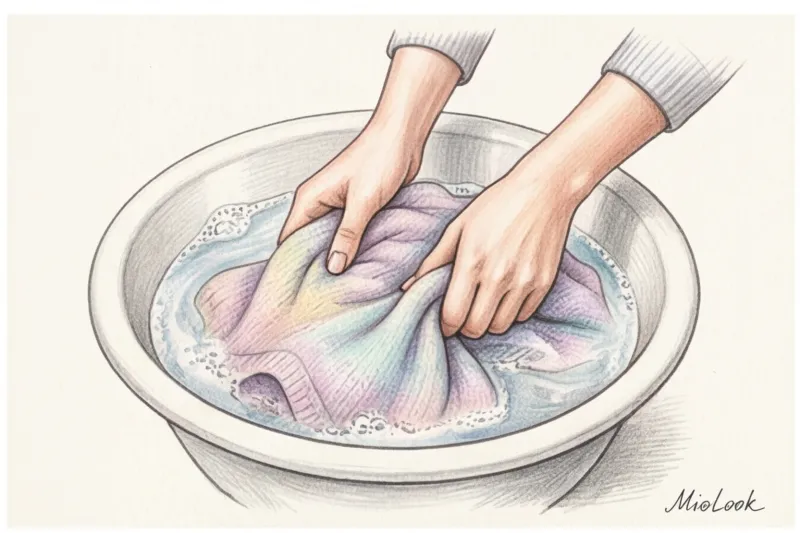
Choosing a product: why regular powder is the enemy
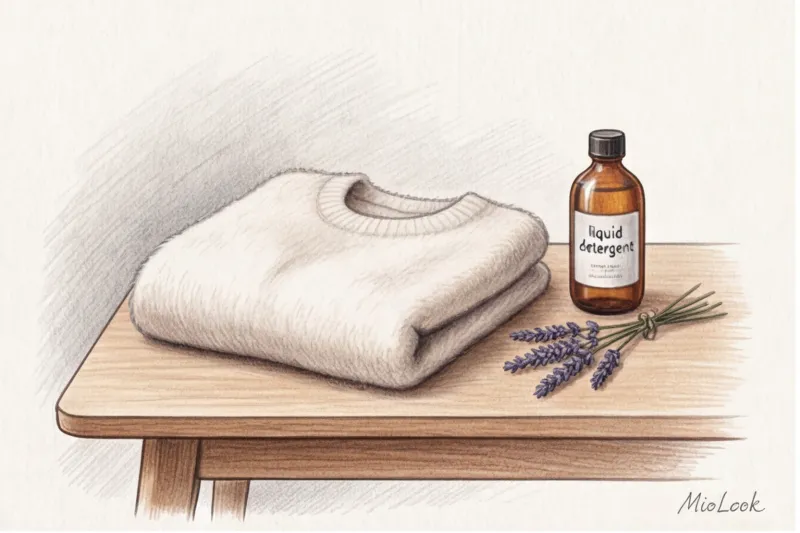
Never use regular laundry detergents or capsules. They contain enzymes, particularly protease. Its job is to break down protein stains (blood, sweat, food). But wool and cashmere are made of animal protein (keratin). The enzymes literally digest your sweater, weakening the threads with each wash.
- What to use: Specialized liquid shampoos for wool and silk with neutral pH.
- Alternative: A regular, mild baby shampoo. If it's safe for baby hair, it's safe for goat hair.
- Stylists' secret: During the final rinse, add a drop of regular hair conditioner (without heavy silicones) to the water. This will smooth the fiber scales and restore incredible softness to your clothes.
Washing temperature and technique
Rule number one: the water should be consistently cool – exactly around 30°C. But the most important thing is to avoid temperature shock According to The Woolmark Company, shrinkage is caused not so much by hot water as by sudden changes in temperature. If you washed your sweater in warm water and then rinsed it in ice-cold tap water, it would instantly shrink two sizes.
Washing techniques should avoid friction. Imagine kneading very delicate dough: immerse the sweater in soapy water and gently "squeeze" it, forcing the water through the fibers. Avoid wringing and spot-washing—that will simply felt the fluff in one spot.
The Art of Drying: How to Maintain Shape and Avoid Stretching
Wet wool loses up to 30% of its strength. If you lift a wet sweater by the shoulders, the weight of the water will stretch it to the knees, making it almost impossible to return to its original shape.
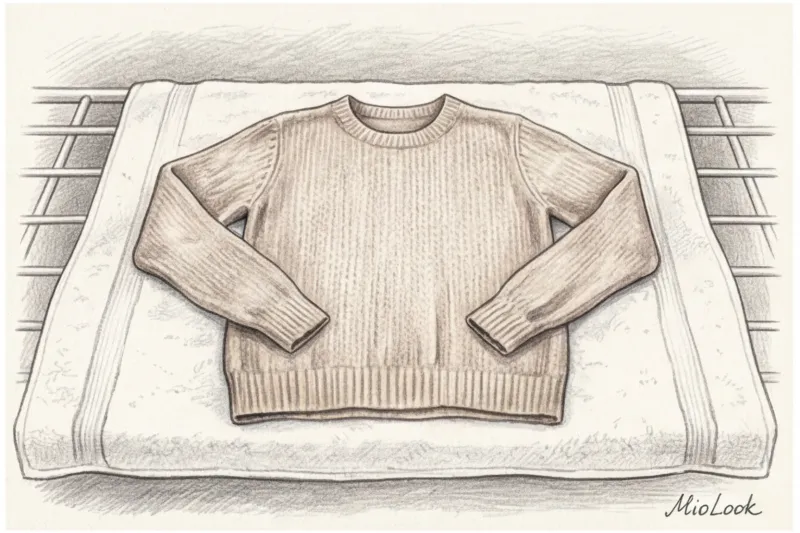
How to remove water properly? Use the "roll" trick. Lay a thick terry towel on the floor, place the sweater on it, roll them together into a tight roll, and gently press down (you can even walk on it with clean feet). The towel will absorb 80% of the moisture.
What follows is a process that professionals call blocking:
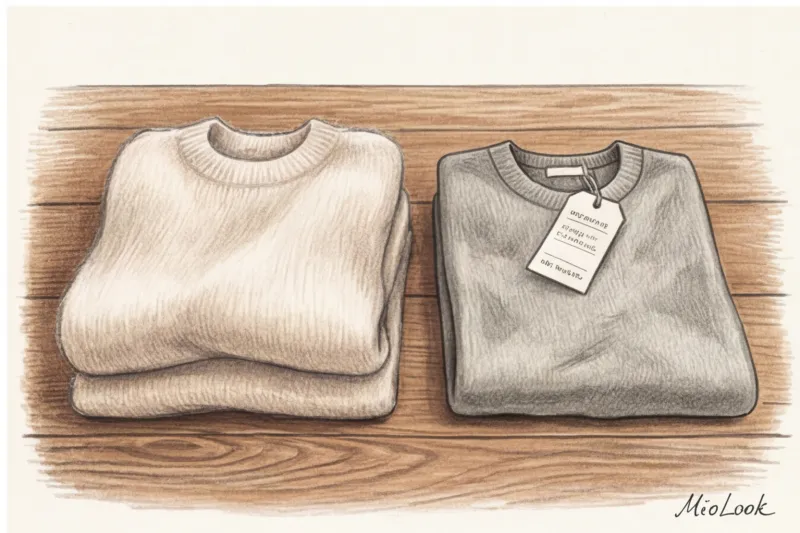
- Lay the damp item out strictly horizontally on a dry towel or special net.
- Use your hands to create the correct geometry: gather the elastic at the bottom, align the shoulder seams, and attach the sleeves to the body.
- In my experience, T-pins work great—you can use them to secure the edges of a sweater to a porous mat so that it dries exactly to the specified measurements.
The main enemies of drying are: central heating radiators, direct sunlight (cashmere fades) and hangers.
Pilling isn't a sign of a cheap item. How do you care for it properly?
Did you know that 100% premium cashmere pills more during the first few weeks of wear than cheap acrylic blends? Many customers panic, thinking they've bought a fake. It's actually just physics.
Cashmere yarn is spun from short hairs. When it rubs against a car seat belt, a crossbody bag strap, or the edge of a table, the shortest and weakest hairs are released to the surface and form balls. This is a natural process of "shedding" excess hair.
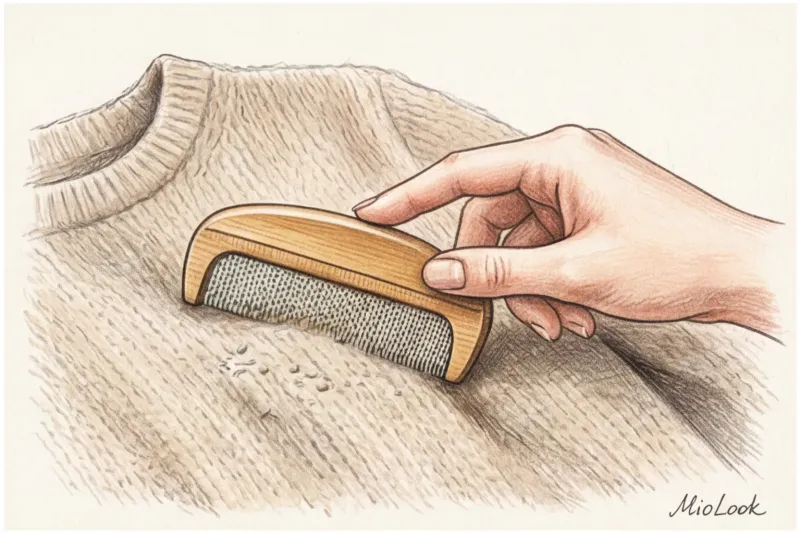
How to remove lint safely?
- What you shouldn't do: Don't use electric trimmers on fine cashmere. One wrong move, and the machine will pull the warp thread tight, leaving you with a visible hole.
- What to do: Buy a wooden cashmere comb with a fine wire mesh. Lay the sweater out on a table and use light, sweeping motions to target problem areas.
- Prevention: Give your wool a rest. Don't wear the same sweater two days in a row. After 24 hours of rest, natural fibers regain their natural bounce.
Access to MioLook for €0.99 — one-time payment
A smart AI stylist will help you digitize your knitwear wardrobe and show you how to pair your favorite sweaters this season.
Get access — €0.99 onceSeasonal storage: protection from deformation and moths
Spring has arrived, and you're ready to pack away your winter capsule. The first and most strict rule: never hang knitwear on hangers. Even wide, velvet ones. Over the next few months, gravity will do its work: the sweater will stretch out, and the characteristic stretched "ears" will appear on the shoulders.
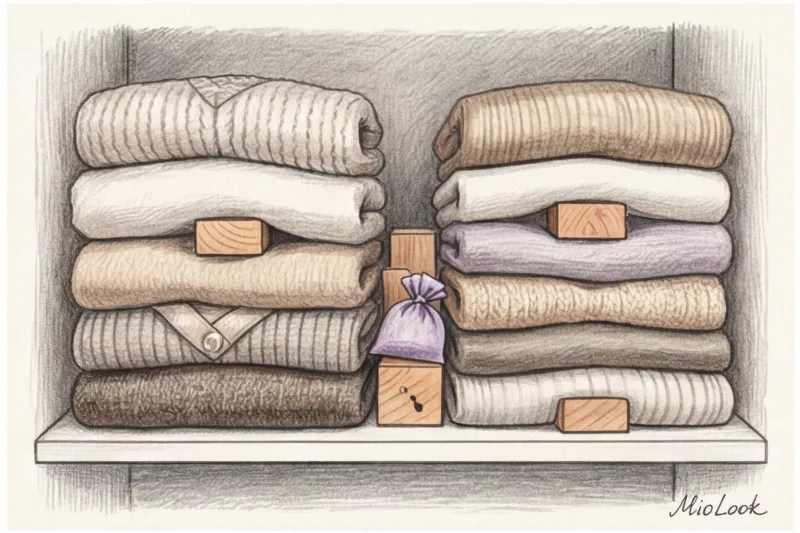
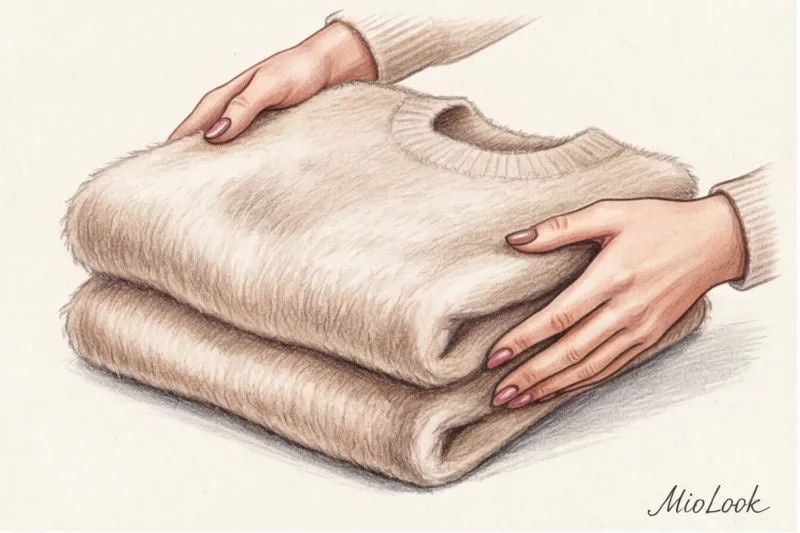
I recommend folding items in piles, using tissue paper (tissue) on the folds to prevent hard creases. Save vacuum bags for down jackets. Wool needs to breathe. Choose fabric or cardboard bags.
Moths are a separate issue. It's a misconception that moths eat the wool itself. Moth larvae feed on microscopic particles of human skin and sweat remaining on the fibers. The main defense against moths is absolute cleanliness Never put away anything you've worn even once for the summer. Place natural cedar balls or lavender sachets in clean backpacks—their essential oils mask the smell of fur from insects.
To always keep track of which sweaters you have stored on the back shelves and avoid buying duplicates, digitize them. I recommend using the "smart wardrobe" feature in MioLook , where you can plan looks with clothes without even taking them out of the closet.
Stylist checklist: can a shrunken wool sweater be saved?
Let's imagine a worst-case scenario: someone in your household accidentally throws your sweater in the washing machine at 60°C. The flakes we mentioned at the beginning are stuck together by the hot water and the friction of the drum.
I'll give you a fair warning (this is the limitation people don't like to mention online): if the sweater has felted to the point of being a thick, standing felt (like a felt boot), the magic won't work. The fiber structure is baked in. Give the item to a child or turn it into a luxurious cat bed.
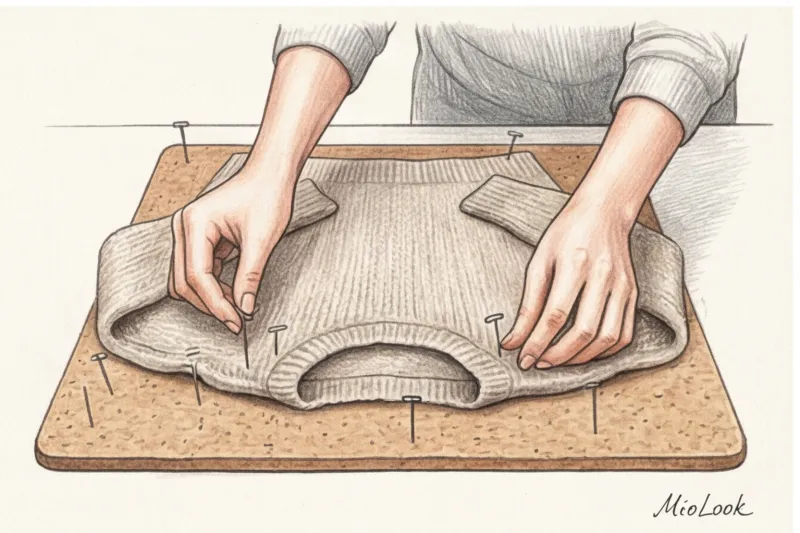
But if the sweater has shrunk but the loops have retained their elasticity, you can try to revive it:
- Relaxation of fibers: Pour a generous amount of hair conditioner (or glycerin from the pharmacy) and cool water into a basin. Soak the item for 30–40 minutes. The silicones and fats in the conditioner will make the hair cuticles slippery.
- Spin: Gently blot the item with a towel (without rinsing out the conditioner completely!).
- Stretching: Place the sweater on a cork mat. Slowly, centimeter by centimeter, begin stretching the fabric in width and length, securing the edges with sewing pins. Move symmetrically from the center outward.
- Leave it to dry in this stretched state.
Properly caring for cashmere isn't a chore, but an investment in your personal style. Once you've overcome the fear of hand washing, you'll discover that high-quality knitwear can last for decades, only improving with age, like fine vintage.