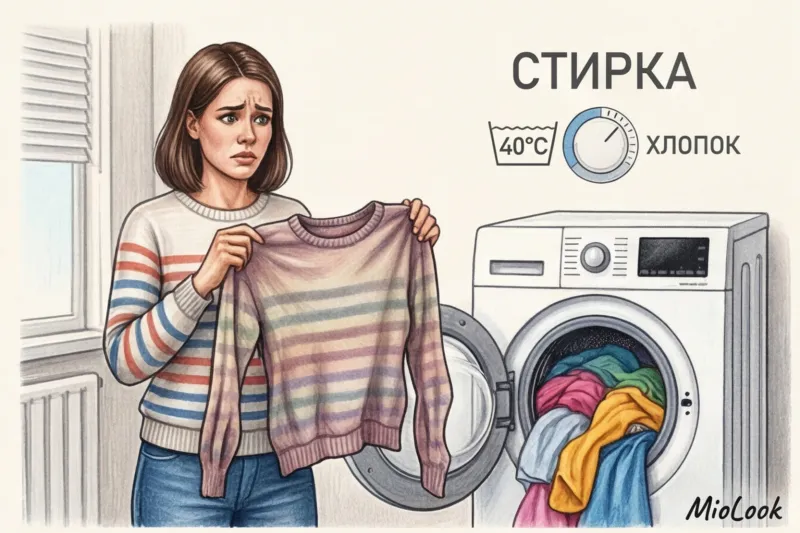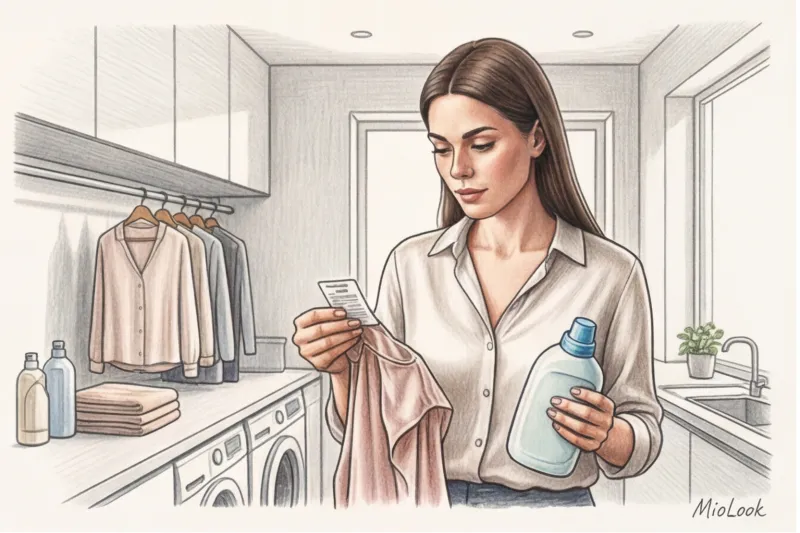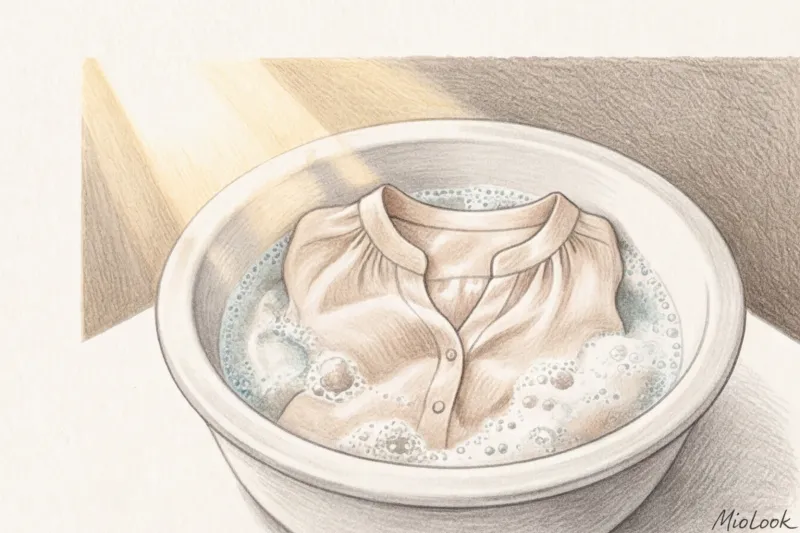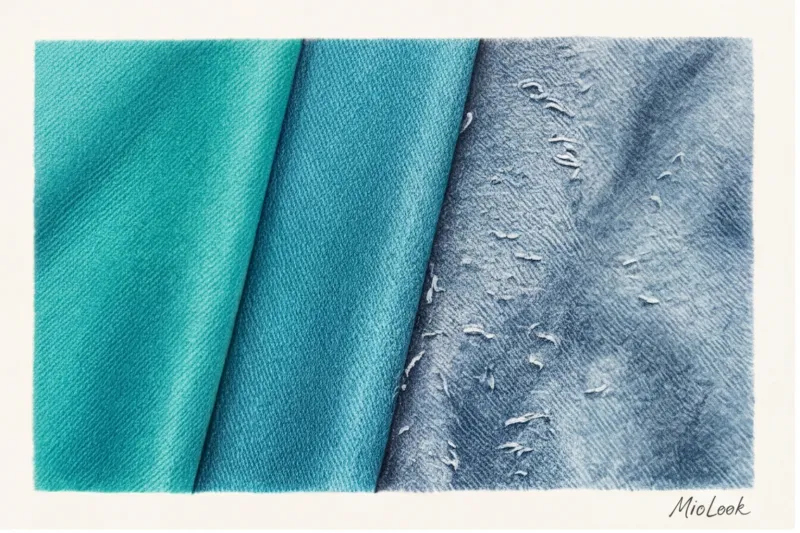
Have you ever looked into your washing machine's filter after a long wash cycle? That damp, gray lump you pull out isn't just dust and hair. It's your favorite pants, cozy sweaters, and basic tops, literally dissolving. After 12 years as a personal stylist, I've learned one scary thing: standing out microplastics in washing clothes — this isn't just a global environmental threat to the ocean. It's a sign that your wardrobe is currently thinning, losing its perfect shape, and irrevocably losing its value with every spin of the drum.
We have already talked in more detail about the integrated approach to the durability of things in our the complete guide to eco-friendly clothing care But today I want to talk about the hidden enemy that's killing your stuff from the inside.
What are microplastics in laundry and why does it matter to your wardrobe?
Let's define the terminology. Microplastics are tiny fiber particles less than 5 millimeters long that are shed from synthetic and blended fabrics during the washing process. According to a landmark study from Plymouth University, just one standard washing machine load (about 6 kg) can release up to 700,000 of these microfibers.
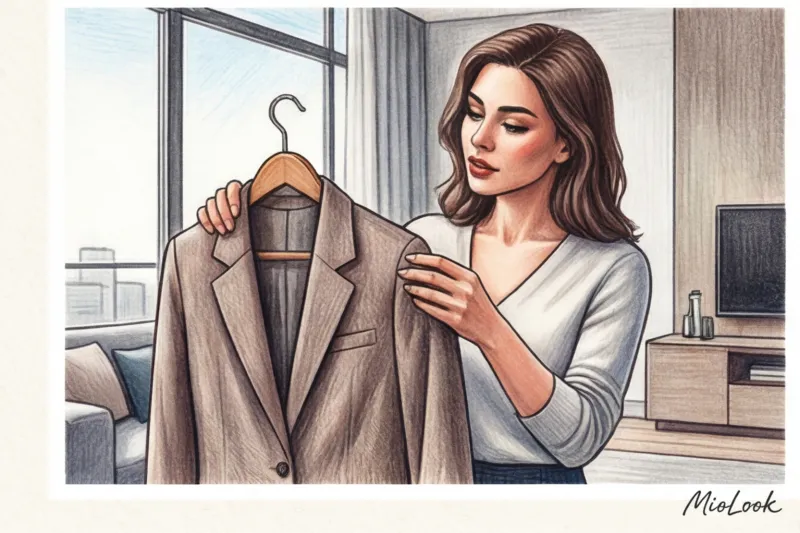
Now let's translate environmental statistics into the language of personal style and money. In professional styling, there's a golden rule: cost-per-wear. Let's say you bought a great basic blazer from Zara or Mango for €80. If after five washes it's lost its original density, become limp, and covered in microscopic fuzz, you won't wear it to an important meeting again. Its cost-per-wear skyrockets.
"Every lint in the washing machine drain is literally lost money. We're not just saving fish and the environment, we're saving our favorite basic items from becoming shapeless rags."
According to the Ellen MacArthur Foundation, approximately 60% of all modern clothing contains synthetic materials. This means more than half of your closet is at risk with each wash.
The main myth: “Just don’t buy synthetics!”
When it comes to microplastics, internet experts love to offer unrealistic advice: "Wear only 100% natural fabrics." It sounds great, but in practice, it's a utopia.
As a practicing stylist, I never forbid my clients from buying blended fabrics. In fact, I recommend them. A small percentage of elastane or high-quality polyester (say, 5-10%) is what makes your clothes wearable. Synthetics prevent the knees of trousers from stretching out by the middle of the workday, help the fabric drape beautifully, and extend the life of wool suits. A perfect mid-priced jacket (for example, one from Massimo Dutti for €150-200) made with a blend will last longer and look neater than 100% linen, which will wrinkle before you even leave the house.
Why Recycled Polyester Isn't a Panacea
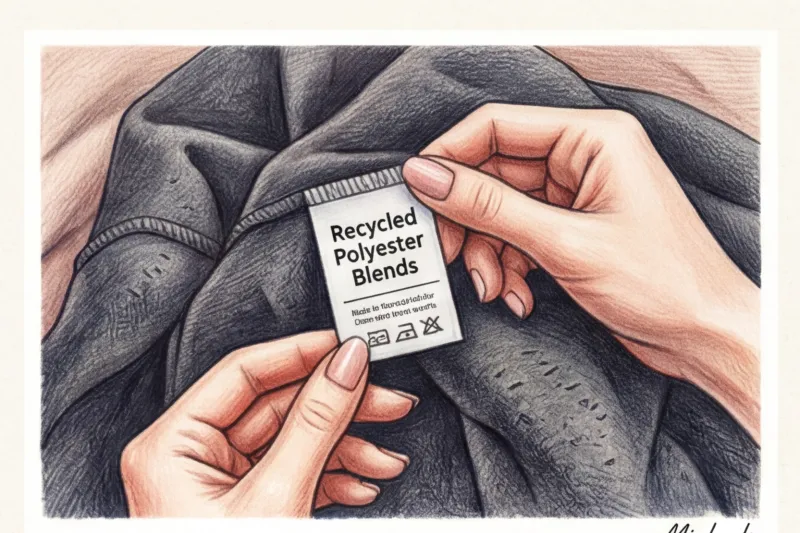
Here we come to one of the most counterintuitive facts in modern fashion. Brands are actively promoting collections made from recycled plastic (Recycled PET), positioning them as saving the planet. But this coin has a dark side.
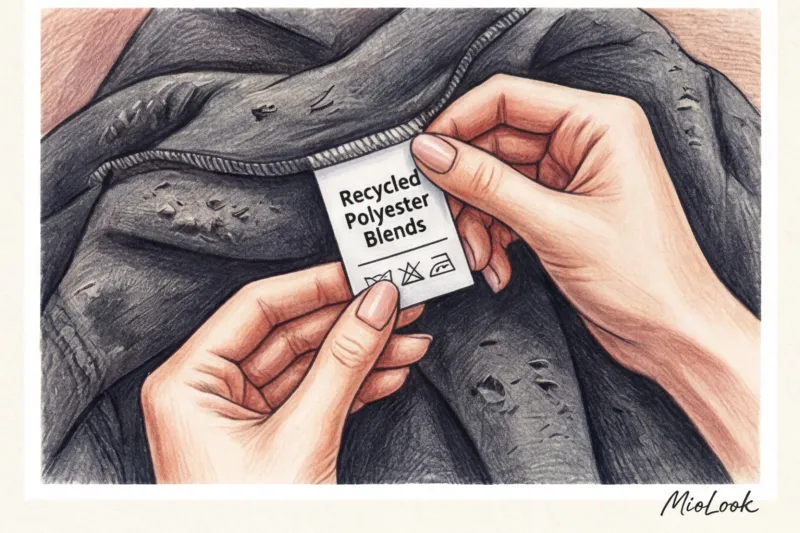
When plastic bottles are mechanically recycled into yarn, the resulting fibers become significantly shorter and weaker than the virgin material. As a result, a fleece sweatshirt made from recycled polyester sheds microplastics at a significantly higher rate. You buy something with a green "Conscious" tag, but it ends up polluting water and losing its appearance faster than regular synthetics.
Your perfect look starts here
Join thousands of users who look flawless every day with MioLook. A smart AI stylist will analyze your wardrobe and suggest fresh combinations.
Get access — €0.99 onceThe Mechanics of Destruction: How Your Washing Machine Eats Your Clothes
To stop clothes from deteriorating, you need to understand how exactly it happens. A washing machine is a rather aggressive environment. Three main factors work against your clothes.
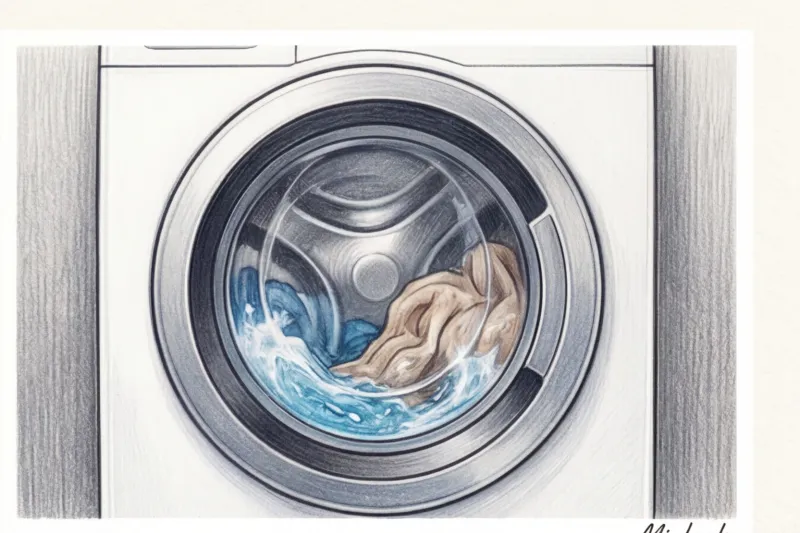
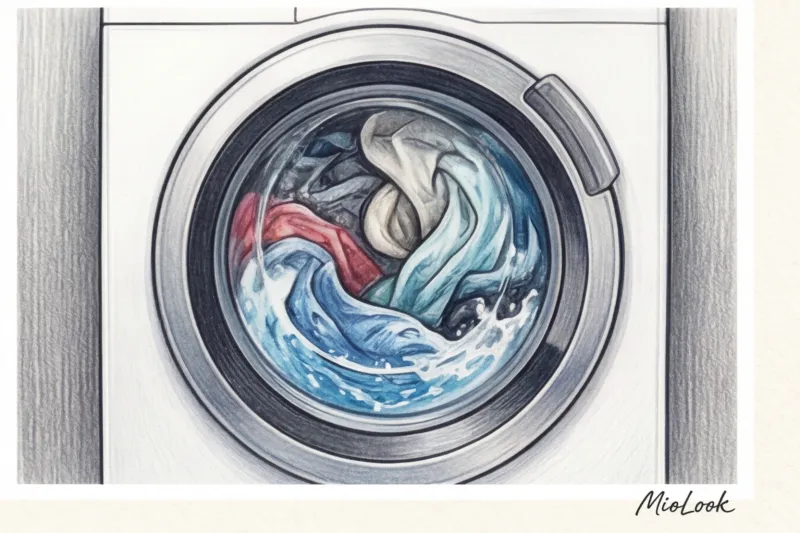
- Friction in the drum. It's logical to assume that washing fewer items at a time will result in a gentler wash. In fact, the opposite is true. In a half-empty drum, clothes are violently slammed against the metal walls and reinforcing ribs. The fibers are literally broken by the impact.
- Temperature shock. Hot water (above 40°C) softens the plastic threads of polyester and elastane. In this soft state, they become extremely vulnerable to breaking.
- The hidden threat of powder. Regular laundry detergent doesn't dissolve instantly in water. During the first 15 minutes of washing, its undissolved granules act as a powerful abrasive—a harsh scrub that wears down the fibers of your clothes.
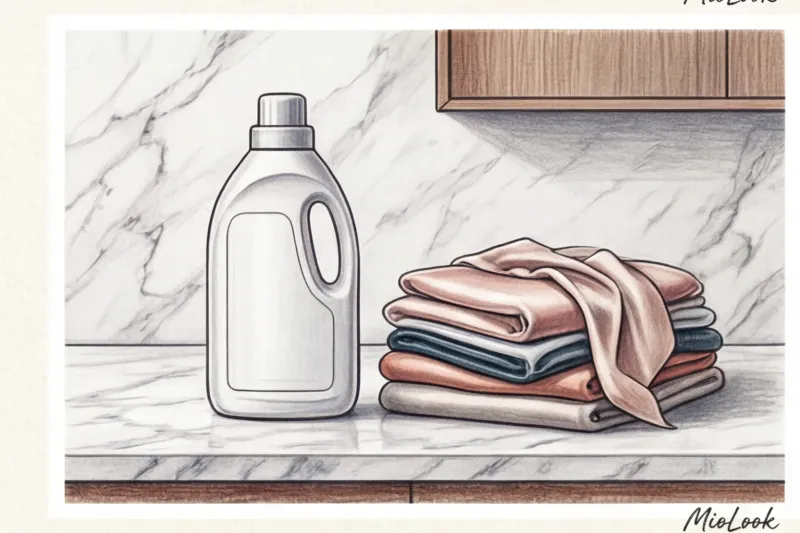
5 washing rules: reduce microplastics and maintain shine
About a year ago, a frustrated client came to me. She'd bought a stunning pleated skirt made of a thick polyester blend for about €120. Deciding to freshen it up after a corporate party, she threw it in the washing machine along with a pair of heavy jeans, added regular laundry detergent, and set the wash cycle to 60 degrees.
The result? The mechanical destruction of the fibers was so severe that the fabric lost its noble luster, became covered with a whitish film of micro-damages, and the pleated folds lost their geometric clarity forever. The skirt turned into a "washcloth" in a single cycle.
To prevent this from happening, implement these 5 unbreakable rules into your routine:
- Colder and faster. Reducing the temperature from 40°C to 30°C reduces microplastic emissions by 30%. A quick cycle of 15–20 minutes is sufficient to refresh items after one day of wear.
- Liquid products only. Switch to enzyme-based laundry detergents. They gently coat fabrics and are non-abrasive, unlike dry powders.
- The secret of loading 3/4. The drum should be filled so that only the palm of your hand (held vertically) fits between the laundry and the top wall. This volume allows the items to gently rub against each other in the water rather than slamming against metal.
- Hard texture sorting. Never wash rough denim or items with heavy metal zippers together with delicate knits or smooth blouses. Rubbing against rough fabrics can rip microfibers from delicate materials.
- Slow down. For most basic items, a spin of 800 rpm is more than sufficient. 1200 rpm and above is a surefire way to wear out your clothes.
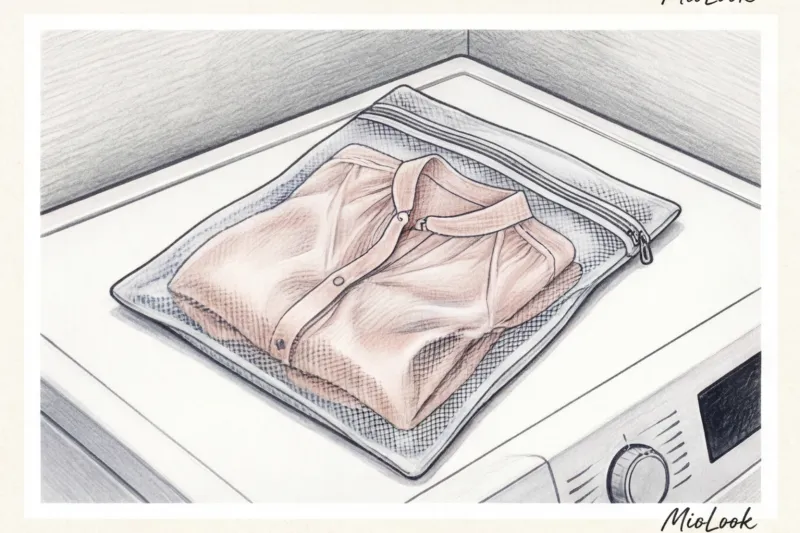
Special gadgets: do bags and filters work?
Today, the industry offers a multitude of microfiber-blocking solutions. But are they worth the money?
Guppyfriend bags. This is my absolute favorite, and I highly recommend it to all my clients. They're made of smooth monofilament nylon, which doesn't shed fibers on its own. The inside of the bag is so smooth that friction is significantly reduced. And here's a stylist's honest review: Guppyfriend bags are brilliant not only because they're eco-friendly. They're perfect for keeping delicate knits, silk, and tights (which cost €20-€30 a pair) from getting snagged. It's a double investment.
Catcher balls (like Cora Ball). They're thrown into the drum and mechanically collect lint, mimicking coral. It's a perfectly functional gadget, but it has a strict limitation (and this is often overlooked): this ball should never be used when washing lace or loosely knitted items—it will simply snag and tear the fabric.
External filters (eg PlanetCare). They attach to the washing machine drain hose and capture up to 90% of microplastics. This is a great long-term investment in clean water, but unfortunately, it doesn't protect the clothes themselves from friction. inside drum.
Ready to get started?
Try a free plan—no commitments. Create your virtual capsule wardrobe in MioLook and learn how to style items so you wear them more often and wash them less.
Get access — €0.99 onceSmart Care Checklist: Wash Less, Look Flawless
Want to know the secret to keeping clothes in perfect condition, whether in high-end boutiques or on set? We practically never wash them.
The most effective way to avoid producing microplastics and damaging your clothes is to not wash them unless absolutely necessary.
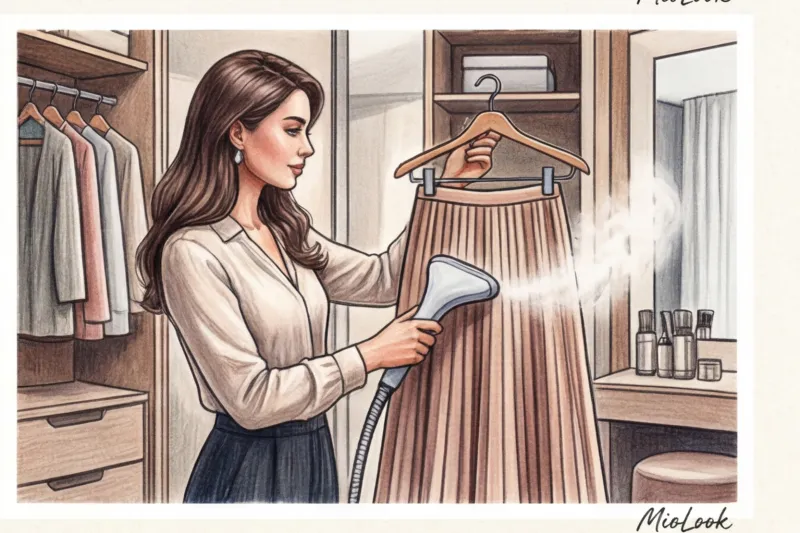
- Steaming instead of washing. A good handheld steamer (costing around €60–100) will change your life. Hot steam kills bacteria, removes food and sweat odors, smooths out wrinkles, and restores fabric elasticity. There's no mechanical friction involved. If the item doesn't have visible stains, simply run the steam over it. (Note: steam won't remove stubborn deodorant stains—underarms will still require washing or spot-washing.)
- Local cleaning. A drop of sauce on a pant leg isn't a reason to wash the entire pair. Use wet wipes to remove stains or apply a drop of mild detergent directly to the stain.
- Airing and rest. Using smart wardrobe feature in MioLook , you can plan your outfits so you don't wear the same item multiple days in a row. Natural and blended fabrics need time (usually 24–48 hours) to regain their shape on a hanger. During this time, the fibers straighten out, and the odor dissipates with good airing.
Laundry these days isn't so much a matter of hygiene as it is a matter of habit. We automatically throw jeans in the laundry basket simply because we've worn them twice. By changing this pattern, you'll not only make a huge contribution to the purity of the water we drink, but you'll also find that your wardrobe no longer looks washed out. This means every item you buy will last much longer.