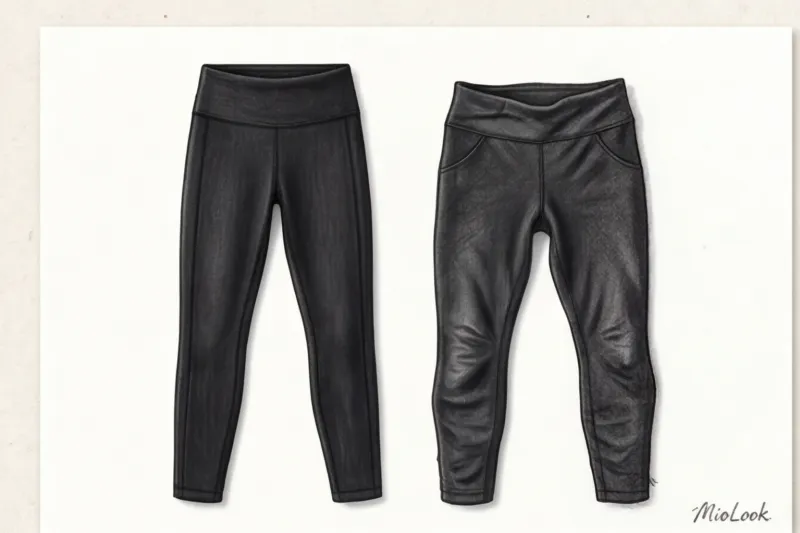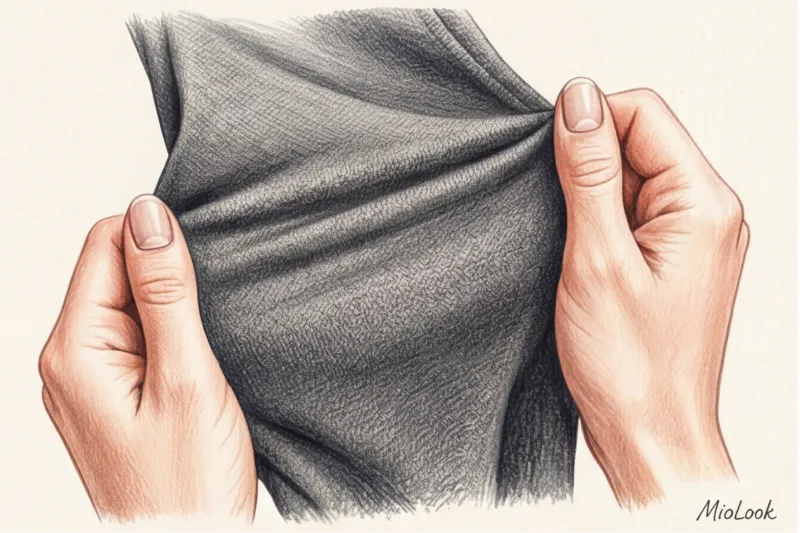
Picture this familiar scenario: you come home from an intense strength training session, throw your damp leggings and top in the laundry basket, and think, "I'll wash them with the rest of my clothes at the end of the week. I'll save water and help the environment." Sound reasonable? As a textile expert, I'm sorry to disappoint you. This seemingly harmless habit is actually ruining your workout clothes faster than daily machine washing.
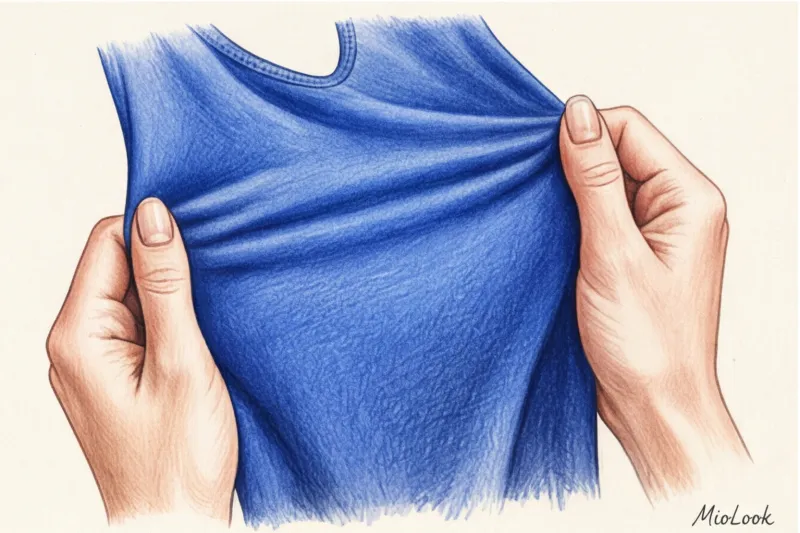
Since 2020, the fashion industry has embraced sustainability, and we hear the same message from every iron: wash less often. This rule works flawlessly for heavy denim or wool sweaters. (We covered this in more detail in our the complete guide to eco-friendly clothing care ). But when it comes to high-tech synthetics, the logic changes dramatically. If you want to know, How to wash sportswear To ensure that it retains its firming effect and color for years, you'll have to forget the advice from glossy magazines from decades ago and delve a little into the chemistry of fibers.
Why Sportswear Loses Shape: The Anatomy of Elastane
To understand the care mechanics, you need to know what your favorite tights are made of. Most often, it's a mix of a basic synthetic (polyester or nylon) and the ultimate stretch factor—elastane, also known as Spandex or Lycra. It acts like a microscopic spring, allowing the fabric to stretch in all four directions and instantly return to its original state, providing that all-important compression.
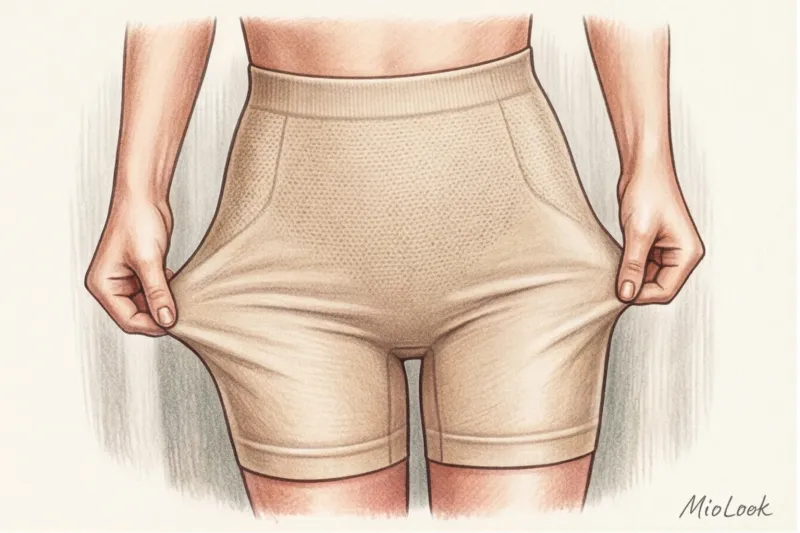
But every spring has a breaking point. During wardrobe reviews, I regularly show my clients how to visually and tactilely distinguish a quality garment from one that's "tired." If you stretch the fabric slightly in the light and notice tiny whitish threads, like a torn spider web, and hear a barely perceptible micro-crunch when you stretch it, that's it, the elastane is burned out. The fabric will no longer support the muscles; it's just hanging.
"Proper care is pure math. Buying a premium sports kit for €100-€150 only seems expensive at the time of purchase. If you wear it 200 times with proper washing, the cost-per-wear (CPO) will be less than €1. But if you ruin it within a month, it's money down the drain."
How Your Own Sweat Destroys Fabric Faster Than a Washing Machine
The main myth of an eco-friendly wardrobe is: "Sportswear should be washed less often to save the planet." However, the sustainability departments of giants like Patagonia and Lululemon emphasize the opposite in their care guides: technical fabrics require prompt cleaning.
It's all about a chemical reaction. During exercise, not only water is released, but also salts and sebum (oil). The polyurethane fibers of elastane have oleophilic properties—they literally attract and absorb oils. If you leave a sweat-soaked garment in a warm, dark laundry basket for 48 hours, bacteria and lipids begin to break down the spandex structure. It loses elasticity, becomes loose, and begins to emit an unpleasant odor that even perfume can't mask.
My golden rule: for active sports, the "24-hour rule" applies. Can't machine wash an item right away? At least rinse it in cool water or hang it outside to air out, but never crumple it while it's still damp.
Your perfect wardrobe starts here.
Organize your capsule wardrobe, plan workout looks, and track the lifespan of your favorite items with a smart app.
Get access — €0.99 onceHow to Wash Sportswear: A Step-by-Step Guide to Avoiding Mistakes
Proper washing of technical items begins even before they reach the washing machine drum. The devil is in the details. Always, without exception, turn leggings, rashguards, and shorts inside out.
Why is this necessary? Firstly, the face of technical fabrics often has a special treatment that is easily damaged by friction (leading to pilling). Secondly, the main contaminants—bacteria, skin particles, and sweat—are located on the underside. Also, be sure to close all zippers, buttons, and especially Velcro on sports bras. Exposed Velcro in the tumble dryer acts like a cat's claw: it can pull out loops and ruin smooth nylon in a single cycle.
Sorting Rule: Why You Shouldn't Wash Leggings with Towels
One of the most common questions I get during my consultations is: "Can I throw my sportswear in with my home textiles?" My answer is always a resounding no.
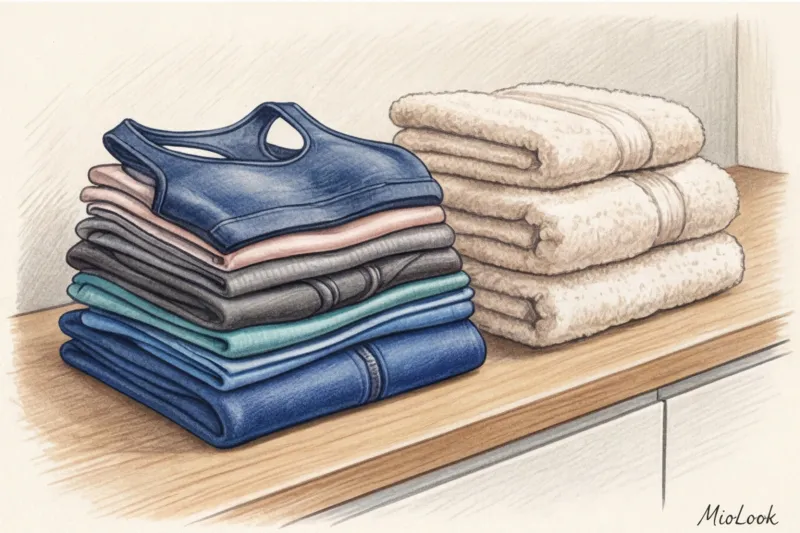
Cotton towels, fleece hoodies, and fluffy robes lose microfibers during the washing process. When rubbed against smooth synthetics, this lint becomes firmly embedded in the micropores of athletic fabric. As a result, your perfectly black, glossy leggings acquire a dusty, washed-out appearance that's impossible to remove with a lint roller.
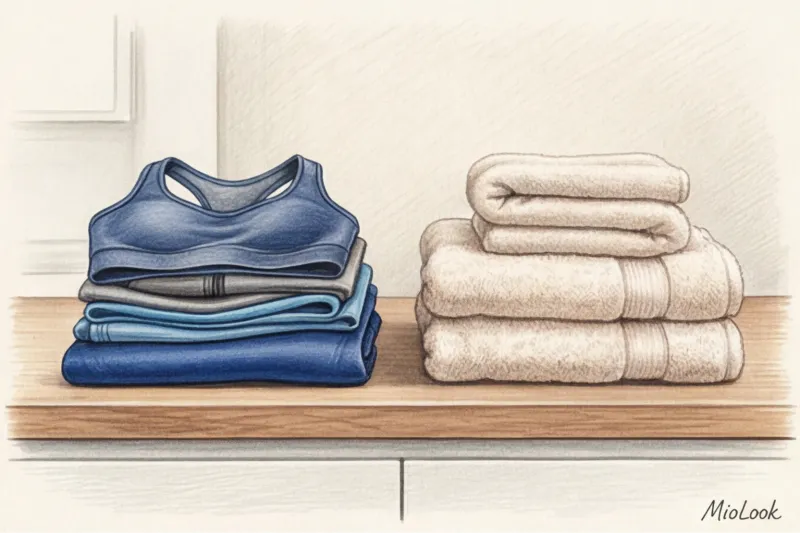
Also consider weight categories. Heavy, damp jeans or sweatshirts create tremendous pressure during the spin cycle. Pressing delicate mesh sports bras against the metal drum wall under the weight of wet denim will inevitably break the fibers and deform the cups.
Ideal parameters: temperature and spin
High temperatures are a sure death for spandex. Above 40°C, the molecular memory of the polyurethane threads begins to break down.
- Temperature: The gold standard is 30°C. Trust me, a high-quality modern laundry detergent will handle sweat even in cool water. Hotter water will cause the fabric to shrink and the elastic waistband to ripple.
- Spin speed: Set the maximum speed to 600–800 RPM. Why not 1200 to get your items almost dry? At high speeds, centrifugal force literally tears apart the finest elastic fibers. You'll save an hour on drying, but you'll turn your expensive compression garment into a shapeless bag.
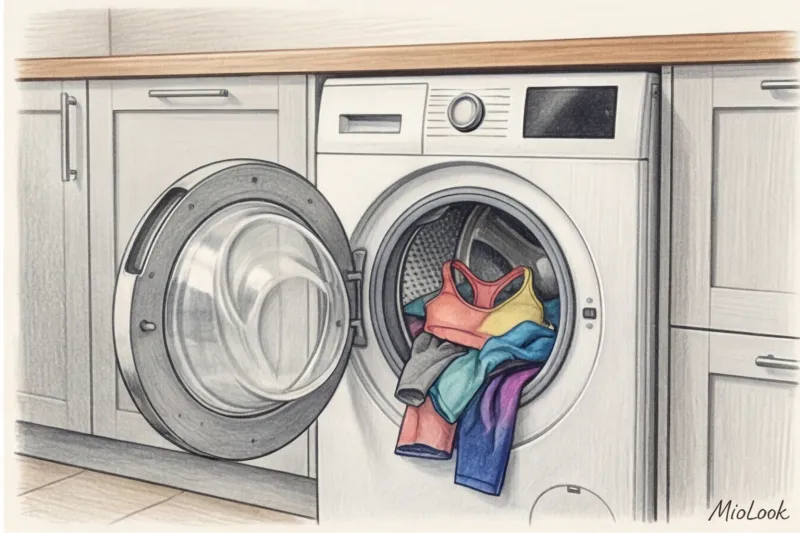
The Main Enemy of Elasticity: Why Fabric Softener Is Strictly Banned
I had a telling case. A client brought in a pair of brand-new Lululemon leggings (costing around €120), purchased two months ago, for inspection and complained, "They're no longer breathable. They feel like a plastic bag, and even after washing, they still smell of sweat." The reason became clear after the first question: the client had been generously adding fabric softener "for freshness."
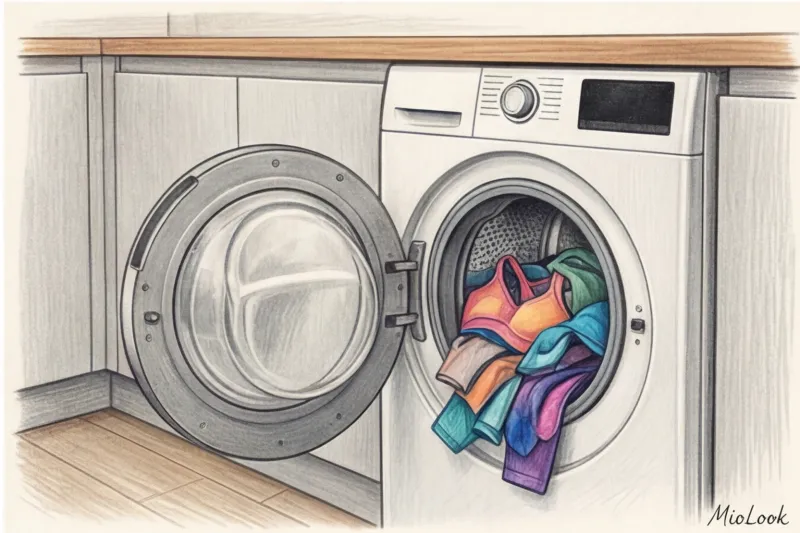
The mechanics of any fabric softener are that it coats the fibers with a thin wax or silicone film, which makes the fabric appear softer. But for sportswear, whose primary function is wicking, this film becomes devastating. Research shows that fabric softener reduces the moisture-wicking properties of sportswear by 70% after just the first wash. The fabric "suffocates."
Moreover, the chemicals in fabric softeners make rubber bands loose and unpleasantly sticky. What should you do if you have hard water or want to get rid of bacterial odor?
Life hack from a stylist: Replace commercial fabric softener with regular white vinegar (9%). Pour half a cup directly into the fabric softener compartment. It leaves no odor on dry items, softens water perfectly, removes detergent residue, and kills odor-causing bacteria.
A smart approach to wardrobe
Forget about the "nothing to wear" problem and ruined clothes. MioLook will help you create a capsule wardrobe that works for you.
Get access — €0.99 onceChoosing a product: how to wash membranes and spandex
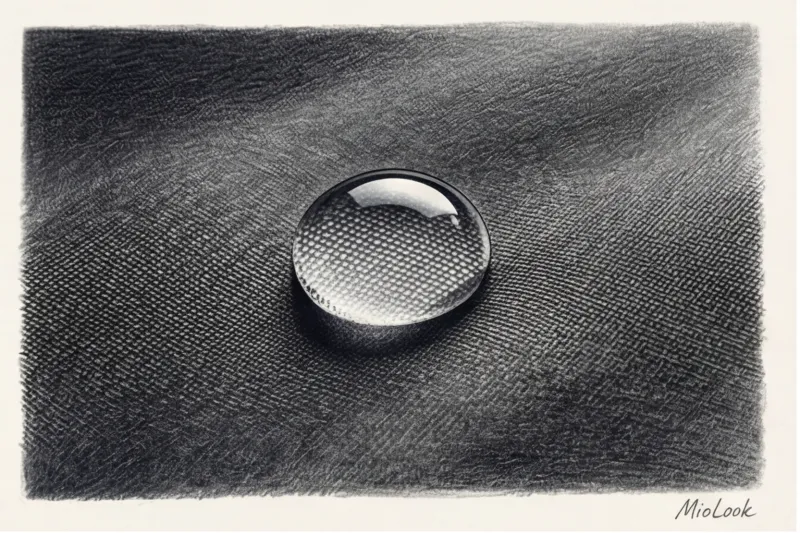
If you're still using standard bulk laundry detergent for your sportswear, stop. When washed at 30°C, the powder granules often don't dissolve completely. They act like microscopic abrasives—sandpaper—that methodically scratch the elastane fibers from the inside and clog the membrane pores.
Liquid gels with enzymes are an ideal choice. Enzymes (such as protease and lipase) biologically break down protein and oil stains, even in cold water. They absorb sweat and sebum without damaging the thread itself.
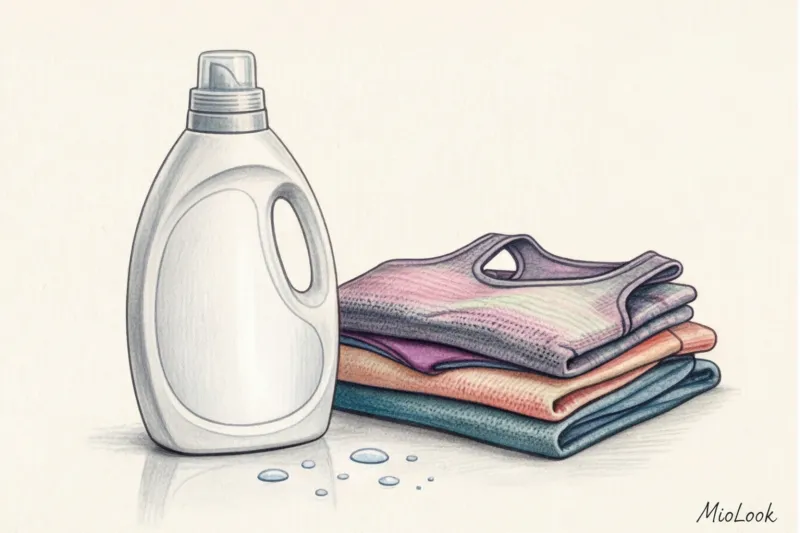
Is it worth paying extra for specialized gels labeled "Sports Wash"? As an expert who reads product labels, I can tell you: not always. While budget items (€30-€50 per capsule) can be washed with a good phosphate-free baby or eco-friendly gel, premium items and membrane fabrics are best washed with sports gels. Their formula is designed to remove complex sweat salts and maintain a durable water-repellent finish (DWR). Choose products with eco-labels—they're safer for skin that sweats heavily.
Drying without loss: how to avoid ruining your shape at the last minute
Even if you've washed your set perfectly, improper drying will ruin all your efforts. Tumble drying is absolutely terrible for any garment containing elastane. While 40°C (104°F) water simply stretches the spandex, the hot air of a tumble dryer (which can reach temperatures of 70-80°C) literally melts it. The fibers become brittle, and the garment shrinks 1-2 sizes.
The physics of the drying process for technical fabrics means they dry very quickly naturally—usually within 2–4 hours at room temperature. But there's a catch: Never hang heavy, damp leggings by the waistband on a regular clothesline. Under its own weight, multiplied by the weight of the water, the fabric will inevitably stretch in length.
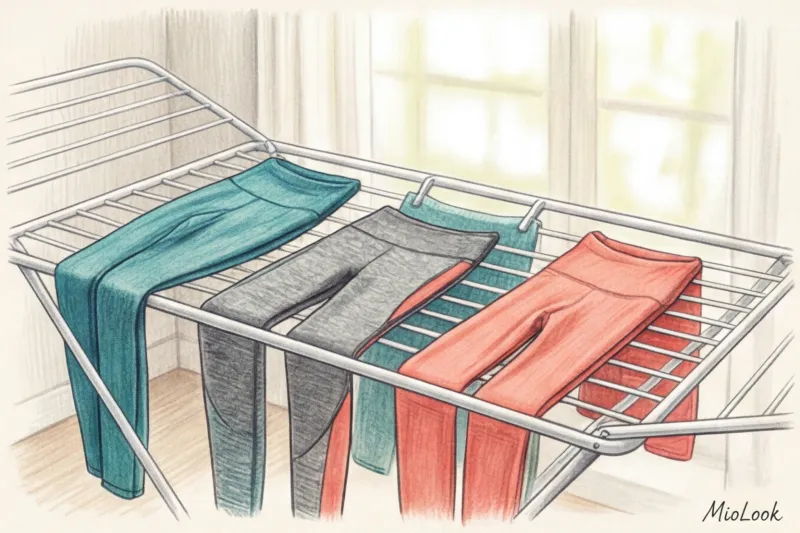
Drying rule number one: lay your sportswear flat on a special drying rack. Avoid direct sunlight (UV rays destroy pigment and reduce compression properties) and never place items on a hot radiator.
Checklist: 5 Steps to Making Your Sports Capsule Last Forever
To summarize, let's translate all this theory into a clear action plan. Save this checklist to keep your gear looking like it came from the store even after two years of regular training:
- Ventilate immediately: If you can't turn on the machine, remove the mold from the bag and hang it up to air. Don't feed the bacteria.
- Sort hard: No towels, brushed hoodies, or heavy jeans next to your leggings.
- Protect the details: Close all zippers, and always wash sports bras with thick cups and underwire in special mesh bags.
- Observe the temperature regime: 30°C, delicate cycle, spin no more than 800 rpm.
- Eliminate chemicals: Only liquid gel with enzymes, no conditioner.
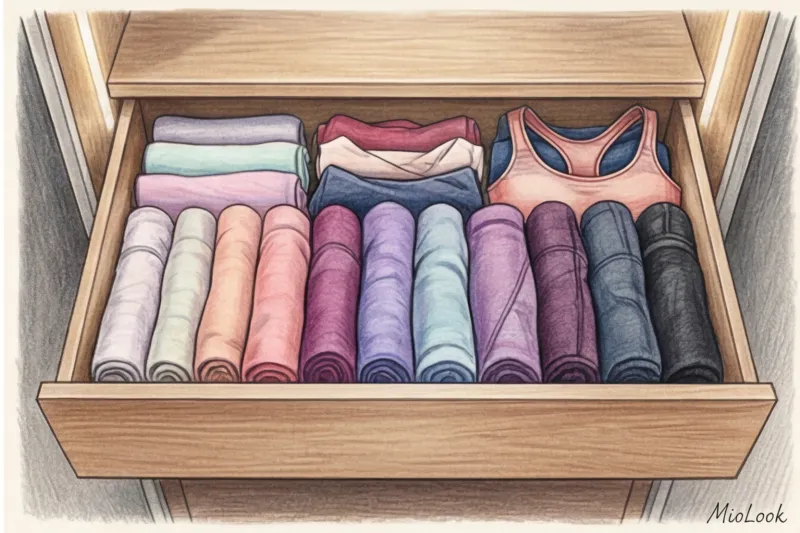
A smart wardrobe isn't just about investing in basic items, it's also about using them wisely. Knowing how to care for delicate fabrics means you won't have to constantly buy replacements for those stretched-out sweatpants. And to easily manage your gym (and other) wardrobe, try digitizing your items. MioLook app This helps you visually assess what you wear most often and notice when it's time to update your wardrobe without making impulse purchases.
Ready to get started?
Try the MioLook plan for free—no commitments required. Organize your closet and get organized in style.
Get access — €0.99 once