Why your public speaking clothes are your second microphone
You step out from behind the curtains, the spotlight hits your eyes, you take a deep breath to deliver your prepared greeting... But the audience has already given you their verdict. A well-chosen clothing for public speaking starts working for you long before the real microphone turns on.
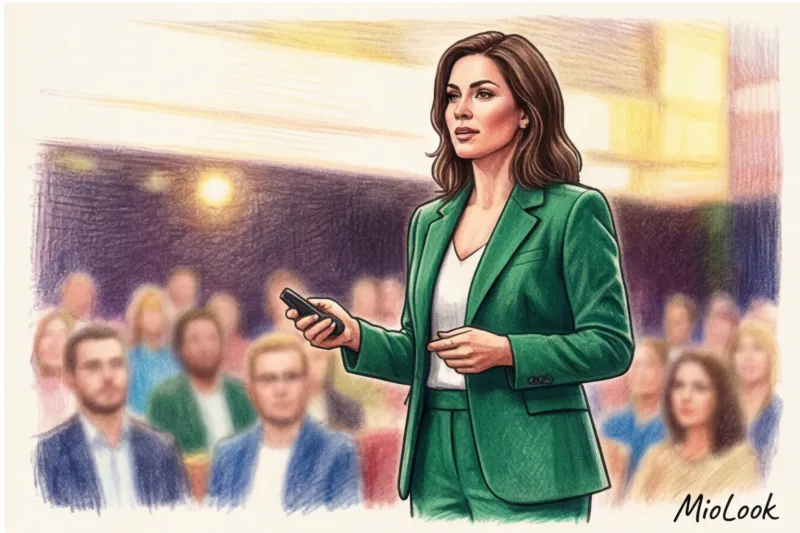
Over 12 years of working with speakers, including preparing top managers for TEDx, I've seen the same mistake time and again: experts spend weeks rehearsing their speeches and only remember their wardrobe an hour before they go on stage. But let's look at the data. A classic study by psychology professor Albert Mehrabyan on nonverbal communication proved that 55% of an audience's trust is formed solely based on visual perception. In neuroscience, this is called the "7-second rule." That's how long it takes the listener's brain to scan your silhouette, posture, and colors, and automatically assign you a status: "an authority worth trusting" or "just a random person on stage."
Clothes aren't just a pretty wrapper for your intellect. They're a highly precise tool for controlling the audience's attention.
When you stand before an audience, every detail of your appearance either helps people focus on your ideas or steals their cognitive resources. A too-tight jacket that you constantly tug at or a pale sweater that blends into the background distracts viewers. Our goal is to ensure that the visual signal doesn't compete with the verbal one, but rather directs the audience's gaze directly to your face.
Today, the rules of the game have changed dramatically. We live in the era of hybrid events, where in-person presentations are almost always accompanied by online broadcasts. According to industry statistics, over 80% of public speaking engagements are now recorded on video. This means that the traditional business dress code no longer applies—you need a fully-fledged "TV-ready" approach to style.
The camera is merciless: it flattens the silhouette, distorts colors, and demands a completely different level of contrast. In a hybrid format, the audience in the audience sees you full-length, while the audience on the other side of the screen is often only chest-high (the so-called mid-shot). What looks stylish and relaxed in a meeting room can turn you into a shapeless blob on a plasma screen. To avoid such failures, I strongly recommend assembling and testing the stage capsule in advance. MioLook app By digitizing your best "performance" looks, you can evaluate how the geometry of your clothes will look in the frame in advance, and no longer waste the morning hours before a conference panicking in front of the mirror.
Technical traps of the stage: what ordinary stylists don't tell you
In 2018, I was dressing a client—a senior executive at a fintech company—for a presentation at a major industry forum. We chose a luxurious dusty rose silk collarless blouse and soft, flowing palazzo pants. In the fitting room, the look looked like a million bucks. That is, until ten minutes before we went on stage, a stern-looking sound engineer approached us with a lavalier microphone and a heavy black radio transmitter unit.
Spoiler alert: it was a disaster. There was absolutely nothing to hook the loop onto, the delicate fabric was treacherously pulled down by the weight of the clamp, and the heavy transmitter had to be hastily hidden in her back underwear because there were no pockets in her pants. The client stood unnaturally upright throughout the entire presentation, afraid the whole thing would collapse.
The stage is a harsh engineering environment. Your suit must function like an exoskeleton, masking physiological stress responses and integrating technical equipment without compromising your silhouette.
Most fashion stylists think in terms of aesthetics, trends, and color. But when you step under the spotlight, your outfit must pass a rigorous technical crash test. Television personalities and experienced speakers know: performance clothing is, first and foremost, a functional interface. Let's explore the hidden requirements that fashion magazines don't cover.
Lavalier microphones and transmitters: where to hide?
Did you know that a standard radio transmitter (bodypack) from professional systems like Sennheiser or Shure weighs around 100-150 grams? It may seem like a small weight in your hand, but on your clothes it feels like a brick.
Where can you hide this block if you're wearing a tight dress without pockets or a soft skirt with an elastic band? There are few options, and all of them are bad: attaching it to your bra strap (which distorts the silhouette of your back), hanging it on the edge of your neckline (which is unacceptable), or holding it in your hand throughout the entire performance, preventing you from gesturing properly.
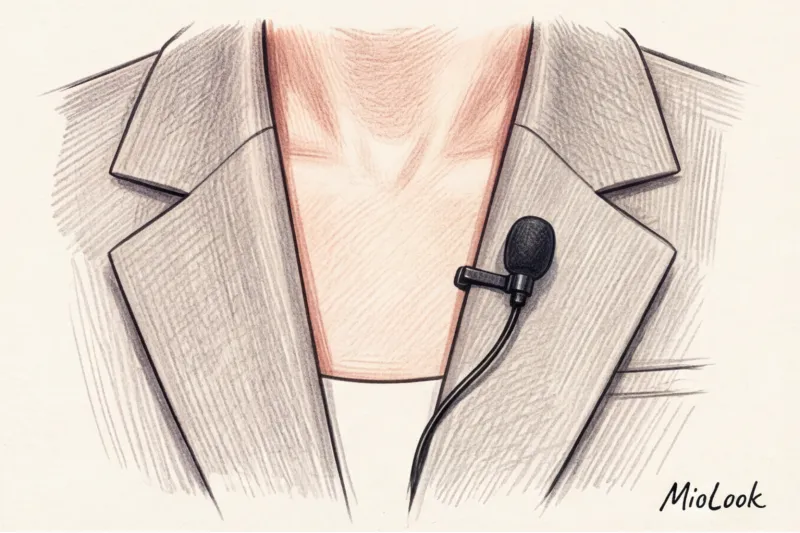
The second problem is the microphone itself. The clip should be positioned 15-20 centimeters from your mouth, precisely centered or on your lapel. If you're wearing a thin knit top or dress without a tight hem, the microphone clip will pull the fabric down, exposing unwanted skin, and the sound will be muffled due to friction against your clothing.
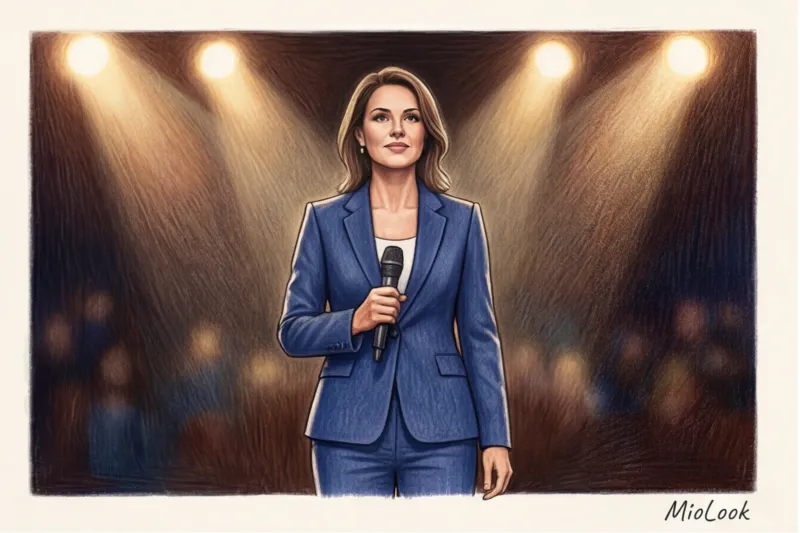
This is where it comes into effect hard edge rule Jackets with thick lapels, shirts with starched collars, and trousers with a stiff, structured belt are a sound engineer's best friends and guarantee your peace of mind. A lapel holds the microphone perfectly at the right angle, and a thick belt easily supports the weight of the transmitter without deforming the waistline.
Moiré and camera effects: banned prints
Have you ever noticed how sometimes, in conference videos or TV interviews, a speaker's jacket starts to strangely "ripple," shimmer, and literally dance across the screen? This isn't a hallucination or a malfunction of your monitor. It's a physical conflict between the camera sensor and the fabric's geometry.
In optics, this is called the moiré effect (aliasing). It occurs when a fine, repeating pattern on your clothing overlaps the pixel grid of a digital camera sensor. The viewer's brain goes crazy, and their focus instantly shifts from your intelligent thoughts to this pulsating, psychedelic effect.
According to leading broadcasters' technical guidelines (for example, the BBC's internal rules for television presenters, updated in 2022), there is a strict list of prohibited patterns for filming. These include:
- Small contrasting checks (especially black and white);
- A pinstripe, even if it looks barely noticeable in real life;
- Classic houndstooth (pied de poule);
- Fine rib or corduroy.
Even if your pinstriped suit looks as elegant as a Wall Street banker in the mirror, it can be a disaster on screen. That's why monochrome is the safest, most predictable, and most prestigious choice for video shoots and hybrid events.
Soffits and sweat stains: choosing the right fabrics
The stage is always stressful, accompanied by a surge of cortisol and adrenaline, even if it's your hundredth performance. Add to this professional stage lighting. Theatrical spotlights and powerful LED panels can increase the temperature in the performance area by 5-7 degrees compared to the auditorium. You're literally in a microwave.
This is where the real battle of the fabrics begins. Traitorous fabrics — thin silk, light cotton, and cheap synthetics (100% polyester). A light blue or gray cotton shirt is a ticking time bomb. They instantly darken with the slightest moisture, revealing telltale sweat stains under your arms or on your back. Synthetics also create a greenhouse effect, depriving you of oxygen.
Yours fabrics-saviors These are highly hygroscopic materials with a consistent texture that breathe and wick away moisture. These include:
- Thick suit wool (especially Super 100s and higher spins - it regulates heat exchange perfectly);
- Blended fabrics (where at least 50% viscose or tencel);
- Textured crepe — an absolute favorite for women's suits and blouses. Its grainy, matte surface diffuses light and visually conceals any imperfections, creases, or moisture.
Before purchasing a piece for the stage, I make clients conduct a wrinkle test Squeeze the fabric tightly in your fist for 10 seconds, then release. If it becomes covered in a persistent network of creases, leave the item at the store. At a conference, after two hours of sitting in a chair waiting to go on, those creases in the groin area will look like you slept in the suit.
To avoid having to think about all these technical details before each business trip, I recommend streamlining the process. In the appendix MioLook You can digitize your wardrobe and create a separate capsule tagged "Stage." Add only those jackets, trousers, and blouses that have already passed the spotlight test, are wrinkle-free, and have thick lapels for the microphone. This will save you hours of getting ready the night before an important event.
Access to MioLook for €0.99 — one-time payment
A smart AI stylist will create the perfect on-stage look based on your body type and needs. Digitize your wardrobe and plan capsule outfits for business trips with a single click.
Get access — €0.99 onceColor and Status: How to Control the Audience's Attention
According to the Pantone Color Institute, up to 90% of a person's first impression is formed solely by the color of their clothing. In a 500-person conference room, this percentage works like a magnifying glass. Choosing the right attire for public speaking isn't just a matter of aesthetics; it's your visual megaphone and a tool for focusing the audience's attention.
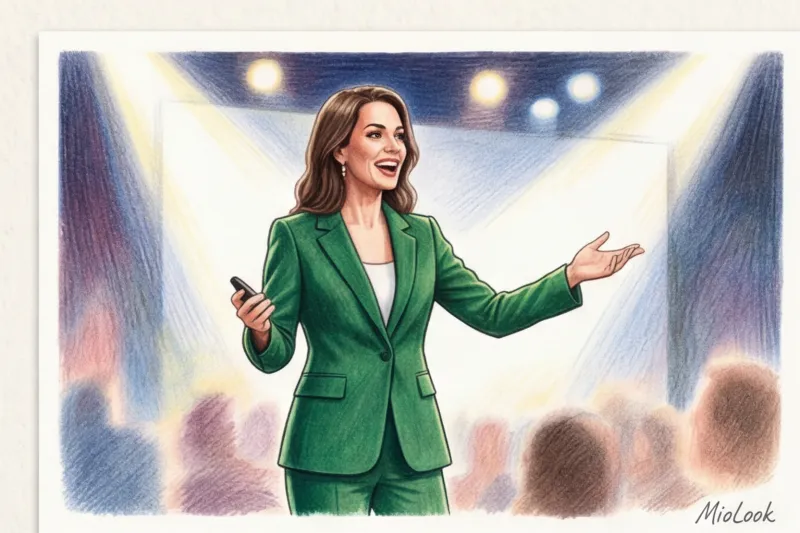
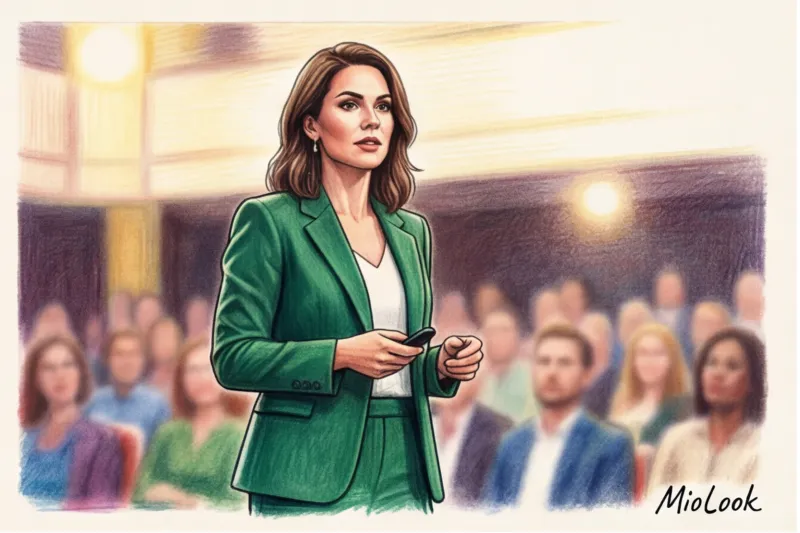
One of my regular clients, a B2B sales coach, for a long time exclusively presented in light gray pantsuits. She considered them to be the most neutral, "professional," and undistracting to the point of her presentation. We experimented with replacing this "safe" gray with a rich emerald three-piece suit made of a thick wool blend. We quantified the results: conversion rates for her consulting appointments after her presentations increased by 15%. Why did this happen? From a distance of twenty meters, the gray blended with the audience's faces and the projector screen—the audience's brain simply lost track of it. The emerald, on the other hand, acted as a powerful visual anchor, holding the audience's attention throughout the hour-long presentation.
The Myth of Black: Why It's the Worst Choice for Stage
"But Steve Jobs always performed in a black turtleneck!" is perhaps the most common argument I hear during initial consultations. From the perspective of stagecraft and the laws of physics, this choice is extremely dangerous for most speakers.
Yes, in real life, black elongates the silhouette and hides minor imperfections in the body. But under harsh theater spotlights, it behaves completely differently. The black pigment absorbs directional light, turning your figure into a flat, two-dimensional blob lacking volume and structure. Cameras operating in high dynamic range (HDR) settings often struggle to focus on black fabric, turning it into a noisy texture.
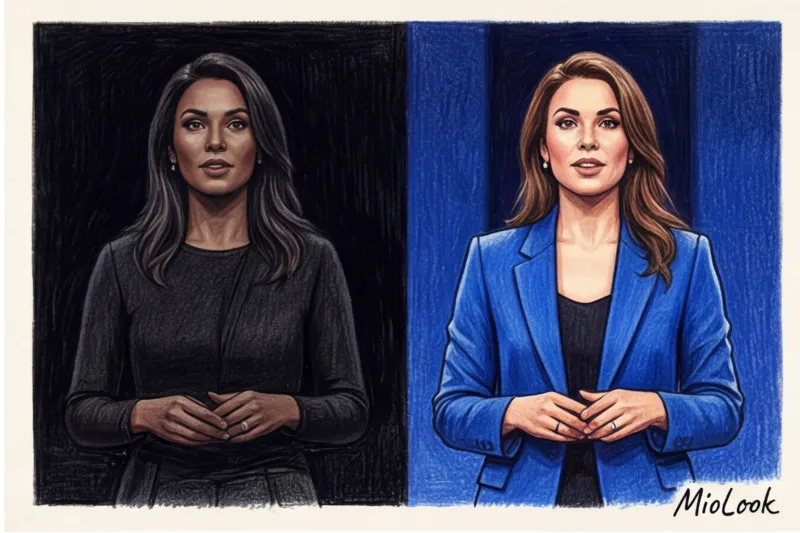
If organizers use a dark velvet backdrop or black curtains (which is standard for 80% of business venues), you risk creating a comical "flying head" effect. The body visually dissolves into the background, leaving the audience to observe the face and hands floating in the air. This creates a subconscious discomfort in the audience, as body language becomes unreadable.
Furthermore, macro photography and bright overhead lighting are merciless to dark fabrics. The tiniest hair, microscopic dandruff, powder, or chalk dust—all of this is projected onto huge screens with alarming clarity against a black background. Worse, black against the face under the spotlights acts as a shadow reflector, visually deepening nasolabial folds and emphasizing dark circles under the eyes. You'll look 10 years older and infinitely tired.
Colors that inspire trust and maintain focus
If we're ruling out basic black and gray, what should we go for? My absolute favorite for the stage are so-called jewel tones: royal blue, deep emerald, rich burgundy (marsala), and amethyst.
Neuromarketing research shows that these shades convey high status and authority without creating the aggressive distance that pure red does. Fabrics in these colors (especially matte wool or dense crepe) offer optimal light reflection: the speaker's face appears fresh, and their silhouette remains sharp and clear, even for audience members in the farthest rows.
What about pastel colors? Light blue, powder, or beige work great for intimate morning breakfasts, panel discussions in bright lofts, or when recording webinars with a ring light. However, on a large, dark stage, a speaker in a powder-colored suit risks becoming "invisible" or appearing underdressed from a distance. If the format calls for a light shade, be sure to incorporate a contrasting element near the face—for example, a dark silk scarf or eyeglass frames with accents.
The most important rule that even seasoned experts forget is that clothing color should contrast with the background. Wearing a blue suit against a corporate blue press wall is visual suicide.
Before approving the look, make it a rule to request the event's brand book and stage photos from previous years from the organizers. And to avoid having to remember all these color nuances before each business trip, I recommend digitizing your successful stage outfits. Upload your items to MioLook app and create tags for different venue types: "Light Background," "Dark Room," "LED Screen." The app lets you filter your wardrobe by color in just two clicks and create an outfit guaranteed to make you the visual center of attraction in the room.
Silhouette and fit: the geometry of a confident speaker
From fifteen meters away, a viewer won't notice the texture of your silk blouse or the logo on the buttons. The only thing the audience's brain instantly perceives is your silhouette. The geometry of your image is the architectural framework of your expertise, and it must be constructed according to strict laws.
Today's street style dictates a love of hyper-volume. We happily wear relaxed, oversized jackets in the spirit of Balenciaga or The Row and wide, flowing trousers. But what looks conceptual at Fashion Week works against you on stage. Shapeless oversize clothes visually "eat up" the speaker. Baggy clothes make you appear smaller, and your posture is perceived as unsure—as if you're hiding behind excess fabric. On stage, we need maximum poise.
This is where my favorite part comes into play hard shoulder rule A structured jacket with a defined shoulder line (even if it's made of soft fabric, with built-in shoulder pads a must) physiologically conveys authority. Listeners subconsciously associate a smooth, slightly flared shoulder line with strength, competence, and the ability to "take a hit"—precisely the qualities expected of an opinion leader. Have you noticed how your own posture automatically straightens when you put on a well-tailored blazer?
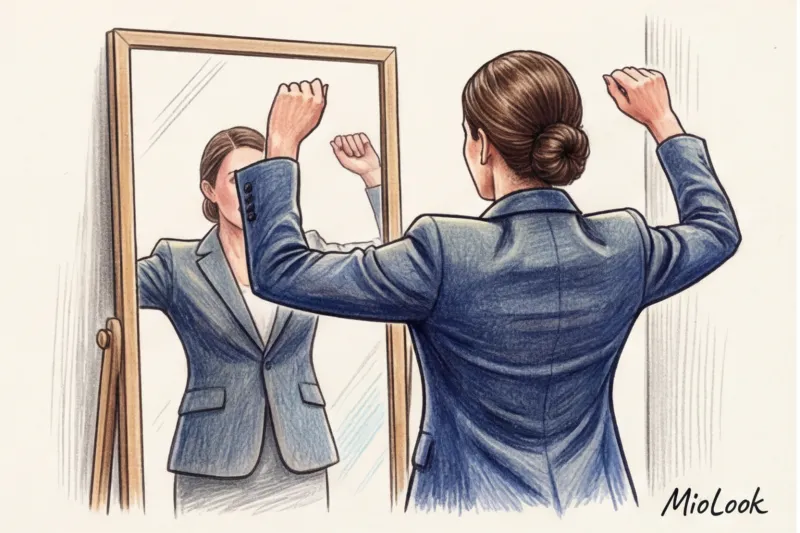
But perfect statics are worthless if your clothes restrict your movement. A performance is always dynamic. A sweeping arm gesture is your main tool for capturing attention. If your jacket has too low an armhole (a common problem with mass-market brands), the slightest upward movement of your arms will cause the entire jacket to slide with them. You'll instinctively tuck your elbows into your waist to keep your clothes from riding up, and your body language will become tense.
Practical advice from a stylist: never make a decision about purchasing stage clothing simply by standing straight in front of a fitting mirror. Always check the fit dynamically. Raise your arms as if pointing to the upper right corner of the presentation screen. Sit on a chair. Lean forward, mimicking a conversation with the audience. If there's any tugging, pinching, or unsightly creases, the item stays in the store.
Another critical detail that 90% of beginning speakers forget is the angle. The stage is typically elevated 0.5–1.5 meters above the audience. This means that the front row audience (often occupied by investors and key partners) is looking up at you. From this vantage point, a classic knee-length skirt suddenly becomes an extreme miniskirt when perched on a high bar stool. Slightly cropped trousers reveal a strip of bare leg above the toe, which is unacceptable in business etiquette. Choose a midi skirt (at least a hand's length below the knee), and pair your trousers with high socks that completely cover your calf when seated.
Finding pieces with flawless architecture that have passed your personal "dynamic crash test" can be difficult. Once you finally assemble such a set, it needs to be treasured. I strongly recommend immediately digitizing successful stage images in MioLook By creating a separate "For Performances" capsule there, you'll save yourself hours of stressful preparation before your next conference—a smart wardrobe will clearly show you what tried-and-true gear you already own.
Access to MioLook for €0.99 — one-time payment
Start creating perfect images with the help of artificial intelligence
Get access — €0.99 onceSpeaker's Shoes: A Balance Between Status and Endurance
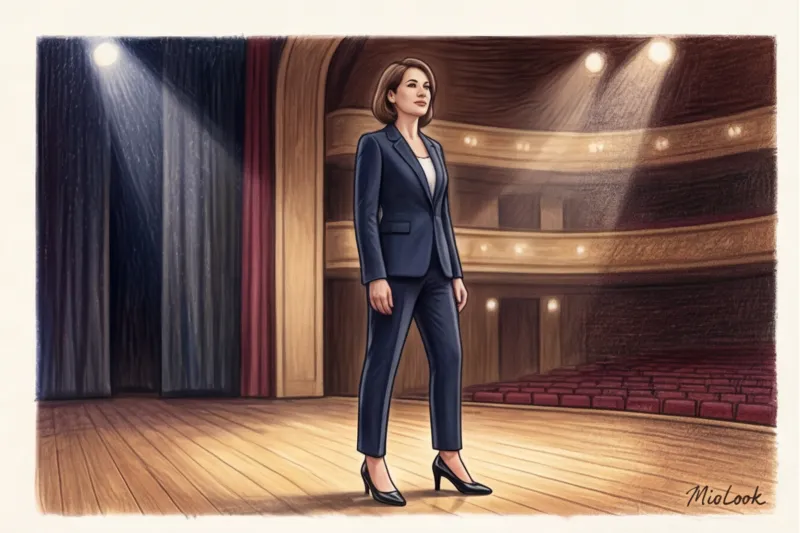
Do you know what the stage of a prestigious business forum and a renovation site have in common? An abundance of thick cables, joints in the flooring, and unpredictable gaps between panels. A thin hairpin in such conditions poses more than just the risk of tripping over a monitor cable.
Biomechanically, the lack of a wide base under the heel forces the body to constantly struggle to balance. This micro-stress is transmitted upward: the calves tighten, the diaphragm becomes blocked, proper breathing is disrupted, and as a result, your voice sounds less deep and confident. Furthermore, fatigue from 10-centimeter heels sets in after just twenty minutes of active gesticulation and movement around the stage.
"A speaker's confidence literally starts with their feet. If you don't feel solid ground beneath your feet, your brain subconsciously perceives the situation as unstable, raising cortisol levels." This principle of body kinetics works flawlessly.
The ideal stage shoe is one you forget you're wearing the moment you step toward the microphone. Swap stilettos for a sturdy block heel, 5-7 centimeters high. It adds the necessary presence and elongates the silhouette, while providing a secure base of support. If the event format allows for a heel-free look, opt for masculine classics: leather loafers with a rigid shape, oxfords, or brogues. They instantly pull together your look, projecting authority without sacrificing comfort.
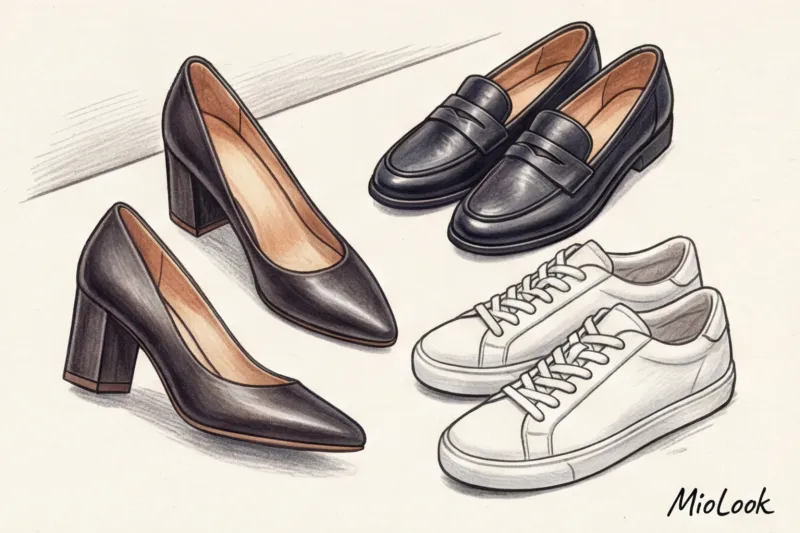
The global trend toward smart casual, driven by CEOs of major tech companies, deserves special attention. Sneakers are perfectly appropriate on stage at an IT conference or startup pitch today, but the line between relaxed class and sloppiness is very fine. For athletic shoes to enhance your image, they must meet three strict criteria:
- Premium materials: Only smooth matte leather or thick suede. No mesh, neoprene, or technical fabrics.
- Absolute minimalism: Basic monochrome sneakers (in the spirit of classic Common Projects or Santoni lines) without massive logos, complex lasts, or neon inserts.
- Impeccable condition: perfectly clean, unworn soles and fresh laces.
The final, but crucial, test before going on stage is the noise check. Stages are often covered with resonant laminate or thin plastic. Hard heels that click loudly with every step, or rubber soles that squeak sharply when you turn the body, will transmit noise directly into your lavalier microphone, mercilessly distracting your audience from the meaning of your speech. Be sure to test the pair on a similar surface beforehand.
A piece of advice from my personal experience: as soon as you find that very quiet, comfortable and status pair, take a photo of it and add it to MioLook Create a separate "Stage" capsule and tie your trusted footwear to it—it'll save you hours of stress when packing for your next important business trip.
Accessories: What identifies an expert and what cheapens the look
"Any sound engineer's worst nightmare is a speaker wearing massive jewelry," the technical director of a major IT conference once told me. And he's absolutely right. We often overlook a crucial technical detail: a lavalier microphone is incredibly sensitive. If your multi-tiered pendant rhythmically slams against a metal jacket button, or you're actively gesturing with a hand full of bracelets, it will sound like a sledgehammer hitting an anvil on the hall's speakers. Jingling bracelets and earrings are a microphone's worst enemies. This monotonous clacking instantly destroys the listener's concentration and hopelessly ruins the audio track of your presentation.
The second trap is lighting. Under powerful stage lights, large, glossy stones, rhinestones, and polished gold become like disco balls. The danger of glare is that it draws attention away from your face, casting irritating spots of light directly into the cameras and the eyes of front-row audience members.
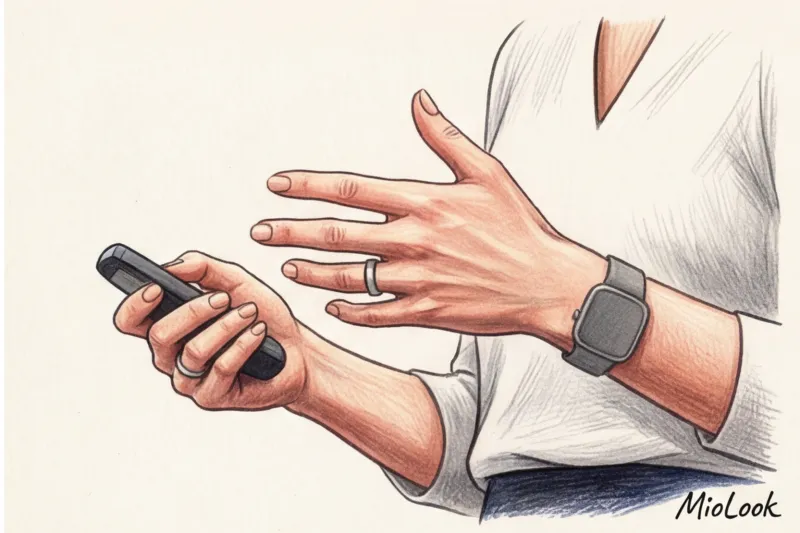
Glasses deserve special attention. If you wear glasses, be sure they have a high-quality anti-reflective coating—for example, from Carl Zeiss or similar professional brands. Without it, in all close-ups of the video, viewers will see only bright white rectangles of reflected spotlights instead of your eyes. This creates an invisible wall and psychologically disrupts eye contact with the audience.
Your ideal image
it begins Here
Join thousands of users who look flawless every day with MioLook.
Get access — €0.99 onceSo what should you wear? The main status markers on the scene are matte textures, architectural minimalism, and expensive watches. Satin silver, matte gold, high-tech ceramic, or a simple leather strap convey confidence without unnecessary fuss. A restrained approach to detail demonstrates that you don't need to prove anything with glitz—your expertise speaks for itself.
To avoid grabbing my favorite but “noisy” necklace in the hustle and bustle before flying to the forum, I always keep ready-made stage capsules along with my tried-and-true accessories in MioLook The app helps you visually assess the harmony of details and eliminate unnecessary items before you even start packing.
Pre-release checklist: testing the image
On the eve of major events—whether a panel discussion at Web Summit or a local business forum—I always provide my clients with a strict, step-by-step action plan. In my experience, the ideal outfit for public speaking isn't determined by the price tag, but by how it performs under stress. In the dressing room, under soft lighting, everything looks flawless, but the stage is no place for illusions. Here are five tests your suit must pass before leaving the house.
- Take a photo with flash (check for transparency). Powerful spotlights reveal fabrics much more clearly than office lamps. Turn off the lights in the room and take a photo of yourself with a strong flash. You'll be surprised how often seemingly thick poplin or light silk suddenly reveals the treacherously contoured lines of your underwear.
- Record a video in motion (check for moire and creases). A camera lens captures what a static mirror ignores. Walk from corner to corner while recording: this will check the fabric for optical ripples and make sure your pants don't bunch up in the groin area when you take a long stride.
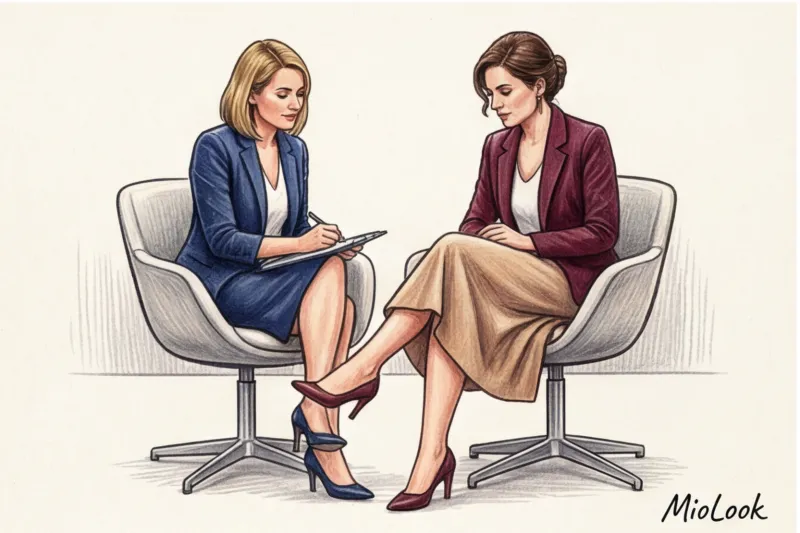
- Sit on a bar stool and in a deep armchair. Public speaking formats often require a relaxed posture. Make sure your skirt doesn't ride up to a critical point, and your trousers don't reveal a strip of bare leg above your socks (high socks that match your shoes are an absolute must-have for male speakers).
- Raise your arms up and spread them out to the sides. You'll be actively gesturing, pointing at the screen, or using a clicker. The armholes of your jacket shouldn't block your shoulder joint, and your top shouldn't stick out from your waistband. If your blouse constantly comes off when you move, consider switching to a bodysuit.
- Crease test (10 second rule). Squeeze the fabric of your pants or skirt tightly in your fist for ten seconds, then release. If there are any sharp creases, stay home. Imagine what it will look like after a taxi and an hour-long wait in a cramped dressing room.
To avoid repeating this stress test before every business trip, I strongly recommend recording your results. Take a photo of the image that successfully passed all five stages and save it in MioLook I recommend creating a dedicated smart tag in the app called "Stage Verified"—that way, you can pack for your next conference in ten minutes, feeling 100% confident in your armor.
Speaker Capsule: How to Build a Tour Wardrobe with MioLook
It's two in the morning. Your flight is delayed, you've just checked into a strange hotel, and you have to open a plenary session at nine. You pull your carefully chosen outfit out of your suitcase, only to discover it looks like it's been chewed. And the hotel iron, as luck would have it, is treacherously spitting out rusty water. Sound like a familiar touring nightmare?
For an expert who frequently travels for conferences, the right attire for public speaking should not only be classy but also literally "indestructible." I categorically forbid my clients from taking linen, fine cotton, and viscose without synthetic blends on business trips. We prefer high-tech blended fabrics. Consider triacetate (often found in the basic lines of brands like Theory or COS)—this material flows like expensive silk but doesn't wrinkle at all when folded. Heavyweight wool crepe and cold-spun jersey work well. Remember my golden rule for the traveling traveler: if an item doesn't straighten out on its own after 15 minutes of hanging on a hanger in a steamy bathtub, it absolutely doesn't belong in your suitcase.
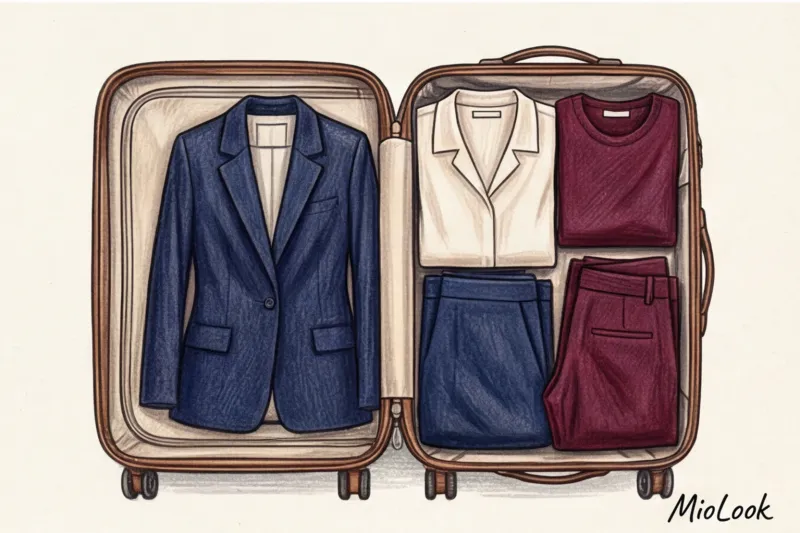
Even the right fabrics take up space, and flying with huge luggage for two days of the forum is irrational. To always have a backup plan (in case of spilled coffee at breakfast) and not carry unnecessary things, I have set up a strict rule for my clients Speaker capsule formula: 2 bottoms, 3 tops, 1 accent jacket.
- Two bottoms: Perfectly fitted full-length trousers and a midi skirt (or culottes). One element is dark and formal, the other a little more relaxed.
- Three tops: A basic top to wear under a jacket (avoid a low neckline where the microphone might fall), a thick blouse with a closed collar for a solo outing without a jacket, and a high-quality jumper made of fine merino wool for informal networking or an afterparty.
- One accent jacket: Structured, with a defined shoulder line, it will instantly pull any look together and provide that "hard edge" for attaching the transmitter we talked about earlier.
Do you know what separates a good speaker from an outstanding one? The ability to tightly manage your cognitive resources. Your task before going on stage is to think about meaning, audience connection, and timing, not whether an emerald blouse matches graphite trousers. And this is where technology comes in.
I insist on a complete digitalization of your tour wardrobe. Download all the elements of your "2-3-1" formula into MioLook Create a separate smart tag called "Conferences" and, while still at home, create a schedule for each leg of your trip: welcome dinner, keynote address, panel discussion, and commute home. When the morning arrives, simply open the app and select your pre-made schedule. No more struggling to choose in front of the mirror.
"The most valuable thing about a technological approach is analytics. Maintaining winning combinations and honestly analyzing what you feel most confident in can work wonders."
Use the app's calendar feature to track your feelings after each presentation. After tracking statistics in MioLook for six months, one of my entrepreneurial clients discovered a striking pattern: her highest-converting presentations were always delivered in the same dark blue three-piece suit. Her posture changed, her gestures became smoother, and her voice deepened. The numbers don't lie. We simply eliminated all the questionable experiments from her stage capsule and scaled up this successful formula.
The stage doesn't forgive fuss, but it generously rewards preparation. Delegate the stylistic routine to algorithms, pack your smart suitcase according to a formula, and walk out to the audience with absolute certainty: your look is flawless, and now it's your turn.
Guide Chapters
How to Dress for a Business Conference for Women: A Style Guide
Large-scale events require a wardrobe that's not only stylish but also durable. We'll share how to put together the perfect conference look that won't wrinkle and will help you make valuable connections.
Speaker Dressing: How to Dress for TED
How to dress for a presentation to look expert but not too formal? We explore the anatomy of TED-style style, taking into account spotlights and camera lenses.
Webinar Attire: How to Look Professional
A webcam distorts colors and proportions, so your usual style won't work. Learn how to choose the right look for an online presentation.
The perfect color to wear on stage
Why can a perfectly good outfit turn into a neon blur under the spotlight? We explore how camera lenses and stage lighting alter the colors of your clothes.
Ideal clothing for video shooting and interviews
What looks luxurious in real life can be a disaster on camera. Learn how to choose the right look for TV and video shoots.
The Perfect Lapel Pin: Tips for Speakers
Choosing clothes for performing with a lavalier microphone is not only a matter of style but also acoustics. Learn how to avoid common mistakes and feel confident on stage.
Stage Performance Clothing for Plus Size Women: Styling Tips
How can you stop hiding behind shapeless robes and start commanding your audience's attention? We'll explore the key rules for choosing stage looks for plus-size women.
Fabrics that don't show sweat stains: A guide for speakers
Pre-performance jitters can ruin your look by leaving telltale marks on your clothes. We'll discuss with a stylist which materials will save you from awkward situations on stage.
Stage Makeup: How to Keep Your Face
What looks great in real life falls flat under the spotlight. We explore the main mistakes and rules of stage makeup for speakers.
Stage Shoes: How to Choose
Uncomfortable shoes can ruin even the most brilliant speech by constricting your diaphragm. We'll tell you how to choose the perfect pair that will enhance your status and ensure comfort.
Hairstyles for Public Speaking: The Best Speaker Hairstyles
A speaker's hair is a functional tool that influences acoustics and audience attention. We explore which hairstyles will help you deliver a flawless performance and avoid microphone issues.
Public Speaking Jewelry: Dos and Don'ts
Inappropriate accessories can ruin your microphone sound and distract your audience. Learn what jewelry is strictly prohibited for speakers.