Backstage. There are exactly three minutes left before you go on stage. You're repeating the opening lines of your presentation to yourself, adjusting your lavalier microphone, and suddenly you feel a telltale sweat under your arms. Sound familiar? Adrenaline is doing its job, and suddenly you're thinking not about the shiny graphs in your presentation, but about whether that dark stain on your shirt is spreading.
In our complete guide "Public Speaking Clothing: How to Look Confident and Respectable as a Speaker" We've already covered the psychology of color and the right silhouette. But today I want to talk about pure physics and textile engineering. Over 12 years of working as a personal stylist, I've brought dozens of top managers and speakers onto stage. And I know for a fact: your comfy office sweater can become your worst enemy under the spotlight. Let's explore a critically important question: which fabrics don't show sweat stains, and how to physically prevent them with the right cut.
The Anatomy of Stage Anxiety: Why Standard Wardrobe Rules Don't Work on Stage
Stress sweating is fundamentally different from the body's response to summer heat. When you're nervous, the apocrine glands are activated. The reaction is immediate and localized. Add to this the harsh external environment: according to research by WGSN (2024), intense stage lighting increases the temperature around a speaker by 2-3 degrees, which, under stress, increases sweating by 50%.
There's a cruel psychological trap here. The sensation of moisture makes you even more nervous. Your pulse quickens, your body produces even more sweat—a vicious cycle begins. Now let's remember the famous "7-second rule" (a Harvard University study on first impressions). If the audience notices dark circles on your clothing within the first few seconds, their attention subconsciously shifts from your expertise to your nervousness.
"Your stage presence isn't just a pretty facade. It's your armor. If that armor cracks, you lose control of your audience."
The Biggest Myth: Why 100% Cotton and Silk Are Your Main Enemies
If you Google "tips for speakers," the first link you get is: "Wear breathable natural fabrics like cotton or linen." As a practicing stylist, I declare: this is the worst advice you can give someone before an important performance.
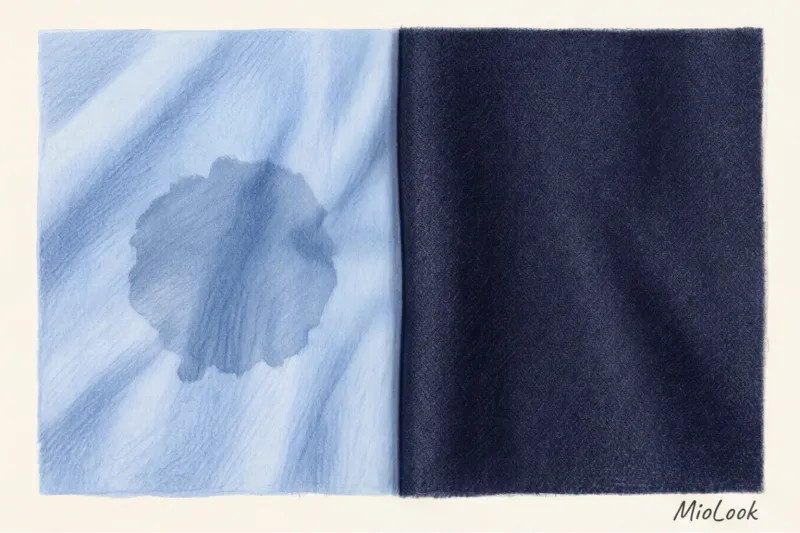
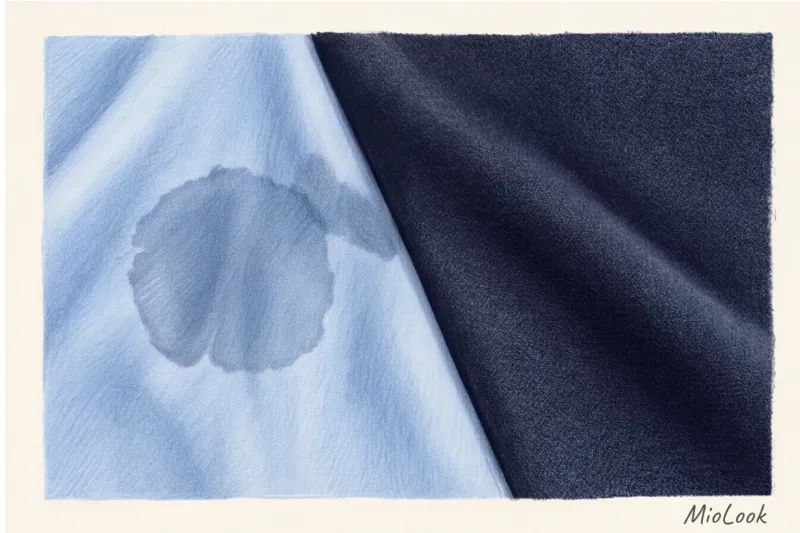
Yes, hydrophilic fibers (cotton, linen, viscose) breathe well. But they absorb moisture like a sponge! When wet, 100% cotton instantly changes its optical properties and darkens by 3-4 shades. Worse, it takes 3-4 times longer to dry than modern blended materials, leaving you with a "wet back" effect for the entire hour of your performance.
Smooth silk is even more insidious. I once had a client, a director, nearly ruin her own TEDx talk. She chose a luxurious light blue silk blouse. Ten minutes before she was supposed to go on stage, a light sweat had caused huge dark circles to form under her arms. Silk not only instantly shows the slightest drop of water, but also leaves whitish salt stains after drying. The situation was only saved by me literally taking off my oversized black blazer and putting it on her. Since then, pure silk for the stage is strictly prohibited in my clients' riders.
Your perfect look starts here
Join thousands of users who look flawless every day with MioLook. Our intelligent AI stylist will create the perfect look for any occasion.
Get access — €0.99 onceTop 5 Fabrics That Don't Show Sweat Stains
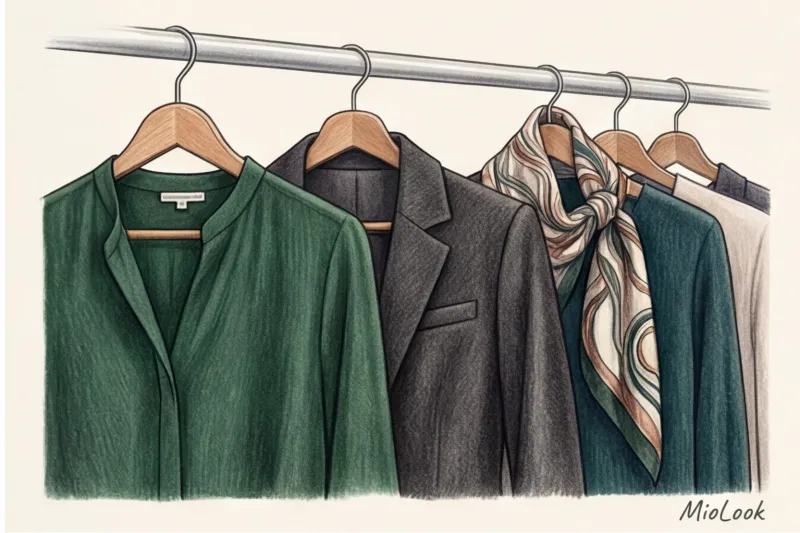
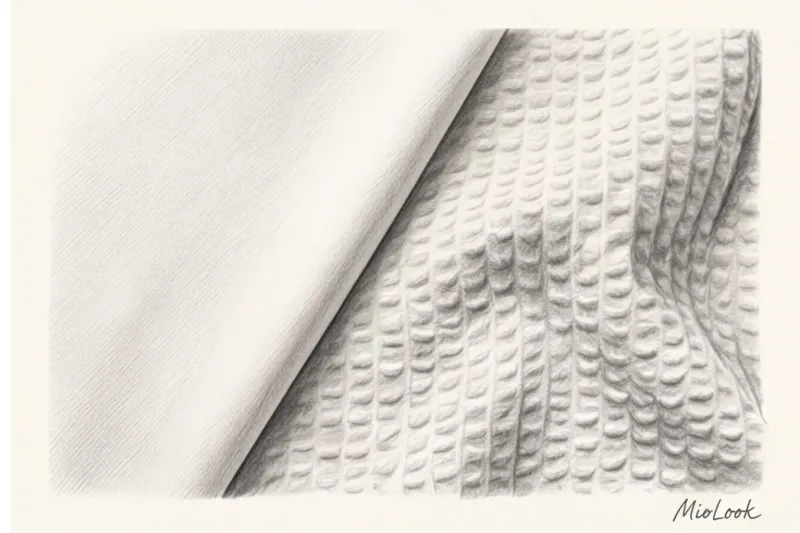
The main principle to remember is that for masking moisture, it is not so much the composition of the thread that is important, but fabric texture A smooth surface (like satin or poplin) reflects light evenly, so a wet spot is immediately noticeable. Textured fabrics diffuse light, creating the optical illusion of dryness.
Crepe and Georgette: grainy texture
My absolute favorite for women's blouses and dresses. The grainy, rough surface of crepe physically hides moisture thanks to the micro-shadows in the special twisted weave of the threads. Polycrepe blouses (a blend of viscose and high-quality polyester) are the gold standard for TV presenters. I often conduct a test in the studio: I spray water on smooth cotton and textured crepe. Cotton darkens instantly, but on crepe, the water simply disappears into the texture.
Fine suit wool (Cool Wool)
Many people are afraid of wool, thinking it will be hot. Wrong! Fine worsted wool (look for Super 100s-120s) acts as an ideal climate control material. Wool fiber is unique in that it is hygroscopic on the inside, but its scaly outer surface is hydrophobic (water-repellent). A high-quality wool suit breathes well, holds its shape, and doesn't darken at all from light perspiration.
Modern high-tech lens hoods
Forget the "glass" polyester of the '90s. Today, brands from COS to premium labels are creating tech wear for business—blends of natural fibers with next-generation polyester. Fabrics with moisture-wicking finishes draw moisture away from the body and distribute it over a wide surface area, causing it to evaporate in minutes without leaving stains.
Color Matrix: Which Shades Will Give You Away
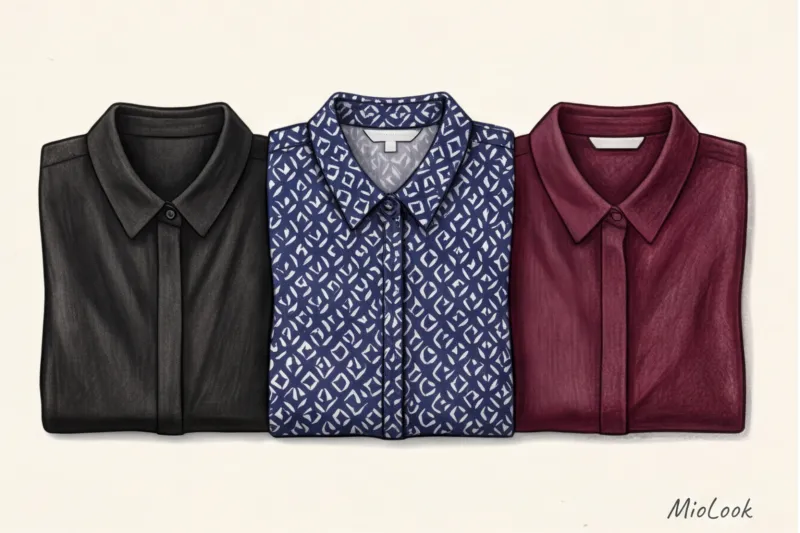
Even the right fabric can fail if you choose the wrong color. The physics of color are unforgiving: the lighter and more complex the shade, the greater the contrast between the dry and wet areas.
- The most dangerous colors: Light gray, sky blue, dusty rose, khaki, taupe. The difference between dry and damp fabric is greatest here. Light gray cotton looks almost black when wet.
- The safest colors: deep black, optical white (it doesn’t darken, but becomes transparent, so you must wear flesh-colored underwear under it) and dark blue (navy).
Dark blue is the perfect balance. It hides stains as reliably as black, but looks more intimate and less dramatic. And if you want to add movement, use the magic of print. A small geometric pattern, a classic houndstooth, or an abstract design create visual noise. The human eye is unable to focus on a stain if it's broken up by a contrasting pattern.
Access to MioLook for €0.99 — one-time payment
Start creating your perfect looks with AI. Upload your wardrobe and get ready-made formulas for every day.
Get access — €0.99 onceThe architecture of cut: how style saves from awkwardness
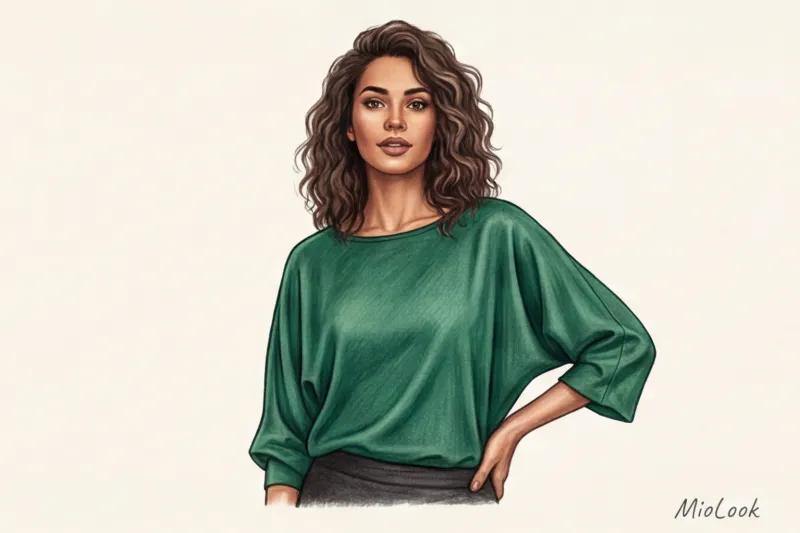
Fabric and color are half the battle. The other half is the geometry of your clothing. The main culprit of awkward situations is a tight, high armhole combined with a tight silhouette. This design literally rubs the fabric against the skin, leaving no chance for ventilation.
What silhouettes work for you?
- Dolman sleeve and dropped shoulder: They create an air gap in the underarm area. The fabric simply doesn't touch the body where it matters most.
- Oversized shirts made of thick material: The density of the fabric (for example, heavy cotton from 180 g/m² or dense lyocell) allows the shirt to keep its shape and not stick to the back.
My signature formula for speakers, which has never failed: A loose silk tank top + a structured heavy wool jacket = absolute invulnerability In this combination, the jacket takes the brunt of the impact, hiding everything that's going on underneath, while the loose T-shirt provides ventilation.
Stylists' Secret Weapon: Invisible Assistants
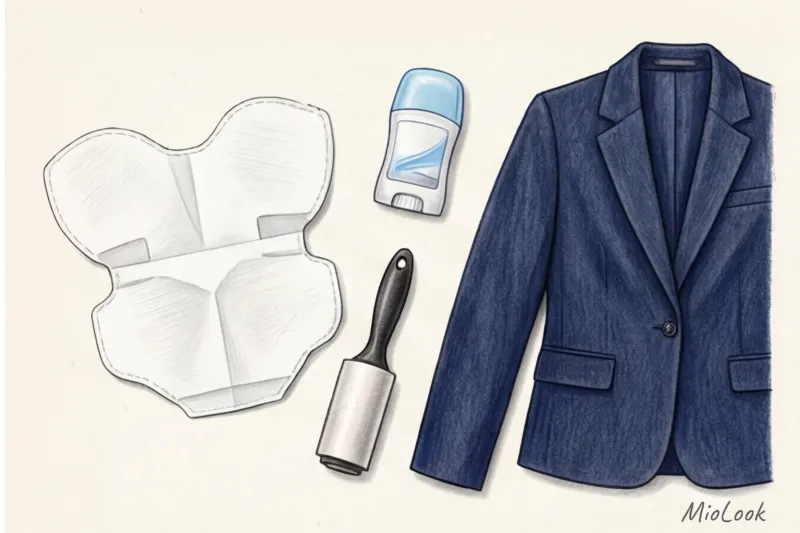
Behind the scenes at major conferences and on television, we don't rely solely on luck. Every professional stylist has an arsenal of invisible helpers in their toolbox.
First, special armpit pads (dress shields). These are thin cotton pads with a waterproof layer that stick to the inside seam of a jacket or dress's armhole. The key: choose pads with a fabric backing, not paper, otherwise they will rustle treacherously into the microphone with every arm movement.
Second, base layers. For men in formal suits, a thin cotton T-shirt under a dress shirt is a must. Yes, I said cotton absorbs moisture. But in this case, the T-shirt acts as a barrier sponge, preventing sweat from reaching your expensive shirt.
Thirdly, clinical antiperspirants. According to the recommendations of the International Hyperhidrosis Society (2023), antiperspirants containing aluminum chloride should be applied exclusively at night on dry skin , not 5 minutes before going out. Overnight, the active ingredients form a reliable barrier in the gland ducts.
An important caveat: I must be honest with you. If you have been diagnosed with clinical hyperhidrosis, clothing alone will not solve the problem. Fabrics and cuts are camouflage, not a cure. In this case, be sure to consult a dermatologist.
Checklist: Your Stage Armor
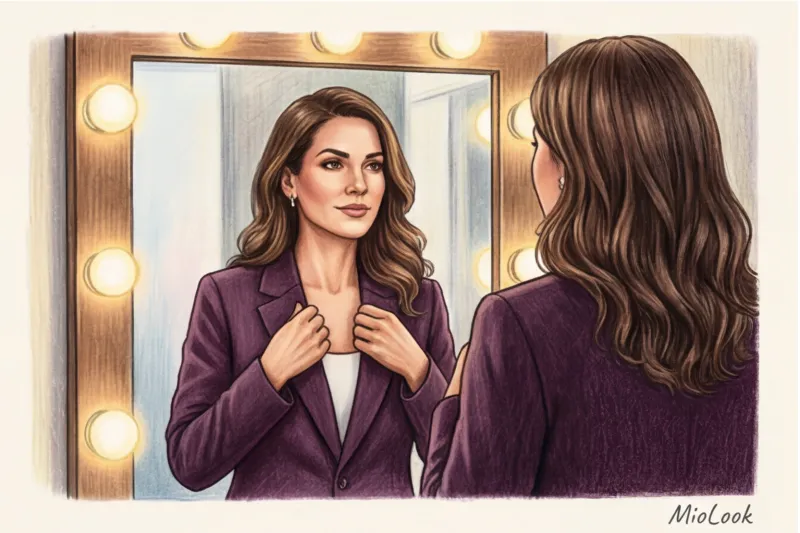
To avoid having to keep all these rules in your head before every important event, I recommend using the "smart wardrobe" feature in the MioLook app You can create a special "performance capsule" in advance and tag safe items. While you're putting together this capsule, here's your quick checklist:
- Take a test drive: The day before the performance, spray the back of your chosen garment with water. Observe how much the color darkens on the front and time the drying time. If the fabric takes longer than 10 minutes to dry, change your look.
- Check freedom of movement: Raise your arms in front of a mirror. If the fabric under your arms is pulled tight against your body, the risk of stains doubles.
- Add the final layer: When in doubt, throw on a blazer or a thick cardigan over the top. Layers are your best friend.
Clothes should serve you, protect you, and give you confidence, not take it away. When you know for sure that your appearance is impeccable and protected from any physiological surprises, you can fully commit your energy to the audience. And that's exactly why you go on stage.