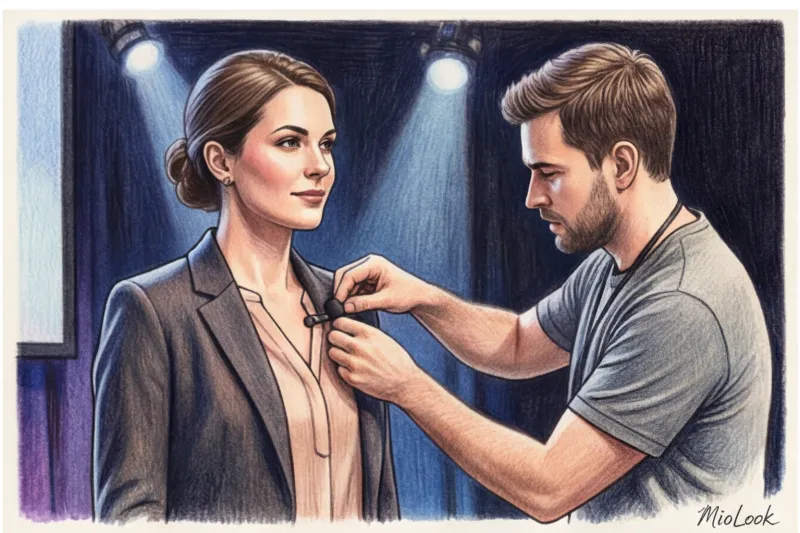
Do you know what a sound engineer's worst nightmare at a business conference looks like? It's the speaker who, five minutes before going on stage, appears in a flowing silk dress with no pockets or a three-button, ultra-fine linen shirt. A flurry of activity ensues, attempts to hide wires, awkward touches, and panic.
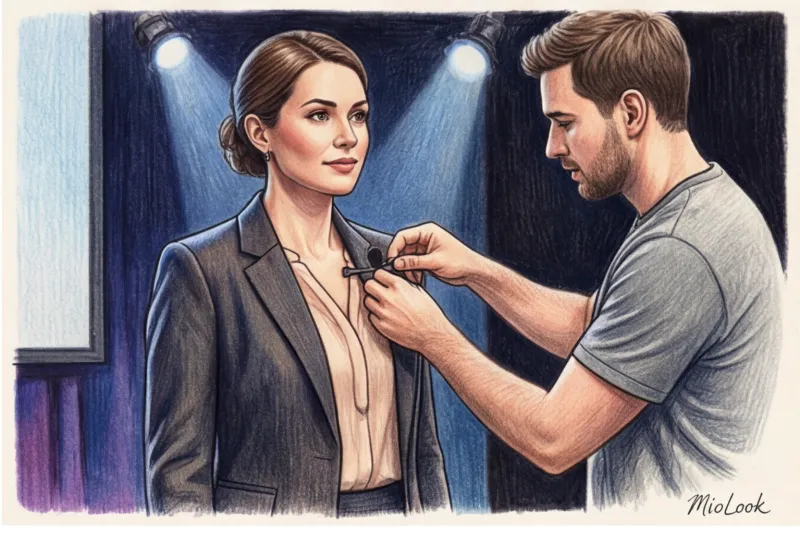
Over 14 years as a stylist, I've recruited clients for TEDx, international forums, and television broadcasts. And I can confidently say: the right clothes under the buttonhole It's not just a matter of aesthetics. It's a matter of physics, acoustics, and your personal comfort on stage.
We have already discussed in detail how to form an expert image and manage the audience's impression in our The Complete Guide to Dressing for Public Speaking But today I want to look at your wardrobe through the eyes of a technical team. Let's explore why what looks perfect in your bedroom mirror can turn into a disaster under the spotlight.
Why "lapel-style clothing" is a separate genre of business wardrobe
To understand the scale of the problem, it's important to understand the anatomy of a radio system. A lavalier microphone consists of three elements: the capsule itself with a clip (clip), a long cable, and a transmitter unit (bodypack). The main problem lies in the transmitter.
A standard transmitter weighs between 80 and 150 grams and is about the size of a deck of cards. That doesn't seem like much. But try hanging a 150-gram weight on the hem of your favorite blouse. The fabric will inevitably pull down 3-5 centimeters, throwing off the proportions of the cut and possibly revealing something you didn't intend to show.
"Stage clothes are your work tools. They should not only convey status but also withstand the weight of technical equipment without losing their shape."
This is why a speaker's wardrobe requires a completely different approach to choosing fabrics, silhouettes, and layering.
Anatomy of the problem: where to mount the microphone and base
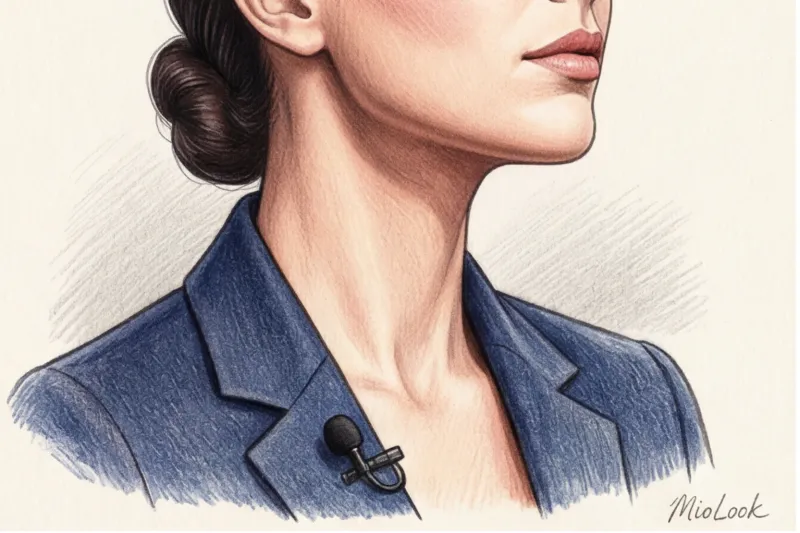
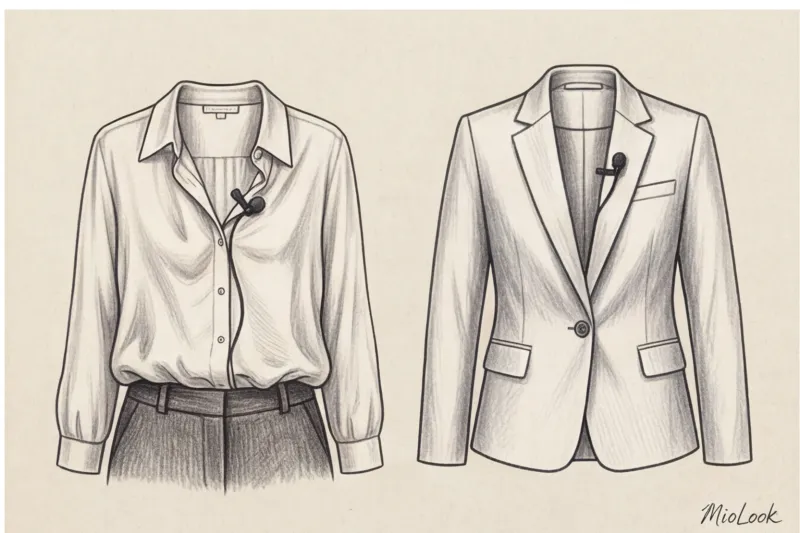
Sound engineers have a golden "triangle rule." For clear, spacious sound without echo, the microphone capsule should be positioned exactly in the center of the chest, 15-20 centimeters from the speaker's mouth. Mounting the microphone too low will make the voice sound muffled. Moving it too far to the side will make you sound out of place when you turn your head.
Ideal areas for clipping the lapel clip
- Jacket lapels. This is absolute perfection. A classic jacket's lapel always has interlining (an adhesive backing) inside it, which stiffens the fabric. The clip is held securely, and the microphone points straight up.
- Shirt placket. The space between the second and third buttons is great for fastening, especially if the cotton is fairly thick.
- The edge of a thick jumper. A V-neck or a thick round collar in basic knitwear (from 300 g/m²) will do the job perfectly.
Hiding the transmitter unit: pockets and belts
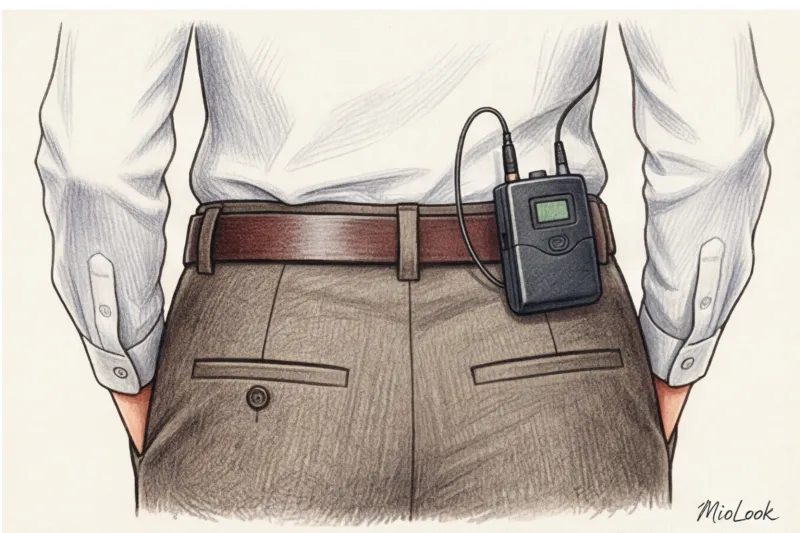
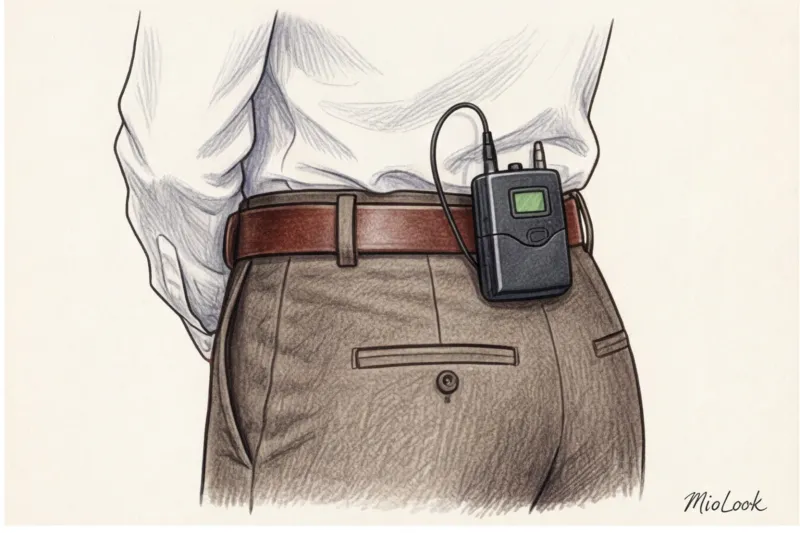
Now that we've sorted out the microphone, where do we hide the proverbial "deck of cards"? The black transmitter rectangle with the protruding antenna needs to be secured so it doesn't bulge under clothing or pull it down.
The best place for the transmitter clip is a sturdy leather belt on trousers or a skirt. Another excellent option is deep slit pockets in jackets. However, the only place you shouldn't put the base station is in the pockets of thin summer trousers. This is where the rule doesn't apply: under the weight of the device, the pocket of thin viscose trousers will stretch almost to the knee, completely distorting the silhouette of the thigh.
Access to MioLook for €0.99 — one-time payment
A smart AI stylist will select the perfect look for your performances, taking into account the dress code and your body type.
Get access — €0.99 onceTraitorous fabrics: what will ruin the sound and picture on video
Herein lies the most subtle, counterintuitive insight, one that female executives rarely consider. A flowing silk blouse, considered the epitome of expensive, feminine business attire, is a speaker's worst enemy.
Why? Firstly, silk, chiffon, and thin viscose are prone to catastrophic deformation. The weight of the clothespin will cause the collar to droop unattractively, creating folds. Secondly, thin fabrics accumulate static electricity and stick to wires.
But there's a third problem: acoustic noise. According to the Association of Audio Engineers (AES) 2023 technical guidelines, rustling synthetics, taffeta, and hard nylon create micro-noise in the 2-5 kHz range with every breath. This crackling noise is virtually impossible to remove in post-production without distorting the timbre of your voice.
Ideal fabrics for the stage:
- Thick cotton (from 180 g/m²).
- Suit wool (super 100s - 120s).
- Dense blended knitwear (ponte, jersey).
- Tweed and matte denim.
Women's Stage Wardrobe: Common Mistakes and Best Solutions
I've encountered situations that were close to disaster. One of my clients, a top manager at an IT company, was preparing for a TEDx talk. She chose a stunning, form-fitting silk sheath dress. It had no pockets, no belt, and a smooth back.
Ten minutes before the performance, it became clear there was simply no place to attach the transmitter. It would have been unsightly to attach it to her underwear—the bulge on her back would have been unsightly. The sound engineer had to literally tape the base to her thigh under her dress with masking tape. This restricted her movement; she couldn't walk freely on stage, and the video showed her shifting her weight unnaturally.
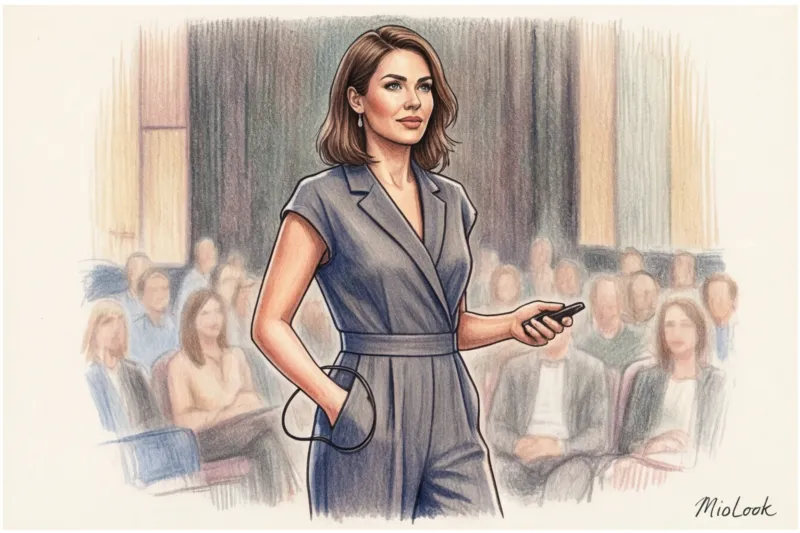
To avoid such situations, exclude sheath dresses without belts, tops with thin straps, and blouses with deep necklines from your stage wardrobe (the microphone will either be too low or will have to be hooked onto the edge of the neckline, which will look unsightly).
Best solutions for women:
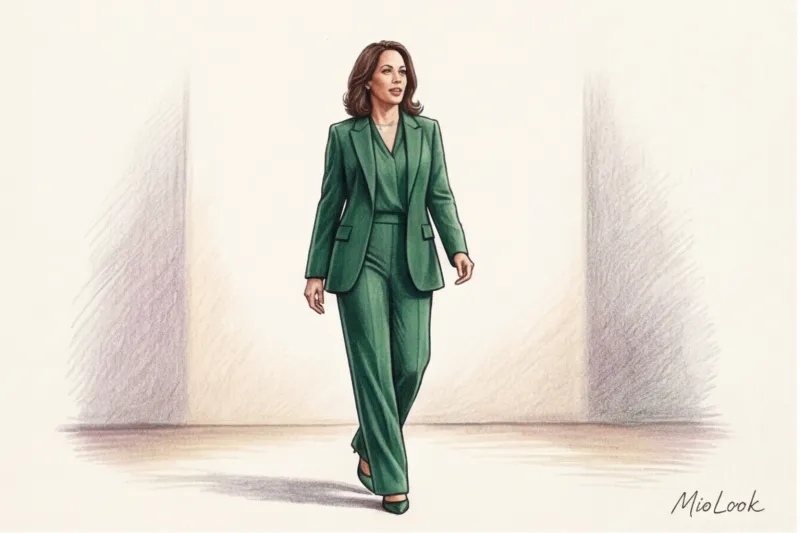
- Two-piece trouser suit (the wire is hidden under the jacket, the base is attached to the trouser belt).
- An A-line dress made of thick fabric with a mandatory wide belt.
- Modern business overalls with deep pockets.
Men's Business Style: A Checklist for Perfect Sound
For male speakers, a jacket isn't just a style statement; it's versatile armor and the best way to conceal cables. Even if the event is smart casual, I always recommend wearing an unstructured blazer or a thick cardigan.
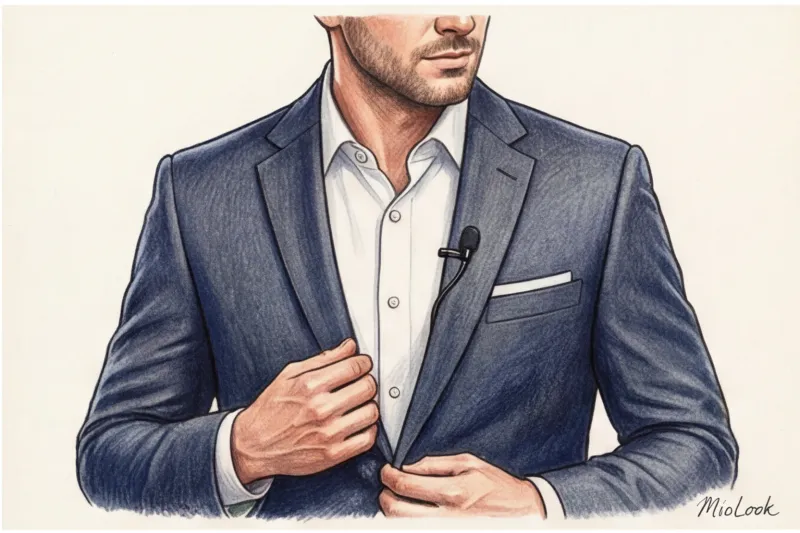
If you're performing in just a shirt, unbuttoned a couple of buttons, a problem arises: the wire sticks out treacherously on your chest, and the microphone itself, under its own weight, falls to the side, since the edge of the thin cotton cannot hold it straight.
Your tie deserves special attention. If you're using a classic lapel tie, it should be secured about halfway down the tie. And here's the catch: if your tie isn't secured with a special pin, it will swing with every step, and the microphone will rub against your shirt buttons, creating a rhythmic clicking sound in the speakers.
Your perfect look starts here
Join thousands of users who look flawless every day with MioLook. Upload your items and create a capsule for your performances.
Get access — €0.99 onceAccessories and Hair: The Sound Engineer's Invisible Enemies
According to statistics from major video production companies (including WGSN Media's 2024 reports), up to 20% of editing time is spent trying to eliminate the sound of jewelry slamming and hair rustling. Sometimes, this flaw is impossible to fix.
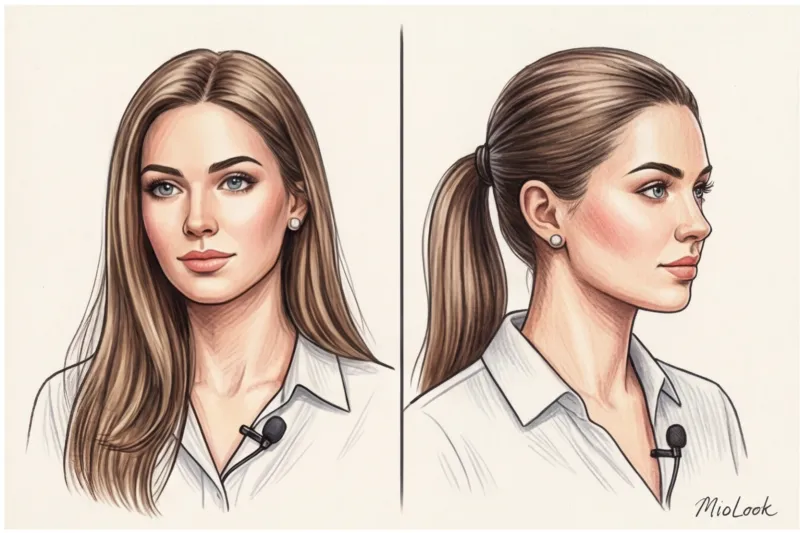
Long, flowing hair is beautiful in real life, but terrible for lavalier microphones. Every time you turn your head, strands of hair rub against the microphone's windshield. The solution is simple: gather your hair into a sleek ponytail, a low bun, or drape it over one shoulder (the one opposite the microphone).
Layered chains, massive pendants, and beads are strictly prohibited. When gesturing, they will strike the microphone capsule, creating a bell-like sound. Large dangling earrings should also be removed, especially if a headset microphone (a body-sized microphone on a boom) is used on set, as the earrings will constantly touch the metal base.
By the way, to think through an image in advance without dangerous accessories, I recommend using MioLook You can digitize your items into a virtual wardrobe and create a stage look right on your phone, instantly eliminating inappropriate necklaces and bracelets.
Practical checklist: testing your look before going live
Even if you've followed all the rules, you should still do the final test at home or in your hotel room. After putting on your chosen suit, do a quick check.
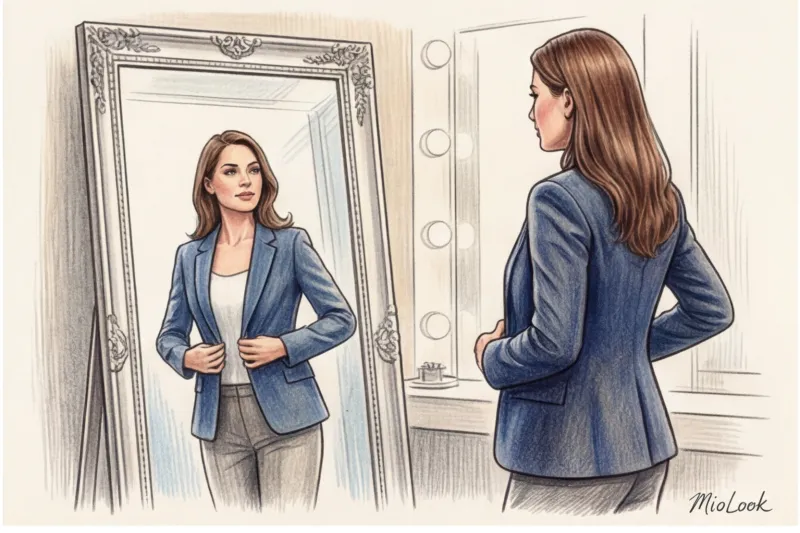
First, do the "Jump and Tilt" test. Raise your arms up as if pointing at a slide, then lean forward. Imagine a taut string running from your belt to your collar. If your clothing is too tight, the lavalier cord will stretch and pull the microphone downward.
Secondly, check the light. A dark microphone cable threaded under a thin white blouse can be unsightly under the bright stage lights. Choose opaque fabrics.
And my main advice from a stylist: always wear a base layer under your shirt or blouse. A simple cotton tank top or silk cami top will solve a lot of problems. The microphone cord should be threaded between the tank top and the shirt. This way, it won't touch your bare skin, won't stick to your skin if you sweat from nervousness, and won't cause any discomfort.
Public speaking is always stressful. But your wardrobe shouldn't be the source of it. Choose thick fabrics, consider your fastenings, and remember: the perfect stage look is one you forget about the second you pick up the clicker for your presentation.