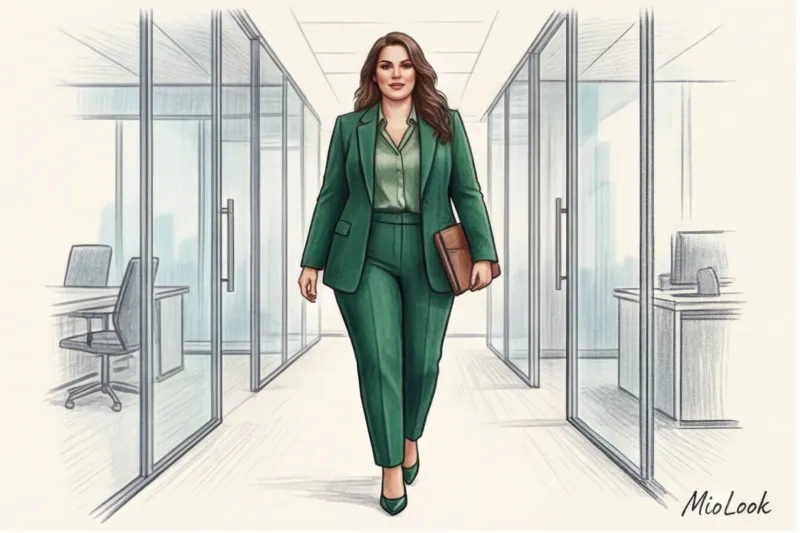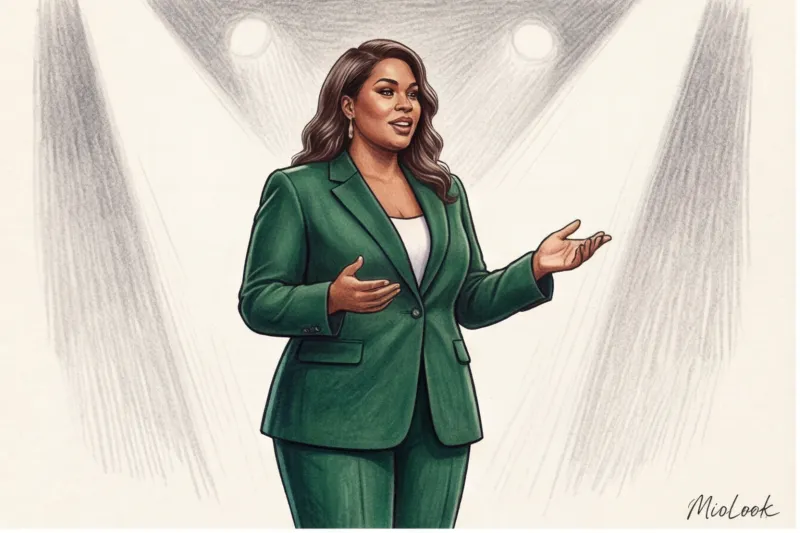
Over 12 years of working as a stylist, I've learned one hard and fast rule of the stage: the spotlight doesn't forgive fussiness in your clothes. According to Princeton University research (2006, and the figures are still relevant today), you have exactly seven seconds for the audience to judge your status before you even utter a word. And if the event is being broadcast live, the merciless camera will visually add 5-7 kilograms to your silhouette. So what do most plus-size women do in such a stressful situation? They try to "hide." They choose shapeless, dark robes, hoping to become invisible.
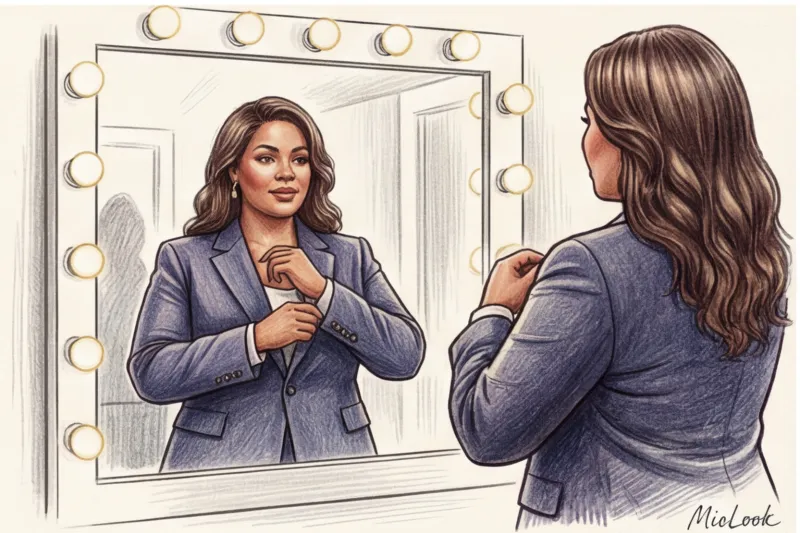
But on stage, you shouldn't hide; you should command attention. The right stage clothes for plus-size women aren't about hiding their size, but about creating a well-designed silhouette. I've already discussed the basic principles of a classy appearance in more detail in our The Complete Guide to Dressing for Public Speaking , and today we will take a detailed look at the nuances specifically for luxurious forms.
Why "hiding in a black robe" is your biggest mistake
The myth that black is always slimming is the most dangerous misconception my clients bring to me. In everyday life, black does indeed sculpt the body. But under the bright lights of a theater, it behaves differently. The light is literally absorbed by the fabric, turning it into a flat, shapeless spot—a veritable "black hole" that deflates the figure.
And if you add oversized clothing to this, trying to hide your stomach or hips, you'll create the effect of a monumental mass. Your figure will become heavy and static.
Last year, I was preparing a senior executive at a large IT company for a TEDx talk. She insisted on wearing her signature black cardigan. We recorded a test video of her on stage. In the video, she looked tired, and her body language seemed tense. When we swapped out the soft cardigan for a structured suit in a deep marsala (burgundy), everything changed—from her posture to the tone of her voice.
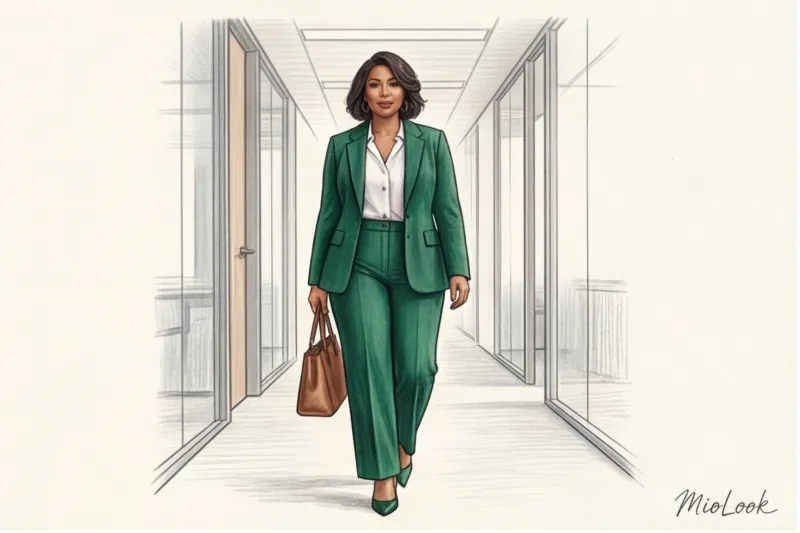
"Color on stage is your nonverbal voice. Choose precious stone tones: emerald, sapphire, ruby, amethyst. According to the Pantone Color Institute, these deep tones are subconsciously associated by the audience with intelligence, power, and high status."
Access to MioLook for €0.99 — one-time payment
A smart AI stylist will select the perfect look for your next performance, taking into account your body type.
Get access — €0.99 onceImage architecture: stage performance clothing for plus-size women
Forget the word "conceal." Our focus is "build." Luxury plus-size brands like Marina Rinaldi or 11 Honoré don't make tank covers. They construct a rigid framework. Your clothes should hold their shape, no matter what your body features. This is true image architecture.
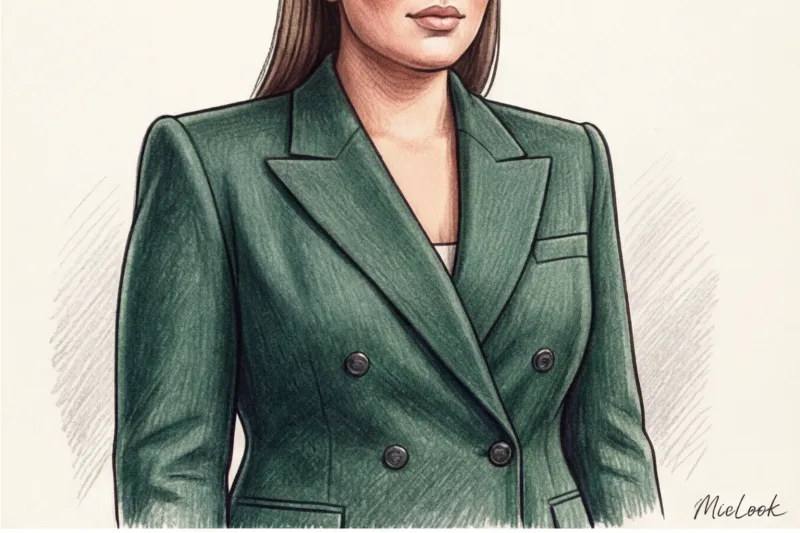
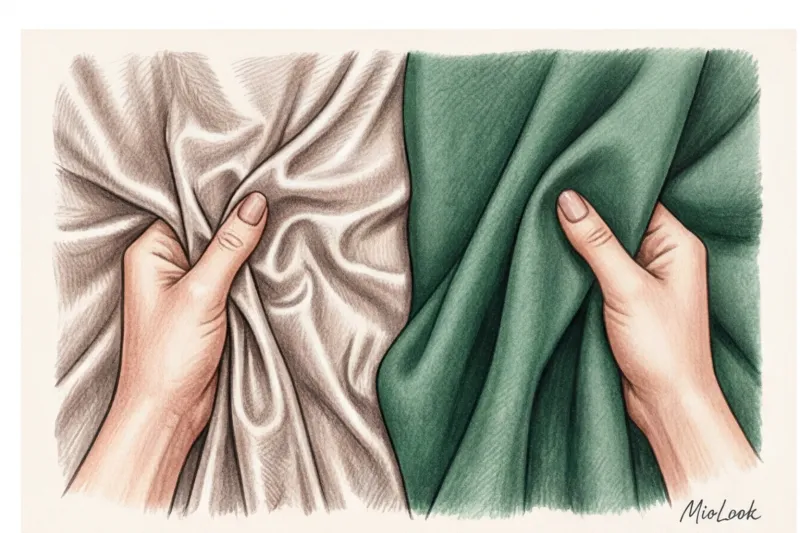
Invest in the right materials. Thin knits, low-density viscose, and soft linen are your worst enemies on stage. They'll highlight every detail, cling to your body with the slightest sweat, and wrinkle instantly. Choose from: heavy wool crepe, gabardine, matte silk (from 22 momme), or high-quality suiting blends (for example, cotton with a weight of 180 g/m² or more, with 5% elastane added for comfort).
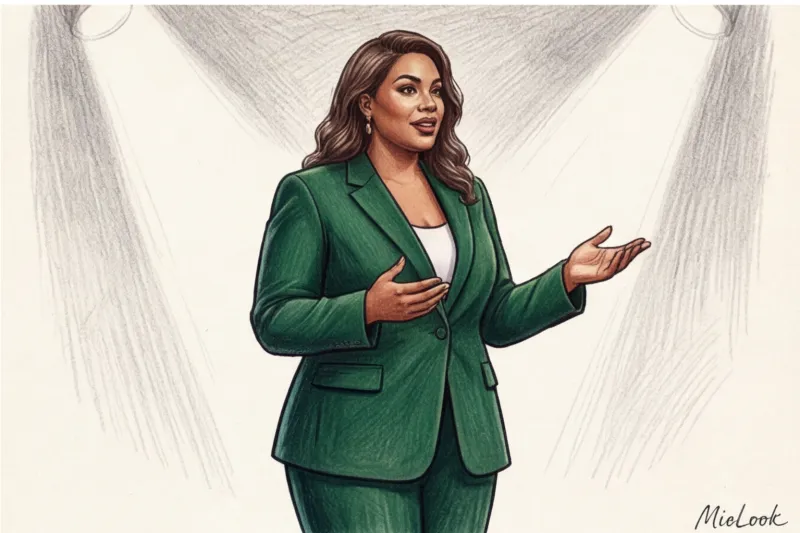
Yes, a perfectly tailored wool crepe jacket isn't cheap. But let's consider the cost-per-wear. One luxurious $500 jacket worn to 10 key conferences will earn you more confidence and contracts than five cheap polyester blouses that will leave you nervous about sweat stains.
The shoulder girdle as a support point
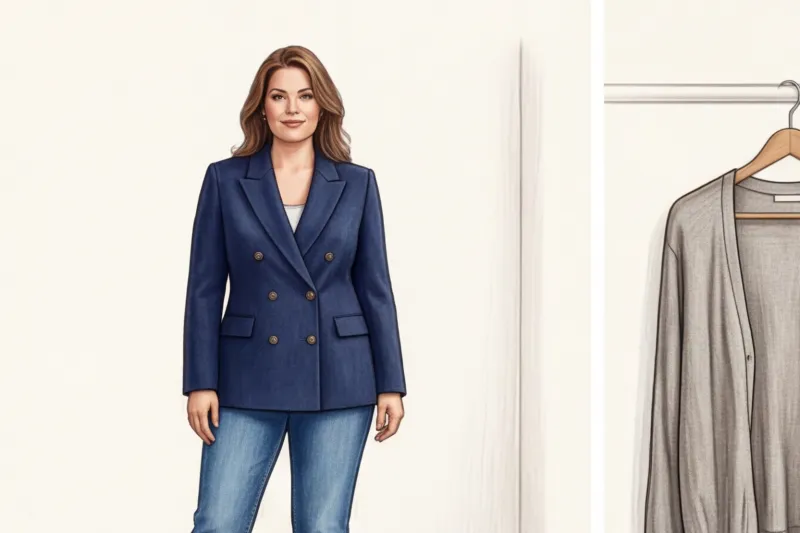
The key to balancing wide hips or a voluminous belly is a strong shoulder line. This is your visual fulcrum. Dropped sleeves or a raglan cut will make the figure appear sloping and weak. We need clear, set-in shoulder pads. Not the oversized '80s style, but modern, anatomical ones that create a straight line from the neck to the shoulder joint. You'll be surprised, but once a jacket has a well-defined, architectural shoulder, a speaker's posture automatically straightens.
Controlling the audience's attention: focus on the face
On stage, people should listen to your ideas, not stare at a complex print on a skirt. That's why we always shift the visual center of gravity to the portrait area.
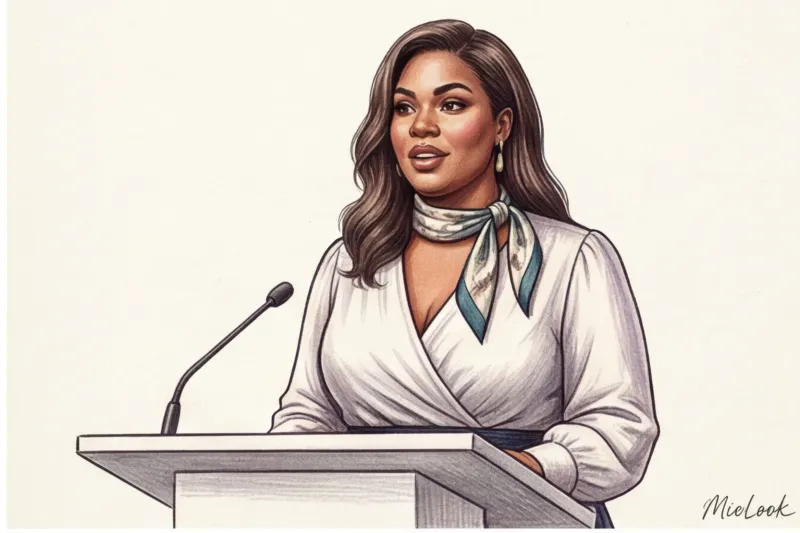
How to do this technically correctly?
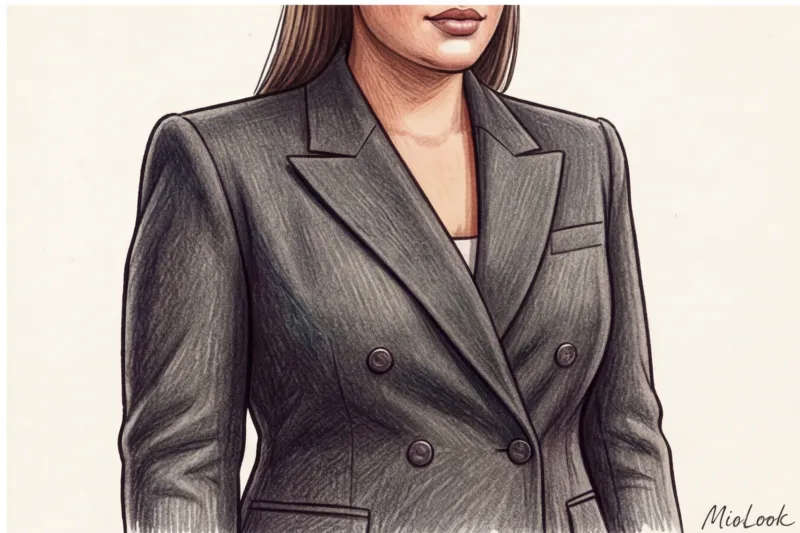
- V-neck: A classic that works without fail. It visually elongates your neck and directs the audience's gaze directly to your face.
- Notched lapels: The peak lapels of a jacket work on the same principle, creating two powerful vertical lines along the torso.
- Asymmetry: Diagonal lines in a cut (such as a wrap-over) add dynamism to the look. The figure is no longer a static square.
Stylists of top CEOs and politicians follow a strict "one statement piece" rule. No scattered tiny chains or jingling bracelets (they also create a distracting sound when used with a microphone!). Choose one large, sculptural piece. For example, a matte gold lapel brooch 5-7 cm in size or minimalist yet striking earrings. This is a sign of confidence: you're not fussing over details; you're making a statement.
Your perfect look starts here
Join thousands of users who look flawless every day with MioLook. Digitize your wardrobe in just a few clicks.
Get access — €0.99 onceTechnical nuances of the stage that beginners forget
You may look like a goddess in the mirror of your dressing room at home, but the stage dictates harsh technical requirements. You know who I always listen to most attentively on set? The sound engineers and lighting technicians.
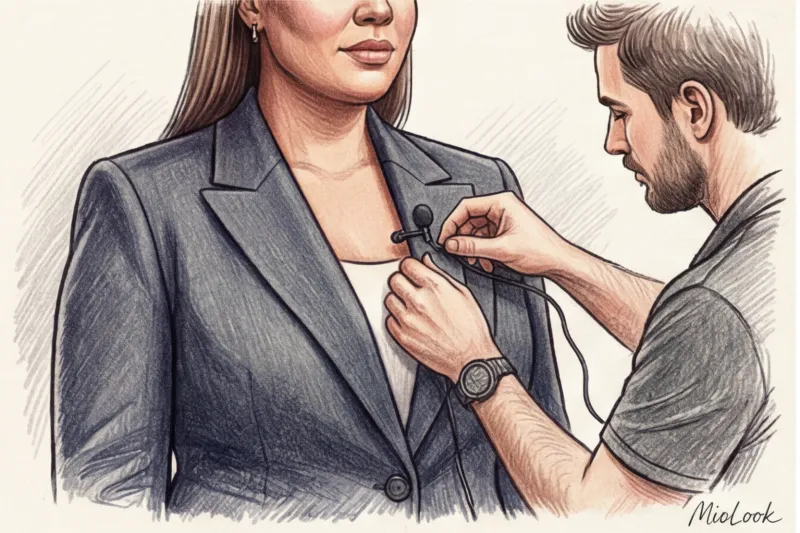
I once literally had to rescue a client's entrance 10 minutes before the broadcast. She'd chosen a stunning, but too-thin silk blouse. When the technician attached the lavalier microphone, the fabric pulled shamefully down under its weight, revealing the hem of her underwear. And there was nowhere to hide the heavy transmitter unit (the size of a pack of cigarettes) because her skirt didn't have a secure waistband. Since then, I've been adamant: for stage, you need a thick lapel that can support the microphone clip, and a structured jacket pocket (or a secure trouser waistband) for the transmitter.
Another enemy of the speaker is temperature. Under the theater spotlights, the air can heat up to 30 degrees. But, as I already said, pure linen is a no-no; it will wrinkle on the way to the microphone. Choose breathable blends (wool and silk, heavy cotton and viscose).
But here I must make a reservation. My advice about a stiff architectural jacket isn't appropriate for all settings. If you're presenting at an IT conference with a panel discussion, where speakers are seated in low, soft beanbag chairs, a heavy jacket will ride up to your ears, and your trousers will dig into your stomach. For such relaxed, seated settings, a thick, loose-fitting midi shirtdress is better.
Three ready-made formulas for status images for a speaker
If you don't have time for lengthy experiments in front of a mirror, use these three proven schemes. For more information on how to adapt them to your needs, read our article on How to choose clothes for your body type without stereotypes.
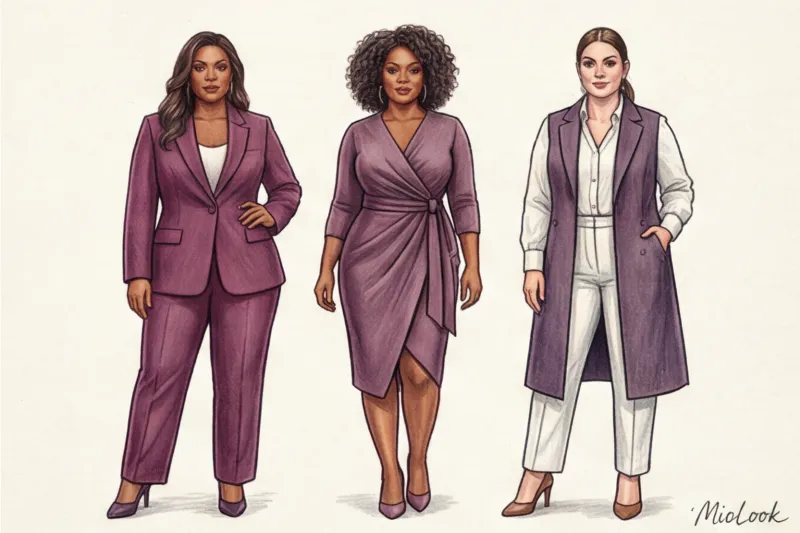
- Monochrome pantsuit with a contrasting textured top. For example, a matte wool suit in a dark chocolate shade and a smooth silk top in the same color. The contrasting textures create depth within the same color. This combination is ideal for an apple-shaped figure, as the unbuttoned jacket creates a vertical line down the center of the body.
- Dress-jacket made of thick fabric. An architectural, gathered silhouette. The double-breasted cut perfectly cinches the midriff, and the just-below-the-knee length looks elegant and appropriate even when seated on high barstools.
- Long structured vest with straight trousers. A brilliant solution for the pear-shaped figure. The vest covers the widest part of the hips, creating straight lines at the sides, while leaving the arms free (especially valuable for those who gesture a lot).
By the way, in order to quickly assemble such capsules from existing things, I recommend using MioLook app — a smart algorithm will analyze your wardrobe and show you which status formula items you already own and which are worth buying.
Stage Shoes: A Balance of Elegance and Stability
Going on stage in 10-centimeter stilettos is an unnecessary risk. Balancing on a thin heel puts physiological tension in your body. This tension inevitably transfers to your vocal cords, causing your voice to become higher-pitched, flatter, and more tense.
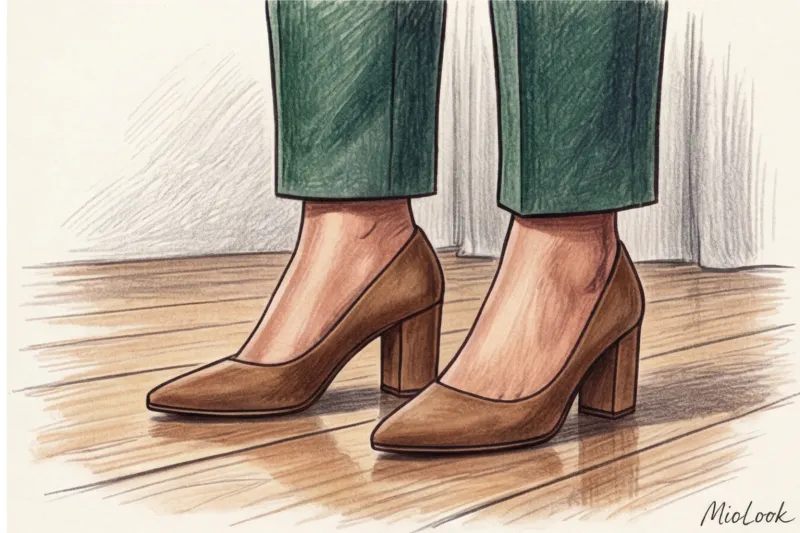
Look for shoes with a stable block heel of 5-