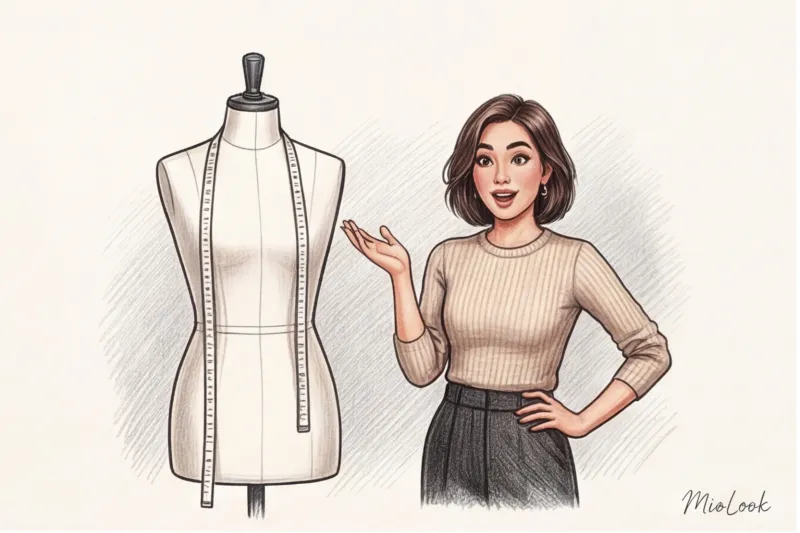
The Anatomy of Proportions: Why Standard Rules No Longer Work
I remember vividly the day I stopped searching for "how to look taller" forever. It happened after I analyzed the wardrobes of over fifty of my clients, all under 160 cm tall. Do you know what they all had in common? Closets full of clothes that were "supposed" to elongate the silhouette, but in fact made the figure look squat and disproportionate. As a stylist, I can say for sure: the right clothes for short girls It doesn't start with buying twelve-centimeter stiletto heels, but with understanding the engineering mathematics of your body.
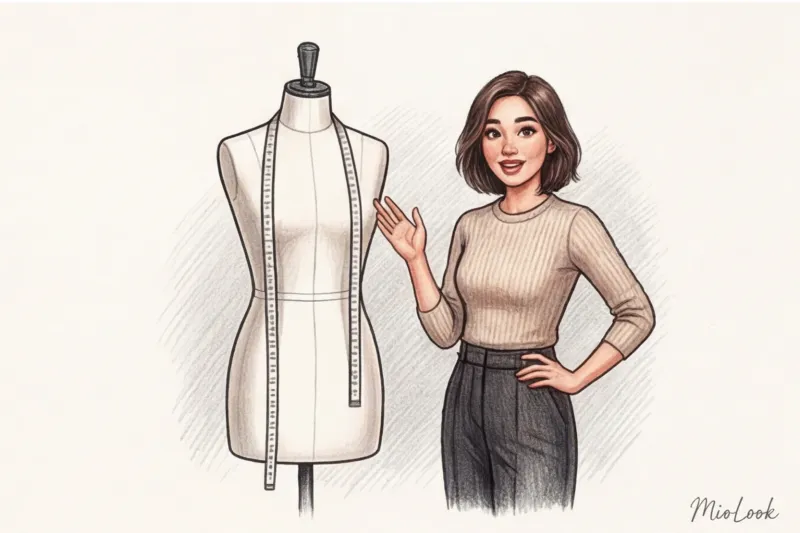
The mass-market industry operates under strict rules. According to international clothing design standards (for example, ASTM D5585), the basic female mannequin is designed for a height of 165–168 cm. When a woman who is 155 cm tall puts on a garment made according to these patterns, Standard The problem isn't just the extra length of the legs. The entire architecture of the garment is ruined.
Let's look at the anatomy of the cut. In standard patterns, the bust darts fall below your actual bust, creating unnecessary volume where it shouldn't be. The armholes are too deep, causing the entire blouse to ride up whenever you raise your arms. And the waistline on the dress tends to slide down onto your hips, making your bottom appear heavier.
This is especially critical with trousers. One of my clients would constantly buy regular trousers and simply take them to the tailor. But the trick is that if you shorten long trousers by 10-15 centimeters, you irreversibly shift the designer's intended knee line. The narrowest part of the leg, which is supposed to accentuate the gracefulness of the leg, ends up being at your calf. That's why, for example, when choosing office-style jeans You can't just cut a standard model - you need to look for special rulers Petite with recalculated proportions.
The major paradigm shift that needs to happen in your head is: miniature size is a given, not a disadvantage Give up the obsession with "looking taller at any cost." When we try to artificially elongate our silhouettes through extreme methods, we often end up looking disproportionate. Our true goal is not to look like a runway model, but to achieve perfect proportional harmony. A well-proportioned figure of 152 cm will always look more impressive than an artificially elongated and distorted silhouette.
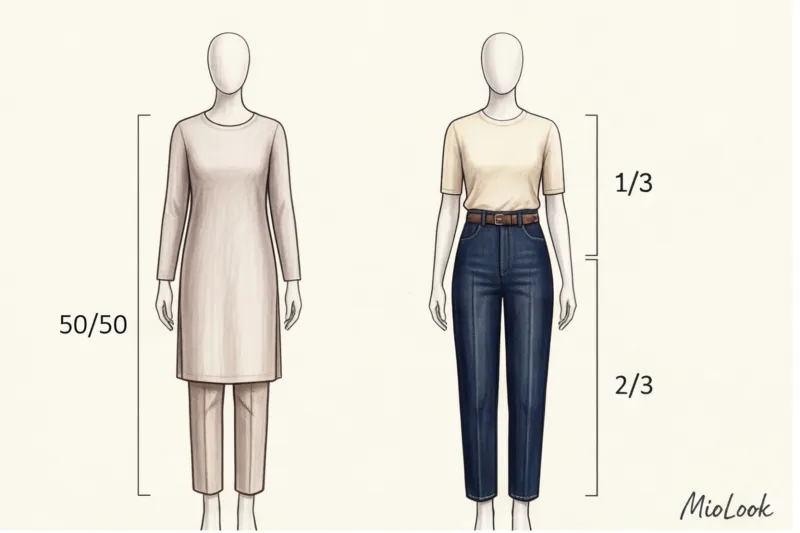
To achieve this harmony, there is one sure-fire mathematical formula: rule of thirds Forget about the 1:1 ratio, where the top and bottom pieces divide your body exactly in half (for example, a long tunic worn outside and jeans). This combination visually shortens your legs and makes your torso look bulky.
"The formula for the ideal silhouette for petites is: 1/3 of the figure is the top, 2/3 is the bottom. This proportion deceives the eye, creating the illusion of infinitely long legs at any height."
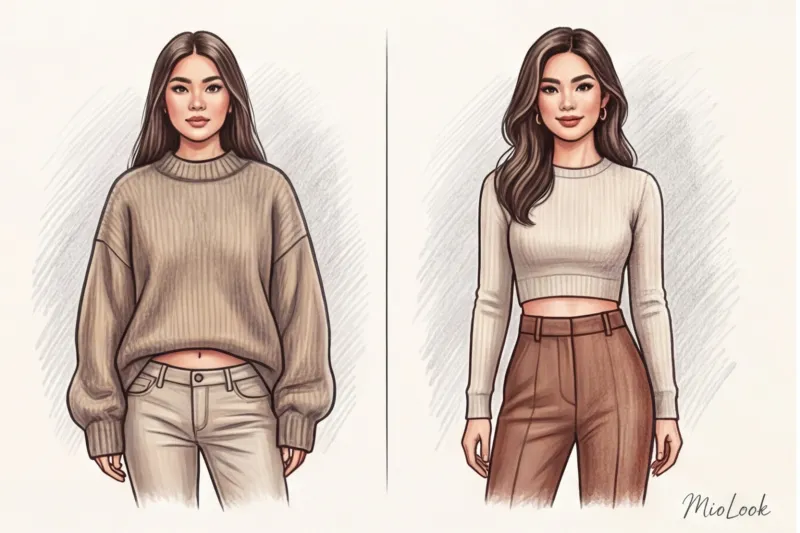
How do I put this into practice? Use cropped tops, tuck blouses in, or choose high-waisted pants. When my clients upload their looks to MioLook I often ask them to mentally overlay a grid of three horizontal sections on the photo. If a belt or the hem of a sweater cuts the figure exactly along the equator, the look needs to be reassembled, shifting the emphasis upward.
The myth of vertical stripes and heels
Open any article from ten years ago, and you'll read: "Wear vertical stripes and never take off your heels." In my experience, these are the two most harmful stereotypes for petite women.
Let's start with prints. Theoretically, vertical lines are indeed slimming. But if a striped garment fits you poorly (remember those darts that slip in the standard 168 cm height?), these straight lines will curve across your figure, highlighting every crease and imperfection in the cut. Instead of elongating your silhouette, you'll get a distorted mirror effect, making you appear wider and shorter.
The situation with heels is even more interesting, and this is where biomechanics comes into play. Daily wear of 8-centimeter-high heels changes the angle of the pelvis (called anterior tilt). To compensate for the shifted center of gravity, the body is forced to slouch at the thoracic spine. This constant, unnoticeable slouching can reduce your actual height by up to 2-3 centimeters! You wear heels to make yourself taller, but your posture actually makes you shorter.
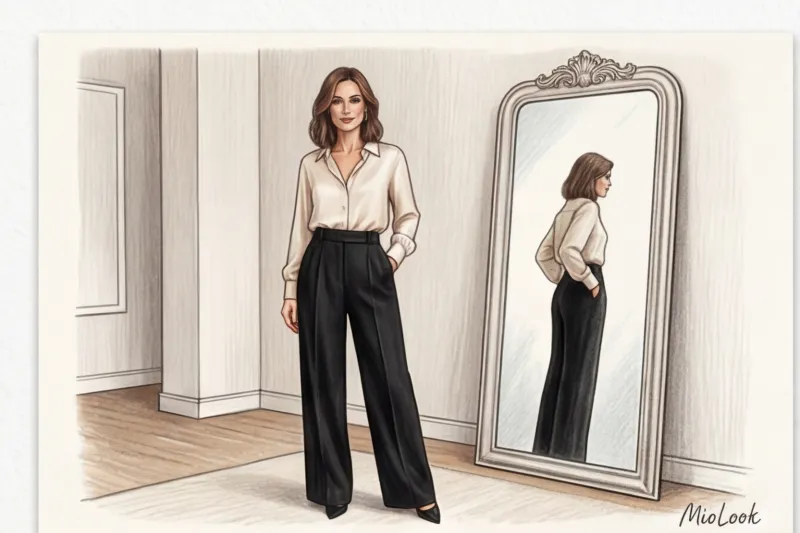
What is a healthy and stylish alternative? Continuous color vertical , or monochrome. Instead of fussing with prints, put together an outfit in a single shade—for example, a navy silk blouse paired with navy straight-leg trousers. The lack of a sharp color transition between the top and bottom draws the eye down the figure without stopping. This creates the illusion of an elongated, solid, and classy silhouette, without compromising your spine.
Basic Wardrobe: The Right Clothes for Short Girls
When I decided to digitalize my wardrobe and began meticulously tracking my wear statistics, the numbers proved merciless. Over the 12-month experiment, out of 85 items in my closet, I only regularly wore about fifteen. Do you know what these "golden assets" of my closet had in common? They fit me perfectly.
This personal experience has proven to me a mathematical truth: it's better to have just five perfectly fitting items in your closet than 20 standard-fitting ones bought on sale with the thought, "No big deal, I'll just hem them later." For us, any extra fold of fabric or incorrect volume isn't just a stylistic gaffe; it's a visual loss of precious centimeters.
Proper clothing for petite women tolerates no compromises in cut. A functional capsule collection for heights up to 160 cm is built on a strict elimination principle: if a garment is out of proportion, it's sent to a tailor or returned to the store. And the main battleground here is hem length.
Take midi skirts, for example. Popular mass-market styles are designed for average heights, and the length of such a skirt is typically 75–80 cm. On a woman 172 cm tall, this hemline ends in an elegant taper just below the calf. But on you and me, this same skirt ends right at the widest part of the calf muscle.
"The main rule of horizontals for petite figures: never cut the leg at the widest part. A horizontal hemline draws the eye and visually widens the part of the body where it ends."
Your ideal midi should either end just below the knee (where the leg just begins to flare) or extend into a maxi, revealing only your slender ankles. For most of my clients who are around 155 cm tall, the ideal midi/maxi length ranges from 85–90 cm, depending on their frame and leg length.
The Perfect Pants and Jeans: Fit is Everything
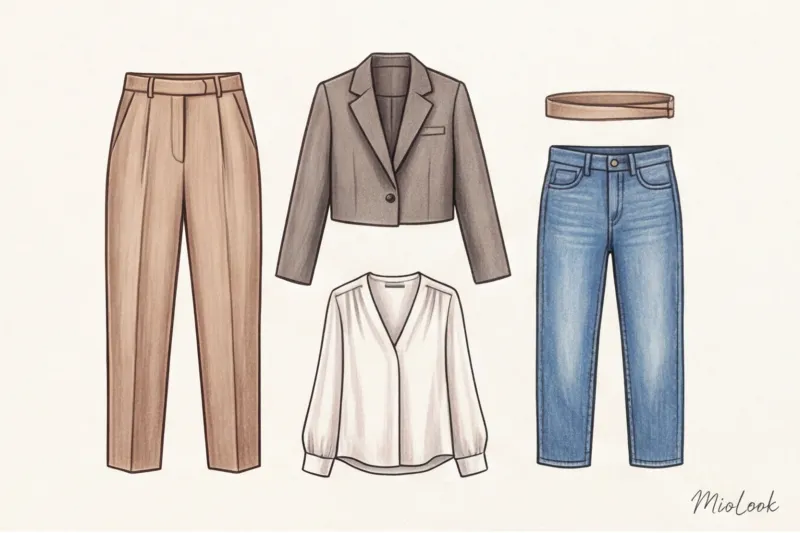
If our primary goal is to elongate the legs relative to the torso, then the waistline of trousers becomes your primary height-control tool. High-rise and mid-rise rises work flawlessly for you. However, there's an important anatomical nuance: if you have a naturally short torso and a full bust, an extremely high waist can create a disproportionate effect, where the bust immediately merges with the legs. In this scenario, a confident mid-rise (2-3 cm below the navel) will balance the figure much better.
Trouser length is the second critical factor. For petite women, there are two truly effective strategies:
- Full length to the floor (Puddle pants). Trousers should literally rest on the shoes, almost completely covering the heel or chunky sole. This creates that continuous vertical line of color that elongates the silhouette.
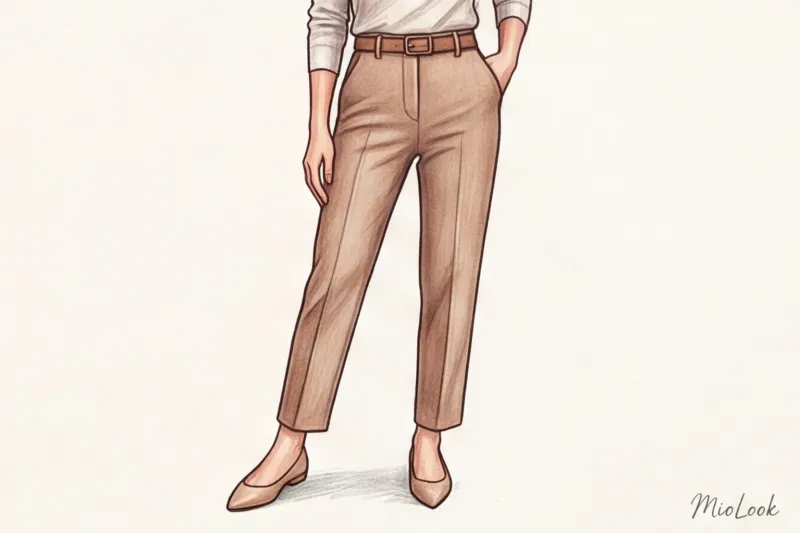
- Length 7/8 (open ankle). It works great because it shows off the most graceful and narrow part of your leg. But remember: there shouldn't be a sharp color contrast between the hem of your pants and your shoes, otherwise you'll cut off your feet.
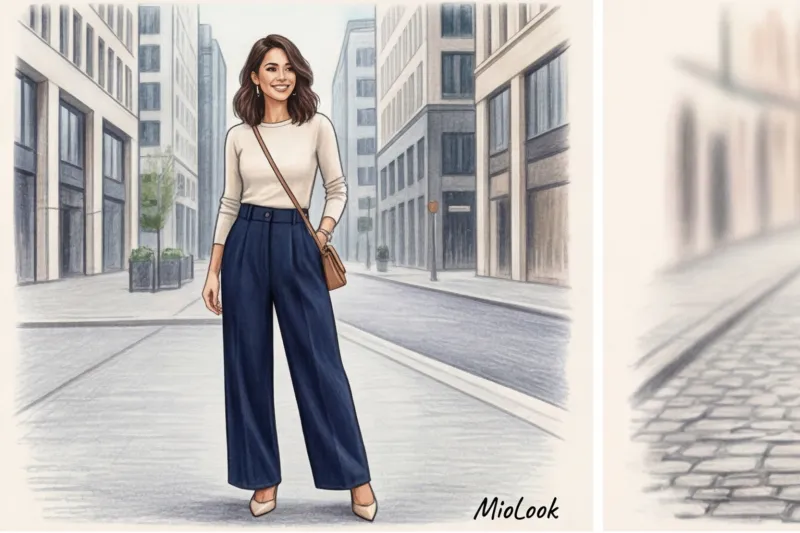
However, be extremely careful with the width of the legs. Wide-leg flares, which look luxurious on tall models, often act like a tent on shorter models, pulling the center of gravity down with excess heavy fabric. Straight leg styles remain a safe and versatile alternative.
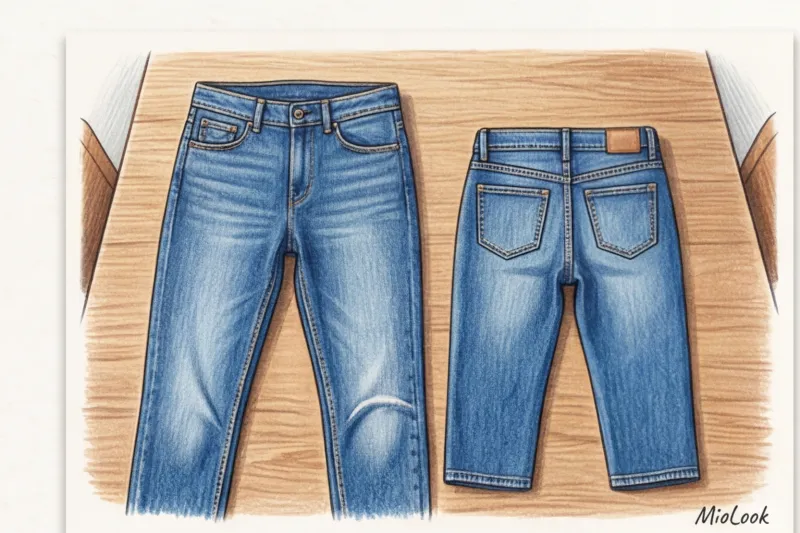
For example, classic straight-leg jeans made of heavy denim (costing around $100–$120, like the iconic Levi's Ribcage) pay for themselves within the first season. They visually flatter the figure, hold their shape, and don't add excess bulk to the hips.
Access to MioLook for €0.99 — one-time payment
A smart AI stylist will select the perfect look based on your proportions and help you digitize your wardrobe.
Get access — €0.99 onceTops, jackets, and outerwear: watch your shoulders
While we struggle to save every centimeter of leg length in our lower body, shoulder line and sleeve length are crucial in our upper body. Jackets, coats, and shirts with dropped shoulders, so common in oversized collections, can play a nasty trick on you.
Dropped armholes visually pull the shoulders down, creating a hunched, heavy silhouette. For petite women, the shoulder seam of clothing should be exactly where your anatomical shoulder bone ends—not a centimeter lower. This instantly establishes structure and conveys confidence.
Another often-overlooked secret is sleeve length. Standard jacket sleeves (60-62 cm) almost always cover the wrists of petite women, making the look childishly sloppy, as if you're wearing your older sister's leftovers. Make it a habit to roll or gather your sleeves to a 3/4 length. Showing off your slender wrists instantly adds lightness and airiness to the entire silhouette.
When it comes to cut, cropped blazers are the best investment in your wardrobe. Finishing at your natural waist, they automatically create the right proportions, even when worn with a voluminous shirt underneath.
When it comes to choosing a fall or winter coat, the length rule applies just as strictly. Avoid a length that hits just above the knee (approximately 90-95 cm at the back)—this is the worst possible option, as it cuts the figure in half. You have two stylistically strong options:
- Maxi length. The coat should fall below mid-calf (back length 115 cm or more). This creates a strong, continuous vertical line. Pay attention to the width of the lapels: they should be narrow or medium, so as not to overwhelm your natural proportions with large details.
- Cropped jackets and pea coats. The length to the hip bone or slightly above leaves the legs as open as possible, while maintaining the correct proportion of the elongated silhouette.
When building a basic capsule, always remember: things should adapt to you, not you to them. I recommend loading your favorite, perfectly fitting pieces into MioLook to analyze their styles. By understanding which lengths and fits work best for your figure every day, you'll be able to avoid random purchases that end up hanging in your closet for years with the tags still attached.
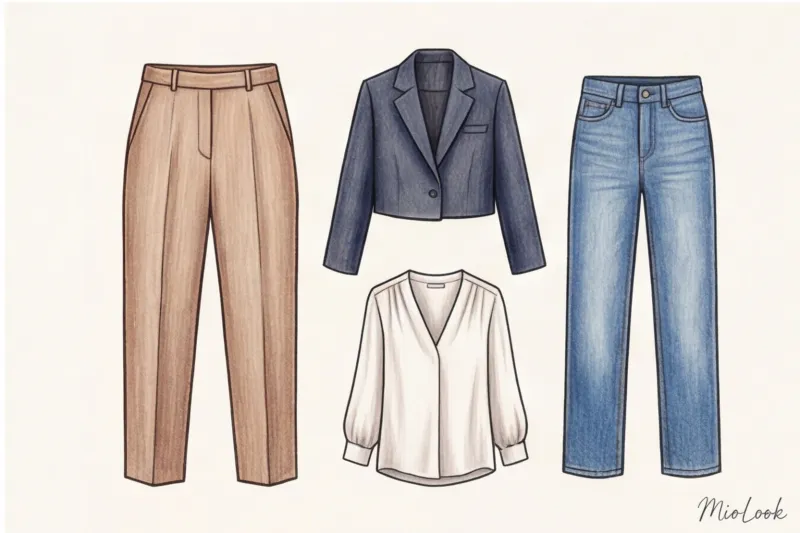
Business style for short people: how to look classy and not like a schoolgirl
In the corporate world, petite stature often works against us. According to research in the field of perception psychology (particularly publications in the Journal of Applied Psychology), people unconsciously associate tallness with leadership qualities and authority. For women under 160 cm, this results in a classic problem: instead of a stern professional, colleagues and partners see a "cute intern" or "yesterday's graduate." Proper attire for petite women in the office is not just about adhering to a formal dress code; it's your primary tool for nonverbal influence.
One of my most telling stories from my stylist career involved Anna, the CFO of a large IT integrator. Standing 152 cm tall, she complained that during important negotiations, new contractors instinctively approached her taller but more junior deputy. We conducted a rigorous audit of her business wardrobe. I insisted on completely eliminating soft knit cardigans, blouses with round Peter Pan collars, and full midi skirts. Instead, we introduced structured jackets with peaked, upward-sloping lapels and crisp V-necklines. The effect was immediate: the visual sharpness of the lines added the necessary toughness to the look and immediately changed the attitude of those interviewing her.
The secret to the perfect business suit for a petite figure lies in the physics of materials. Avoid flimsy viscose in favor of shape-stabilizing fabrics. Dense suiting wool (Super 100s or 120s), gabardine, or heavy crepe create a clear frame. The rigid, architectural lines of the shoulders and legs act as your personal armor. Soft fabrics merely cling to the figure, emphasizing its petiteness, while dense materials establish the scale you choose to convey.
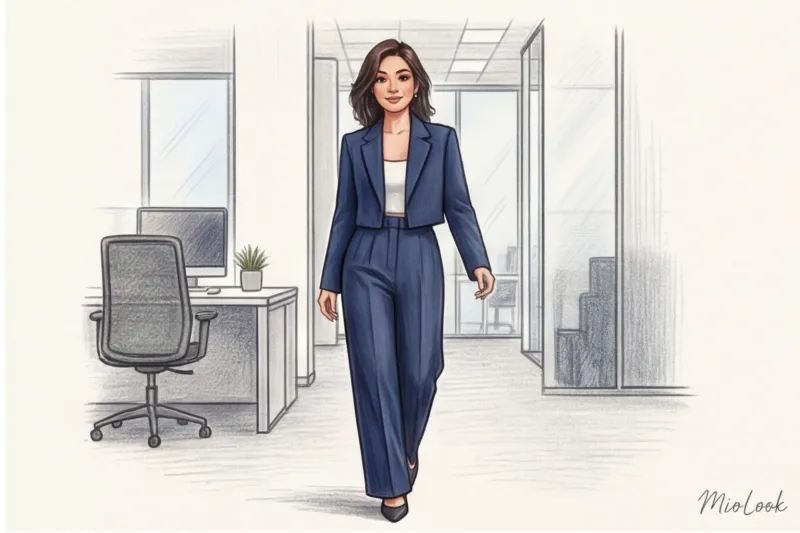
The third pillar of a business wardrobe is total monochrome. This is not only a way to create a continuous vertical line of color (critical for elongating the silhouette), but also a powerful tool for building a strong personal brand. Head-to-toe looks in all-black, deep navy, emerald, or flawless camel always look classy, expensive, and uncompromising. Unlike a blocky silhouette (light top, dark bottom), monochrome draws the eye upward without pause.
If you are unsure how to assemble such a capsule, try digitizing your things and uploading them to the "smart wardrobe" feature in MioLook The app will clearly show you color statistics: whether you have enough items of the same color to create stylish outfits for the entire work week, or whether your closet is too full of disparate pieces that break up your figure.
Remember the golden rule of corporate style for petites: the shorter you are, the sharper the angles in your silhouette should be. Pressed creases on straight trousers, pointed toes on shoes, and crisp, geometric lapels—this is your personal power architecture.
The Main Mistakes: What Eats Up Your Height and Distorts Your Figure
Have you noticed how striking current trends look on models taller than 178 cm, yet how mercilessly they distort proportions in the actual fitting room? It's a classic "expectation versus reality" trap. Many trends—from hyper-oversized fits to low-waisted silhouettes—are created for completely different shapes and are categorically unsuitable for petite women. Let's look at four fatal mistakes that visually steal those precious inches from you.
The first and most common mistake is a harsh color block that cuts the figure exactly in half. Imagine the popular combination: a crisp white top and black low-rise trousers. This contrasting horizontal line divides the body in a 1:1 ratio. According to the laws of visual perception, our brain reads the silhouette not as a single line, but as two separate short rectangles. For a height of 155 cm, this means that both the torso and legs appear equally short. If you love contrasting blocking, always shift the color boundary—for example, by pairing a light blouse with dark high-waist trousers.
The second pitfall lies in the distortion of scale. The trend for oversized prints (like the large tropical flowers from the cruise collections) and chunky hardware literally overwhelms petite figures. A huge belt buckle or buttons the size of a €2 coin on a jacket make you look like you're wearing your older sister's leftovers. Choose small or medium-sized patterns and delicate hardware—they're proportionate to your natural features and don't steal the show.
The third hidden enemy is dropped armholes in knitwear and outerwear. Global fashion dictates relaxed silhouettes, but when the shoulder seam hangs to mid-forearm, it physically pulls the shoulder line down. The entire silhouette instantly becomes bulky, and posture appears hunched. For women under 160 cm, a set-in sleeve with a defined shoulder line is an architectural framework that pulls the look together and makes you look more put-together.
Access to MioLook for €0.99 — one-time payment
Start creating perfect looks based on your proportions using artificial intelligence.
Get access — €0.99 onceFinally, consider shoes with a contrasting ankle strap. In theory, dainty Mary Janes or sandals with a black ankle strap look incredibly feminine on a bare foot. In practice, however, this strap acts like a barrier: it creates a sharp horizontal line that mercilessly cuts the foot off the shin right at the narrowest point, shortening the leg by at least 5 centimeters. If this type of support is essential for comfort, choose styles that match your skin tone (nude) or the color of your tights to maintain a continuous vertical line of color.
Shoes and accessories: hidden reserves and the right scale
Let's talk about details that can either elongate a silhouette or instantly ground it. At the Institute of Design and Merchandising (FIDM), we were taught a strict rule of scale, which I call the mathematics of accessories. Remember the basic formula: The width of your everyday bag should not exceed 1/3 of your height.
If you're 158 cm tall, the mathematical limit for a bag's width is around 52 cm, but even this is visually too wide for a petite figure. In practice, the ideal size for a basic model ends at 30–35 cm. Shapeless XXL shoppers are strictly contraindicated—they make you appear even smaller, violating all laws of proportionality. My choice for a petite wardrobe is a rigidly structured tote or a classic saddle bag. Clear geometric lines bring the look together, making it more prestigious and dynamic.
Let's move on to shoes. The key optical lifehack, rarely mentioned in the glossy magazines, is the depth and shape of the vamp. Shoes with a deep V-neck—classic pumps or trendy slingbacks inspired by Prada's archival collections—magically add a couple of centimeters to your legs, as the exposed instep visually blends with the shin. And if you choose shoes that match your skin tone in summer or your trousers and tights in winter, you'll create that seamless vertical line of color.
When it comes to belts, the rule of minimizing horizontal lines applies. Wide, 2000s-style corset belts mercilessly cut an already compact torso in half. Choose thin (1.5–2 cm) or medium (up to 3 cm) belts made of thick leather. They delicately define the waist without taking up too much of the scarce vertical space.
The finishing touch is the portrait area. Often, perfectly chosen clothes for petite women pale in comparison to poorly chosen glasses or heavy jewelry. The scale of jewelry should match your natural facial features and bone thickness. If you have thin wrists (less than 14 cm in circumference), massive €400 chronograph watches or oversized chokers will look out of place. Opt for elegant cuffs, simple snake chains, and glasses whose frames don't extend far beyond your cheekbones.
"To avoid getting the proportions wrong right in the fitting room, take a full-length photo of yourself with your new bag or glasses. If the accessory takes up 80% of the attention, it's scaled incorrectly."
I always advise my clients to upload such test photos from the fitting rooms in MioLook The app helps you take your mind off your emotions and objectively assess on your smartphone screen whether a new detail disrupts the harmony of scale before you spend money on it.
Smart Shopping Strategy and the Petite Tax
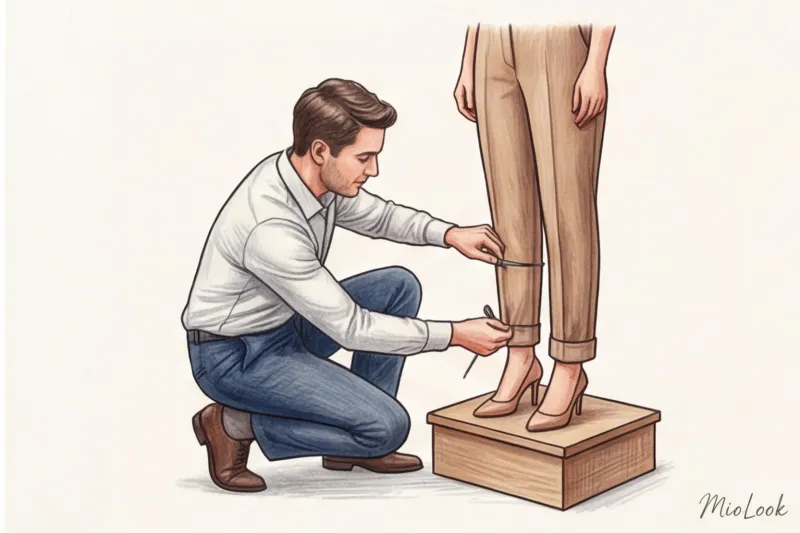
Let's talk about money. There's an unspoken economic term that every petite woman is well aware of: "Petite Tax." According to my regular wardrobe reviews, a basic purchase costs us an average of $20-$40 more due to the inevitable visit to the tailor.
The surest way to minimize these financial losses is to specifically seek out brands with dedicated petite lines. It's a mistake to think that mass-market brands simply trim off the excess inches from the hems of standard trousers. Reliable brands (check out J.Crew, Madewell, Reformation, and, in denim, the phenomenal Short/Extra Short line from Abercrombie & Fitch) completely redesign patterns. In these garments, armholes are raised higher, the waistline rises a healthy 2-3 centimeters, and bust darts finally align with the body. If you're looking for the right clothes for petite women—especially in complex categories like coats and structured business suits—always start your search with these specialized sections.
But what if the perfect item is found in a standard collection? This is where cold calculation and an understanding of cut architecture come into play. Remember the strict rule of cost-effectiveness: shortening straight trousers or the hem of a basic skirt is a simple and inexpensive procedure (usually around $15-$20). A slight increase in waist volume along the back seam is also painless. But altering the shoulder line of a jacket, raising the armholes, or shortening the sleeves of a classic trench coat with tabs and intricate cuffs is a risky investment that can cost between $60 and $100. In 90% of cases, the balance of the garment is irreversibly disrupted, and the item simply "slips."
A practical insider tip: never buy items with intricate details (zippers, embroidery, contrasting piping) at the hem if they need to be shortened. The entire design concept will be mercilessly cut away by the tailor's scissors, and replacing such elements is unreasonably expensive.
That's why I always insist on calculating the actual cost of an item—the Cost Per Wear (CPW)—taking into account all the hidden costs of alterations. Buying a pair of basic trousers on sale for $45 and paying $35 for shortening and moving the belt loops means the actual cost of the garment is $80.
To make this math work for you, turn your smartphone into a wardrobe financial analyst. When you add a new item to MioLook , immediately add the cost of tailoring services to the store receipt. Using this app's capsule wardrobe planning features, you'll clearly see how your actual CPW is formed after each wear. You'll quickly come to a counterintuitive conclusion: high-quality jeans from a specialized Petite collection for $130, which fit perfectly right out of the box, are significantly cheaper over the next year than compromised options from standard mass-market lines for $50, which require constant alterations.
Your ideal image
it begins Here
Join thousands of users who look flawless every day with MioLook.
Get access — €0.99 onceChecklist: How to create the perfect look for women up to 160 cm tall
In professional styling, we rely not on intuition but on geometry. According to research by the analytical agency WGSN (2024), women spend an average of 17 minutes each morning choosing their outfit for the day, and most often, dissatisfaction with their reflection in the mirror is due to an unconscious imbalance of proportions. To once and for all resolve the "what to wear" question, I've developed a strict four-step algorithm for my clients. It's a binary system: the answer is either "yes" or "no." If even one step is off, clothes for petites stop working for you. Save this checklist—it will save you hundreds of hours and dollars in front of the mirror and in fitting rooms.
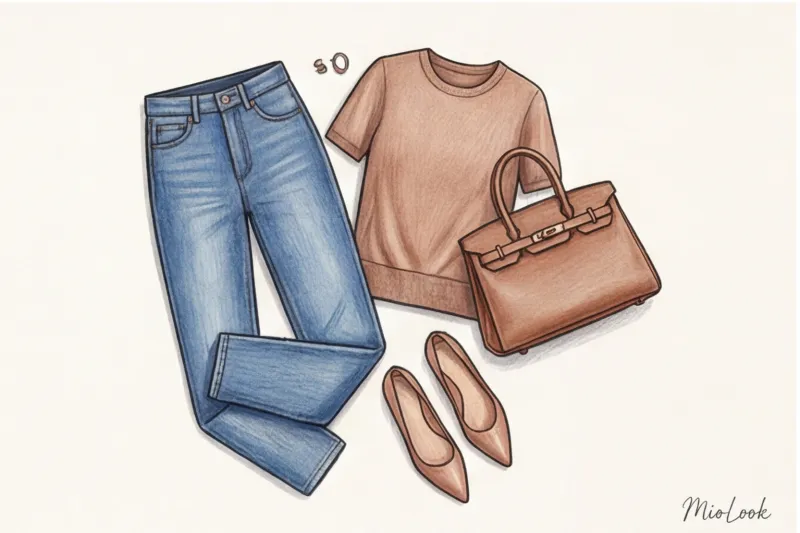
1. Checking proportions: where is the waistline in the image?
Stand up straight and place the edge of your hand on the point where your outfit visually divides your figure in half. If this line runs below your anatomical belly button, you've just stolen at least 5 centimeters of leg length. The ideal silhouette always follows the strict formula of 1/3 (upper half) to 2/3 (lower half).
Practical action: If your waistline is low, try a "French tuck" (casually tucking just the front of your top into your pants' waistband). Alternatively, wear a belt that matches your bottoms and sits just above your natural waist, or swap out a baggy, long sweater for a snug, cropped style (ending right at your hipbone).
2. Color check: is there a color vertical?
Use the "squint test," a technique taught to visual merchandisers. Take a few steps away from the mirror and squint hard to blur the details. What do you see? A single, elongated block of color or sharp, contrasting, "chopped" stripes (e.g., a black jacket, a white T-shirt, blue jeans, red sneakers)?
Practical action: If your figure is broken into squares, create a color column. You don't have to wear tone-on-tone monochrome. Maintaining a consistent lightness is sufficient—for example, pairing navy blue trousers with an emerald or burgundy jumper. And if you want to wear a contrasting unbuttoned jacket over the basic column, great—the hem will create additional elongating vertical lines.
3. Checking the details: is the shoulder seam in place and is there any excess volume?
Blindly chasing the global hyper-oversized trend is the main enemy of petite women. The design of any quality garment begins with the shoulders. Feel the acromioclavicular joint (that prominent bone at the edge of the shoulder). The seam of a structured coat or jacket should extend exactly 1–1.5 centimeters beyond this point, without slipping down.
Practical action: Do the "pinch test." Grasp the excess fabric with your fingers at your biceps or thighs. If you have more than 4-5 centimeters of excess material, the garment isn't "stylishly casual"—it's simply too big. Width always mercilessly eats up height.
4. Checking the shoes: does it continue the line of the foot?
Look at your ankles. Shoes should be a logical extension of your calf, not a separate accent spot cutting horizontally across it. A deep V-shaped cutout on the vamp (like classic pumps or slingbacks) visually adds length to your feet.
Practical action: Avoid contrasting ankle straps (buy Mary Janes only in nude shades or wear them with thick tights in a matching color). Chunky boots with a tractor sole are acceptable only if their narrow shaft fits snugly around the leg and extends well under full-length trousers. If there is a visible strip of leather between the edge of the pant leg and the top of the ankle boots, replace the shoes with a higher sock-style model.
Running a look through these four steps takes exactly 30 seconds. I always require my clients to take a photo of each successful combination that flawlessly passes this filter. Upload your finished looks to MioLook — The smart wardrobe feature will allow you to get ready in the morning with just one click. You'll rely on your own digital database of ideal proportions, rather than making random choices when stressed.
"Styling for a 155cm woman is no different from styling for a 175cm woman in terms of trend relevance or aesthetic depth. The difference lies solely in the mathematical precision of the fit."
You don't need to appear taller to sound convincing in a meeting room or to create a striking everyday look. Impeccable tailoring, attention to scale, and an understanding of your own geometry are your greatest superpowers. Use them every day.
Guide Chapters
Prints for Petites: How to Choose the Perfect Design
We're debunking the outdated myth that only small prints suit petite women. Learn how to choose the right patterns based on aesthetics and style.
The Perfect Bags for Short Women: Debunking the Myths
We're debunking the biggest stylist myth: that only micro bags suit petite women. Learn how to choose a stylish and roomy accessory for those under 160 cm tall.
Where to Buy Petite: Petite Clothing Brands
Shortening standard items at the atelier is a bad idea, as it can ruin your figure's proportions. We'll explain how the Petite line works and where to buy the right clothes for those up to 160 cm.
Coats for Petite Women: How to Choose the Perfect Fit
Choosing outerwear for a petite figure is a challenging task. We'll explore the architecture of cuts so you can wear absolutely any style.