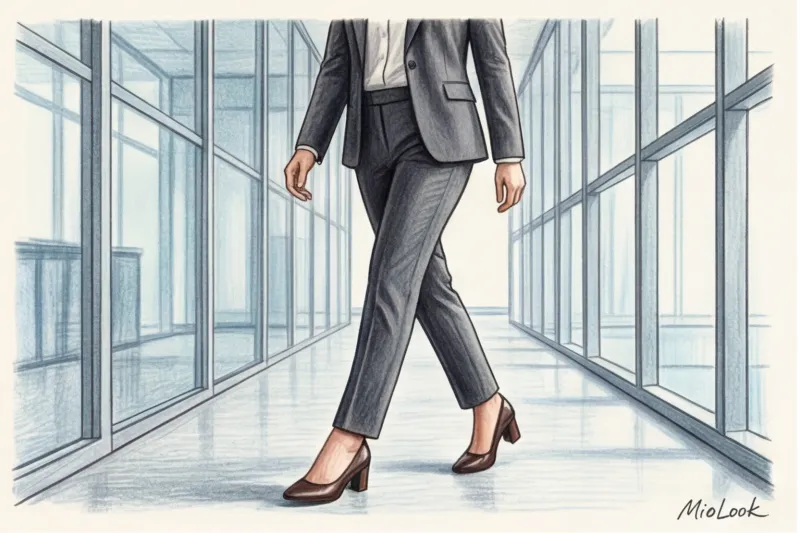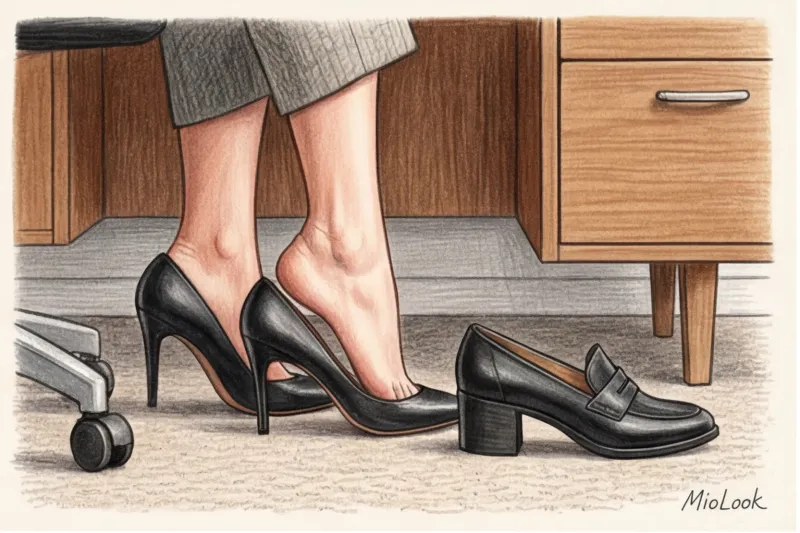
Three years ago, a client of mine, a senior executive at a major fintech company, began losing her voice 15 minutes into her first TEDx talk. It wasn't nervousness, the dry studio air, or a bad microphone. It was her 4-inch stiletto heels. The extreme instep angle of her foot caused her pelvis to tilt forward, her lower back to arch unnaturally, and her diaphragm to tighten. She simply didn't have the lung capacity to push through the rest of her sentence.

As a practicing stylist, I constantly see the same mistake: experts spend weeks rehearsing speeches and choosing the perfect suit, but only think about shoes an hour before they're supposed to go out. We discussed the expert's comprehensive visual package in more detail in our The Complete Guide to Dressing for Public Speaking Today we will analyze the foundation.
Correct shoes for stage performance It's not just part of a dress code. It's your biomechanical instrument. The firmness of your heel and the angle of your foot directly affect your posture, the depth of your breathing, and, ultimately, the persuasiveness of your words.
Why your stage shoes are the foundation of your speech
Try standing up right now and shifting your weight onto your toes, as if you were standing in high heels. Do you feel your calves tense and your shoulders shift slightly forward for balance? This position puts your body into micro-stress mode.
According to a 2023 study by the American Podiatric Medical Association (APMA), heels higher than 7 centimeters shift the body's center of gravity forward by almost 20%. To avoid falling, the body compensates by tensing the back and neck muscles. As a result, diaphragmatic breathing—the foundation of a strong, deep voice—becomes physiologically impossible. You begin to breathe shallowly, from your chest, and your voice sounds higher and weaker.
Moreover, an uncomfortable shoe last robs you of cognitive energy. A speaker on a large stage takes an average of 1,500–2,000 steps during an hour-long presentation. If your shoes are too tight, your brain processes pain signals in the background instead of focusing on the audience's reaction and the structure of your presentation.
The visual aspect is no less important. Audiences in the front rows look up to you. According to the laws of perspective, shoes take up to 30% of their visual attention. Worn-out toes, inappropriate embellishments, or ankles trembling in thin stiletto heels are perceived by the audience as markers of insecurity.
Access to MioLook for €0.99 — one-time payment
A smart AI stylist will find the perfect look for your next performance.
Get access — €0.99 onceStatus vs. Comfort: How to Find the Perfect Balance
Many speakers go to extremes: either enduring pain for the sake of a "status" image, or step out in shapeless but comfortable loafers, ruining the credibility of a business suit. The secret to the perfect pair lies in the shoe's internal architecture.
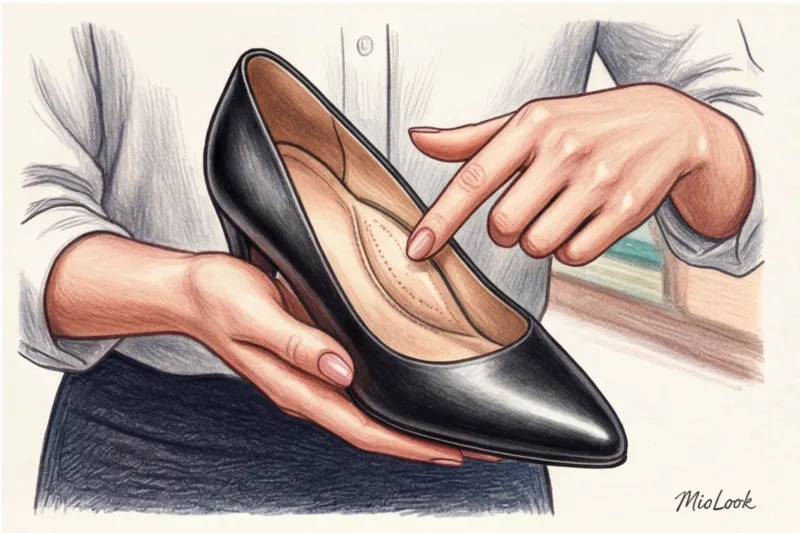
What makes shoes suitable for stage performance:
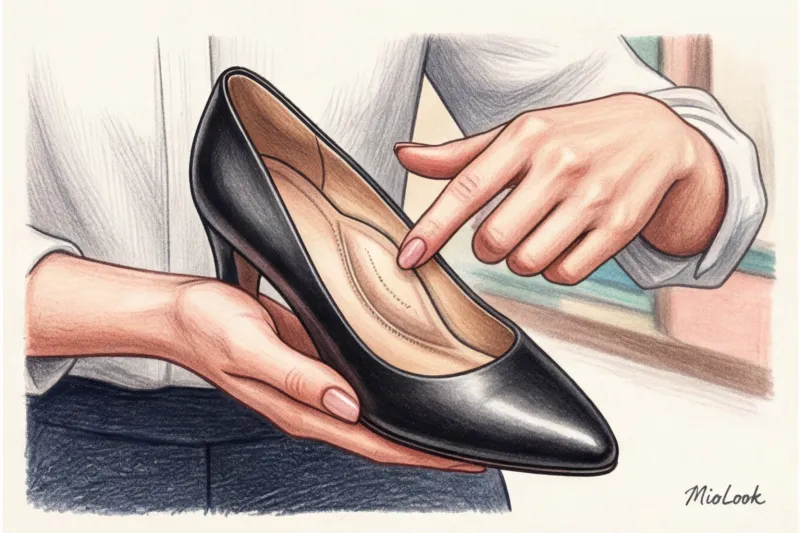
- Presence of instep support: It supports the arch of the foot, preventing it from collapsing inward (pronation) when standing for a long time.
- Sufficient toe width: Your toes shouldn't overlap. If deep red marks remain on your skin after you take your shoes off, the last is too small, even if the length is perfect.
- Rigid heel fixation: The heel counter should be snug. If your heel moves when you walk, you'll instinctively curl your toes to hold the shoe in place, which will lead to cramps within 20 minutes.
The Flat-Heel Illusion: Why a Speaker Needs a Micro-Heel
Here we come to the main myth: "If I have to stand for a long time, I'll wear flat ballet flats.".
As a stylist, I'm categorically against wearing ballet flats on stage. The physiology of standing is such that without even the slightest incline, your entire weight falls on your heel. There's no cushioning. The shock load is transmitted directly to your knee joints and lower back. After 40 minutes of standing in ballet flats, your back will reflexively slouch to relieve the strain on your lumbar region. Visually, you'll look tired and unsure.
Shoes with completely flat soles are the enemy of your posture. The ideal heel height for proper weight distribution and voice support is 2–4 centimeters.
Women's Stage Shoes: A Guide to Current Styles
The classic 10-centimeter stiletto heel is hopelessly outdated for business settings. Moreover, it's dangerous. At one conference in Berlin, I witnessed a speaker get her heel stuck in a technical joint on the stage. She had to interrupt her presentation to free the shoe. What styles are considered the gold standard today?
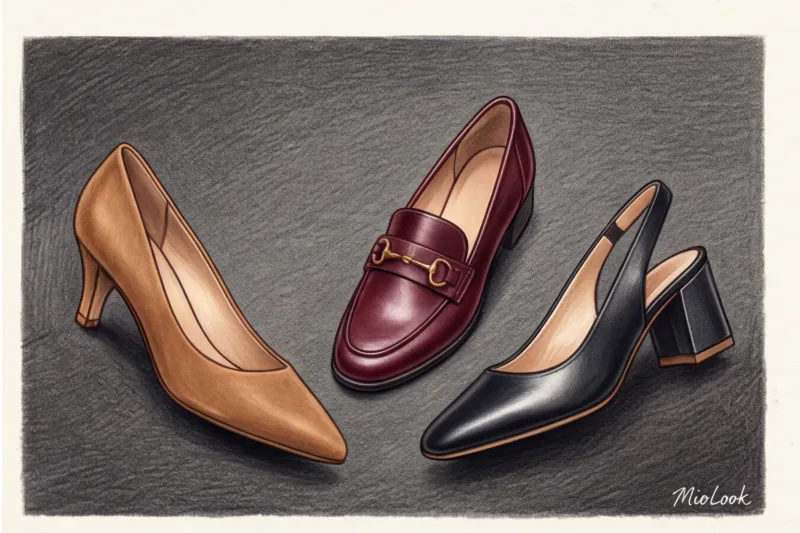
Pumps 2.0 (Kitten heel and block heel). A micro-stiletto heel, 3-5 cm high, or a stable square heel. They retain the elegance of a classic pump but provide 3-4 times the support surface. You can gesture freely and shift your body weight without risking loss of balance.
Smooth leather loafers. An ideal choice for smart-casual wear, business lectures, and IT conferences, choose models with an almond-shaped or slightly pointed toe and a sturdy sole. They convey a sense of poise without being overly formal.
Slingbacks (shoes with an open heel). A great option for warmer weather. However, there's a strict etiquette rule: slingbacks are appropriate in creative industries, marketing, and IT, but violate protocol if you're working in banking, law, or the public sector (where the heel must always be covered).
Mary Jane. Shoes with a strap on the instep have been a huge trend in recent years, even noted by the analytical agency WGSN. To avoid them looking childish (like schoolgirl shoes) on stage, choose models with a pointed toe, several thin straps, or a crocodile-effect texture.
Your perfect look starts here
Join thousands of users who look flawless every day with MioLook by uploading your wardrobe to the app.
Get access — €0.99 onceSilicon Valley Trap: Sneakers on Stage
Steve Jobs wore worn-out New Balance shoes on stage, and it became a symbol of genius. But let's be honest: what works for a billionaire visionary can easily destroy the credibility of a mid-level expert. Audiences forgive geniuses' sloppiness, but they expect respect for the format from hired executives and guest speakers.

Integrating athletic shoes into a business look requires precision. If you decide to wear sneakers with a pantsuit, follow these three rules:
- Only minimalism. No mesh running shoes, chunky soles (ugly shoes), or neon accents. The perfect reference is basic leather sneakers in the style of Common Projects.
- No logos. Oversized Nike galoshes or Adidas stripes cheapen a business look and distract attention.
- Impeccable cleanliness. Stage sneakers should look like they just came out of the box five minutes ago. Even the slightest scuff on the white sole looks like dirt under the spotlights.
Limitation: This technique absolutely doesn't work if you're speaking to a conservative audience (an old-school boardroom, a medical symposium). In such cases, wearing sneakers will be perceived as disrespectful.
Materials and textures: how shoes perform under spotlights
The way shoes look in a fitting room mirror and the way they look on stage under professional lighting are two different things. Over the course of 12 years, I've worked closely with dozens of videographers, and they all have their own "blacklist" of clothes and shoes.
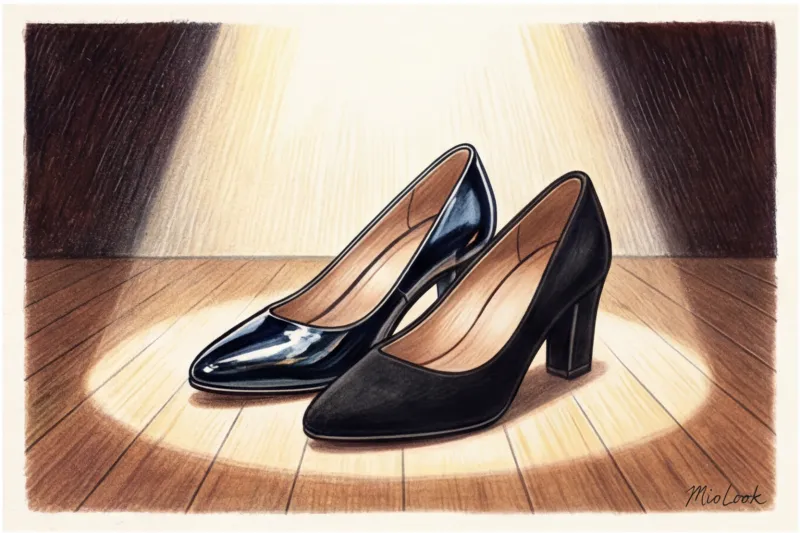
Patent leather. An absolute no-no for major performances with video coverage. Varnish acts like a mirror: under the spotlights, it creates harsh, chaotic glare that hits the camera lens and distracts the audience. Furthermore, varnish is the hardest material, it barely wears in and doesn't breathe.
Suede. It looks incredibly expensive, absorbs light, and produces a deep, rich color. But there's a catch: backstage at theaters and conference halls can often be dusty. Black suede will pick up all the lint before you even get to the microphone. If you choose suede, keep a lint roller in your bag.
Smooth matte leather. The gold standard. It has a beautiful shine, is easy to clean, and quickly conforms to the shape of your foot.
Another insider tip: floors on modern stages (especially laminate or poured plastic) can be incredibly slippery. If your shoes have genuine leather soles, be sure to take them to a repair shop and have them fitted with thin rubber soles. prevention Otherwise, your performance could end with a spectacular but painful fall.
Brands and Investments: Where to Find Statement Shoes
You don't have to spend half your salary on performance shoes, but you can't skimp on lasts either. Let's look at specific segments.
In the premium mass market (middle-up segment) I recommend paying attention to Massimo Dutti , COS And & Other Stories Massimo Dutti makes excellent, smooth leather, but their lasts are often too narrow—they're not suitable for wide feet. COS emphasizes architectural design and a looser fit, and their leather loafers last for years of wear. &Other Stories is the leader in perfect kitten heels, with some of the most balanced lasts in this price range.
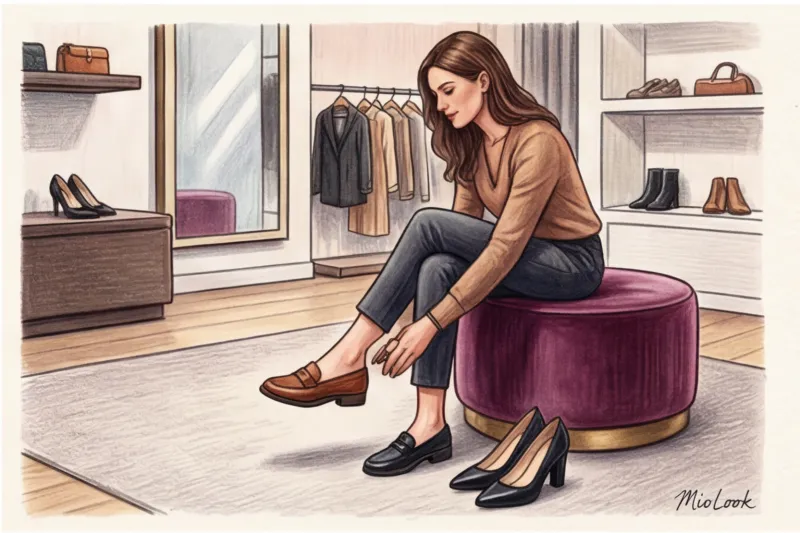
If you have problematic feet, look into specialized comfort brands like Geox or Ecco The main rule here is to choose the most minimalist styles without perforations, contrasting stitching, or unusual hardware to avoid a "senile" look.
What about luxury? Is it worth investing in Christian Louboutin's iconic red-soled stage shoes? My answer: No These are classic red carpet shoes (where you have to stand gracefully for five minutes in front of photographers), not for an hour-long lecture. Their lasts have an extreme lift, and the soles are so rigid that they offer no cushioning at all. Save them for restaurants.
By the way, in order not to get confused in your purchases and always know which shoes go with a particular suit, I recommend using wardrobe digitization feature in the MioLook app You simply upload photos of your items, and an AI stylist will help you put together a ready-to-wear capsule for your performances.
Speaker's checklist: test drive shoes 24 hours before release
Even the most expensive pair of shoes can throw a surprise. Never, under any circumstances, wear brand-new shoes to a presentation. This is a law written in the blood (and calluses) of thousands of speakers.
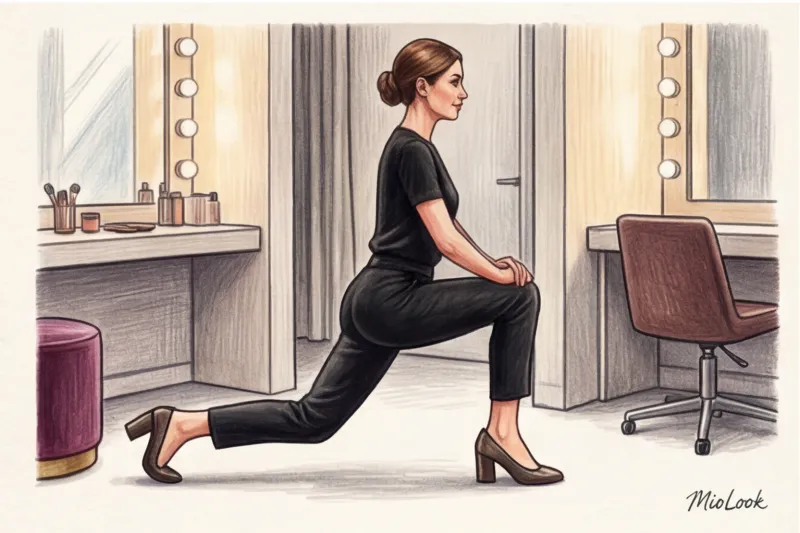
Take a test drive the day before the event:
- The 2-hour rule: Put on your shoes at home or in the office and walk around in them for at least two hours straight. If you feel any pressure anywhere, this micro-pain will be multiplied tenfold on stage due to adrenaline and slight swelling in your feet.
- Step-stop-turn test: Take a few quick steps across a smooth floor, stop abruptly, and turn around. Your heel shouldn't jump out, and your sole shouldn't slip.
- Pack an emergency kit: A speaker's bag should always contain: gel pads for the fingertips (a lifesaver when standing for long periods), an anti-chafing pencil (for example, Compeed - applied to the skin before calluses appear), and a compact sponge with silicone impregnation for quickly restoring the shine of matte leather.
Ready to get started?
Try MioLook's free plan—upload your shoes and outfits and let AI find the perfect combinations.
Get access — €0.99 onceChoosing shoes for stage performance is a strategic decision. Your shoes should work for you, not against you. They should provide reliable physical support so you can fully focus on the message you're conveying to the audience. Invest time in finding your perfect last, and you'll feel your confidence as a speaker grow along with your physical stability.