What are perfume families and why are they the basis of your style?
Have you noticed how often we buy perfume on impulse? A friend recommends a new product, the bottle looks like a work of art, and the salesperson convincingly promises "incredible sillage." You pay 150 euros, bring the coveted box home, and a couple of days later, you realize: the scent is unbearably suffocating. To stop wasting your budget on random purchases, you need to learn more. perfume families — the basic coordinate system in the world of olfactory art.
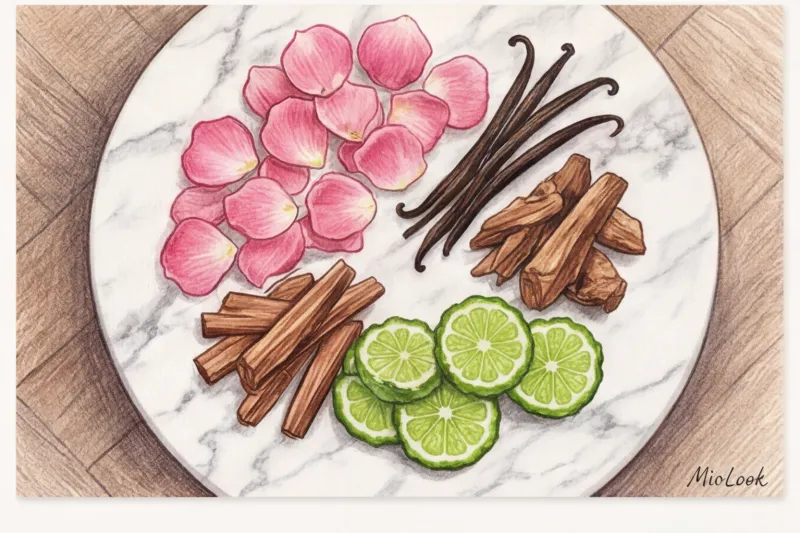
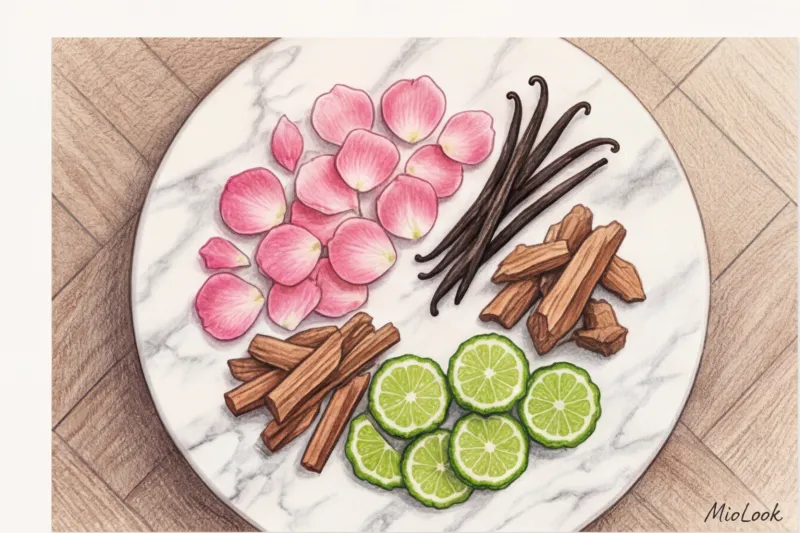
As a certified colorist, I always begin my work on a client's appearance by determining their color type. Just as we select the perfect shade palette to match your skin tone, we need to choose a "palette" for your sillage. Back in 1992, perfume expert Michael Edwards created the legendary Fragrance Wheel. He systematized the chaos of thousands of ingredients and divided compositions into four global groups: floral, oriental, woody, and fresh.
This isn't just a pretty infographic, but a rigorous classification that explains the anatomy of your preferences. Edwards' wheel divides fragrances into 14 subgroups that flow seamlessly into one another. If you love sparkling citrus, you'll likely appreciate the green notes located nearby. However, heavy oriental resins at the opposite end of the wheel can trigger a migraine.
Over 12 years of working as a stylist, I've learned that knowing your olfactory group saves you thousands of euros. Understanding that your base is, for example, cool fougères, you'll no longer fall for the aggressive marketing of heavy gourmands. You'll begin to consciously build your fragrance wardrobe. Incidentally, when my clients plan capsules through the "smart wardrobe" feature in MioLook , I always ask them to mentally “attach” a specific bottle to each image.
Perfume is your most powerful, albeit invisible, accessory. It can either pull your look together or completely destroy it. Imagine: you're wearing an impeccable three-piece suit made of thick wool, and you've created a formal business makeup You're ready for an important meeting, but you smell like cotton candy and praline. Your interlocutor immediately experiences cognitive dissonance. Your level of expertise plummets before you've even opened your mouth.
"Scent goes before you and lingers long after you've gone. If your outfit says, 'I'm a professional,' but your perfume screams, 'I'm a frivolous girl,' people will believe it."
And if for business photo shoot While we create the right studio lighting, in real life, it's the scent that highlights or conceals the right facets of your character. Let's figure out how to stop guessing based on the notes and learn to read fragrances like an open book, so your scent trail always works for you, not against you.
The Anatomy of Fragrance: Why the Note Pyramid Is a Marketing Trap
Have you ever read a perfume description before buying it? "Frosty cherry," "cashmere wood," "solar notes"... It sounds incredibly poetic. But let's be realistic: no one squeezes juice out of a cashmere sweater or distills sunlight.
As an image consultant, I regularly see women become hostages to beautiful press releases. The stated note pyramid is most often a marketing fantasy, designed to evoke a specific association and sell a mood. In reality, the perfumer uses complex chemistry. For example, that "cashmere wood" is a synthetic molecule called Cashmeran, which smells of damp wood, pine, and musk. And the mouth-watering "frosty cherry" is created in a lab by combining benzaldehyde and ionones. Jean-Claude Ellena, the legendary former perfumer for Hermès, once described this process with utmost honesty: "I don't use real flowers, I create the illusion of their scent using molecules.".
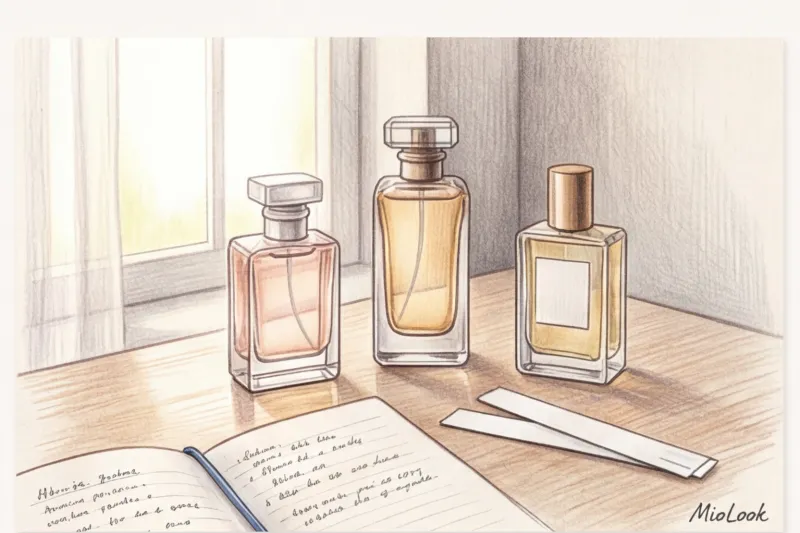
To avoid spending 150–200 euros on bottles that will irritate you and collect dust on your shelf after just two uses, you need to understand the basic physics of the process. Any fragrance is a mixture of molecules of varying sizes, weights, and volatility. This is why it transforms over time.
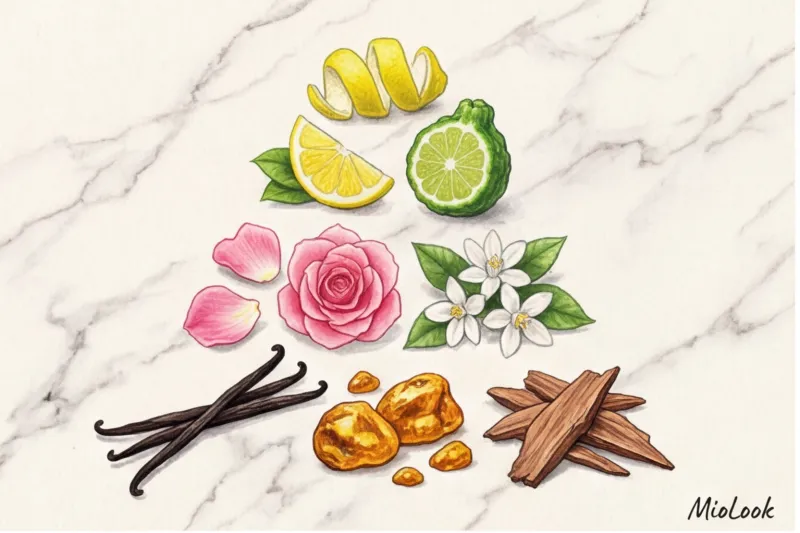
- Top notes (last 5-15 minutes): These are the lightest, smallest, and fastest-evaporating molecules—citrus, green accords, light berries. Their main commercial purpose is to grab your attention at the store display and make you say "wow!"
- Middle notes or “heart” (last from 2 to 4 o’clock): Heavier molecules. Here, the main floral, fruity, and spicy notes unfold. This is the trail your colleagues will smell in the office until lunch.
- Base notes (from 8 hours on skin to several days on clothes): The largest and most unwieldy molecules are musks, resins, patchouli, dense woods, and vanilla. They act as fixatives. If you spray this perfume on a heavy wool jacket or tweed coat, the base vanilla will stay with you until the next dry cleaning.
And herein lies the main trap that 90% of buyers fall into. We spray perfume on a paper blotter, instantly fall in love with the sparkling, juicy bergamot opening, and head to the checkout... Three hours later, we're sitting in an important meeting, literally suffocated by the heavy, itchy musky-amber base, which turns out to be the true "face" of the composition.
Access to MioLook for €0.99 — one-time payment
A smart AI stylist will select the perfect look.
Get access — €0.99 onceOne of my clients, a top manager at an IT company, bought herself a "fresh summer scent" for the office this way. For the first ten minutes, it smelled like icy lemonade and mint, but by midday, on her hot skin, it had transformed into a thick, suffocating oriental scent, completely destroying her strict business image.
Counter-insight: the fresher and lighter the scent at the start, the more likely it is to contain a powerful synthetic fixative hidden in its base, otherwise the perfume will simply evaporate within half an hour.
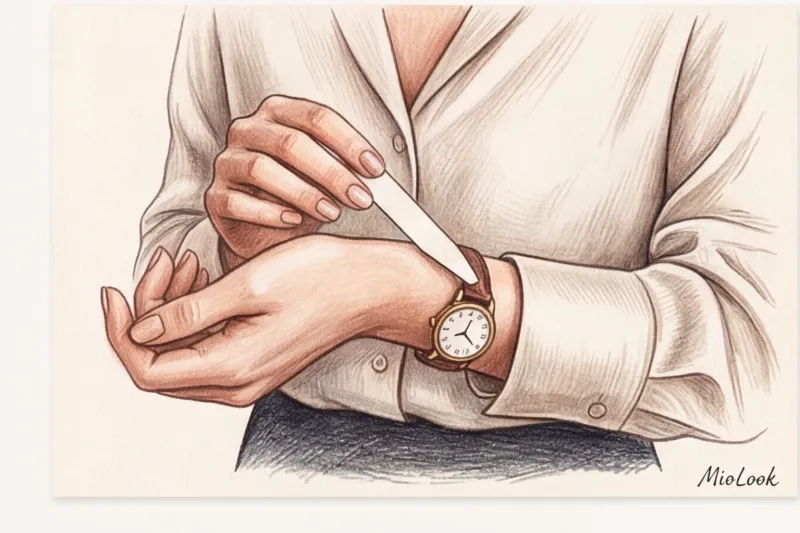
The main rule of a conscious fragrance wardrobe: never judge a composition by the first five minutes. Spray the fragrance on your wrist—your body chemistry will inevitably alter the rate at which the molecules evaporate—and let it sit for at least 3-4 hours. Only when the light citrus "enticements" fade and the base is revealed will you know whether you're ready to let this scent into your personal space.
The Main Fragrance Families: Translating Notes into Wardrobe Language
Imagine a woman in an impeccably tailored wool tuxedo. She confidently walks into a conference room, sits at the head of the table, opens her laptop... and at that moment, the space fills with the thick, sticky scent of strawberry gum and cotton candy. What happens to her image? It crumbles in a second. The visual message screams authority, while the olfactory one evokes childish naivety and frivolity. Cognitive dissonance ensues.
A 2022 study by specialists at the Monell Chemical Senses Center demonstrated a curious feature of our brain: we subconsciously associate scents with visual and tactile textures. If the scent doesn't match the texture of your clothes, others perceive it as fake, even if they can't explain the discomfort.
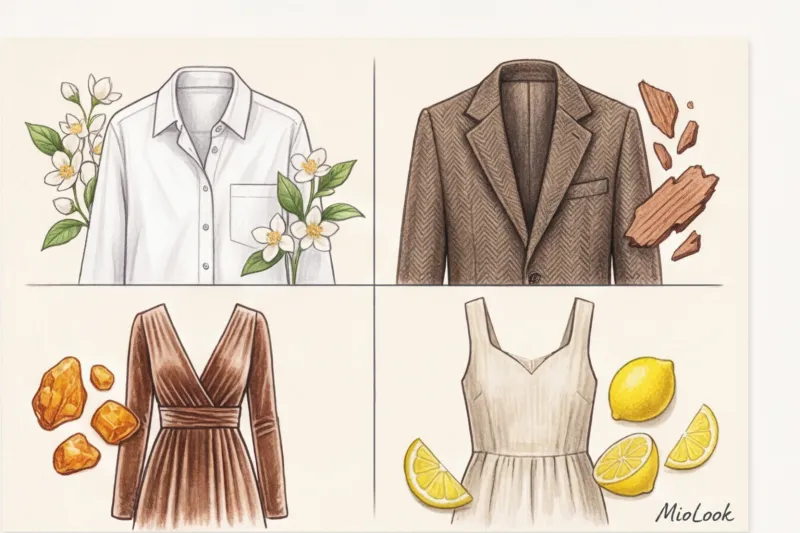
As a stylist and colorist, I always say: fragrance families aren't just chemists' classifications of ingredients. They're your invisible wardrobe. Just as you wouldn't wear a chiffon dress in a snowstorm, you shouldn't "wear" heavy amber with a tracksuit. Let's translate abstract perfume terms into the understandable language of fabrics, silhouettes, and psychological archetypes.
Floral and fruity: from romance to classy femininity
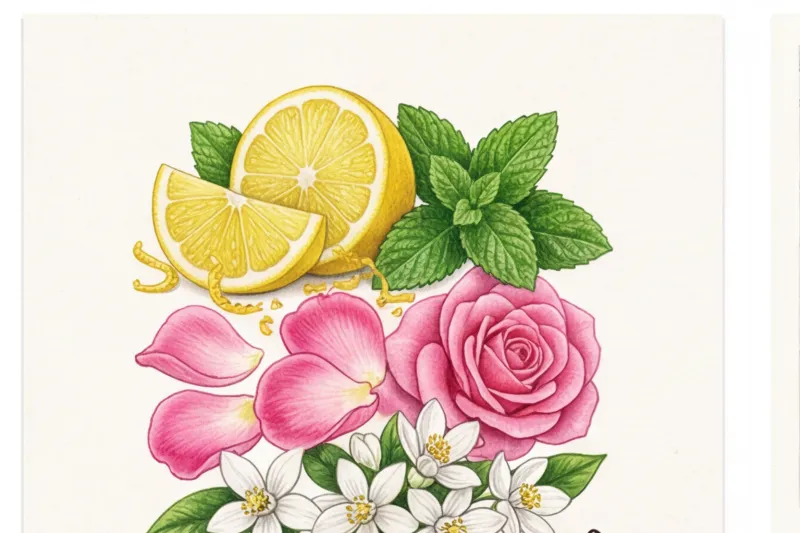
The floral family is the largest and, perhaps, the most insidious. Many women buy floral perfumes by default, considering them a universal synonym for femininity. But not all flowers are the same. Stylistically, we strictly distinguish between white florals and powdery pinks.
White floral notes (jasmine, tuberose, gardenia, lily) are heavy artillery. They possess a so-called indolic, almost animalic undertone. This is the scent of mature, conscious sensuality, which fits perfectly with the archetype of the Lover or Aesthete. In premium perfumes (from 200 euros per bottle), tuberose has a predatory and prestigious quality. What to wear with? White flowers call for smooth, flowing, and cool textures. Natural silk, satin, the finest chiffon, or polished cotton. The smooth texture of the fabric visually echoes the dense, oily aroma of jasmine.
Rose, peony and powdery notes (rose, violet, iris) convey a completely different message. This is the archetype of the Innocent: well-groomed, distanced, slightly melancholy, and purity. Powdery fragrances blend beautifully with shaggy yet lightweight fabrics—fine mohair, angora, and matte silk with a peach effect (cupro).
"Fruity notes without a woody base often cheapen a look. If you choose a pear, peach, or berry as a highlight, make sure your outfit has a strict geometric design, otherwise you risk looking like a 'teenage girl,' no matter what your passport."
Woody and fougere: core, confidence and business dress code
If floral scents are blouses and dresses, then woody and fougère fragrances are like a perfectly tailored jacket with a crisp shoulder line. This group includes cedar, sandalwood, vetiver, oakmoss, patchouli, and classic lavender.
Historically, fougères (from the French fougère, meaning fern) were created for men's colognes. Their structure is based on the contrast of crisp lavender and bitter oakmoss. When a woman wears a fougère or dry woody fragrance, she appropriates this historical masculinity, transforming it into professional authority. The lack of sweetness in such perfumes is subconsciously interpreted as a sign of personal boundaries and distance.
One of my clients, a financial director, had a hard time choosing a perfume for difficult negotiations with investors. She liked sweet berry perfumes, which made her appear too "soft" in the eyes of her partners. We replaced them with a dry, smoky vetiver (in the spirit of classic Sycomore ). The result? In her own words, the scent became an invisible exoskeleton for her. She physically felt more focused.
What textures to combine with: Woody notes require density and a matte finish. This is an ideal choice for heavy suiting wool, English tweed, starched shirts, gabardine, and heavy denim. The roughness of tweed brilliantly rhymes with the coarse sound of cedar or vetiver.
Oriental and Gourmet: Luxury, Evening, and Distance
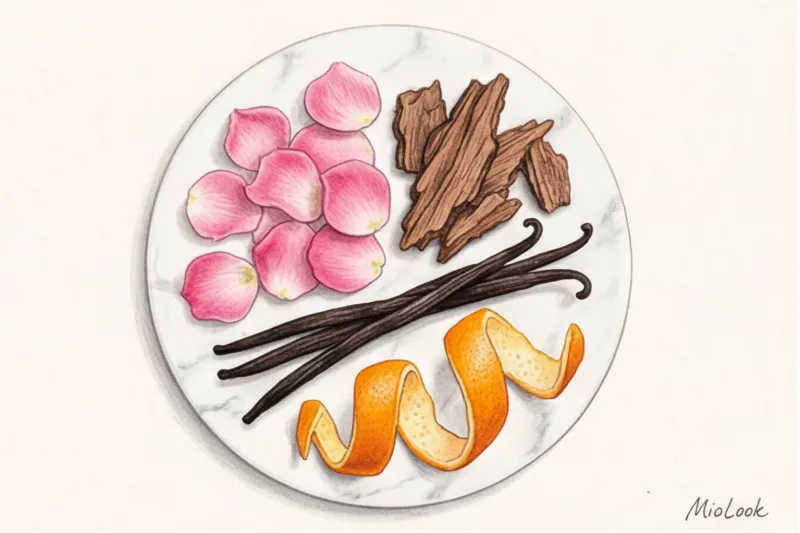
The oriental family is characterized by dense, resinous, and warm scents. Amber, incense, myrrh, spices (cinnamon, cardamom), and gourmand notes such as vanilla, chocolate, caramel, and praline reign supreme here.
Let's be honest: gourmet food in the office is a stylistic crime I see (and hear) regularly. "Edible" smells evoke basic, physiological associations with comfort, cooking, baking, and relaxation. Vanilla literally reduces stress and calms the nervous system. Have you ever wondered why it's so hard to convince your colleagues of your staunch expert position if you smell like vanilla cupcake? You're projecting the Nice Guy or Guardian archetype, toning down your professional sternness.
Oriental and gourmand perfumes are created for evening, seduction, and luxurious relaxation. They possess a physically perceptible "temperature"—they warm.
What textures to combine with: These are fragrances for heavy, rich, tactile fabrics. Velvet, velour, thick cashmere, brocade, and chunky knits. If you wear an oriental perfume with a light linen sundress, the scent will simply overwhelm your look with its monumentality. Furthermore, resins and spices smell wonderful on natural fur or a high-quality eco-friendly coat on a frosty winter evening.
Fresh, citrusy, and aquatic: energizing and smart-casual
The final base group is the olfactory equivalent of a white basic T-shirt or a crisp shirt fresh from the dryer. Bergamot, bitter lemon, yuzu, sea salt, ozone, green tea, and freshly cut grass.
These are scents of kinetics, movement, and youth. They don't carry a deep philosophical message and don't require complex tailoring or evening makeup. Their main purpose is to convey energy, purity, and freshness. In the era of the trend for Clean Girl Aesthetics (The clean girl aesthetic)—aquatic and green fragrances with molecular musks have become top sellers. They create the illusion that you don't wear perfume at all, but just got out of the shower and put on clean clothes.
When my clients pack their summer or sports capsules through the "smart wardrobe" feature in MioLook I always recommend pairing citrus-green compositions with such images. This completes the image of a dynamic, modern person.
What textures to combine with: Linen (especially slightly rumpled, vibrant), fine cotton, viscose, light denim, and high-tech sports fabrics. Fresh fragrances are an absolute must-have for hot summer and smart-casual style. But be careful: in the winter cold, the subtle aquatic notes can be distorted, producing an unpleasant metallic ringing, as if you forgot to dry your hair before going outside.
The Art of Blind Perfume Buying: A Step-by-Step Guide
According to beauty industry marketing reports from 2023, over 60% of women have purchased a full-size bottle of perfume at least once without testing it first. The trigger is usually aggressive marketing, aesthetically pleasing packaging, or an enthusiastic review from an influencer. The result, unfortunately, is often predictable: a beautiful bottle costing €150-250 ends up gathering dust on a shelf because the scent is overpowering or doesn't fit with their everyday wardrobe.
However, blind buying isn't a gamble if you understand how fragrance families work and can analyze the raw data. Over the years of working with hundreds of clients on their personal image, I've developed a rigorous four-step algorithm. It transforms a blind purchase from a gamble into a precise calculation.
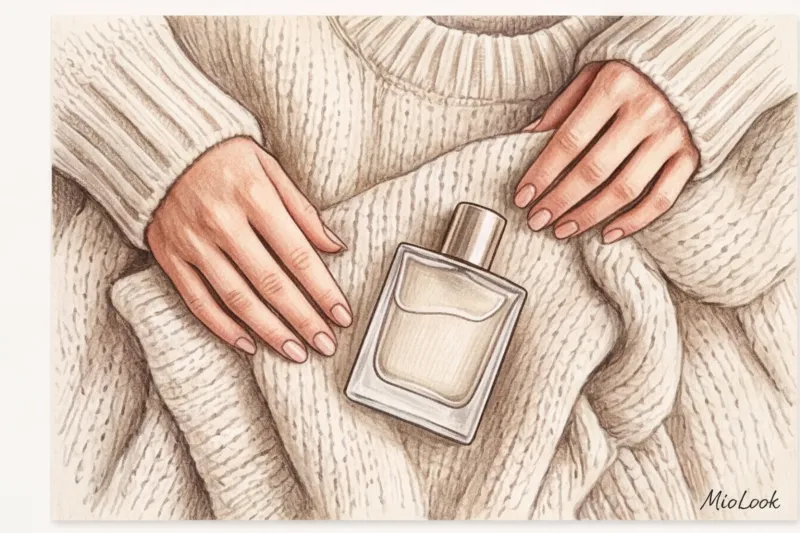
Step 1: Calculate your "anchor note"
Before seeking new olfactory experiences, take stock of what you already own. Write down the names of three or four perfumes you've worn to the last drop or worn twice. Open any perfume encyclopedia and study their fragrance pyramids. Your goal is to find overlaps in the base or heart notes.
I had a particularly revealing case in my stylist career: a client genuinely believed she loved light, citrusy scents. But a detailed analysis of her empty bottles revealed that all the compositions that truly "settled" her featured dry, earthy vetiver in the base. This is the "anchor note" rule—find the ingredient your brain recognizes as your own, and seek it out in new, unfamiliar compositions. It will become your guarantee of comfort.
Step 2: Follow the perfumer, not the brand
A common mistake is to rely solely on the logo on the box. A fashion house is simply a client with a marketing brief and a budget. The true architecture of a fragrance is created by a specific "nose"—the perfumer.
If you once found Quentin Bisch's dense, lingering mass-market work perfect, chances are his niche creations for Marc-Antoine Barrois or Ex Nihilo will also suit you perfectly. Each master has their own recognizable signature, favored molecules, and compositional style. Some work brilliantly with aquatic fragrance families, while others masterfully balance heavy resins. Start memorizing the names of the creators of your favorite perfumes.
Access to MioLook for €0.99 — one-time payment
Start creating perfect images with the help of artificial intelligence
Get access — €0.99 onceStep 3: Filter reviews on Fragrantica
The main rule when reading specialized resources is to ruthlessly cut off any emotions. Comments like "it smells like grandma's chest" or "it's a divine elixir of femininity" are of no practical value, as the perception of scents is deeply subjective.
You need to extract specific physical parameters from the text. Look for answers to three questions. First: What is the actual longevity on hot and cold skin? Second: What is the sillage length (is it intimate or does it fill an entire office)? Third: What is it compared to in the "similar to..." section? If ten different users write that the new product is an exact replica of the perfume that gives you a headache, feel free to close the tab.
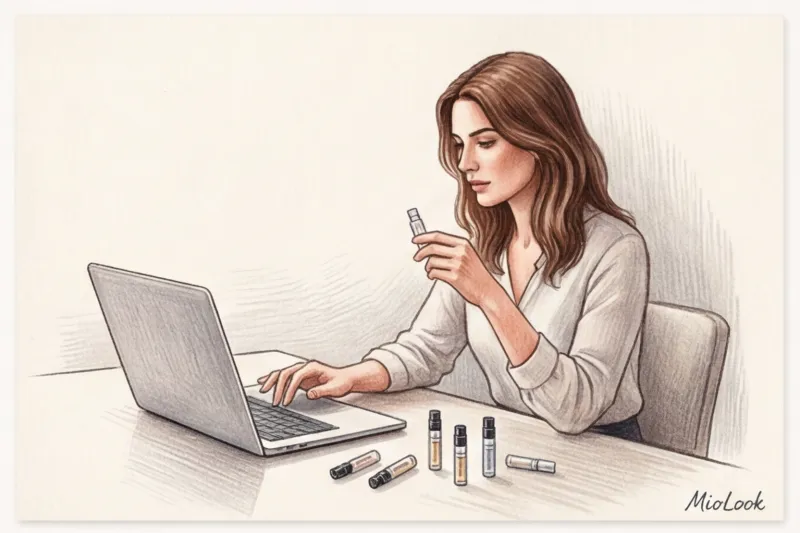
Step 4: Start with Discovery Sets
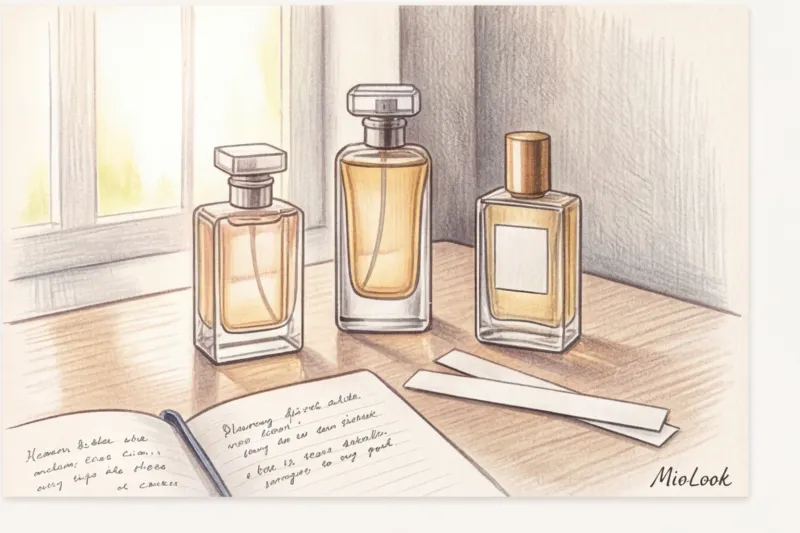
No matter how masterful your theory, individual skin chemistry can always surprise you. Discovery sets—sets of official brand miniatures—or high-quality decants remain the safest way to try on a perfume before purchasing a full-size bottle.
The statistics are stark: buying sample sets reduces the risk of a bad purchase by 80%. Instead of risking a large sum, you spend 30-50 euros on a set of five fragrances. This gives you the opportunity to wear the composition for a few days, test how it smells on thick wool and fine silk, how it performs in a warm room and on a frosty street. And only after this test drive do you purchase the full set, confident that it will become a harmonious part of your style.
How scent influences personal branding and perception of expertise
Neuroscience research proves that smell is the only one of the five senses directly connected to the brain's limbic system, which is responsible for emotions and memory. While your conversation partner or client is still assessing the cut of your jacket, their subconscious has already drawn fundamental conclusions based on your perfume. Scent works faster than words and even faster than body language.
This brings us to the most powerful tool of image - olfactory anchor If you want clients or partners to remember you as a reliable professional, you need a consistent, recognizable signature scent. Think of the effect of an expensive boutique hotel—the lobby always smells the same refined scent (usually notes of white tea, fig, or cedar), which instantly relaxes and instills a sense of status. You can create a similar effect for your personal brand. Find a single dominant note that reflects your professional essence. For lawyers and financiers, this is often dry wood (conveying reliability and boundaries), while for the creative class, unusual mineral or green accords (innovation).
"The brain interprets any discrepancy between the visual message and the scent as false. Dissonance destroys trust faster than a poor presentation," confirms a study of nonverbal communication in the Journal of Applied Psychology (2022).
I often encounter this in my practice. Recently, a client, a practicing crisis psychologist, came to me. Visually, we had created a flawless, inviting image: soft cashmere, muted shades, enveloping textures. But during the session, she wore a loud, hyper-sweet gourmand fragrance with notes of praline and cotton candy. This created severe cognitive dissonance. Imagine: a formal suit, a serious conversation about trauma, and the scent of a children's party hanging in the air. The client subconsciously sensed the childish undertone and withdrew. We replaced the "cotton candy" with delicate sandalwood with a hint of iris—and the perception of her professionalism instantly synced with her appearance.
The search for that perfect olfactory anchor is not something to be rushed. Don't immediately invest €200–300 in a full-size bottle just because of a pretty pyramid.
Once the perfect perfume has been found, it is crucial to follow perfume etiquette A scent should be your invisible companion, not a gaseous assault. Remember the golden rules of sillage:
- In the office and during negotiations: The radius shouldn't exceed 30–40 centimeters (your personal comfort zone). The ideal choice is skin scents, such as molecular compounds or pure musks.
- On stage or during a public performance: Here, the trail can be longer, up to 1.5–2 meters. You move, gesture, and a light, diffuse scent (for example, a modern chypre) will add dynamism to your image in the front row.
- On a date: Paradoxically, the trail should be minimal and intimate (15–20 cm). The idea is for your partner to notice the scent as soon as they get close, rather than being suffocated by it at the other end of a restaurant table.
Collecting images for important meetings through the "smart wardrobe" feature in MioLook I always recommend my clients include a note about the fragrance in their capsule collection notes. A formal three-piece suit calls for a cool vetiver, while relaxed smart-casual with a linen shirt perfectly complements a citrusy cologne. Synchronizing clothing and scent is the pinnacle of impression management that will set you apart from the competition.
Checklist: 5 Rules for Testing a Fragrance to Avoid Disappointment
Perfume boutiques, with their scent-laden atmosphere, are objectively the worst place to make a purchasing decision. When I'm consulted on choosing a fragrance wardrobe, I categorically forbid clients from buying a full-size bottle for €150-200 on the same day. Choosing a signature fragrance requires method and composure. Here's my five-step checklist to help you avoid impulsive spending.

1. Blotter - for first acquaintance only
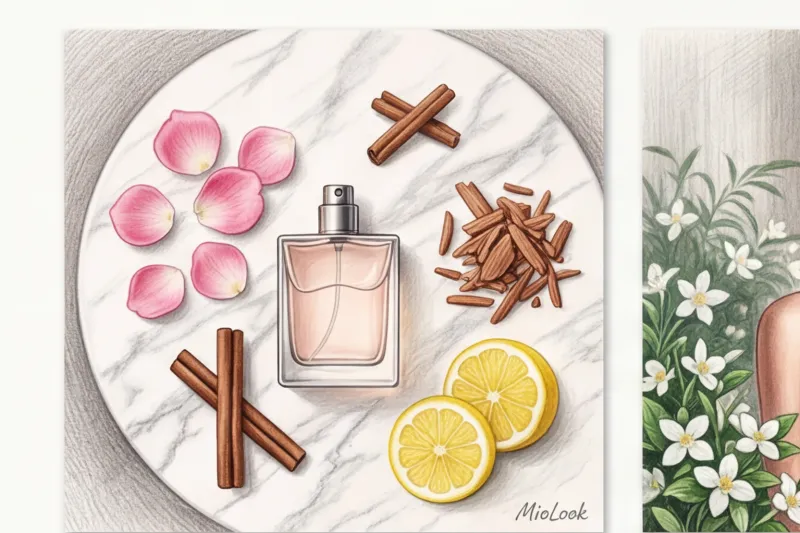
A paper strip reveals an idealized, laboratory-prepared version of the composition. But as soon as the liquid touches your skin, your individual body chemistry comes into play. pH level, temperature, and skin type (so-called "cool" or "hot") all dramatically alter the scent. I once experienced a case where a luxurious woody scent unfolded like a flat, damp cardboard on a client's cold skin, while on my hot skin it revealed a deep, voluminous sandalwood. A skin test is an absolute must-have; without it, purchasing a fragrance is a gamble.
2. Mandatory fabric test
While skin distorts the scent, clothing acts as a reliable fixative. Natural fibers—wool, linen, thick cotton, or silk—absorb essential oils and release them very slowly. Perfume smells different on fabric: top and middle notes linger for hours, whereas on hot skin they can fade in 20 minutes. Practical advice: Apply a micro-dose to the inside seam of a jacket or the cuff of a shirt. This will help you determine how the fragrance will react with your wardrobe and whether it will leave oil stains.
3. The Eight-Hour Rule
Never judge a composition by the first fifteen minutes. You'll need to wear it all day to wait for the base to fully develop. Those heavy animalic musks or suffocating, confectionery vanilla can be skillfully hidden behind a delicate citrus top note. Spray the fragrance on your wrist in the morning and check your sensations every two hours. If the base gives you a headache or irritation by evening, cross this bottle off your wish list.
4. Calibration by season and humidity
Various perfume families Require different climates. Take, for example, a classic oaky chypre. In the damp autumn air or the crisp winter, it sounds aristocratic, resonant, and austere—the perfect complement to a cashmere coat. But try applying it at 30°C in a dry climate, and it will unleash a heavy, almost metallic bitterness that will suffocate both you and those around you. Always consider the season when testing: what delighted you in December may be completely unwearable in July.
5. Taking into account the “blind spot” and dosage
Our brains are designed to block out constant background stimuli to avoid overloading the nervous system. In neuroscience, this is called olfactory adaptation. You stop smelling your perfume after an hour, but others around you can still smell it! The biggest mistake is reapplying your scent every three hours, thinking it's worn off. To avoid the "gas attack" effect and maintain your sense of smell, apply perfume away from your nose.
Expert advice: Apply the fragrance to the crook of your elbow or behind your knees. As you move, the composition will rise, creating a soft, pulsating trail. It won't overwhelm your senses and will remain delicate for those you're talking to.
Your ideal image begins Here
Join thousands of users who look flawless every day with MioLook. Organize your wardrobe, plan your looks, and choose fragrances all in one app.
Get access — €0.99 onceBuilding a fragrance wardrobe is as analytical a process as assembling the perfect capsule wardrobe. When you consciously integrate scents into your style system, they begin to work for you, enhancing the desired impression. In the app MioLook When planning my weekly looks, I always recommend adding a specific perfume to the outfit description. A formal pantsuit—a woody profile, a flowing dress—a delicate white floral composition. This micro-habit transforms simply good clothes into a flawless, meticulously crafted personal brand. Don't be afraid to experiment, test thoughtfully, and listen to your skin—your ideal olfactory signature is already waiting for you.
Guide Chapters
The Fragrance Pyramid: How to Read Notes and Choose a Perfume
Do you choose a perfume based solely on its first notes? Learn how a scent unfolds throughout the day and how to avoid perfume mistakes when buying.
What's the difference between eau de toilette and perfume: EDT and EDP
Reducing the difference between EDT and EDP to longevity alone is a major misconception. Learn how to choose the right fragrance concentration for different occasions.
How to choose perfume online without testing: rules
Are you blind-shopping for perfume and often disappointed? Learn how to choose perfume online by analyzing your wardrobe textures to ensure the perfect fit.
Gourmand Fragrances: A Guide to Dessert Perfumes
Why do top models choose perfumes with the scent of burnt sugar and vanilla? We explore dessert fragrances through the eyes of a stylist and learn how to wear them correctly.
Chypre fragrances are the scent of luxury. A stylist's guide
Forget the myths about retro perfumes. Find out why chypre fragrances have become a symbol of "quiet luxury" and how to choose the perfect perfume for a classy look.
Floral Fragrances for Women: A Guide to Choosing a Perfume
Think flowers in perfumery always mean lightness? Let's dispel those myths and learn how to choose the perfect floral perfume as a wardrobe staple.
Long-lasting perfumes for women: how to choose the best scent
The right fragrance is an invisible accessory and an essential part of your personal brand. We'll explain what sillage is and how to find your perfect scent.
Oriental Fragrances for Women: How to Wear Amber and Spices
Oriental perfumes aren't just about heavy scents for winter evenings. A stylist's take on how to skillfully incorporate resins and spices into your everyday wardrobe.
Woody perfumes for women: sandalwood, cedar, vetiver and oud
The right perfume is the olfactory equivalent of the perfect jacket. Discover how notes of sandalwood, cedar, and vetiver help convey confidence and status.
Perfume Wardrobe: How to Create the Perfect Base
Stop saving your perfume for a "special occasion." Learn how to create a basic perfume capsule that will perfectly complement your style and outfit.
The Secret of Perfume: How Perfume Unfolds on the Skin
Perfume isn't a ready-made dress, but rather the fabric from which the body weaves its garment. Find out why the same perfume smells completely different on everyone.
Fresh citrus perfumes for women: status fragrances
We're busting the myth that light fragrances smell cheap. Learn how to choose an expensive, fresh perfume that will become your signature invisible accessory.
How Niche Perfumes Differ from Luxury: A Guide
Is it worth shelling out hundreds of euros for a complex fragrance, or is it better to choose a tried-and-true luxury item? We explore the key differences between the perfume segments.
How to smell a scent in a store: no mistakes
80% of impulse perfume purchases end up gathering dust on the shelf for years. Discover the expert algorithm that will help you choose the perfect perfume without unnecessary emotions.