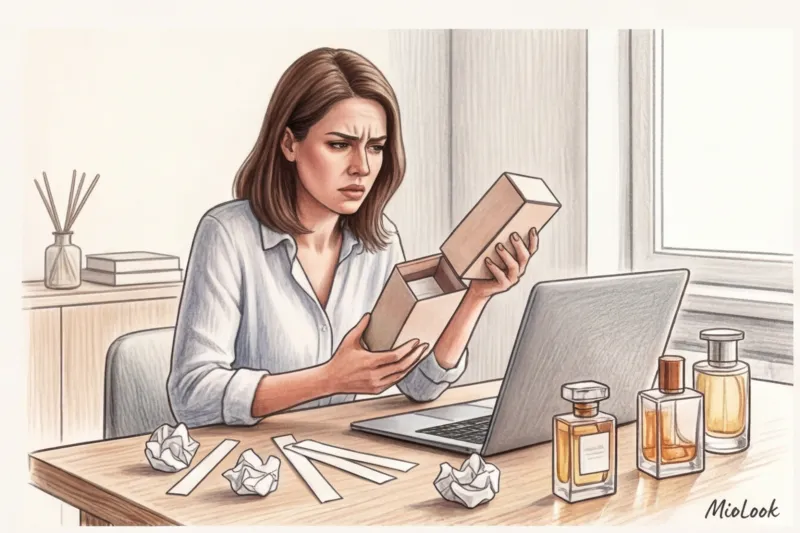
Imagine this: you're reading a captivating fragrance description. "Crispy morning cotton, dew on white rose petals, and a gentle breeze." You order a bottle, anticipating the perfect office perfume. But after the first spray, you're knocked out by a suffocating, thick, metallic musk. Sound familiar? If you're wondering how to choose a perfume online without testing it first and avoiding adding to your home "graveyard" of bottles, forget everything marketers say in product descriptions.
We have already discussed the basic principles of classification in more detail in our a complete guide to perfume families Today, I'd like to invite you to look at perfumery differently—through the eyes of a stylist and fabric expert. We'll choose a fragrance not by abstract "notes," but by analyzing the textures of your wardrobe and understanding the chemical volatility of molecules.
Why 70% of Blind Purchases End in Disappointment (and How to Avoid It)
According to secondary platform analytics (including McKinsey's 2023 resale reports), about 70% of perfumes purchased blindly (so-called blind buys ), resold or given away within the first few months. The psychology of blind buying is insidious: we don't buy the scent itself. We buy the aesthetics of the bottle, aggressive marketing, and the promise of a certain state—confidence, sexuality, or tranquility.
The main problem lies in the notorious "skin chemistry." I had a client, Anna, who was looking for a light scent for work. She ordered a popular fresh perfume after reading reviews about its "ringing cleanliness." But Anna has hot skin. On her, the subtle citrus molecules burned out within ten minutes, revealing a heavy, animalic base that smelled simply inappropriate in the office. The same perfume on a paper blotter, on cool skin, and on hot skin are three completely different compositions.
Moreover, unsuccessful purchases are an environmental issue. The production of the glass bottle, pump (which is nearly impossible to recycle due to its metal spring), mica, and cardboard leaves a significant carbon footprint. Conscious consumption begins with avoiding impulse purchases.
The Pyramid Illusion: Why Claimed Notes Lie
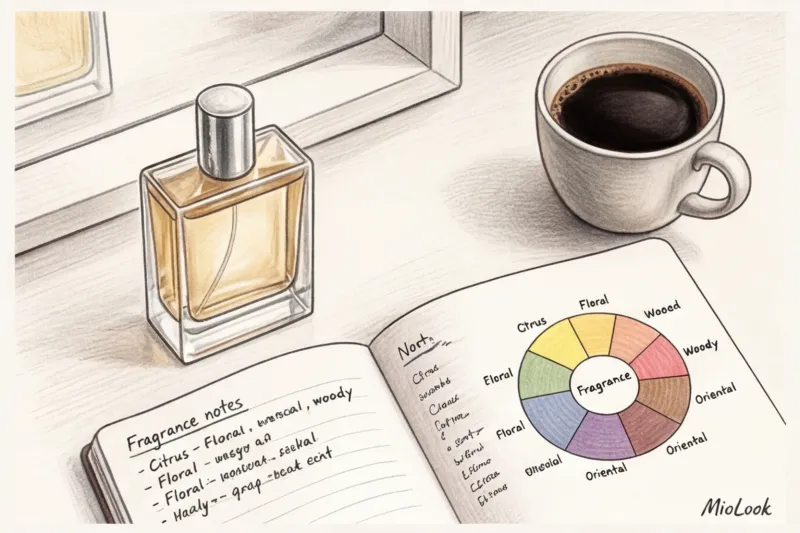
The most counterintuitive insight you need to accept: The olfactory pyramid is a marketing construct This isn't an ingredient list. When you see a description of a fragrance with a "morning rose note," there's no rose in the bottle. It's a combination of synthetic molecules—geraniol and citronellol—that your brain is supposed to interpret as a flower.
"The fragrance pyramid was invented by Jean Carle in the mid-20th century solely to help sales assistants explain abstract scents to customers. It has only an indirect relationship to the actual chemicals in the bottle."
Many modern fragrances don't even have a classic (top, middle, base) structure, but rather a linear or spherical one. They smell the same from the first minute to the last. And if you're buying a perfume for its beautiful top notes (like bergamot or lemon), keep physics in mind. According to IFRA (International Fragrance Association) standards, citrus molecules like limonene are extremely volatile. They evaporate from your skin in 15-30 minutes at most. Relying on these standards when buying online is a recipe for disappointment.
Your perfect look starts here
Join thousands of users who look flawless every day with MioLook. Artificial intelligence will help you create a capsule to match any fragrance.
Get access — €0.99 onceHow to choose perfume online without testing: a step-by-step guide
If you can't trust pyramid schemes, what can you rely on? Structural analysis. Before adding a product to your cart, do some research.
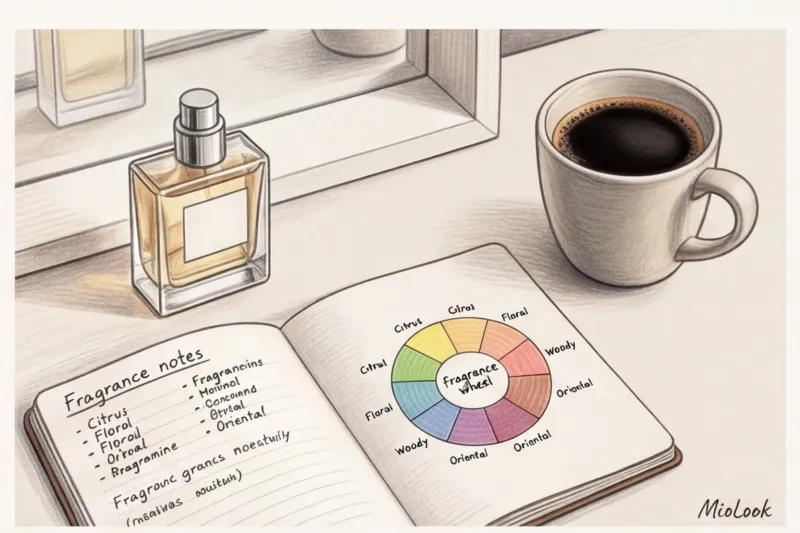
1. Find a common denominator. Take three or four of your favorite fragrances and run them through Michael Edwards' classification system (Fragrance Wheel, 1992). You'll be surprised, but they'll likely all fall into one or two adjacent segments. For example, "soft florals" and "floral orientals." Look for new perfumes strictly within these clusters.
2. Read reviews like an analyst. On specialized forums (Fragrantica, Parfumo), ignore "like/dislike" comments. Look for patterns. If 10 out of 50 people write the word "soap," "shaving foam," or "retro," it means the composition contains a powerful accord of aldehydes or lavender. If they write "medicine" or "dentistry," it's eugenol or saffron with a baccarinic profile.
3. Look for “perfume twins”. In the industry, there's a concept called flankers (versions of the original fragrance) and dupes. If you like fragrance X, search the forums for voting under the heading "Is this fragrance similar to..." There's an 80% chance that a perfume with a high similarity rating will suit you.
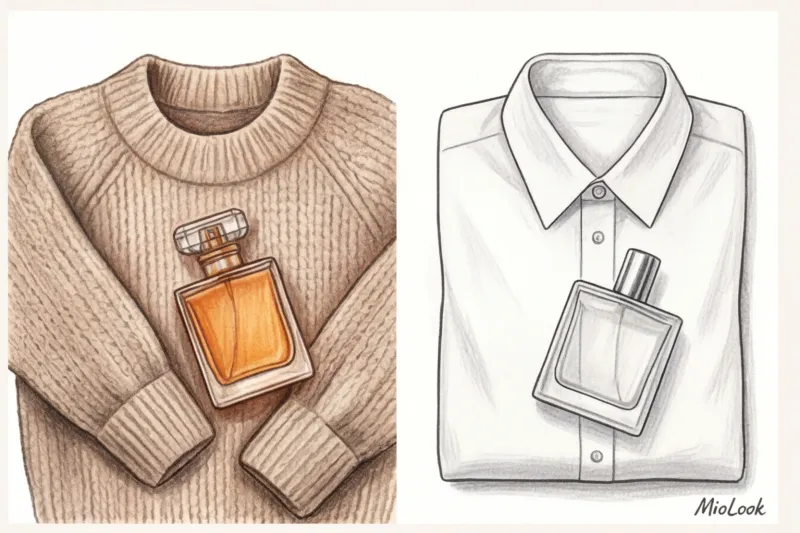
Fragrance Texture: How to Pair Perfume with the Fabrics of Your Wardrobe
As a textile expert, I always teach my clients one rule: perfume and fabric speak the same language. They have density, weight, temperature, and tactility. When choosing a fragrance blind, look at your closet. What textures do you see?
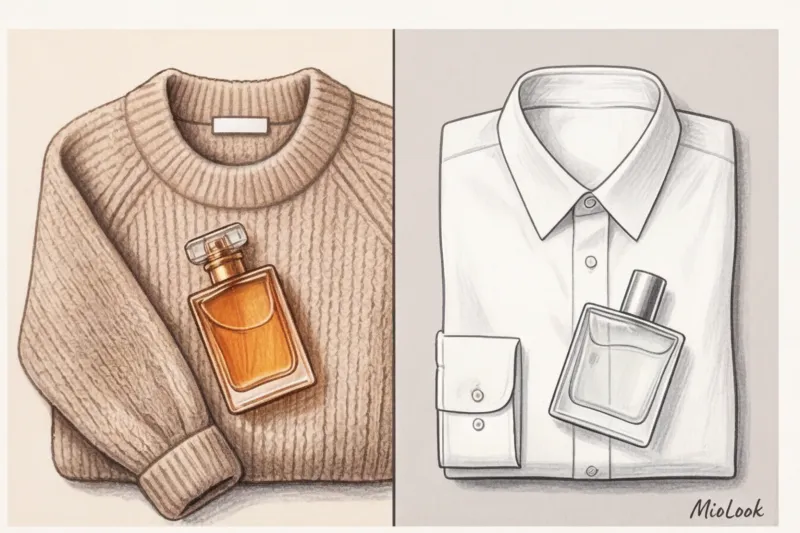
- Crisp cotton and dense linen: If your base is poplin shirts (120 g/m² and above) and tailored linen jackets, you need fragrances with a starched collar texture. These include aldehydes, crisp neroli, vetiver, and green notes. They continue the idea of purity and structure.
- Cashmere and fine merino wool: Fluffy, enveloping fabrics require the same aura. Ideal blind selections would be fragrances with dominant iris (which imparts a powdery quality), sandalwood, and white musk. They create a cozy, fleshy cocoon.
- Velvet, thick silk and leather: Dramatic textures call for heavyweight perfumes. Patchouli, rich resins (labdanum, benzoin), and complex, unsweetened gourmands are appropriate here.
In the appendix MioLook When digitizing your wardrobe, we always recommend associating a specific fragrance profile with a clothing capsule. Wearing a thin silk blouse with an aggressive oud perfume creates dissonance: visually, you're light, but olfactorily, you're like a concrete slab.
Access to MioLook for €0.99 — one-time payment
A smart AI stylist will select the perfect look for you, taking into account the texture of fabrics and your personal aesthetic.
Get access — €0.99 onceRed Flags: Which Notes Should You Never Buy Blindly?
Even if you've thoroughly researched your wardrobe, there are fragrance profiles that are absolutely taboo to purchase without first testing them on your skin. The risk of them revealing unexpected scents approaches 90%.

- Indolic white flowers (jasmine, tuberose, lily). Indole is an organic compound that, in microdoses, produces the scent of a blooming garden, while in macrodoses, it produces a decaying, animalic aroma. On hot skin, indole jasmine can convey a distinctly "animalistic" or medicinal quality.
- Complex chypres and oakmoss. If you're accustomed to modern luxury perfumery, classic chypre may seem like "grandma's trunk" or the scent of a damp basement. This aesthetic requires gradual acclimation.
- Amber wood (modern durable bases). Ambrocenide, cashmeran, and other super-resistant synthetic materials. Thirty percent of people have anosmia (smudges) to them, while others perceive them as the smell of acetone or sweat. Over the course of 12 years of work, I've seen the prestige of an image completely destroyed: a man in a Loro Piana Super 150s wool suit smelled of a pungent amberwood base, costing $50, which negated the fabric's high price.
- Aquatics of the early 2000s. Calone molecules (the scent of watermelon and sea breeze) on specific skin often transform into the air freshener "Sea Breeze".
Fair limitation: This advice doesn't work for everyone. If your nose has been trained by years of dabbling in niche perfumes, you can afford to take a risk with indole. But for a basic everyday wardrobe, these notes are high-risk.
The package has arrived: key testing rules
You've finally placed your order, and the courier has handed you the coveted box. Don't rush to spray the fragrance on your neck right away. You risk ruining the experience forever.
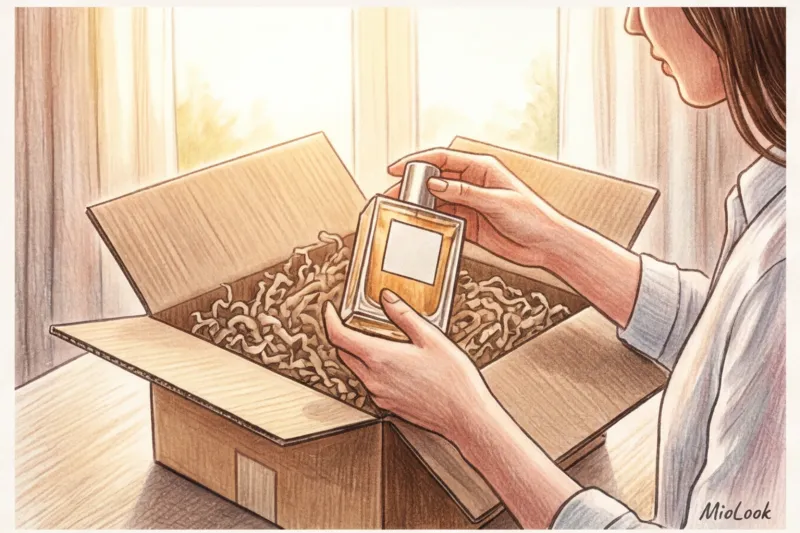
First, the fragrance needs to rest after traveling. During transportation, the bottle is subject to vibrations and temperature fluctuations (from a cold warehouse to a warm car). This temporarily destabilizes the molecular structure of the composition. Leave the bottle in a dark cabinet at room temperature for at least 3-4 days.
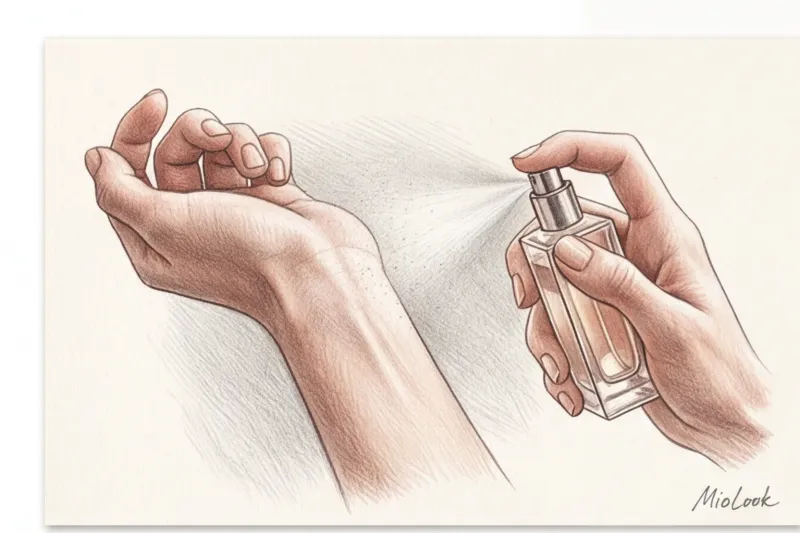
Secondly, follow the first spray rule. There's air in the spray tube. The first 2-3 sprays should be empty—blow them into the air or onto a napkin to allow fresh liquid to enter the pump.
Third, test wisely. If you're concerned about skin chemistry, spray perfume on your clothes. But as a fabric expert, I must warn you: perfume oils (especially in Eau de Parfum and Extrait concentrations) leave permanent yellow stains on natural silk, viscose, and light-colored linen. Never spray perfume on the front of a blouse. The ideal spot is the lining of a wool jacket or the inseam of a skirt hem.
A conscious buyer's checklist before placing an order
Before you hit the "Pay" button, check out this strict but helpful filter. It will save you money and protect the planet from unnecessary waste.

- I know exactly which Edwards perfume family this scent belongs to, and I already have successful experience with this group.
- I have read at least 10 negative reviews on independent resources to understand the worst-case scenario of disclosure (and I am prepared for it).
- I clearly understand which capsule of clothes (fabric, color, style) and in what season I will wear it.
- The composition does not contain my personal stop notes or aggressive amber-wood bases.
- I checked all the available stores: is it possible to order a branded sample (discovery set) in 2 ml volume before buying a 100 ml bottle.
Buying perfume blind is always a gamble. But if you approach it not as a consumer, lured by beautiful words about "dew on petals," but as an architect of your own style, analyzing textures and chemistry, your chances of winning increase exponentially. Choose wisely, and enjoy with your senses.