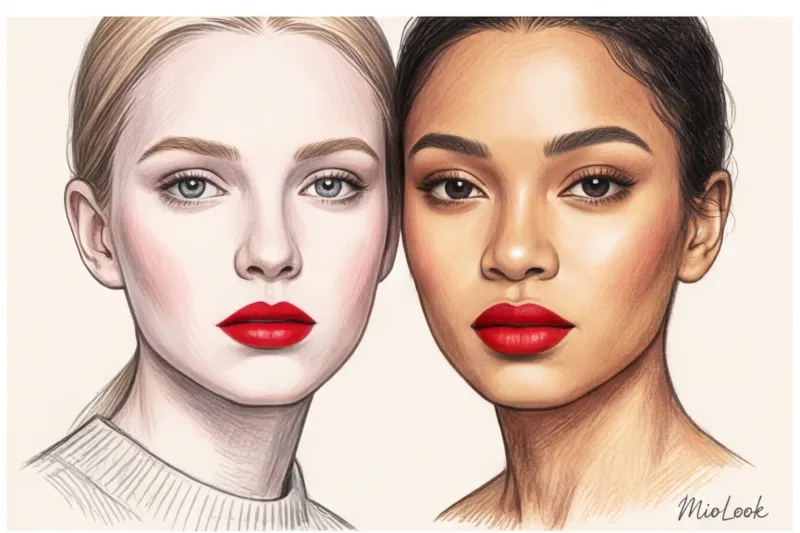
You probably have at least one red lipstick in your makeup bag that you don't use. You bought it on a whim, swayed by the hype of yet another "cult" shade, applied it at home in front of the mirror, and... wiped it off. Sound familiar? For decades, most glossy magazines have been selling us the idea that there are universal shades like MAC Ruby Woo or Dior 999 that suit everyone. It's one of the most persistent beauty myths.
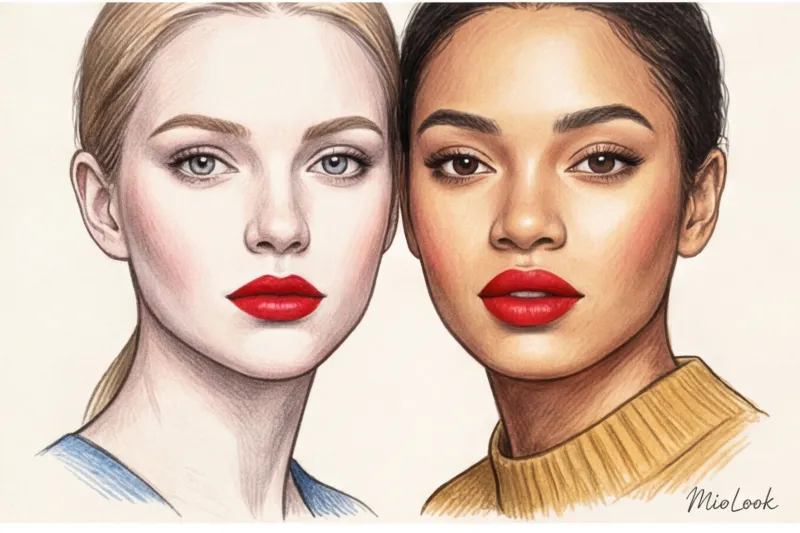
As a practicing stylist, I see the results of this myth every other wardrobe review. A woman with a muted Soft Autumn color scheme buys neon red, and instead of a femme fatale look, she ends up with lips that seem separate and detached, visually "cheating" the face. The secret to the perfect choice lies elsewhere: red lipstick by color type It's selected not by brand, but by the laws of color physics. We've covered how this base works in more detail in our a complete guide to perfect makeup based on your color type.
Why "Universal Red" Is a Major Beauty Myth: The Mathematics of Color
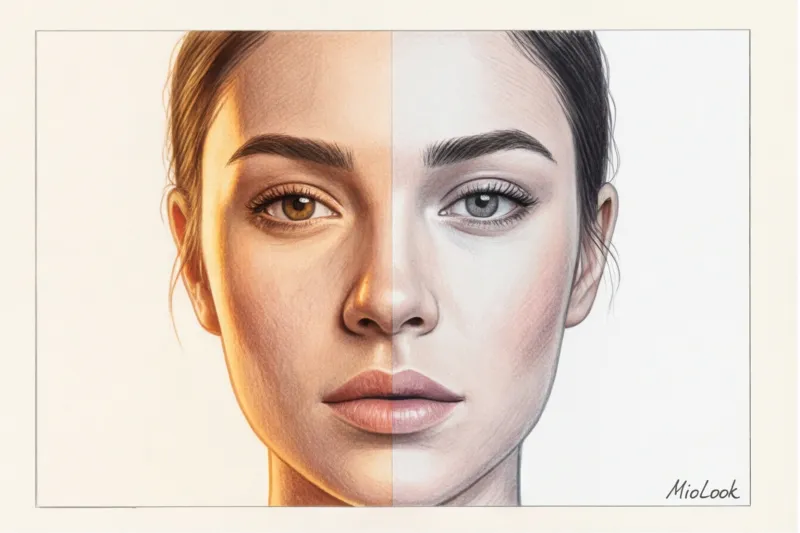
Red lipstick should be an extension of your face, not a standalone accessory. When makeup pigment is applied to your skin, it inevitably reacts with your natural melanin and hemoglobin.
"There's no such thing as a universal red. The shade that makes one woman look fresh and rested will turn another into a tired version of herself."
Last year, Anna, the CEO of a large IT company, approached me. She was preparing for a TEDx talk and wanted to add a pop of red to her look. Before our meeting, she had rejected a dozen lipsticks—her face looked sallow in photo shoots. We tried over 40 shades before finding the perfect one: a deep, slightly dusty carmine. The problem wasn't the shape of her lips or the quality of the makeup, but the fact that she was persistently offered pure, vibrant colors that clashed with her complex, muted skin tone.
My personal statistics are relentless: 80% of women in business avoid red lipstick for fear of "looking vulgar." But vulgarity is almost always the result of a mismatched undertone, not the idea of a bright lip itself.
Access to MioLook for €0.99 — one-time payment
A smart AI stylist will select the perfect look.
Get access — €0.99 onceThe Anatomy of the Perfect Red: How Skin Temperature Changes Everything
Forget the outdated advice of applying gold and silver foil to your face or looking at the veins on your wrists (this works 50% of the time, at best). Let's rely on Johannes Itten's color theory (1961), which remains the gold standard for colorists.
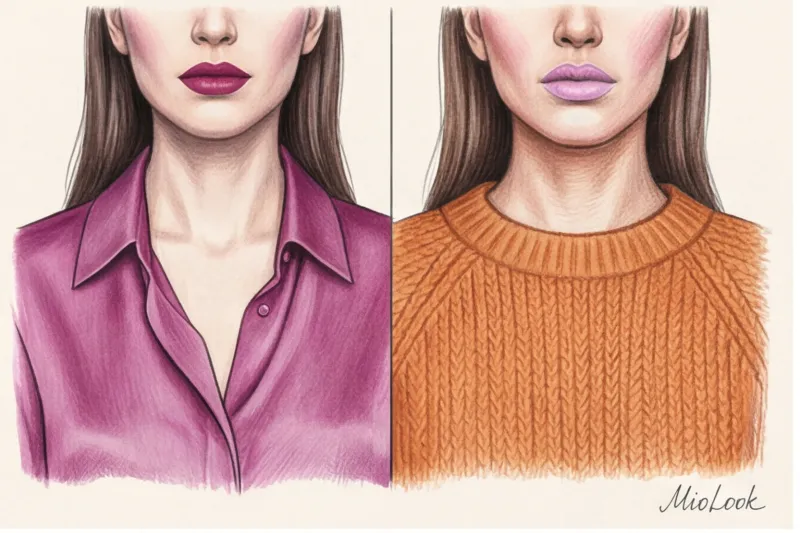
Every red has a base. If a drop of blue pigment is added to red, it becomes cool. If a drop of yellow is added, it becomes warm. And herein lies the main pitfall: if you apply a warm (yellowish) red to skin with a pronounced cool (pinkish) undertone, the lipstick will instantly highlight the yellowness of your teeth and make the whites of your eyes look inflamed.
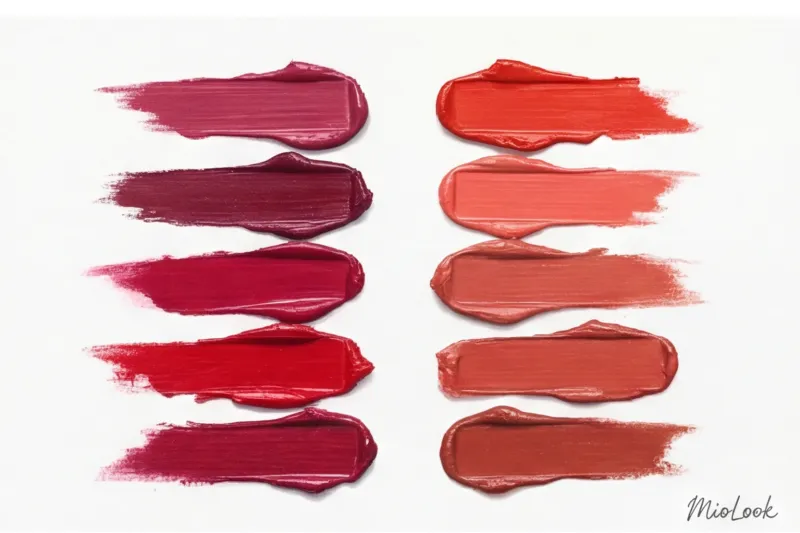
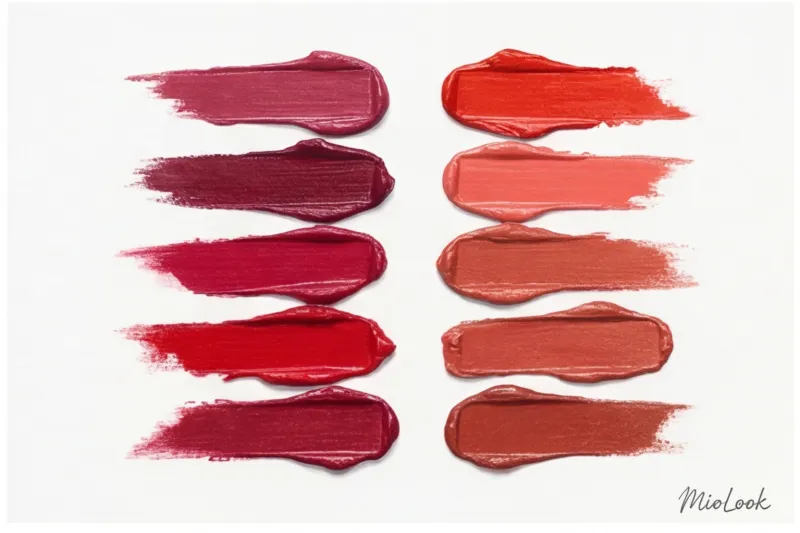
Cool Undertones (Summer and Winter): Berry and Wine Accents
If your skin has a cool undertone, look for lipsticks with a blue base (blue-based reds). When blended on a white napkin, they turn pink, raspberry, or fuchsia.
- Shades: cranberry, ripe raspberry, classic cold scarlet, burgundy, wine.
- Textures: Summer-inspired girls should choose glossy or satin finishes (they add a touch of lightness). Winter's palette is luxuriously enhanced by a deep, matte finish.
Warm Undertones (Spring and Fall): Terracotta, Tomato, and Coral
Warm-toned skin (golden, peach, or olive undertones) requires lipsticks with a yellow or orange base (yellow-based reds). They will leave a carrot- or brick-colored mark on a napkin.
- Shades: brick, tomato, poppy red, warm copper, rowan.
- Why it works: These are the shades that look incredibly "expensive" on tanned or freckled skin, while cool fuchsia would look like a foreign, plastic spot on it.
Contrast Level: A Hidden Filter for Choosing Red Lipstick by Color Type
Temperature is only half the equation. The other half is your natural contrast level. This is the difference in lightness between your skin, hair, and eyes. Snow White (black hair, white skin) is high contrast. A girl with light brown hair, gray eyes, and beige skin is low contrast.
If you're a low-contrast type (Summer or Soft Autumn), a rich, pure red will simply "shout out" your face. Your lips will be the first to enter the room, and then you.
For my clients with soft complexions, I use a professional makeup artist technique called "watercolor application." We take the desired lipstick shade and tap it into the center of the lips with our fingertips, creating a translucent tint. Important note: The matte texture visually “eats” up to 15% of the lip volume If your lips aren't naturally plump and you have a low-contrast complexion, a matte finish will make your face look harsh. Opt for moisturizing formulas.
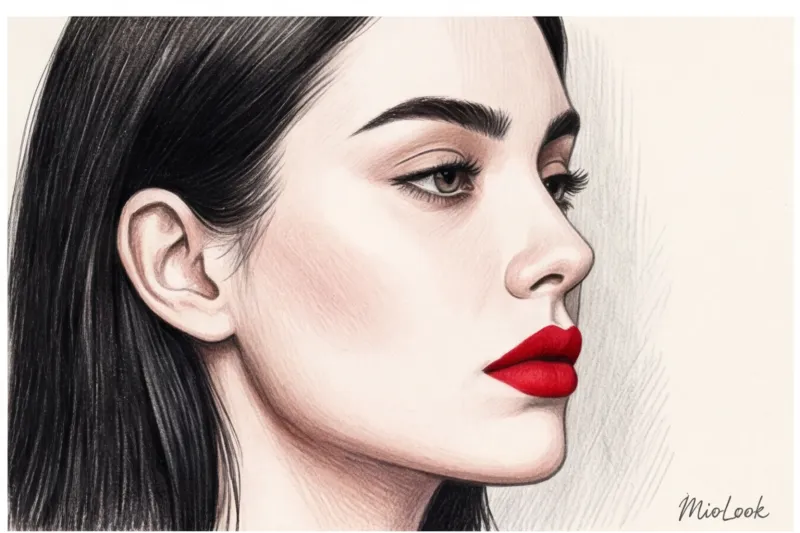
Your ideal image begins Here
Join thousands of users who look flawless every day with MioLook.
Get access — €0.99 onceRed Lipstick by Color Type: A Guide to 12 Skin Tones
To save you hours of wandering around Sephora or the Golden Apple, I've put together a basic shade matrix. Be sure to check it before purchasing.
- Light types (Light Summer, Light Spring): You need clean, but not too dark tones. Watermelon, light coral, transparent berry.
- Deep types (Dark Winter, Dark Autumn): They can withstand the most complex, dark colors: burgundy, rotten cherry, dark terracotta.
- Bright types (Bright Winter, Bright Spring): Your face requires pure color. Ruby, fiery red, neon scarlet without a hint of gray.
- Soft types (Soft Summer, Soft Autumn): Your choice is a complex red. Brick pink, muted lingonberry, mahogany shades.
If you are unsure about your coloring, take a look at our article “ Stylish Office Makeup: Forget Boring Nude ", where we discuss how to adapt bright colors to daylight.
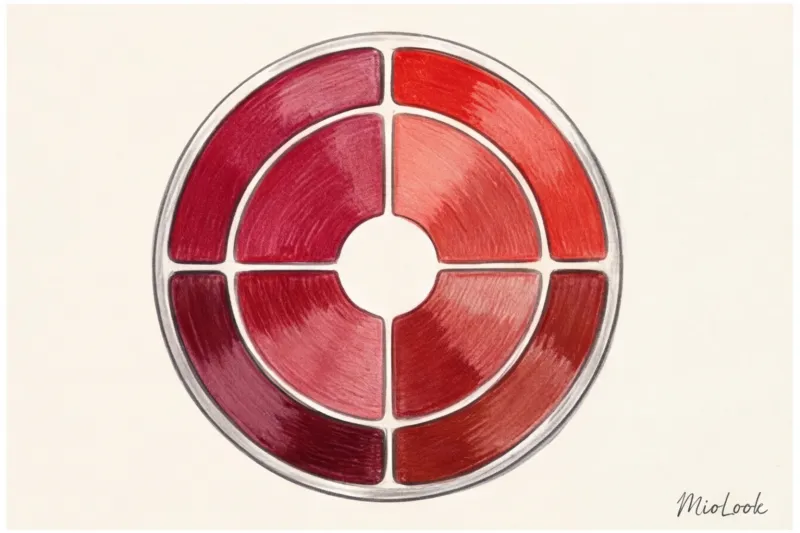
Zoom and Office Lighting: How to Test Red Lipstick Like a Pro
A month ago, I conducted a personal experiment: I applied five “cult” red shades (from budget to premium) and photographed myself in daylight, under cool office lamps, and with a ring light for phone calls.
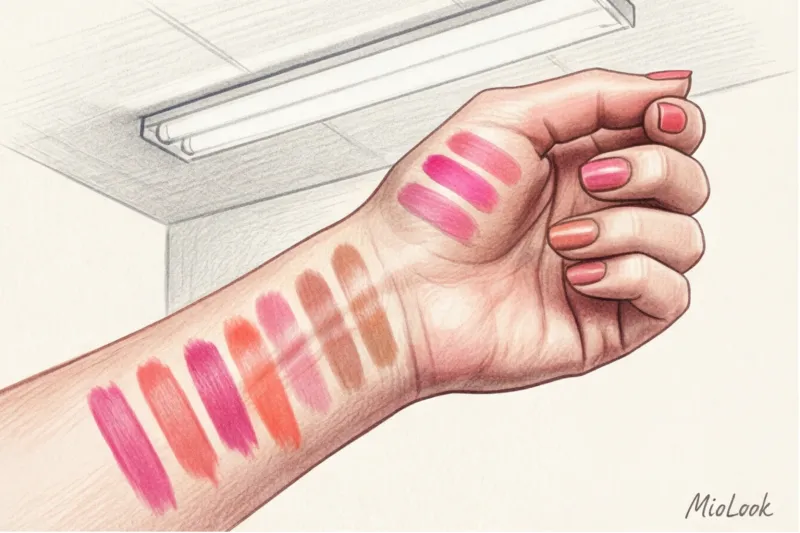
The results are striking: the cool fluorescent lights in the open-plan office turn warm coral shades into a dirty red. And a cheap laptop webcam reduces the contrast of makeup by 20-30%, causing sheer glosses to disappear completely.
Front camera test rule: Never buy a bright lipstick by simply swiping the stick on the back of your hand. The skin on your hand has a different shade and texture than the skin on your lips. Apply the tester to your lips (using a disposable applicator), leave the store for daylight, and take a selfie with the front camera without filters. Then, look at the photo in the shade.
To make the process easier, I always recommend the virtual fitting room feature in the app to my clients. MioLook There you can try on hundreds of makeup shades in advance on your selfie and figure out which undertone makes your skin look porcelain and which highlights dark circles under your eyes, even before you go to the store.

Red Lips and a Business Capsule: The Laws of Status Balance
Red lipstick is the loudest accessory in your look. According to a study by Harvard University in collaboration with P&G, "The Red Lipstick Effect," women with contrasting lip makeup are perceived by colleagues as more competent and confident. But there's a catch: this effect only works against a flawless background.
The business dress code follows a one-piece rule: red lipstick requires a minimalist cut and subdued textures. Pairing bright lips with leopard print or intricate ruffles instantly detracts from your status. The ideal formula: red lipstick, a white, menswear-inspired shirt, a sleek bun, and a flawless complexion.
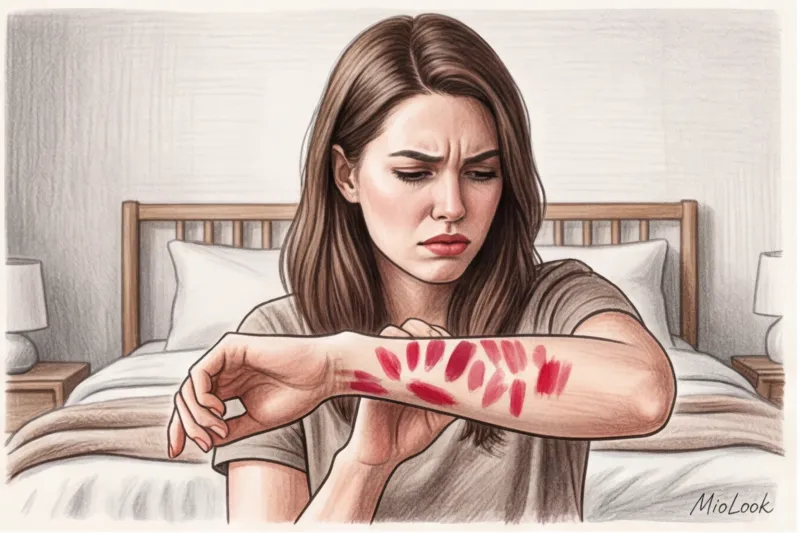
Honest disclaimer: Red lipstick is NOT suitable if you're experiencing a flare-up of acne or rosacea. The sheer red pigment will instantly highlight any blemishes. On such days, it's best to opt for a more subdued nude or emphasize your eyes.
Don't forget about metals. If you've chosen a warm-toned lipstick (tomato), complement it with gold jewelry. If it's cool (raspberry), go with white gold, platinum, or silver. We've written more about how to create these looks in our guide " Business Makeup for Executives: Status and Style ".
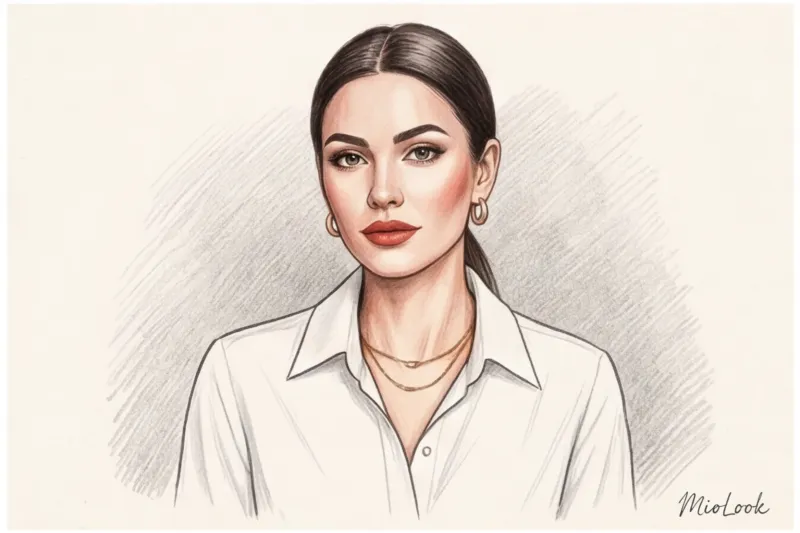
Checklist: 3 Steps to Buying Your Perfect Red
Finding the right red lipstick for your skin tone can be transformed from a lottery into a clear algorithm. Follow these three steps before your next visit to the beauty salon:
- Step 1: White shirt test. Wear a crisp white shirt to the store (or hold a white sheet of paper to your face in the fitting room). This will instantly reveal your true skin temperature and filter out unwanted tones.
- Step 2: Halftone Test. Apply a small amount of lipstick from the tester to the pad of your index finger (where your skin tone is closest to your lip color) and blend it into a light haze on a clean white tissue. You'll immediately see the base color—blue, pink, or orange.
- Step 3: Sync with your wardrobe. Think about the three main basic colors in your closet. If it's dominated by camel, khaki, and warm beige, you absolutely shouldn't choose a cool ruby lipstick; it will ruin the harmony of your look.
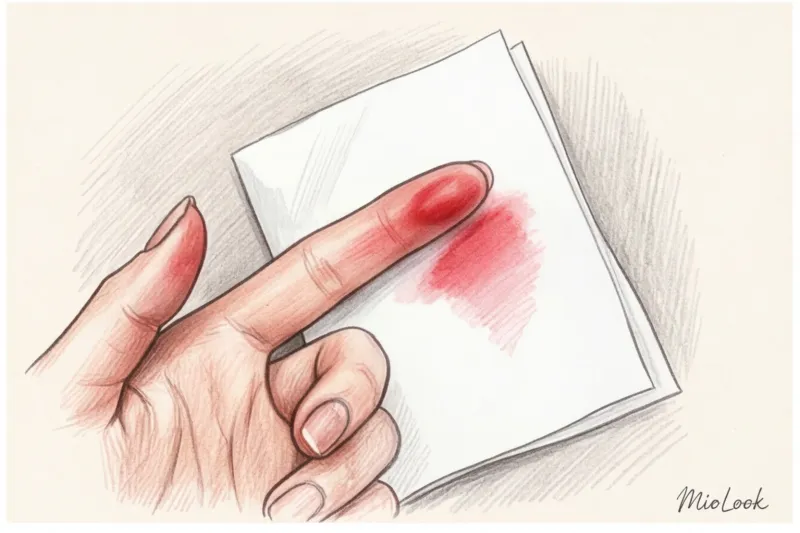
The most important rule I never tire of repeating to my clients is: you wear your lipstick, not your lipstick that wears you. The right red doesn't steal the show. It works like a great spotlight, highlighting your natural facial structure and making your eyes pop. Invest 15 minutes in a napkin test, and you'll find your perfect red that will last for years.