Over 12 years as a stylist, I've created hundreds of capsules, and you know what 80% of my clients complain about? "I bought a new perfume for spring, and it's literally suffocating me." We're used to thinking that florals in perfumery always evoke absolute lightness, youth, and flowing chiffon dresses. But this is a dangerous and very expensive misconception.
Choosing floral fragrances for women It's easy to make a mistake if you rely solely on advertising posters featuring rosebuds. In fact, some members of this family smell heavier and denser than the dense oriental gourmand. We've already discussed the architecture of fragrances in more detail in our The Complete Guide to Fragrance Families: How to Blind Buy Perfume Today, I suggest looking at perfume through the eyes of a stylist: as a wardrobe item with its own weight, texture, and temperature.
Why Floral Fragrances for Women Are Not Just About "Spring and Romance"
According to marketing agency statistics, floral compositions account for approximately 60% of the entire women's fragrance market. This is the largest category and the one that sells best. However, it is precisely this mass appeal that has given rise to the stereotype that any flower in a bottle is a safe, non-committal choice.
Let's turn to Michael Edwards' classification and his famous "Fragrance Wheel." He divides this vast group into several subfamilies: from sheer florals (Soft Floral) to heavy floral-orientals (Floral Oriental). The difference between them is like the difference between a basic white T-shirt made of fine cotton and a tailored tuxedo made of thick wool.
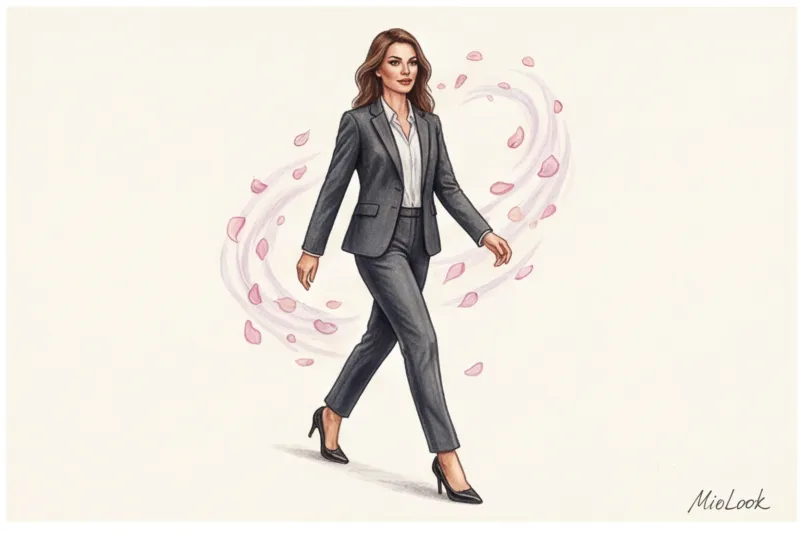
I had a telling case in my practice. A top manager at a major IT company showed up for a challenging negotiation in an impeccable graphite Jil Sander suit, but before leaving, she generously applied a lighthearted fruity-floral "compote." The visual status was shattered by the olfactory dissonance. The scent conveyed the relaxed atmosphere of a beach party, while the clothes demanded rigidity and distance. Perfume is invisible clothing, and it should match the density of your actual wardrobe.
Anatomy of a Flower: From Transparent Watercolors to Heavy Indole
To avoid making mistakes when shopping again, I suggest dividing all floral notes into three easily understandable subgroups. Imagine you're choosing fabric for a suit, not perfume.
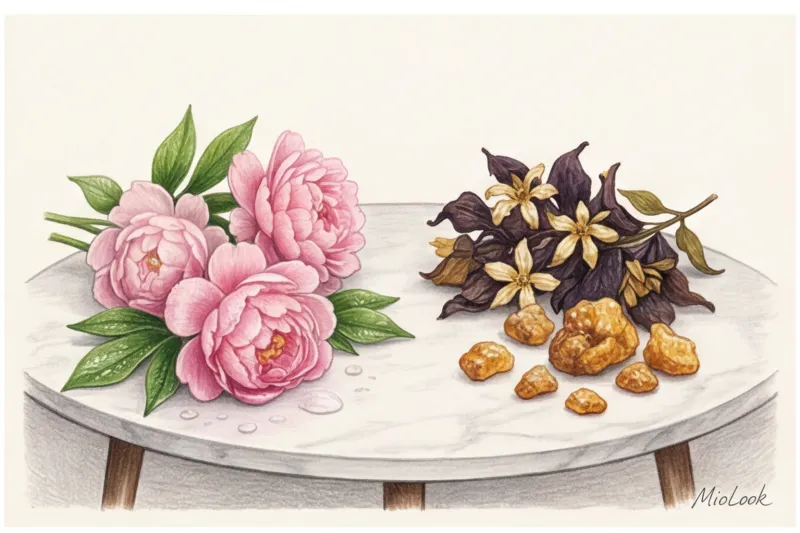
Light and green: peony, lily of the valley, freesia (Perfume silk)
These are tinkling, cool, and moist compositions. They smell of morning dew, cut stems, and a flower shop where a fresh batch of peonies has just arrived. The volatility of modern, light fragrances often comes from the molecule hedione—a synthetic compound that imparts volume and that ethereal, water-color quality to the composition.
What to wear with: This is your fragrance equivalent of a crisp white shirt. These fragrances pair perfectly with smart casual, denim, white cotton (180 g/m² and above), and summer linen suits. They don't require elaborate makeup or heels.
Dense and indolic: jasmine, tuberose, ylang-ylang (Perfume velvet)
Herein lies the main catch. White floral scents are among the heaviest, densest, and most opulent in perfumery. It's a myth that white florals are made for hot summers. Tuberose and ylang-ylang have a creamy, almost predatory sweetness. They fill every space and require air.
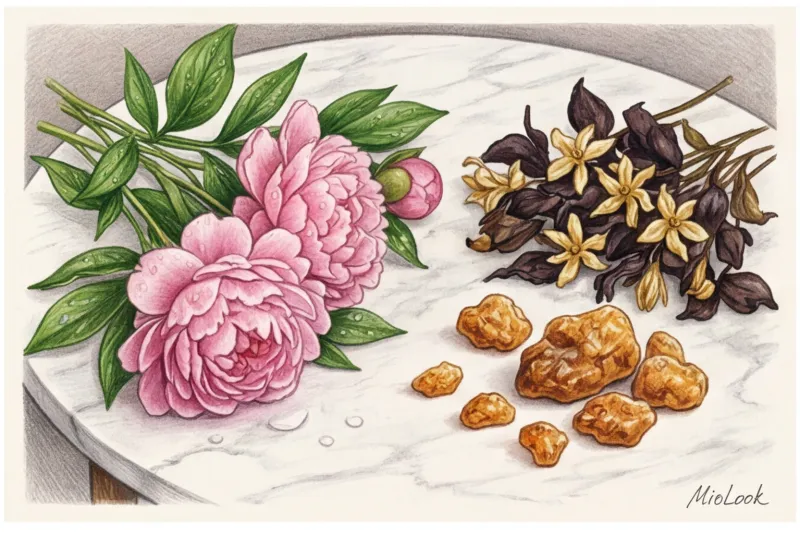
What to wear with: These are evening dresses, thick suiting fabrics, heavy silk and leather. White flowers resonate luxuriously in winter, when the frost "shrinks" their excess sweetness, leaving only a ringing crystal trail.
Powdery: rose, iris, violet (Perfume cashmere)
Dry, cosmetic, slightly retrograde, yet incredibly prestigious notes. Interesting fact: to create the iris note, perfumers use not the flower itself, but its root (orris), which is dried for three to five years. This is why natural iris absolute is one of the most expensive ingredients in the world, surpassing gold in price.
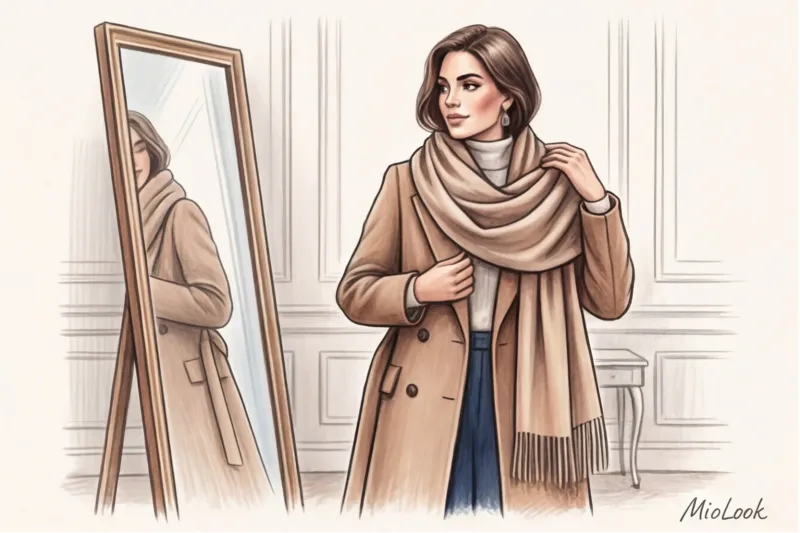
What to wear with: Knitwear, chunky knit sweaters, camel wool coats. Powdery flowers perfectly fit the old-money aesthetic and quiet luxury.
Your perfect look starts here
Join thousands of users who look flawless every day. Digitize your wardrobe and find the perfect perfume to complement every look.
Get access — €0.99 onceBeware of indole: Why does the same jasmine smell like luxury or... like a tray?
If you've ever tested an expensive niche perfume with a jasmine note and discovered to your horror that it smelled something inappropriate (often referred to as "kitty litter"), congratulations, you've encountered indole.
Chemically, indole is an organic compound. The paradox is that it's found in nature in enormous quantities, both in fragrant white flowers (jasmine, neroli, gardenia) and in... decay products. So why do perfumers add it to perfumes?
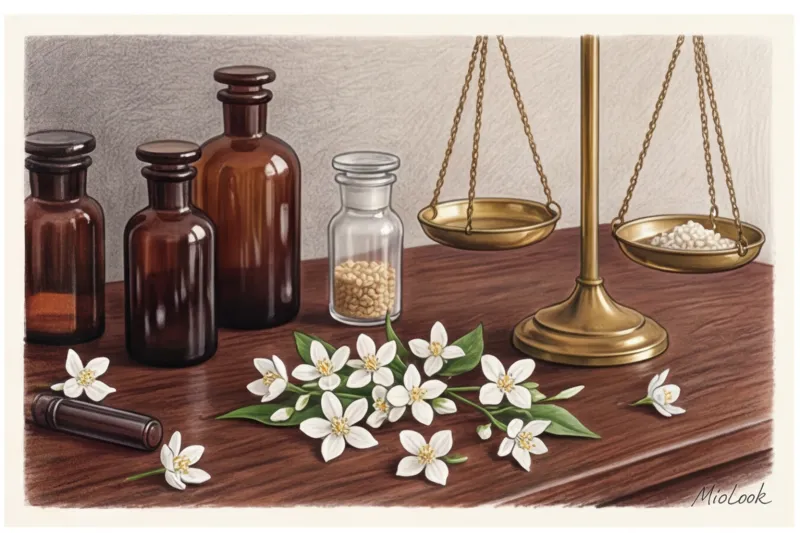
The thing is, absolutely "pure" jasmine, devoid of indole, smells flat, like cheap soap or air freshener. It's the microdoses of indole that give the composition its hypnotic depth, physicality, and sexiness. It makes the fragrance come alive.
When I first tried this complex indolic tuberose at 30°C on vacation, it was a disaster. My hot skin instantly heated the perfume and pulled out all the animalic base notes, missing the floral opening. People around me at the cafe tactfully sat back. But in winter, at -10°C, the same bottle produced stunningly beautiful creamy, icy flowers. The temperature of your skin and the environment is critical for such fragrances.
How to Incorporate Floral Fragrances for Women into Your Business Wardrobe
The office dress code concerns not only the length of your skirt but also the length of your train. The rule of appropriateness states that your perfume should not intrude more than an arm's length into your colleagues' personal space.
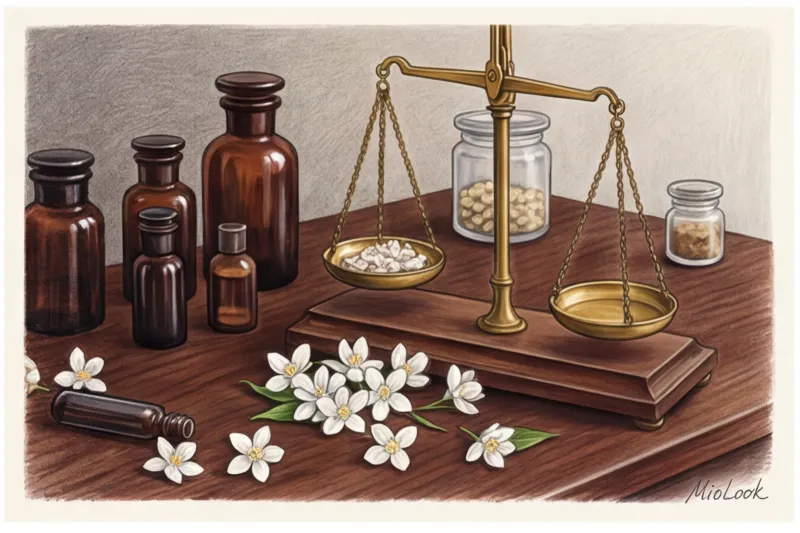
A lingering tuberose or a rich ylang-ylang are an absolute no-no for an open space. They'll give others a headache and ruin your professional image. For work, choose flowers with a different meaning:
- Iris for negotiations: Powdery, dry iris creates an invisible distance. It smells of cleanliness, starched collars, and expensive paper. Perfect for meetings where you need to show status and maintain boundaries.
- Peony and freesia for creative encounters: Light, diffuse flowers are inviting. They convey openness and energy, which works well at networking events or interviews with companies with a casual dress code.
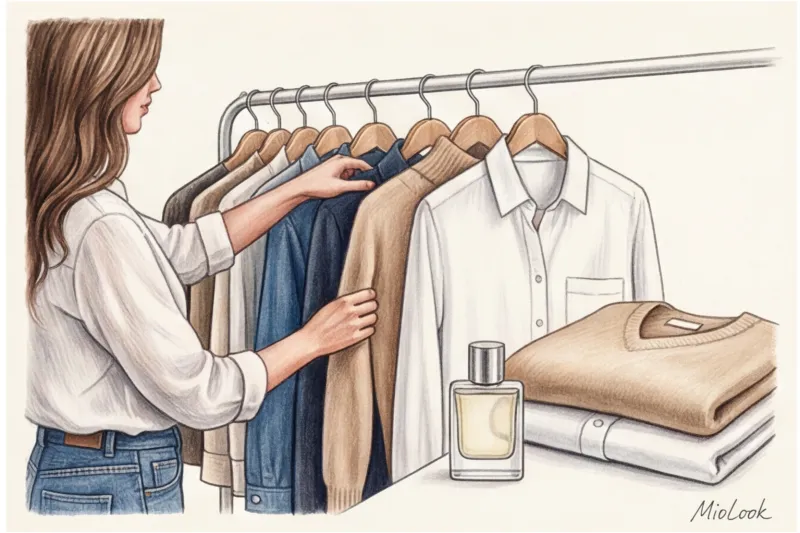
In the appendix MioLook When we help users organize their smart wardrobes, I always recommend creating tags not only for clothes but also for perfume. We virtually "pair" a tailored pantsuit with a bottle of iris powder, and a Friday outfit with jeans and a jacket with a light neroli scent. This saves time in the morning and protects against styling mistakes.
Checklist: How to Test and Buy Floral Perfumes
Buying perfume is an investment. To keep your bottle from gathering dust on the shelf, follow three rules I've learned over years of working with clients' wardrobes.
- No blind purchases of white floral fragrances. The 24-hour rule is essential. Spray the fragrance on your wrist, leave the store, and live with it for 24 hours. You need to see how indole reacts on your skin.
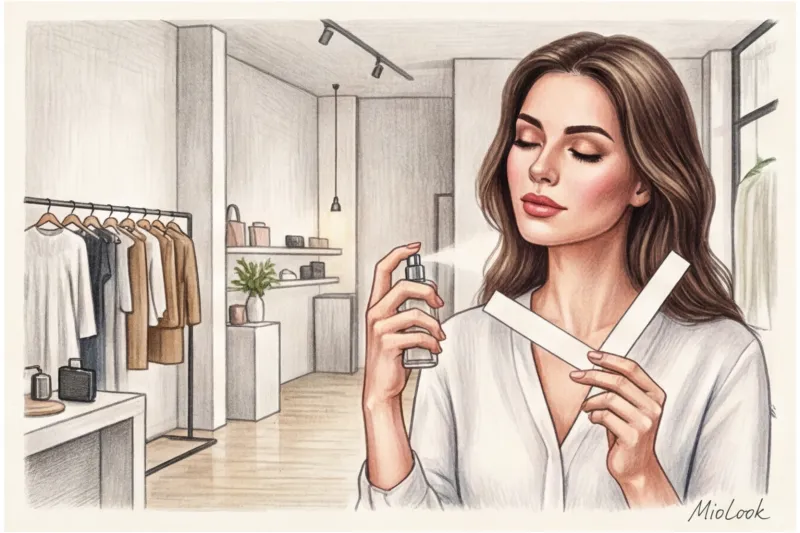
- Don't trust the blotter. The paper strip in the store is a lie. Paper doesn't have a pulse, a temperature of 98.6 degrees, or sebum (sebum). What sounds like a delicate rose on the blotter can turn into a heavy musk on hot skin.
- Change the application point. If you really want to wear a thick jasmine scent during the day, avoid applying it to your neck or behind your ears (you'll suffocate yourself). Spray the fragrance under your knees or on the hem of your skirt. But there's an important caveat: this hack absolutely does NOT work with oil-based perfumes or extracts—they will leave permanent greasy stains on the fabric. Use only alcohol versions (Eau de Parfum or Eau de Toilette) and spray from a distance of 20-30 cm.
Ready to get started?
Try the MioLook free plan—no commitments required. Organize your looks and find the perfect combination in just a few clicks.
Get access — €0.99 onceSynthetic vs. Natural: Is It Worth Paying Extra?
There's a myth that persists among perfume lovers: "Natural ingredients are luxurious and long-lasting, while synthetics are cheap." This is fundamentally untrue, especially when it comes to floral fragrances.
Let's look at the numbers. To obtain just 1 kilogram of jasmine absolute, approximately 8 million flowers must be hand-picked at dawn, before the sun evaporates the precious essential oils. The cost of such raw materials runs into tens of thousands of dollars. If modern perfumes consisted solely of natural extracts, a bottle of perfume would cost as much as a used car.
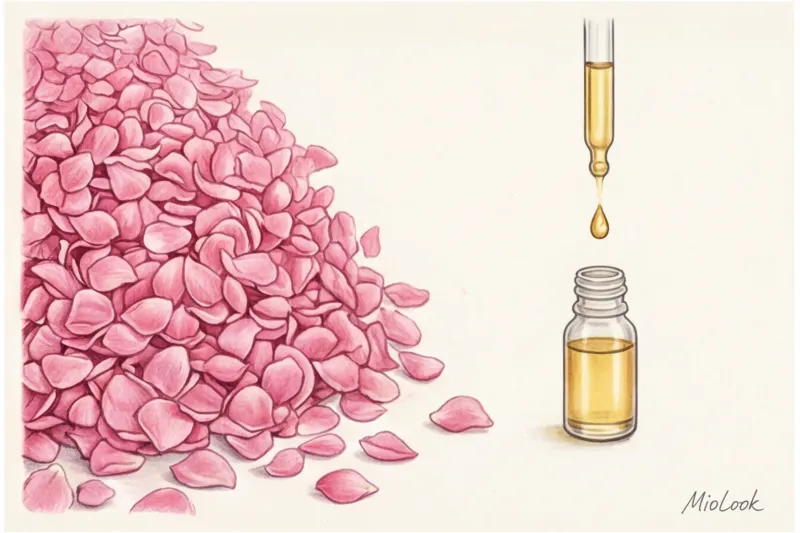
Furthermore, natural ingredients are unstable and often cause severe allergies. According to IFRA (International Fragrance Association) standards, many natural extracts (including certain types of oakmoss and even rose absolute) are strictly limited or prohibited for use in high concentrations due to the risk of dermatitis.
Synthetic molecules (aldehydes, modern musks, and even hedione) aren't an attempt to cut corners. They're an innovative framework that makes floral fragrances for women long-lasting, safe, and multifaceted. Chemicals make it possible to recreate the scent of lily-of-the-valley or lilac, which are essentially impossible to extract essential oil from using traditional extraction methods.
Next time you reach for a new bottle, don't think of flowers as a simple spring whim. Treat them as a complete fabric of your look. Consider the density, test the reaction to skin temperature, and remember: sometimes a single drop of the right powdery iris can say more about your professionalism than a premium brand watch.