According to statistics, the average woman has about six bottles of perfume on her vanity. But if you ask her which ones she uses regularly, the answer usually boils down to one or two. The rest gather dust, waiting for a "special occasion" or simply annoying with their obsession. In 12 years of working in fashion journalism and styling, I've realized one thing: we meticulously assemble capsule wardrobes, calculate proportions and texture combinations, but completely forget about the invisible layer of our look. If you're wondering, How to create a perfume wardrobe so that it works for you, and does not live a separate life, it is time to change the approach.
In this article, we'll abandon the banal distinction between "day and evening." We'll build an olfactory base according to the laws of style: linking notes to the texture of fabrics (silk, cashmere, leather) and integrating them into your look. And if you're still confused about the difference between chypre and fougère, we've covered this in more detail in our a complete guide to perfume families.
Why the concept of "signature scent" is hopelessly outdated
The idea of "your one and only scent," by which you'll be recognized even with your eyes closed, is a beautiful but hopelessly outdated 20th-century marketing myth. It was invented in an era when perfume cost a fortune and was bought once a decade.
Wearing the same perfume year-round is like wearing the same cashmere coat in both freezing winter and the July heat. Fragrance should be an adaptive accessory, not a uniform.
"When you wear the same scent every day, your brain begins to perceive it as white noise. You stop hearing it and start applying more and more, literally 'dousing' yourself in perfume, suffocating those around you," Jean-Claude Ellena, former head perfumer for Hermès, rightly noted.
This phenomenon is called olfactory blindness. To keep the receptors sensitive, scents need to be alternated. That's why the concept of a conscious fragrance wardrobe isn't a whim for perfume enthusiasts, but a hygienic and stylistic necessity.
Access to MioLook for €0.99 — one-time payment
A smart AI stylist will select the perfect look, taking into account every detail of your style.
Get access — €0.99 oncePerfume Wardrobe: How to Create the Perfect Base
A perfume wardrobe is a system, not a chaotic collection of beautiful bottles bought on the spur of the moment. Michael Edwards, creator of the legendary Fragrance Wheel, proved that our preferences rarely extend beyond one or two related fragrance families. If you love woody notes, you're unlikely to be genuinely pleased by a cloying gourmand, no matter how fashionable it may be this season.
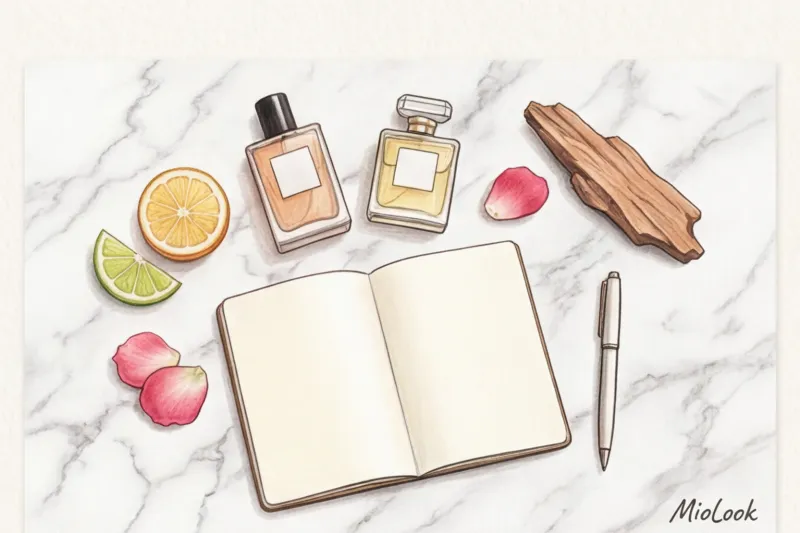
In the appendix MioLook We often pair a perfume with a specific client's clothing capsule. And experience shows: you don't need dozens of bottles to get started. Three basic needs are enough.
The Three Bottle Rule: A Minimalist Start
- White Shirt Scent: A scent of purity and focus. It features aldehydes, light citrus, and notes of freshly washed cotton or green tea. It doesn't trail for three meters, sits close to the skin, and is perfect for the office, business meetings, or days when you just want to smell like "you after the shower."
- Second Skin (Skin Scent): Scents for relaxation and weekends. These include molecular perfumes (Iso E Super, ambroxan) and body musks. They blend with your skin chemistry, creating an aura of comfort. Perfect for brunch with friends or a lazy Sunday in your favorite knit.
- Statement-aroma (Power Scent): Your personal manifesto. Woody, rigorous chypre, leathery, or deep spicy notes. This is the scent for evening outings, important meetings, or those days when you need to feel 100% confident. It creates distance and asserts status.
Synchronization: How to Match Perfume to Fabric Texture
Perhaps my favorite stylistic technique, one that few people consider, is the physics of how notes unfold across different materials. A year ago, I had a client whose flawless date night look (a flowing pearl-toned silk slip dress) was mercilessly ruined... by a heavy, dense Montale oud.
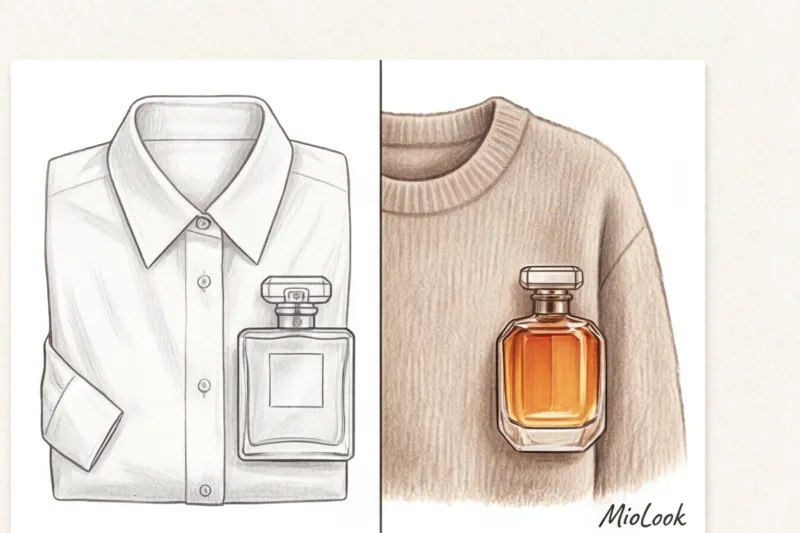
A profound cognitive dissonance arose: the eyes saw the fragility and coolness of silk, but the nose detected a heavy, oriental density. We replaced the oud with a cool, powdery iris, and the image instantly took shape.
According to the archives of the Osmothèque in Versailles (the world's main repository of perfume formulas), natural fabrics can retain base notes for up to several weeks, gradually revealing them, while synthetics often distort the sound of a perfume, making it "flat."
Silk, cotton and linen: the scents of cleanliness and coolness
Smooth, flowing, or delicate textures call for equally smooth and ethereal fragrances. Heavy gourmands (praline, rich vanilla, caramel) sound vulgar when paired with light chiffon or austere poplin.
White flowers (jasmine, lily of the valley), aquatic, and green notes are ideal here. Dry, slightly rough linen resonates beautifully with dried herbs—classic fougères, vetiver, and bitter citrus.
Wool, cashmere and leather: warming textures
Loose, fuzzy fabrics trap heavy perfume molecules. A chunky cashmere sweater or tweed jacket perfectly "catch" and softly release resins, amber, tonka bean, and sandalwood, lasting long.
Thick, smooth leather (biker jackets, trench coats) requires a strong fragrance. Leather jackets + tobacco, alcoholic (rum, cognac), or spicy notes = a perfect stylistic match.
Your perfect look starts here
Join thousands of users who look flawless every day with MioLook.
Get access — €0.99 onceIntegrating fragrances into your capsule wardrobe
Scent is a powerful tool for impression management. If you've assembled a strict business capsule wardrobe but use a strawberry-and-cream scent, you're destroying the Expert or Ruler archetype you were trying to build with your tailoring.
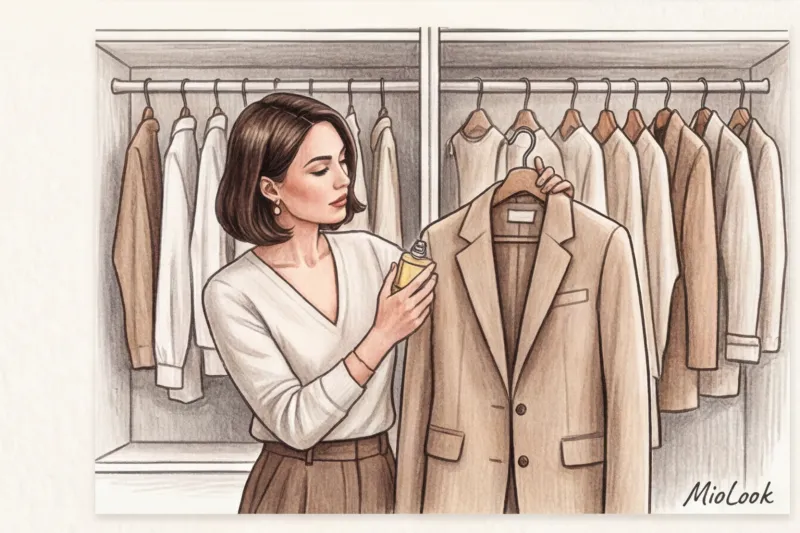
Try to link specific bottles to your main life scenarios:
- For interviews or difficult negotiations: A formal pantsuit (wool/silk) + classic chypre (oakmoss, bergamot, patchouli). Chypres are cool, they don't flirt with the person you're talking to, but rather establish a professional distance and convey status.
- For Friday casual at the office: Jeans, a white T-shirt, a blazer, and a woody-citrus scent. It's put-together, but not overly harsh.
Important limitation: This advice won't work if your skin chemistry conflicts with certain notes. For example, on "hot" skin, subtle citrus notes burn out within 10 minutes, and some musks can give off an unwashed body odor. Always test the fragrance on yourself, not just on fabric.
Common Mistakes: How to Avoid Buying "Another Unnecessary Bottle"
Why are our shelves overflowing with perfumes we don't use? Because we're buying them incorrectly. The biggest enemy of a perfume wardrobe is emotional duty-free shopping.
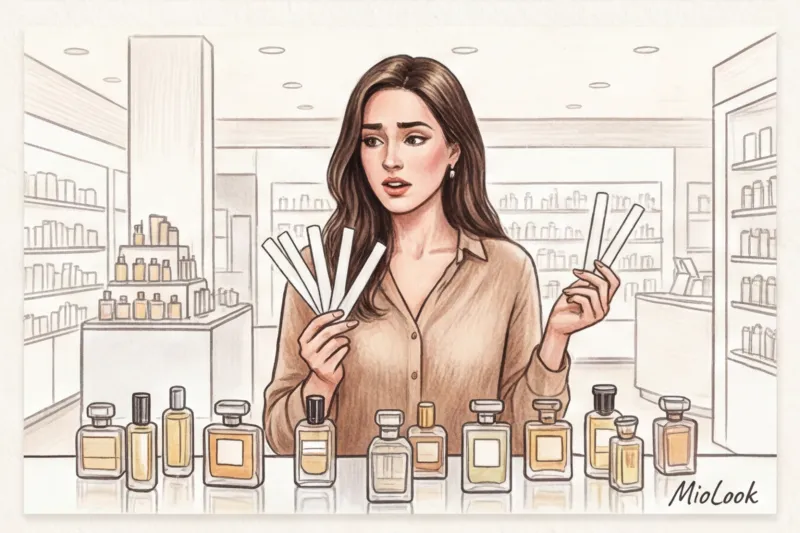
The physics of fragrance are inexorable: the top notes (usually sparkling citrus and light fruits), which are meant to "sell" the bottle in the first few seconds, evaporate within 15-30 minutes. Buying a perfume based on its first notes is like buying a house based only on the doormat. The actual scent you'll be living with all day (base notes of wood, musk, and resins) will only reveal itself after 1.5-2 hours.
The second fatal mistake is testing only on a paper blotter. Paper is cold and dead. It has no temperature, pH, or scent of its own. The perfume will smell completely different on your neck.
Checklist: Auditing and Assembling Your Olfactory Wardrobe
Ready to get organized? Here's the step-by-step plan I give my clients. Do it this weekend.
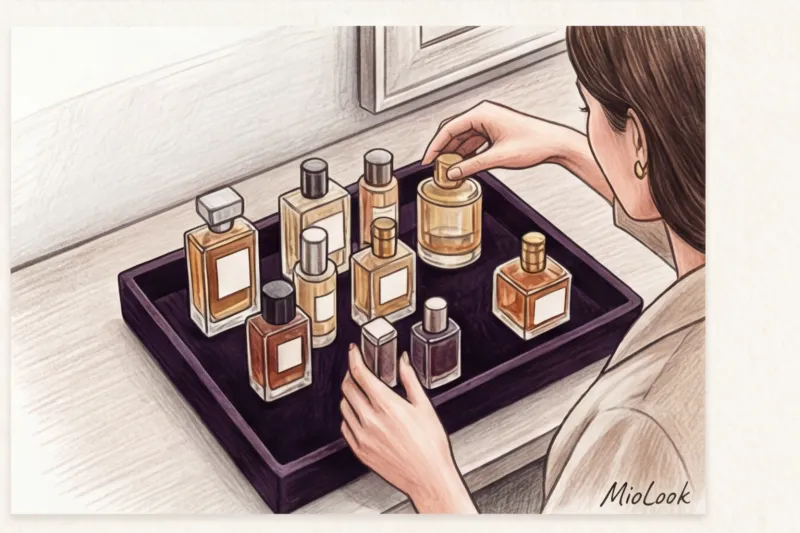
- Inventory. Take out all your bottles. Ruthlessly discard any that have changed color, become cloudy, or smell like rancid oil (they've oxidized). Give away any that give you headaches to your friends.
- Lifestyle analysis. Draw a diagram of your time: what percentage does the office, home, gym, dates, and theaters take up?
- Search for gaps. Compare the diagram with the remaining bottles. It often turns out that a woman spends 80% of her time at work with a strict dress code and outings with children, while five heavy evening fragrances with tuberose and incense sit on the shelf.
- The rule of decants. Before buying a full-size bottle for $200, order a decant (sample) of 2-5 ml. Wear it for three days: in different weather conditions, with different outfits. If your hand naturally reaches for it on the fourth day, it's the one for you.
Ready to get started?
Try the MioLook plan for free—no commitments, organize your wardrobe in one click.
Get access — €0.99 onceSummary: Fragrance as your invisible accessory
Perfume is the finishing touch that ties your entire look together like an invisible thread. Without it, even the most expensive suit can feel incomplete, but the right scent can elevate even a basic T-shirt from a mass-market store.
Stop searching for that one scent. Start treating your perfumes as utilitarian and creative as you do your clothes. Audit your shelf today, eliminate visual and olfactory noise, and keep only those bottles that work for your goals. And to align your new fragrance habits with your actual wardrobe, upload your favorites to MioLook — and let technology help you create impeccable style every day.