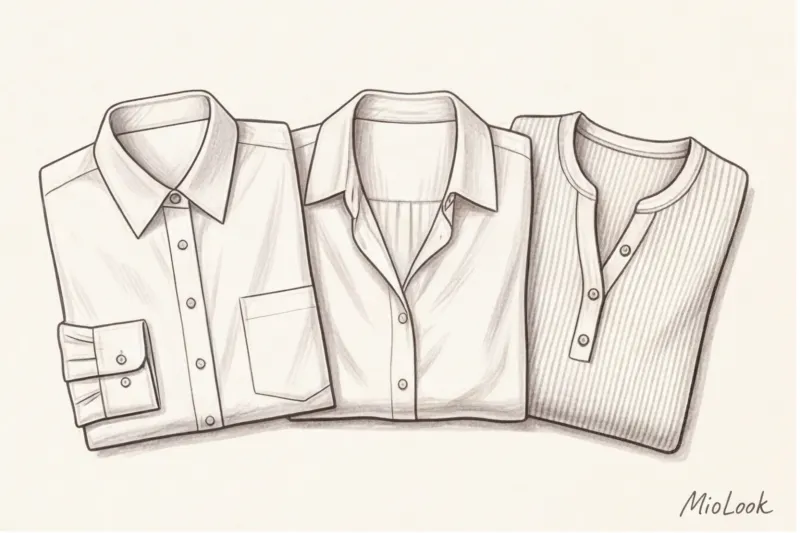
The Myth of the Universal Database: Why Standard Lists Don't Work
You open a glossy magazine or fashion blog, and you're almost certainly met with yet another definitive list: "10 Basic Items Every Woman Should Have in Her Closet." Sound familiar? A white shirt, a beige trench coat, straight blue jeans, a pencil skirt. After 12 years of working as a stylist and studying textiles, I've realized one important thing: this list is the biggest fashion illusion of our time. It works perfectly. basic wardrobe by body type is never based on blindly copying other people's average checklists.
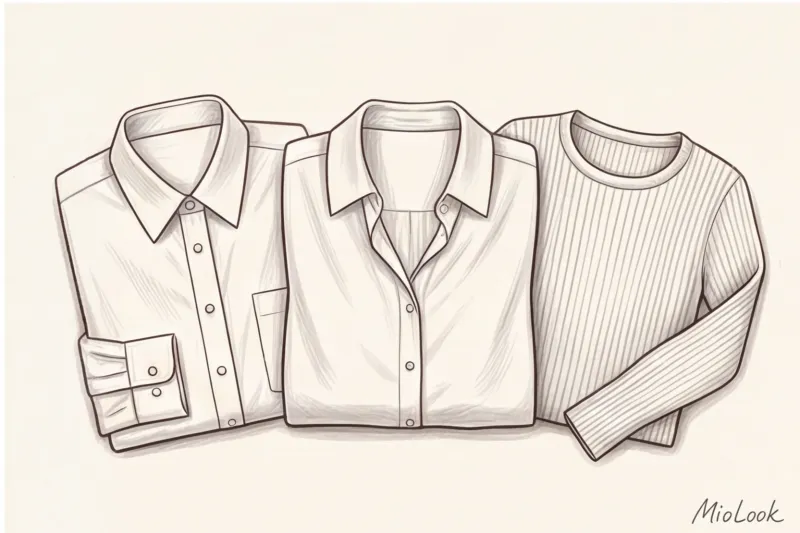
Take, for example, a classic white shirt made of stiff cotton poplin. Magazines promise that this investment (say, in the €100-€150 range) will save any look and last for years. But let's face it. If you have a linear figure with straight shoulders, thick poplin will create a beautiful, graphic frame. But what if you have pronounced curves, a full bust, or sloping shoulders? The same shirt will be too big, add bulk, and bulge unattractively at the back. For one woman, it's a style staple; for another, it's wasted money and daily discomfort.
A true basic isn't a list of specific styles. I put it this way: the right basic wardrobe is a seamless blend of your individual body shape and the physical properties of the fabric. A garment shouldn't just hang beautifully on a hanger; it should dynamically interact with your body. And this principle is absolutely universal—from business suits to loungewear (if you're putting together a capsule wardrobe for your home, I recommend checking out our guide). the best fabrics for home wear ).
The myth of universality directly fuels the global environmental problem of overconsumption. According to research by the British organization WRAP (2022), more than 60% of discarded clothing ends up in landfills not because of a loss of appearance, but because of poor fit and discomfort.
We buy must-have items, realize they're uncomfortable, hang them in the back of the closet, and then throw them away. Furthermore, clothes that aren't tailored for your body shape literally fall apart faster. Why do clothes rip and lose their shape so quickly? It's not always a matter of poor quality manufacturing.
If your body geometry and the pattern don't match, the fabric experiences enormous, unnatural tension. For example, if jeans aren't sized for your leg width, excess friction occurs in the inner thigh seams, and the denim wears out within a couple of months. If a jacket's armholes don't accommodate your back width, every arm movement will pull the seams from the inside. And the constant tension in the thigh area causes the elastane fibers to simply snap, creating unsightly "ripples" in the fabric.
To break this cycle of bad purchases, you need to take a close look at your current closet. One of my clients recently digitized her clothes through MioLook app And she was surprised to discover that she only regularly wore 20% of the clothes—those whose fabric density matched her natural curves. The remaining 80% were those same "universal" tips that didn't work for her.
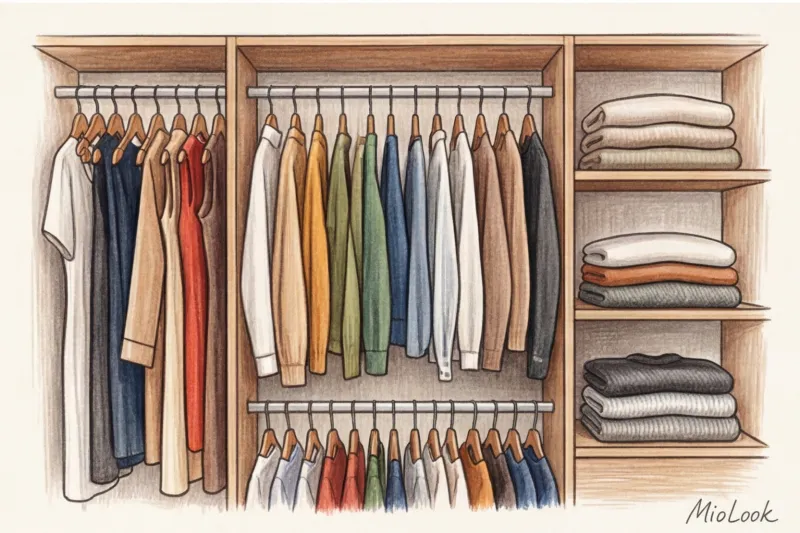
Before buying another foundation from an influencer's list, ask yourself one practical question: how will this particular texture behave around my curves or angles? Understanding the physics of fabric is your most important tool.
Body architecture and tissue physics: a new perspective on capsule design
Have you ever noticed how the same straight jacket pattern looks like a €500 tailoring masterpiece on one woman, but bulges like a cardboard box on another? The problem is rarely in the pattern itself. As a textile specialist, I always begin my work with clients with one fundamental rule: the cut is secondary, the fabric's physics is primary.
In materials science, there are three pillars that determine how a basic garment will fit your figure: weight , density And plasticity (drape) Weight pulls a garment downward, density determines the thickness of the layer and its ability to hold its shape, and pliability determines how the material forms soft folds. Imagine a classic white oversized shirt. If you make it from heavy, flexible silk crepe, it will flow softly along the body, visually elongating the silhouette. The same shirt made from dense, shape-resistant cotton will stand upright, visually adding a few extra pounds to the volume. This isn't the magic of visual illusions; it's pure physics.
Clothing is an architectural project, where your body is the foundation and fabric is the building material. You can't build a flexible bridge out of bricks, just as you can't create a flowing silhouette out of thick poplin.
Here we come to the most important concept - dynamic landing In the fitting room, we most often evaluate statics: standing up straight, pulling in our stomachs, and looking in the mirror. But clothes are alive in motion. Dynamic fit is how the fabric behaves when you walk, sit at your desk, or raise your hand to get a cup of coffee. Research into clothing ergonomics (in particular, the Hohenstein Institute's 2022 report) shows that 70% of discomfort and premature wear are due to improper dynamic tension distribution in the fabric. One of my clients constantly complained that the seams on the back of her basic office shirts were tearing, even though the size was perfect. The cause was the wide shoulder width and the choice of a very stiff cotton. By replacing the material with stretchy Tencel, we solved the problem permanently.
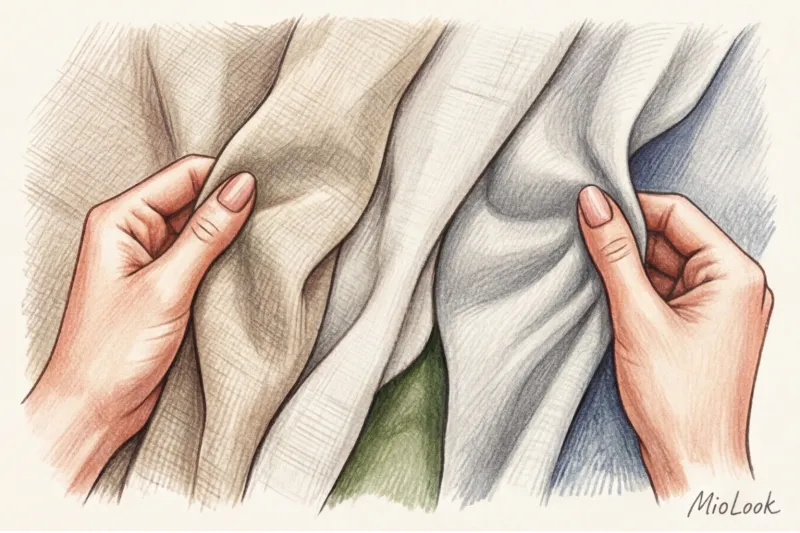
When choosing eco-friendly fabrics for your wardrobe basics, it's crucial to match their properties to your body shape. If you have a curved figure (rounded hips, a noticeable difference between your waist and pelvis), eco-friendly lyocell (also known as Tencel) is your best friend. Thanks to its smooth fiber structure, Tencel has phenomenal fluidity. It literally flows around curves, falling down without creating excess volume. However, stiff organic cotton or dense linen (linen canvas) behave differently: hitting the widest point of the hip, they fall down in a vertical line, visually widening the figure to that maximum point. For rectangular figures without a defined waist, dense linen is a lifesaver—it will create the missing architectural volume.
Rigid vs. Flexible Fabrics: Which to Choose?
To avoid mistakes when buying basic clothing, I recommend dividing all fabrics into two broad categories. Understanding which one suits your body type will save you hundreds of euros in poor purchases.
The first category is - shape-stable (rigid) fabrics These include classic denim with a 12-ounce weight, gabardine, and cotton poplin. Their main feature is that they create their own independent frame. This is ideal for linear figures (H-shaped silhouettes). If your figure lacks natural curves or a defined shoulder line, a stiff fabric will skillfully "draw" them. A jacket made of heavy gabardine will create strict geometry even on the most sloping shoulders, and straight-cut jeans made of 100% cotton will elongate the leg line, concealing any unevenness.
The second category is - fluid and plastic fabrics These include silk, cupra, high-quality viscose (such as EcoVero), and fine merino wool. They don't hold their shape on their own; their job is to respectfully follow the lines already created by nature. They're an absolute must-have for curved figures (X- and A-line silhouettes). Instead of trying to "pack" the bust and hips into a rigid shell that will inevitably wrinkle and bulge at the back, flexible fabrics will delicately contour the silhouette.
Analyzing these parameters requires a certain amount of observation. If you're unsure which textures are right for you, you can entrust this task to algorithms. By uploading your parameters to MioLook smart wardrobe , you'll receive not just a list of basic items, but also precise fabric recommendations that will ensure a flawless, dynamic fit for your specific figure.
Access to MioLook for €0.99 — one-time payment
A smart AI stylist will select the perfect look.
Get access — €0.99 onceBasic wardrobe for figures with a dominant lower half (A-line silhouette)
Every other client with a pronounced A-line silhouette begins our consultation with the same phrase: "Sofia, how can I hide my hips?" My answer is always categorical: we won't hide anything. A successful styling strategy isn't based on concealment, but on creating the right balance through texture and top design.
If the lower body has natural volume, trying to squeeze it in with thick black fabrics only accentuates the disproportion. Instead, we shift the visual weight upward, creating a geometric counterbalance.
Basic tops: focus on structure
Your capsule wardrobe should be based on pieces that create a defined frame in the shoulder area. Forget shapeless, thin knits—they'll hang limply, accentuating the sloping shoulders often found in pear-shaped individuals. Look for dense fabrics that maintain the shoulder's shape: shape-stabilizing cotton, gabardine, or thick double-knit merino wool.
- Boat neckline (bateau): Optically widens the collarbone line, physically balancing the width of the pelvis. This is a classic French styling technique.
- Accent hardware: Large metal buttons on a cardigan, epaulettes on a trench coat, or contrasting details on the collar draw the attention of the interlocutor to the upper third of the silhouette.
Basic Bottoms: Fluidity Instead of Stiffness
It's a paradox, but stiff fabrics are often the enemy of full hips, as they feel stiff and add extra inches to your movement. Your best investment (in the €80–€150 range) will be flowy palazzo pants made of Tencel. This material has a unique property: it's heavy, so it falls straight down, not clinging to the widest part of the leg, yet it's incredibly flexible in movement.
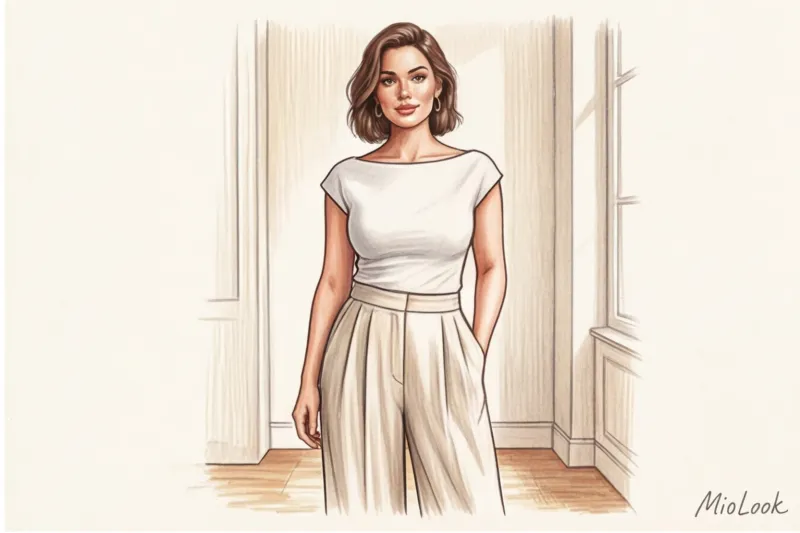
The second essential investment is A-line skirts, cut on the bias, in thick silk or high-quality viscose. A 45-degree cut to the grain allows the fabric to flow smoothly around curves without creating horizontal creases in the crotch area. To maintain the formula for perfect proportions, I recommend digitizing your best outfits through the "smart wardrobe" feature in MioLook The neural network will help visually assess how the architectural top changes the geometry of the entire image.
A sore subject: how to prevent jeans from wearing out
The most common technical problem with A-line jeans is the notorious "chub rub." Customers often complain that premium jeans last a maximum of one season. The mistake stems from a blind love of skinny fits and high elastane content for the illusion of comfort.
As a textile expert, I'll share the key rule for choosing denim for your body type:
Look for a twill weave with a distinct diagonal rib and a minimum weight of 12 ounces (oz). The elastane content should not exceed 1–2%.
Why is this critical? Research by the Textile Institute (2022) proves that elastomer threads lose up to 40% of their strength under regular friction combined with body temperatures above 36°C. Cotton is a durable fiber, while polyurethane (elastane) literally melts and tears under the strain of stepping. The more stretchy jeans are, the faster they will wear out where your thighs meet. Choose straight-leg or slightly flared styles made of stiff denim: they will fit slightly looser in the saddlebag area, minimize seam tension, and save you money.
Capsule for figures with a dominant upper body (V-silhouette)
Analyzing the wardrobes of hundreds of clients, I discovered a paradoxical pattern: women with a V-shaped silhouette (pronounced shoulders and narrow hips) are more likely than others to try to "disguise" their upper body in stiff, oversized jackets. But the laws of visual physics are inexorable—by adding structural volume where there's already a dominant feature, we only make the structure heavier. The strategy for an inverted triangle should be the exact opposite: maximum softening of the shoulder line and creation of architectural volume in the lower third.
Let's look at the mechanics of how a top fits. If you're wearing a classic basic shirt with set-in sleeves, the shoulder seam should line up perfectly with the knuckle. If you have broad shoulders, this seam inevitably creeps up toward the neck. What's happening from a textile engineering perspective?
Tension in the grain line disrupts the natural balance of the fabric. Horizontal creases form in the armhole area due to overstretching, and microfiber tears in this area significantly reduce the lifespan of the garment. This is a classic example of how poor cutting can ruin a material.
That's why the basic tops for your capsule should be built on a foundation raglan sleeves. Its diagonal seam, running from the collarbone to the armpit, utilizes the fabric's flexibility along the bias cut. A raglan has no fixed point on the shoulder, so the material dynamically adjusts to your width without any creasing or tension in the threads. The optimal fabrics for this style are fluid and soft: dense silk (from 19 momme) or fine cashmere. Be sure to include a V-neckline to elongate the vertical line, and categorically avoid stiff shoulder pads on jackets and blouses.
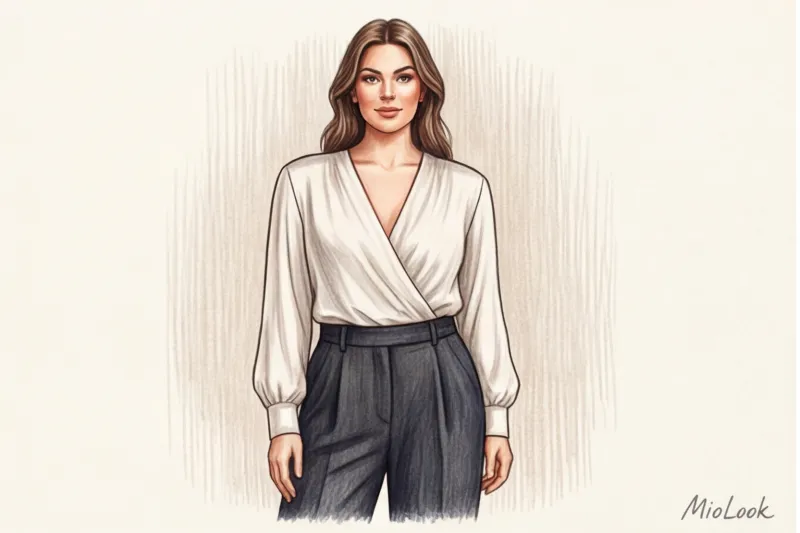
If we're going for a streamlined top, the bottoms should be a solid foundation. Basic bottoms for this figure require a solid feel. Your ideal choice is structured trousers with pleats at the waist (darts) made of heavy wool suiting (with a fabric weight of at least 300 g/m²). Darts create the necessary 3D volume at the hips, geometrically balancing the shoulder girdle. For denim, opt for rigid, straight-leg jeans made of 100% cotton without added elastane. They create a clear column of legs without clinging to a narrow hip. High-quality, heavy denim or wool from mid-range brands typically ranges from €90–€150, but these are essentials that won't lose their shape season after season.
Another crucial investment for a V-neck is quality knitwear. Why? ribbed merino wool Is rib knit your best friend? The secret lies in the knit structure. Rib knit works like a textile accordion: it gently unfolds across the broad shoulders without adding a millimeter of extra bulk, and gathers naturally at the narrower waist. Unlike plain knit, which often hangs in a shapeless "box" from the shoulders to the hips, rib knit made of fine merino wool provides an anatomical fit without the taut drum effect. To easily find these perfect combinations of textures and proportions for your looks, I recommend using smart styling feature in MioLook.
Try MioLook
for free
Start creating perfect images with the help of artificial intelligence
Get access — €0.99 onceWardrobe Essentials for Curved Figures (X-Silhouette/Hourglass)
The physics of fabric is merciless when it comes to irregular proportions. If you have a pronounced curved figure (an X-shaped silhouette or the classic hourglass shape), you're probably familiar with the drumroll effect: the buttons on your shirt seem to fly off with a deep breath, and you can easily fit two fists into the waistband of your jeans. This colossal difference in measurements between your waist and hips (or bust) makes buying ready-to-wear clothing a real challenge, and a standard wardrobe based on your body type often becomes a series of compromises.
As a textile expert, in such cases I always turn to the history of French tailoring. In the 1920s, the great Madeleine Vionnet revolutionized the fashion industry by inventing the bias cut. bias cut ). Fabric cut at a 45-degree angle to the grain grain, thanks to gravity, acquires a unique elasticity even without the addition of elastane. Midi skirts and lingerie dresses made of silk or thick viscose, cut on the bias, are an absolute must-have. They gently hug the hips without creating stress in the seams, and naturally taper at the waist, contouring to the body's anatomy.
Besides bias-cuts, wrap dresses, which allow for millimeter-by-millimeter adjustments, and suits made of Milanese knit (punto di Roma) should be your everyday uniform. Unlike thin jersey, which treacherously highlights the slightest unevenness in underwear, the dense knit of punto di Roma works like soft armor: it perfectly holds the garment's structure, doesn't stretch out at the elbows and knees, and yet stretches precisely where needed.
Now, on to the most pressing issue: denim and structured trousers. Forget the endless search for "those jeans" that fit perfectly everywhere. The stylist's golden rule: Always buy a garment according to the measurement of the widest part (hips) and have the waist taken in by a good tailor.
Many of my clients initially consider a trip to the tailor a waste of time. But from a conscious consumer perspective, creating additional waistband darts is the most eco-friendly and cost-effective investment in your wardrobe. Waistband alterations cost an average of €15–€30, but this surgical intervention will save €100–€150 trousers from sitting idle on the shelf. A perfectly fitted garment will last for years, reducing your personal carbon footprint. By digitizing your capsule wardrobe MioLook app , you will clearly see: the indicator cost-per-wear (the price per one-time purchase) of customized trousers is always several times lower than that of store-bought standard ones.
With pronounced bends, the stress on the hardware doubles. Regular plastic zippers and thin threads on buttons are the first to give way, rendering the garment unusable.
Pay close attention to technical details when purchasing. Choose trousers exclusively with metal zippers (such as YKK or Riri) and buttons secured with a special metal shank button—these have the necessary play and better withstand the radial tension of the waistband. If a fitted dress has a row of buttons, be sure to check whether the placket is reinforced with interlining or grosgrain tape on the inside. If not, the pressure of the fabric's volume will cause unsightly ripples within the first few hours of wear.
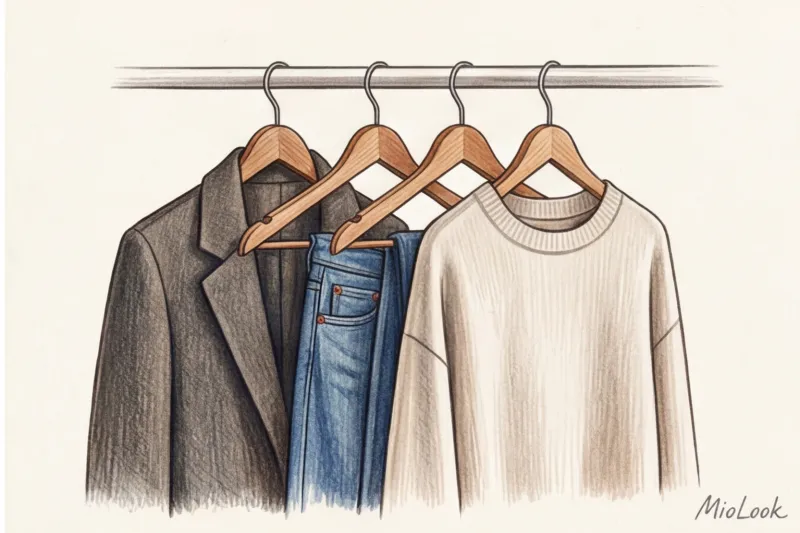
Basic capsule for linear and rectangular shapes (H-silhouette)
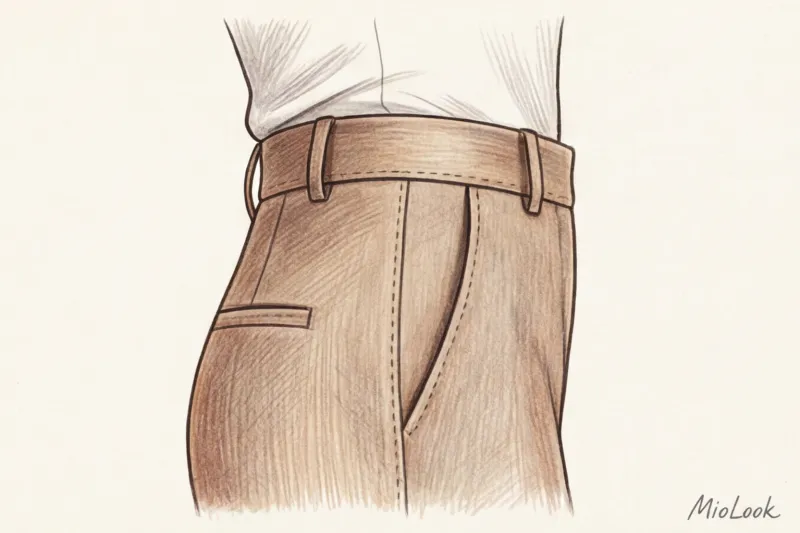
In the 1990s, designers like Jil Sander and Calvin Klein demonstrated to the world that the absence of pronounced curves isn't a flaw, but the perfect canvas for pure, intelligent design. While the fluidity of fabric is crucial for the hourglass figure discussed above, the physics of materials here demands a completely different approach.
Collecting basic wardrobe by body type For an H-shaped figure, you make one of two strategic decisions. The first is to use dense, architectural fabrics to artificially create shape and a clear geometric framework. The second is a conscious embrace of absolute normcore and minimalism. The linear figure doesn't clash with voluminous pieces at all, allowing you to wear oversized, masculine pieces with that aristocratic casualness often unattainable by other body types.
Your main allies in the upper section are pieces that can hold their shape regardless of your body's contours. A straight-cut jacket made of shape-resistant wool is an ideal investment (look for at least 80% densely twisted yarn and check for a stiff interlining on the fronts). Another essential basic top is a shirt made of heavyweight Oxford cotton.
Here I'd like to share a professional secret of fabric buyers. How can you tell in a store that a stiff Oxford shirt won't develop a messy network of wrinkles after an hour of wear? Perform the "squeeze test." Take the edge of the shirt and squeeze the fabric tightly in your fist for 10 seconds. Release and run your palm over it. If the creases remain deep and sharp, the cotton is overdried or has been cheaply processed. If the fabric springs back and the folds come apart smoothly, you've got a quality item that's worth its €90-€150 price tag.
For the lower half of your silhouette, the "no tightness" rule works flawlessly. Your basic bottoms are straight-leg jeans made exclusively from 100% cotton. No elastane. Why is this so important? Elastane makes denim cling to the leg, emphasizing the lack of volume in the hips. 100% cotton falls vertically, creating the desired vertical silhouette. For an elegant alternative, choose cigarette pants with a crease in a heavy suiting fabric. They visually elongate the leg, and the absence of unnecessary folds creates a perfectly put-together silhouette.
To prevent a linear figure from appearing flat, clever layering is crucial. It adds the necessary depth to the silhouette. Instead of trying to artificially "draw" a waist with a thin belt (which often produces a comical effect), create a textured sandwich. Wear a thin, smooth turtleneck under that same rough Oxford shirt, and layer a structured jacket over it. This contrast of textures—smooth, matte, and dense—will instantly create the optical illusion of 3D volume.
Building complex, multi-layered structures can be difficult without practice. To visualize how architectural fabrics will work together, I recommend uploading your basic pieces to MioLook An AI stylist will help you create dozens of combinations based on the density of materials without overloading your natural proportions.
Your ideal image begins Here
Join thousands of users who look flawless every day with MioLook.
Get access — €0.99 onceA practical guide: how to check the quality and fit of basic clothing in the fitting room
A 2023 study by McKinsey reveals a terrifying figure: the average modern consumer wears a mass-market item only 7–8 times before discarding it. The main reason is that it quickly loses its original appearance. As a specialist who regularly consults with brands on fabric durability, I can confidently say: the fate of your clothing is decided not in the washing machine drum, but in those cramped 15 minutes inside the fitting room.
I've developed a special checklist of four essential steps for my clients. This quick test accurately determines whether a potential purchase will survive 50 washing and wearing cycles or fall apart at the seams within a month.
Four steps to assessing the perfect fit and quality
- Evaluation of seam tension. When putting on a jacket or shirt, cross your arms over your chest, as if hugging yourself tightly. When trying on pants, be sure to sit on a deep chair. Carefully inspect the seams in areas of maximum tension (armholes, shoulder blades, buttocks). If the threads begin to show through the stitching, or the fabric around the puncture begins to gather in micro-folds, remove the item immediately. This is a sign that the pattern is clashing with your body structure. After a couple of weeks of tight tension, the threads will simply cut through the material, creating holes that will be impossible to mend. This is especially critical for non-stretch fabrics like linen or cupra.
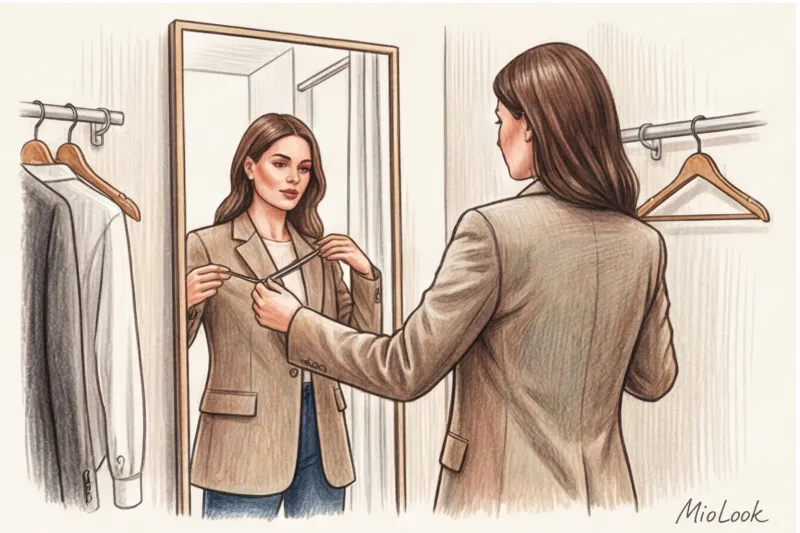
- Recovery stretch test. If you're choosing a base fabric containing elastane (for example, a ribbed turtleneck or skinny jeans), perform a physical fatigue test. Grasp a section of fabric exactly 10 centimeters long with your fingers, stretch it outward to 15 centimeters, and then release it quickly. High-quality fabric with a high recovery rating will instantly and with a slight pop return to its original 10 centimeters. If the section is even a couple of millimeters longer or has a slight "wavy" appearance, you're looking at cheap spandex. Such items are guaranteed to stretch out at the elbows and knees by the end of the first work day.
- Checking the direction of the grain line. Have you ever experienced the side seam on your trousers starting to slip forward after the first wash, twisting the leg around your calf? This happens due to a serious violation of cutting technology: factories often lay out patterns not strictly along the grain line, but at an angle to reduce fabric loss. It's very easy to spot this defect before paying at the checkout. Grasp the trousers by the hem and fold them in half while hanging. The side and inner seams should lie strictly parallel to each other, without creating a twisted pattern.
- Assessment of the quality of fittings. Basic clothing must withstand daily mechanical stress. Pay attention to the buttons: they should be sewn on a shank (a small column of thread) to allow room for the thickness of the fabric when fastening. Check the inside—in high-quality items, the button attachment point is always reinforced with a transparent counter-button. As for fasteners, reliable trousers priced from €80 will have a metal zipper with an additional internal hook on the waistband, which absorbs most of the tension and protects the zipper puller.
Database integration with the MioLook app: smart silhouette management
A thorough physical selection in the store is a crucial foundation. But for things to truly last, their lifespan needs to be managed wisely. It's at this stage that I recommend digitizing your closet, using smart wardrobe feature in the MioLook app.
The app's AI stylist algorithms don't just catalog your photos. They analyze your individual proportions and help you identify the most flattering patterns. By uploading your verified database to the system, you begin tracking a critical metric for a sustainable wardrobe: cost-per-wear (cost per outing). A perfectly fitting €200 jacket worn 50 times will only cost you €4 per outing. That's a lot cheaper than a €40 compromise jacket that you throw away after three wears because the seams have popped.
Furthermore, the MioLook virtual fitting room serves as an excellent tool for preventative shopping. It allows you to try on potential new items on your digitally captured silhouette, evaluate how the new texture will pair with your existing wardrobe, and dramatically reduce the number of online order returns.
By creating a basic wardrobe based on your body type, we stop blindly following glossy templates. We begin to treat our bodies as unique architectural projects, where fabric, proper cut, and modern technology work in perfect synergy. Choose items consciously, test them for durability before buying, and your capsule wardrobe will serve you flawlessly season after season.
Guide Chapters
How to choose a jacket for your body type: stylist tips
Why does vintage Yves Saint Laurent fit flawlessly, while mass-market pieces ruin the silhouette? We explore the secrets of the perfect jacket fit without outdated rules.
How to choose a coat according to your body type: stylist's advice
Forget about one-size-fits-all trends. Learn how to choose the perfect outerwear that will flatter your features and last for years.
How to choose a skirt for your body type: stylist tips
Forget the outdated "apple" and "pear" shapes. Learn how to choose the perfect basic skirt using body geometry and common sense.
Basic wardrobe for petite women without heels
Forget about mandatory stilettos and the ban on oversized clothes. We're talking to a professional stylist about how to properly achieve proportions for petite women.
How to choose trousers for your body type: stylist tips
Tired of ill-fitting trousers? A personal stylist explains how to choose the perfect fit based on cut geometry and fabric quality.
How to determine your body type: a new 3D approach
Forget about "apples" and "pears"! Discover a new architectural approach to proportion analysis that will help you create a flawless basic wardrobe.
Basic Wardrobe for a Pear-Shaped Body: Balance Your Silhouette
Discover how premium cuts and flowing fabrics transform body proportions. We'll explore the rules for creating the perfect capsule for the pear-shaped figure.
Basic Wardrobe for an Apple Shape: How to Hide Your Belly
Stop hiding your figure in shapeless robes! Learn how to create a stylish silhouette that will conceal problem areas and highlight your best features.
Basic Wardrobe for Plus Size Women: Stylist Tips
Tired of hiding your figure behind oversized clothes? Discover how tailoring can help you create a stylish and slimming plus-size capsule.
The Perfect Basic Wardrobe for an Hourglass Figure
Forget wide elastic waistbands and rigid corsets! Learn how to create an elegant capsule skirt for an hourglass figure using the right proportions.
The perfect basic wardrobe for a rectangle body shape
The rectangle body shape is the perfect canvas for fashion experimentation. Learn how to create feminine curves without discomfort with the right cut.
A Basic Wardrobe Guide for the Inverted Triangle
Standard packing lists don't work for a T-shaped figure. Learn how to build a wardrobe based on the principles of architecture and turn your body's features into your advantage.
Ideal Dress Styles for Your Body Type: Expert Advice
Standard styling advice won't work if you don't consider the fabric's properties. We'll explore how to choose a basic dress that will truly flatter your figure.
How to choose jeans for your body type: stylist tips
The problem with poorly fitting denim isn't your body shape, but the factory cut. Let's figure out how to choose the perfect basic jeans based on your body shape.