I recently conducted a small professional experiment: I bought a heavily damaged vintage Yves Saint Laurent jacket from the late 1980s at auction and completely ripped out its lining. As a stylist, I absolutely needed to see the garment's inner architecture with my own eyes. Why does this jacket fit almost any woman flawlessly, bringing the silhouette together, while modern mass-market equivalents often transform the figure into a shapeless, boxy container?
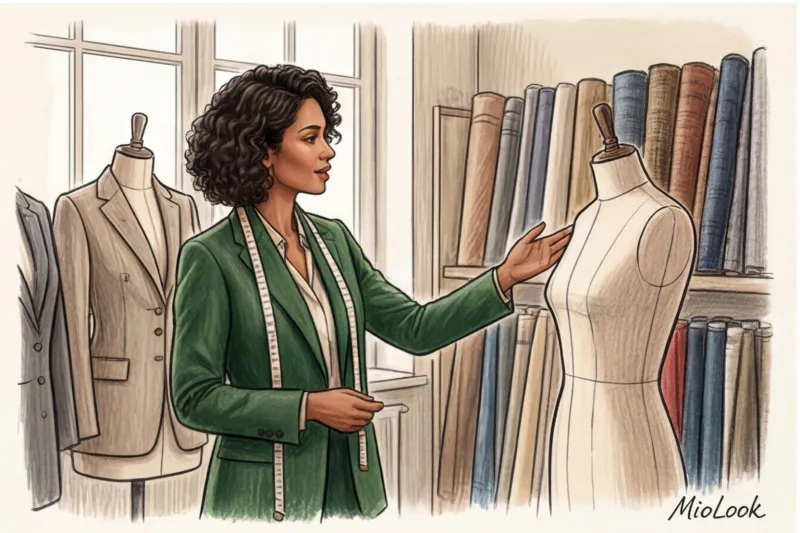
The secret lay in the complex internal framework—the interlining system, the exquisite angle of the shoulder seam, and the mathematically precise balance of the back and front. Asking the question, How to choose a jacket based on your body type , women habitually start Googling lists of tips for "pears" and "inverted triangles." But let's be honest: this classification is hopelessly outdated.
We have already discussed the systemic approach to individual capsules in more detail in our a complete guide to a basic wardrobe tailored to your body type Today, we'll be taking a detailed, almost engineering-level look at the most complex element of a woman's wardrobe—the jacket.
The Architecture of the Perfect Jacket: Why Fruity Body Types Are Outdated
According to the WGSN Trend Forecasting Institute's 2024 analytical report, the custom-fitting industry is finally abandoning the fruit-based body classification system. As a style consultant, I'm incredibly happy about this. The female body isn't a basket of apples and pears; it's a complex geometry of vectors, angles, and curves.
When we try to squeeze ourselves into the typical pear shape, we ignore the most important factors: bone density, shoulder slope, and the body's natural curves. A basic jacket won't fit everyone the same way precisely because its cut is initially based on a specific tailoring tradition.
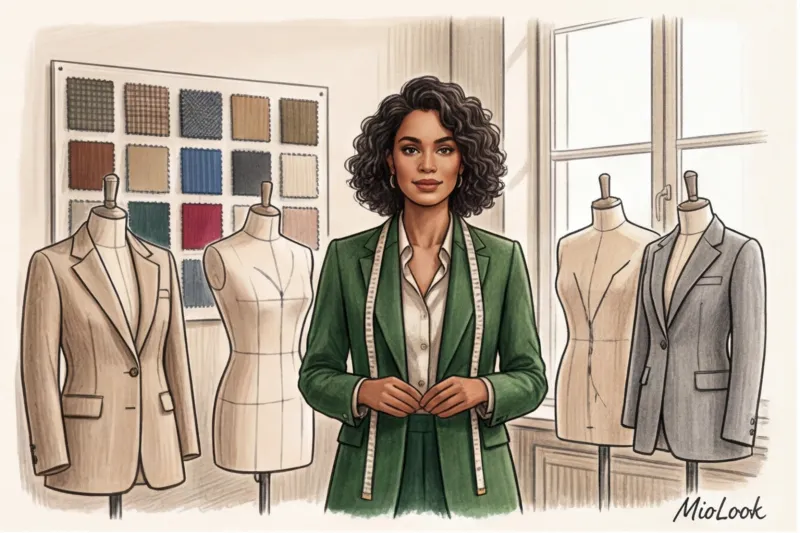
In classic tailoring there are two polar approaches:
- English School (Savile Row): A rigid structure, dense fabrics, pronounced shoulder pads, and a graphic silhouette. This jacket maintains its shape no matter who wears it. It's a kind of armor.
- Neapolitan tailoring: A soft cut, minimal lining, and a natural shoulder line, this jacket flows and follows the contours of the body like a second skin.
The choice between them depends not on where you store excess weight, but on the lines of your natural silhouette.
Straight and Curved Lines: Compatibility Test
If you have a linear figure (pronounced collarbones, straight hips, and defined facial features), crisp fabrics and structured English cuts are ideal for you. Peaked lapels and clean lines will highlight your natural grace.
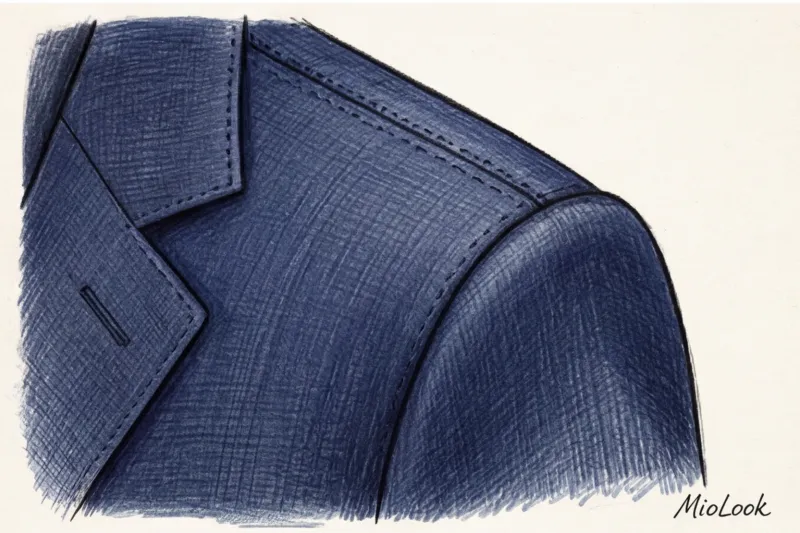
If your figure is curved (rounded hips, a soft shoulder line, a pronounced difference between your waist and hips), a stiff English jacket will be too tight. You need flexible fabrics that contour to your body and a cut with darts that create a defined waist.
Access to MioLook for €0.99 — one-time payment
A smart AI stylist will analyze your figure and select the perfect jacket silhouette in just a few seconds.
Get access — €0.99 onceThe Shoulder Girdle: The Main Secret of Expensive Jackets
I always tell my clients: it's not the button or even the fabric that gives away a cheap jacket; it's always the shoulder. This is where 80% of a tailor's skill lies.
Let me tell you a story from my own experience. A client, a top manager at an IT company, came to me. She had a full bust and sloping, soft shoulders. For ten years, she avoided jackets because the standard styles with stiff shoulder pads made her look like an American football player, while the ones without shoulder pads hung loosely, depriving her of a professional look. The solution was a jacket with Neapolitan shoulder (spalla camicia).
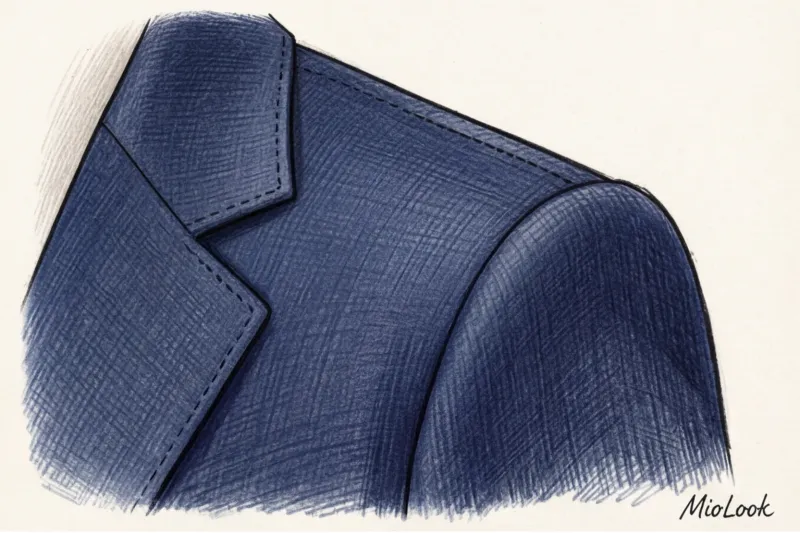
What is the difference and how to choose yours?
- Structured shoulder (with shoulder pad and roping). Roping is a small roll that lifts the sleeve cap above the shoulder line. It's the perfect choice if you need to correct narrow shoulders, balance out large hips, or simply add authority and toughness to your look.
- Spalla camicia (shirt-type shoulder). The sleeve is sewn under the armhole with a light gather (grinze). There are no stiff pads. This is a godsend for women with broad shoulders, a large bust, or for those who want a classy yet relaxed look with a "quiet luxury" feel.
How to choose a jacket based on your body type: working with proportions
Knowing the geometry of cutting is half the battle. The other half is the mathematics of proportions. High-class tailors never eyeball their designs; they use the golden ratio.
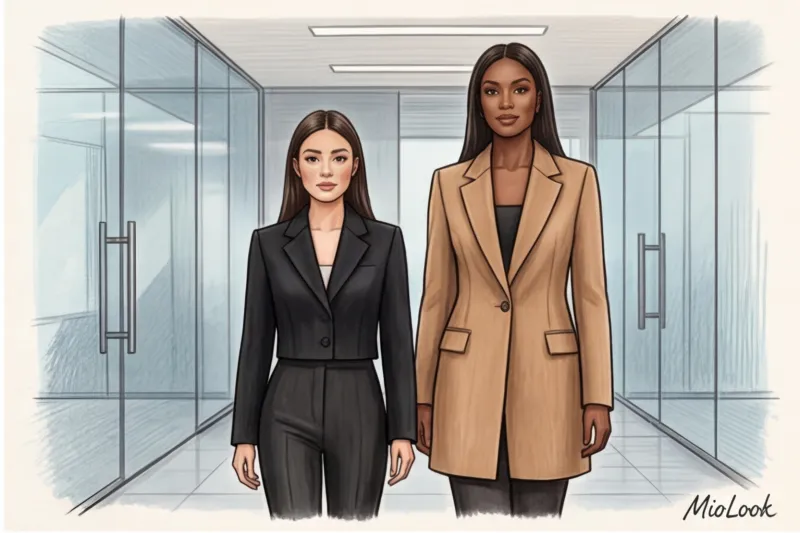
There is an immutable rule of length that works for everyone without exception: a jacket should never end at the widest part of your hips It should either not reach it (shortened models), or cover it completely.
If a jacket cuts in half at the widest part of your hips, it visually widens you by at least two sizes and shortens your legs. When choosing the length, consider your height: the classic proportion for a harmonious silhouette is 1/3 (torso) to 2/3 (legs). If you're petite (up to 160 cm), a long jacket that reaches mid-thigh will make you look like a teenager in a dad coat. A length that reaches your hipbone is your best bet.
Chest size and lapel shape: the mathematics of cutting
The size of your lapels isn't just a design whim. It's an optical illusion that should be proportionate to your facial features and body measurements.
- For large breasts: Choose single-breasted styles with a deep V-neck (fastened with a single button located under the bust). Lapels should be narrow or medium. Wide lapels will rest directly on the bust, visually enlarging it even more.
- For small breasts: Your trump card is double-breasted styles and wide peak lapels. They create a horizontal line across the upper body, adding much-needed volume. You can also indulge in textured fabrics, like thick tweed or bouclé.
Your perfect wardrobe in one app
Forget about the "nothing to wear" problem. Upload your items to MioLook and receive ready-made outfits every day.
Get access — €0.99 onceFabric is everything: investing in the right material
No design, no matter how ingenious, will save a jacket made of 100% cheap polyester. Synthetics are neither absorbent nor flexible. They don't conform to your body shape as you wear them, meaning the jacket will always fit awkwardly.
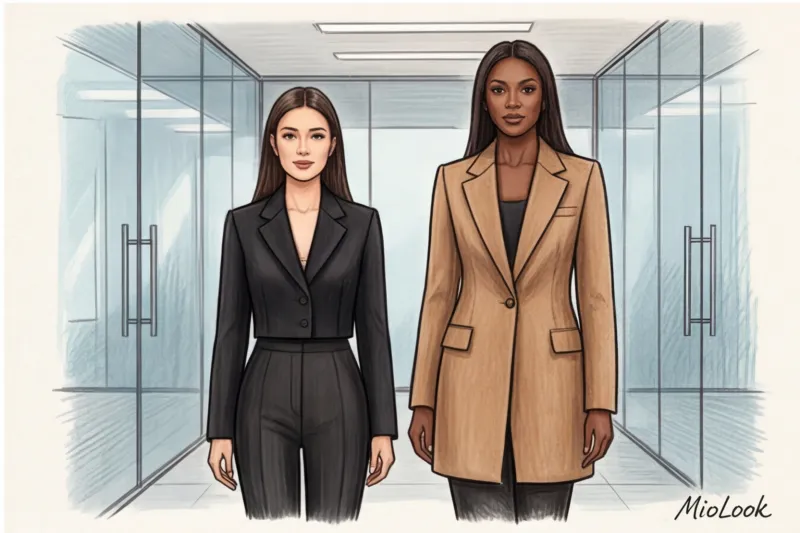
As an investment wardrobe expert, I encourage you to calculate the value of an item not by the price tag, but by the formula Cost-Per-Wear (cost per outing). A mass-market jacket for €80 that will lose its shape after three months will cost you more in the long run than a premium jacket for €350 that you'll wear for five years.
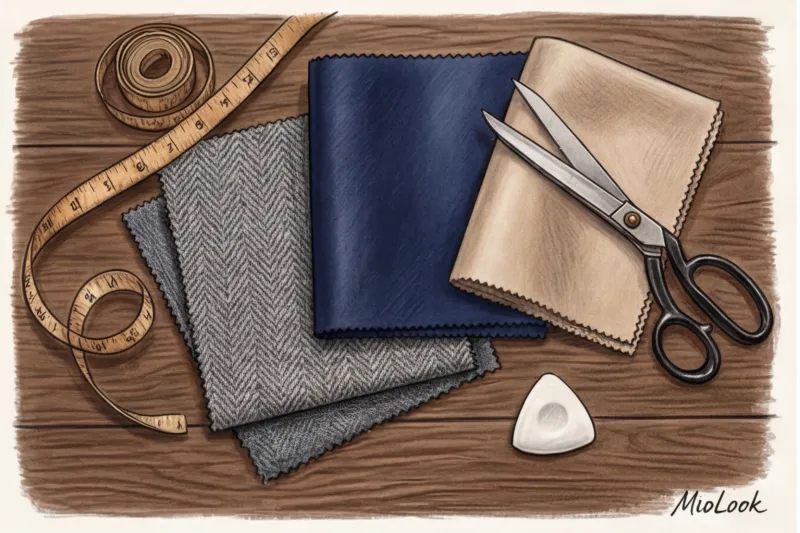
Research by The Woolmark Company (2023) confirms that high-quality wool products last 3-4 times longer than synthetic alternatives. For the perfect everyday essential, look for the label Super 100s or Super 120s This is an indicator of the fineness of the wool: the fabric will be thin enough to be worn all year round, but durable enough to not fray at the elbows.
"The price difference between a premium and a cheap jacket is often hidden. It's the construction technique. Cheaper jackets are fused, while premium ones are stitched with horsehair and canvas."
A fused jacket begins to peel when exposed to hot steam at the dry cleaner. You've probably seen these unsightly bubbles on the lapels of old jackets. A jacket with a quilted lining (half-canvas or full-canvas) will only improve in shape over time, adapting to your body heat.
The Oversized Myth: Why One Style Can't Suit Everyone
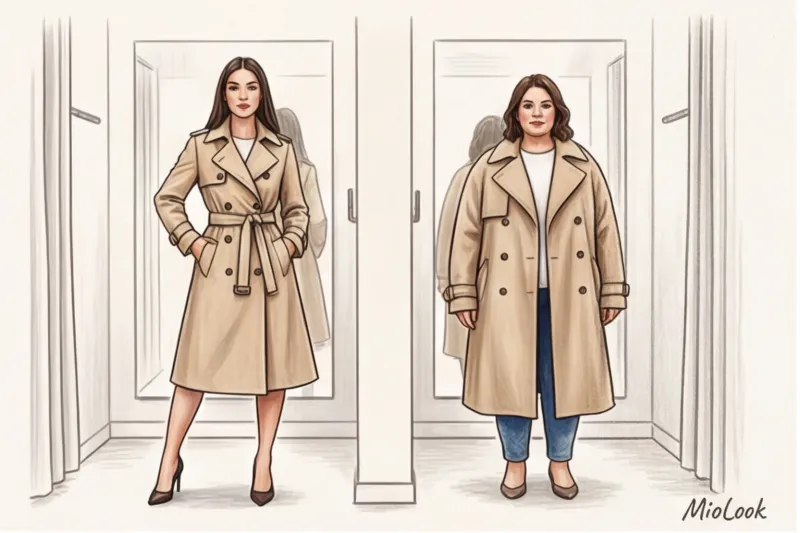
Here, I want to challenge one of the most persistent trends of recent years. Fashion influencers assure us that a giant, oversized "masculine" jacket is a universal staple that saves any look and suits absolutely everyone. This is a dangerous misconception.
Let's be honest: this rule has serious limitations. Oversized jackets look stunning on tall women with linear, androgynous figures. They look great in static shots for social media. But in real life, when moving, a massive, boxy jacket can be disastrous for figures with pronounced curves.
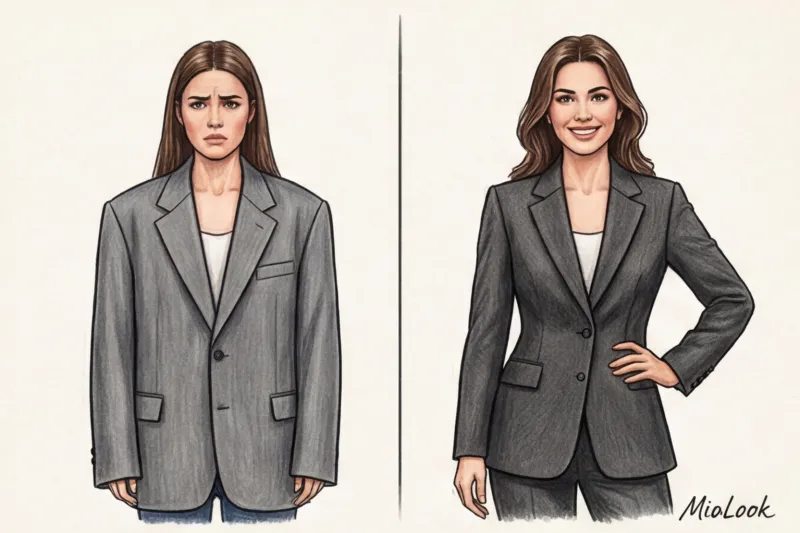
If you have a full bust, a small waist, and rounded hips (the so-called "hourglass"), a large, straight jacket will hang at the highest point of your chest and fall in straight lines. You'll instantly add 10-15 visual pounds and lose your femininity.
What's an alternative for classy, but not baggy looks? Semi-fitted silhouette This is a timeless classic. This jacket has a relaxed fit (you can fit your fist between you and the fabric), but the darts subtly define the waist. It's a garment that works. on your figure, not hide it.
Pre-purchase checklist: test drive in the fitting room
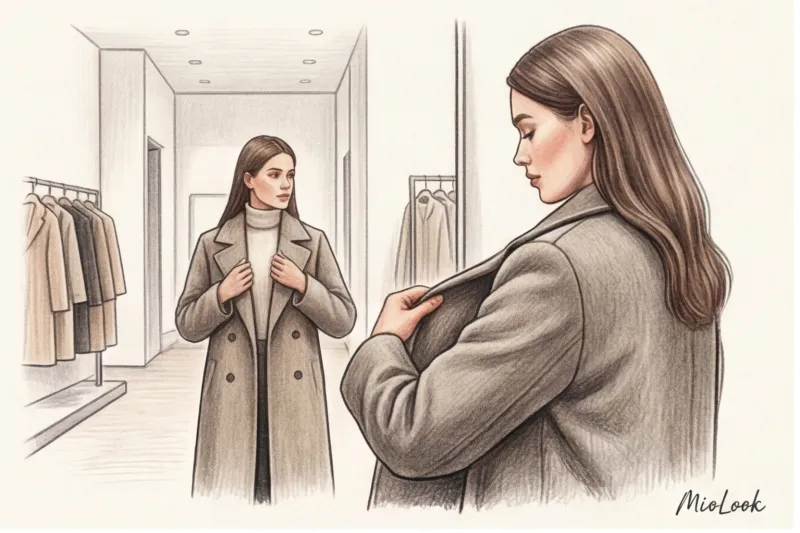
Even if you've found the perfect fabric composition and the perfect shoulder line, you still need to try it on properly. In my practice, I've developed a strict checklist that I use with my clients to try on every jacket before they pay.
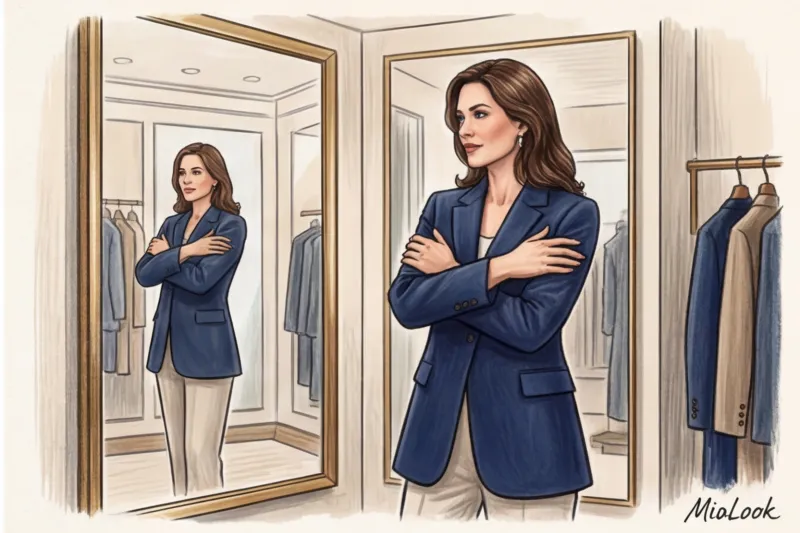
Remember these 4 rules for the fitting room:
- Hug test. Put on your jacket, button it, and hug your shoulders. If the fabric at your back is stretched so tight that the seams are bursting and the sleeves are cutting into your biceps, the back width is too small. A jacket shouldn't restrict your movement, even if it's fitted.
- Button test. Button the jacket on the main button (usually the top or middle one). If an "X"-shaped wrinkle forms around it (an "X"-shaped pull), the jacket is definitely too small in the waist. The lapels should lie flat.
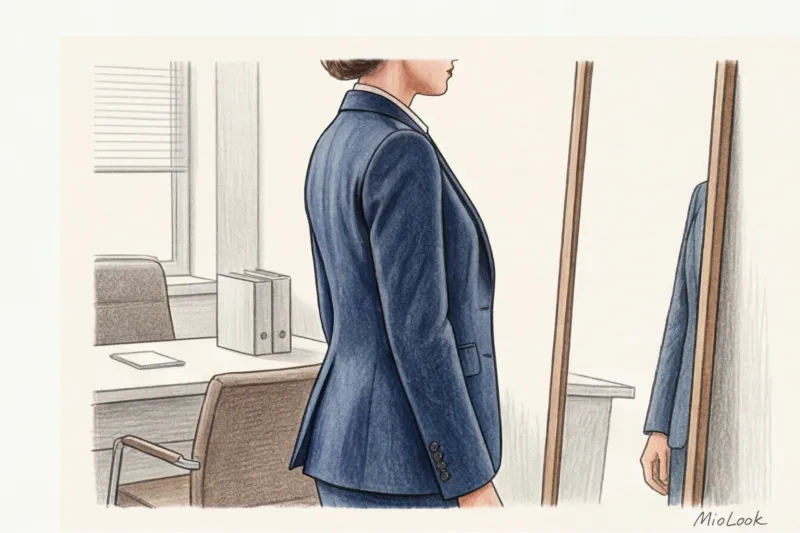
- Checking the spline. Turn your back to the mirror. The back vent should be perfectly vertical and closed when you stand up straight. If the back vent spreads, revealing your buttocks, the jacket is too tight in the hips.
- Perfect sleeve length. Hang your arms down. The sleeve of a proper jacket should reach right to your wrist bone. This is a design detail: this length allows for 1-1.5 centimeters of shirt cuff to show off or a beautiful bracelet to make the look appear lighter and more luxurious.
Choosing a basic jacket isn't about following passing trends, but about understanding your own unique body structure. Invest time in finding your own cut, don't be afraid to visit a tailor for a sleeve length adjustment, and you'll end up with a piece that will become a solid foundation for your wardrobe for years to come.