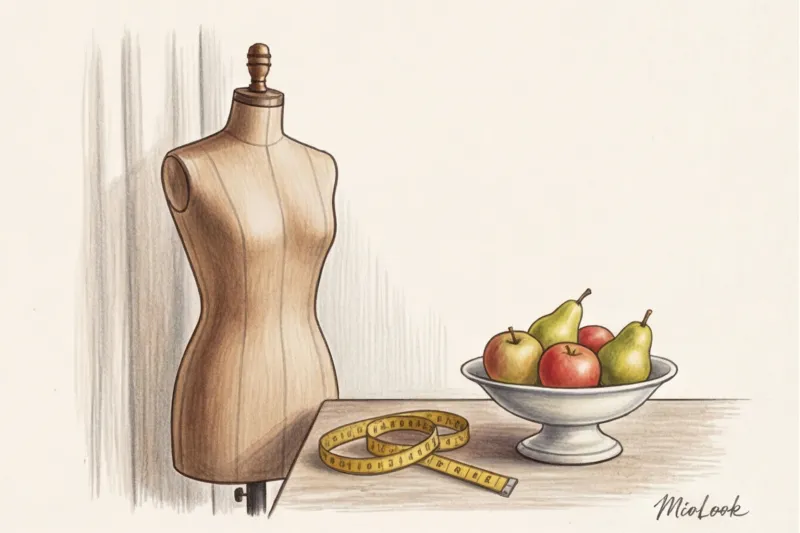
Have you ever wondered why we modern women still describe our bodies with fruit names? "Apple," "pear," "banana"—they sound like a grocery list, not the basis for creating an elegant personal style. Over 12 years of working at fashion weeks and personal styling, I've realized one terrifying thing: this outdated classification forces us to methodically disguise and hide ourselves, instead of understanding our own geometry.
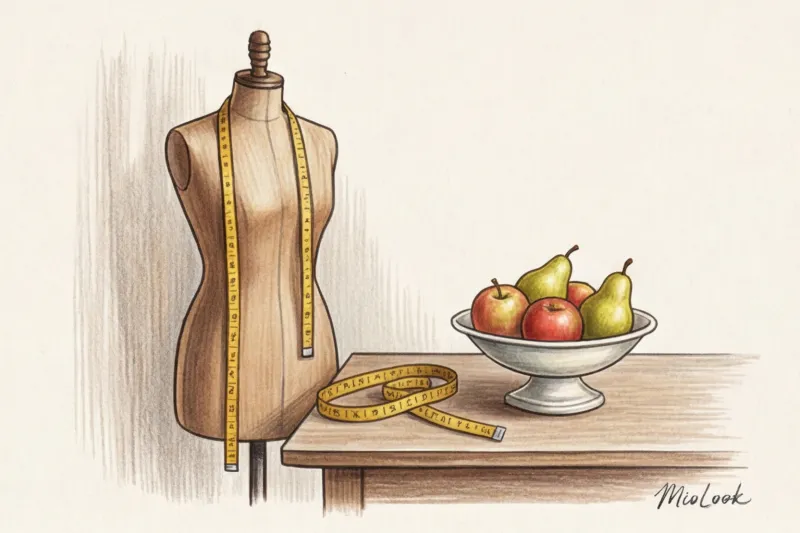
If you are looking for a way, How to determine your body type , the first thing you need to do is throw away the measuring tape. We covered this in more detail in our the complete guide to the perfect capsule , but here I want to give you a completely new, architectural 3D approach. We'll stop measuring girths in an attempt to fit them to some standard and start analyzing bone structure, vertical proportions, and the body's interaction with tissue physics.
The End of the Apples and Pears Era: Why Old Body-Shaping Methods Don't Work
The body typing system based on fruits and geometric shapes (like the infamous "inverted triangle") appeared in glossy magazines in the 1990s. Its main goal wasn't to help women find their style, but to sell them shapewear and clothing that "corrected flaws."
According to a large-scale anthropometric study SizeUK A study conducted by the Textile Institute in collaboration with leading British retailers found that only 8% of women have a classic hourglass figure (with a pronounced difference between their waist and hips). 8 percent! And yet, for decades, we've built the fashion industry around attempts to artificially "pull" the remaining 92% to this imposed standard.
"The psychological damage of the old system is enormous. One of my clients spent 10 years hiding her voluptuous hips under shapeless black robes, thinking she was pear-shaped and had to conceal her bottom. As soon as we stopped hiding her and balanced her silhouette with a structured jacket, her career and personal life took off. Clothes change the way we carry ourselves."
The main problem with the old school is that it uses 2D measurements (bust-waist-hips). But in real life, we move in three-dimensional space. Shoulder width isn't as important as their slope. Hip circumference matters less than the shape of the pelvic bone and the hip line (steep or flat). We need to move toward a 3D perception of the body.
A Modern Algorithm: How to Determine Your Body Type Using Body Architecture
Forget the "to find your body type, measure your shoulders and hips" rule. The essential tools of modern styling are a full-length mirror and a smartphone camera.
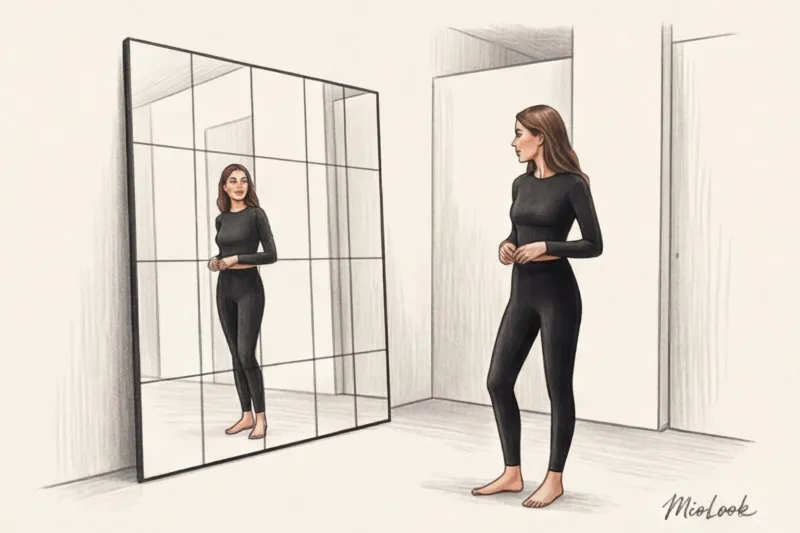
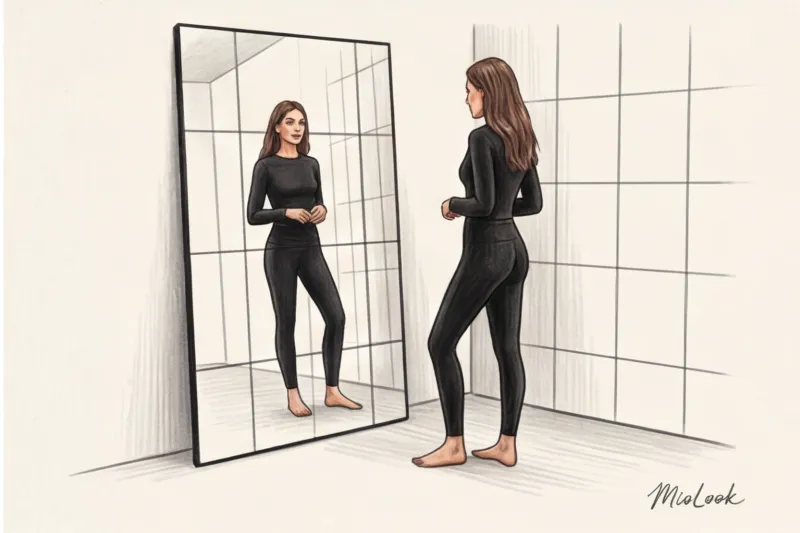
Professional secret: Put on some form-fitting black clothing (leggings and a turtleneck) or underwear, stand directly in front of a mirror, and take a full-length photo at chest level. Then, convert the photo to a black-and-white, high-contrast filter. You'll see your pure silhouette—the negative space between your body and the background. This is exactly what the great Cristóbal Balenciaga worked with when creating his iconic cocoon coats in the 1950s.
Step 1: Assess the vertical proportions (torso and legs)
Horizontal dimensions (how wide the hips are) are secondary. The balance between the length of the torso and legs is primary. This is what dictates, How to determine your body type to select the length of trousers, skirts and jackets.
- Short torso and long legs: Your waist is naturally high. Trendy crop tops paired with high-waisted tops can visually "swallow" your torso, leaving you with more head on your feet. Mid-rise jeans and longer jackets are your best bet.
- Long torso and short legs: The waistline is low. A common mistake here is buying low-rise jeans, which were brought back into fashion by Miu Miu in 2022. They will visually elongate the torso even further and shorten the legs. High-waisted jeans and cropped jackets are recommended.
Step 2: Analyze Lines and Geometry (Yin/Yang Balance)
Look at a black-and-white photo of yourself. What catches your eye first (this is called your "dominant" feature)? The sharp angles of your shoulders and collarbones and the straight line of your hips (Yang energy, structure)? Or the soft, sloping shoulders and rounded hips (Yin energy, fluidity)?
The shape of your shoulders dictates your choice of necklines. If you have sharp, square shoulders, V-necks and stiff shirt collars will look luxurious. If your shoulders are sloping and soft, cowl necks, draped sleeves, and raglan sleeves will suit you.
Access to MioLook for €0.99 — one-time payment
A smart AI stylist will select the perfect styles for your body shape.
Get access — €0.99 onceFabric Physics and Your Body: The Secret to a Perfect Fit
The most important rule that's not mentioned in the glossy magazines: a basic wardrobe isn't a list of items, it's a marriage of your natural geometry and the properties of your fabric. 70% of wardrobe items end up unused precisely because of the conflict between the texture of the fabric and your bone structure.
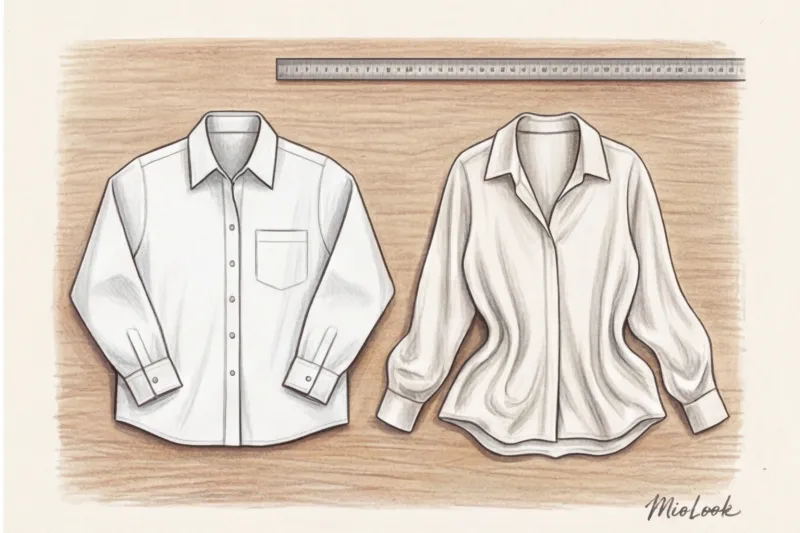
I've seen this many times backstage at fashion shows in Paris. Take a classic white shirt made of thick cotton poplin (120 g/m² and up). On a woman with a straight, linear bone structure, it looks expensive and classy, creating a clean, minimalist silhouette. But put the same shirt on a woman with pronounced curves and a full bust—the thick cotton won't be able to contour to these curves. It will become stiff, stretch over her chest, and hang down at a right angle, visually adding two extra sizes to her figure.
Girls with curves need plastic The shirt should be made of crepe de chine, heavy viscose, or silk with added elastane. The fabric should flow over the body like water, following its contours rather than creating a box around it.
From Theory to Practice: 4 Modern Vector Figures for Capsule Assembly
Instead of a dozen types of fruit, I use my proprietary 4-vector system when working with clients. It's intuitive and immediately tells you which section of the store to visit.
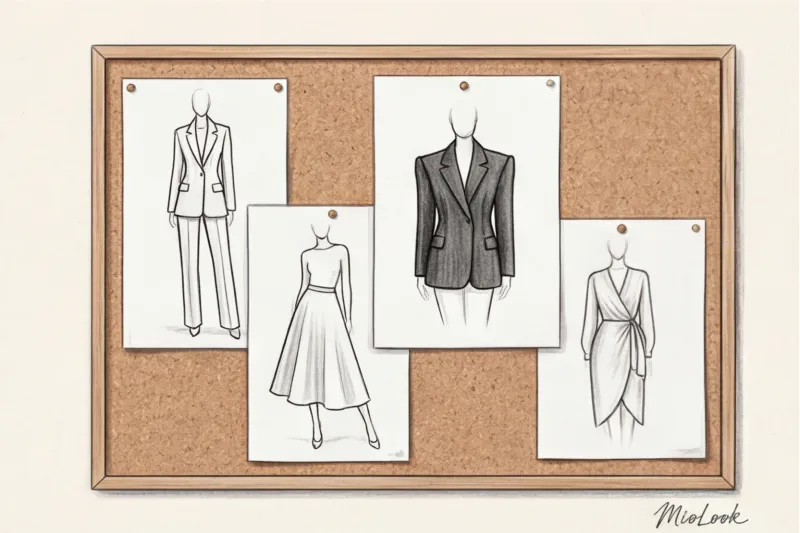
Linear vector (straight lines, structure)
Peculiarities: The shoulders are roughly equal to the hips, the waist is slightly defined, and the body is elongated and geometric. This is the body shape of most models on the catwalk.
Ideal base: Your forte is architecture and layering. Stiff fabrics like heavy denim, structured wool, and leather look incredibly flattering on you. Menswear-inspired pantsuits, straight-cut coats, and oversized pieces are your style of choice. Consider brands like COS or Massimo Dutti (a quality structured jacket here costs around €130–€180).
A-vector (dominant of the lower part)
Peculiarities: Visual weight is concentrated in the hips, the waist is thin, the shoulder girdle can be narrow or sloping.
Ideal base: The goal isn't to hide your hips, but to balance out your top. Jackets with pronounced shoulder pads (a throwback to the '80s trend à la Saint Laurent) are ideal. For the bottom, opt for flowing A-line skirts (biased) in matte fabrics. Shiny fabrics (satin) around the hips will visually widen them due to the reflective effect.
V-vector (dominant of the upper part)
Peculiarities: Straight, active shoulder line, chest wider than hips, narrow pelvis, slender long legs.
Ideal base: Add volume to the bottom and soften the top. V-necks (hence the name of the vector) and wrap blouses are ideal. The bottoms are palazzo pants with pleated waists and wide-leg jeans in thick denim (around €50–€80 in high-street stores), which will create the necessary counterbalance to broad shoulders.
Bending vector (smooth lines)
Peculiarities: A pronounced difference in measurements (bust-waist-hips) regardless of your weight. The body lines are rounded and soft.
Ideal base: Your enemy is rigid oversize. Your best friends are wrap-style pieces (think Diane von Furstenberg's iconic wrap dress), flowing, pliable fabrics, draping, and a waist accent. Choose ribbed knits that stretch where you need volume and gather where you need it.
Your perfect look starts here
Join thousands of users who look flawless every day with MioLook's intelligent recommendations.
Get access — €0.99 onceThe main mistake when adapting a basic wardrobe
The most painful mistake I see every other time I review my wardrobe is trying to hide my "flaws" with shapeless clothes. Remember: oversized clothes don't make a fuller figure look slimmer. They make it look oversized.
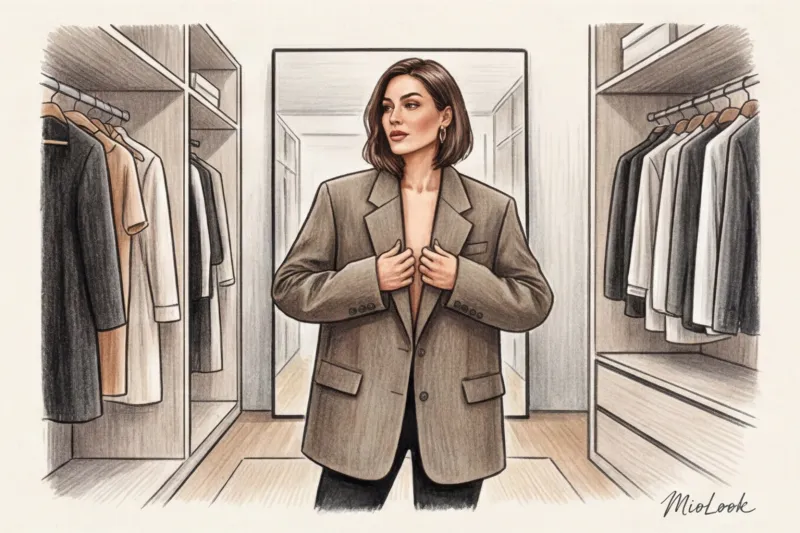
One day, a client came to me convinced that, at her size XL, she could only wear black knitwear without a uniform. We found her a monochrome, light-colored look (in an ecru shade) with the right-length trousers and a structured, long suiting vest (priced at around €120). The vest's strong vertical lines pulled her figure together, and the monochrome elongated her height. She cried in the fitting room, seeing her true, statuesque beauty for the first time.
But there is an important limitation. I'll be honest: the architectural approach and knowledge of that, How to determine your body type , absolutely don't work if you're buying clothes a size too small in hopes of losing weight for vacation. Fabric should fit loosely or structure the body, with some air between you and the clothes. If the buttons on your chest are too tight, no amount of geometry theory will save you.
Checklist: Audit your current wardrobe to ensure it fits your figure
Now that you understand your architecture, it's time to take a look inside your closet. How can you identify "parasites"?
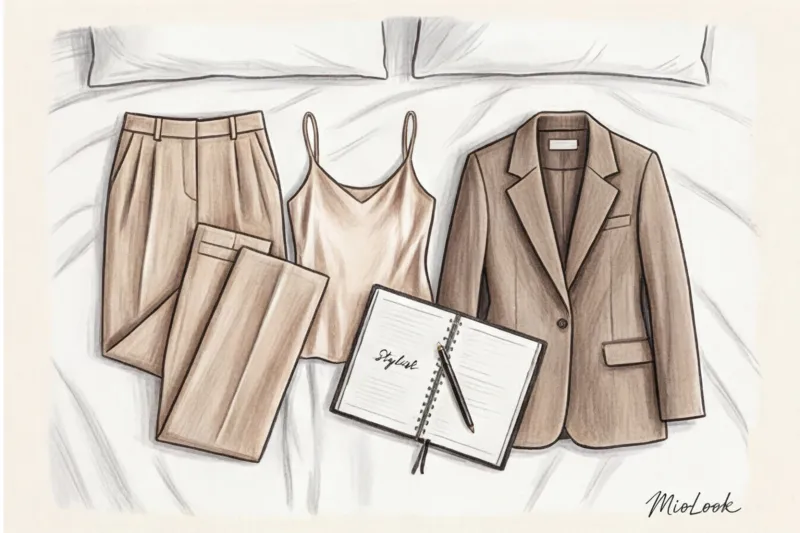
- Geometry test: Pick up an item you don't like the way it fits. Look at its shape. Is it boxy and rigid, and you're a Curve Vector? Put it aside.
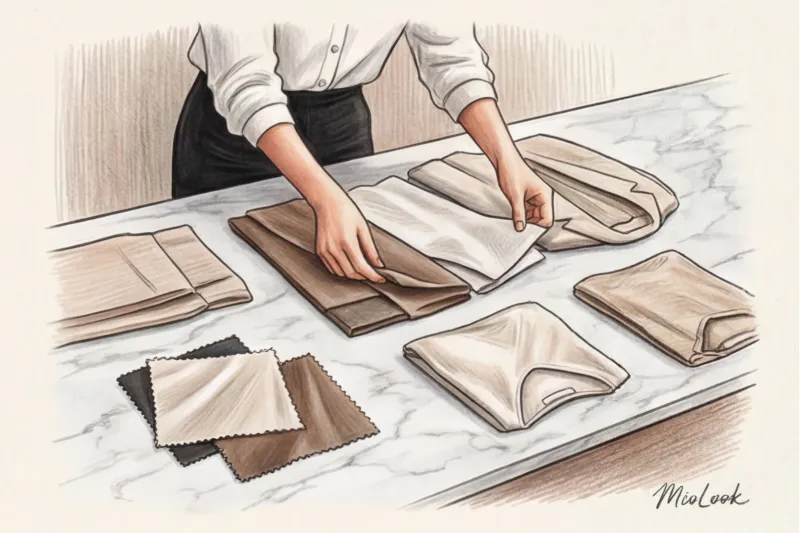
- Fabric test: Squeeze the fabric in your fist. If it wrinkles easily and is stiff (like linen or cheap poplin), it's only suitable for the Linear Vector. If it flows beautifully, it's best suited for soft shapes.
- Proportion test: Where does the hem of a jacket or sweater end? The widest part of the hips is the worst place for a horizontal line. The garment should end either higher (at the waist) or lower (covering the groin and going vertical).
Before purchasing a new basic item, always ask yourself 3 questions: Does this garment follow the contours of my body? Is the fabric density appropriate for my bone structure? Will it cut off my vertical proportions at the widest point?
Intelligent styling with MioLook: a foundation that understands your body
Keeping in mind all the rules of cutting, fabric density (from 100 g/m² for blouses to 400 g/m² for coats) and balance of proportions is difficult even for professionals.
This is where technology comes in. You no longer have to guess in the fitting room. MioLook It works like your personal pocket stylist. By digitizing your measurements and uploading your current wardrobe, you get a virtual fitting room. AI algorithms, trained on the laws of body geometry and fabric properties, analyze your body structure and suggest which styles will be your ideal base.
As we conclude our discussion of body architecture, I want to impart one key insight: your figure isn't a flaw of nature to be corrected or hidden. It's a unique canvas. By stopping fighting your curves and choosing fabrics and cuts that complement them, you'll solve the "nothing to wear" problem forever. Clothes should serve your body, not the other way around.
Ready to get started?
Try a free plan—no commitments. Upload your items to the MioLook smart wardrobe.
Get access — €0.99 once