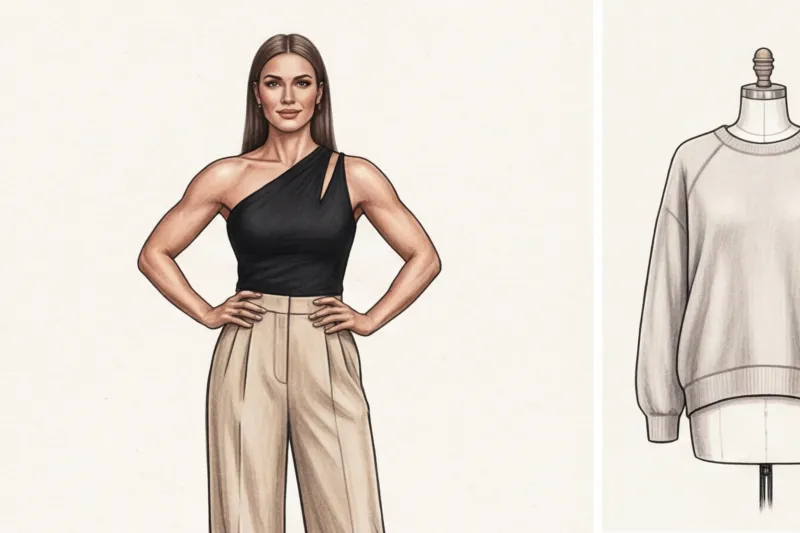
Have you ever noticed what happens when you try on a classic white shirt made of stiff poplin? The one glossy magazines insist on calling a "must-have" for every woman? Chances are, it's treacherously tight in the shoulders, doesn't meet at the chest, and hangs shapelessly at the waist. Sound familiar? Congratulations, you've fallen victim to the myth of the one-size-fits-all basic. If you have a T-shaped figure, standard packing lists simply don't work.
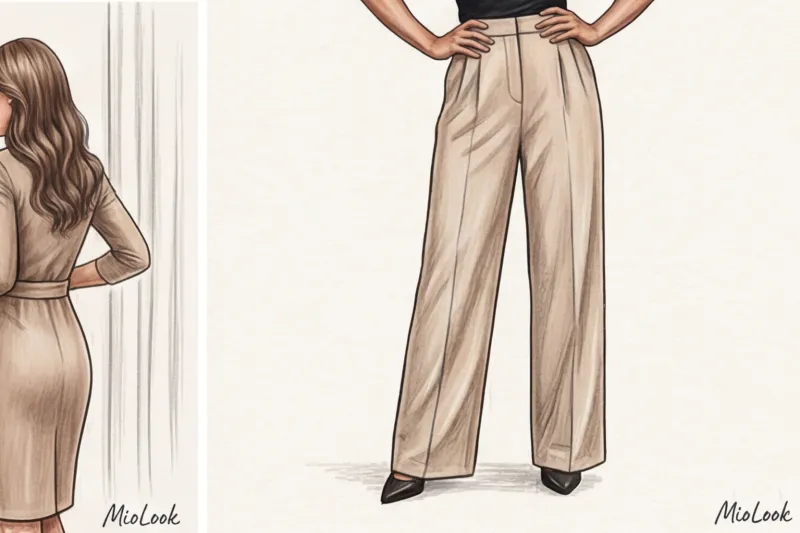
I am Darina Marchenko, a colorist and stylist, and over 12 years of practice I have realized one important thing: to collect Basic wardrobe for an inverted triangle We need to follow the laws of architecture and optics, not templates. We won't hide your shoulders under robes. We'll use the physics of fabrics and asymmetry to turn your figure's unique features into a catwalk trump card. We've already discussed why blindly following trends is detrimental to style in our article. A complete guide to creating the perfect capsule for different body types.
Inverted Triangle Body Shape Essentials: Why Your Shoulders Are a Runway Ace
Let's be honest: the ready-to-wear (mass-market) industry is tailored to average measurements. Fit statistics are merciless: about 80% of standard shirts in the budget segment (€30–€50) will be too tight in the upper back. The anatomy of an "inverted triangle" is characterized by broad, often straight shoulders, a narrow ribcage (or, conversely, a full bust with a narrow hips), a soft waist, and slender, long legs.
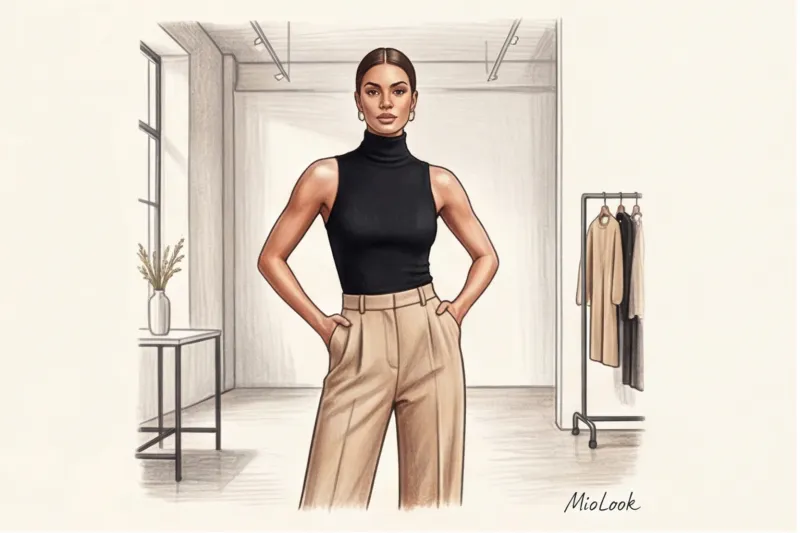
Many women make the same mistake: they try to visually "tighten" their tops with dark turtlenecks and tight tops, neglecting their bottoms. But in clothing design, a paradigm shift is at work: we don't hide flaws, but rather balance the body's architecture. Broad shoulders are the foundation of a model figure. They're what make coats and jackets fit perfectly, without sagging or creating unnecessary folds at the back.
The stylist's main secret: work with optical weight, not stereotypes
I had a client in my practice who was a swimmer. She genuinely hated her shoulders and spent years hiding them in shapeless, oversized, chunky knit sweaters. It got to the point where she started slouching, trying to appear smaller. This is a classic mistake. Trying to hide her shoulders with loose knits, she only added extra pounds of visual weight.
Here we encounter the main and most pernicious myth: soft raglan sleeves and dropped shoulders are considered to make the top appear narrower. Forget it! If you have full or broad, sloping shoulders, a raglan made of soft fabric will cling to them, creating a massive "mountain" effect. Meanwhile, a precise set-in seam along the natural shoulder line (and sometimes even a 0.5 cm micro-shoulder pad) gathers the silhouette into a rigid frame, making the figure appear more delicate.
Fabric density plays a huge role. A loose cardigan will add width, while heavy, flowing crepe (200 g/m² and above) or viscose will fall in vertical lines without clinging to the body. If you're having trouble imagining how different textures will look together, try loading items into MioLook - This is a great way to evaluate the balance of proportions in an image in advance.
Tops and jackets: architecture that really narrows the shoulders
Visual correction is based on the principles of optical illusions. In particular, the Müller-Lyer illusion works well with necklines. The diagonal lines of a V-neckline, sweeping downwards, visually break up the wide horizontal line of the chest and elongate the neck.
- Perfect cutouts: deep V-shape, U-shape and one-shoulder asymmetry.
- What to avoid: boat necklines (they draw a rigid horizontal line from shoulder to shoulder), thin spaghetti straps that make the shoulders appear gigantic, and any active decoration in the form of ruffles or epaulettes.
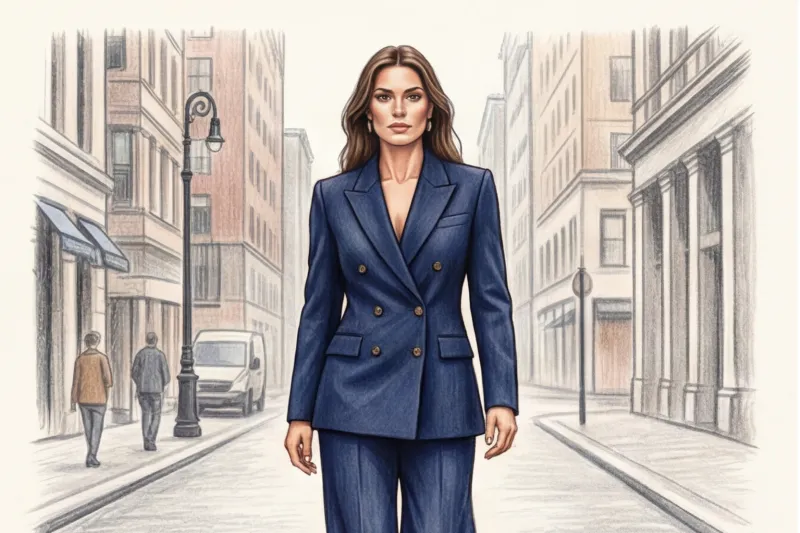
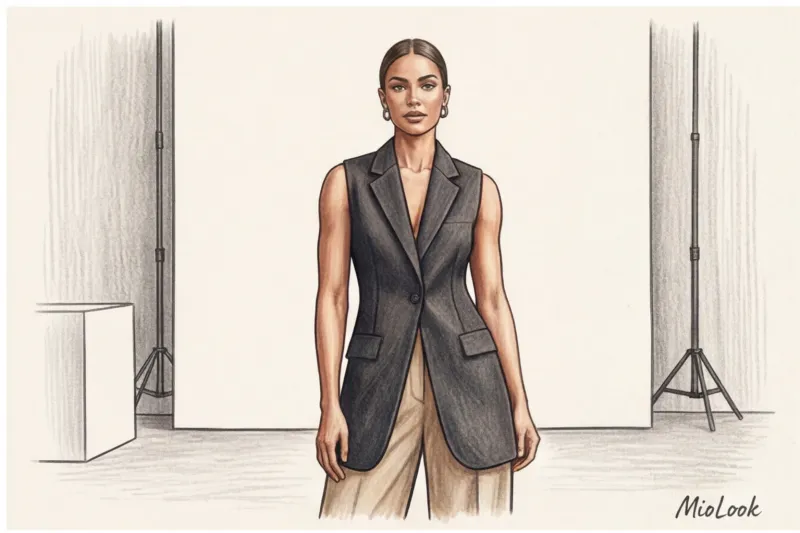
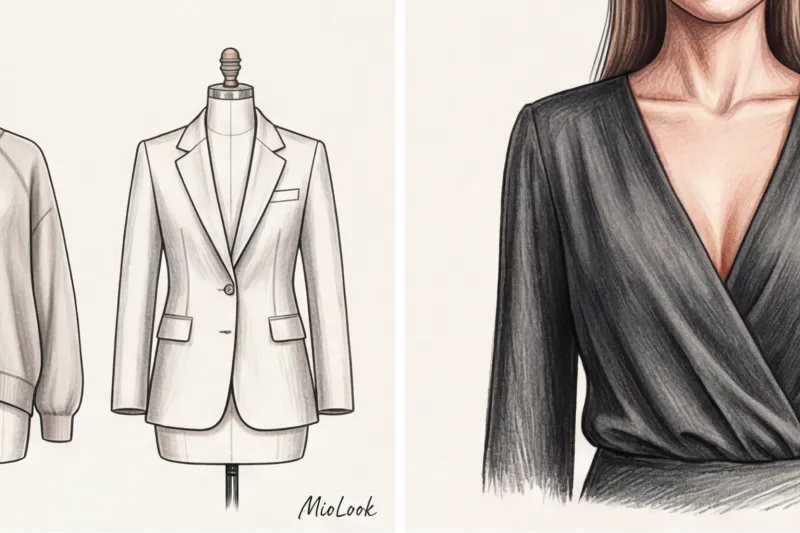
According to the laws of clothing design and volume distribution according to the Golden Ratio (as detailed by experts at the Istituto Design Marangoni), the right jacket visually makes the waist appear 15-20% thinner. For your figure, this is a single-breasted, elongated jacket with narrow, long lapels that fastens just under the bust. By the way, if you choose a deep neckline, don't forget about your hair—it also plays a role in geometry. Check out our article about the perfect hairstyle to match the neckline of your dress.
Your perfect wardrobe without stress
Try MioLook for free: A smart AI stylist will analyze your figure and select the perfect looks from your own clothes.
Get access — €0.99 onceBottoms: Create balance and add volume to the hips
Since nature has deprived the "inverted triangle" body of full hips, we will create them ourselves with the right cut. Our goal is to add visual weight to the lower half to balance out the massive top.
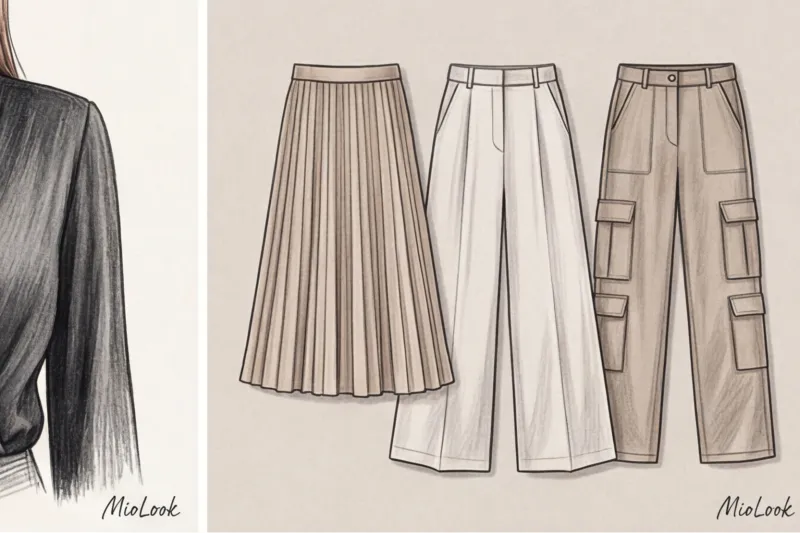
Your best allies in the trouser department are palazzo pants, wide straight-leg styles, and ultra-fashionable cargo pants with large patch pockets on the sides (they visually widen the hips). When it comes to skirts, opt for A-line silhouettes, confident pleats, tulip skirts, and peplum styles. The key here is the thickness of the fabric. Thin silk will simply hang off the hips, while heavy denim (12 oz or more) or gabardine will maintain a bell shape.
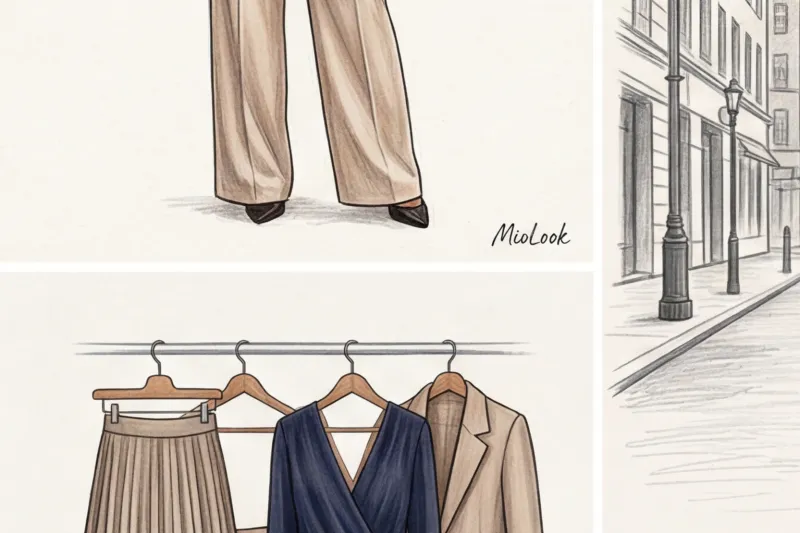
But here I must make a reservation: This advice does not work for everyone. If you have a T-shaped figure but a noticeable tummy or your weight is distributed in the upper body (apple-shaped), trousers with a crisp waistband will make you look boxy. In this case, choose a smooth waistband and a slight flare from the hip.
What about your favorite skinny jeans and pencil skirts? They're dangerous. By hugging narrow hips and legs against broad shoulders, you risk creating a "lollipop" effect. If you really want to wear skinny jeans, balance them with a long, straight, mid-thigh jacket to hide the difference in size.
Dresses and Outerwear: Shaping the Hourglass Silhouette
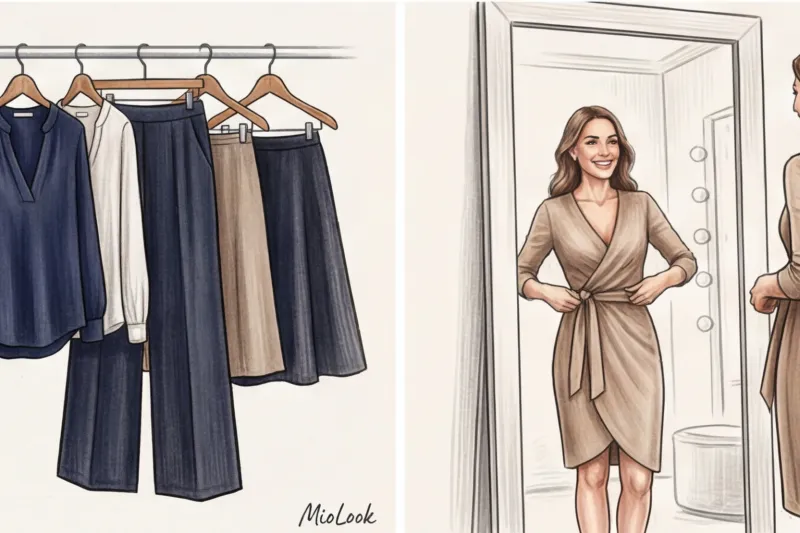
A wrap dress is an absolute design genius and a must-have for the inverted triangle. It kills two birds with one stone: it creates the desired diagonal across the chest and flares out toward the bottom, creating a waist where there might not be one. Shirt dresses in thick cotton also work well, but always with a flared skirt.
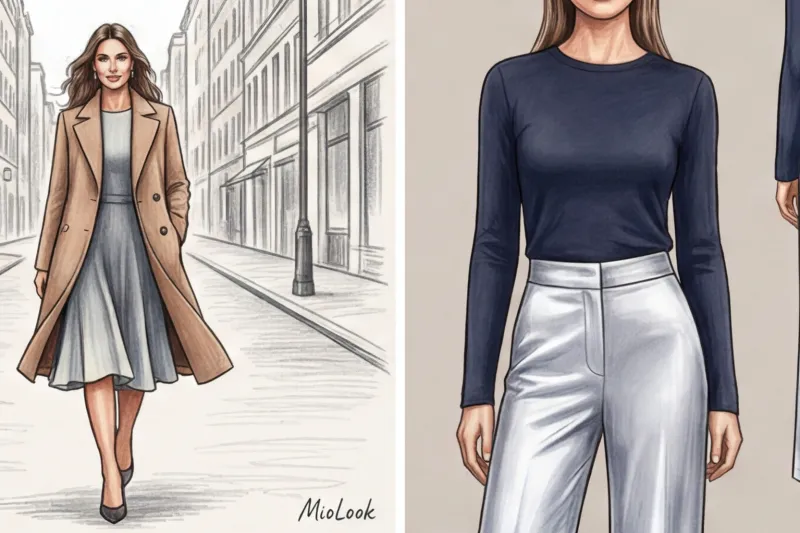
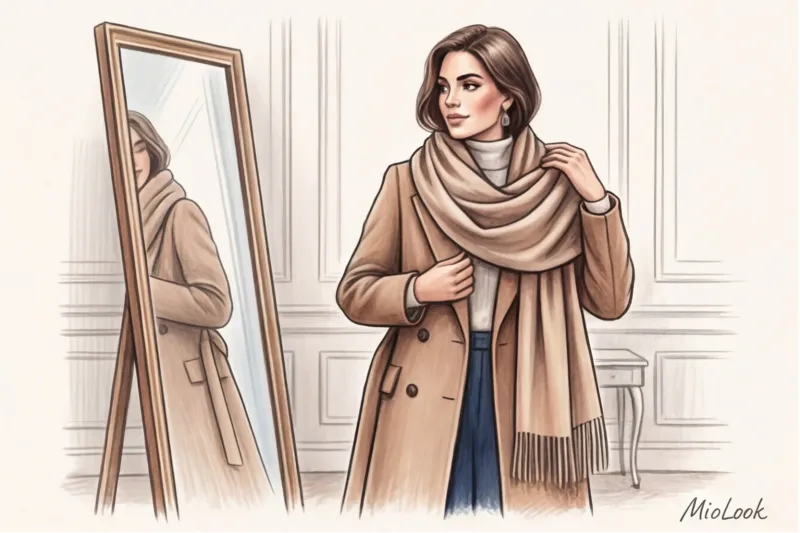
You need to be especially careful with outerwear. The beloved classic double-breasted Burberry-style trench coat (which will set you back around €1,800-€2,200 for the original) is your worst enemy. The abundance of detailing—epaulettes, yokes on the chest and back, double rows of buttons—will transform you into a grenadier. What to wear instead? Look for single-breasted mackintoshes, minimalist A-line trench coats without shoulder embellishments (Massimo Dutti or COS always have excellent options in the mid-range price range of €150-€200), and robe coats with dropped but smooth shoulders.
The Illusion of Color and Texture: Coloristics for Correcting Proportions
As a colorist, I love working with the optics of color. The basic rule of figure contouring is simple: "light enhances, dark diminishes." But that doesn't mean you're doomed to wear a boring black top and white bottoms.
A 2023 study by the PANTONE Color Institute and the laws of physics prove that glossy surfaces visually increase the surface area of an object by 10-15% due to intense light reflection. Matte surfaces, on the other hand, absorb light, creating the illusion of compactness.
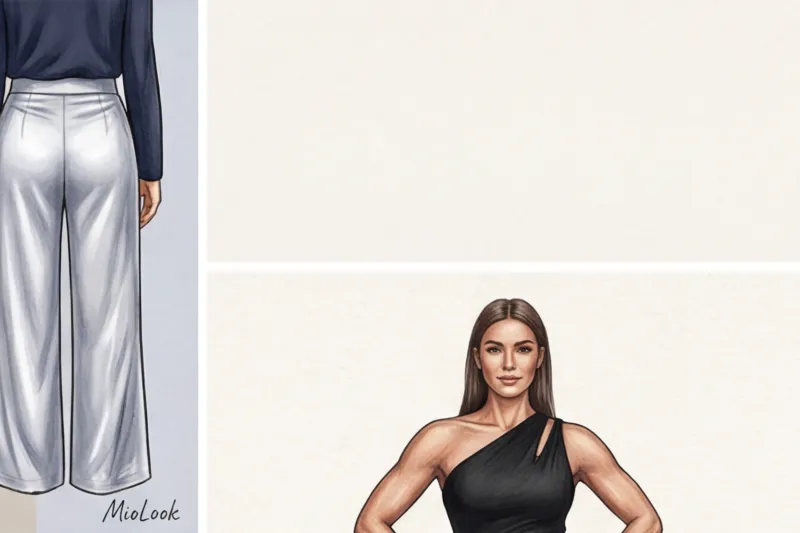
How do we put this into practice? We wear a matte dark blue viscose top (it absorbs light and slims the shoulders) and pair it with palazzo pants in light silver satin (it reflects light and adds volume to the hips). The same trick works with prints: a large geometric pattern or a bold floral print on a skirt instantly draws the eye downwards.
Checklist: A Basic Wardrobe for the Inverted Triangle (12 Functional Items)
Enough theory, let's get practical. I've put together a capsule for you where every item is 100% effective. No random purchases.
- 3 tops: an asymmetrical one-shoulder top, a crepe wrap blouse, a solid matte ribbed turtleneck in a deep dark shade (burgundy, emerald, chocolate).
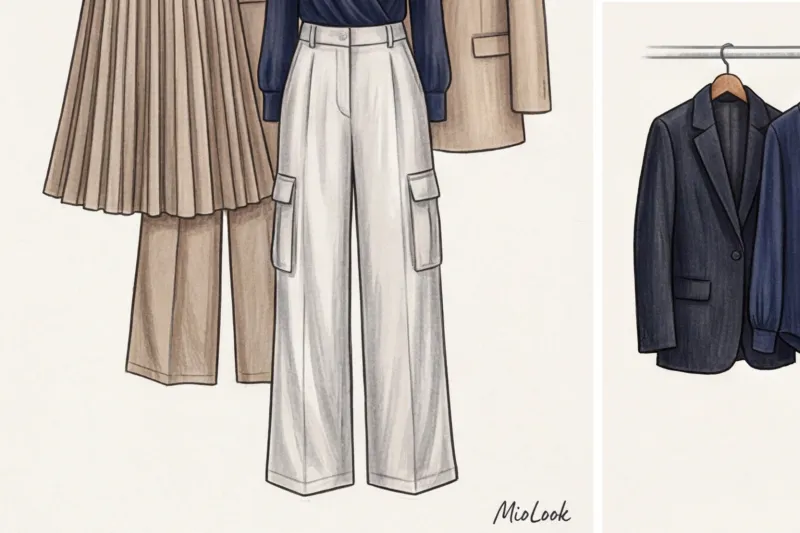
- 3 bottoms: Wide palazzo trousers with pleats at the waist, an A-line skirt made of thick gabardine, light wide-leg jeans made of stiff denim.
- 2 dresses: A wrap dress made of flowing viscose, a midi dress in a shirt style with a flared skirt.
- 2 layers: Single-breasted elongated jacket with set-in sleeves and narrow lapels, smooth-knit cardigan with a deep V-neck.
- 2 pieces of outerwear: A simple robe coat without epaulets, a straight-cut jacket that reaches mid-thigh (avoid jackets that end right at the waistline - they "cut" the silhouette).
Not sure about combinations?
Try MioLook for free: Start creating perfect capsules with AI right now.
Get access — €0.99 onceSummary: Your style, your rules
Your body type isn't a medical diagnosis or a set of rigid, prison-like restrictions. It's simply your individual architecture, a canvas you need to work with. Take stock of your closet tonight. See how many items with boat necklines or epaulets are lurking on the shelves. Don't rush to throw them out—just think about how you can compensate for their bulk at the bottom.
Remember: straight, defined shoulders are the hallmark of a stately, catwalk-ready figure. Don't be shy about them; style them well. Start incorporating asymmetry and plunging necklines, and you'll be surprised how much lighter and more graceful your silhouette becomes.